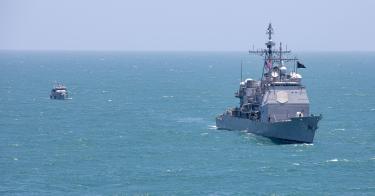
Last December, President Donald Trump introduced his vision for the United States Navy: a 30-year shipbuilding plan called the “Golden Fleet.” Flanking him during his unveiling of this plan were renderings of a core component of that future Navy: USS Defiant, the lead ship of a new, modern class of battleship. But delivering it faces significant hurdles. The first is realistically addressing the Navy’s shaky shipbuilding track record. The second is surviving the changed political reality in Washington—made more challenging by Trump’s original plan to name the class of warship after himself.
By any name, the battleship addresses critical needs for the U.S. Navy. A modern battleship’s firepower, command and control, and data-fusion capabilities have been proven vital in recent conflicts in the Black Sea, the Red Sea, and the Persian Gulf. Mitigating shipbuilding risks, such as constrained production capacity and the integration of numerous advanced technologies, necessitate a continuous testing regimen that scales up as the ships are built.
The U.S. Navy Could Use a Modern “Battlecruiser” Warship
The unveiling of the battleship comes as the Navy faces the imminent loss of significant at-sea firepower. By 2031, the departures of various submarines, cruisers, and destroyers will see nearly 2,000 missile-launch tubes lost. To blunt this loss, the next iteration of Virginia-class nuclear submarines will carry 28 hypersonic missiles, and the Navy’s unmanned vessels may also begin to carry offensive weapons.
>>> The U.S. Navy Must Build the “Golden Fleet”
The Navy missed an opportunity to address this firepower dilemma with its aborted CG(X) next-generation cruiser program, abandoned in 2011. These forced aging destroyers and Ticonderoga-class cruisers to continue shouldering the air and missile defense responsibilities for carrier strike groups. Flight III Arleigh Burke-class destroyers, however, lack the firepower and crew to fully assume the cruiser mission. The Arleigh Burke-class has 96 missile tubes, against 122 on the Ticonderoga-class, and has limited berthing for the needed staff to manage air and missile defenses for the carrier strike group.
In the long term, the Defiant and subsequent battleships are intended to fill this mission and firepower gap. The Defiant, with its added firepower, sensors and crew, will take over the Ticonderoga-class warships’ responsibilities for defending carrier strike groups. The ship will also employ long-range hypersonic missiles in support of carrier air-strike operations to rapidly suppress emerging threats.
The combination of capabilities merged in Defiant with sustained high speeds makes the vessel more closely resemble a battlecruiser—a high-speed battleship able to deliver long-range firepower and defend the carrier strike group from air and missile threats. However, recent battle lessons are creating another critical mission.
The damage inflicted upon U.S. Fifth Fleet Headquarters in Bahrain, and its temporary evacuation due to Iranian missile launches, demonstrates the vulnerability of permanent land-based naval installations to air attack. Moving headquarters to sea is one way to mitigate this danger, and follows a long tradition of numbered fleet command ships. A battlecruiser with robust command and control capabilities can maintain a common operational picture with the warships and unmanned platforms of its numbered fleet, reducing the Navy’s reliance on global communications.
How the Defiant Can Clear the Political Minefield on Capitol Hill
While battlecruisers are needed now, the United States faces numerous constraints that must be navigated before they can join the Golden Fleet. The high build cost of these ships will likely stir substantial resistance from budget-conscious members of Congress; a bill estimated by the Congressional Budget Office to be upwards of $23 billion for the first and subsequent ships costing $18 billion each. There are also serious shortages of skilled workers capable of efficiently building such intricate and substantial ships. Moreover, establishing new or expanding existing shipyards to build these battlecruisers requires working through onerous shipbuilding regulations.
Keeping Congress’ support will necessitate reducing the potential for cost overruns and program delays. One way to accomplish this is to use proven technologies and systems in the initial design. Doing this would result in Defiant embracing existing systems to meet its mission requirements the soonest. Integrating systems like the hypersonic missile technologies being developed for the Zumwalt-class destroyers and the new AN/SPY-6 radars being installed in Arleigh Burke-class vessels will further compress production timelines.
In time, the design will need to be improved on through continuous updates—one being the transition to nuclear power to sustain high speeds and pace the aircraft carrier the battlecruiser is intended to protect. One option is using the same A1B nuclear power plant now used in the Ford-class aircraft carriers, given enough time for production to ramp up to support aircraft carrier and battlecruiser production.
Resurrecting the battlecruiser for modern naval missions is a highly ambitious plan, and it may yet fall through. But it is needed to equip the U.S. Navy with the capabilities for fighting a modern naval war across the Pacific.
This piece originally appeared in The National Interest.