

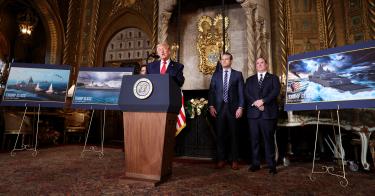
While most Americans were on their way to spend Christmas with family, President Trump on December 22 unveiled an ambitious new plan for the Navy: the Golden Fleet. Echoing President Reagan’s first cabinet meeting order to build a fleet of 600 warships to counter the Soviets, Trump gathered his secretaries of State, War, and the Navy at his Mar-a-Lago residence for the announcement, making clear the Golden Fleet is an administration priority.
In the days since, much has been made of a new proposed battleship—the USS Defiant—but there is more to the Golden Fleet as the Secretary of the Navy has detailed in recent speaking engagements: a new frigate based on U.S. Coast Guard’s National Security Cutter, large unmanned corvettes armed with long-range weapons, and logistics ships.
There was also mention of a new class of aircraft carrier at Mar-a-Lago—perhaps an escort carrier to augment the existing Ford-class carriers as argued in the book U.S. Naval Power in the 21st Century.
To be clear, America’s Navy is too small and its armory too thin for a modern Pacific war that seems inevitable with China—a danger explicitly stated in the recent National Security Strategy. It’s a war China has been assiduously preparing for as detailed in the most recent Congressionally mandated report on military and security developments of China—a doubling of defense spending in just over 10 years, recent nuclear weapons breakout, and a modern navy larger than the U.S fleet.
>>> The Necessity of Testing Our Nuclear Weapons
Sadly, the plans, budgets, and performance of the Navy have not reversed a decade of decline which now will see an irreversible nadir in 2027 of the smallest the Navy has been since World War I—280 warships to China’s 400. Aggressive action, had it been taken shortly after inauguration, would have put the Navy on track for 333 warships at sea by January 2029. This is now looking unlikely.
Yet the President’s commitment to a strong Navy with the Golden Fleet can still reverse the downward trajectory, get firepower into the Pacific quickly, and deliver new classes of warships needed for modern naval warfare. Top of the list is a new nuclear-powered capital ship—better classified as a battlecruiser.
The need for such a ship has long been argued to replace the Ticonderoga-class cruisers, which have defended carrier strike group since the 1980s. And, like the former cruiser Long Beach, later iterations of this new battlecruiser would be nuclear-powered to meet massive power needs for sensors and energy weapons, while sustaining high speeds.
The battleship is inspired by the long-range strike capacity of Zumwalt-class destroyers, with a capacity to launch large numbers of long-range hypersonic ballistic missiles.
But for the Golden Fleet to win at sea, it must be supported by a network of logistic ships, built at expanded shipyards, and sustained by a larger number of modern shipyards in the Pacific. There is much design work to be done which must be deeply informed by the existing capacity of our shipyards today—a task the nation has too few naval architects risking mistakes leading to higher costs and delays.
>>> Drones Don’t Win Wars, Stockpiles Do: The Case for a U.S.-India Munitions Partnership
Even the straightforward idea of repurposing a Coast Guard cutter no longer in production for the Navy as a frigate comes with significant risk. Modifications will be required for carrying munitions like torpedoes, expanded berthing for air crew, and to employ sonar for submarine detection.
While the big ships got all the spotlight, it is the small, unmanned vessels armed with long-range strike and air/missile defense systems that will be most strategically impactful in the near-term.
For this the Navy has a ready platform and weapon system—the USV Ranger (a repurposed offshore support vessel made in the USA) capable of carrying several containerized tomahawk cruise missiles as well as the capable SM-6 missile launched from it in 2021.
More is needed urgently to get firepower into the Philippine Sea and these platforms are the only way to do so inside China’s planning horizon of being ready to win a war over the fate of Taiwan by 2027.
What Happens Now?
The President’s commitment to reviving the nation’s maritime strength is clear, but tangible progress has been too limited. An invigorated effort led by the White House, in league with Congress and industry, is now necessary to drive results.
This piece originally appeared in 1945.com



