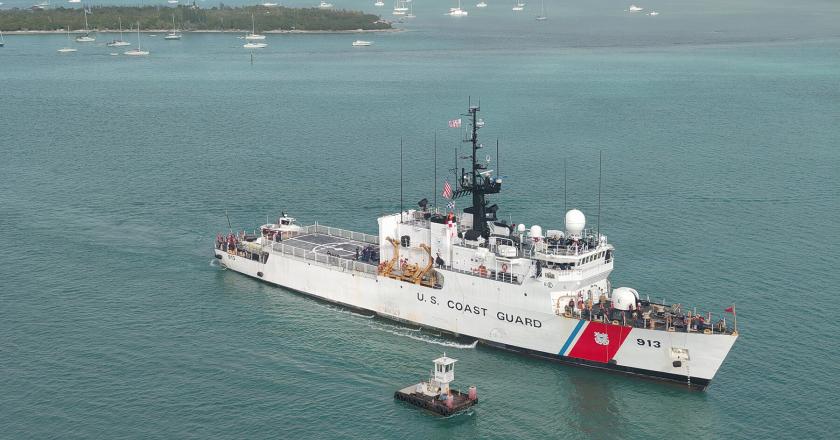
U.S. Coast Guard
Phillip Smyth
Introduction
The United States Coast Guard (USCG), after years of underfunding, particularly during the Biden years, is on the verge of major changes following the infusion of $25 billion from President Trump’s One Big Beautiful Bill Act (OBBBA) and the announcement of Force Design 2028. However, needed programs, ships, and other equipment still face delays and cancellations, and recruitment has been abysmal. In the face of competition from near-peer and peer competitors, especially the People’s Republic of China (PRC), the Coast Guard remains at a severe disadvantage.
The USCG maintains a unique place as both an armed service and a civilian law-enforcement entity. Along with providing port security and mass-mobilization capabilities to support the U.S. Navy, it must deal with such serious problems as marine safety and the flow of illegal immigration, illegal criminal narcotics, and illegal fishing in addition to assisting partner and allied states around the world in building their own naval and coast guard capabilities.
The USCG is still woefully underprepared and ill-equipped to deal with a peer competitor such as the PRC. China’s distant-water fishing fleet, People’s Liberation Army Navy (PLAN), Maritime Militia, and China Coast Guard (CCG) have grown exponentially during the past decade. Additionally, China continues to increase deployments of its state-controlled fishing fleets, research ships, and military vessels not just in the seas around Southeast and Northeast Asia, but into the U.S.’s Exclusive Economic Zone (EEZ) and extended continental shelf. All of these multiplying threats pose serious challenges to the USCG’s policy of “meeting presence with presence.”
Heavy use, old age, maintenance problems, and lack of funds continue to undermine USCG capabilities. The USCG’s shorter-range HH-65 helicopter is being decommissioned after 36 years of service, and its workhorse HH-60 helicopters, the platform on which the USCG was hoping to base future helicopter purchases and strategy, have been grounded because of safety issues resulting from their decrepit state and overuse.
The United States also needs to replace and expand its aging polar icebreaker fleet. With more than 1,000 miles of coastline in the Arctic, a presence in other Arctic states and Antarctica, and deficient capabilities, the U.S. is strategically vulnerable. One of its two active polar icebreakers is nearly 50 years old; to continue deployments, the USCG was forced to cannibalize from a sister ship. China, a state with no Arctic coastline, was able to deploy five new polar icebreakers to the Arctic (near Alaska) in August 2025.
Nor are new platforms and equipment all the USCG needs to remain viable. Maintaining and staffing the Coast Guard requires a more concerted effort to recruit and retain servicemembers. The USCG has a strong auxiliary volunteer element that can be utilized in time of war; it should also be used to increase participation in rebuilding the organization. The USCG will need both to reinvigorate its reserve elements and to attract new active-duty members.
A service that is charged with protecting the homeland should not be allowed to continue its rudderless drift, especially as competitors and other threats are actively increasing their capabilities.
Service Overview
Since the beginning of the Republic, the U.S. Coast Guard has taken on countless roles in defense of the United States. Founded in 1790 as the United States Revenue Cutter Service, the Coast Guard served as America’s first and only official naval force until the creation of the U.S. Navy in 1798.[REF]
In 1861, Coastguardsmen fired the first maritime shot of the American Civil War.[REF] During World War II, off the coast of Greenland, the Coast Guard seized the Busko, a Norwegian Nazi-aligned Quisling government ship. It was the first capture of an enemy surface vessel by the United States during the war.[REF]
Today’s Coast Guard is also the result of an amalgamation of numerous governmental organizations dealing with safety, port security, and smuggling. It includes what was once the U.S. Revenue Cutter Service, the U.S. Life-Saving Service, and several other former sections of the U.S. government related to managing lighthouses. The combination of these elements culminated in the U.S. Coast Guard Act of 1915.[REF]
As the only armed service that performs law-enforcement duties, the USCG has operated under shifting authorities since its beginning. From 1790–1967, it belonged to the U.S. Department of the Treasury. The U.S. Navy took over leadership of the Coast Guard during the War of 1812 as well as from 1941–1945 during the Second World War. From 1967–2003, the USCG was under the U.S. Department of Transportation, and in 2003, following the terrorist attacks of September 11, 2001, it was transferred to the U.S. Department of Homeland Security (DHS).
As a mission-oriented organization, the U.S. Coast Guard has a number of set programs that fall under both homeland and non-homeland security tasks. Specifically:
The Coast Guard manages six major operational mission programs: The operational mission programs oversee 11 Missions codified in the Homeland Security Act of 2002. That act delineates the 11 missions as “homeland security” or “non-homeland security” missions.
- Ports, Waterways & Coastal Security
- Drug Interdiction
- Aids to Navigation (ATON: including maintaining the nation's lighthouses, buoys & VTS; also legacy ATON missions including lightships & LORAN)
- Search & Rescue (SAR)
- Living Marine Resources
- Marine Safety
- Defense Readiness (National Security & Military Preparedness)
- Migrant Interdiction
- Maritime Environmental Protection
- Polar, Ice & Alaska Operations (including the International Ice Patrol)
- Law Enforcement (including Prohibition Enforcement History)
Homeland Security Missions: Ports, Waterways, and Coastal Security; Drug Interdiction; Migrant Interdiction; Defense Readiness; and Other Law Enforcement
Non-Homeland Security Missions: Marine Safety; Search and Rescue; Aids to Navigation; Living Marine Resources; Marine Environmental Protection; and Ice Operations.[REF]
The contemporary USCG safeguards over 100,000 miles of U.S. coastline, the U.S.’s Exclusive Economic Zone (EEZ) and extended continental shelf, and such inland waters as major rivers and lakes. It also operates with partner states and allies in law enforcement to prevent illegal fishing, smuggling, and narcotics. As a force, it has 39,000 active-duty members,[REF] approximately 6,300 reservists,[REF] and 26,000 to 32,000 volunteer auxiliary members.[REF]
Search and rescue efforts continue to be a principal focus for the Coast Guard, which was heavily utilized to rescue those on disabled or sinking ships, survivors of natural disasters, and victims of other incidents throughout 2025. The Coast Guard also has continued to aim for a two-hour search and rescue response time within USCG sectors.[REF]
The contemporary Coast Guard has been plagued by chronic underfunding, major recruitment shortfalls, old or declining equipment, extensive maintenance problems, and the lack of enough key ships to carry out the missions it has been tasked with performing. If a conflict with China over Taiwan were to develop, the USCG’s strong search and rescue, seamanship, vessels, and aircraft would play a major role in assisting the U.S. Navy and protecting the U.S. homeland. However, in its current state, it is doubtful that the service could execute many of its other assigned missions.
Nevertheless, 2025 saw a number of major changes that will have a positive impact on the service as it continues into the 21st century. The most significant were the creation of Force Design 2028 and the funding provided by the OBBBA.[REF] The additional funding has allowed the USCG to put more attention into acquisition and shipbuilding. These efforts have also helped the USCG to demonstrate what systems have not worked or what newer tools might be needed in the future.
Force Design 2028. In an effort to reconfigure and modernize the U.S. Coast Guard, DHS and Coast Guard leaders issued a new strategy in 2025: Force Design 2028, a program to rebuild the organization around four major themes:
- Organization,
- People,
- Technology, and
- Contracts and Acquisitions.[REF]
Focusing on these four major issues sets a clear standard for where and how the Coast Guard is to be rebuilt with new funds and focuses attention on the need to ready the service for the future.
Decline of Coast Guard Assets and Forces
Chronic underfunding has undermined the U.S. Coast Guard’s capabilities. In May 2025, DHS Secretary Kristi Noem told Congress that the USCG was underfunded by at least $21 billion.[REF] The purchase and acquisition of new cutters, ice breakers, and aircraft and the updating of facilities to remove backlogged maintenance issues are all needed to restore the Coast Guard as an effective multi-mission force that can tackle its multi-mission focus.
Cutters. The USCG’s cutters are the backbone of its fleet of vessels, which also includes smaller boats. Cutters are ships that have crew accommodations and are over 65 feet in length. The USCG had 241 cutters as of January 2025[REF] and 1,508 smaller boats as of 2024.[REF] These ships take on roles related to port security, drug interdiction, surveillance, and illegal fishing, among many others. Unfortunately, however, many of these vessels have suffered from maintenance backlogs, and cutters are often unavailable for major anti-drug missions, in addition to which many cutters currently in the fleet are quite old: Many inland and river cutters average around 55 years of age, and medium endurance cutters average between 30 and 50 years of age.[REF]
Newer cutters were beset by delays in design and production, but the OBBBA enabled Coast Guard shipbuilding programs to receive $162 million for inland buoy tenders (Waterways Commerce Cutters); $1 billion to buy more of the service’s small but successful Fast Response Cutters; and $4.3 billion to acquire more Offshore Patrol Cutters, the long-delayed replacements for the aging medium endurance cutter fleet.[REF] However, until shipbuilding is ready to take on and deliver these orders, the delivery process for these cutters will likely be a slow one.
Icebreakers and the Arctic. Given the geopolitical and climatological changes in the Arctic, the USCG’s need for new icebreakers has never been more pressing. Icebreakers protect the sea-lanes needed for commerce, scientific research, and the maintenance of presence and projection in both the Arctic and the Antarctic. However, there is a serious shortage of the vessels that the United States requires for these tasks. A 2023 U.S. Coast Guard analysis said the service would need “eight to nine” new icebreakers,[REF] but efforts to produce these ships have been undermined by cost overruns, issues with design, and numerous delays.
As of August 2025, the USCG was operating only three polar-capable icebreakers.
- The USCGC Polar Star is 49 years old, the USCG’s only heavy icebreaker, and currently the only Coast Guard ship capable of Antarctic missions to the McMurdo Station.[REF] The Polar Star has also suffered from fires, maintenance issues, and other problems.[REF]
- Commissioned in 1999, the medium icebreaker USCGC Healy has experienced numerous fires and lacks spare parts.[REF]
- The newest, a non-military icebreaker, is the USCGC Storis. Purchased from a private owner, the Storis was commissioned on August 10, 2025.[REF] It is still waiting for its future homeport in Juneau, Alaska, to be fitted with an upgraded pier.[REF]
Compared to America’s deficient icebreaker capabilities, Russia currently operates the world’s largest and best-equipped fleet of polar icebreakers: 57 ships including the world’s only nuclear icebreaker.[REF] It also has extensive facilities and other security architecture to support icebreaking in the Arctic. Canada has the world’s second largest fleet of icebreakers: 18 with delivery of two more expected by 2032.[REF] Nordic states such as Sweden, Norway, and Finland heavily utilize icebreakers in their ice-filled coastal waters, and Finland is a world leader in icebreaker construction.[REF]
For its part, China, a state with no coastline in the Arctic and an initially limited albeit expanding presence in the Antarctic, claims to be a “near-Arctic state” and seeks to create a “Polar Silk Road.”[REF] From 2024–2025, China has increasingly sent its ships into the Arctic, particularly near the U.S. EEZ and extended continental shelf. In 2024, three Chinese icebreakers sailed near the Aleutian Islands.[REF] In August 2025, China sent five icebreakers north of Alaska “in or near the U.S. Arctic.”[REF]
In late 2024, the Icebreaker Collaboration Effort (ICE) Pact was created to facilitate the delivery of additional icebreakers, in part by partnering with Finnish and Canadian shipbuilders. The tripartite ICE Pact would also facilitate the exchange of knowledge to American shipbuilders by allowing Finnish and Canadian expertise in icebreaking design and construction of icebreakers to be utilized within America’s ailing shipbuilding apparatus.[REF]
President Trump has affirmed the importance of closing the U.S.’s growing icebreaker gap. In June 2025, the President announced that he intended to buy 40 icebreakers, potentially from Finland.[REF] The OBBBA allotted $4.3 billion for three new PSCs; $3.5 billion for up to three new medium Arctic Security Cutters (ASCs); and $816 million for small and medium cutters.[REF] This funding certainly allowed for more to be done on the acquisition of new icebreakers. However, for almost a decade, shipyards tasked with building and designing the PSCs have experienced delays and cost overruns. The ASC, a vessel that the Coast Guard needs to accomplish its Arctic goals, is still in need of a design; a Request for Information was not submitted until April 2025.[REF]
Since 2017, the USCG has intended to replace its aging heavy icebreakers with what would become the PSC.[REF] Yet, according to the Congressional Budget Office, despite having been authorized in 2019, “[a]s of July 2024, the design of the PSC was only 59 percent complete.”[REF] In May 2025, Bollinger Mississippi Shipbuilding was approved to begin production on the first Polar Sentinel PSCs.[REF]
Increased funding is a positive development, but delays and the need for new vessels quickly require a faster and more proactive approach. As former Coast Guard Captain Luke Slivinski has suggested, allowing the Coast Guard “to bypass the traditional acquisitions process and go straight to…an existing medium polar icebreaker warship design in current operation…would enable an immediate start to construction” and eliminate “years’ worth of time devoted to establishing requirements; advertising, bidding, and awarding the contract; and vessel design.”[REF] The United States should also buy available non-military icebreakers as it did with the USCGC Storis to fill critical gaps. The U.S. may be forced to buy from overseas shipyards to fulfill its icebreaker needs, and while continued multilateral cooperation with partners and allies is a net benefit for U.S. policy and projection, the Coast Guard should seek out foreign options that are affordable and include U.S. shipbuilders in the building of the vessels. The United States needs icebreakers and the capabilities to construct them now.
Aviation. Funding increases in the OBBBA have given the Coast Guard the ability to purchase newer aircraft that comport with its Force Design 2028. Specifically, $1.1 billion was included for six new long-range HC-130J aircraft, along with simulators; $2.3 billion was included for more than 40 MH-60 helicopters; and $266 million was allocated for long-range unmanned aircraft systems (UAS), providing the Coast Guard with another increasingly required asset both for surveillance and for search and rescue. Such funding of specific and more purpose-built aircraft will enable the Coast Guard to move forward with a more streamlined fleet.
“As of 2024,” according to the Congressional Budget Office, “the Coast Guard had about 200 aircraft. About three-quarters were helicopters, and the rest were fixed-wing aircraft.”[REF] These aircraft perform missions ranging from search and rescue to drug interdiction, surveillance, security, and environmental protection. Due to the harsh extremes of their operating environments and issues with supply, many of these aircraft require more intensive maintenance services.
Reduced budgets under the Biden Administration, repairs, and the number of different airframes operated by the USCG have affected the ability of the service to field needed aircraft. From fiscal year (FY) 2018–FY 2022, according to the U.S. Government Accountability Office (GAO), USCG fixed-wing and rotary-winged aircraft failed to meet availability targets.[REF] Systemic maintenance and issues related to heavy use with its air fleet stretched the USCG to its limit in 2023–2024 following a series of groundings.
Fixed-Wing Aircraft. The Coast Guard’s fixed-wing aircraft often perform transportation, patrol, rescue, surveillance, command and control, and interdiction duties. Additionally, some of these platforms’ longer ranges allow the USCG to patrol larger zones—a necessity in the Pacific, Arctic, and stretches of the Atlantic. It was the Coast Guard’s longest-range platform, the HC-130Js, that were key elements in monitoring Chinese ship movements near Alaska, for example, in 2025.[REF]
The fixed-wing fleet has been undergoing a process of modernization, and many older airframes have been retired. The last long-range HC-130H was retired in 2024. The platform had been in service for 56 years.[REF] The Gulfstream C-37A, a long-range command-and-control aircraft acquired in 2007, was complemented by a C-37B, which was acquired in 2022.[REF] However, the fixed-wing fleet also has had maintenance-related problems. In 2023, all of the USCG’s 14 C-27J Spartan Patrol Aircraft had to be grounded when it was discovered that all had structural cracks.[REF]
Rotary-Winged Aircraft. The Coast Guard was an early adopter of rotary-winged aircraft, and because of the multitude of missions that helicopters can perform, they form a large and core portion of the USCG aviation force. In 1944, for example, it was the USCG that flew the first lifesaving mission using a helicopter.[REF]
Around 100 MH-65 helicopters are currently in service with the USCG. A workhorse for the service, particularly with search and rescue, since its first delivery in 1984, the aircraft have cumulatively logged over 1.8 million flight hours.[REF] Although the MH-65 is currently being phased out in favor of the MH-60 Jayhawk, the USCG has signed a memorandum of understanding with Airbus that could keep the helicopter operating until 2037.[REF]
The USCG intends to have the MH-60 as its sole helicopter platform, a move to a single platform that would allow a level of standardization for the USCG to invest more in new attachments, perform more functional maintenance, and streamline training, but the helicopter has been beset by operation stresses as a result of its high usage. “By late 2023,” according to Forbes, “over 90 percent of the Coast Guard’s MH-60T helicopters were operating with more than 16,000 flight hours,” and “[a]s of early December, almost 18 percent of the Coast Guard’s 45-strong MH-60T ‘Jayhawk’ medium range recovery fleet [was] out of service.”[REF] After the November 2023 crash of an MH-60 in Alaska, the USCG cut the service life of the helicopter from 20,000 hours to 19,000.[REF] As a result, six MH-60s were immediately grounded.
Despite these issues, Coast Guard aviation’s talent and mission focus have allowed the service to perform its essential duties. In July 2025, while flying in an MH-65, one Coast Guard swimmer rescued 165 people following major floods in Texas.[REF] However, Coast Guard aviation’s readiness and resources have not recently been tested in a major national crisis such as a Hurricane Katrina–type event. Even with funding increases, the Coast Guard’s performance vulnerabilities are still present.
The Coast Guard requires a cohesive plan and evaluation of its aircraft assets. When there are numerous aircraft types with different maintenance requirements, training regimens, and complex supply chains, costs rise and efficiency diminishes. This is partly why the USCG has not been meeting availability targets. The recently grounded C-27Js came into the Coast Guard by way of an ultimately unneeded U.S. Air Force procurement program when the USCG was already integrating a more purpose-built aircraft, the HC-144 Ocean Sentry, into its fleet.
As more funding arrives, the USCG must address its pressing maintenance issues. Increasing the availability of and access to parts supplies to meet immediate needs should also be factored into its plans. The USCG should explore options for long-range aircraft and unmanned systems that can be utilized for longer-range intelligence, surveillance, and reconnaissance (ISR) equipment. Longer-range ISR assets that can allow other resources to be prepositioned would also help the USCG to maintain presence and support DHS and other national security missions.
Facilities and Maintenance. The maintenance issues that have plagued the Coast Guard, in addition to reflecting ongoing funding neglect, have directly affected mission readiness and capacity to operate. Because the Coast Guard’s facilities, vessels, and aircraft operate in harsh environments and are heavily used, major maintenance shortfalls have caused cutters and air assets to be unable to deploy, thereby hurting their capability to perform missions. The OBBBA gave the USCG $2.2 billion to maintain readiness through depot maintenance.[REF] Without these funds, the service would likely continue to experience major maintenance shortfalls. However, according to a 2025 GAO report, the USCG would need upwards of $7 billion for infrastructure facilities.[REF] This money would not be needed just for rebuilding, overhaul, and regular maintenance, but also to compensate for the extensive backlog created by years of neglect.
Access to spare parts has been another long-term readiness problem for the Coast Guard. During an August 2024 event, then-USCG Vice Commandant Admiral Kevin Lunday told the audience that:
On the asset side we’re struggling to sustain the readiness of our current fleet of ships, of boats, of aircraft, and offshore infrastructure, and our IT systems, and networks. Let me give you an example: If you want to get underway on a major Coast Guard cutter today, you have to do what we call a ‘controlled parts exchange’ with other ships at the pier. That’s a fancy term for cannibalization. We’ll steal parts or borrow…from the other ships just to get another ship underway. Now, you can do that for a short amount of time, but when you do it over a number of years, you're eating your own readiness. And that's what we’re seeing.[REF]
The USCG Auxiliary. The Auxiliary is a 26,000-strong to 32,000-strong volunteer element of the U.S. Coast Guard.[REF] Any adult who meets eligibility requirements and is over the age of 17 can join the Auxiliary, and this allows it to recruit from a broad spectrum of talents and capabilities.[REF] Nevertheless, the force includes many individuals of retirement age, and many lack skills beyond assisting in search and rescue. The Auxiliary does not carry out the Coast Guard’s military or law-enforcement duties, but it does act as a cost-effective and increasingly important force multiplier.
Costing less than $20 million annually and saving taxpayers approximately $240 million a year,[REF] Auxiliary flotillas raise their own funds. As noted, the Auxiliary acts as a force multiplier for the USCG by assisting in safety, maintenance of facilities and vessels, inspection duties, public education, public affairs, and search and rescue.[REF]
The U.S. military is currently hard-pressed to find enough translators and interpreters who specialize in Indo-Pacific languages; the Auxiliary has an Interpreter Corps that serves with Coast Guard operations around the world.[REF] Another major goal of Force Design 2028 is to strengthen the Coast Guard’s cyber capabilities; members of the Auxiliary could be used to further enhance the USCG’s cyber assets and in a cost-effective manner.[REF] And during 2010’s Deep Water Horizon oil rig explosion and spill, Auxiliarists were there to provide extensive environmental, rescue, and other forms of support.[REF]
In a potential war—for example, a war with China—U.S. Naval militias, potentially under National Guard auspices, would be required for the war effort. However, only Alaska, California, New York, Ohio, and South Carolina can currently call upon such units. In World War II, Auxiliarists could join or be enrolled in the Coast Guard’s now-disbanded Temporary Reserve.[REF] In a contemporary conflict, the Auxiliary could be called upon once more to fill the ranks of state-run maritime militias and activities within the USCG.
Recruitment and Retention. The U.S. military’s multi-year recruitment crisis has not left the USCG unscathed. The USCG must do more to address its recruitment and retention of officers, enlisted members, and reserves. This is a particularly challenging issue given that recruitment issues have long plagued the USCG, especially from 2019–2023 when the service did not meet its recruitment goals. In 2022, the Coast Guard “recruited 2,793 service members out of a goal of 4,200,” which was just “a little over 66.5 percent of its annual objective.”[REF] In 2024, then-Vice Commandant Admiral Kevin Lunday told an audience at the Brookings Institution that “we’ve had to lay up three…of our major cutters because we don’t have enough enlisted personnel to crew them.”[REF] In May 2025, the GAO noted that “[h]eavy workloads, command leadership, and physical and technical infrastructure issues hurt morale and affected retention.”[REF]
In 2022, in an attempt to alleviate recruitment issues, the USCG removed some barriers to enlistment. The enlistment age was raised from 34 to 42, single parents were allowed to join, and restrictions on those with higher debt-to-income ratios were relaxed.[REF] In 2024, the Coast Guard finally exceeded its recruitment goal with about 200 more recruits than their target number of 4,200. New recruiting stations and about 100 new recruiters were largely credited with meeting the 2024 goals.[REF] The USCG’s continued use of more recruiters and recruitment offices, along with more targeted marketing of the service, would certainly assist in recruitment efforts.
Nevertheless, the USCG continued to lose servicemembers faster than it could replace them.[REF] Citing the GAO, Stars and Stripes reported in May 2025 that because of retention issues, the USCG was “short about 3,000 members” and “operating below the workforce level that it deems necessary to meet operational demands.”[REF] The GAO has recommended that the Coast Guard focus on collecting and analyzing more data to make up for recruitment shortfalls and for future targeted recruitment,[REF] but the growing need for specialized skills within the USCG indicates that a more immediate focus on certain areas is required. Increasingly, individuals with key skills that assist with retention and/or missions, such as those with a cyber or technology background and those with medical experience, should be a targeted recruitment focus.[REF]
The USCG’s demand for medical, technology, and other professionals, both for its missions and to meet the needs of USCG servicemembers, faces stiff private-sector competition. Salaries for those in the technology and medical fields, for example, are higher in the private sector.[REF] Since August 2025, the USCG has offered upwards of $75,000 as an enlistment bonus,[REF] and additional financial incentives may be required for more specialized skillsets. Retention among those stationed in isolated or rural areas, often key zones for USCG presence, has suffered because of issues related to the provision of health care. Therefore, notes USCG Lieutenant (junior grade) Victoria Folz, “increasing recruitment efforts targeting medical students and professionals could yield positive results.”[REF] Attracting individuals working for technology companies and those attaining degrees for technology positions should also be goals for USCG recruiters.
Attracting those in technology fields often requires a more dynamic approach beyond direct recruitment at schools and universities focused on those skillsets. Many in the cyber field maintain irregular schedules and do not match Coast Guard physical fitness requirements.[REF] Using the USCG’s Auxiliary to appeal to volunteers would save money and create a new opportunity for recruiting outside of the normal paradigms of direct recruitment into the Coast Guard.
Countering Narcotics, Illegal Immigration, Human Smuggling, and Human Trafficking
Illegal Narcotics. The U.S. Coast Guard’s narcotics interdiction efforts have increased significantly since 2024. Approximately 1,024 metric tons (2,257,534 pounds) of cocaine were seized from 2020–2024.[REF] The Eastern Pacific, the Caribbean, and the border with Mexico have been key areas of focus. In July 2025, the USCG stated that it had “seized over 242,000 pounds [around 109 metric tons] of cocaine” since January 20, 2025.[REF] In March 2025, one seizure in the Pacific yielded narcotics worth more than $500,000,000.[REF] Also in 2025, during Operation Pacific Viper, the USCG made the largest seizure of cocaine in its history: 61,740 pounds.[REF]
In February 2025, the U.S. Department of State listed eight Mexican, Central American, and South American drug cartels as foreign terrorist organizations;[REF] the USCG’s efforts to counter the threat of illegal narcotics have never been greater than they have been since then. In view of the 2026 actions in Venezuela and continued efforts to counter drug flows, elements of the USCG’s special operations Maritime Security Response Team might be better utilized if they were more integrated with the ranks of the United States Special Operations Command. Along with the use of dedicated aircraft devoted to deploying fast-ropers, the USCG could better assist in many of these efforts.
Drug cartels, particularly many of these recently listed groups, have been expanding their trafficking through maritime routes. According to DHS, non-commercial go-fast boats, fishing boats, and sailing vessels have transported a majority of illegal drugs into the United States.[REF] In August 2025, DHS Secretary Noem noted that “80% of illicit drug seizures occur at sea.”[REF]
Increasingly, the drug cartels are using narco-submarines to traffic illegal narcotics. According to InSight Crime, “A near-record number of narco-submarines were intercepted crossing the Atlantic and Pacific in 2024.”[REF] USCG Lt. Commander Stephen Brickey told CNN in 2019 that “[t]hey blend in…. Most of the vessel is underwater, so it’s hard to pick out. They’re painted blue. They match the water.”[REF] According to one report, these low-cost and difficult-to-detect vessels “have also become more advanced.”[REF] One intercepted narco-submarine came equipped with a Starlink system and antenna.[REF]
Narco-submarines are also traversing greater distances, traveling to Europe and Australia. The Wall Street Journal has characterized their utilization as the equivalent of a “secret cocaine superhighway under the Atlantic,” noting that narco-submarines were transporting narcotics as far away as Spain.[REF] By mid-2025, the cartels were often complementing their smuggling efforts by also using underwater drones.[REF]
As the quality and technological capabilities of narco-submarines have increased, the USCG has relied primarily on human intelligence generated by partner states in intercepting narcotics shipments.[REF] The addition of higher-technology approaches with a focus on ISR and combining new passive sensors and unmanned systems would certainly aid in the anti-narcotics mission. Additionally, given that the USCG must continue its patrols over expansive areas, the further integration of these systems would help it to cover more ground. In keeping with Force Design 2028, the USCG has been looking at capabilities and systems that can better integrate a wider spectrum of information to “Sense, Make Sense, and Act.”[REF]
The USCG must also look at its core capabilities. Increased access to newer and better-maintained cutters would also be beneficial. The Coast Guard’s extensive maintenance issues have had a negative effect on its missions. According to the DHS Inspector General, “Coast Guard cutters were unavailable for 2,058 cumulative days over a 3-year period” from 2021–2023.[REF] In 2024, citing a Coast Guard statement, the GAO noted that the USCG’s medium endurance cutters, “a key asset for interdicting drugs,” were not available because “the declining condition of the cutters risked decreased capability for meeting mission requirements.”[REF]
Illegal Immigration, Human Smuggling, and Human Trafficking. Illegal immigration utilizing sea routes expanded during the Biden Administration, and illegal immigrants, professional human smugglers, and human traffickers have continued to use them.[REF] Moreover, smuggling and illegal immigration attempts have not abated. By March 2025, the USCG had “tripled” its personnel commitment to dealing with these issues.[REF] At around the same time, the USCG announced that it had diverted cutters, aircraft, and other patrol craft to heighten its “operational presence near southwest border between [the] U.S. and Mexico.”[REF] While distinct issues, illegal immigration, human smuggling, and human trafficking often overlap and require specialized expertise and resources.
Countering China
The PRC has aggressively promoted a strategy of grey-zone conflict with the U.S. and its Pacific partners. From 2024–2025, the Chinese have increasingly been sending icebreakers, ostensible research vessels, and their CCG into the U.S. EEZ off the coast of Alaska. In October 2024, a China Coast Guard vessel entered the Arctic for the first time and was later joined by another CCG vessel for exercises with Russia.[REF] Thus, the USCG is increasingly coming into contact with Chinese vessels that are both creeping closer to U.S. claims and challenging America’s ability to protect the homeland.
As China has continued its efforts to copy and then utilize lessons gleaned from the United States, it has invested heavily in its CCG. In 2017, analyst and researcher Ryan Martinson noted that “China’s expansion in maritime East Asia has relied heavily on non-naval elements of sea power, above all white-hulled constabulary forces.”[REF] Nearly a decade later, the buildup of and reliance on these “white-hulled constabulary forces” (the CCG) has only increased.[REF] The CCG has exhibited close cooperation with the PLAN and China’s maritime militia forces.[REF] In fact, it has been so close that a PLAN warship collided with a CCG vessel in the South China Sea as they were harassing Filipino fishermen in August 2025.[REF]
Known by Western observers as the PRC’s “Second Navy” or “Shadow Navy,” the China Coast Guard was created in 2013 and modeled after its U.S. counterpart.[REF] The CCG has also undergone a meteoric rise in its adoption of new types of shipping, equipment, tasking, and restructuring as well as its contribution to China’s militant posturing in the Pacific.
A 2019 Naval War College study reported that the CCG had 1,275 hulls. By 2024, the CCG had 150 oceangoing patrol vessels.[REF] Compared to the USCG, which has around 200 cutters and 1,400 smaller boats, the CCG’s vessels are newer and have not suffered from the same maintenance issues. CCG ships have been widely utilized in the disputed waters of the South China Sea. Many of the CCG’s ships have had a more naval than white-hulled focus. Many of China’s ships can be fitted with anti-ship missiles.
Like the USCG, the CCG is an amalgamation of different capabilities with a multi-mission focus. The China Marine Surveillance, China Fishery Law Enforcement Command, China Maritime Police, and some seaborn units belonging to the PRC’s General Administration of Customs were all combined into the CCG.[REF] Superficially, the CCG’s strongest elements relate to its maritime patrol and law-enforcement capabilities,[REF] although the CCG was removed from its position under the Ministry of State Security’s People’s Armed Police in 2018.[REF]
The combining of these disparate entities and their centralization through the creation of a new force bears many hallmarks similar to the U.S.’s 1915 Coast Guard Act and the later incorporation of different agencies into the USCG. Unlike the USCG’s, the CCG’s goals appear to be more military-focused and law enforcement–focused with search and rescue as a distant secondary goal.
The CCG has been involved in “rescue” operations that were made necessary by its ramming of other ships. In January 2025 and in rough seas, the CCG shadowed and did little to assist in the Filipino effort to recover the body of a Filipino fisherman.[REF] The CCG even impeded the rescue of a drowning Filipino fisherman in July 2024 near the disputed Scarborough Shoal.[REF]
These incidents also show how the USCG can better assist regional partners in their efforts to counter the Chinese menace. In fact, the USCG has conducted a number of deployments to the Western Pacific, including assisting with the monitoring of fisheries in the Marshall Islands in July 2025 and joint exercises with Japan, South Korea, and the Philippines in June.[REF] The USCG has also increased assistance to its Filipino counterparts in the Philippine Coast Guard.[REF] Through continued joint training, the promotion of interoperability, and collaboration with the Philippines and other regional partners and allies, the United States can better counter China’s grey-zone tactics. The USCG’s exchange of tactics and new knowledge about how to counter China with overseas partners is a great asset in U.S. military planning.
In 2022, the USCG launched its first anti–illegal, unreported, and unregulated fishing (IUU) effort for the intergovernmental South Pacific Regional Fisheries Management Organization. The South Pacific Ocean covers nearly a quarter of the world’s oceans and is plied regularly by ships belonging to China’s distant-water fishing fleet, which has deep links to the PRC’s maritime militias and has contributed to depleting the seas of numerous resources.[REF] Near the Galapagos Islands, the USCG has shadowed Chinese fishing vessels that have plundered local fisheries. The Chinese maritime militia fleet also fields several skilled units, some of which have been used repeatedly to advance Chinese geopolitical goals in the South China Sea.[REF]
The increase in the use of Chinese “research” vessels, CCG, and maritime militias will require the USCG to move at a faster pace to acquire icebreakers, cutters, and longer-range ISR equipment to assist in countering Chinese grey-zone warfare. The USCG has a valuable role in countering Chinese illegal fishing maneuvers and penetrations into U.S. territory and claims, along with backing partners and allies in the Pacific and Arctic.
Assisting regional partners and allies must also include the construction and modernization of bases that can give the Coast Guard a more forward operating position. Geographically, the Pacific is incredibly vast, and the area between USCG in Honolulu, Hawaii, and other USCG facilities in Guam is around 4,000 miles. A Coast Guard facility that could host cutters in American Samoa, an American territory in the South Pacific, would improve America’s ability to assist allies and safeguard large swaths of ocean against Chinese projections.[REF]
As a military support element for the U.S. Navy, however, the USCG is at an extreme disadvantage vis-à-vis a militarized China and a CCG set up to act as a support element for China’s PLAN. The USCG’s main tasks in wartime would include the execution of anti-submarine warfare (ASW) and convoy escort, but its personnel lack the training, weapons, and equipment that would enable them to assume those functions quickly. In order to counter narco-subs in the Pacific, for example, the USCG has had to ask the U.S. Navy to provide ASW capabilities and support.[REF] Given the USCG’s maintenance backlogs and demonstrated inability to deploy cutters to deal with drug flows in the Caribbean and Pacific, the extent to which the U.S. Navy could depend on the Coast Guard’s capabilities in an all-out fight against China becomes a matter of some doubt.
Beijing has shown a keen interest in pushing the United States out of the South Pacific. In 2022, China signed a security pact agreement with the Solomon Islands. That year, the island country turned away a USCG cutter engaged in patrols in the area.[REF] In 2023, China and the Solomon Islands also agreed to a pact on “law enforcement and security matters.”[REF] In 2024, the island nation of Nauru switched its diplomatic recognition from Taiwan to China. A direct and more formidable USCG presence in the region would do much to let the Chinese know that the South Pacific is not their property.
Conclusion
The USCG’s 2025 adoption of Force Design 2028 and the needed funds provided by the OBBBA will go far to ready the USCG for the future. The challenge of systemic institutional dysfunction within the Coast Guard is beginning to be addressed. The USCG has executed record-breaking drug busts, countered Chinese projections near the United States, assisted partners and allies abroad, continued missions for port security, and performed many search and rescue operations. However, the service continues to suffer from the residual effects of years of neglect and underfunding.
As the U.S. Coast Guard finds a firmer footing with new fiscal support, there are still many questions to be resolved with regard to how many and how effectively missions can be executed. Despite significant investments in the Coast Guard, the road to being a fully functional service with negligible backlogs—particularly with regard to new ships, maintenance, and aircraft—is still years away. The USCG will require sustained support to become the service it needs to be in case of any potential conflict with China over Taiwan.
Scoring the U.S. Coast Guard
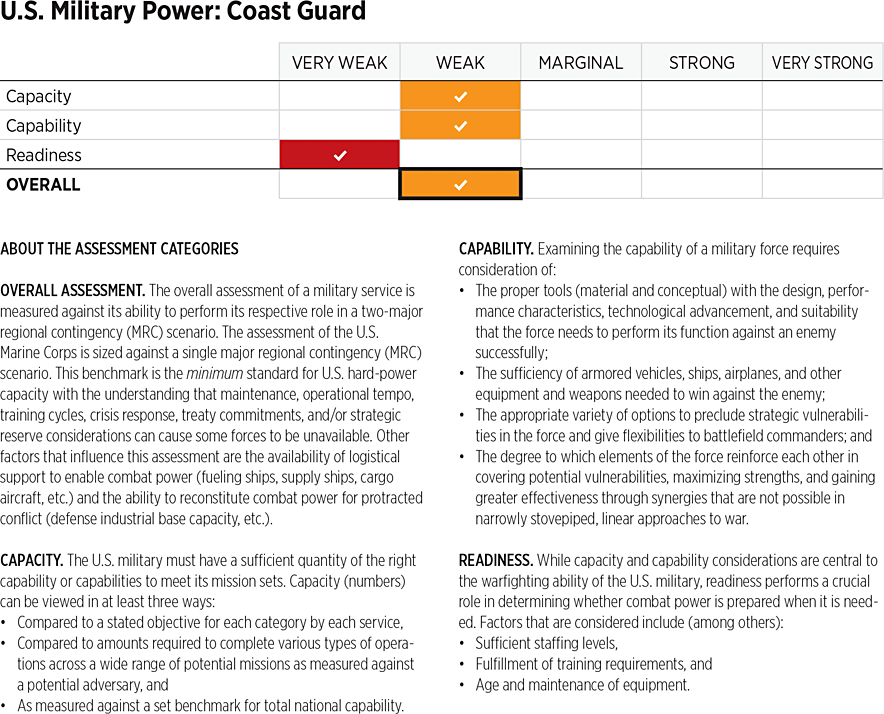
Capacity Score: Weak
Funds allotted to the USCG by the OBBBA combined with Force Design 2028 will push the Coast Guard in a more positive direction, but its current capacity score is “weak.” Maintenance issues continue to undermine the effectiveness of the service’s nearly 240 cutters, and facilities needed to maintain newer ships have not yet been constructed. More recruitment and retainment mechanisms are necessary along with the acquisition of new ships and aircraft and an extensive rebuilding of the Coast Guard’s maintenance capabilities. In 2025, the Government Accountability Office reported that “the Coast Guard is short about 2,600 active-duty staff and operating below the workforce level it thinks necessary to meet mission needs.”[REF] Lacking sufficient staff and maintenance capacity, the Coast Guard struggles to remain mission ready.
Capability Score: Weak
The USCG’s capability score is “weak” trending toward “marginal.” The lack of icebreakers in the Arctic puts the United States at a severe disadvantage with peer competitors and near-peer competitors, particularly China and Russia. Because of maintenance issues, the USCG had problems deploying cutters to the Caribbean. In the Arctic and Pacific, China’s newer and more modern vessels make it harder to meet “presence with presence” against its increasingly frequent aggressive advances. The inability to field functional cutters, helicopters, and fixed-wing aircraft in a variety of zones has had a detrimental effect on the USCG’s ability to execute its missions. As a warfighting entity, the USCG lacks anti-submarine and convoy escort capabilities, and “as competition with China accelerates,” in the words of Navy Lieutenant Commander James Halsell, “the homeland once again is not secure from undersea threats. Chinese and perhaps Russian submarines could interdict logistics, disrupt critical infrastructure, or threaten the American public’s sense of security.”[REF]
Readiness Score: Very Weak
The USCG’s readiness score is “very weak.” Modernization has hit numerous snags that have forced the service to rely on older and/or deficient equipment. Inadequate maintenance infrastructure and a workforce that is not large enough to meet current needs continue to be major problems. In 2025, the DHS Inspector General observed that “Coast Guard cutters were unavailable for 2,068 cumulative days over a 3-year period” and “calculated that the Coast Guard could have interdicted an additional 57 to 89.1 metric tons of cocaine had these cutters been performing the counterdrug mission.”[REF] The fact that the need for parts and need for cannibalization are ever-present issues means that entire air fleets have been grounded because of maintenance issues that, along with a lack of personnel, make the USCG’s readiness to face a peer competitor such as China a matter of serious concern.
Overall USCG Score: Weak
Maintenance issues have been a major problem for the U.S. Coast Guard, and significant backlogs were a significant issue from 2024–2025. With the passing of the One Big Beautiful Bill Act, the USCG finally has much of the funding (approximately $25 billion) it needs to be less dysfunctional than it has been for many years. Even as the Coast Guard’s air and sea fleets are modernized, there will likely be continued shortfalls in its ability to deploy assets. The USCG still lacks the icebreaking capabilities required to compete with China and Russia in the Arctic, and in the Eastern Pacific and Caribbean, as noted above, the lack of enough key vessels and aircraft has hurt the Coast Guard’s ability to complete drug interdiction missions and carry out other critical operations.
Policy Recommendations
- End the maintenance backlog. As it receives needed funding, the USCG can assess its maintenance needs, refit some facilities, buy needed parts, and improve training. Security infrastructure in the Caribbean, Pacific, and Arctic should take precedence because of their harsher operating environments and security needs.
- Too many bases, particularly smaller facilities that are placed closely together, are in disrepair and unnecessary. As the USCG continues its efforts to become a more modern and well-organized force, some base closures and consolidations may be necessary. Due to faster boats, helicopters, and other equipment, and as assessed by the GAO and by the Coast Guard, some of these bases are functionally obsolete. Although closing USCG facilities would be a relatively unprecedented move, the closing and consolidation of some bases might be very effective in assisting the USCG in its modernization and deployment efforts.[REF]
- Improve recruitment and retention. Despite the dedication of its servicemembers and having recruited at a desired level in 2024, the Coast Guard is still woefully undermanned. As of August 2024, the Coast Guard had “more than 4,000 empty billets in its military workforce” out of an authorized “active duty end strength of 44,500.” Specifically, “according to the latest figures from the Defense Manpower Data Center, from the end of June [2024], the active force only [had] 40,358 members.”[REF] In 2023, recruitment and retention issues “forc[ed] the Coast Guard to take ten cutters out of service, transfer five tugs to seasonal activation, and shutter 29 boat stations.”[REF] The USCG should continue to offer financial incentives for new recruits, increase its marketing for recruitment, target recruits that can bring added value to the service, and create facilities (particularly in more isolated areas) that better cater to the needs of its servicemembers. Additionally, a more focused utilization of volunteer elements, such as the Coast Guard Auxiliary, might do more to provide some services needed by the USCG.
- Increase investment in unmanned aerial systems. The USCG has put $350 million into AI and robotics research but only $11 million of its budget into upgrading and purchasing current autonomous systems, many of them short-range.[REF] Upgrading current systems and bringing more onboard should be a primary focus. As drug flows through the eastern Pacific and Caribbean increase and the threat of China looms, the USCG requires larger numbers of and more advanced equipment to maintain a layered approach to interdiction and military support. The adoption of further unmanned aerial systems, particularly medium-range and longer-range vehicles, would significantly enhance these efforts. The first MQ-9 Reaper drones came into service with the USCG in September and quickly demonstrated their worth in countering illegal immigration, smuggling, and illegal drugs.[REF] These systems help the USCG to maintain a more constant presence, are cheaper to operate and maintain, and do not require the same levels of training that are needed for the USCG’s aviation wing.
- Significantly increase the number of USCG icebreakers. The United States has only three operational icebreakers, and only one is capable of reaching U.S. facilities in Antarctica. At a time when a focus on security infrastructure in the Arctic should be a priority, the USCG lacks the icebreakers it needs, particularly as the Arctic becomes a zone for great-power competition. In October 2025, the Trump Administration announced that it would purchase 11 Arctic Security Cutter icebreakers from Finland; four would be produced in Finland, and seven would be produced in the United States.[REF] This can serve as a needed stopgap before the Arctic Security Cutters can be brought into service, but the U.S. will still need to accelerate domestic efforts and produce at least 20 heavy and medium-sized vessels. In the shorter term, a mix of at least nine medium and heavy icebreakers would help to fill gaps in the Arctic for the U.S.[REF] As northern sea-lanes continue to open to billions of dollars in trade and resource acquisition, newer, more capable icebreakers can support a longer-range U.S. strategic approach to the Arctic. However, these icebreakers will need specialized docking and maintenance facilities, and purchased icebreakers should have modular capabilities that comport with changing Coast Guard requirements.
- Replace old and outmoded cutters. The USCG’s cutters are old and need to be replaced. The age and poor maintenance of these cutters have undermined the USCG’s ability to counter the activities of cartels operating in Central and South America. Replacing its 29 medium endurance cutters should be a priority. Additionally, the USCG has requested funding for two more fast response cutters for deployment to the Pacific, but more should be commissioned and brought online.[REF] Despite many successful missions countering drug cartels and Chinese IUU in the Caribbean and Eastern Pacific, the lack of key vessels and aircraft has hurt the Coast Guard’s ability to complete other drug interdiction missions and carry out other critical operations.
- Increase forward positioning in the South Pacific. American Samoa provides a needed base for the USCG to project American strength and counter Chinese advances in the region. The United States cannot afford to ignore this region and its importance to the security of key American allies such as Australia.
Endnotes
[1] Irving H. King, George Washington’s Coast Guard: Origins of the U.S. Revenue Cutter Service, 1789–1801, (Annapolis, MD: Naval Institute Press, 1978), p. ix.
[2] U.S. Department of Homeland Security, U.S. Coast Guard, “Harriet Lane, 1858,” January 10, 2020, https://www.history.uscg.mil/Browse-by-Topic/Assets/Water/All/Article/2054643/harriet-lane-1858/ (accessed November 22, 2025).
[3] Thomas P. Ostrom, The United States Coast Guard in World War II: A History of Domestic and Overseas Actions, (Jefferson, NC: McFarland & Company, 2009), p. 72.
[4] 14 U.S. Code § 101, https://www.law.cornell.edu/uscode/text/14/101 (accessed November 24, 2025).
[5] U.S. Department of Homeland Security, U.S. Coast Guard, “Missions,” https://www.history.uscg.mil/Home/Missions/ (accessed November 24, 2025). Emphasis in original.
[6] U.S. Government Accountability Office, Coast Guard: Progress Made to Address Recruiting Challenges but Additional Actions Needed, GAO-25-107224, May 2025, p. 1, https://www.gao.gov/assets/gao-25-107224.pdf (accessed November 22, 2025).
[7] U.S. Department of Homeland Security, U.S. Coast Guard Reserve, 2024 United States Coast Guard Reserve Annual Report, p. 8, https://www.reserve.uscg.mil/Portals/2/New%20Website/Strategic%20Documents/Annual%20Reports/FY2024%20USCG%20Reserve%20Component%20Annual%20Report_Feb2024%20(1).pdf (accessed November 22, 2025).
[8] U.S. Department of Homeland Security, United States Coast Guard Auxiliary, “About the Coast Guard Auxiliary,” https://wow.uscgaux.info/content.php?unit=053-19&category=about-the-uscg-aux (accessed November 23, 2025); Staff Report, “A Special Force Endures: The US Coast Guard Auxiliary,” Waterway Guide, posted July 14, 2025, https://www.waterwayguide.com/knowledge-center/news-post/12187/a-special-force-endures-the-us-coast-guard-auxiliary (accessed November 23, 2025).
[9] U.S. Department of Homeland Security, U.S. Coast Guard, U.S. Coast Guard Office of Search and Rescue (CG-SAR), “SAR Program Information,” https://www.dco.uscg.mil/Our-Organization/Assistant-Commandant-for-Response-Policy-CG-5R/Office-of-Incident-Management-Preparedness-CG-5RI/US-Coast-Guard-Office-of-Search-and-Rescue-CG-SAR/CG-SAR-1/SAR-Program-Information/ (accessed January 7, 2026).
[10] H.R. 1, One Big Beautiful Bill Act, Public Law 119-21, 119th Congress, July 4, 2025, https://www.congress.gov/119/plaws/publ21/PLAW-119publ21.pdf (accessed November 24, 2025). Cited hereinafter as Public Law 119-21.
[11] See U.S. Department of Homeland Security, U.S. Coast Guard, Force Design 2028, 2025, https://media.defense.gov/2025/May/27/2003724531/-1/-1/0/REPORT%20-%20FD28%20EXECUTIVE%20REPORT%20_1166_V14.PDF (accessed November 24, 2025), and U.S. Department of Homeland Security, U.S. Coast Guard, Force Design 2028: Execution Plan Summary, 2025, https://media.defense.gov/2025/Jul/25/2003761706/-1/-1/0/FD28%20EXECUTION%20PLAN%20SUMMARY.PDF (accessed November 24, 2025).
[12] Salvador Rivera, “US Coast Guard Underfunded by $21 Billion, DHS Secretary Noem Says,” Border Report, May 7, 2025, https://www.borderreport.com/regions/california/us-coast-guard-underfunded-by-21-billion-dhs-secretary-noem-says/ (accessed January 7, 2026).
[13] U.S. Government Accountability Office, Coast Guard: Actions Needed to Address Cutter Maintenance and Workforce Challenges, GAO-25-107222, June 2025, p. 13, https://www.gao.gov/assets/gao-25-107222.pdf (accessed November 22, 2025).
[14] U.S. Department of Homeland Security, U.S. Coast Guard, Office of Boat Forces (CG-731), “Boats of the United States Coast Guard,” 2024, https://www.dcms.uscg.mil/Portals/10/CG-9/Acquisition%20PDFs/Boats%20of%20the%20Coast%20Guard%20(2024).pdf?ver=6yDpZkGOJ1W4G8cnYDA5iA%3d%3d (accessed November 22, 2025).
[15] U.S. Government Accountability Office, Coast Guard: Actions Needed to Address Cutter Maintenance and Workforce Challenges; Shana Brouder, “Pay Increase for Members Assigned to Cutters,” U.S. Department of Homeland Security, U.S. Coast Guard, MyCG, December 8, 2020, https://www.mycg.uscg.mil/News/Article/2431762/pay-increase-for-members-assigned-to-cutters/ (accessed November 22, 2025); Professional Mariner Staff, “White, black or Red, Coast Guard Needs New Hulls,” Professional Mariner, March 1, 2021, https://professionalmariner.com/white-black-or-red-coast-guard-needs-new-hulls/ (accessed November 22, 2025).
[16] MarineLink, “U.S. Coast Guard Receives Historic Investment,” July 6, 2025, https://www.marinelink.com/news/us-coast-guard-receives-historic-527656.
[17] Cited in Ronald O’Rourke, “Coast Guard Polar Security Cutter (PSC) and Arctic Security Cutter (ASC) Icebreaker Programs: Background and Issues for Congress,” Congressional Research Service Report for Members and Committees of Congress No. RL34391, updated June 30, 2025, pp. 5 and 55, https://s3.documentcloud.org/documents/25988282/report-to-congress-on-icebreaker-programs.pdf (accessed November 22, 2025).
[18] John Grady, “USCGC Polar Star Departs Seattle, Headed to Antarctica,” U.S. Naval Institute News, November 27, 2024, https://news.usni.org/2024/11/27/uscgc-polar-star-departs-seattle-headed-to-antartica. (accessed November 22, 2025).
[19] Joseph Trevithick, “Only U.S. Heavy Icebreaker Is Falling Apart on Antarctic Mission,” The War Zone, updated June 30, 2019, https://www.twz.com/18385/only-u-s-heavy-icebreaker-is-falling-apart-on-antarctic-mission (accessed November 22, 2025).
[20] John Grady, “Coast Guard Cancels Icebreaker Healy’s Arctic Mission,” U.S. Naval Institute News, August 14, 2024, https://news.usni.org/2024/08/14/coast-guard-cancels-icebreaker-healys-arctic-mission (accessed November 22, 2025).
[21] Sam LaGrone, “Coast Guard Commissions First New Icebreaker Since the 1990s,” U.S. Naval Institute News, August 11, 2025, https://news.usni.org/2025/08/11/coast-guard-commissions-first-new-icebreaker-since-the-1990s (accessed November 22, 2025).
[22] Mark Sabbatini, “Coast Guard: ‘It Will Be Several Years Before Families Arrive in Juneau’ with Icebreaker," Juneau Empire, January 6, 2025, https://www.juneauempire.com/news/coast-guard-it-will-be-several-years-before-families-arrive-in-juneau-with-icebreaker/ (accessed November 22, 2025). The USCG has stated that the ship will be based in the area by the summer of 2026.
[23] Sidarth Kaushal et al., “The Balance of Power Between Russia and NATO in the Arctic and High North,” Royal United Services Institute for Defence and Security Studies Whitehall Paper No. 100, April 12, 2022, https://www.rusi.org/explore-our-research/publications/whitehall-papers/balance-power-between-russia-and-nato-arctic-and-high-north (accessed November 22, 2025) (RUSI membership required); Anna Fleck, “Russia Has the World’s Largest Icebreaker Fleet,” Statista, January 24, 2025, https://www.statista.com/chart/33823/icebreakers-and-ice-capable-patrol-ships/ (accessed November 22, 2025).
[24] News release, “Government of Canada Marks Start of Construction of Its Polar Max icebreaker,” Government of Canada, Public Services and Procurement Canada, August 20, 2025, https://www.canada.ca/en/public-services-procurement/news/2025/08/government-of-canada-marks-start-of-construction-of-its-polar-max-icebreaker.html (accessed November 22, 2025); news release, “Construction of New Polar Icebreakers for the Canadian Coast Guard,” Government of Canada, Public Services and Procurement Canada, March 8, 2025, https://www.canada.ca/en/public-services-procurement/news/2025/03/construction-of-new-polar-icebreakers-for-the-canadian-coast-guard.html (accessed November 22, 2025).
[25] Jason C. Moyer and Rickard Lindholm, “Icebreaking Explained—Finland: Europe’s Icebreaker Superpower,” Woodrow Wilson International Center for Scholars, Global Europe Program, Insight and Analysis, November 12, 2024, https://www.wilsoncenter.org/article/icebreaking-explained-finland-europes-icebreaker-superpower (accessed November 22, 2025).
[26] Doug Irving, “What Does China’s Arctic Presence Mean to the United States?” RAND Corporation, December 29, 2022, https://www.rand.org/pubs/articles/2022/what-does-chinas-arctic-presence-mean-to-the-us.html (accessed November 22, 2025); Jane Nakano and William Li, “China Launches the Polar Silk Road,” Center for Strategic and International Studies, Energy Fact & Opinion, February 2, 2018, https://www.csis.org/analysis/china-launches-polar-silk-road (accessed November 22, 2025).
[27] John Grady, “Chinese Icebreaker Mission to Arctic ‘Clear Signal’ of Beijing’s Polar Ambitions, Says Expert,” U.S. Naval Institute News, September 3, 2024, https://news.usni.org/2024/09/03/chinese-icebreaker-mission-to-arctic-clear-signal-of-beijings-polar-ambitions-says-expert (accessed November 22, 2025).
[28] Howard Altman, “Unprecedented Chinese Icebreaker Deployment off Alaska Being Monitored by U.S.,” The War Zone, August 8, 2025, https://www.twz.com/news-features/unprecedented-chinese-icebreaker-deployment-off-alaska-being-monitored-by-u-s (accessed November 22, 2025).
[29] Lieutenant Isaac LaLonde, “Close the Icebreaker Gap with ICE Pact,” U.S. Naval Institute Proceedings, Vol. 151, No. 8 (August 2025), https://www.usni.org/magazines/proceedings/2025/august/close-icebreaker-gap-ice-pact (accessed November 22, 2025).
[30] Malte Humpert, “U.S. Looking to Acquire ‘Fennica’ Icebreaker from Finland, Order Several New Ones,” High North News, June 30, 2025, https://www.highnorthnews.com/en/us-looking-acquire-fennica-icebreaker-finland-order-several-new-ones (accessed November 22, 2025).
[31] Press release, “U.S. Coast Guard Commissions USCGC Storis, Bolstering Arctic Presence and Advancing Force Design 2028,” U.S. Department of Homeland Security, U.S. Coast Guard, August 11, 2025, https://www.news.uscg.mil/Press-Releases/Article/4270746/us-coast-guard-commissions-uscgc-storis-bolstering-arctic-presence-and-advancin/ (accessed November 22, 2025).
[32] U.S. Department of Homeland Security, U.S. Coast Guard, “Request for Information—Arctic Security Cutter (ASC): Icebreaking Capable Vessels or Vessel Designs that Are Ready for Construction,” General Services Administration, System for Award Management (SAM.gov), April 11, 2025, https://sam.gov/opp/ee911f0016fd4bb0b98d589cfcfc3dca/view (accessed November 22, 2025).
[33] Ronald O’Rourke, “Coast Guard Polar Security Cutter (Polar Icebreaker) Program: Background and Issues for Congress,” Congressional Research Service Report for Members and Committees of Congress No. RL34391, updated April 29, 2022, https://www.congress.gov/crs_external_products/RL/PDF/RL34391/RL34391.230.pdf (accessed November 22, 2025).
[34] Congressional Budget Office, “The Cost of the Coast Guard’s Polar Security Cutter,” August 2024, https://www.cbo.gov/publication/60656 (accessed November 22, 2025).
[35] Sam LaGrone, “Bollinger Approved to Start Full Construction of First Polar Security Cutter,” U.S. Naval Institute News, May 1, 2025, https://news.usni.org/2025/05/01/bollinger-approved-to-start-full-construction-of-first-polar-security-cutter (accessed November 22, 2025).
[36] Luke Slivinski, “How the United States Can Overcome Icebreaker Construction Woes and Grow the Maritime Industrial Base,” Center for Strategic and International Studies, July 2025, p. 5, https://csis-website-prod.s3.amazonaws.com/s3fs-public/2025-07/250714_Slivinski_Icebreaker_Construction.pdf?VersionId=pV4AecCL_ji4U8zqKHvnqYTL8O2xkJvv (accessed November 22, 2025).
[37] Congressional Budget Office, Availability and Use of Aircraft in the Coast Guard, November 2025, p. 1, https://s3.documentcloud.org/documents/26293587/61804-coast-guard-aircraft.pdf (accessed November 22, 2025).
[38] U.S. Government Accountability Office, Coast Guard: Aircraft Fleet and Aviation Workforce Assessments Needed, GAO-24-106374, April 2024, pp. 1, 5, and 13, https://www.uscg.mil/datasheet/display/Article/1547982/aircraft/ (accessed November 22, 2025).
[39] Press release, “Coast Guard Continues Response to Chinese Research Vessel Activity in U.S. Arctic,” U.S. Department of Homeland Security, U.S. Coast Guard, August 16, 2025, https://www.news.uscg.mil/Press-Releases/article/4276832/coast-guard-continues-response-to-chinese-research-vessel-activity-in-us-arctic/ (accessed November 22, 2025).
[40] “Progress on US Coast Guard Super Hercules Programme,” Scramble [Dutch Aviation Society], September 2, 2025, https://www.scramble.nl/military-news/progress-on-us-coast-guard-super-hercules-programme?highlight=WzIwMjVd (accessed November 23, 2025).
[41] U.S. Department of Homeland Security, U.S. Coast Guard, Systems Integration Directorate, “Coast Guard Accepts New C-37B Long Range Command and Control Aircraft," July 6, 2022, https://www.dcms.uscg.mil/Our-Organization/Assistant-Commandant-for-Acquisitions-CG-9/Newsroom/Latest-Acquisition-News/Article/3084688/coast-guard-accepts-new-c-37b-long-range-command-and-control-aircraft/ (accessed November 22, 2025).
[42] Tom Kington, “US Coast Guard Keeps Its C-27Js Grounded,” Defense News, December 22, 2023, https://www.defensenews.com/air/2023/12/22/us-coast-guard-keeps-its-c-27js-grounded/ (accessed November 22, 2025).
[43] Captain George Krietemeyer, “USCG Helos to the Rescue (Part 1),” Naval History, Vol. 34, No. 6 (December 2020), https://www.usni.org/magazines/naval-history-magazine/2020/december/uscg-helos-rescue-part-1 (accessed November 23, 2025).
[44] Vertical Mag, “USCG & Airbus Celebrate 40 Years of the MH-65 Dolphin,” Vertical, November 18, 2024, https://verticalmag.com/news/uscg-ahi-celebrate-40-years-of-the-mh-65-dolphin/ (accessed November 23, 2025).
[45] Press release, “Airbus and U.S. Coast Guard Sign Support Agreement for MH-65 Fleet,” Airbus, January 29, 2025, https://www.airbus.com/en/newsroom/press-releases/2025-01-airbus-and-us-coast-guard-sign-support-agreement-for-mh-65-fleet (accessed November 23, 2025).
[46] Craig Hooper, “U.S. Coast Guard Aviation, Facing Crisis, Rethinks Strategy,” Forbes, December 15, 2024, https://www.forbes.com/sites/craighooper/2024/12/15/us-coast-guard-aviation-facing-crisis-rethinks-strategy/ (accessed November 23, 2025).
[47] Craig Hooper, “U.S. Coast Guard Cuts MH-60T Jayhawk Service Life, Grounds Helicopters,” Forbes, August 30, 2024, https://www.forbes.com/sites/craighooper/2024/08/30/us-coast-guard-cuts-mh-60t-jayhawk-service-life-grounds-helicopters/ (accessed November 23, 2025).
[48] Jennie Taer and Chris Nesi, “New Jersey Native on First Rescue Mission with Coast Guard Helps Save 165 Texas Flood Victims: ‘American Hero,’” New York Post, July 6, 2025, https://nypost.com/2025/07/06/us-news/coast-guard-american-hero-scott-ruskan-helps-save-texas-flood-victims/ (accessed November 23, 2025).
[49] Public Law 119-21, Section 40001.
[50] Heather MacLeod, Director, Homeland Security and Justice, U.S. Government Accountability Office, “Coast Guard Shore Infrastructure: Project Backlogs Reportedly Exceed $7 Billion,” testimony before the Subcommittee on Coast Guard and Maritime Transportation, Committee on Transportation and Infrastructure, U.S. House of Representatives, GAO-25-108064, March 5, 2025, https:// www.gao.gov/assets/gao-25-108064.pdf (accessed November 23, 2025).
[51] Uncorrected transcript, “Navigating Global Challenges: A Conversation with Vice Commandant of the Coast Guard Admiral Lunday,” Brookings Institution, August 7, 2024, p. [3], https://www.brookings.edu/wp-content/uploads/2024/07/fp_20240807_coast_guard_transcript.pdf (accessed November 23, 2025).
[52] U.S. Department of Homeland Security, United States Coast Guard Auxiliary, “About the USCG Auxiliary.” https://wow.uscgaux.info/content.php?unit=053-19&category=about-the-uscg-aux (accessed January 7, 2026); Staff Report, “A Special Force Endures: The US Coast Guard Auxiliary.”
[53] U.S. Department of Homeland Security, United States Coast Guard Auxiliary, “USCG Auxiliary Membership Eligibility,” https://join.cgaux.org/eligibility (accessed November 23, 2025).
[54] Lieutenant Commander Dan Bell, “AuxCyber Could Be a Potential Force Multiplier,” U.S. Naval Institute Proceedings, Vol. 150, No. 7 (July 2024), https://www.usni.org/magazines/proceedings/2024/july/auxcyber-could-be-potential-force-multiplier (accessed November 23, 2025); Staff Report, “A Special Force Endures: The US Coast Guard Auxiliary.”
[55] U.S. Department of Homeland Security, United States Coast Guard Auxiliary, “Auxiliary: What We Do,” https://wow.uscgaux.info/content.php?unit=A-DEPT&category=what-we-do (accessed November 23, 2025).
[56] Petty Officer 1st Class Nate Littlejohn, “Coast Guard Auxiliary Offers Adventure, Seeks Skills Beyond Maritime Experience,” U.S. Department of Defense, Defense Visual Information Distribution Service, May 19, 2022, https://www.dvidshub.net/news/421033/coast-guard-auxiliary-offers-adventure-seeks-skills-beyond-maritime-experience (accessed November 23, 2025).
[57] Bell, “AuxCyber Could Be a Potential Force Multiplier.”
[58] PA2 Elizabeth Bordelon, “Coast Guard Base Unit Hosts Auxiliary Public Affairs Training Course,” SITREP eMagazine, April 8, 2011, https://teamcoastguard.adept.cgaux.org/2011/Apr/A110408/index.htm (accessed November 23, 2025).
[59] John Saran, “Perspective: No Time Like the Present to Revive the Coast Guard Temporary Reserve,” Homeland Security Today, February 21, 2025, https://www.hstoday.us/featured/perspective-no-time-like-the-present-to-revive-the-coast-guard-temporary-reserve/ (accessed November 23, 2025).
[60] Sam Lagrone, “USNI News Interview: Coast Guard Commandant Adm. Linda Fagan,” U.S. Naval Institute News, January 9, 2023, https://news.usni.org/2023/01/09/usni-news-interview-coast-guard-commandant-adm-linda-fagan (accessed November 23, 2025). See also Dexter Filkins, “The U.S. Military’s Recruiting Crisis,” The New Yorker, February 3, 2025, https://www.newyorker.com/magazine/2025/02/10/the-us-militarys-recruiting-crisis (accessed November 23, 2025), and René Campos, “House Hearing Uncovers Concerning Recruitment and Retention Trends in the Coast Guard,” Military Officers Association of America, May 16, 2023, https://www.moaa.org/content/publications-and-media/news-articles/2023-news-articles/advocacy/house-hearing-coast-guard-recruiting/ (accessed November 23, 2025).
[61] Uncorrected transcript, “Navigating Global Challenges: A Conversation with Vice Commandant of the Coast Guard Admiral Lunday,” p. [3].
[62] U.S. Government Accountability Office, “U.S. Coast Guard Left Short Staffed Amidst Recruitment and Retention Challenges,” GAO WatchBlog, posted May 20, 2025, https://www.gao.gov/blog/u.s.-coast-guard-left-short-staffed-amidst-recruitment-and-retention-challenges (accessed November 23, 2025).
[63] Kathy Murray, “Coast Guard Removes Barriers to Boost Recruiting,” U.S. Department of Homeland Security, U.S. Coast Guard, MyCG, November 3, 2022, https://www.mycg.uscg.mil/News/Article/3208270/coast-guard-removes-barriers-to-boost-recruiting/ (accessed November 23, 2025).
[64] Zach Shapiro, “Mission Success! Coast Guard Exceeds 2024 Recruitment Target,” U.S. Department of Homeland Security, U.S. Coast Guard, MyCG, September 25, 2024, https://www.mycg.uscg.mil/News/Article/3917013/mission-success-coast-guard-exceeds-2024-recruitment-target/ (accessed November 23, 2025).
[65] U.S. Government Accountability Office, “U.S. Coast Guard Left Short Staffed Amidst Recruitment and Retention Challenges.”
[66] Caitlyn Burchett, “Coast Guard Needs to Do More to Understand Retention, Recruiting Challenges, Federal Watchdog Says,” Stars and Stripes, May 16, 2025, https://www.stripes.com/branches/coast_guard/2025-05-16/coast-guard-recruiting-retention-17812467.html (accessed November 23, 2025).
[67] U.S. Government Accountability Office, “Coast Guard: Enhanced Data and Planning Could Help Address Service Member Retention Issues, GAO-25-107869, April 2025, https://www.gao.gov/assets/gao-25-107869.pdf (accessed November 23, 2025).
[68] Petty Officer 1st Class Thomas J. Huttner, “How to Recruit, Train, and Retain the Best Talent in Cybersecurity,” U.S. Naval Institute - Proceedings, Vol. 150, No. 4 (April 2024), https://www.usni.org/magazines/proceedings/2024/april/how-recruit-train-and-retain-best-talent-cybersecurity (accessed November 23, 2025).
[69] Bell, “AuxCyber Could Be a Potential Force Multiplier.”
[70] U.S. Department of Homeland Security, U.S. Coast Guard, “Hiring Incentives,” https://www.gocoastguard.com/hiring-incentives (accessed November 23, 2025).
[71] Lieutenant (junior grade) Victoria Folz, “Retain to Rebuild,” U.S. Naval Institute Proceedings, Vol. 151, No. 4 (April 2025), https://www.usni.org/magazines/proceedings/2025/april/retain-rebuild (accessed November 23, 2025).
[72] Annabelle Hutchinson and Madison Poe, "Coding over Conditioning: Reimagining Physical Standards in a Digital Age," U.S. Naval Institute Proceedings, Vol. 150, No. 4 (April 2024), https://www.usni.org/magazines/proceedings/2024/april/coding-over-conditioning-reimagining-physical-standards-digital (accessed November 23, 2025).
[73] U.S. Department of Justice, Drug Enforcement Administration, Office of Forensic Sciences, Special Testing and Research Laboratory CY 2024: Annual Cocaine Report, unclassified PRB# 2025-42, p. 4, https://www.dea.gov/sites/default/files/2025-09/CY2024%20Annual%20Cocaine%20Report%20PRB-2025-42%20Final.pdf (accessed November 23, 2025).
[74] “This week marked a major milestone in the Coast Guard’s drug interdiction efforts,” Official U.S. Coast Guard Facebook Page, July 15, 2025, https://www.facebook.com/watch/?v=9657214781050568 (accessed November 23, 2025).
[75] Press release, “Coast Guard Offloads over $517.5 Million in Illicit Drugs Interdicted in Eastern Pacific Ocean,” U.S. Department of Homeland Security, U.S. Coast Guard, March 20, 2025, https://www.news.uscg.mil/Press-Releases/article/4130261/coast-guard-offloads-over-5175-million-in-illicit-drugs-interdicted-in-eastern/ (accessed November 23, 2025).
[76] Press release, “Operation Pacific Viper: U.S. Coast Guard Announces Largest Drug Offload in Its History,” U.S. Department of Homeland Security, August 26, 2025, https://www.dhs.gov/news/2025/08/26/operation-pacific-viper-us-coast-guard-announces-largest-drug-offload-its-history (accessed November 23, 2025).
[77] Fact Sheet, “Designation of International Cartels,” U.S. Department of State, February 20, 2025, https://www.state.gov/designation-of-international-cartels (accessed November 23, 2025).
[78] U.S. Department of Homeland Security, Office of Inspector General, Final Report: The Coast Guard Faces Challenges Interdicting Non-Commercial Vessels Smuggling Drugs into the United States, OIG-25-17, February 19, 2025, p. 1, https://www.oig.dhs.gov/sites/default/files/assets/2025-02/OIG-25-17-Feb25.pdf (accessed November 23, 2025).
[79] Press release, “U.S. Coast Guard Takes on Drug Cartels and Human Smugglers in Operation Pacific Viper,” U.S. Department of Homeland Security, August 20, 2025, https://www.dhs.gov/news/2025/08/20/us-coast-guard-takes-drug-cartels-and-human-smugglers-operation-pacific-viper (accessed November 23, 2025).
[80] Sam Woolston and Henry Shuldiner, "Under the Radar: What Hundreds of Narco Sub Seizures Tell Us About Global Cocaine Routes,” InSight Crime, May 16, 2025, https://insightcrime.org/news/under-radar-what-hundreds-ofnarco-sub-seizures-tell-us-about-global-cocaine-routes/ (accessed November 23, 2025).
[81] Leah Asmelash and Brian Ries, “Watch the US Coast Guard Board a Narco-Sub Carrying 17,000 Pounds of Cocaine,” CNN, updated July 12, 2019, https://www.cnn.com/2019/07/11/us/cocaine-coast-guard-trnd (accessed November 23, 2025).
[82] Vanessa Buschschlüter, “Colombian Navy Intercepts Narco-Subs Taking New Route to Australia,” BBC, November 28, 2024, https://www.bbc.com/news/articles/clyrjng13jlo (accessed November 23, 2025).
[83] CBS News/Agence France-Presse, “Drone ‘Narco Sub’—Equipped with Starlink Antenna—Seized for the First Time in the Caribbean,” updated July 3, 2025, https://www.cbsnews.com/news/drone-narco-sub-seized-first-time-caribbean-colombia/ (accessed November 23, 2025).
[84] Eve Hartley, “The ‘Narco-Subs’ Helping to Flood Europe with Cocaine,” The Wall Street Journal, May 8, 2025, https://www.wsj.com/world/europe/the-narco-subs-helping-to-flood-europe-with-cocaine-51cc6874 (accessed November 23, 2025); The Wall Street Journal, “The New, Secret Cocaine Superhighway Under the Atlantic,” YouTube, May 8, 2025, https://www.youtube.com/watch?v=XnLIThfY2qc (accessed November 23, 2025).
[85] Grégory Priolon, “Colombia, United States: How the US Coast Guard Intelligence Service Is Waging War on Drug Traffickers,” Intelligence Online, May 19, 2025, https://www.intelligenceonline.com/surveillance--interception/2025/05/19/how-the-us-coast-guard-intelligence-service-is-waging-war-on-drug-traffickers,110452013-eve (accessed November 23, 2025).
[86] Interview with a key stakeholder, July 11, 2025.
[87] Capt. Thom Remmers (Ret.) and Michael Nasitka, Command, Control (C2) and Navigation Program Manager, “How New Sensor Technology Is Improving Operational Decisions,” U.S. Department of Homeland Security, U.S. Coast Guard, MyCG, June 25, 2025, https://www.mycg.uscg.mil/News/Article/4224729/how-new-sensor-technology-is-improving-operational-decisions/ (accessed November 23, 2025).
[88] U.S. Department of Homeland Security, Office of Inspector General, The Coast Guard Faces Challenges Interdicting Non-Commercial Vessels Smuggling Drugs into the United States, p. 1.
[89] Heather MacLeod, Director, Homeland Security and Justice, U.S. Government Accountability Office, “Coast Guard: Actions Needed to Address Persistent Challenges Hindering Efforts to Counter Illicit Maritime Drug Smuggling,” testimony before the Subcommittee on Oceans, Fisheries, Climate Change, and Manufacturing, Committee on Commerce, Science, and Transportation, U.S. Senate, GAO-24-107785, September 19, 2024, https://www.gao.gov/assets/gao-24-107785.pdf (accessed November 25, 2025).
[90] Adam Sabes, “Illegal Immigrants Storm US Beaches as Coast Guard Battles Migrant Surge that Rose Under Biden,” Fox News, July 28, 2025, https://www.foxnews.com/us/illegal-immigrants-storm-us-beaches-coast-guard-battles-migrant-surge-rose-under-biden (accessed November 23, 2025).
[91] Salvador Rivera, “US Coast Guard ‘Tripled’ Personnel to Prevent Maritime Human Smuggling," KUSI News [San Diego, California], March 31, 2025, https://fox5sandiego.com/news/border-report/us-coast-guard-tripled-personnel-to-prevent-maritime-human-smuggling/?nxsparam=1 (accessed November 23, 2025).
[92] Press release, “Coast Guard Increases Operational Presence Near Southwest Border Between U.S. and Mexico,” U.S. Coast Guard, March 28, 2025, https://www.news.uscg.mil/Press-Releases/Article/4138877/coast-guard-increases-operational-presence-near-southwest-border-between-us-and/ (accessed November 23, 2025).
[93] Reuters, “China’s Coast Guard Enters Arctic for the First Time for Patrol with Russia,” October 2, 2024, https://www.reuters.com/world/chinas-coast-guard-enters-arctic-first-time-patrol-with-russia-2024-10-02/ (accessed November 23, 2025).
[94] Ryan D. Martinson, “The Arming of China’s Maritime Frontier,” U.S. Naval War College, China Maritime Studies Institute, China Maritime Report No. 2, June 2017, https://digital-commons.usnwc.edu/cgi/viewcontent.cgi?article=1001&context=cmsi-maritime-reports (accessed November 23, 2025).
[95] Janes, “Insight Report: Assessing China Coast Guard’s Role and Capabilities in Relation to Taiwan,” March 27, 2025, https://www.janes.com/osint-insights/defence-and-national-security-analysis/insight-report-assessing-china-coast-guards-role-and-capabilities-in-relation-to-taiwan (accessed November 23, 2025).
[96] Ryan D. Martinson, “Getting Synergized? PLAN-CCG Cooperation in the Maritime Gray Zone,” Asian Security, Vol. 18, No. 2 (2022), pp. 159–171, https://www.tandfonline.com/doi/full/10.1080/14799855.2021.2007077?scroll=top&needAccess=true (accessed November 23, 2025).
[97] Aaron-Matthew Lariosa, “VIDEO: Chinese Warship, Cutter Collide in South China Sea,” U.S. Naval Institute News, August 11, 2025, https://news.usni.org/2025/08/11/chinese-coast-guard-navy-ships-collide-in-south-china-sea-during-blockade-attempt-against-philippine-forces (accessed November 23, 2025).
[98] Ryan D. Martinson, “China’s Second Navy,” U.S. Naval Institute Proceedings, Vol. 141, No. 4 (April 2015), https://www.usni.org/magazines/proceedings/2015/april/chinas-second-navy (accessed November 23, 2025); Lieutenant Commander Mike Moyseowicz, “Insights from China’s Studies of the U.S. Coast Guard,” U.S. Naval Institute Proceedings, Vol. 148, No. 3 (March 2022) https://www.usni.org/magazines/proceedings/2022/march/insights-chinas-studies-us-coast-guard (accessed November 23, 2025).
[99] Austin Ramzy, “China’s Heavyweight Coast Guard Ships Bring Muscle to Sea Disputes,” The Wall Street Journal, November 16, 2024, https://www.wsj.com/world/china/china-coast-guard-pacific-sea-disputes-09f535c0 (accessed November 23, 2025).
[100] Ryan D. Martinson, “Early Warning Brief: Introducing the ‘New, New’ China Coast Guard,” Jamestown Foundation China Brief, Vol. 21, Issue 2 (January 25, 2021), https://jamestown.org/program/early-warning-brief-introducing-the-new-new-china-coast-guard (accessed November 23, 2025).
[101] Shigeki Sakamoto, “China’s New Coast Guard Law and Implications for Maritime Security in the East and South China Seas,” Lawfare, February 16, 2021, https://www.lawfaremedia.org/article/chinas-new-coast-guard-law-and-implications-maritime-security-east-and-south-china-seas (accessed November 23, 2025).
[102] Martinson, “Early Warning Brief: Introducing the ‘New, New’ China Coast Guard.”
[103] Baird Maritime, “Philippine Coast Guard Claims Chinese Vessel Hindered Recovery of Deceased Fisherman’s Remains,” January 28, 2025, https://www.bairdmaritime.com/security/emergency-services/search-and-rescue/philippine-coast-guard-claims-chinese-vessel-hindered-recovery-of-deceased-fishermans-remains (accessed November 23, 2025).
[104] “Injured Filipino Fishermen Slam China Coast Guard’s Attempts to Block Rescue,” ANC [ABS-CBN News Channel, the Philippines], July 1, 2024, https://www.youtube.com/watch?v=VTK1uz0dzxo (accessed November 23, 2025); Ghio Ong, “China Coast Guard Hindered Rescue of Filipino Fishermen,” The Philippine Star, July 2, 2024, https://www.philstar.com/headlines/2024/07/02/2367045/china-coast-guard-hindered-rescue-filipino-fishermen (accessed November 23, 2025).
[105] U.S. Coast Guard Pacific Area, “US Coast Guard and the Republic of the Marshall Islands Conduct Fisheries Inspection at Sea,” Defense Visual Information Distribution Service, July 10, 2025, https://www.dvidshub.net/image/9179989/us-coast-guard-and-republic-marshall-islands-conduct-fisheries-inspection-sea (accessed November 23, 2025); U.S. Coast Guard Pacific Area, “U.S. Coast Guard Cutter Stratton Returns Home from Indo-Pacific Patrol,” Defense Visual Information Distribution Service, July 30, 2025, https://www.dvidshub.net/video/972347/us-coast-guard-cutter-stratton-returns-home-indo-pacific-patrol (accessed November 23, 2025).
[106] U.S. Coast Guard Pacific Area Public Affairs, “U.S. Coast Guard Cutter Stratton Concludes Joint Operations with Japan, Philippine Coast Guards,” Commander, U.S. Pacific Fleet, June 30, 2025, https://www.cpf.navy.mil/Newsroom/News/Article/4230645/us-coast-guard-cutter-stratton-concludes-joint-operations-with-japan-philippine/ (accessed November 23, 2025).
[107] Ian Urbina, “The Deadly Secret of China’s Invisible Armada,” NBC News, July 22, 2020, https://www.nbcnews.com/specials/china-illegal-fishing-fleet/ (accessed November 23, 2025).
[108] Conor M. Kennedy and Andrew S. Erickson, “Model Maritime Militia: Tanmen’s Leading Role in the April 2012 Scarborough Shoal Incident,” Center for International Maritime Security, April 21, 2016, https://cimsec.org/model-maritime-militia-tanmens-leading-role-april-2012-scarborough-shoal-incident/ (accessed November 24, 2025).
[109] Ridge Alkonis, “The Case for U.S. Coast Guard Cutters in American Samoa,” Center for International Maritime Security, July 20, 2022, https://cimsec.org/the-case-for-u-s-coast-guard-cutters-in-american-samoa/ (accessed November 24, 2025).
[110] Caitlyn Burchett, “Navy Destroyer Deploys to Southern Border Mission to Deter Illegal Crossings, Drug Trafficking,” Stars and Stripes, March 17, 2025, https://www.stripes.com/branches/navy/2025-03-17/navy-destroyer-southern-border-17175053.html (accessed November 23, 2025).
[111] Andrew Mark Miller, “US Coast Guard Cutter Denied Entry into Solomon Islands Port Sparking Concerns of China’s Growing Influence,” Fox News, August 27, 2022, https://www.foxnews.com/world/us-coast-guard-cutter-denied-entry-solomon-islands-port-sparking-concerns-chinas-growing-influence?msockid=02e5836121d764a03b4f96b1204e658a (accessed November 24, 2025).
[112] Associated Press, “China Signs Pact with Solomon Islands to Boost Cooperation on ‘Law Enforcement and Security Matters,’” July 11, 2023, https://apnews.com/article/china-solomon-islands-security-agreement-de468190f3e0cf40c160e19ceebfedf1 (accessed November 24, 2025).
[113] U.S. Government Accountability Office, “U.S. Coast Guard Left Short Staffed Amidst Recruitment and Retention Challenges.”
[114] Lieutenant Commander James Halsell, “ASW Should Be a Coast Guard Mission–Again,” U.S. Naval Institute Proceedings, Vol. 151, No. 9 (September 2025), https://www.usni.org/magazines/proceedings/2025/september/asw-should-be-coast-guard-mission-again (accessed November 23, 2025).
[115] U.S. Department of Homeland Security, Office of Inspector General, The Coast Guard Faces Challenges Interdicting Non-Commercial Vessels Smuggling Drugs into the United States, “Highlights.”
[116] U.S. Government Accountability Office, “Why Can’t the Coast Guard Close Stations It Doesn’t Need?” GAO WatchBlog, posted May 2, 2019, https://www.gao.gov/blog/%3Fp%3D6519 (accessed January 7, 2026).
[117] Jared Serbu, “Coast Guard Weathers Operational Cutbacks amid Serious Personnel Shortage,” Federal News Network, August 13, 2024, https://federalnewsnetwork.com/defense-news/2024/08/coast-guard-weathers-operational-cutbacks-amid-serious-personnel-shortage/ (accessed November 24, 2025).
[118] Craig Hooper, “Personnel Shortage at U.S. Coast Guard Sinks 10 Cutters, 29 Stations,” Forbes, updated November 4, 2023, https://www.forbes.com/sites/craighooper/2023/11/02/personnel-shortage-at-us-coast-guard-sinks-10-cutters-29-stations/ (accessed November 23, 2025).
[119] Press release, “Coast Guard to Invest $350 Million in Robotics and Autonomous Systems,” U.S. Department of Homeland Security, U.S. Coast Guard, September 24, 2025, https://www.news.uscg.mil/Press-Releases/Article/4314137/coast-guard-to-invest-350-million-in-robotics-and-autonomous-systems/ (accessed November 24, 2025).
[120] Carla Babb, “Coast Guard to Get First MQ-9 Drones,” Military Times, September 2, 2025, https://www.militarytimes.com/news/pentagon-congress/2025/09/02/coast-guard-to-get-first-mq-9-drones/ (accessed November 23, 2025).
[121] Steve Holland, Anne Kauranen, Jeff Mason, and Gram Slattery, “Trump and Finland’s Stubb Approve Deal for Icebreaker Ships,” Reuters, October 9, 2025, https://www.reuters.com/world/us/trump-finlands-stubb-expected-reach-icebreaker-deal-2025-10-09/ (accessed November 23, 2025).
[122] Slivinski, “How the United States Can Overcome Icebreaker Construction Woes and Grow the Maritime Industrial Base.”
[123] Ronald O’Rourke, “Coast Guard Cutter Procurement: Background and Issues for Congress,” Congressional Research Service Report for Members and Committees of Congress No. R42567, March 5, 2025, https://s3.documentcloud.org/documents/25555374/r42567-7.pdf (accessed November 23, 2025).