Missile Defense for the 21st Century
Robert Peters
Introduction
Today, as demonstrated in real-world combat environments in the Middle East and Ukraine as well as in realistic, live-fire exercises, the United States fields a missile defense capability that is second to none. However, because adversaries continue to enhance their missile capabilities and expand their nuclear arsenals, the United States is now embarked upon the largest missile defense buildup in world history.
Missile defense is a critical part of the national security architecture that enables U.S. military efforts, deters attacks, and protects such critical infrastructure as population, industrial centers, and politically and historically important sites. It can strengthen U.S. diplomatic and deterrence efforts and give senior decision-makers the time and options they need to respond effectively during crises involving missiles that fly on both ballistic and non-ballistic trajectories.
The United States is now embarked on building the Golden Dome missile defense system, which is designed to intercept adversary missile threats before they reach the U.S. homeland. The boldest endeavor in missile defense since 1983’s Strategic Defense Initiative, Golden Dome offers a way to protect the American people from enemy missile attacks.
History of America’s Missile Defense
The current U.S. missile defense system is a result of investments made by successive U.S. Administrations with the support of Congress. In 1983, President Ronald Reagan envisioned a defensive shield—the Strategic Defense Initiative (SDI)—as a layered ballistic missile defense (BMD) system that ultimately would render nuclear missiles “impotent and obsolete.”[REF] The system’s layers would have boost, ascent, midcourse, and terminal interceptors, including directed-energy interceptors, providing the United States with more than one opportunity to shoot down an incoming missile.
In the end, however, the United States stopped far short of this goal even though the SDI program generated tremendous technological advances and benefits.[REF] Instead of a comprehensive layered system, the United States now has no boost-phase BMD systems and extremely limited midcourse defense against the advanced ballistic missile threats from China and Russia.
The volatility and inconsistency of priority and funding for missile defense by successive Administrations and Congresses—controlled by both major political parties—have yielded a system that is limited both numerically and technologically, extremely limited in defending against more sophisticated or more numerous long-range missile attacks, and part of the current impetus behind building more and more capable missile defenses.
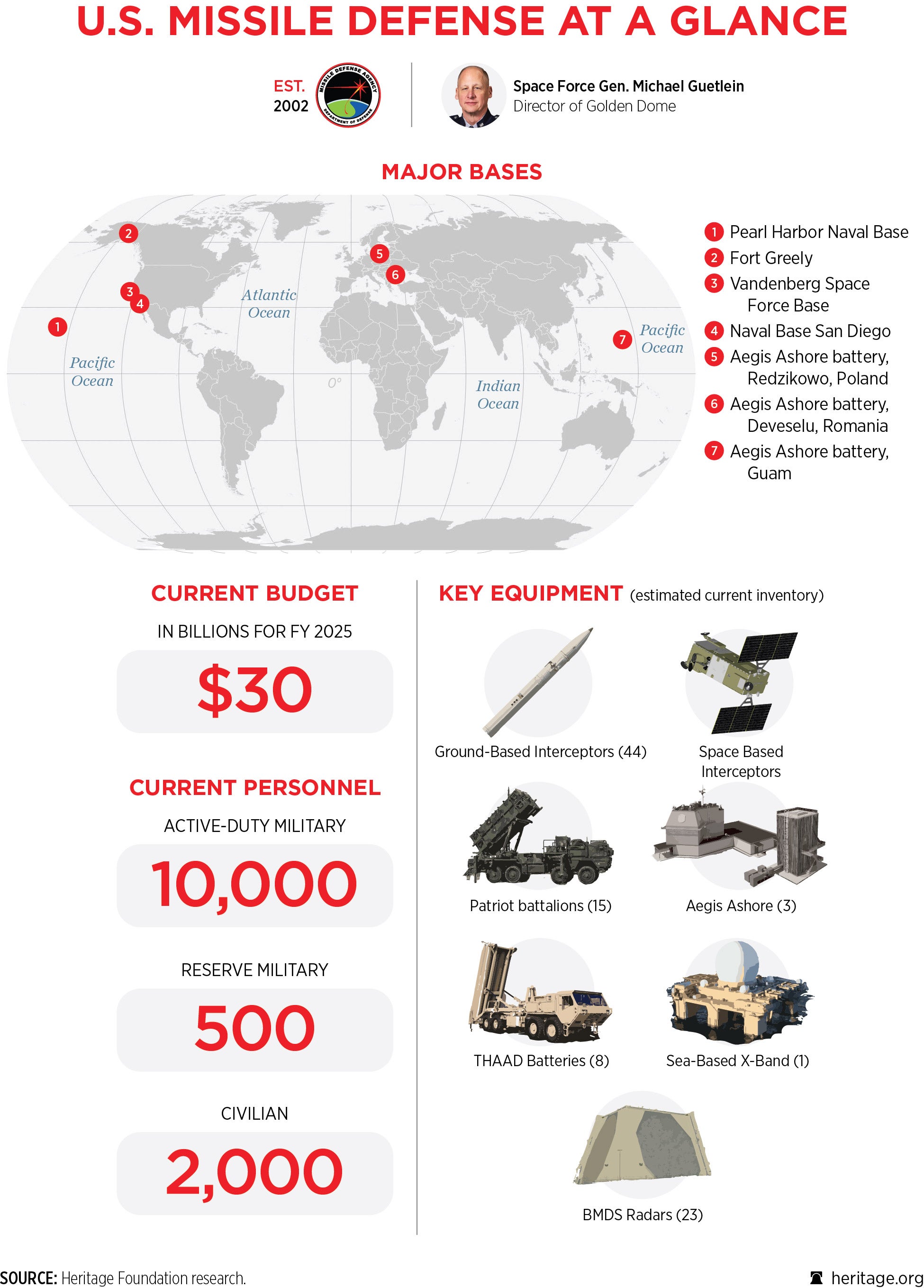
In 2002, citing the growing rogue state missile threats, the United States withdrew from the 1972 Anti-Ballistic Missile Treaty, which limited the ability of the United States to field ballistic missile defenses.[REF] In the years that followed this withdrawal, the United States built and fielded 44 missile defense interceptors in Alaska and California. These interceptors were limited in numbers as they were designed not to intercept advanced ballistic missiles such as those from Russia or China, but rather to intercept missiles from emerging rogue states that were investing in both nuclear and long-range missile technologies, such as North Korea and Iran.[REF]
For a decade and a half, the United States’ missile defense posture remained largely unchanged, focusing on a limited capability and capacity. By the latter half of the 2010s, however, the vision for missile defense started to change with the deterioration of the global security environment. The National Missile Defense Act of 1999 had made it official U.S. policy to protect the homeland only from a “limited ballistic missile attack.”[REF] The National Defense Authorization Act (NDAA) for Fiscal Year 2017, however, dropped the word “limited” even as it continued to focus on ballistic missiles.[REF]
In January 2019, the Trump Administration published its congressionally mandated Missile Defense Review (MDR), a statement of policy intended to guide the Administration’s missile defense programs. The 2019 MDR addressed the dangerous threat environment that had evolved since the previous MDR in 2010 and recognized that future missile defense systems might have to defend against cruise and hypersonic missiles in addition to ballistic missiles.[REF]
The 2020 NDAA made it a matter of policy to rely on nuclear deterrence to defend against “near-peer intercontinental missile threats” and focus on improving missile defense against “rogue states.”[REF] During roughly the same period, the Missile Defense Agency (MDA) began to solicit proposals for the Next Generation Interceptor (NGI), meant to be a more effective missile defense interceptor capable of intercepting not just rudimentary intercontinental ballistic missiles (ICBMs) such as those fielded by North Korea or Iran, but also from more advanced missile threats, to include Russia and China.[REF]
The Biden Administration’s 2022 Missile Defense Review recognized that the “evolution of offensive air and missile threats has accelerated greatly since the United States began developing its first ballistic missile defense systems over fifty years ago” and that “[t]his trend represents a growing national security challenge expected to multiply in scope and complexity over the coming decade.”[REF]
In January 2025, President Trump released Executive Order 14186, “The Iron Dome for America,” mandating the establishment of a multilayered missile defense system (now known as Golden Dome) that includes a space-based platform.[REF] The 119th Congress has identified close to $24 billion in fiscal year (FY) 2026 to begin work on President Trump’s missile defense system, to include a robust space-based layer.[REF]
In the future, as technological trends progress and modern technologies become cheaper and more widely available, North Korean or Iranian ballistic missiles and countermeasures may rival in sophistication, if not in numbers, those of Russia or China. It is for this reason, coupled with the adversary threats of coercive or limited-escalation nuclear attacks, that the United States is committed to building Golden Dome.
The Evolving Air and Missile Threat Environment
America’s adversaries—particularly China, Iran, North Korea, and Russia—are building more and more diverse capabilities that can target not only their regional neighbors, some of whom are American allies, but the United States itself. Such new weapons systems, including ICBMs, long-range cruise missiles, hypersonic missiles, and even orbital bombardment systems, are coupled with increasing attempts at coercion, particularly against America’s regional allies. This coercion sometimes takes the form of attempted nuclear coercion, as is the case with North Korea both against the American homeland and against U.S. allies in the Pacific and Russia’s regular threats of nuclear use against the U.S. homeland and our allies in Europe. Other times, it takes the form of outright attacks on civilian and military targets as evidenced by the Iranian attacks on Israel and Russian attacks on Ukraine.
It is clear that America’s adversaries increasingly see potential missile and autonomous systems strikes on not only military targets, but also on homelands and civilian population centers, as legitimate. This is true not only for targets in the homelands of America’s allies, but for the United States as well.
This development in adversary perception is because America’s adversaries see the U.S. homeland to be not only a valid target, but a vulnerable one as well. It also explains both why they are building a growing array of long-range strike capabilities—and why the United States must develop and field a credible multilayered missile defense architecture.
The Evolving Long-Range Strike Threat
Adversaries seek to threaten and potentially exploit America’s vulnerability to long-range attacks as a means to achieve their own wide-ranging revisionist goals, be they breaking up the North Atlantic Treaty Organization (NATO), diminishing American global influence, or projecting power to the Western Pacific. As noted, America’s adversaries are increasingly building long-range threats, many of which may be nuclear-capable, in order to achieve the above goals. These long-range threats include ballistic missiles, long-range cruise missiles, hypersonic missiles, and threats that potentially could be deployed from orbital platforms.
Ballistic Missiles. States have built ballistic missiles for purposes of warfare since the 1940s. By the 1950s, with the Atlas missile program, both the United States and the Soviet Union were pursuing ICBMs as delivery vehicles for nuclear warheads, capable of striking each other’s homelands.
Russia and China have had ICBMs capable of carrying nuclear warheads for decades, and both countries are modernizing their ICBM arsenals. Russia is pursuing the “super-heavy” SS-28 Sarmat ICBM, capable of carrying multiple nuclear warheads to targets in North America.[REF] China is the fastest-growing nuclear power on the planet and is building nuclear ICBM silos in its western desert at a breathtaking pace.[REF] North Korea, meanwhile, is advancing its Hwasong-18, a road-mobile three-stage ICBM capable of carrying nuclear weapons and reaching targets in North America.[REF]
Long-Range Cruise Missiles. In recent years, Russia has shown a proclivity to proclaim the development of new systems and capabilities, many of which never materialize. One of interest was outlined in a Defense Intelligence Ballistic Missile Committee report, which identified the SSC-X-09 Skyfall as a program of concern.[REF] The Skyfall is reportedly a cruise missile with a range of up to 20,000 kilometers that is maneuverable and can fly at low altitude.[REF] The range of the missile means that Russia can base the missile anywhere in its territory and still be able to reach targets in the continental United States; because of its maneuverability and low flight altitude, such a system can evade most missile defense radars and interceptors. While this and other long-range cruise missile systems remain in the development and testing stage, it is possible that Russia is seeking to deploy such capabilities with an eye to having an additional capability of striking the United States with a limited number of nuclear weapons from a platform that could evade existing missile defenses. The 2024 annual assessment of Military and Security Developments Involving the People’s Republic of China published by the U.S. Department of Defense (now U.S. Department of War) suggests that China is pursuing its own arsenal of such long-range cruise missiles.[REF]
Hypersonic Missiles. Hypersonic flight, generally described as beginning at around five times the speed of sound, is gaining more interest from advanced militaries around the world. Hypersonic weapons are divided into two general categories: hypersonic cruise missiles and hypersonic glide vehicles. Hypersonic cruise missiles use a scramjet thrust that enables them to sustain speed and maneuver as necessary at lower altitudes of flight. Hypersonic glide vehicles use rockets to accelerate to high speeds during a boost phase and then glide in the atmosphere at enormous speeds with significant maneuverability during the terminal phase of flight. Their speed, range, and maneuverability mean they can be effective against regional targets or against targets in North America while complicating enemy efforts to detect, track, and prevent attack.
The speed and maneuverability of hypersonic weapons present real challenges from defense perspectives—which is one reason adversaries are building them. Hypersonic weapons’ maneuverability at low altitudes makes targeting and engagement with traditional missile defenses such as Terminal High Altitude Air Defense (THAAD) and Patriot Air Defense difficult if not impossible. Faster interceptors and battle management systems, along with more precise radars, can likely ensure greater effectiveness of missile defenses, but much needs to be done to counter the novel threats posed by hypersonic weapons.
Russia has been interested in hypersonic capabilities since the 1980s. It claims that the Kinzhal, which has seen service in the Ukraine war, is a jet-launched hypersonic missile and that its Avangard hypersonic glide vehicle is nuclear-capable.[REF] Moscow is also pursuing a ship-based hypersonic cruise missile, the Tsirkon.[REF] Russia seems to be pursuing hypersonic capabilities as part of a broader strategy of fielding long-range precision fires that could be nuclear or conventionally armed.
For the past several years, U.S. Department of Defense officials have warned of China’s interest in hypersonic capabilities. According to the Defense Department’s 2020 assessment of China’s military power, the People’s Liberation Army Rocket Force (PLARF) “paraded the DF-17 missile [its first hypersonic glide vehicle] for the first time as part of the PRC’s 70th anniversary parade in 2019.”[REF] An unclassified Congressional Research Service report noted that China had the potential both to evade U.S. missile defenses and to be nuclear-capable.[REF] More recent reports suggest that China is pursuing a variety of hypersonic capabilities, to include ground-launched, air-launched, and even submarine-launched capabilities, many of which could support a nuclear warhead.[REF]
Beyond Russia and China, in March and April of 2024, North Korea claimed to have tested a hypersonic glide vehicle capable of striking targets in Japan and South Korea.[REF] Although there has yet to be a confirmed test of a North Korean hypersonic capability, it is very possible that North Korea seeks hypersonic capabilities.
One positive characteristic of hypersonic weapons is that their high speed may make them more vulnerable to disruption by smaller impacts of interceptors or changes in their structures. Put another way, the tight performance margins needed to ensure that they perform high-speed maneuvers over extended spaces may make them far more vulnerable to interception than traditional and generally more robust ballistic missiles are.
Fractional Orbital Bombardment System (FOBS). FOBS is an orbital platform that could launch strikes from space against terrestrial targets, using kinetic, high-explosive, or even nuclear weapons. FOBS has never been fielded, but it has been discussed for more than half a century.
However, it is now known that the Russians sought nuclear-armed FOBS for a number of reasons: unlimited flight range; lesser flight time from launch to target than is the case with missiles; the impossibility of predicting the target of a FOBS platform during flight time; the likely high degree of accuracy of such a system; the lack of strategic warning of such an attack; and—most important—the ability to overcome American missile defenses due to the speed of a FOBS-launched weapon.[REF] The Soviets understood that FOBS can put warheads on a target with no warning and are impossible to intercept.
FOBS was largely ignored for decades, but in the past few years, two major reports have indicated that China and Russia were potentially interested in putting nuclear weapons on FOBS. In 2021, Under Secretary of Defense Frank Kendall noted that China was potentially pursuing a FOBS capability,[REF] and in October 2023, the U.S. Department of Defense noted that “[t]he PRC probably is developing advanced nuclear delivery systems such as a strategic hypersonic glide vehicle and a fractional orbital bombardment (FOB) system.”[REF] In February 2024, reports suggested that Moscow once again was interested in putting nuclear weapons in orbit—potentially as antisatellite weapons but also potentially as a FOBS capability.[REF]
The Lower-Escalation Pathway Temptation
China, Iran, North Korea, and Russia are challenging American interests and seeking to constrain American influence and freedom of action around the world. Russia is attempting to use nuclear weapons to coerce the West due to its support for Ukraine and has hinted at pursuing a possible low-escalation pathway attack on NATO states in pursuit of such a goal. Other actors may also pursue a lower-escalation pathway attack as their missile forces expand and diversify.
In a lower-escalation pathway, an enemy would attack an American homeland site, potentially including military assets, with a limited number of conventional or low-yield nuclear weapons limiting civilian casualties, in an attempt to change the behavior of the United States.
In a low-escalation pathway attack, China or Russia may try to escalate its way out of a conventional conflict it is losing against the United States by conducting a series of limited conventional or nuclear strikes at key targets in the U.S. homeland. These coercive strikes would be intended to demonstrate enough resolve and result in significant damage to convince U.S. political leaders to give in to adversary demands but limited enough in scope and scale (meaning not catastrophic) to not prompt an overwhelming U.S. response.
This lower-escalatory pathway of forcing a nation to negotiate has not been tested, but the logic is sound, and there is some indication that America’s adversaries are considering such a strike. China is building a nuclear arsenal that in the coming years could enable it to carry out such a strike, and Russia openly discusses the prospects of limited nuclear strikes against targets in the West.
The United States’ existing approach to missile defense, as enacted through the Missile Defense Agency, is not comprehensive and can neither address lower-escalation coercive attacks from China or Russia nor compete with China’s pacing challenge. Specifically:
In 2020, DoD estimated the PRC’s operational nuclear warhead stockpile was in the low-200s and was expected to at least double by 2030. However, Beijing has accelerated its nuclear expansion, and DoD estimates this stockpile has surpassed 600 operational nuclear warheads as of 2024, on track to exceed previous projections….[REF]
By 2030, DoD estimates that the PRC will have over 1,000 operational nuclear warheads, most of which will be fielded on systems capable of ranging CONUS [the Continental United States].[REF]
As a consequence of these developments, the United States requires a comprehensive set of missile defense layers to counter an adversary’s lower-escalation temptation. A set of comprehensive missile defense layers that can destroy at least a hundred adversary nuclear-armed missiles—be they from China, North Korea, or Russia—would incentivize adversaries’ leaders to abandon plans for “easy coercion” or “cheap shot” attempts with a few missiles to coerce or intimidate American political leaders. Forcing adversary leaders to consider the lower likelihood of success for attacks below 100 missiles, in addition to the potential for provoking an unacceptably damaging U.S. response, may help to improve deterrence and raise the threshold for missile-based strikes against the U.S. homeland. Making escalation more difficult and riskier to achieve lowers the risk of adversaries’ seeing value in escalation.
While adversaries might be tempted to execute a lower-escalation pathway strike (say, by firing only a dozen nuclear-armed missiles at the American homeland) as a high-risk but potentially high-reward strategy to end a conflict on terms acceptable to them, they would be far more cautious about firing more than a hundred nuclear-armed missiles at the United States. Such a strike would almost certainly trigger the kind of massive U.S. nuclear retaliation that they would otherwise try to avoid, in addition to the uncertainty of success for the initial attack.
In this way, a credible and effective multilayered missile defense architecture could deter America’s adversaries from pursuing an otherwise attractive lower-escalation pathway in the near future. The existing Ground-Based Interceptor (GBI) architecture, first fielded in 2004 and designed to defend against limited attacks from North Korea, may no longer be sufficient to defend against even a rogue state attack, given the expansion and maturation of North Korea’s missile program.[REF] To put it another way, effective and credible missile defenses are not a “future nice to have;” they are a “near-term must have.”
Missile Defense in America’s Strategic Posture
The United States maintains credible nuclear capabilities and highly lethal, battle-proven conventional capabilities that give its adversaries pause, deter aggression, assure allies, and defeat threats should deterrence fail. A credible, integrated, and multilayered missile defense architecture as envisioned by Golden Dome is a strategic imperative on par with maintaining a credible and diverse nuclear arsenal, particularly in an era when America’s adversaries are developing, deploying, and employing ever more capable and lethal missile threats.
Adversaries may grow more desperate during a prolonged conventional conflict with a superpower like the United States, and this could lead them to take riskier strategies like conventional or even nuclear strikes on America’s homeland and critical infrastructure. To counter this threat, the United States should deploy integrated air and missile defense (IAMD) systems that can deter and defeat such coercive attacks. It should also be prepared to defeat multiple salvos conducted over extended periods of time. It is likely to strain credibility to have defenses that can defeat just a single salvo. A credible missile defense architecture such as Golden Dome must be able to defeat (or seem to be able to defeat) multiple waves of attacks during a protracted conflict.
There are three possible ways the United States may respond to adversaries’ long-range missile threats—be they lower-escalation pathway strikes, repeated salvos on the American homeland during a protracted conflict, or even larger-scale strategic attacks—to its allies and the American homeland. Washington can:
- Acquiesce to the wishes of adversaries by, for example, accepting a fragmented NATO, reduced American global influence, and limits to its ability to project power;
- Rely solely on the threat of punishment to deter a growing list of ever more capable adversaries from striking civilian population centers; or
- Build effective missile defenses to deny adversaries the ability to coerce the United States or its allies.
Given the emerging threats and the apparent desire of America’s adversaries to field an arsenal of ICBMs, long-range cruise missiles, hypersonic capabilities, and FOBS—many of which are optimized to overwhelm or evade U.S. missile defenses—the United States can and should build an integrated, multilayered missile defense architecture that can deter and defeat coercive strikes on the homeland while also providing a regional defense of key capabilities overseas.
A credible Golden Dome that incorporates existing homeland missile defenses, to include existing GBIs and regional missile defenses in the Indo–Pacific, Europe, and the Middle East, and builds additional capacity and capabilities in several key areas is required given the expanding threats. Such a missile defense architecture must perform a number of functions, including:
- Defending the homeland. The United States must ensure that its population centers and critical locations are protected and preserved.
- Defending key overseas nodes. Such nodes could be key bases, logistical sites, or allied population centers.
- Defending the U.S. and its allies against a variety of inbound threats. Typically, the United States has focused its missile defense on intercepting ballistic missiles and cruise missiles overseas and ballistic missiles at home. Given the evolving nature of the threat, the United States should field the capabilities necessary to defeat all types of inbound threats, to include long-range cruise missiles, hypersonic threats, and those delivered from orbit.
- Defending the U.S. and its allies against a variety of actors. No longer should the United States optimize its missile defenses only against rogue actors, such as Iran or North Korea. It can also field capabilities that can destroy threats from other, more advanced adversaries, such as China and Russia.
An effective Golden Dome would support a number of U.S. defense objectives, including:
- Deterring attack. Deterrence by denial, which is the ability to prevent an attacker from achieving its operational objectives, can be a powerful tool. An effective missile defense architecture that could credibly intercept a variety of long-range threats from a variety of actors could deter U.S. adversaries from launching an attack in the first place because they believe that such an attack would not achieve their objectives and instead would leave them vulnerable to significant reprisals from the United States.
- Limiting damage should deterrence fail. Even if a missile defense architecture is not perfect, it could significantly limit the extent of damage through a partial success rate. That is, if an adversary seeks to destroy six critical targets, even a partially effective missile defense could ensure that some quantity of those targets survived an attack.
- Assuring allies. Regional allies, particularly those located close to U.S. adversaries and would therefore be on the front line should a conflict erupt, often seek assurance that the United States will support them during times of crisis or conflict. In many cases, their need for assurance drives their calculations about whether they need an independent nuclear arsenal. In many ways, the more insecure they feel, the more likely they are to pursue an independent nuclear weapons program, which it has been U.S. policy to oppose since 1963. Forward deploying nuclear weapons is one way to assure allies and convince them not to pursue their own nuclear weapons programs. Integrated missile defenses are another important tool.
Finally, it is America’s policy that no nation should be allowed to put nuclear weapons in orbit for the purposes of targeting sites on Earth. Therefore, the United States reserves the right to destroy, preemptively, any adversary orbital platform that carries nuclear weapons, and may do so using any tool best suited to the purposes—whether that tool is based terrestrially or in orbit.
Framing Missile Defense Capabilities and Missions
The U.S. missile defense system has three critical physical components:
- Sensors,
- Interceptors, and
- Command-and-control infrastructure that provides data from sensors to interceptors.
Of these, interceptors receive much of the public’s attention because of their visible and kinetic nature. Components of missile defense systems may be classified based on the phase of flight during which intercept occurs, although some—for example, the command-and-control infrastructure or radars—can support intercepts in various phases of flight. Interceptors can shoot down an adversary ballistic missile in the boost, ascent, midcourse, or terminal phase of its flight. As cruise missiles and hypersonic glide vehicles continue to proliferate, the MDA and the military services must therefore consider intercepts in all four phases of flight.
Another way to classify missile defense systems is by the range of an incoming missile (short-range, medium-range, intermediate-range, or intercontinental-range). An interceptor’s flight time determines both the time available to conduct an intercept and the optimal interceptor placement to improve intercept probability. The United States has “30 minutes or less” to detect an ICBM, track it, provide the information to the missile defense system, find the optimal firing solution, launch an interceptor, and shoot down the incoming missile, ideally with enough time to fire another interceptor if the first attempt fails—a tactic known as “shoot-look-shoot.” The time needed to intercept short-range, medium-range, and intermediate-range ballistic missiles is shorter.
Finally, missile defense can be framed by the origin of interceptor launch. At present, U.S. interceptors are launched from the ground or from the sea. In the past, the United States explored possible ways to intercept ballistic missiles from the air or in space, but such efforts have been limited since the U.S. withdrawal from the ABM Treaty in 2002.[REF]
Assessing America’s Missile Defense
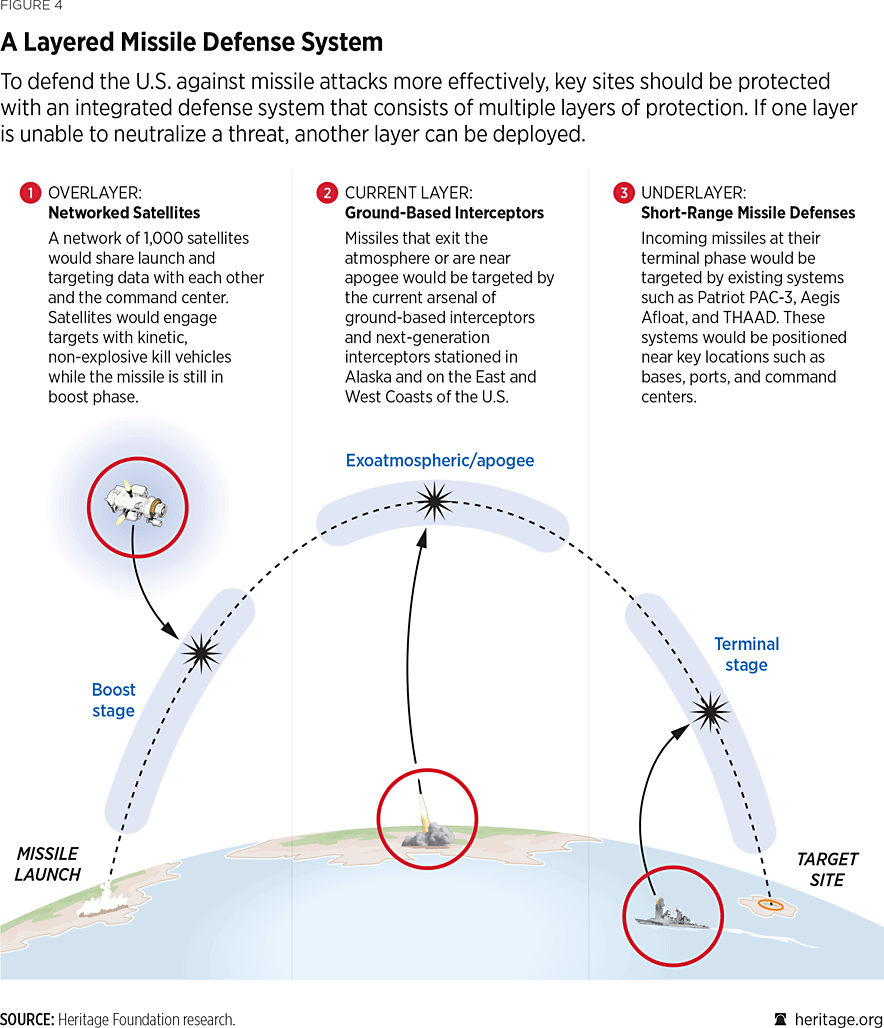
An effective and credible missile defense architecture must include a number of components, such as an integrated sensor architecture that takes multiple data streams from multiple U.S. and allied or partner sources and creates an integrated command-and-control and management structure and three different engagement levels:
- A short-range defense to protect key high-value nodes in the U.S. homeland and overseas,
- A ground-based system to give general coverage over North America, and
- A space-based overlayer that can engage a number of threats across the world in various stages of flight.
This is the essence of Golden Dome, President Trump’s groundbreaking missile defense architecture unveiled in 2025.[REF] Taken together, such an architecture can increase America’s ability to address adversary threats and strengthen deterrence by denying adversaries the benefit of missile strikes on key targets.
While some of the critical components for a Golden Dome exist today, including regional command-and-control nodes, theater air defense systems, and GBIs, there is important work to be done in (1) integrating disparate systems into a cohesive architecture and (2) expanding existing systems to include more capacities and building capabilities in orbit if the United States is to field a credible missile defense architecture.
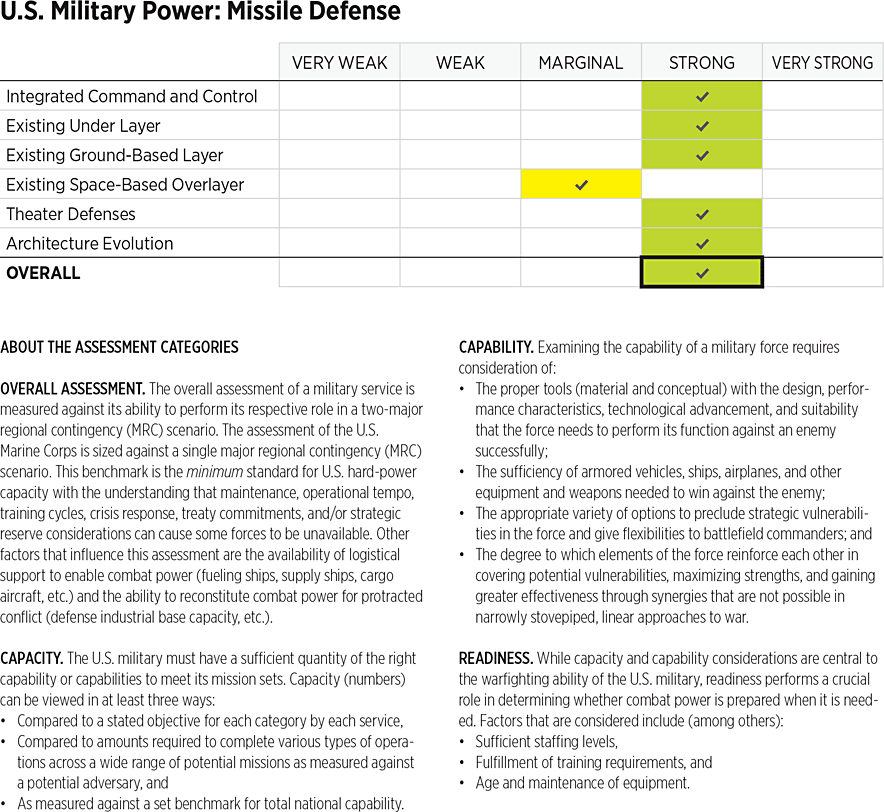
Integrated Command and Control. An integrated command-and-control system can more effectively coordinate the tracking and interception of enemy missile launches by developing and fielding a Hypersonic and Ballistic Tracking Space Sensor Layer, and integrating shots from the various layers, missile defenses can get more shots at incoming missiles, thereby increasing the likelihood of a successful interception. Put another way, if the overlayer misses the interception, GBIs have the opportunity to engage the incoming target. If the GBIs miss, the underlayer can have some utility in potentially intercepting inbound missiles or warheads at a limited number of critical sites.
Assessment: Strong.
An Effective Underlayer for Protecting Critical Sites. Current off-the-shelf missile defenses such as Patriot PAC-3s, Aegis Afloat, air-to-air missiles and surface-to-air missiles, directed-energy weapons (DEW), and THAAD systems may provide robust missile and autonomous systems defenses around a limited number of key locations within the U.S. homeland, at forward bases, and at key allied locations.[REF] Locating such systems near key bases, ports of embarkation, and command-and-control nodes provides multiple interception opportunities of enemy missiles that target critical, high-value nodes. Accordingly, the United States should develop and deploy an underlayer that leverages terminal phase intercept capabilities that are postured to defeat a countervalue attack.
Assessment: Strong.
Ground-Based Layer. The current missile defense layer comprises 44 ground GBIs at sites in Alaska and California. They are optimized for targets coming from North Korea and were built when North Korea had a very modest ability to target North America with missiles. Later this decade, the next-generation interceptors (NGIs) should augment the existing GBIs on the West Coast with 20 additional interceptors.[REF]
The fielding of NGIs is a necessary step, but one that is inadequate for the current threat. A modest expansion of missile interceptors is necessary to contain not only the expanding North Korean and Iranian missile threats but also threats posed by Russia and China. To that end, the United States should expand the number of NGIs it purchases from 44 to approximately 64 and plan to station a significant portion of the new interceptors on a new missile defense site on the East Coast to better target incoming adversary missiles from Eurasia.[REF] These 64 NGIs should replace the older GBIs currently deployed in Alaska and California.
These capabilities, needed today given the growing threat from adversary long-range fires, are an important interim step to a more robust, space-based missile defense layer and will form a critical component of Golden Dome.
Assessment: Strong.
A Space-Based Overlayer. The “overlayer” is a capability that can field a network of microsatellites in orbit that would serve as both sensors and communication relays, as well as platforms for launching interceptors capable of destroying long-range threats regardless of point of origin, destination, or delivery mechanism. Of particular utility against rogue states such as Iran and North Korea, an overlayer can make an important contribution on threats posed by China and Russia.
The constellation’s networked sensors automatically would share launch and targeting data with each other and with ground-based command-and-control networks. They can carry small kinetic, non-explosive kill vehicles or directed-energy weapons that can engage targets across multiple stages of flight, including the boost phase, midcourse flight, or coasting phase.
The technology to share launch and targeting data among the orbital sensors exists today. Similar to how ride-share applications use networked artificial intelligence (AI) to identify which vehicles are closest to a customer’s location, networked satellites can identify a threat and identify which interceptors are best positioned to engage and destroy an enemy’s launched missile.
A constellation of satellites in orbit through the development and deployment of a Proliferated Warfighter Space Architecture can engage enemy missiles far sooner than a ground-based system, particularly those that are located thousands of miles away in North America. Because they are closer to the target in space and en masse, they can get not only multiple shots at enemy missiles during their trajectory but the satellites can engage some targets while the targets are still in their ascent phase, thereby increasing the chances that interceptors may destroy inbound targets.
In addition, an orbital sensor and engagement capability addresses many of the challenges posed by terrestrial-based engagement, particularly its ability to surveil huge portions of the Earth’s surface from orbit. This expanded sensor coverage, coupled with redundant interceptors, increases the likelihood of a successful interception before the missile strikes its intended target.
A proliferated constellation of orbital satellites may address a variety of terrestrial or space-based threats. Further, a robust space-launched resupply capability that leverages commercial launch capabilities would be able to replace expended satellites quickly during a conflict, thus strengthening the resilience (and therefore, efficacy) of such a capability. Building such satellites at scale enables cost-efficiency, resilience, and rapid reconstitution.
Assessment: Marginal.
Allied and Theater Missile Defenses. The United States can strengthen its homeland defenses while at the same time strengthening missile defenses for forward deployed U.S. forces and with allies and partners against missile threats from any adversary. By strengthening, integrating with, and operating with allied and partner missile defense systems, the United States may better deter and, if necessary, defeat missile and autonomous systems threats globally, thereby reducing the risk to deployed American forces, the lives and citizenry of America’s allies and partners, and, ultimately, the American homeland.
Threats from adversary missile and autonomous systems increasingly blur the line between theater or regional missile threats and missile threats to the American homeland. To combat such threats, regional Combatant Commanders can now and may increasingly work with key allies and partners in the Indo–Pacific, Europe, and the Middle East on information-sharing (both pre-launch and post-launch), targeting data, and interceptions. Iran’s 2024 attacks on Israel—which mixed ballistic missiles, cruise missiles, and autonomous systems—failed due to the integration of American and partnered missile defense capabilities and command-and-control nodes.[REF] This type of collaboration may be a model for successful capability integration among American, allied, and partner missile defense architectures. Cooperation with like-minded allies and partners can be crucial both for real-world interceptions but also, increasingly, on development of ever more advanced and capable missile defense systems.
Such advances can be crucial to counter adversary anti-access/area-denial (A2AD) strategies that increasingly rely on advanced missile threats to deny American access to forward theaters. Collaborating with allies and partners to build and deploy advanced missile interceptors, both at home and abroad, may enable American freedom of action and key access to the most critical parts of the globe. Regional missile defense architectures in the Western Pacific, including national missile defenses in Japan and South Korea, NATO missile defense architectures and the effective missile defense systems employed by U.S. partners in the Middle East, only strengthen America’s position, standing, and freedom of action.
Where appropriate and feasible, the United States should work with allies and partners on IAMD detection and defeat capabilities that may be concealed or disguised to enhance deterrence and complicate adversary targeting.
Assessment: Strong.
An Ever-Evolving Architecture. In addition to the above layers, which are designed to prevent adversaries from launching a long-range strike on the United States or its regional allies, the United States must continue to develop new capabilities both to strengthen defenses and to introduce uncertainty into the minds of adversaries. With these two goals in mind, the U.S. Department of War should continue to explore new capabilities while employing existing capabilities in innovative ways.
For instance, placing missiles on autonomous aerial systems and on drones to shoot down enemy missiles in the boost phase or placing missile interceptors, such as the SM-6, in shipping containers in overseas ports that could target enemy missiles close to their homelands would not only help to protect key areas, but also keep America’s adversaries guessing. To this end, the War Department should embark on an aggressive campaign to identify key capabilities that can mitigate today’s adversary missile threat.
Assessment: Strong.
Policy Recommendations
The single most urgent recommendation is for Congress to fund and for the Department of War to build and field Golden Dome, to include the orbital constellation of sensors and shooters, a third ground-based missile defense site on the East Coast, and the associated Golden Dome battle management systems. To this end, the United States should build on the GOLDEN DOME for America Act, sponsored by Senator Dan Sullivan and Senator Kevin Cramer and Representative Mark Messmer, to field a robust and integrated multilayered defense architecture with a heavy emphasis on space-based interceptors.
Between the GOLDEN DOME for America Act and the One Big Beautiful Bill,[REF] the United States is on track to fund Golden Dome with an initial budget of ~$25 billion to begin building the architecture. Such an architecture should include an initial space-based capability of a few dozen interceptors, on the way to an overall space-based interceptor architecture of between 1,500 and 2,200 interceptors.
Eventually, Golden Dome should examine the threats posed by non-arctic trajectories. While not a direct threat now, it is not beyond the realm of possibility that an adversary could forward deploy nuclear-capable missiles in the Western Hemisphere, from which they can range the United States without having to overfly missile interceptors in Alaska or the West Coast. Further, it may be possible at some point in the future for adversaries to build a super long-range ICBM that is able to attack the United States not from a polar-arctic trajectory, but from a polar-Antarctic trajectory using rockets with a range of more than 20,000 kilometers. While still a future possibility, it is one that an evolving 21st century missile defense architecture should take into account and be prepared to address.
Conclusion
America is well on its way to building a robust missile defense architecture that can deny our adversaries from carrying out a strategic attack on the American homeland. This will require patience, innovation, and resources, but from an engineering perspective, building a credible orbital missile defense shield such as Golden Dome is simple in comparison with putting a man on the moon within seven years or coming up with the idea for an atomic bomb and then building and employing it in less than four years.
The time is now.
Endnotes
[1] Aaron Bateman, “The Enduring Impact of Reagan’s Strategic Defense Initiative,” Arms Control Today, Vol. 53 (September 2023), https://www.armscontrol.org/act/2023-09/features/enduring-impact-reagans-strategic-defense-initiative (accessed October 20, 2025).
[2] See Keara Gentry and Robert Peters, “Ground-Based Interceptors 20 Years On: What Has the Missile Defense Agency Bought Us?” Heritage Foundation Issue Brief No. 5355, June 26, 2024, https://www.heritage.org/defense/report/ground-based-interceptors-20-years-what-has-the-missile-defense-agency-bought-us.
[3] Wade Boese, “U.S. Withdraws from ABM Treaty; Global Response Muted,” Arms Control Today, Vol. 32 (July/August 2002), https://www.armscontrol.org/act/2002-07/news/us-withdraws-abm-treaty-global-response-muted (accessed October 20, 2025).
[4] See Peppino DeBiaso and Robert Joseph, “U.S. Homeland Missile Defense: Charting a Different Course,” National Institute for Public Policy Information Series No. 585, May 6, 2024, https://nipp.org/information_series/peppino-debiaso-and-robert-joseph-u-s-homeland-missile-defense-charting-a-different-course-no-585-may-6-2024/ (accessed October 20, 2025).
[5] H.R. 4, National Missile Defense Act of 1999, Public Law 106-38, 106th Congress, July 22, 1999, Sec. 2, https://www.congress.gov/106/statute/STATUTE-113/STATUTE-113-Pg205.pdf (accessed October 20, 2025).
[6] S. 2943, National Defense Authorization Act for Fiscal Year 2017, Public Law 114-328, 114th Congress, December 23, 2016, https://www.congress.gov/114/plaws/publ328/PLAW-114publ328.pdf (accessed October 20, 2025).
[7] Tom Karako, “The 2019 Missile Defense Review: A Good Start,” Center for Strategic and International Studies Critical Questions, January 17, 2019, https://www.csis.org/analysis/2019-missile-defense-review-good-start (accessed October 20, 2025). For the full text of the 2019 MDR, see U.S. Department of Defense, Office of the Secretary of Defense, 2019 Missile Defense Review, https://apps.dtic.mil/sti/trecms/pdf/AD1066924.pdf (accessed October 21, 2025).
[8] S. 1790, National Defense Authorization Act for Fiscal Year 2020, Public Law 116-92, 116th Congress, December 20, 2019, Sec. 1681, https://congress.gov/116/plaws/publ92/PLAW-116publ92.pdf (accessed October 20, 2025).
[9] See video of presentation by Vice Admiral Jon Hill, Director, Missile Defense Agency, at Association of the United States Army, “Hot Topic: Army Space & Integrated Air & Missile Defense,” YouTube, March 5, 2020, https://www.youtube.com/watch?v=6qgjMka8FMA (accessed October 20, 2025).
[10] U.S. Department of Defense, 2022 National Defense Strategy of the United States of America Including the 2022 Nuclear Posture Review and the 2022 Missile Defense Review, p. 12, https://apps.dtic.mil/sti/trecms/pdf/AD1183514.pdf (accessed October 22, 2025).
[11] President Donald J. Trump, Executive Order 14186, “The Iron Dome for America,” January 27, 2025, Federal Register, Vol. 90, No. 21 (February 3, 2025), pp. 8767–8769, https://www.govinfo.gov/content/pkg/FR-2025-02-03/pdf/2025-02182.pdf (accessed October 21, 2025).
[12] S. 2142, Ground and Orbital Launched Defeat of Emergent Nuclear Destruction and Other Missile Engagements (GOLDEN DOME) Act of 2025, 119th Congress, introduced June 23, 2025, Sec. 7, https://www.congress.gov/119/bills/s2142/BILLS-119s2142is.pdf (accessed October 20, 2025).
[13] Sidharth Kaushal, “Russia’s Sarmat Test Failure: Implications for the Strategic Balance,” RUSI [Royal United Services Institute for Defence and Security Studies] Commentary, October 22, 2024, https://www.rusi.org/explore-our-research/publications/commentary/russias-sarmat-test-failure-implications-strategic-balance (accessed October 20, 2025).
[14] See, for example, U.S. Department of Defense, Military and Security Developments Involving the People’s Republic of China 2024: Annual Report to Congress, pp. 63, 101, 103, and 107, https://media.defense.gov/2024/Dec/18/2003615520/-1/-1/0/MILITARY-AND-SECURITY-DEVELOPMENTS-INVOLVING-THE-PEOPLES-REPUBLIC-OF-CHINA-2024.PDF (accessed October 20, 2025).
[15] Vann H. Van Diepen, “Third Successful Launch of North Korea’s Hwasong-18 Solid ICBM Probably Marks Operational Deployment,” Henry L. Stimson Center, 38 North, December 21, 2023, https://www.38north.org/2023/12/third-successful-launch-of-north-koreas-hwasong-18-solid-icbm-probably-marks-operational-deployment/ (accessed October 20, 2025).
[16] Defense Intelligence Ballistic Missile Analysis Committee, “Ballistic and Cruise Missile Threat 2020,” https://media.defense.gov/2021/Jan/11/2002563190/-1/-1/1/2020%20BALLISTIC%20AND%20CRUISE%20MISSILE%20THREAT_FINAL_2OCT_REDUCEDFILE.PDF (accessed October 20, 2025).
[17] Jonathan Landay, “Putin Appears Ready to Test New Missile as He Prepares for Trump Talks, Researchers Say,” Reuters, August 13, 2025, https://www.reuters.com/world/europe/putin-appears-ready-test-new-missile-he-prepares-trump-talks-researchers-say-2025-08-13/ (accessed October 20, 2025).
[18] See, for example, U.S. Department of Defense, Military and Security Developments Involving the People’s Republic of China 2024, pp. VII and 56.
[19] Alexander H. Montgomery and Amy J. Nelson, “Ukraine and the Kinzhal: Don’t Believe the Hypersonic Hype,” Brookings Institution Commentary, May 23, 2023, https://www.brookings.edu/articles/ukraine-and-the-kinzhal-dont-believe-the-hypersonic-hype/ (accessed October 20, 2025).
[20] Mark Episkopos, “What Is Behind Russia’s Hypersonic Tsirkon Missile?” The National Interest, The Reboot Blog, January 29, 2022, https://nationalinterest.org/blog/reboot/what-behind-russias-hypersonic-tsirkon-missile-200043 (accessed December 10, 2025).
[21] U.S. Department of Defense, Military and Security Developments Involving the People’s Republic of China 2020: Annual Report to Congress, p. 56, https://media.defense.gov/2020/Sep/01/2002488689/-1/-1/1/2020-DOD-CHINA-MILITARY-POWER-REPORT-FINAL.PDF (accessed October 22, 2025).
[22] Kelley M. Sayler, “Hypersonic Weapons: Background and Issues for Congress,” Congressional Research Service Report for Members and Committees of Congress No. R45811, updated March 17, 2022, p. 15, https://www.congress.gov/crs_external_products/R/PDF/R45811/R45811.24.pdf (accessed October 20, 2025).
[23] Kelly A. Grieco, Hunter Slingbaum, and Jonathan M. Walker, Cratering Effects: Chinese Missile Threats to US Air Bases in the Indo-Pacific, Henry L. Stimson Center, Security and Strategy, Reimagining US Grand Strategy Program, December 2024, https://www.stimson.org/wp-content/uploads/2024/12/Cratering-Effects-Report_Dec-6_WEB.pdf (accessed October 20, 2025).
[24] Seo Ji-Eun, “North Korea Claims Successful Test of New Intermediate-Range Hypersonic Ballistic Missile,” Korea JoongAng Daily, January 7, 2025, https://koreajoongangdaily.joins.com/news/2025-01-07/national/northKorea/North-Korea-claims-successful-test-of-hypersonic-missile/2216834 (accessed October 20, 2025).
[25] See Sebastien Roblin, “Before China’s Orbital Missile Test, the Soviets Had Their Own Fractional Orbital Nukes,” The National Interest, The Buzz Blog, October 18, 2021, https://nationalinterest.org/blog/buzz/chinas-orbital-missile-test-soviets-had-their-own-fractional-orbital-nukes-195178 (accessed October 20, 2025).
[26] Air Force News Service, “Kendall Outlines China Threat in Stark Detail, Offers Blueprint for Effective Response,” September 11, 2023, https://www.af.mil/News/Article-Display/Article/3521976/kendall-outlines-china-threat-in-stark-detail-offers-blueprint-for-effective-re/ (accessed October 20, 2025).
[27] U.S. Department of Defense, Military and Security Developments Involving the People’s Republic of China 2023: Annual Report to Congress, p. 67, https://media.defense.gov/2023/Oct/19/2003323409/-1/-1/1/2023-MILITARY-AND-SECURITY-DEVELOPMENTS-INVOLVING-THE-PEOPLES-REPUBLIC-OF-CHINA.PDF (accessed October 20, 2025).
[28] Kelly Garrity, “Turner Defends Releasing Cryptic Statement About Russia’s Nuclear Capabilities in Space,” Politico, February 18, 2024, https://www.politico.com/news/2024/02/18/turner-statement-russia-nuclear-capabilities-in-space-00142061 (accessed October 20, 2025).
[29] U.S. Department of Defense, Military and Security Developments Involving the People’s Republic of China 2024, p. 107.
[30] Ibid., p. 109.
[31] Center for Strategic and International Studies, Missile Defense Project, “Ground-Based Midcourse Defense (GMD) System,” Missile Threat, last updated July 26, 2021, https://missilethreat.csis.org/system/gmd/ (accessed October 21, 2025).
[32] Wade Boese, “U.S. Withdraws from ABM Treaty; Global Response Muted.”
[33] Hannah D. Dennis, “Golden Dome: Executive Order Overview and Issues for Congressional Consideration,” Congressional Research Service Insight No. IN12544, April 16, 2025, https://www.congress.gov/crs_external_products/IN/PDF/IN12544/IN12544.2.pdf (accessed October 21, 2025).
[34] For an assessment of the critical role of the underlayer, see Matthew R. Costlow and Robert M. Soofer, “US Homeland Missile Defense: Room for Expanded Roles,” Atlantic Council, Scowcroft Center for Strategy and Security Issue Brief, November 15, 2023, https://www.atlanticcouncil.org/wp-content/uploads/2023/11/Costlow-Soofer-Homeland-Missile-Defense.pdf (accessed October 21, 2025).
[35] U.S. Department of Defense, Missile Defense Agency, “Ground-Based Midcourse Defense (GMD),” page last updated August 5, 2025, https://www.mda.mil/system/gmd.html (accessed October 21, 2025).
[36] Rich Abbott, “MDA Reveals More NGI Timeline Details,” Defense Daily, August 10, 2023, https://www.defensedaily.com/mda-reveals-more-ngi-timeline-details/missile-defense/ (accessed October 21, 2025).
[37] Bradley Bowman, Ryan Brobst, and Mike Daum, “What We Can Learn from Iran’s Attack on Israel,” Foundation for Defense of Democracies Insight, April 16, 2024, https://www.fdd.org/analysis/2024/04/16/what-we-can-learn-from-irans-attack-on-israel/ (accessed October 21, 2025).
[38] H.R. 1, One Big Beautiful Bill Act, Public Law 119-21, 119th Congress, July 4, 2025, Sec. 20008, https://www.congress.gov/119/plaws/publ21/PLAW-119publ21.pdf (accessed October 24, 2025).