America's Strategic Deterrent
Robert Peters
Introduction
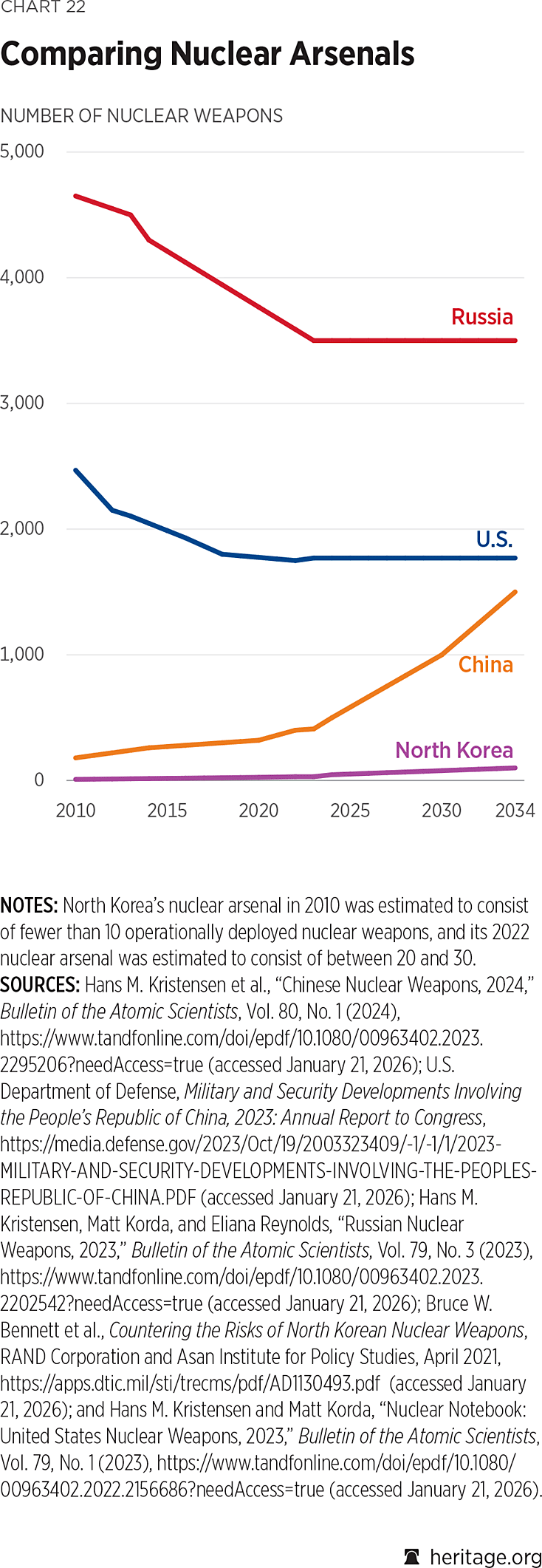
After decades of neglect, the United States is finally building new missiles, new bombers, new submarines, and—most important—new nuclear warheads. This massive nuclear modernization is happening at the same time as China’s “breathtaking” nuclear breakout,[REF] Russia’s 10-to-1 advantage over the United States in non-strategic nuclear weapons, the breakdown in arms control following China’s refusal to engage in any forms of arms control or strategic stability discussions and Russia’s abrogation of the New START and Intermediate-Range Nuclear Forces treaties, and lesser nuclear threats that include the ever-advancing North Korean nuclear program and even Pakistan’s nuclear buildup, which includes the pursuit of nuclear-capable missiles with the potential to hit targets in North America.
Although this deterioration in the security environment is bad enough, the U.S. nuclear modernization program is not going well. The United States is years behind schedule on fielding the Sentinel missile, the Columbia-class submarine, and new nuclear warheads; as of 2025, the National Nuclear Security Administration (NNSA) was nine years behind schedule in producing new plutonium pits, the fissile core of a nuclear weapon; and the United States still does not have a credible non-strategic nuclear option forward deployed in the Indo-Pacific theater despite the Chinese and North Korean nuclear buildups.
For these reasons, the U.S. deterrent is a mixed bag. America’s strategic deterrent remains strong, but the ability of the U.S. to deter multiple nuclear-armed peers at the strategic level, as well as at the theater non-strategic level, will come under increasing strain. Accordingly, the U.S. strategic deterrent earns a very mixed rating.
History of America’s Nuclear Deterrent
Born of the Second World War, America’s nuclear deterrent remains the cornerstone and ultimate guarantor of American security.
Beginning in 1942, the Manhattan Project unfolded at laboratories and facilities across America, from the University of Chicago to Oak Ridge, Tennessee, and the mesas of Los Alamos, New Mexico. Academics, physicists, engineers, and military officers worked together to build the bombs that finally ended the Second World War.
The advent of the Cold War brought about larger arsenals of atomic weapons and new generations of ever more powerful weapons on a variety of platforms and delivery systems. In time, the United States fielded tens of thousands of nuclear weapons designed to deter Communist aggression. By the end of the Cold War, the United States maintained a strategic triad of nuclear-capable bombers, nuclear-armed ballistic missile submarines (SSBNs), and intercontinental ballistic missiles (ICBMs) that could carry high-yield nuclear warheads to any target in the world. At the same time, it fielded shorter-range, lower-yield non-strategic weapons.
America’s strategic deterrent consists largely of the missiles, bombers, and weapons developed in the Cold War. This deterrent is undergoing a significant modernization process, and that process has not gone well with significant cost and schedule overruns.
The question then becomes: How credible is America’s strategic deterrent, and where does it need to be strengthened?
Capacity, Capabilities, and Readiness
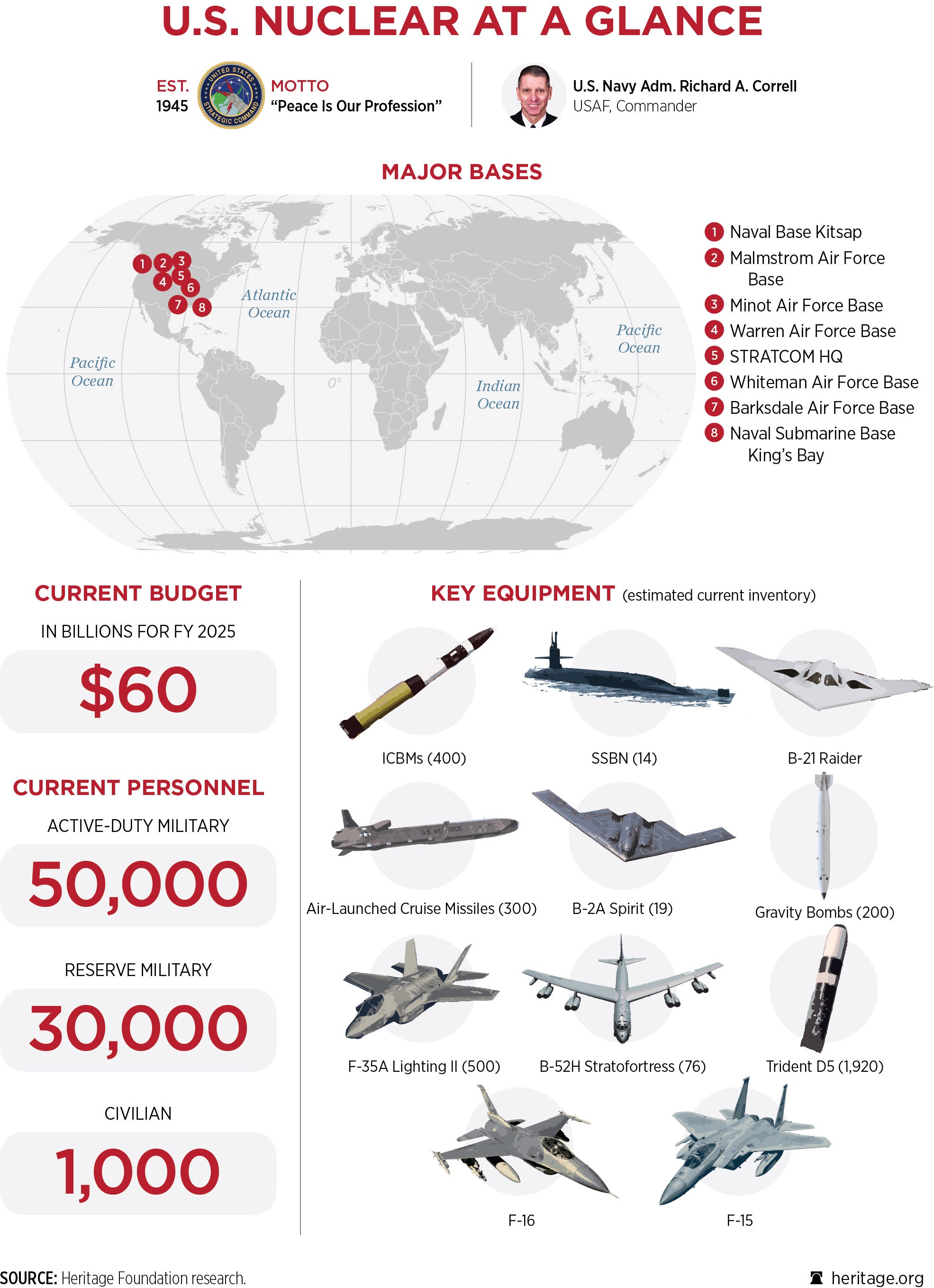
As noted, America’s strategic deterrent consists of a triad of ICBMs, bombers, and ballistic missile submarines. In addition, the United States maintains a small arsenal of non-strategic nuclear weapons that are designed to deter limited nuclear attack.
ICBMs. The American intercontinental ballistic missile force consists of Minuteman III ICBMs dispersed across a number of states in 450 silos. These missiles are the most promptly responsive leg of the nuclear triad because of their constant readiness and direct communication with America’s leadership. Their payload and speed also make their interception by adversary missile defenses difficult.
Each ICBM is currently loaded with a single high-yield, highly accurate warhead that can hold targets at risk throughout Europe and Asia in less than an hour. Each missile also has the capacity to carry additional uploaded nuclear warheads if there should be a policy decision to upload.
The ability to launch the ICBM force promptly means that our adversaries cannot be sure that they will be able to destroy our ICBMs prior to a launch—which means that even a large-scale nuclear strike on America’s ICBM force could fail to destroy the ICBMs and also trigger the large-scale American nuclear response that our adversaries were trying to avoid by targeting our ICBMs in the first place. In this sense, the ICBM force’s very existence contributes to deterrence and strategic stability because neither the United States nor an adversary has an incentive to launch a nuclear first strike on the other’s homeland.
Because the ICBMs are stationed in hardened silos, they are highly survivable against all but multiple strikes from high-yield nuclear warheads. This survivability means that our adversaries cannot destroy a large number of our strategic bombers and ballistic missile submarines as part of an exquisite first strike without also committing significant (and nearly prohibitive) numbers of their high-end forces to the neutralization of America’s missile fields. If the United States were to abandon its ICBM force, adversaries might be tempted to destroy our bombers and SSBNs while they are in garrison, thereby destroying a large percentage of America’s strategic deterrent with relatively few weapons as part of an exquisite first strike.
America’s Minuteman III force was first deployed in 1970 with an expected service life of roughly 10 years.[REF] The last Minuteman was meant to retire during the Reagan Administration; however, for more than 30 years, the United States has been using life extension programs (LEPs) to extend the Minuteman III’s service life. The Sentinel missile, the Minuteman III’s replacement, is scheduled to come online in the 2030s.[REF]
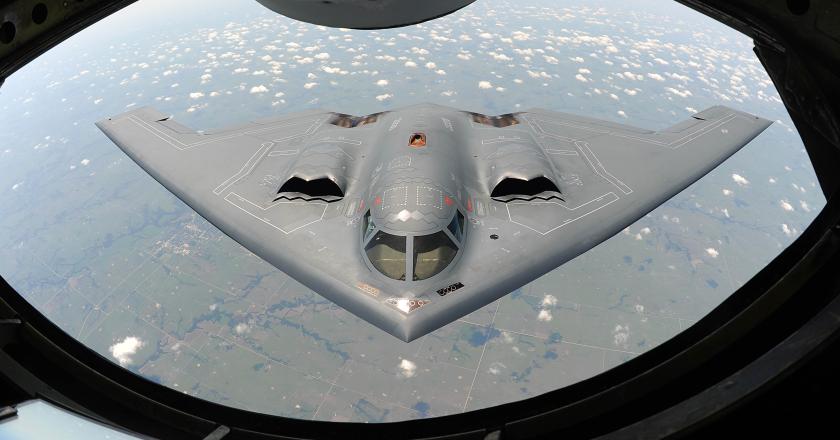
Bombers. The air leg of America’s deterrent force consists of B-52 and B-2 nuclear-capable bombers. During the first Cold War, America’s strategic bombers were kept on day-to-day strip alert; today’s nuclear-capable bombers are de-alerted but remain ready to respond to crises and deterrence requirements.[REF]
Bombers are not as prompt as the missile force and take hours to reach their target. This longer flight time between the decision to employ nuclear weapons and the time of weapon on target gives policymakers the ability to recall bombers while in flight—a flexibility that is unique among America’s strategic deterrent capabilities.
Also, because bombers are globally deployable, they provide an important signaling capability that can be directed both at America’s allies, thus providing a visible assurance of America’s extended deterrence commitment to them, and at America’s adversaries as a visible demonstration of America’s willingness to employ nuclear capabilities in defense of its interests and allies. The ability to deploy nuclear-capable bombers forward visibly and openly can demonstrate will and ultimately de-escalate tensions in a region by signaling that America is willing to use force and that an adversary may be crossing a red line.
Bombers are also able to carry a variety of munitions, including standoff air-launched cruise missiles, and a variety of gravity bombs with a number of different explosive yields. This flexibility in payload makes bombers of particular utility in the mission as a hedge against uncertainty.
The totality of the bomber leg of the nuclear triad is currently modernizing with the B-61 Mod 11 gravity bombs being replaced by the more advanced-yield B-61 Mod 12 bombs and the high-yield B-83 gravity bombs being replaced by the B-61 Mod 13 bombs. The standoff air-launched cruise missile is being replaced by the Long-Range Standoff (LRSO) cruise missile, and the B-2 stealth bomber will be replaced by the B-21 Raider bomber later this decade. This modernization of the weapons, missiles, and the bomber itself means that the bomber leg of the triad will be more survivable in a conflict and therefore more likely to carry out deterrence missions and deliver munitions successfully if deterrence fails.[REF]
Ballistic Missile Submarines. SSBNs equipped with Trident II (D5) submarine-launched ballistic missiles (SLBMs) are the backbone of America’s strategic deterrent. Taken as a whole, this sea-based leg of the triad is the most survivable component of America’s strategic deterrent. Patrolling the Pacific and Atlantic oceans, SSBNs are virtually undetectable, which means that even if an adversary could carry out a cataclysmic attack on the American homeland, the submarine force could respond with an assured second-strike capability.
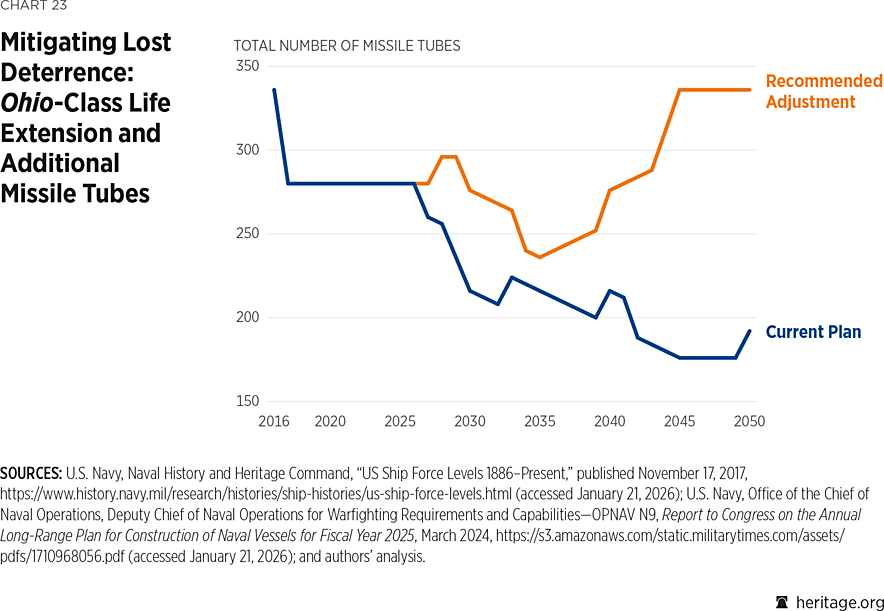
The Ohio-class submarine force, which first entered service in 1981, is in the twilight of its service life. The service life of these vessels, originally intended for 30 years, has been extended to more than 40 years.[REF] Further significant life extensions are not feasible beyond the emergency LEPs the Navy is currently considering as a stopgap measure. Beginning in the early 2030s, the Ohio-class submarines will be replaced by the next-generation Columbia-class submarines.[REF]
Non-Strategic Nuclear Weapons. Since the early days of the Cold War, the United States has forward deployed low-yield theater-range nuclear weapons to nations on the front lines. Nuclear munitions were stored in Korea, and North Atlantic Treaty Organization (NATO) pilots in Europe were trained to fly their nations’ dual-capable aircraft, which could carry and employ American nuclear weapons. This was called nuclear burden-sharing.
NATO allies continue to host American B-61 nuclear gravity bombs to deter regional aggression. NATO allies are transitioning their Dual Capable Aircraft (DCA) squadrons from fourth-generation aircraft to fifth-generation F-35 DCA aircraft. Because of their stealthy nature, F-35s will have a greater chance of penetrating enemy air defenses and servicing relevant targets. This upgrade will enhance NATO’s deterrent posture in the face of Russian attempts at nuclear coercion. Therefore, the United States will maintain the ability to forward deploy nuclear-capable bombers and U.S. and allied DCA globally.
In addition, the U.S. Departments of War and Energy will continue two programs established by the 2018 Nuclear Posture Review: the sea-launched cruise missile-nuclear (SLCM-N) and the low-yield SLBM. The SLCM-N is a major defense acquisition program that is slated for fielding in 2035.[REF] It fills a hole in the U.S. arsenal that was created with the retiring of the TLAM-N nuclear Tomahawk cruise missile as directed by the 2010 Nuclear Posture Review.[REF] The SLCM-N will be launched from a submarine or surface vessel without having to rely on host nation support. It may have a range of between 1,000 and 2,000 nautical miles, making it an important intermediate-range, penetrating theater capability with a low-yield warhead.[REF]
The SLCM-N will serve as a visible or overt assurance to allies in the Indo-Pacific and Europe. Its non-ballistic trajectory, combined with its non-visible generation characteristics, will give our adversaries pause and therefore contribute to America’s ability to deter strategic attacks on allies. The SLCM-N’s deployability to the Western Pacific or Europe during times of crisis would signal to our adversaries that, despite their theater nuclear advantage, they cannot use nuclear threats or nuclear employment to coerce or gain advantage without risking a U.S. theater nuclear response in kind.[REF]
The United States should continue to field the W76-2, the low-yield SLBM introduced following the 2018 Nuclear Posture Review and meant to give the United States a prompt, low-yield nuclear option delivered through a ballistic trajectory, even after SLCM-N is fielded to ensure that America fields a deterrent that is diverse in characteristics and composition. Because the so-called 2025 One Big Beautiful Bill Act includes increased funding for both the missile and the warhead,[REF] SLCM-N’s future should be secure.
Importance of the Modernization Program of Record. The United States began its current nuclear modernization program in 2010—when relations with China were mostly positive and before Russia set fire to the global arms control regime, invaded Ukraine, and began its now-tiresome series of nuclear threats against the West—to replace the Cold War legacy triad one-for-one with new warheads, missiles, bombers, and submarines. Every existing legacy platform or warhead would be replaced by a successor system.[REF]
Modestly amended in 2018 to include the low-yield SLBM and the SLCM-N, the 2010 modernization program is a multi-decade endeavor to produce a modernized arsenal. However, the current nuclear modernization program of record is characterized by cost overruns and schedule delays in virtually every major aspect of the nuclear enterprise.
Most nuclear warheads in the arsenal are older than the median age of the average American. While it is safe to assume that the current force of bombers, submarines, missiles, and associated warheads will continue to perform their military function until they are replaced with the new arsenal in the coming decade, our nation cannot accept further delays in the modernization of its strategic deterrent.[REF]
In many cases, this investment in America’s strategic deterrent will pay dividends for the next half-century, including in the 2070s and 2080s when it is expected that the new warheads, ballistic missile submarines, and many of the missiles will be retired. This twice-in-a-century moment of recapitalizing our nuclear enterprise and ensuring that the cornerstone of American security remains strong is of paramount importance in protecting our nation.
Role and Function of America’s Strategic Deterrent
America’s nuclear deterrent has a number of important functions and is spread across a triad of capabilities, including land-based intercontinental ballistic missiles (ICBMs), ballistic missile submarines, and bombers as well as a set of non-strategic nuclear weapons.[REF] The totality of America’s strategic triad is being modernized to ensure that America’s deterrent remains credible for the next half-century. However, while this modernization is necessary, it is also not enough to meet the challenges at hand effectively.[REF]
As noted above, nuclear weapons are the ultimate guarantor of American security. For decades, both Republican and Democratic Administrations have sought to maintain a robust strategic deterrent capable of (1) deterring strategic attack, (2) assuring our allies, (3) achieving U.S. objectives if deterrence fails, and (4) hedging against future uncertainty.[REF]
Deterring Strategic Attack. The primary goal of nuclear weapons is to deter a strategic attack on the American homeland, U.S. forces abroad, and allies around the world. Such an attack is most often thought of as a nuclear attack. The American nuclear arsenal therefore is meant to convey to our adversaries that the United States has the will and capability to deter nuclear attacks under any conditions and respond to such attacks with the full range of force in the nation’s arsenal.
However, strategic attack does not necessarily have to be nuclear. Other strategic, non-nuclear attacks could include a biological weapons attack on the American homeland, a significant chemical weapons employment against U.S. forces or citizens, a devastating cyberattack against critical U.S. capabilities, or other forms of strategic attack that take place in space or against space-based targets. While this list is not exhaustive, our adversaries should understand that the types of capabilities used in such an attack are less important than their impact and that the United States will respond to any type of attack that has a strategic effect on the American homeland, U.S. citizens, or U.S. interests with overwhelming force.
Assuring Allies. For decades, the United States has extended nuclear deterrence commitments to allies in the Indo-Pacific and Europe.[REF] Assuring our allies of America’s commitments advances our mutual interests by deterring and, if necessary, defeating adversary aggression before it reaches America’s shores. Assurance is built upon decades of trust, joint force deployments, strategic dialogues, and personnel exchanges. No one—not our own people, our allies, or our adversaries—should doubt the credibility and capability of America’s nuclear umbrella. America’s nuclear arsenal has been its most successful tool in assuring allies that they do not need to pursue their own nuclear weapons programs.
Achieving U.S. Objectives if Deterrence Fails. No one seeks to employ nuclear weapons, nor would anyone do so lightly.[REF] Every U.S. President in the atomic age has considered employing nuclear weapons only in the most extreme circumstances and only for defensive use. Credibility, however, demands that the United States must maintain a reliable nuclear arsenal that is capable of achieving a variety of effects so that if deterrence fails and America’s adversaries choose to secure their objectives by using violence and force, the United States is able to achieve its objectives.
Hedging Against Future Uncertainty. The United States has pursued and always should pursue a stable security environment that allows for freedom and prosperity for all of the world’s peoples, but it also must be prepared for a significant degradation of the security environment. Just as the world security environment degraded from 2010 to 2024, it is entirely possible that further degradations could manifest in heretofore unseen ways. Nuclear weapons must therefore remain a credible deterrent against unknown and unknowable developments in the years to come.[REF]
As Russia increasingly relies on nuclear coercion as a means of “diplomacy” and China continues on its path as the world’s fastest-growing nuclear power, nuclear weapons will become more important than ever as a hedge against uncertainty.[REF] This is particularly true during a period when Russia and China have invested so heavily in their defense industrial bases and are seemingly prepared for large-scale, protracted conflict.[REF] However, this also means that the United States must maintain the ability to produce nuclear warheads and associated delivery mechanisms—to include missiles, bombers, and submarines—at scale and rapidly in order to shore up deterrence in times of global uncertainty. This will require sustained investment both in the defense industrial base and across the nuclear enterprise itself.
The Force Today
Since the 1950s, the United States has relied on a triad of nuclear systems—ICBMs, bombers, and ballistic missile submarines—as the backbone of its strategic deterrent. Each leg of this triad performs specific functions that, while different, are mutually supportive and contribute to a nuclear posture that is meaningful to allies and adversaries alike. These functions and attributes mean that the nuclear triad is:
- Survivable—Ensures that the force and associated nuclear command and control are resilient and robust enough to survive adversary attack and function throughout the course of a conflict.
- Deployable—Is able to relocate to allied or partner territory for the purposes of political signaling or to enable military effect.
- Diverse—Has a number of range options, yield options, warhead and delivery types, and flight profiles; is able to engage multiple geographic locations despite adversary defenses; and is able to change targets quickly to enable adaptive planning and employment, thus giving the United States the ability to craft effective, credible, and tailored deterrent strategies.
- Accurate—Is able to strike targets with precision, thus minimizing the effects on non-targeted areas.
- Penetrating—Is able to overcome adversary active defenses while still holding at risk hardened and deeply buried targets.
- Responsive—Has the ability to deploy and deliver military effects as quickly as possible.
- Visible—Has the ability during crisis and conflict to signal to allies and adversaries the political message of America’s willingness to employ nuclear weapons.
Assessing America’s Nuclear Deterrent
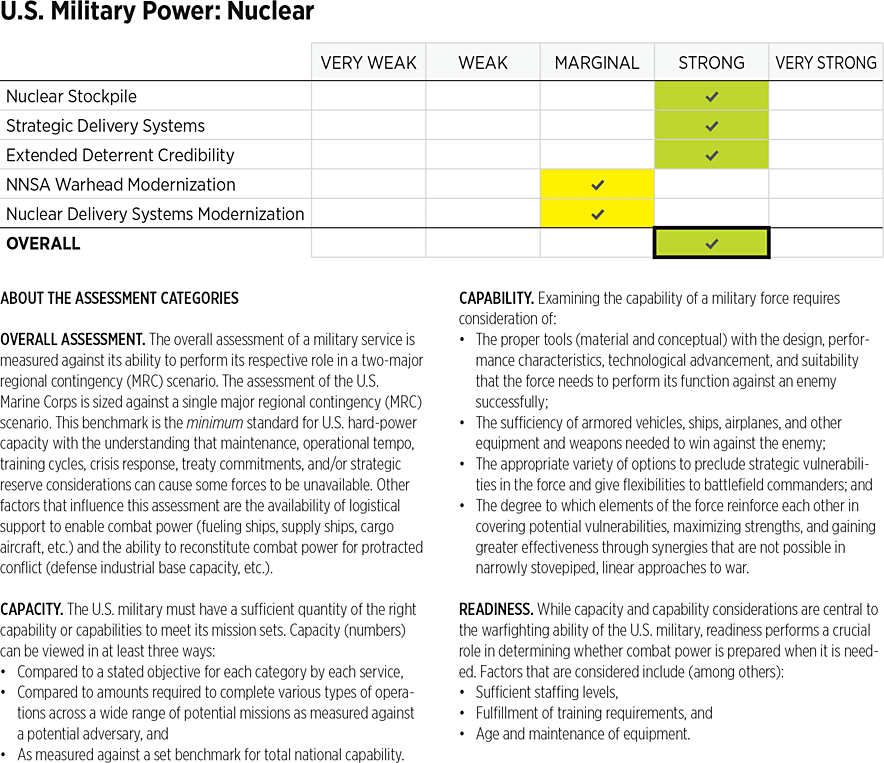
The U.S. strategic deterrent includes nuclear warheads, associated delivery systems, and the ability to assure America’s allies. Taken together, they make it possible to assess the effectiveness of America’s nuclear deterrent.
Nuclear Warhead Stockpile. The United States currently has roughly 1,550 operationally deployed strategic nuclear weapons and around 200 operationally deployed non-strategic nuclear weapons.[REF] Although the nuclear warheads are old—the newest was assembled in 1989, and some are decades older—all of the NNSA’s computer modeling suggests that they will perform the military functions for which they were designed.[REF] The B-61 gravity bombs, W76 and W88 warheads deployed on submarine-launched ballistic missiles, and W78 and W87 warheads on ICBMs should therefore be able to fulfill their military requirements if employed.[REF] The W80, the sole warhead for the nuclear-armed air-launch cruise missile, is similarly effective.
Assessment: Strong.
Strategic Delivery System. America’s ability to put nuclear weapons on target remains strong. As it embarks upon a significant recapitalization, or nuclear modernization, of the missiles, submarines, bombers, and weapons that comprise its strategic deterrent, the United States also maintains a robust set of capabilities that can hit any fixed target anywhere in the world with a strategic nuclear weapon. There is no question that, if called upon, the U.S. deterrent will be able to execute its mission.
Assessment: Strong.
America’s Extended Deterrent. If nuclear weapons deter America’s adversaries, they also assure its closest allies, who benefit from America’s extended deterrent, under which the United States would come to their defense, potentially with nuclear weapons, in the event of strategic attack. Increasingly, however, America’s allies are questioning the credibility of its willingness to defend them.
This problem is particularly acute in Asia where allies in Seoul and, to a lesser degree, Tokyo desire ever more concrete examples of America’s willingness to defend them. In Europe, the situation is different. Some in Europe’s capitals are suggesting that American demands that Europeans assume a more active role in their own conventional defense indicates a hesitancy to come to Europe’s defense—particularly with nuclear weapons—if Russia overtly threatened Europe with armed aggression. Although no American ally has yet embarked upon an indigenous post–Cold War nuclear weapons program, it is increasingly common to hear them question the role and functionality of America’s nuclear umbrella.
Assessment: Strong.
Nuclear Enterprise Modernization Program of Record. The current nuclear modernization program of record falls into two major buckets. The first is the warhead production program of record, which focuses on producing new warheads designed to meet 21st century military requirements. This is overseen by the National Nuclear Security Administration. The second is the modernization of the platforms needed to deliver warheads to the target. This includes the bombers, ICBMs, and ballistic missile submarines that constitute the triad.
Nuclear Stockpile. More than 20 years ago, the Administration of President George W. Bush established the National Nuclear Security Administration within the Department of Energy to ensure the ability of the United States to maintain and produce nuclear warheads in a timely fashion. The NNSA is responsible for America’s nuclear weapons infrastructure; is responsive to military-generated warhead requirements; and oversees the assessment, design development, production, test, and research programs that respond to War Department warhead requirements.
The NNSA must focus on the mission of designing and building nuclear warheads above all else, even at the cost of other presumably worthy efforts within the NNSA or the Department of Energy. The fact is that the NNSA is taking too long to produce warheads at scale and putting our nation at risk in the process.[REF]
Recalibrating Where and How the NNSA Accepts Risk. The United States has not produced new plutonium pits (the fissile material central to a nuclear detonation) at scale since Rocky Flats ceased production in 1989, and current efforts to restart the capability are years behind schedule.[REF] The Los Alamos National Laboratory began to produce plutonium pits at a small scale in late 2024—14 years after the modernization program began—and the Savannah River site’s ability to produce plutonium pits in any meaningful quantity is approximately a decade away.[REF] Other key projects, such as the Uranium Processing Facility and Lithium Processing Facility, are similarly over budget and behind schedule.[REF]
After not having built nuclear weapons or produced nuclear fissile material in almost three and a half decades, the United States is having to relearn how to enrich uranium for defense purposes. Despite some attempts by the government to shelve critical projects, such as the Tritium Finishing Facility in South Carolina and the High Explosive Synthesis, Formulation, and Production (HESFP) Facility in Texas, the modernization program of record must be not only sustained, but also accelerated and expanded.[REF]
Construction of the Rocky Flats, Colorado, plutonium facility began in 1952, and Rocky Flats was producing plutonium pits by 1954. By 1962, our nation was producing more than 2,000 nuclear warheads a year. As of 2025, however, the United States had built roughly a dozen new plutonium pits and no new nuclear warheads despite being in the 15th year of the 2010 nuclear modernization program.[REF] Considering that China is building more than 100 new nuclear warheads a year—every year—the NNSA has to do better.
Nuclear Enterprise Workforce. The nuclear enterprise workforce consists of the skilled people who design, develop, and produce nuclear warheads according to military requirements and sustain the nuclear stockpile to ensure its continued safety, security, and effectiveness. They also extend the life of nuclear warheads and design, develop, and produce new nuclear weapons.[REF]
The workforce also assesses and certifies that the reliability of the nuclear stockpile can be assured in the absence of nuclear testing and maintains a nuclear test capability that can be employed if testing becomes necessary. It provides an effective response to technical problems with a warhead or to adverse global security developments that call for force augmentation by uploading reserve nuclear warheads onto existing systems.
America’s nuclear enterprise workforce is without peer. They must understand the importance of and the stakes involved in their work. They must be empowered to build the arsenal of the 21st century without being hamstrung by bureaucratic and regulatory paralysis—which is the situation in which far too many of today’s workers operate: a “no risk” environment characterized by more concern for workplace safety and environmental regulations than is shown for executing the mission at hand: producing warheads.[REF]
NNSA’s Role in Building a 21st Century Arsenal. Today, North Korea can illicitly produce nuclear warheads, China is building 100 new nuclear weapons a year, and the United States does not have the sustained plutonium pit manufacturing capability that it needs to avoid stockpile age-out, support life-extension programs, and prepare for future uncertainty.[REF] Plutonium pits are critical components of every nuclear warhead, and nearly all current stockpile pits were produced between 1978 and 1989.[REF] The NNSA’s limited ability to produce plutonium pits is creating a strategic risk for the United States.[REF]
Assessment: Marginal.
Nuclear Delivery Systems Modernization. Much has been written about delays in the Sentinel missile and Columbia programs. Both projects are behind schedule and over budget.
The Sentinel program’s challenges resulted in a Nunn–McCurdy review, in which the Pentagon in 2024 had to certify that Sentinel was a defense critical program. Such reviews are triggered when U.S. Department of War programs reach a certain threshold of cost overrun and are required by law.[REF] The Air Force now says that certain Minuteman III missiles may be in operation well into the 2040s or even until 2050 given programmatic delays.[REF] Many have said that, because of these overruns and delays, the United States should terminate the Sentinel and move to a strategic “dyad” of bombers and submarines, but the primary driver of the cost and budget overruns is not that the rocket itself is troubled, but rather that the missile infrastructure—silos, tunnels, and command-and-control centers built in the 1960s for the Minuteman program—is old and needs to be replaced. This replacement of the missile infrastructure is the primary driver of programmatic cost overruns.
The Columbia program is increasingly challenged with schedule overruns that impose even greater requirements on Ohio-class submarines to continue to patrol beyond their programmed lifespans. The first Columbia subs should be conducting operations by the early 2030s, but it is possible that the program could instead fall further behind schedule.
The B-21 bomber—designed to supersede the B-2 stealth bomber—is more on track and will be flying within the next few years, but it was originally scheduled to be flying by 2018.[REF]
In short, all of the nuclear delivery systems modernization programs are underway—but all are at least behind schedule, and some are significantly over budget.
Assessment: Marginal.
Overall Assessment: Strong.
Policy Recommendations
China’s nuclear breakout, Russia’s advantage in non-strategic nuclear weapons, North Korea’s slow but steady nuclear expansion, and the death of arms control make it imperative that the United States builds the arsenal it needs to deter America’s adversaries. This will require action to achieve at least six broad goals by 2035. These goals include:
- Enhancing America’s Global Posture. The United States, in coordination with its allies, must strengthen deterrence and shrink the deterrence gap, but building more capabilities by itself is not a sufficient response to the problems that face us. Global posture must change as part of a broad strategic reset. To this end, the United States, working with allies in Asia and Europe, should reexamine the forward stationing of non-strategic nuclear weapons in both theaters to help stabilize their deteriorating security environments. The United States should also consider returning to intermittent strip alerts for our strategic bomber forces so that a number of nuclear-armed bombers are loaded with munitions and ready to take off for nuclear operations missions within minutes, establish a new U.S.-based and globally deployable DCA squadron, and develop procedures for the regular movement of road-mobile ICBMs.
- Updating NATO’s Nuclear Posture. During the Cold War, the United States had nuclear weapons stationed on the front lines. In addition to ground-launched systems stationed in Germany, they included forward deployed fighter-bombers certified to carry nuclear gravity bombs. The United States also trained allied pilots and certified allied aircraft to carry and employ U.S. nuclear weapons in the event that NATO found itself in a nuclear conflict with the Warsaw Pact. The mission of such aircraft and munitions was to deter and, failing that, rapidly defeat Warsaw Pact aggression against NATO members.
- Today, NATO maintains a residual nuclear capability of U.S. and allied fighter-bombers that are prepared to employ nuclear weapons, but what was forward deployed and near the NATO borders in 1989 is now in the center of NATO, and the nuclear gravity bombs and nuclear-capable aircraft remain in the same bases where they were stationed when the Berlin Wall fell. Germany and Italy, which were on the front lines of the Cold War, are 1,000 nautical miles or more from the Russian threat to NATO. Fighter-bombers that would carry nuclear weapons would almost certainly have to conduct an aerial refueling as part of the employment of a nuclear weapon against non-NATO targets. Additionally, there is a growing risk of nuclear “haves” and “have-nots” within NATO with only those allies that were part of NATO during the Cold War participating in the nuclear DCA mission and newer member countries, which are now the front lines of the Alliance and arguably most at risk of Russian aggression, relegated to non-DCA status.
- In view of Russia’s attempts at nuclear coercion and even nuclear blackmail against Ukraine and NATO member states, it is time to reexamine the utility of a Cold War nuclear force posture and particularly Cold War–era basing.[REF] The United States, in concert with its allies, should examine the forward deployment of nuclear-capable fighters and the storage of nuclear gravity bombs. This examination should include the training of new DCA pilots in new NATO DCA-participating nations, to include nations like Poland and Finland that are currently defending NATO’s borders from potential Russian aggression.[REF] The United States and its NATO allies should also examine the utility and implications of diversifying the Alliance’s nuclear arsenal within Europe to include, in addition to nuclear gravity bombs, long-range air-launched nuclear cruise missiles stationed in Europe. Updating NATO’s deterrence posture may be expensive, but it is also necessary as part of a 21st century deterrence posture that is both credible and effective at deterring Russian aggression.
- Forward Stationing Non-Strategic Nuclear Weapons in Asia. At the end of the Cold War, the United States unilaterally removed its non-strategic nuclear weapons from Asia as part of the Presidential Nuclear Initiatives.[REF] In the 2010s, the United States officially retired the TLAM-N, the final nuclear system that was seen by many allies as the “Asian” deterrence capability.[REF] While the development of the SLCM-N is a good step toward providing a theater-range nuclear deterrent in the Western Pacific, allies in Korea and, increasingly, Japan are questioning the viability of America’s extended deterrent commitments. Such questions could cause those nations to seek indigenous nuclear weapons capabilities. Further, the continued expansion of both China’s and North Korea’s nuclear weapons could further destabilize an already tense region.
- The United States should therefore discuss with Korea the reopening of nuclear weapons storage sites on the Korean Peninsula and the possible forward deployment of non-strategic nuclear weapons to Korea.[REF] Such a move is not to be taken lightly, but given that the United States and its allies have attempted for two decades to engage in denuclearization discussions with North Korea only to be rewarded with continued threats of nuclear holocaust against the United States, South Korea, and Japan, it is time for a different approach.
- Updating America’s Nuclear Posture at Home. In addition to updating its nuclear posture in Europe and Asia to reflect the changed global security environment, the United States should update its nuclear posture at home. The Air Force should regularly conduct strip alert exercises so that nuclear-capable bombers are ready to execute deterrence operations at a moment’s notice. The Air Force should also certify an additional squadron of U.S.-based F-35s as nuclear-capable. This additional squadron should be globally deployable and ready to conduct deterrence operations from allied nations or overseas American territory on order. Finally, the Air Force should develop the tactics, techniques, and procedures needed to enable exercises for road-mobile Sentinel operations. Although these actions represent an increase in nuclear deterrence activities from levels over the past 30 years, they still constitute a deterrence posture that is more relaxed than the posture the United States maintained throughout most of the Cold War.
- Building a Larger, More Diverse Strategic Arsenal. To prepare for the emerging security environment, the United States must field a credible strategic deterrent that is moderately larger and somewhat more diverse than the current arsenal. To that end, the United States should seek to field the following force by 2035.
- Strategic Bombers. The United States should continue to field a mix of B-52 and B-21 nuclear-capable bombers into the 2030s. At least 100 of the B-21s should be nuclear-capable. Within the strategic arsenal, the United States should field 200 B-61 gravity bombs of various configurations. It should also field a stockpile of 1,000 LRSO nuclear cruise missiles.
- ICBMs. The United States should field an arsenal of 450 Sentinel ICBMs, 400 of which should be silo-based. Each missile should carry a mix of one to three warheads of various yields. The United States should also field a road-mobile variant of the Sentinel missile to ensure that it has an additional second-strike capability throughout the program life of the Columbia-class SSBN fleet. The Columbia-class boats have an expected lifespan of roughly 40 years, which means that they should be operating into the early 2080s.
- It is assumed that the Columbia-class submarines, built using 2020s technology, should remain undetectable throughout most of the 21st century; that U.S. adversaries should not develop new technologies with which they can detect the submarines; and that the U.S. should therefore retain an assured second-strike capability that can disincentivize U.S. adversaries from attempting a first strike. However, these assumptions raise critical issues. It is not certain that the Columbia-class submarines will be undetectable a half-century from now. Nor is it certain that the technologies and capabilities developed in the 2020s will not be overcome by heretofore undeveloped detection technologies.
- Because it is not certain that 2020s technology will be undetectable through the 2080s, it is in America’s interest to consider an additional survivable, second-strike capability as a hedge against the day when SSBNs may no longer be undetectable. The United States should therefore field a small road-mobile Sentinel force as a hedge against an advancement in anti-submarine warfare by our adversaries. The Air Force should design and field vertical erector launchers that can be attached to heavy trucks that are capable of holding and launching either the Sentinel ICBM or modified Sentinel ICBMs as may be required. Combined with security details on accompanying vehicles, the Sentinel becomes a road-mobile ICBM—something that it is, while not impossible, exceedingly difficult to target.
- Road-mobile Sentinels should be permanently stationed in garrisons on existing missile bases but able to exit those garrisons and move on randomized circuits during exercises or times of crisis as a signaling tool. Air Force missileers may operate and drive them on designated public and U.S. Department of War roads and highways. Road-mobile Sentinels may be armed with up to three nuclear warheads of variable yield, giving them the equivalent of a submarine-launched ballistic missile’s striking power. Road-mobile Sentinels may operate inside American territory along preapproved (but not preplanned) routes in relatively unpopulated areas, thereby—given the flight times that even extremely fast missiles need to traverse from Russia or China to the United States—creating significant targeting challenges for our adversaries. Should a launch against the American homeland be detected, the ICBMs would be able to move to any number of launch sites to await further orders (to include launch or alert orders). In this way, road-mobile Sentinels may provide the United States with a backup second-strike capability for most of the rest of the 21st century.[REF]
- Columbia-Class SSBNs. First fielded in the 1960s, nuclear ballistic missile submarines patrol the waters of the North Atlantic and Pacific Oceans undetected with only the ships’ captains knowing exactly where they lie. The value of these submarines lies in their secrecy and ability to deliver scores of nuclear warheads in a relatively brief period of time. Amazingly silent to the point of being undetectable, they represent the assured second-strike leg of the American nuclear triad.
- The Columbia-class SSBNs will perform a function similar to that of the Ohio-class submarines, albeit in smaller quantity. The current program of record calls for the United States to replace the 14 Ohio-class SSBNs with 12 Columbia-class boats at the rate of one boat per year beginning in 2031. Although the Navy will field a smaller fleet, the current program of record calls for the Columbia-class SSBNs to carry fewer missiles than the current Ohio-class SSBNs carry. When originally deployed, the Ohio class operated 24 ballistic missile tubes. After the 2010 New START nuclear arms control treaty entered into force, the U.S. Navy shuttered four ballistic missile tubes to comply with the treaty.[REF] The Columbia class is currently programmed to have a smaller missile capacity, fielding only 16 missile tubes per boat. With the current Trident II (D5) missile, this fleet of 12 Columbia SSBNs could deploy a maximum of 1,920 warheads versus the nearly 5,000 possible warheads loaded onto the original Ohio-class ballistic missile fleet.
- The new Columbia SSBNs are designed to be the quietest ever built and therefore undetectable by current technologies. Averaging between $8.4 billion and $9.2 billion per boat for the 12 to be built, they are admittedly expensive, but they will be patrolling the world’s oceans and providing a continuous deterrence presence into the 2080s.[REF]
- Given the increasing number and diversity of adversary nuclear weapons, which create additional targets that the United States must consider holding at risk both to deter strategic attack on the United States or its allies and to hedge against future uncertainty and further degradation of the security environment, it is incumbent upon the United States to field a larger SSBN force for the next half-century to ensure that it can field a credible deterrent. The fundamental question facing the U.S. Navy is therefore how the current ballistic missile submarine program of record, conceptualized in 2010, can be amended to ensure that we have a fleet of SSBNs that is sufficient to maintain this deterrent into the 2080s.
- The U.S. Navy has a duty to ensure the viability and credibility of the nation’s assured second-strike capability in a way that is flexible and responsive to the evolving threat environment. For this reason, it is time to revisit America’s at-sea deterrent writ large. Specifically, the United States will need to take immediate action on the existing Ohio-class SSBN fleet and longer-term actions on the Columbia-class fleet. Beginning in February 2026, the Navy should reopen the missile tubes that were shuttered on Ohio-class SSBNs as a result of the New START treaty limitations, thus bringing the total number of tubes to 24 on each Ohio-class submarine. Each Ohio should carry the full complement of D5 Trident SLBMs akin to their pre–New START loadout.
- The Navy should expand the Columbia program of record to include four additional SSBNs and should make the necessary budgetary and industrial plans for such an expansion. This programmatic expansion is necessary not only to hedge against an uncertain 21st century future and maintain a credible deterrence posture against a single nuclear peer—the driving construct that led the U.S. Navy to program for 12 Columbia SSBNs in 2010—but also to deter two nuclear peers in the 2030s. Assuming that the build rate of one Columbia a year by 2031 is sustained, the United States should build a total of 16 SSBNs by 2045.[REF]
- Building a Significantly Larger, Far More Diverse Non-Strategic Arsenal. The current nuclear force posture was designed for a benign security environment in which adversaries did not engage in nuclear coercion against their neighbors and were not rapidly expanding their strategic and non-strategic nuclear arsenals. Today, additional U.S. theater, non-strategic nuclear capabilities are necessary in both Europe and the Indo-Pacific to deter adversary theater nuclear advantage and offset potential adversary conventional advantage.[REF] Such additional theater, non-strategic nuclear capabilities must be deployable, survivable, and variable in their available yield options.
- While it is not necessary to match the number or diversity of non-strategic systems fielded by adversaries of the United States in order to present a credible deterrent, it is necessary to field a credible arsenal of variable yields that is capable of holding a variety of theater-range targets at risk from multiple launch points within the theater. The importance of this capability should not be overlooked or discounted. If the United States needed to respond to adversary theater-range nuclear strikes with relatively high-yield U.S. nuclear strikes generated from the American homeland, the chances of retaliatory nuclear strikes against those bases might well increase. By fielding a capable theater nuclear arsenal that can generate effects from within theater, the United States can reduce the chances that the homeland will be struck with nuclear weapons and limit the chances of horizontal escalation. This is not to say that the United States seeks a theater nuclear war—but it does seek to field a credible force that will deter our adversaries. Theater-range nuclear weapons—particularly those that are of variable yield—strengthen deterrence and therefore promote stability by limiting the chances for escalation and increasing the options for tailored deterrence strategies.[REF]
- Gravity Bombs. Given Russia’s staggering advantage in theater-range nuclear weapons, the United States should increase the number of B-61 gravity bombs in Europe by 75. In addition, given China’s dual-capable theater-range systems, particularly the nuclear-capable DF-21 anti-ship missile and nuclear-capable intermediate-range DF-26 land attack missile, the United States should dedicate 75 nuclear weapons to the Indo-Pacific theater.
- Anti-Ship Nuclear Weapons. As noted above, the United States must be able to hold adversary targets at risk in order to deter adversaries from pursuing escalation pathways during a conflict. Increasing the types of targets that the military can hold at risk with either conventional or nuclear weapons gives the United States more flexible—and therefore more tailorable—deterrence options.
- There is reason to believe that America’s adversaries are developing theater-range, nuclear-capable anti-ship missiles. Therefore, the United States obviously has good reasons for doing so as well. The ability to target enemy capital ships with nuclear weapons offers a leader the ability to employ low-yield theater-range weapons against legitimate military targets with virtually no chance of civilian casualties and with minimal nuclear fallout because of the maritime nature of the target set. Adding naval vessels to potential target lists further expands the attack surface from which that actor can select. The U.S. Department of War should therefore field an integrated sensor and targeting package that will enable a long-range anti-ship missile to find, fix, and finish moving adversary naval assets with a nuclear warhead.
- An anti-ship nuclear capability should give the President more graduated nuclear response options in the face of an adversary’s use of nuclear weapons, thereby better deterring the adversary’s limited nuclear strikes.[REF] Accordingly, the United States should build 100 theater-range, nuclear-capable anti-ship missiles with 50 allocated to the Indo-Pacific and 50 held in reserve for contingencies in other areas of operation.
- Nuclear-Capable Hypersonic Weapons. America’s adversaries are developing nuclear-capable hypersonic systems. These platforms allow them to hold key U.S. and allied targets at risk with fast-traveling and maneuverable delivery systems that are difficult to intercept with missile defenses. They are prompt, penetrating, and potentially responsive and can be delivered from a variety of platforms. Taken together, the combination of hypersonic-speed, long-range maneuverable missiles and nuclear warheads presents an asymmetric capability that could erode strategic stability and incentivize our adversaries to be the first to employ nuclear weapons in a conflict.
- By fielding a similar capability, the United States should provide the President with more options by which he can hold enemy targets—particularly those protected by missile defenses deep inside their homelands—at risk. While the development and fielding of such capabilities might not necessarily strengthen or compensate for the erosion of strategic stability triggered by adversary development of hypersonic nuclear weapons, it would address some of the asymmetry that results from such adversary capabilities. Accordingly, the United States should field nuclear-capable variants of the Army’s Long-Range Hypersonic Weapon and the Navy’s Mako Multi-Mission Hypersonic Missile for a total of 150 nuclear-capable hypersonic missiles.
- Ground-Based, Intermediate-Range Nuclear Weapons. The dissolution of the Intermediate-Range Nuclear Forces (INF) Treaty because of Russian treaty violations is unfortunate, but it is also a reality.[REF] Moreover, China’s breathtaking expansion of its theater-range conventional and nuclear-capable missile force creates an opportunity for it to hold at risk maritime and ground targets from Japan to Northern Australia.[REF]
- The ability to strike adversary targets with ground-based, road-mobile, intermediate-range nuclear-capable missiles complicates the adversary targeting calculus. Such a deployment would also help to deter conventional and nuclear aggression against allies by presenting adversaries with the demonstrable threat of America’s non-strategic arsenal, which is forward deployed for use in the defense of America’s interests and allies. Such a step would also assure U.S. allies of the credibility of the American security commitment and therefore reduce proliferation risks among key allies who enjoy but may be questioning America’s extended deterrence commitments. The United States should therefore develop and field an arsenal of intermediate-range, nuclear-capable missiles that can be deployed to American and allied bases in the Indo-Pacific, European, and Middle Eastern areas of operation.[REF]
Conclusion
Given the increasingly dangerous threat environment, the United States must work with purpose, urgency, and determination to ensure that it fields a strategic deterrent that can deter strategic attack on the American homeland and limited theater nuclear attack overseas. It must think about strategies that can deter and, if necessary, defeat multiple nuclear-armed adversaries simultaneously or sequentially. It must also field a force that is qualitatively second to none even if adversaries field a combined force that is quantitatively superior to that of the U.S.
The stakes involved in America’s nuclear deterrent are nothing less than America’s global interests and—more important—the welfare of the American people and continuation of the American constitutional republic. A credible nuclear deterrent is not cheap, but it is far cheaper than fighting a nuclear war, even if the United States were to “win” such a war. The goal is not to fight such a war, but to deter the war from unfolding in the first place.[REF]
If the autocrats in Beijing and Moscow are not deterred, they will become increasingly emboldened. They will become increasingly threatening and, in the absence of a credible American deterrent, more likely to use nuclear coercion to achieve their goals, not only against their neighbors, but also against America’s allies—and, potentially, the United States itself.
The United States should not let such a world come about. Instead, it should build and field the arsenal that is needed to keep the American people safe for the next half-century. It cannot afford to do anything else.
Endnotes
[1] Admiral Charles Richard, Commander, U.S. Strategic Command, quoted in Aaron Mehta, “STRATCOM Chief Warns of Chinese “Strategic Breakout,’” Breaking Defense, August 12, 2021, https://breakingdefense.com/2021/08/stratcom-chief-warns-of-chinese-strategic-breakout/ (accessed October 24, 2025).
[2] Bill Medema, “August 16 Marks 50th Anniversary of First Minuteman III Launch,” Air Force Nuclear Weapons Center, August 15, 2018, https://www.afnwc.af.mil/News/Article-Display/Article/3587137/aug-16-marks-50th-anniversary-of-first-minuteman-iii-launch/ (accessed October 22, 2025).
[3] Brent M. Eastwood, “The Air Force’s Sentinel ICBM Is Starting to Have Problems,” 1945, December 26, 2024, https://www.19fortyfive.com/2024/12/the-air-forces-sentinel-icbm-is-starting-to-have-problems/ (accessed October 22, 2025).
[4] See, for example, Jennifer DiMascio and Anya L. Link, “U.S. Strategic Bombers,” Congressional Research Service In Focus No. IF12945, March 17, 2025, https://www.congress.gov/crs_external_products/IF/PDF/IF12945/IF12945.2.pdf (accessed October 23, 2025), and Rebecca Grant, “The Perils of Chrome Dome,” Air Force Magazine, August 2011, pp. 54–57, https://www.airandspaceforces.com/PDF/MagazineArchive/Documents/2011/August%202011/0811dome.pdf (accessed October 23, 2025).
[5] Adam Mount, “Adapting Nuclear Modernization to the New Administration,” Bulletin of the Atomic Scientists, May 4, 2017, https://thebulletin.org/2017/05/adapting-nuclear-modernization-to-the-new-administration/#post-heading (accessed October 22, 2025).
[6] Justin Katz, “Navy Planning to Execute 3-Year Ohio-Class Sub Life Extensions,” Breaking Defense, November 7, 2023, https://breakingdefense.com/2023/11/navy-planning-to-execute-3-year-ohio-class-sub-life-extensions/ (accessed October 22, 2025).
[7] Table A1-5, “Resultant Battle Force Inventories and Trade Space,” in U.S. Navy, Office of the Chief of Naval Operations, Deputy Chief of Naval Operations for Warfighting Requirements and Capabilities–OPNAV N9, Report to Congress on the Annual Long-Range Plan for Construction of Naval Vessels for Fiscal Year 2024, March 2023, p. 18, https://www.govexec.com/media/navy_2024_shipbuilding_plan.pdf (accessed October 22, 2025).
[8] Bryant Harris, “GOP Moves to Instate Sea-launched Cruise Missile Nuclear Program,” Defense News, June 21, 2023, https://www.defensenews.com/congress/budget/2023/06/22/gop-moves-to-instate-sea-launched-cruise-missile-nuclear-program/ (accessed October 22, 2025).
[9] U.S. Department of Defense, Nuclear Posture Review Report, April 2010, pp. xiii, 28, and 46, https://csps.aerospace.org/sites/default/files/2021-08/Nuke%20Posture%20Review%20Apr10.pdf (accessed October 24, 2025).
[10] Anya L. Fink, “Nuclear-Armed Sea-Launched Cruise Missile (SLCM-N),” Congressional Research Service In Focus No. IF12084, updated September 19, 2025, https://www.congress.gov/crs_external_products/IF/PDF/IF12084/IF12084.13.pdf (accessed October 23, 2025).
[11] Connor O’Brien, “Political Brawl Looms over Nuclear Cruise Missile Biden Plans to Scrap,” Politico, April 13, 2022, https://www.politico.com/news/2022/04/13/biden-nuclear-cruise-missile-scrap-00024865 (accessed October 23, 2025).
[12] H.R. 1, One Big Beautiful Bill Act, Public Law 119-21, 119th Congress, July 4, 2025, Sec. 20008, https://www.congress.gov/119/plaws/publ21/PLAW-119publ21.pdf (accessed October 24, 2025).
[13] For a contrarian view of the current modernization program, see The Editors, “The U.S.’s Plans to Modernize Nuclear Weapons Are Dangerous and Unnecessary,” Scientific American, December 1, 2023, https://www.scientificamerican.com/article/the-u-s-s-plans-to-modernize-nuclear-weapons-are-dangerous-and-unnecessary/ (accessed October 23, 2025).
[14] U.S. Government Accountability Office, Weapons Systems Annual Assessment: Programs Are Not Consistently Implementing Practices That Can Help Accelerate Acquisitions, GAO-23-106059, June 2023, https://www.gao.gov/assets/gao-23-106059.pdf (accessed October 23, 2025).
[15] Amy F. Woolf, “Nonstrategic Nuclear Weapons,” Congressional Research Service Report for Members and Committees of Congress No. RL32572, updated March 7, 2022, https://sgp.fas.org/crs/nuke/RL32572.pdf (accessed October 23, 2025).
[16] Amy F. Woolf, “U.S. Strategic Nuclear Forces: Background, Developments, and Issues,” Congressional Research Service Report for Members and Committees of Congress No. RL33640, updated December 14, 2021, https://s3.documentcloud.org/documents/21154709/us-strategic-nuclear-forces-background-developments-and-issues-dec-14-2021.pdf (accessed October 23, 2025).
[17] See “2022 Nuclear Posture Review” in U.S. Department of Defense, 2022 National Defense Strategy of the United States of America Including the 2022 Nuclear Posture Review and the 2022 Missile Defense Review, https://media.defense.gov/2022/Oct/27/2003103845/-1/-1/1/2022-NATIONAL-DEFENSE-STRATEGY-NPR-MDR.PDF (accessed October 23, 2025), and U.S. Department of Defense, “Report on the Nuclear Employment Strategy of the United States,” RefID: B-56D699F, generated November 7, 2024, https://media.defense.gov/2024/Nov/15/2003584623/-1/-1/1/REPORT-ON-THE-NUCLEAR-EMPLOYMENT-STRATEGY-OF-THE-UNITED-STATES.pdf (accessed October 23, 2025).
[18] Jennifer Bradley, “Preventing the Nuclear Jungle: Extended Deterrence, Assurance, and Nonproliferation,” Joint Force Quarterly, Vol. 112 (1st Quarter 2024), pp. 70–75, https://ndupress.ndu.edu/Portals/68/Documents/jfq/jfq-112/jfq-112_70-75_Bradley.pdf (accessed October 23, 2025).
[19] See Matthew Costlow, “Restraints at the Nuclear Brink: Factors in Keeping War Limited,” NucleCast by ANWA [Advanced Nuclear Weapons Alliance] Deterrence Center, September 14, 2023, https://rss.com/podcasts/nuclecast-podcast/1119446/ (accessed October 23, 2025).
[20] Aaron R. Miles, “Implementing the Hedge Strategy in the 2018 Nuclear Posture Review,” Lawrence Livermore National Laboratory, Center for Global Security Research, LLNL-TR-759500, January 17, 2019, https://cgsr.llnl.gov/sites/cgsr/files/2024-08/NPR_hedge_planning_final.pdf (accessed October 23, 2025).
[21] Nikolai Sokov, “Russian Nuclear Strategy: Background, Current Status, Future,” Middlebury Institute of International Studies at Monterey, James Martin Center for Nonproliferation Studies, June 2016, https://www.nonproliferation.org/wp-content/uploads/2016/06/Nikolai-Sokov-Russian-Nuclear-Strategy.pdf (accessed October 23, 2025).
[22] Robert Peters, “Russia and China Are Running in a Nuclear Arms Race,” Heritage Foundation Commentary, September 28, 2023, https://www.heritage.org/defense/commentary/russia-and-china-are-running-nuclear-arms-race.
[23] Hans M. Kristensen, Matt Korda, Eliana Johns, and Mackenzie Knight, “United States Nuclear Weapons, 2025,” Bulletin of the Atomic Scientists, Vol. 81, No. 1 (January 2025), pp. 53–79, https://www.tandfonline.com/doi/epdf/10.1080/00963402.2024.2441624?needAccess=true (accessed October 23, 2025).
[24] U.S. Government Accountability Office, Nuclear Weapons: NNSA Should Further Develop Cost, Schedule, and Risk Information for the W87-1 Warhead Program, GAO-20-703, September 2020, https://www.gao.gov/assets/gao-20-703.pdf (accessed October 23, 2025).
[25] Michael Baker, “With Redesigned ‘Brains,’ W88 Nuclear Warhead Reaches Milestone,” Sandia Lab News, Vol. 70, No. 15 (August 13, 2021), pp. 1 and 4, https://www.sandia.gov/app/uploads/sites/81/2021/08/labnews_08-13-21.pdf (accessed October 23, 2025).
[26] See U.S. Government Accountability Office, National Nuclear Security Administration: Assessments of Major Projects, GAO–23–104402, August 2023, https://www.gao.gov/assets/gao-23-104402.pdf (accessed October 23, 2025).
[27] Fact Sheet, “Rocky Flats Site, Colorado,” U.S. Department of Energy, Legacy Management, June 2020, https://www.energy.gov/lm/articles/rocky-flats-site-colorado-fact-sheet (accessed October 23, 2025).
[28] U.S. Department of Energy, National Nuclear Security Administration, “NNSA Completes and Diamond-Stamps First Plutonium Pit for W87-1 Warhead,” October 2, 2024, http://www.energy.gov/nnsa/articles/nnsa-completes-and-diamond-stamps-first-plutonium-pit-w87-1-warhead (accessed October 23, 2025).
[29] Robert Peters and Maiya Clark, “America’s Ossified Nuclear Infrastructure Needs an Overhaul—Now,” Heritage Foundation Issue Brief No. 5338, January 23, 2024, https://www.heritage.org/defense/report/americas-ossified-nuclear-infrastructure-needs-overhaul-now.
[30] U.S. Government Accountability Office, “National Nuclear Security Administration: Assessments of Major Projects.”
[31] See U.S. Department of Energy, National Nuclear Security Administration, Savannah River Site, “SRS History Highlights,” November 21, 2024, http://www.srs.gov/general/about/history1.htm#:~:text=The%20Savannah%20River%20Site%20was,Fifty%2C%20our%2050th%20anniversary%20book (accessed October 23, 2025).
[32] U.S. Department of Energy, National Nuclear Security Administration, “NNSA Administrator Jill Hruby Remarks at Strategic Weapons in the 21st Century Symposium,” April 18, 2024, http://www.energy.gov/nnsa/articles/nnsa-administrator-jill-hruby-remarks-strategic-weapons-21st-century-symposium (accessed October 24, 2025).
[33] Alicia Inez Guzman, “Workers Are Getting Paid to Do Nothing at Los Alamos National Laboratory,” The Nation, November 9, 2023, https://www.thenation.com/article/society/los-alamos-laboratory-waste-fraud/tnamp/ (accessed October 24, 2025).
[34] Lara Seligman, “‘Major Expansion’: China Now Has More than 500 Nukes, Pentagon Says,” Politico, October 19, 2023, http://www.politico.com/news/2023/10/19/major-expansion-china-now-has-more-than-500-nukes-pentagon-says-00122440 (accessed October 24, 2025).
[35] U.S. Department of Energy, National Nuclear Security Administration, “Transparency in the U.S. Nuclear Weapons Stockpile,” 2024, http://www.energy.gov/nnsa/transparency-us-nuclear-weapons-stockpile (accessed October 24, 2025).
[36] Kelly Beierschmitt, Deputy Laboratory Director, Operations, Los Alamos National Laboratory, “Growth and Mission Support: Presentation to the Los Alamos County Council and Town Hall,” July 18, 2023, https://www.lasg.org/MPF2/documents/LANL-Growth-Mission-Support-Beierschmitt_18Jul2023.pdf (accessed October 24, 2025).
[37] John A. Tirpak, “New ICBM Has ‘Critical’ Cost and Schedule Overruns, Needs SecDef Certification to Continue,” Air & Space Forces Magazine, January 18, 2024, https://www.airandspaceforces.com/new-icbm-critical-cost-schedule-overruns/ (accessed October 24, 2025).
[38] Sarah Salem, “Last Minuteman III Decommissioned 2050 or Later, W87 Non-Sentinel Test Within Year,” ExchangeMonitor, January 27, 2025, https://www.exchangemonitor.com/last-minuteman-iii-decommissioned-2050-or-later-w87-non-sentinel-test-within-year/?printmode=1 (accessed October 24, 2025).
[39] See Shawn Barnes and Robert Peters, “Time to Double the Production Rate of the B-21,” Heritage Foundation Issue Brief No. 5384, June 23, 2025, https://www.heritage.org/sites/default/files/2025-06/IB5384.pdf.
[40] Factsheet, “NATO’s Nuclear Sharing Arrangements,” North Atlantic Treaty Organization, February 2022, https://www.nato.int/nato_static_fl2014/assets/pdf/2022/2/pdf/220204-factsheet-nuclear-sharing-arrange.pdf (accessed October 24, 2025).
[41] Robert Peters, “A Road Map for Rebuilding America’s Nuclear Arsenal,” Heritage Foundation Issue Brief No. 5373, March 4, 2025, https://www.heritage.org/sites/default/files/2025-03/IB5373.pdf.
[42] Susan J. Koch, “The Presidential Nuclear Initiatives of 1991–1992,” National Defense University, Center for the Study of Weapons of Mass Destruction Case Study No. 5, September 2012, https://nsarchive.gwu.edu/document/22067-document-22 (accessed October 24, 2025).
[43] See U.S. Department of Defense, Nuclear Posture Review Report, April 2010, pp. xiii, 28, and 46, https://csps.aerospace.org/sites/default/files/2021-08/Nuke%20Posture%20Review%20Apr10.pdf (accessed October 24, 2025).
[44] Robert Peters, “The Case for Redeploying Non-Strategic Nuclear Weapons to South Korea,” Heritage Foundation Backgrounder No. 3923, August 18, 2025, https://www.heritage.org/defense/report/the-case-redeploying-non-strategic-nuclear-weapons-south-korea.
[45] Robert Peters, “It Is Time to Make the Next Generation of America’s ICBMs Road-Mobile,” Heritage Foundation Issue Brief No. 5337, January 11, 2024, https://www.heritage.org/defense/report/it-time-make-the-next-generation-americas-icbms-road-mobile.
[46] Ronald O’Rourke, “Navy Columbia (SSBN-826) Class Ballistic Missile Submarine Program: Background and Issues for Congress,” Congressional Research Service Report for Members and Committees of Congress No. R41129, updated September 25, 2025, p. 35, https://www.congress.gov/crs-product/R41129 (accessed October 24, 2025).
[47] Table A1-3, “Battle Force Delivery Plans,” in U.S. Navy, Office of the Chief of Naval Operations, Deputy Chief of Naval Operations for Warfighting Requirements and Capabilities–OPNAV N9, Report to Congress on the Annual Long-Range Plan for Construction of Naval Vessels for Fiscal Year 2024, p. 17.
[48] Robert Peters and Brent D. Sadler, “Columbia Submarine Fleet Production Should Be Radically Expanded,” Heritage Foundation Backgrounder No. 3834, June 3, 2024, p. 9, https://www.heritage.org/defense/report/columbia-submarine-fleet-production-should-be-radically-expanded.
[49] Patty Jane Geller, “The U.S. Must Strengthen Its Nuclear Forces to Deter Growing Nuclear Threats,” Heritage Foundation Backgrounder No. 3736, November 30, 2022, https://www.heritage.org/defense/report/the-us-must-strengthen-its-nuclear-forces-deter-growing-nuclear-threats.
[50] Keith B. Payne and Mark B. Schneider, “U.S. Nuclear Deterrence: What Went Wrong and What Can Be Done?” National Institute for Public Policy Information Series, Issue No. 601, October 7, 2024, https://nipp.org/wp-content/uploads/2024/10/IS-601.pdf (accessed October 24, 2025).
[51] See Brad Roberts, The Case for U.S. Nuclear Weapons in the 21st Century (Stanford, CA: Stanford University Press, 2015); Brad Roberts, “On Theories of Victory, Red and Blue,” Lawrence Livermore National Laboratory, Center for Global Security Research, Livermore Papers on Global Security No. 7, June 2020, https://cgsr.llnl.gov/sites/cgsr/files/2024-08/CGSR-LivermorePaper7.pdf (accessed October 24, 2025); and Brad Roberts, “Limited Nuclear War, Extended Deterrence, and Counterforce,” in Counterforce in Contemporary U.S. Nuclear Strategy, ed. Brad Roberts, Lawrence Livermore National Laboratory, Center for Global Security Research, May 2025, pp. 143–150, https://cgsr.llnl.gov/sites/cgsr/files/2025-05/2025-0529-CGSR-Occasional-Paper-Counterforce-In-Contemporary-US-Nuclear-Strategy.pdf (accessed October 24, 2025).
[52] C. Todd Lopez, “U.S. Withdraws from Intermediate-Range Nuclear Forces Treaty,” U.S. Department of Defense, August 2, 2019, https://www.defense.gov/News/News-Stories/Article/Article/1924779/us-withdraws-from-intermediate-range-nuclear-forces-treaty/ (accessed October 24, 2025).
[53] Aaron Miles, “Implications of China’s Nuclear Expansion for Strategic Stability,” War on the Rocks, July 27, 2023, https://warontherocks.com/2023/07/implications-of-chinas-nuclear-expansion-for-strategic-stability/ (accessed October 24, 2025).
[54] Robert Peters, “It’s Time for the Army to Get Back into the Nuclear Mission,” Heritage Foundation Commentary, May 30, 2025, https://www.heritage.org/defense/commentary/its-time-the-army-get-back-the-nuclear-mission.
[55] See, for example, Ronald Reagan Presidential Library and Museum, “Peace Through Strength,” https://www.reaganlibrary.gov/permanent-exhibits/peace-through-strength (accessed October 24, 2025).