U.S. Space Force
Shawn Barnes
Introduction
Space capabilities are increasingly vital to our national security and to the Joint Force warfighter. The U.S. Space Force was formed pursuant to the fiscal year (FY) 2020 National Defense Authorization Act (NDAA) with an initial budget of approximately $15 billion. This year’s budget request combined with funding in the One Big Beautiful Bill Act will provide the Space Force with over $40 billion in FY 2026—a dramatic increase that must be sustained for several more years.
Several factors are driving the need for continued robust funding growth for the Space Force.
- The Space Force must recapitalize existing capabilities providing strategic and tactical missile warning, global communication, weather forecasting, and position, navigation, and timing service. As it does this, new capabilities must also be made resilient to a variety of existing and emerging threats from China, Russia, and other state and nonstate actors.
- The Space Force must develop and field an extensive arsenal to deny our adversaries their access to space during conflict. China, Russia, and others must not be permitted to use their space systems to track, target, and conduct operations against our terrestrial warfighters.
- The Space Force is taking on missions, such as tracking ground-based moving targets, that historically have been performed by airborne platforms. New space-based sensing, information processing, and intercept capabilities are necessary for the Golden Dome missile defense system and will require significant additional resources.
- The Space Force must be prepared to protect the expanding commercial space capabilities that are driving rapid economic vitality on Earth. It is estimated that the global space economy will far exceed $1 trillion in the next decade. Commercial space will evolve from purely sensing and communicating and soon will include resource extraction, manufacturing, and power generation. Just as our blue-water Navy ensures maritime commerce, so must our Space Force be the guarantor of space commerce.
Today’s Space Force provides extraordinary and essential support to the Joint Force warfighter. As our newest military branch moves into the second half of its inaugural decade, the nation will demand much more. The President must continue to request—and Congress must continue to provide—the resources necessary for our Space Force to answer the call of our nation’s future. As General B. Chance Saltzman, Chief of Space Operations, has said, “The Space Force we have is still not the Space Force we need. We have come a long way, but I think we can all acknowledge there is still work to be done.”[REF]
Service Overview
Space has been important to U.S. national security and national pride since the late 1950s.[REF] The Army, Navy, and Air Force all developed rockets that would serve as early Intercontinental Ballistic Missiles (ICBMs) and satellite launchers, including the Atlas and Titan.[REF] The U.S. National Reconnaissance Office (NRO) flew a variety of electro-optical, radar, and signals intelligence satellites that helped to underwrite the nation’s deterrence of nuclear war with the Soviet Union.[REF] Since the fielding of the Global Positioning System (GPS) in the mid-1980s, space capabilities have provided direct support to the terrestrial warfighter on the ground, at sea, and in the air. In recognition of the growing importance of space to U.S. national security, Congress directed the establishment of our nation’s sixth military branch, the United States Space Force, in the FY 2020 NDAA. With respect to the new service’s functions, the act specified that Title 10, Section 9801, of the U.S. Code should be amended to reflect that:
“The Space Force shall be organized, trained, and equipped to provide—
(1) freedom of operation for the United States in, from, and to space; and
(2) prompt and sustained space operations.”
With respect to the service’s duties, the NDAA specified that the Code should be amended to reflect that:
“It shall be the duty of the Space Force to—
(1) protect the interests of the United States in space;
(2) deter aggression in, from, and to space; and
(3) conduct space operations.”[REF]
That same NDAA directed substantial changes within the Offices of the Secretary of Defense and Secretary of the Air Force to focus and improve support for space policy and acquisition. Specifically, the law directed creation of two new positions: Assistant Secretary of Defense for Space Policy and Assistant Secretary of the Air Force for Space Acquisition and Integration.[REF]
The first few years of the Space Force were marked by organizational stand-up activities, internal reorganization, and consolidation. Like every other military branch, the Space Force is led by a four-star general officer, the Chief of Space Operations (CSO), and is headquartered in the Pentagon. The Space Force falls within the Department of the Air Force, just as the Marine Corps falls within the Department of the Navy. The CSO reports to the Secretary of the Air Force and is a member of the Joint Chiefs of Staff. The Space Force’s headquarters staff is similar to but much smaller than those of the other branches. “In order to create a leaner, more agile force, the USSF eliminated two levels of command that exist within the Air Force and now consists of: USSF Headquarters (at the Pentagon with the other services), FIELDCOMs [Field Commands], Space Deltas (DELs); and Squadrons.”[REF]
Space Force uniformed military personnel, called Guardians, focus on a few key areas, including operations, acquisition, cyberspace, engineering, and intelligence. Additional necessary support such as legal, contracting, finance, human resources, medical/dental, security, chaplains, and many others are provided by civilians or uniformed members of the U.S. Air Force.
The Space Force has three Field Commands led by subordinate general officers: Space Systems Command (SSC); Combat Forces Command (CFC), formerly Space Operations Command (SpOC); and Space Training and Readiness Command (STARCOM).[REF] Creation of a fourth, Space Futures Command, has been discussed, but prospects for its establishment are uncertain.[REF]
The SSC is headquartered in Los Angeles, California, at the Los Angeles Space Force Base. The FIELDCOM is responsible “for acquiring, developing, and delivering resilient capabilities to outpace emerging threats and protect our Nation’s strategic advantage in, from, and to space.”[REF] It also manages a $15.6 billion space acquisition budget.[REF] The Space Force also has two other acquisition organizations assigned to it: the Space Development Agency (SDA) and Space Rapid Capabilities Office (Space RCO).
The CFC is headquartered in Colorado Springs, CO, at Peterson Space Force Base. The FIELDCOM generates and “present[s] combat-ready intelligence, cyber, space and combat support forces” to U.S. Space Command and the other combatant commands.[REF]
The STARCOM is headquartered in Florida, at Patrick Space Force Base. The FIELDCOM “is responsible for the deliberate development, education, and training of space professionals in addition to the development of space warfighting doctrine, tactics, techniques, and procedures, and the operational test and evaluation of Space Force systems.”[REF]
The Space Futures Command has been proposed by the CSO. The location has not yet been determined. If established, it will “forecast the threat environment, develop, and validate concepts, conduct experimentation and wargames, and perform mission area design.”[REF]

Space Force, Space Command, NRO, NASA, and NOAA
The focus of this assessment is on the United States Space Force. It is important to note, however, that there are other U.S. government organizations that support national security with their space capabilities, authorities, and responsibilities.
Space Force. As described earlier, the U.S. Space Force is the military branch responsible for space capabilities. The roles of the military branches (Army, Navy, Marine Corps, Air Force, Space Force, and Coast Guard) are to organize, train, equip, and present forces to the geographic and functional combatant commands.[REF] As a military branch dedicated exclusively to space operations, the Space Force develops, trains, and sustains space professionals responsible for operating satellites, conducting space surveillance, and providing crucial data for defense operations. They are tasked with enhancing the resilience of space systems against potential threats and ensuring uninterrupted access to and use of space for military operations.
Space Command. U.S. Space Command (USSPACECOM) is the geographic combatant command responsible for overseeing space operations. It provides command and control of space forces and coordinates with other combatant commands to integrate space capabilities into national defense strategies. U.S. Space Command “plans, executes, and integrates military spacepower into multi-domain global operations in order to deter aggression, defend national interests, and when necessary, defeat threats.”[REF] The relationship between U.S. Space Force forces and U.S. Space Command is essentially the same as the relationship between U.S. Air Force forces and other combatant commands such as U.S. Indo-Pacific Command (INDOPACOM) or U.S. Central Command (CENTCOM).
NRO. The National Reconnaissance Office designs, builds, and operates reconnaissance satellites that provide critical intelligence to national security leaders. NRO’s high-resolution imaging, signals intelligence, and other surveillance capabilities are essential for monitoring global events, detecting threats, and supporting military operations. Its satellites offer real-time data that enhance situational awareness, inform decision-making, and support defense and intelligence missions. The NRO is not part of the U.S. Space Force, but the two organizations collaborate closely on a variety of acquisition programs and efforts. Additionally, approximately 800 Guardians are assigned to the NRO to support acquisition and operation of its reconnaissance satellites.[REF]
NASA. The National Aeronautics and Space Administration (NASA) focuses primarily on civilian space exploration and research, but its contributions to national security are substantial. NASA’s advancements in space technology, satellite communications, and Earth observation support military operations and national security objectives. NASA–Space Force–NRO collaborations enhance the capabilities of space systems used for reconnaissance, navigation, and communication. Additionally, NASA’s research in space weather and its impact on satellite operations contributes to the protection and resilience of space infrastructure that is crucial for national defense.[REF]
NOAA. The National Oceanic and Atmospheric Administration (NOAA) is tasked with monitoring and understanding environmental conditions, including space weather. NOAA’s satellites provide essential data for weather forecasting, climate monitoring, and environmental assessments. This information is vital both for planning and executing military operations and for ensuring the safety and effectiveness of defense missions. NOAA’s role in tracking space weather phenomena like solar flares and geomagnetic storms helps to protect space-based assets and communication systems from potential disruptions, thereby supporting national security.[REF]
Key U.S. Space Force Capabilities
U.S. space capabilities, including those of the U.S. Space Force, NRO, NOAA, NASA, and a rapidly growing number of commercial space companies, are essential to the American way of war and the American way of life. Specifically:
[Space-based capabilities] provide the backbone for more than half of our nation’s infrastructure including communications, emergency services, energy, financial, agriculture and food, and transportation. Collectively, space-enabled applications account for hundreds of billions of dollars in U.S. economic activity. Moreover, the modern U.S. military is built around the assumption that spacepower will be there when needed. Military forces on land, in the air, and at sea rely on space capabilities to include global communication, command and control, navigation, precision targeting, missile warning and defense, and persistent battlespace awareness.[REF]
Put simply, space is foundational to the Joint Force: National security depends on military spacepower. Admiral Samuel Paparo, Commander of USINDOPACOM, reinforced this sentiment in his written testimony to the House Armed Services Committee in April 2025:
Space superiority is essential to our operations across all domains. U.S. adversaries are rapidly developing sophisticated counter-space capabilities, including direct-ascent anti-satellite weapons, co-orbital threats, and advanced jamming systems. To maintain our competitive advantage, USINDOPACOM and USSPACECOM require resilient space-based systems that operate through contested domains without capability degradation. This includes enhanced space domain awareness systems, combat credible defensive counter-space systems, and rapidly deployable satellite constellations that provide redundancy and complicate adversary targeting.[REF]
The importance of space to the U.S. way of war cannot be overemphasized. A key U.S. advantage is the ability to network an extensive variety of sensors, shooters, and decision-makers—Command, Control, Communication, Computers, Intelligence, Surveillance, and Reconnaissance (C4ISR)—across all domains. The warfighter requires that the network be resilient to myriad kinetic, electromagnetic, and cyber threats. Adversaries, particularly China, recognize this importance and are developing and fielding capabilities to deny the U.S. such an advantage. They intend to disrupt and destroy the satellites and ground stations critical to the U.S. C4ISR network. This is not a future problem: It is a “now” problem and one that requires resources and innovative capabilities, tactics, techniques, and procedures to improve resilience and constantly stay ahead of the threat.
U.S. Space Force capabilities include both satellites and a significant ground-based infrastructure. Satellites support the terrestrial warfighter with positioning/navigation/timing, missile warning and defense, communications, weather forecasting, and tactical surveillance/reconnaissance/tracking. Additionally, Space Force satellites provide space domain awareness. U.S. Space Force also flies experimental and developmental satellites in support of future space programs. Ground-based capabilities include launch facilities and related launch range support, satellite command and control, space domain awareness sensors, and missile warning and defense sensors. The Space Force does not control or operate the NRO’s exquisite intelligence satellites, nor does it have manned capabilities (although Guardians have flown missions on the International Space Station).
Positioning, Navigation, and Timing (PNT). PNT includes three distinct functions:
- Positioning, the ability to accurately and precisely determine one’s location and orientation two-dimensionally (or three-dimensionally when required) referenced to a standard geodetic system (such as World Geodetic System 1984, or WGS84);
- Navigation, the ability to determine current and desired position (relative or absolute) and apply corrections to course, orientation, and speed to attain a desired position anywhere around the world, from sub-surface to surface and from surface to space; and
- Timing, the ability to acquire and maintain accurate and precise time from a standard (Coordinated Universal Time, or UTC), anywhere in the world and within user-defined timeliness parameters. Timing also includes time transfer.[REF]
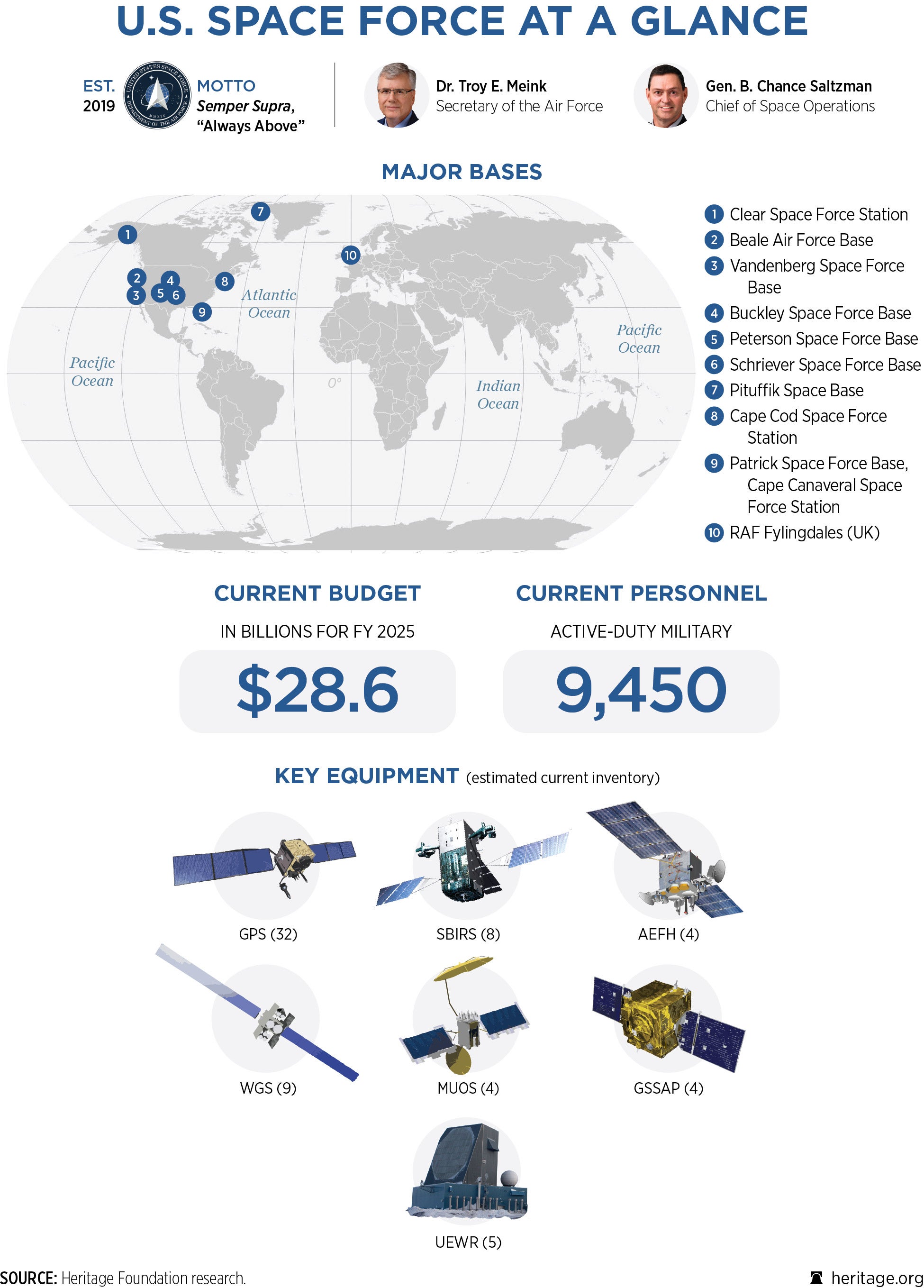
PNT is provided by the U.S. Space Force’s Global Positioning System (GPS). The GPS is operated by Delta 8 at Schriever Space Force Base in Colorado. The system includes satellites in nearly circular orbits approximately 12,550 miles above the Earth’s surface, a Master Control Station, six dedicated monitor stations, four ground antennas, and receivers (or the user segment). The constellation requires a minimum of 24 operational satellites and can include as many as 32. Currently, there are 31 operational satellites in the constellation.[REF]
GPS is indispensable to the terrestrial warfighter. It offers unparalleled precision in navigation, positioning, and timing. It also enables the accurate and economical delivery of precision munitions so that targets are hit with minimal collateral damage. This capability is vital in contemporary warfare, where accuracy is paramount for both tactical and strategic missions. Moreover, GPS supports the coordination of troops, vehicles, and aircraft, facilitating seamless movements and operations in complex environments. The integration of GPS with command-and-control systems enhances situational awareness and decision-making, thereby enabling forces to respond swiftly and effectively to emerging threats. In essence, GPS is foundational to all domains—land, air, sea, space, and cyberspace.[REF]
Beyond its military applications, GPS holds immense value for civil and commercial functions. It drives significant economic activity both in the U.S. and globally, and GPS technology facilitates operations and improves efficiency in various industries, including transportation, agriculture, telecommunications, and finance. For instance, GPS enables precise navigation for commercial aviation and maritime shipping, which in turn enhances safety and reduces fuel consumption. In agriculture, GPS-guided equipment allows for optimized planting and harvesting that lead to increased crop yields and reduced resource use. The telecommunications sector relies on GPS for network synchronization, which ensures reliable communication services. Financial markets use GPS timestamps for transaction accuracy to support high-frequency trading. Overall, GPS contributes hundreds of billions of dollars annually to the U.S. economy and trillions to the global economy. According to a 2019 study by RTI International, GPS “has driven $1.4 trillion in economic growth since 1983.”[REF]
Ensuring the resilience of PNT capabilities is paramount for both military and civilian operations. The inherent resilience of the GPS system is further bolstered through allied Global Navigation Satellite Systems (GNSS) such as the European Union’s Galileo and Japan’s QZSS. These systems not only provide redundancy, but also enhance the robustness and reliability of global PNT services. In a contested environment, the interoperability and combined resilience of these GNSS networks ensure that critical operations, from precision munitions delivery to synchronized financial transactions, remain uninterrupted.[REF]
Missile Warning and Defense. Mission Delta 4, headquartered at Buckley Space Force Base in Colorado, operates and maintains a robust strategic missile warning system that includes both satellites and ground-based radars to detect and track missile launches worldwide. This system includes a network of satellites in geostationary and highly elliptical orbits that provide persistent global surveillance and early warning capabilities. Complementing these satellites are advanced ground-based phased-array radars in Alaska, California, Massachusetts, North Dakota, Greenland, and the United Kingdom that are strategically positioned to enhance detection and tracking accuracy, offering comprehensive coverage and resilience against potential threats. These same space-based and ground-based sensors provide tipping and cueing information to missile defense capabilities, enhance battlespace awareness to the geographic combatant commanders, and gather technical intelligence. Together, these capabilities ensure constant vigilance and preparedness, safeguarding national security and supporting strategic decision-making in a contested environment.[REF]

Satellite systems include the Defense Support Program (DSP) and the Space-Based Infrared System (SBIRS). The notional constellation is four satellites in geosynchronous orbit (at approximately 22,500 miles altitude) and two sensors in highly elliptical orbits to provide coverage of the most northern latitudes. The DSP satellites, which have been a cornerstone of missile detection since the 1970s, feature infrared sensors to identify heat signatures from missile launches. These systems have been progressively enhanced by SBIRS, which offers improved surveillance, tracking, and missile warning capabilities through its constellation of geosynchronous satellites and sensors in highly elliptical orbit.
These enhanced capabilities result in improved prediction accuracy for global strategic and tactical warfighters. The ongoing evolution of the ground system includes improved mission processing software that increases event message accuracy and reduces manpower for support and operations of the DSP and SBIRS portfolio.[REF] As missile threats continue to evolve, the Space Force is developing next-generation missile warning satellites to improve detection accuracy and resilience. These future systems will operate in low-Earth, mid-Earth, geosynchronous, and highly elliptical orbits. They will integrate advanced infrared technology, enhanced ground processing capabilities, and increased interoperability with allied missile warning networks.
Communications. Satellite communications provide critical infrastructure for both military and civilian applications. At geosynchronous orbit, satellites maintain a fixed position relative to the Earth’s surface, ensuring continuous coverage and reliable communication links for strategic command and control and secure data transmission. Mid-Earth orbit satellites offer broader coverage and faster signal transmission, which are vital for real-time operations and global connectivity. Low-Earth orbit satellites, with their closer proximity to the Earth, support modern demands for rapid data exchange and internet services by enabling high-speed communication with minimal latency. Together, these satellite systems underpin such essential services as GPS, weather forecasting, telecommunications, and emergency response and help to promote significant economic activity and foster global trade.
The United States Space Force operates a variety of satellites in support of strategic and tactical communication as well as broadcast service. The current strategic communication satellite systems include MILSTAR (Military Strategic and Tactical Relay); AEHF (Advanced Extremely High Frequency); ESS (Evolved Strategic SATCOM); and EPS (Enhanced Polar System).
Operated by Space Delta 8 at Schriever Space Force Base in Colorado, “MILSTAR provides the President, Secretary of Defense, and America’s armed forces with assured, survivable satellite communications (SATCOM) with low probability of interception and detection, and is designed to operate through contested environments.”[REF]
AEHF is the follow-on to MILSTAR and provides survivable, global, secure, protected, and jam-resistant communications for high-priority military ground, sea, and air assets. AEHF enables the Department of War to control tactical and strategic forces through all levels of conflict. It provides connectivity across the spectrum of mission areas, including land, air, and naval warfare; special operations; strategic nuclear operations; strategic defense; theater missile defense; and space operations and intelligence. Multiple international partners support the AEHF program.[REF]
ESS will eventually replace the AEHF satellite constellation. The new system is projected to provide critical jam-resistant communication channels for the National Command Authorities and deployed forces worldwide, even in the North Polar region—a capability that the current system lacks. The Space Force plans to start production in 2025 and field the constellation by 2030. The ESS constellation will include at least four satellites in geosynchronous and highly elliptical orbits.[REF]
The Space Force’s tactical SATCOM capabilities are essential for maintaining resilient and secure communication links in diverse operational environments. The Wideband Global SATCOM (WGS) system plays a pivotal role in this framework by providing high-capacity data transmission for military and government users worldwide. Currently, 10 WGS satellites, positioned in geosynchronous orbit, offer both X-band and Ka-band communication capabilities, enabling flexible and reliable connectivity for tactical and strategic missions. Two additional WGS satellites are in development. These satellites support a range of applications, including battlefield coordination, intelligence dissemination, and logistical support, to ensure that U.S. forces and their allies can maintain robust communications even in contested or remote areas. The WGS program is funded and supported by several allied nations including Canada, Australia, Denmark, Luxembourg, and the Netherlands.[REF]
The WGS system consists of three principal segments:
- The Space Segment (satellites), a constellation of satellites in geosynchronous orbit;
- The Control Segment (operators), which consists of the Delta 8 squadrons and resources for the planning, management, and control of the constellation; and
- The Terminal Segment (users), which consists of thousands of fixed, transportable, ground-mobile, air-mobile, ship-based SATCOM terminals with antennas the diameters of which range from about half a meter to almost 20 meters in size.[REF]
Narrow-band satellite communications are a crucial component of the Space Force’s strategic and tactical communications architecture. They provide reliable and secure communication channels in bandwidth-constrained environments, a capability that is essential for a range of users, including ground troops, special operations forces, and maritime units, who require dependable communication links in diverse and often contested operational settings. The Space Force operates several narrow-band satellite communication programs, including FLEETSATCOM, UHF Follow-on (UFO), and the Mobile User Objective System (MUOS).[REF]
FLEETSATCOM, the initial narrow-band SATCOM system, consists of a single operational satellite in geosynchronous orbit that provides vital communication links for naval and tactical forces. The operational satellites of the UHF Follow-on program, which succeeded FLEETSATCOM, offer enhanced reliability and coverage. These satellites support a wide array of users, from individual soldiers to entire fleet units, enabling coordinated and effective operations across the globe.[REF]
The latest advancement in narrow-band communications is the MUOS program, which includes five operational satellites designed to provide next-generation capabilities. By enhancing communication capacity and flexibility, MUOS ensures that users can maintain connectivity even in the most challenging environments.[REF]
The Space Development Agency (SDA) is currently advancing its plans to develop and deploy a constellation of low-Earth orbit (LEO) satellites called the Proliferated Warfighter Space Architecture (PWSA). The initial instantiation of PWSA, Tranche 1, is planned to include over 150 satellites to provide tactical communication and missile warning. The SDA operates several test and prototype satellites in LEO, demonstrating essential communication links for strategic command, control, and secure data transmission.[REF] Currently, the Department of the Air Force and U.S. Space Force are reassessing their SDA plans, and the future of the SDA effort is uncertain.[REF]
In addition to dedicated military satellite communication systems, the U.S. military relies increasingly on commercial communication satellite services to enhance its operational capabilities.[REF] These services include satellites in geostationary, medium-Earth, and low-Earth orbits, which offer various advantages in terms of coverage, latency, and data transmission rates. Approximately 40 percent of military communications is facilitated through commercial satellites, highlighting their crucial role in augmenting the military’s capacity for resilient and secure communications across the globe.[REF]
Weather. Weather satellites serve as indispensable tools for military, civil, and commercial activities by providing critical data that ensure safety, efficiency, and strategic advantage. For military operations, these satellites offer real-time weather information that is crucial for planning and executing missions, especially in diverse and challenging environments. Civil authorities, including disaster response agencies, rely on weather satellite data to predict and mitigate the impacts of natural disasters, which helps to ensure public safety and timely emergency response. Commercial enterprises, particularly those in sectors like agriculture, aviation, and maritime, use weather forecasts to optimize operations, reduce risks, and enhance productivity. The comprehensive insights offered by weather satellites not only aid in immediate decision-making, but also contribute to long-term planning and sustainability efforts across various fields.
The U.S. Space Force operates multiple weather satellites that provide vital support for both military and civil operations. These satellites are strategically positioned in geostationary and polar low-Earth orbits to deliver comprehensive and real-time meteorological data. Military users such as ground troops, aviation units, and naval forces use the indispensable insights into weather patterns, climate conditions, and environmental changes provided by the satellites to plan and execute their missions with precision and safety.
The Defense Meteorological Satellite Program (DMSP) includes two operational satellites in sun-synchronous, low-Earth polar orbits at an altitude of approximately 450 miles.[REF] The primary weather sensor is an optical system that provides “continuous visual and infrared imagery of cloud cover over an area approximately 1,600 miles wide.” The satellites provide global coverage of weather features every 14 hours. Additional DMSP sensors “measure atmospheric vertical profiles of moisture and temperature.” Military weather forecasters use this information to detect weather patterns and track existing weather phenomena including fog, thunderstorms, dust and sandstorms, and tropical cyclones. Other DMSP sensors measure space weather such as charged particles, electromagnetic fields, and ionospheric characteristics to “track the impact of the natural environment on ballistic-missile early warning radar systems, long-range communications, and satellite communications.”[REF]
The first Weather System Follow-on–Microwave (WSF-M) satellite was launched in April 2024 and measures “ocean surface winds, tropical cyclone intensity, sea ice, soil moisture, and snow depth, as well as low Earth orbit (LEO) energetic charged particles.”[REF]
The Space Force also operates weather satellites in geostationary orbit that previously were operated by NOAA. The satellites use an existing Remote Ground Station in Western Australia that was put in place in 2020 to support the mission. NOAA operates the satellites on behalf of the Space Force from the NOAA Satellite Operations Facility in Suitland, Maryland, and Wallops Command and Data Acquisition Station in Wallops Island, Virginia.[REF]
Tactical Surveillance, Reconnaissance, and Tracking. Historically, the Air Force and now the Space Force have not developed and operated ISR satellites. This mission has been within the purview of the NRO. More recently, the Space Force and the NRO have established a collaborative arrangement to field and operate a constellation of satellites to develop the Ground Moving Target Indicator (GMTI), a mission previously met by the now-retired Air Force E-8C aircraft’s Joint Surveillance Target Attack Radar System (JSTARS) program.[REF]
Unrelated to the GMTI mission, the Space Force and the NRO are developing an arrangement to improve sharing of commercial satellite ISR products with the terrestrial warfighter.[REF] Scores of existing commercial ISR satellites could provide support to U.S. and allied warfighters. Companies provide electro-optical, radar, and radio frequency geo-location.[REF]
Space Domain Awareness. The U.S. Space Force conducts Space Domain Awareness to monitor and assess the space environment, supporting the safety and security of space operations and facilitating offensive and defensive space control operations. This mission is supported by a network of sophisticated ground-based and space-based systems. Key ground-based systems include a wide variety of geographically dispersed telescopes and radars.[REF] Space-based systems include the Space-Based Surveillance System (SBSS)[REF] and Geosynchronous Space Situational Awareness Program (GSSAP).[REF] These ground-based and space-based capabilities comprise the Space Surveillance Network (SSN), which tracks space objects, predicts potential collisions, warns of potential hostile actions, and enables offensive action.
Offensive and Defensive Space Control. The Space Force’s role in space control includes both offensive and defensive operations, providing freedom of action in space while also protecting U.S. space assets from adversary interference. Offensive space control aims to prevent adversaries from using space capabilities against the U.S.; defensive space control focuses on protecting U.S. space systems from attack or interference.[REF] According to the current Chief of Space Operations, “Domain control is the special province of warfighters, a unique responsibility that only military services hold…. It is the thing that distinguishes the Navy from the merchant marine and the Air Force from Southwest Airlines. It is the purpose of the Space Force to achieve space superiority.”[REF]
Specific capabilities to control the domain are generally classified, but open-source reporting on the adversary sheds light on the types of offensive capabilities the U.S. Space Force might pursue. Such capabilities could include ground or sea-based direct ascent missiles; powerful lasers to dazzle or damage satellite sensors and components; on-orbit kinetic, electromagnetic, and directed energy weapons; and cyber tools to interfere with adversary satellite command and control. The Space Force acknowledges ground-based capabilities to jam adversary satellites.[REF]
Launch. Space launch serves as the gateway to deployment of satellites that enable communications, navigation, weather forecasting, and surveillance capabilities that are vital to both civilian and military operations. These launches ensure that the United States maintains its strategic edge in space by allowing for the monitoring of potential threats, rapid response to emerging situations, and the advancement of technological innovations that drive economic growth.
The U.S. Space Force owns and operates two launch bases and related ranges: Cape Canaveral Space Force Station on the east coast of Florida and Vandenberg Space Force Base on the central coast of California. Space Force procures launches from commercial providers to put national security satellites into space. Technological innovation in launch vehicles (rockets) and launch range operations has dramatically reduced the cost of launch and increased launch range capacity. These developments reduce financial barriers for both satellite and launch companies and allow government to develop and field large constellations of relatively small and relatively inexpensive satellites for national security.[REF]
Satellite Command and Control. The Space Force operates the Satellite Control Network, a system of 19 antennas around the globe that supports launch and day-to-day control of U.S. government satellites, including both defense and Intelligence Community satellites. According to the GAO, increasing demand could compromise satellite missions, and the system is in need of significant modernization.[REF]
Test and Experimentation Satellites. The Space Force routinely launches satellites to test new technologies, tactics, techniques, and procedures. Among the more notable is the X-37B Orbital Test Vehicle, an unmanned reusable space plane. Two of these spacecraft have flown at least seven times in both low-Earth and highly elliptical orbits and have remained in space for as long as 908 days.[REF]
Space Force Budget
The FY 2025 enacted budget for the Space Force was $28.7 billion, a decrease of $0.6 billion from the FY 2024 budget and $800 million less than requested.[REF] The total requested for FY 2026—which notably includes $13.8 billion provided by the One Big Beautiful Bill reconciliation legislation signed into law on July 4, 2025[REF]—is $40.2 billion, an increase of more than $11 billion over the FY 2025 enacted amount.[REF] The nation needs to sustain a Space Force budget of at least this magnitude.
The FY 2025 Operation and Maintenance (O&M) budget of $5.2 billion is about 18 percent of total Space Force funding. The budget funds 81 percent of Weapon System Sustainment requirements and a 2 percent civilian pay raise. It also “sustains mission operations and supports headquarters and field commands for doctrine development, warfare, intelligence, and professional military education.”[REF]
The FY 2025 Military Personnel (MILPERS) budget reflects 4 percent of the budget at $1.2 billion. It includes “end strength growth from 9,400 military authorizations to 9,800 military authorizations” and “a 4.5% pay raise, 4.2% Basic Allowance for Housing, and 3.4% Basic Allowance for Subsistence.”[REF] The FY 2026 budget request for Space Force MILPERS is $1.5 billion.[REF] It increases military authorizations end strength to 10,400 and includes “an across-the-board 3.8 percent pay raise, an increase of 4.2 percent for Basic Allowance for Housing, and 3.4 percent for Subsistence.”[REF]
The FY 2025 Research, Development, Test & Evaluation (RDT&E) budget of $18.7 billion is the largest portion of the Space Force’s annual funding—almost 64 percent of the total. It includes “funding for Resilient Missile Warning/Missile Tracking capabilities, Space Technology Development and Prototyping, Ground/Space Domain Awareness, Next-Generation Overhead Persistent Infrared (OPIR), Evolved Strategic Satellite Communication (SATCOM) (ESS), Protected Tactical SATCOM (PTS), and Tech Transition (Space).”[REF] The FY 2026 budget request includes $15.5 billion (a decrease of ~$3 billion), but the One Big Beautiful Bill Act adds $13.5 billion for a total of $29 billion.[REF] Much of this increase will likely fund elements of the Golden Dome with money specified for “Long Range Kill Chains;” “Resilient Missile Warning Missile Tracking—Low Earth Orbit (LEO);” and “Resilient Missile Warning Missile Tracking—Medium Earth Orbit (MEO).”[REF]
The FY 2025 $4.3 billion Procurement budget reflects approximately 15 percent of total Space Force funding. It “funds acquisition of space vehicles and terminals, ground control systems, launch services for seven National Security Space Launches and four SDA launches, and related communications security and training products.”[REF] The FY 2026 budget request for Space Force procurement is $0.9 billion less than FY 2025’s at $3.4 billion.[REF] The decrease reflects three fewer National Security Space Launches than in the prior year.

Although the FY 2025 Space Force budget is almost twice as large as the initial FY 2020 budget, most of this increase reflects consolidation of other funding previously managed by the Air Force, Navy, Army, and Space Development Agency. The Chairman of the House Appropriations Subcommittee on Defense expressed skepticism as to whether the FY 2025 Space Force budget request would keep pace with the capabilities needed.[REF]
Space Threats
Any discussion of space threats must include the threats against U.S. and allied space capabilities (threats to space) and the threats against U.S. and allied terrestrial capabilities posed by adversary space systems (threats from space).
Threats to Space. For many decades, the Department of Defense recognized that adversaries could threaten U.S. space capabilities through a variety of ground-based and space-based capabilities. These threats include kinetic attacks and cyberattacks against ground infrastructure such as launch infrastructure, command-and-control antennas, and missile warning radars; the use of lasers to blind, damage, or destroy satellites; electronic warfare to jam ground-to-space, space-to-ground, and space-to-space communication and command-and-control links; ground-based kinetic attacks (missiles) against satellites; space-based kinetic attacks from one satellite to another; and the use of nuclear weapons in space (an exo-atmospheric explosion that instantly destroys systems and creates a nuclear environment that disrupts and destroys satellites over time).
China. According to the U.S. Space Force, “China is the PACING CHALLENGE and is rapidly improving its space capabilities to TRACK & TARGET U.S. military forces. China & Russia are pursuing a wide range of counterspace capabilities to DISRUPT & DEGRADE U.S. space capabilities.” The Space Force assesses that “[t]he People’s Liberation Army (PLA) expects space to play an important role in future conflicts by enabling long-range precision strikes and denying other militaries the use of space-based information.” In addition, “the PLA likely sees counterspace operations as means to deter and counter U.S. military intervention in a regional conflict.”[REF]
In 2007, China used a direct-ascent antisatellite missile (DA-ASAT) to destroy one of its defunct weather satellites in low-Earth orbit, “creating more than 2,700 pieces of trackable debris that remain in orbit.” Since 2007, China has advanced that missile “into an operational system intended to target LEO satellites.” In addition:
- China likely intends to field ASAT weapons capable of destroying satellites up to geosynchronous altitudes, effectively holding at risk all U.S. and allied satellites.
- China is developing satellite “inspection and repair” systems which could have a dual-use function as weapons. In January 2022, the Chinese Shijian-21 satellite moved a non-functioning Chinese navigation satellite to a “graveyard orbit” above the geosynchronous belt. This technology could be used in future systems to grapple and move U.S. and allied satellites.
- The Space Force has observed many Chinese experimental satellites conducting “unusual, large, and rapid maneuvers” in the geosynchronous belt. These are tactics that “could have several military applications.”
- China “has multiple ground-based laser weapons able to disrupt, degrade, or damage satellite sensors.” The Space Force believes that China “could have higher-power systems able to damage satellite structures” later this decade.
- Chinese military exercises routinely include jamming “against space-based communications, radars, and navigation systems like GPS.” The Space Force also believes that China “may be developing jammers to target SATCOM over a range of frequencies, including U.S. military protected extremely-high-frequency (EHF) systems.”[REF]
Russia. Russia continues to develop, test, and deploy counterspace systems “to take advantage of a perceived vulnerability of U.S. military dependence on space.” For example:
- In November 2021, Russia tested a DA-ASAT missile against a non-operational Soviet satellite in low-Earth orbit, “creating 1,500 pieces of trackable debris.”
- A large missile observed on a MiG-31 aircraft in 2018 “may be related to an air-launched ASAT missile…that will be ‘capable of destroying targets in near-space.’”
- Russia has deployed several orbital ASAT prototypes in low-Earth orbit in 2017, 2019, 2022, 2024, and 2025. “The four most recent were all placed in orbits matching those of U.S. national security satellites, and one ejected an object near a Russian satellite while testing a space-based ASAT weapon.”
- Starting in 2018, “Russia deployed laser weapons to five strategic missile divisions.” The system is intended to “mask missile deployments by blinding satellite sensors.” The Space Force believes “Russia may deploy more powerful lasers by 2030.”
- Russia is “developing an ASAT capability using a satellite designed to carry a nuclear weapon.”
- Russia told international regulators in 2025 that “it considered European satellites aiding Ukraine’s military as ‘legitimate targets,’” and its “continuing electronic attacks on GPS and SATCOM across Europe have been called ‘extremely worrisome and unacceptable[’] by the International Telecommunications Union.”[REF]
Threats from Space. U.S. adversaries, particularly China and Russia, understand the value that space provides to terrestrial warfighting and have developed significant capabilities to communicate, sense the battlefield, provide navigation, and target U.S. and allied forces in conflict.
China. According to the Space Force, “CHINA’s ambitious space program is…key to Chinese Communist Party (CCP) plans for a powerful and prosperous nation” and, as noted above, is expected “to play an important role in future conflicts by enabling long-range precision strikes and by denying other militaries the use of space-based information.”[REF]
In 2015, the CCP “organized its military space capabilities under the newly-established Aerospace Force which was subsequently aligned under the Central Military Commission in Beijing.” By July 2025, China had conducted 42 space launches, 41 of which were successful, and had placed 112 payloads into orbit, 17 percent of which “were intelligence, surveillance, and reconnaissance capable satellites.” In addition:
- “Since the end of 2015, China’s on-orbit presence has grown by approximately 927% (+1,049 satellites). As of July 2025, China had more than 1,189 satellites in orbit.”
- The Chinese military “benefits from 510+ ISR-capable satellites with optical, multispectral, radar, and radio frequency sensors, increasing its ability to detect U.S. aircraft carriers, expeditionary forces, and air wings.”
- China’s “improving space-based capabilities combine with its growing arsenal of standoff weaponry to enable long-range precision strikes against U.S. and allied forces.”
- “China has launched three reusable spaceplanes that released unidentified objects.” They were in orbit for two days, more than nine months, and almost nine months, respectively.[REF]
Russia. According to the Space Force, “Russia has one of the world’s largest space programs and is among the world’s most capable space actors. Its experience and pedigree are unmatched outside the U.S.” Moreover, “Russia views space as a warfighting domain and believes space supremacy will be a decisive factor in future conflicts.”[REF]
Russia’s military space capabilities and personnel were integrated into the Aerospace Forces in 2015, “in part to better integrate space-based capabilities into larger operations.” More recently, its space technology has declined as a result of such problems as funding shortfalls and growing international isolation. Moscow still hopes to maintain its constellations and develop next-generation capabilities. However:
- Russia conducted only 17 launches in 2024 and “remained largely absent from the international launch market, launching only five foreign payloads.”
- Despite its expertise in rocket engines and space launch, Russia increasingly lags behind the U.S. and China in launch activity.
- Russia operates some of the world’s most capable ISR satellites for optical imagery, SIGINT, and missile warning but relies increasingly on civil and commercial satellites. Russian private military companies, for example, have purchased imagery from Chinese company Spacety to support combat operations in Ukraine.[REF]
Readiness
Any discussion of military readiness should begin with a fundamental question: “Ready for what?” Historically, the U.S. Space Force and the earlier space forces of the Air Force, Army, and Navy have maintained high levels of readiness to operate in a benign, uncontested environment. However, the Space Force is not ready to operate successfully in a contested space environment. Current Space Force capabilities are vulnerable to myriad adversary counterspace systems, and the Space Force does not have sufficient capacity or capability to hold adversary space systems at risk.
The Space Force has taken and continues to take steps to address this situation. There is a Field Command (Space Training and Readiness Command) dedicated to the task of implementing robust training and developing the tactics, techniques, and procedures necessary to operate during wartime. The proposed Space Futures Command would define the set of resilient capabilities as well as offensive and defensive space control capabilities necessary to operate in and through a contested space environment. The Space Development Agency is fielding a constellation of data transport and threat tracking satellites that are inherently resilient to many adversary threats.
All of this action is warranted, but significant additional resources and people will be required. Flat budgets of approximately $30 billion are not enough to address the readiness challenges that the Space Force must confront.
Future Capabilities, Challenges, and Issues
Future Space-based Capabilities. The Space Force is being asked to take on new missions to support the Joint Force. In addition to traditional Communication, Position/Navigation/Timing, Weather, and Missile Warning missions, the Space Force is collaborating with the Intelligence Community to develop and operate a constellation of radar satellites to track ground-based and sea-based moving targets. Heretofore, this mission was accomplished by the now-retired Joint Surveillance Target Attack System (JSTARS) E-8 aircraft. The Air Force and Space Force are also considering how the Space Force can support the Air Battle Management mission currently conducted by the Airborne Warning and Control System (AWACS) E-3 Sentry aircraft.[REF]
The Space Force might consider global logistics as an additional mission in the coming years. As the price of launch continues to drop and launches become increasingly routine, using rockets to move material and even manpower becomes practical. Suborbital launches could move critical material to any place on the planet within a couple of dozen minutes.[REF]
The Space Force might also consider applying kinetic or electromagnetic force from space to the air, land, and maritime domains. China has already demonstrated the capability to do so with its launch and reentry of a hypersonic test vehicle.[REF] Such “force application” capabilities are not prohibited by existing treaties, although they might be perceived as destabilizing.
An Expanding Area of Responsibility (AOR). Historically, the Space Force and its predecessors have operated in relatively near-Earth space—out to approximately 22,500 miles above the Earth’s surface. Both the PRC and the U.S. are now devoting increasing attention to the environment that extends to the moon—approximately 275,000 miles away—commonly called the “cislunar space.” Both nations recognize the geopolitical, military, and potential economic value of operating beyond the traditional near-Earth altitudes.[REF] This emerging recognition presents significant technical and budgetary challenges that the Space Force will need to address in the coming years. For now, the men and women of the Space Force will have their hands full satisfying the Joint Force’s needs and ensuring dominance of the traditional near-Earth Space AOR.
Acquisition Reform. The current House version of the FY 2026 NDAA focuses significant attention on acquisition reform. Key themes include delivering capabilities at speed and scale, revitalizing the defense industrial base, leveraging commercial innovation, and developing a mission-oriented defense acquisition workforce.[REF]
All of these themes are applicable to space acquisition, and many are underway. The Space Development Agency has made significant progress in delivering space capabilities at speed and scale. On September 10, 2025, the SDA launched 21 “Tranche 1” data transport spacecraft into low-Earth orbit. The agency plans to launch the remaining 120-plus Tranche 1 data transport and missile warning and tracking satellites over the next couple of years.[REF]
In April 2024, the Space Force published the “U.S. Space Force Commercial Space Strategy.” In the foreword to the document, the CSO and Assistant Secretary of the Air Force for Space Acquisition and Integration wrote that:
In this increasingly congested and contested space domain, we must seize the opportunity to capitalize on significant innovative commercial space solutions. As outlined in the National Defense Strategy (NDS), we must tap into the spirit of American entrepreneurship, innovation, and vibrant competitive markets to be successful and sustain our competitive advantage across the spectrum of conflict in this era of Great Power Competition.[REF]
Additionally, the Space Force is organizing its forces into “Mission Deltas.” According to the Space Force:
Mission Deltas oversee all aspects of mission area functions—people, training, equipment and combat sustainment. The MD framework consolidates the units in SpOC [Space Operations Command, now Combat Forces Command] that perform crew force operations, cyber defense and intelligence support with the program offices in Space Systems Command that perform Level 1 and Level 2 maintenance, operational enhancements and application-layer software development.[REF]
This organizational construct will help to reinforce the NDAA goal of developing a mission-oriented defense acquisition workforce.
However, while all of these internal Space Force reforms are laudable, there is much more to be done. The department’s most senior leadership must foster an environment that prudently accepts and manages risk. Congressional oversight must account for the need to “fail forward.” Otherwise, acquisition professionals will default to risk aversion and process compliance.
Potential Organizational Changes. There are several important organizational changes that Congress, the President, and the War Department might do well to consider in the coming years. The first would be to make the service a department separate from the Department of the Air Force. Proponents of such a change argue that there is a need for dedicated senior leadership (Secretary and Under Secretary of the Space Force); dedicated support functions (manpower, environment and engineering, financial management, legislative liaison, general counsel, surgeon general, etc.); and champions for budget. Supporters of the status quo argue that recent and current Secretaries of the Air Force have been staunch supporters of the new service and that adding support functions would be an unnecessary growth in staff and bureaucracy with a negative return on investment.[REF]
The second potential organizational change would be to combine the National Reconnaissance Office and the Space Force into a single organization. Perceived benefits of such an arrangement would include closer collaboration on space acquisition and operations; improved intelligence, surveillance, and reconnaissance support for the Joint Force; and reduced bureaucracy. Arguments for maintaining separate organizations focus on the need to satisfy national requirements of the Intelligence Community, the complexity of the current NRO budget sources and processes, and existing congressional oversight committee jurisdiction.[REF]
Scoring the U.S. Space Force
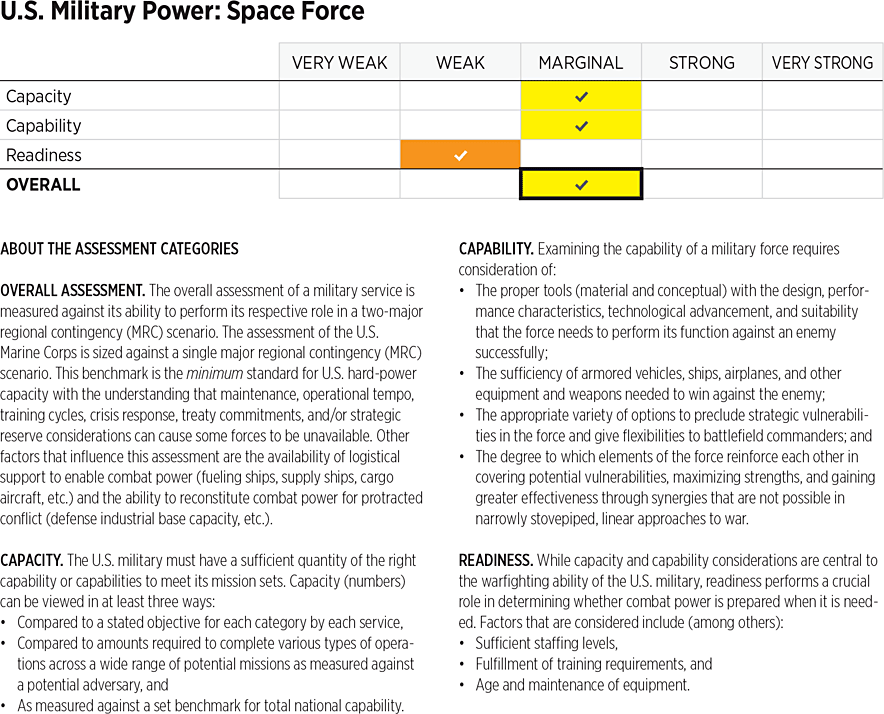
Capacity Score: Marginal
The current capacity of the U.S. Space Force is sufficient in certain areas and inadequate in others. There are sufficient numbers of satellites providing PNT and missile warning. Additional communication, weather, and space domain awareness satellites are necessary to support terrestrial and space operations. Ground infrastructure supporting satellite command and control and space domain awareness is insufficient. Based on publicly available unclassified information, the Space Force has little to no capacity to protect existing and planned space systems. It also is woefully short of the resources required to hold adversary space systems at risk.
Capability Score: Marginal
The Space Force maintains and operates many highly capable systems. Its current communication, weather, PNT, and missile warning systems provide extraordinary capability. However, the Air Force has divested the Ground Moving Target Indicator mission, and there are no Space Force space systems to satisfy this mission. The Air Force will likely continue to divest certain missions historically conducted from the air that are no longer tenable in a contested air domain. The Space Force must be funded properly to develop and procure these capabilities. Additionally, the Space Force is years away from fielding the data transportation capability that is needed to support a way of war that remains dependent on a vast network of sensors, shooters, and decision-makers. Finally, the Space Force does not have the capability that is needed to protect U.S. space systems and hold adversary systems at risk.
Readiness Score: Weak
Previous versions of this assessment scored Space Force readiness as “Marginal.” Space Force readiness has deteriorated both because of the increasing capability and capacity of the adversary and because of the increased likelihood that the adversary will seek to disrupt and destroy U.S. space capabilities. Put simply, the Space Force is not ready to operate in a contested environment. It is likely that any conflict with a major adversary will begin in space. Most of today’s Space Force capabilities are highly effective in an uncontested environment, but unlike the other services, whose readiness challenges can be addressed by additional training, exercises, and improved maintenance, the Space Force lacks the capacity and capability to be ready for conflict in space.
Overall Assessment: Marginal
The Space Force is woefully short of the resources required to hold adversary space systems at risk and is not ready to operate in a contested environment even though conflict with a major adversary will likely begin in space. While most of its current capabilities are highly effective in an uncontested environment, the Space Force lacks the capacity and capability to be ready for conflict in space. The Space Force is years away from fielding the data transportation capability that is needed to support a way of war that remains dependent on a vast network of sensors, shooters, and decision-makers. Space Force readiness has deteriorated both because of the increasing capability and capacity of the adversary and because of the increased likelihood that the adversary will seek to disrupt and destroy U.S. space capabilities. While still capable, for these and many other reasons, the Space Force is assessed as “Marginal.”
Policy Recommendations
Consistent with the criticality of the Space Force’s function in our nation’s way of war, coupled with the need to resource and organize most effectively, the President should:
- Re-energize the National Space Council. The first Trump Administration used the National Space Council to drive key organizational and cultural change, including the creation of U.S. Space Command and the U.S. Space Force. Given the multitude of challenges the nation faces, the President should direct the Vice President to lead the National Space Council.
- Develop a national vision and strategy for space. The President’s leadership is vital if the nation is to realize the necessary space capabilities, innovation, collaboration with allies, acquisition reform, and cultural change. In his first Administration, the President signed a number of critical space policy documents. Each one should be reviewed and, as necessary, updated or rewritten.
- Emphasize the importance of space to deterrence. The President should consider a declaratory statement regarding the importance of space-based capabilities and how the U.S. will consider both kinetic attacks and non-kinetic interference with such systems. Additionally, Congress should direct the Department of War to provide an unclassified report (with an appropriately classified annex) on how robust offensive space control capabilities can deny adversaries the benefits of space and how a declaratory policy and acknowledged set of capabilities can deter adversary hostile actions in space, at sea, in the air, on the ground, and in cyberspace.
For its part, Congress should:
- Order an assessment of Space Force readiness. Congress should direct the Chief of Space Operations to provide a detailed classified report on the state of Space Force readiness to operate in and through an increasingly contested domain. The report should identify shortfalls and a plan to establish high levels of readiness consistent with a multitude of emerging and evolving threats to U.S. national security, civil, and commercial space capabilities.
- Pursue organizational opportunities. Congress should hold hearings and direct reports on the Department of War’s plans to consider such Space Force organizational opportunities as establishing a Space National Guard; raising the U.S. Space Force to a Secretary-led department on organizational par with the Departments of the Army, Navy, and Air Force; and combining the U.S. Space Force with the National Reconnaissance Office. The hearings and reports should include detailed costs and benefits.
- Require the executive branch to report on progress in promoting competition and commercial capabilities. Congress should direct the Chief of Space Operations and the Secretary of the Air Force to report on the progress implementing their plan to integrate commercial capability into Space Force architectures and operations. Congress should also direct the Secretary of War to report on the need for and plan to ensure a robust competitive space industry environment to drive down costs and drive up innovation.
Endnotes
[1] Air Force News Service, “Saltzman Outlines Space Force Priorities, What’s Necessary to Achieve Them,” U.S. Space Force, March 13, 2025, https://www.spaceforce.mil/News/Article-Display/Article/4093782/saltzman-outlines-space-force-priorities-whats-necessary-to-achieve-them/ (accessed November 16, 2025).
[2] Smithsonian Institution, National Air and Space Museum, “What Was the Space Race?” August 23, 2023, https:// airandspace.si.edu/stories/editorial/what-was-space-race (accessed November 17, 2025).
[3] Hill Aerospace Museum [Hill Air Force Base, Utah], “History of Intercontinental Ballistic Missiles (ICBMs) at Hill,” January 5, 2023, https://www.aerospaceutah.org/history-of-intercontinental-ballistic-missiles-icbms-at-hill/#:~:text=While%20it%20was%20the%20first,travel%20speed%20and%20warhead%20size (accessed November 17, 2025).
[4] National Reconnaissance Office, “A Declassified History,” https://www.nro.gov/About-NRO/history/ (accessed November 17, 2025).
[5] S. 1790, National Defense Authorization Act for Fiscal Year 2020, Public Law 116-92, 116th Congress, December 20, 2019, Subtitle D, Section 952(b), https://congress.gov/116/plaws/publ92/PLAW-116publ92.pdf (accessed November 19, 2025). Quotation marks in original.
[6] Ibid., Section 954.
[7] U.S. Space Force, Space Training and Readiness Command, “About Space Training and Readiness Command,” https://www.starcom.spaceforce.mil/About-Us/About-STARCOM (accessed November 17, 2025).
[8] Karl A. Bingen, Kaitlyn Johnson, John Dylan Bustillo, and Marie Villareal Dean, “U.S. Space Force Primer,” Center for Strategic and International Studies, Aerospace Security Project, December 22, 2022, https://aerospace.csis.org/us-space-force-primer/ (accessed November 17, 2025); U.S. Space Force, USSF Combat Forces Command, “About Combat Forces Command,” https://www.ussf-cfc.spaceforce.mil/About-Us/About-Combat-Forces-Command (accessed November 19, 2025); and 1st Lieutenant Laura Anderson, “U.S. Space Force Establishes Combat Forces Command, Welcomes New FLDCOM Commander,” USSF Combat Forces Command, November 17, 2025, https://www.ussf-cfc.spaceforce.mil/News/Article-Display/Article/4333400/us-space-force-establishes-combat-forces-command-welcomes-new-fldcom-commander (accessed November 19, 2025).
[9] See Sandra Erwin, “Space Force Plans New ‘Futures Command’ amid Pressure to Speed up Modernization,” SpaceNews, December 17, 2024, https://spacenews.com/space-force-plans-new-futures-command-amid-pressure-to-speed-up-modernization/ (accessed November 18, 2025); Jen Kirby, “An Uncertain Future for Space Futures Command,” Aerospace America, August 25, 2025, https://aerospaceamerica.aiaa.org/an-uncertain-future-for-space-futures-command/ (accessed November 18, 2025).
[10] U.S. Space Force, Space Systems Command, “About Space Systems Command,” https://www.ssc.spaceforce.mil/about-us/about-us (accessed November 19, 2025).
[11] Ibid.
[12] Anderson, “U.S. Space Force Establishes Combat Forces Command, Welcomes New FLDCOM Commander.”
[13] SAF/PA Staff Writer, “Department of the Air Force Announces Preferred Locations for STARCOMHQ, Three Deltas.” May 31, 2023, https://www.spaceforce.mil/News/Article/3411715/department-of-the-air-force-announces-preferred-locations-for-starcom-hq-three/ (accessed November 20, 2025).
[14] Air Force News Service, “Saltzman Outlines Plan to Reoptimize Space Force for Great Power Competition,” February 13, 2024, https://www.spaceforce.mil/News/Article-Display/Article/3675520/saltzman-outlines-plan-to-reoptimize-space-force-for-great-power-competition (accessed November 18, 2025).
[15] U.S. Department of War, “About: Combatant Commands,” https://www.war.gov/About/combatant-commands (accessed November 19, 2025).
[16] U.S. Space Command, “Our Mission,” https://www.spacecom.mil (accessed November 20, 2025).
[17] Theresa Hitchens, “Lack of Space Force Personnel Support for NRO Draws Congressional Ire,” Breaking Defense, January 14, 2025, https://breakingdefense.com/2025/01/lack-of-space-force-personnel-support-for-nro-draws-congressional-ire (accessed November 17, 2025).
[18] Peter Garretson, “Is NASA a National Security Organization?” Global Security Review, “2 years ago,” https://www.globalsecurityreview.com/is-nasa-a-national-security-organization/ (accessed November 19, 2025).
[19] Noah Fritzhand, “NOAA’s Critical Contributions to US National Security,” Council on Strategic Risks, Center for Climate and Security Blog, March 5, 2025, https://www.councilonstrategicrisks.org/2025/03/05/noaas-critical-contributions-to-us-national-security (accessed November 17, 2025).
[20] U.S. Space Force, “Space Force 101,” Version 2.1, p. 1, https://www.spaceforce.mil/Portals/2/Documents/SF101/ussf_101_glossy_FINAL_e-version.pdf (accessed November 19, 2025).
[21] Admiral Samuel J. Paparo, Commander, U.S. Indo-Pacific Command, statement on “U.S. Indo-Pacific Command Posture” before the Committee on Armed Services, U.S. House of Representatives, April 2025, p. 19, https://armedservices.house.gov/uploadedfiles/indopacom_posture_statement_2025.pdf (accessed November 19, 2025).
[22] U.S. Department of Transportation, “What Is Positioning, Navigation and Timing (PNT)?” last updated February 18, 2025, https://www.transportation.gov/pnt/what-positioning-navigation-and-timing-pnt (accessed November 18, 2025).
[23] Fact Sheet, “Global Positioning System,” U.S. Space Force, current as of October 2020, https://www.spaceforce.mil/About-Us/Fact-Sheets/Article/2197765/global-positioning-system (accessed November 19, 2025); National Coordination Office for Space-Based Positioning, Navigation, and Timing, “GPS: Space Segment,” https://www.gps.gov/space-segment (accessed November 19, 2025).
[24] Cevians, “The Development and Impact of GPS Technology on Military Operations,” October 30, 2024, https://www.cevians.com/the-development-and-impact-of-gps-technology-on-military-operations/ (accessed November 19, 2025).
[25] RTI International, “GPS: A $1.4 Trillion Economic Engine,” September 11, 2019, https://www.rti.org/impact/gps-14-trillion-economic-engine (accessed November 19, 2025).
[26] Taoglas, “GNSS Constellations: Exploring GPS, GLONASS, Galileo, BeiDou, NavIC, and QZSS,” GNSS Technology Blog, June 28, 2024, https://www.taoglas.com/blogs/gnss-constellations-exploring-gps-glonass-galileo-beidou-navic-and-qzss (accessed November 18, 2025).
[27] Fact Sheet, “Space Delta 4,” U.S. Space Force, current as of April 2024, https://www.spaceforce.mil/About-Us/Fact-Sheets/Fact-Sheet-Display/Article/3687813/space-delta-4 (accessed November 18, 2025).
[28] Fact Sheet, “Space Based Infrared System,” U.S. Space Force, current as of March 2023, https://www.spaceforce.mil/about-us/fact-sheets/article/2197746/space-based-infrared-system (accessed November 18, 2025).
[29] Fact Sheet, “Milstar Satellite Communications System,” U.S. Space Force, current as of October 2020, https://www.spaceforce.mil/About-Us/Fact-Sheets/Fact-Sheet-Display/Article/2197755/milstar-satellite-communications-system/ (accessed November 18, 2025).
[30] Fact Sheet, “Advanced Extremely High Frequency System,” U.S. Space Force, current as of July 2020, https://www.spaceforce.mil/About-Us/Fact-Sheets/Fact-Sheet-Display/Article/2197713/advanced-extremely-high-frequency-system (accessed November 18, 2025).
[31] Sandra Erwin, “Space Force Opens Bidding for Classified Communications Satellites,” SpaceNews, April 26, 2024, https://www.spacenews.com/space-force-opens-bidding-for-classified-communications-satellites (accessed November 18, 2025).
[32] Fact Sheet, “Wideband Global SATCOM Satellite,” U.S. Space Force, current as of February 2023, https://www.spaceforce.mil/About-Us/Fact-Sheets/Article/2197740/wideband-global-satcom-satellite (accessed November 18, 2025).
[33] Ibid.
[34] Lisa Sodders, “Satellite Communications Mission Brings Space Force to Navy Town,” U.S. Space Force, July 9, 2024, https://www.spaceforce.mil/News/Article-Display/Article/3831602/satellite-communications-mission-brings-space-force-to-navy-town/ (accessed November 18, 2025).
[35] GlobalSecurity.org, “Ultra High Frequency (UHF) Follow-on (UFO),” https://www.globalsecurity.org/space/library/report/1999/nssrm/initiatives/ufo.htm (accessed November 18, 2025). Subscription required.
[36] Lockheed Martin, “MUOS: Mobile User Objective System,” https://www.lockheedmartin.com/en-us/products/muos.html (accessed November 18, 2025).
[37] U.S. Space Force, Space Development Agency, “Proliferated Warfighter Space Architecture Tranche 1,” PowerPoint Presentation, https://www.sda.mil/wp-content/uploads/2024/06/Tranche-1-Factsheet_FINAL_06.10.2024.pdf (accessed November 18, 2025).
[38] See, for example, Theresa Hitchens, “SDA Again Postpones Launch of First ‘Operational’ Data Relay, Missile Warning Satellites,” Breaking Defense, March 7, 2025, https://breakingdefense.com/2025/03/sda-again-postpones-launch-of-first-operational-data-relay-missile-warning-satellites/ (accessed November 17, 2025).
[39] Yool Kim et al., Operational and Policy Implications of Integrating Commercial Space Services into U.S. Department of Defense Operations, RAND Corporation, Project Air Force Research Report, 2025, https://rand.org/pubs/research_reports/RRA2562-2.html (accessed November 10, 2025).
[40] Jonathan K. Corrado, “Commercial SATCOM: A Risk Mitigation Strategy,” Air & Space Operations Review, Vol. 1, No. 1 (Spring 2022), https://airuniversity.af.edu/Portals/10/ASOR/Journals/Volume-1_Issue-1/Corrado_Commercial_SATCOM.pdf (accessed November 17, 2025).
[41] Fact Sheet, “Defense Meteorological Satellite Program,” U.S. Space Force, current as of October 2020, https://www.spaceforce.mil/About-Us/Fact-Sheets/Article/2197779/defense-meteorological-satellite-program/ (accessed November 18, 2025).
[42] Ibid.
[43] Greg Hadley, “New Weather Satellites Will Start Feeding Data to Warfighters This Fall,” Air & Space Forces Magazine, August 6, 2024, https://airandspaceforces.com/new-weather-satellites-data-warfighters/ (accessed November 17, 2025).
[44] SAF/PA Staff Writer, “Space Force Accepts Second Weather Satellite Through NOAA Partnership,” U.S. Space Force, September 22, 2023, https://www.spaceforce.mil/News/Article-Display/Article/3534522/space-force-accepts-second-weather-satellite-through-noaa-partnership/ (accessed November 18, 2025).
[45] Theresa Hitchens, “Air Force Greenlights Baseline for New NRO–Space Force Satellites to Track Ground Targets,” Breaking Defense, August 29, 2024, https://breakingdefense.com/2024/08/air-force-greenlights-baseline-for-new-nro-space-force-satellites-to-track-ground-targets/ (accessed November 17, 2025).
[46] Theresa Hitchens, “EXCLUSIVE: NRO, Space Force in ‘Final Stages’ of Commercial ISR Arrangement,” Breaking Defense, April 7, 2025, https://breakingdefense.com/2025/04/exclusive-nro-space-force-in-final-stages-of-commercial-isr-arrangement/ (accessed November 17, 2025).
[47] Theresa Hitchens, “Space Force Eyes Buying Commercial Satellite ISR,” Breaking Defense, April 21, 2021, https://breakingdefense.com/2021/04/space-force-eyes-buying-commercial-satellite-isr/ (accessed November 17, 2025).
[48] U.S. Space Force, Space Systems Command, “Space Domain Awareness and Combat Power,” PowerPoint Presentation, https://www.ssc.spaceforce.mil/Portals/3/SSC_Fact_Sheet_SDACP_FINAL_1.pdf (accessed November 18, 2025).
[49] Fact Sheet, “Space Based Space Surveillance,” U.S. Space Force, current as of October 2020, https://www.spaceforce.mil/About-Us/Fact-Sheets/Article/2197743/space-based-space-surveillance/ (accessed November 28, 2025).
[50] Fact Sheet, “Geosynchronous Space Situational Awareness Program,” U.S. Space Force, current as of October 2020, https://www.spaceforce.mil/About-Us/Fact-Sheets/Article/2197772/geosynchronous-space-situational-awareness-program/ (accessed November 28, 2025).
[51] C. Todd Lopez, “Space Force’s Fundamental Role: Space Superiority,” U.S. Department of War, March 5, 2025, https://war.gov/News/News-Stories/Article/Article/4102663/space-forces-fundamental-role-space-superiority/ (accessed November 18, 2025).
[52] Ibid.
[53] Courtney Albon, “New US Space Force Jammers Aim to Disrupt China’s SATCOM Signals,” Defense News, December 19, 2024, https://www.defensenews.com/space/2024/12/19/new-us-space-force-jammers-aim-to-disrupt-chinas-satcom-signals/ (accessed November 18, 2025).
[54] Sandra Erwin, “After Negotiations, Space Development Agency Was Able to Get Reduced Pricing for National Security Launch,” SpaceNews, August 24, 2021, https://www.spacenews.com/after-negotiations-space-development-agency-was-able-to-get-reduced-pricing-for-national-security-launch/ (accessed November 18, 2025).
[55] U.S. Government Accountability Office, Satellite Control Network: Updating Sustainment Plan Would Help Space Force Better Manage Future Efforts, GAO-23-105505, April 2023, https://www.gao.gov/assets/D23105505.pdf (accessed November 18, 2025).
[56] Brett Tingley, “US Space Force Reveals 1st Look at Secretive X-37B Space Plane in Orbit (Photo),” Space.com, February 21, 2025, https://www.space.com/space-force-x-37b-1st-photo-from-orbit-earth (accessed November 18, 2025).
[57] Sandra Erwin, “U.S. Space Force Budget Trimmed in Full-Year Continuing Resolution,” SpaceNews, March 20, 2025, https://www.spacenews.com/u-s-space-force-budget-trimmed-in-full-year-continuing-resolution/ (accessed November 19, 2025).
[58] Greg Hadley, “Space Force Spending Could Hit $40B in 2026,” Air & Space Forces Magazine, June 26, 2025, https://www.airandspaceforces.com/space-force-spending-could-hit-40b-in-2026/ (accessed November 29, 2025). See also Rachel S. Cohen, “Trump Signs Reconciliation Bill, Securing Billions for Air Force and Space Force Programs,” Air & Space Forces Magazine, July 4, 2025, https://www.airandspaceforces.com/trump-signs-reconciliation-bill-air-force-space-force/ (accessed November 29, 2025).
[59] U.S. Department of Defense, Office of the Under Secretary of Defense, Comptroller/Chief Financial Officer, United States Department of Defense Fiscal Year 2026 Budget Request: Defense Budget Overview, July 2025, p. 6-21, https://comptroller.war.gov/Portals/45/Documents/defbudget/FY2026/FY2026_Budget_Request_Overview_Book.pdf (accessed November 20, 2025).
[60] U.S. Department of the Air Force, Financial Management & Comptroller, “Department of the Air Force President’s Budget Request FY25: U.S. Space Force,” https://www.saffm.hq.af.mil/FM-Resources/Budget/Air-Force-Presidents-Budget-FY25/ (accessed November 19, 2025).
[61] Ibid.
[62] Exhibit M-1, “FY 2026 President’s Budget, Total Obligational Authority, Summary,” in U.S. Department of Defense, Office of the Under Secretary of Defense (Comptroller), Department of Defense Budget Fiscal Year 2026: Military Personnel Programs (M-1), June 2025, p. 1, https://comptroller.war.gov/Portals/45/Documents/defbudget/FY2026/FY2026_m1.pdf (accessed November 20, 2025).
[63] U.S. Department of Defense, Office of the Under Secretary of Defense, Comptroller/Chief Financial Officer, United States Department of Defense Fiscal Year 2026 Budget Request: Defense Budget Overview, p. 6-22.
[64] U.S. Department of the Air Force, Financial Management & Comptroller, “Department of the Air Force President’s Budget Request FY25: U.S. Space Force.”
[65] Exhibit R-1, “FY 2026 President’s Budget, Total Obligational Authority,” in U.S. Department of Defense, Office of the Under Secretary of Defense (Comptroller), Department of Defense Budget, Fiscal Year 2026: RDT&E Programs (R-1), June 2025, p. 1, https://comptroller.war.gov/Portals/45/Documents/defbudget/FY2026/FY2026_r1.pdf (accessed November 20, 2025).
[66] Ibid., pp. 55–57.
[67] U.S. Department of the Air Force, Financial Management & Comptroller, “Department of the Air Force President’s Budget Request FY25: U.S. Space Force.”
[68] U.S. Department of Defense, Office of the Under Secretary of Defense, Comptroller/Chief Financial Officer, United States Department of Defense Fiscal Year 2026 Budget Request: Defense Budget Overview, p. 6-21.
[69] News release, “Calvert Remarks at FY25 Budget Request for the United States Air Force and Space Force (As Prepared),” Committee on Appropriations, U.S. House of Representatives, April 30, 2024, https://appropriations.house.gov/news/remarks/calvert-remarks-fy25-budget-request-united-states-air-force-and-space-force-prepared (accessed November 19, 2025).
[70] U.S. Space Force, “Space Threat Fact Sheet,” current as of September 2025, https://www.spaceforce.mil/About-Us/Fact-Sheets/Fact-Sheet-Display/Article/4297159/space-threat-fact-sheet/ (accessed November 19, 2025). Emphasis in original.
[71] Ibid.
[72] Ibid.
[73] Ibid.
[74] Ibid.
[75] Ibid.
[76] Ibid.
[77] Mikayla Easley, “Space Force, IC prep to launch more sats that could enable GMTI,” DefenseScoop, August 5, 2025, https://defensescoop.com/2025/08/05/space-force-ic-gmti-ground-moving-target-indication-launch/ (accessed November 19, 2025).
[78] Sandra Erwin, “U.S. Space Command Sees Promise in Rocket Cargo Initiative,” SpaceNews, June 24, 2024, https://spacenews.com/u-s-space-command-sees-promise-in-rocket-cargo-initiative/ (accessed November 19, 2025).
[79] Ritwik Gupta, “Orbital Hypersonic Delivery Systems Threaten Strategic Stability,” Bulletin of the Atomic Scientists, June 13, 2023, https://thebulletin.org/2023/06/orbital-hypersonic-delivery-systems-threaten-strategic-stability/ (accessed November 19, 2025).
[80] Col. Charles S. Galbreath, Securing Cislunar Space and the First Island Chain off the Coast of Earth, Mitchell Institute for Aerospace Studies, January 2024, https://www.mitchellaerospacepower.org/app/uploads/2024/01/Securing-Cislunar-Space-and-the-First-Island-Off-the-Coast-of-Earth-WEB.pdf (accessed November 19, 2025); Marc Berkowitz and Chris Williams, Strategic Implications of China’s Cislunar Space Activities, National Security Space Association, Moorman Center for Space Studies Occasional Paper, August 21, 2023, https://nssaspace.org/wp-content/uploads/2023/08/Strategic-Implications-of-Chinas-Cislunar-Space-Activities-8.21-final.pdf (accessed November 19, 2025).
[81] House Armed Services Committee, “FY26 National Defense Authorization Act,” https://armedservices.house.gov/uploadedfiles/fy26_ndaa_final.pdf (accessed November 19, 2025).
[82] Chris Gordon, “SDA’s First Operational Data Satellites Launch Successfully,” Air & Space Forces Magazine, September 10, 2025, https://airandspaceforces.com/sdas-first-operational-data-satellites-launch-successfully/ (accessed November 17, 2025).
[83] U.S. Department of the Air Force, U.S. Space Force, “U.S. Space Force Commercial Space Strategy,” April 8, 2024, p. 1, https://www.spaceforce.mil/Portals/2/Documents/Space%20Policy/USSF_Commercial_Space_Strategy.pdf (accessed November 19, 2025).
[84] Ashley D. George, “Two DELs Transition to Fully-Integrated Mission Deltas,” U.S. Space Force, November 1, 2024, https://www.spaceforce.mil/News/Article-Display/Article/3953540/two-dels-transition-to-fully-integrated-mission-deltas/ (accessed November 19, 2025).
[85] See, for example, Michael Spirtas et al., “Creating a Separate Space Force: Challenges and Opportunities for an Effective, Efficient, Independent Space Service,” RAND Corporation Research Brief, published March 13, 2020, https://rand.org/pubs/research_briefs/RB10103.html (accessed November 17, 2025), and Marcia Smith, “HASC Chair Rogers: Five Years On, the Space Force Needs to Grow,” SpacePolicyOnline, December 28, 2024, https://spacepolicyonline.com/news/hasc-chair-rogers-five-years-on-the-space-force-needs-to-grow/ (accessed November 17, 2025).
[86] Theresa Hitchens, “Battle for NRO Takes Shape as Space, Air Forces Grapple with Acquisition,” Breaking Defense, April 22, 2020, https://breakingdefense.com/2020/04/battle-for-nro-takes-shape-as-space-air-forces-grapple-with-acquisition/ (accessed November 17, 2025).