Conclusion: Global Threat Level
America faces a range of challenges to its security and interests at home and abroad from a number of countries and organizations.
The government of the United States faces the challenge of employing—sometimes alone, sometimes with allies—the right mix of diplomatic, economic, intelligence, and military capabilities to defend American interests. Because the 2026 Index focuses on the military instrument of power, its assessment of threats is an assessment of the military threat posed by each adversary addressed in this section.

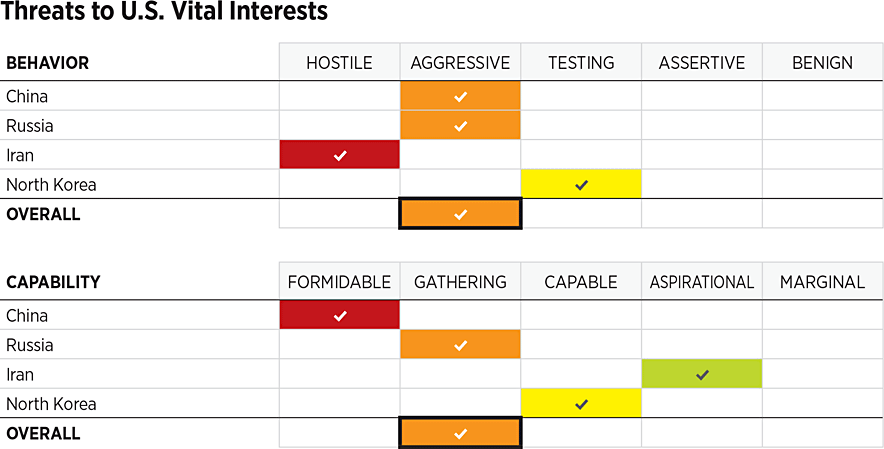
China—the United States’ primary adversary—remains “aggressive” in the scope of its behavior and earns the score of “formidable” for its capabilities. This is because of its modernization and expansion of its military and the particular attention it has paid to its nuclear and space capabilities. The People’s Liberation Army continues to conduct military activities beyond its immediate region and engages in ever larger and more comprehensive exercises, including live-fire exercises in the East China Sea near Taiwan—which seem for all the world like dress rehearsals for an invasion—and aggressive naval and air patrols in the South China Sea and around Australia.
China is rapidly closing the capability gap between its forces and those of the United States and is no longer a distant competitor. Indeed, its navy now has more ships than the U.S. Navy and it has the largest concentration of missiles on the planet. China regularly probes South Korean and Japanese air defense identification zones, drawing rebukes from both Seoul and Tokyo, and its statements about Taiwan and exercise of military capabilities in the air and sea around the island have become increasingly belligerent. China is taking note of the war in Ukraine, recent U.S. actions in Venezuela, and broader U.S. military developments and has been adjusting its own posture, training, and investments accordingly. It is and will remain, for the foreseeable future, America’s primary and most capable adversary.
Russia remains the primary threat to American interests in Europe. While it does not present the same threat to U.S. interests that the Soviet Union once did, it threatens a number of key U.S. allies and interests in Europe. Russia’s invasion of Ukraine reintroduced large-scale conventional war to Europe: It is the largest conflict on that continent since the end of World War II, and its economic and security repercussions are significant. Moscow also maintains the world’s largest nuclear arsenal, which poses an existential threat to the U.S. homeland, and although a strike against the American homeland is unlikely at present, Russia’s repeated attempts at nuclear coercion against our NATO allies using its 2,000 non-strategic nuclear weapons should not be dismissed.
The 2026 Index assesses the threat emanating from Russia as “aggressive” for level of provocative behavior and “gathering” for level of capability. Although Russia remains aggressive, it has lost significant amounts of its combat power to Ukrainian forces and, while its manpower remains robust, has been forced both to conscript more forces and to rely extensively on foreign assistance from North Korea, Iran, and China. Russia is not the formidable power it once was, but it still retains its industrial capacity and has shifted its economy to a wartime footing.
Iran represents by far the most significant security challenge to the United States, its partners, and its interests in the greater Middle East. Its open hostility to the United States and Israel, sponsorship of terrorist groups like Hezbollah (among others), and history of threatening the commons underscore the problem it could pose. Today, Iran’s provocations are of primary concern to the Middle East region and America’s allies, friends, and assets there.
Iran relies heavily on irregular (to include political) warfare against others in the region and fields more ballistic missiles than are fielded by any of its neighbors. Its development of ballistic missiles and its potential nuclear capability also make it a long-term threat to the security of the U.S. homeland. In addition, Iran has continued its aggressive efforts to shape the domestic political landscape in Iraq, adding to the region’s general instability. However, the concerted campaign by the State of Israel against the leadership and capabilities of Hamas and Hezbollah as well as its efforts to destroy Iran’s nuclear and missile capabilities, which have been carried out with support from the United States, have significantly degraded the threat from Iran even as it endures. The 2024 Index assessed Iran’s behavior as “aggressive” and its capability as “gathering.” The extended military campaigns between Iran and Israel have caused Iran to be assessed as “hostile” for its level of provocative behavior in the 2026 Index, but the severe degradation of Iran’s combat power and nuclear capabilities have caused it to be rated “aspirational” for its level of capability.
North Korea’s military poses a security challenge for American allies South Korea and Japan as well as for U.S. bases in those countries and on the island territory of Guam. In addition, North Korea’s continued advancement of its nuclear program and its intercontinental ballistic missile capabilities make it an increasing threat to the American homeland. Indeed, North Korean officials are belligerent toward the United States, often threatening to turn the American homeland into “a sea of fire.” Pyongyang also has engaged in a range of provocative behavior that includes nuclear and missile tests and tactical-level attacks on South Korea.
North Korea has used its missile and nuclear tests in an attempt to extract concessions from the United States in negotiations on its nuclear program. U.S. and allied intelligence agencies assess that Pyongyang has already achieved nuclear warhead miniaturization, the ability to place nuclear weapons on its medium-range missiles, and the ability to reach the continental United States with an intercontinental ballistic missile. The 2026 Index therefore assesses the overall threat from North Korea, considering the range of contingencies, as “testing” for level of provocative behavior and “capable” for level of capability.
Just as there are lower-level American interests that are not covered by the 2026 Index, there may also be additional threats to American interests that are not identified in this analysis. The 2026 Index focuses on the most threatening adversaries to U.S. vital interests.
Based on our assessments of these threat sources, the 2026 Index rates the overall global threat environment as “aggressive” for threat actor behavior and “gathering” for material ability to harm U.S. security interests. China’s dramatic expansion of its power projection abilities (especially its investment in nuclear weapons) and Russia’s potentially desperate desire for victory in its war against Ukraine, which could lead it to be more aggressive in other areas of military competition with the United States and Western allies, in addition to Iran’s ongoing investments in its nuclear and ballistic missile programs, result in an overall score of “high” in the 2026 Index.