Iran
Daniel Flesch and Phillip Smyth
Regional Overview
The Islamic Republic of Iran experienced profound changes and setbacks from 2024–2025. These changes did not alter Tehran’s bellicosity, anti-American and antisemitic rhetoric, pursuit of violent and malign activities, or desire to export its radical theocratic ideology, but they did impose significant costs on the regime and its ability to project strength across the Middle East.
On October 7, 2023, Iran’s strength was at its zenith. It commanded a network of proxy terrorist groups that gave Tehran influence or control in four separate countries or territories: Lebanon, Yemen, Iraq, and the Palestinian Territories of the Gaza Strip and Judea and Samaria (the West Bank). The Assad regime in Syria served as a client state that provided Iran with a land bridge to Lebanon and the means to supply and support its most vital regional asset, Hezbollah. Assad also granted Iran the ability to establish a military presence in the Syrian Golan Heights and directly threaten Israel’s northern border.
Iran had amassed the region’s largest and most sophisticated arsenal of ballistic missiles. Its ever-expanding capabilities threatened U.S. allies—notably Israel—and interests, and Iran’s developing space program suggests that it was developing the means to put much of Europe (and potentially the U.S. homeland) within missile range. Iran’s nuclear ambitions also continued unimpeded. Having survived the first Trump Administration’s “maximum pressure” campaign, the regime used the Biden Administration’s relentless pursuit of a new nuclear agreement to accelerate its enrichment and production capacity.
The invasion of Israel by Hamas on October 7, 2023, with its intent to unite the Iranian proxy network in a coordinated, multi-front assault to destroy the Jewish state led to a regional war in which Israel engaged and, to varying degrees, defeated Iran’s proxies around its borders. Though not a direct belligerent, the Assad regime also fell in December 2024, further undermining Iran’s ability to project power in the region. This war also featured the first direct engagement between Iran and Israel on April 13, 2024, when the regime launched a salvo of over 300 ballistic missiles, cruise missiles, and drones at Israel. This was followed by another ballistic missile attack on October 1, 2024.
On June 13, 2025, Israel launched Operation Rising Lion to destroy Iran’s ballistic missile inventory, launch and production capacity, and air defense assets and slow the development of its nuclear enrichment program. On June 22, 2025, the United States conducted Operation Midnight Hammer, a coordinated attack against three Iranian nuclear facilities that delivered a crippling blow to Iran’s nuclear programs.
In late 2025, Iran experienced a significant water drought that was exacerbated by government mismanagement and followed quickly by a plunging currency and unstable economic environment. This led in January 2026 to the largest protests in the country’s history. The regime responded to these protests with brutal repression, cutting internet access and killing thousands of Iranians.
Although Iran has suffered significant setbacks and is currently at its weakest point in decades, the regime still poses a threat to America’s interests in the region and, through its asymmetric capabilities, the U.S. homeland.
Iran’s Oil Exports
The Iranian regime depends on its natural resources to sustain its economy and export its revolution and regional ambitions. Oil exports accounted for about 57 percent of Iran’s total export revenue in 2024, making the regime highly dependent on its sale and vulnerable to international sanctions.[REF] Following the first Trump Administration’s maximum pressure campaign, sanctions against Iran were relaxed under the Biden Administration. Iran’s oil production increased from a low of 444,660 barrels per day in 2020 to 1,484,215 barrels per day in 2024.[REF]
The primary destination for this oil is China, which accounts for about 90 percent of Iran’s seaborne oil exports.[REF] Beijing helped to underpin Tehran’s ability to sell at steep discounts when necessary and to accept non-conventional arrangements that reduced exposure to the U.S. dollar-based financial system. Analysts also documented the use of insurance and financing workarounds, some involving state-backed Chinese insurers and opaque financial vehicles that smoothed payments and protected long-term projects tied to oil receipts.[REF]
Additional U.S. sanctions in 2025 targeted specific Chinese refining and logistics entities, including specific terminals, vessels, and insurers alleged to have been central to Iran’s export network. Official actions raised the operational cost for Iran’s traders but did not eliminate the regime’s ability to sell barrels to willing buyers.[REF] Iran lost roughly 26 percent of its potential oil export revenue by the end of 2024 because of sanctions evasion costs.[REF]
In February 2025, the U.S. Department of the Treasury and the U.S. Department of State imposed sanctions on more than 30 persons, vessels, and entities in multiple countries for facilitating Iran’s petroleum exports. In May, the U.S. announced threats of “secondary sanctions” on countries importing Iranian oil, making clear that buying Iranian crude or products could bring U.S. business exclusion.[REF]
In September 2025, U.N.-mandated sanctions that had been suspended under the Joint Comprehensive Plan of Action (JCPOA) were reintroduced through the “snap-back” mechanism: travel bans, asset freezes, prohibitions on funds to specific persons and entities. The European Union’s autonomous measures, including asset freezes on the Central Bank of Iran and several Iranian banks, were also resumed.[REF]
Force Assessment: Asymmetric Capabilities
Islamic Revolutionary Guard Corps/Quds Force. The Islamic Revolutionary Guard Corps (IRGC) and its expeditionary arm, the Quds (Jerusalem) Force, remain Iran’s primary instruments for projecting power, shaping regional conflicts, and pressuring adversaries. Their growing capabilities, which include missiles, drones, cyber operations, intelligence networks, and proxy armies, have enabled Tehran to influence events from the Gulf to the Mediterranean, the Red Sea, and beyond.
Historically, the Quds Force has maintained supply lines via air routes through Syria, Iraq, and Lebanon; land corridors forming the “Iran–Iraq–Syria land bridge;” maritime smuggling in the Red Sea and the Mediterranean; and covert factories in Syria, Lebanon, and Yemen. This network enables Iran to arm its proxies even under heavy sanctions and surveillance. Following the fall of the Assad regime and debilitation of its proxy network, it remains to be seen how the Quds Force will continue to support and supply Iranian assets around the region.
The Quds Force conducts intelligence operations abroad, targeting American, Israeli, Gulf, and Western interests, dissidents, and diplomatic and commercial sites as well as infrastructure and energy assets. It employs informant networks, front companies, operatives embedded in embassies, and cyber-enabled espionage.
Assassination attempts against American officials, among them President Donald Trump, have been traced to the IRGC’s Quds Force.[REF] Similarly, threats made to such former American Administration officials as former White House National Security Advisor Robert O’Brien and former Secretary of State and Central Intelligence Agency Director Mike Pompeo have come from these very forces.[REF] The targeted killing of Quds Force Commander Qassem Suleimani by the United States in 2020 was a severe loss for the organization, as was the targeted killing of IRGC Commander Hossein Salami by Israel in 2025.
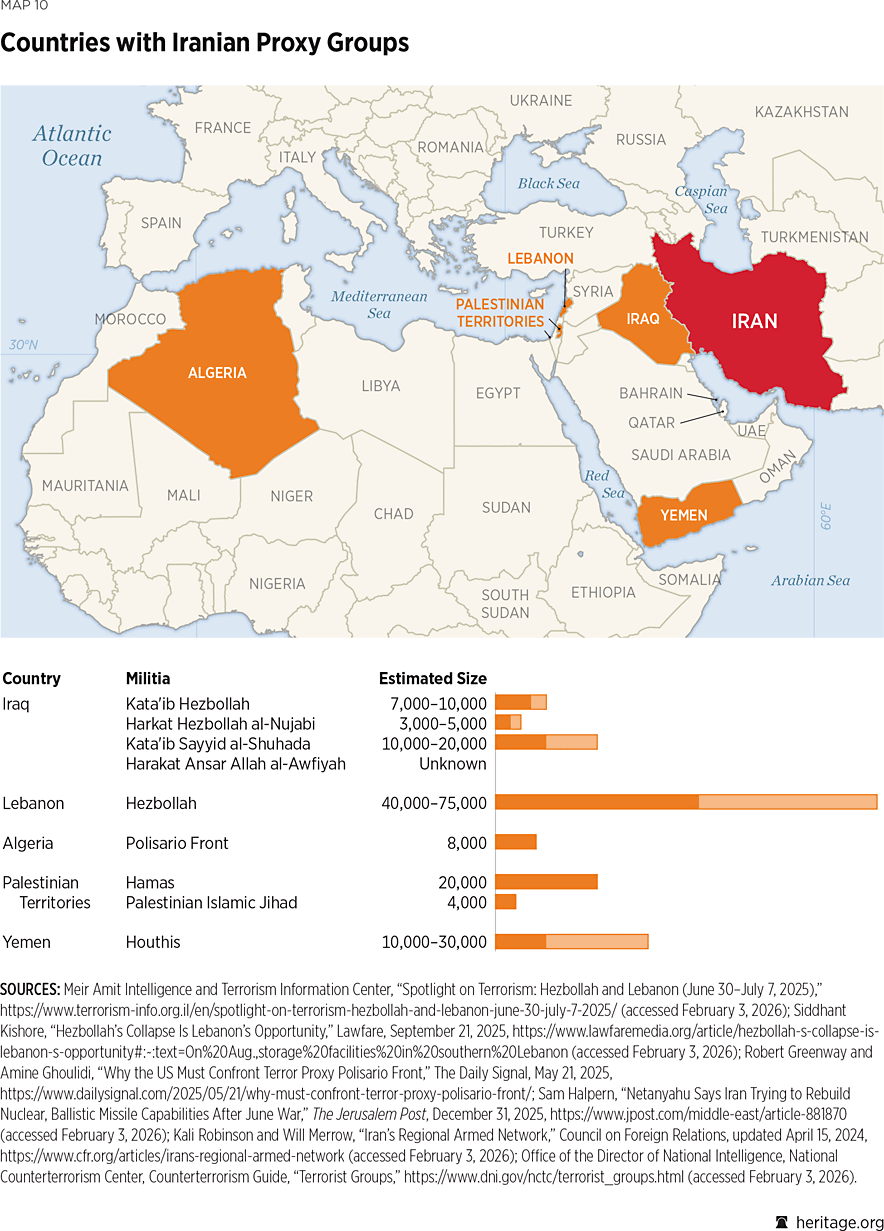
Proxy Network. Iran has adopted a political warfare strategy by which it seeks to avoid direct conflict with its adversaries, preferring an indirect approach that emphasizes irregular warfare, asymmetric tactics, and the extensive use of proxy forces. The IRGC has trained, armed, supported, and collaborated with a wide variety of radical Shia and Sunni militant groups as well as Arab, Palestinian, Kurdish, and Afghan groups that do not share its radical Islamist ideology. This includes numerous proxies, particularly the Lebanon-based Hezbollah; Iraqi Shia militant groups; Palestinian groups such as Hamas and Palestinian Islamic Jihad; and insurgent groups that have fought against the governments of Afghanistan, Bahrain, Egypt, Israel, Iraq, Jordan, Kuwait, Morocco, Saudi Arabia, Turkey, the United Arab Emirates (UAE), and Yemen.
Hezbollah. For more than 40 years, Hezbollah has served as Iran’s key node within a wider network of Iranian proxy organizations spread across the Middle East, Africa, and Central Asia. Hezbollah either has been responsible for or has assisted with dozens of attacks against U.S. targets, allies, and partners and more recently contributed thousands of fighters to aid Iran’s efforts in Syria, maintaining the rule of Bashar al-Assad. Hezbollah functions as a key organization involved in Iranian planning, projection, and attacks across the Middle East and the world generally.
In the 1980s–1990s, Hezbollah made a name for itself by attacking Israeli forces in Lebanon and Israel and by organizing and conducting terrorist attacks against Western targets in Lebanon. The organization also hybridized, gaining further power by entering Lebanese politics and winning seats in the Lebanese parliament. However, its political forays have not moderated the group. In 2006, Hezbollah was strong enough to precipitate a war against Israel by attacking, killing, and kidnapping Israeli soldiers stationed along the Lebanese border. Hezbollah’s arms also allowed it to maintain its power over Lebanon and even resulted in its May 2008 advance into Beirut when the group dispatched Sunni and Druze political foes.
Following the October 7, 2023, Hamas-led attacks against Israel, Hezbollah assisted its Gaza-based Palestinian allies by launching attacks against Israeli border posts, facilitating other Lebanese and Palestinian groups in their attacks from Lebanon, and launching rocket, missile, and drone attacks against Israeli targets.[REF] In July 2024, a Hezbollah rocket attack targeted the Druze border town of Majdal Shams, killing 12 Druze children and wounding 30 others.[REF] One October 2024 drone attack on the Binyamina barracks resulted in the deaths of four Israeli soldiers.[REF] Another Hezbollah rocket attack in October 2024 killed seven, including four Thai farm laborers in northern Israel.[REF] Hezbollah’s repeated and deadly attacks caused about 60,000 Israelis to be displaced from their homes in northern Israel.[REF]
As for Hezbollah itself, targeted retaliatory strikes and other attacks launched by Israel decimated the group’s leadership.[REF] Both Sayyid Hassan Nasrallah, leader of the group for 32 years, and his successor Hashim Safi al-Din were killed in Israeli airstrikes.[REF] Intermediate-level Hezbollah combatant leaders were also effectively targeted during Israeli intelligence operations that utilized explosive-laden pagers and walkie-talkies.[REF]
While Israel was quite effective in destroying large sections of the group’s leadership apparatus, however, Hezbollah is still a functional organization and is actively rebuilding its arsenal.[REF] The group has also resisted attempts to disarm it.[REF] With notable ideological loyalty to Iran, Hezbollah has played a key role in Iran’s attempts to build new radical militant organizations across the Middle East and carry out terrorist activity abroad, and its usefulness to Iran has not diminished.
Kata’ib Hezbollah (Hezbollah Brigades). Founded between 2005 and 2007, Kata’ib Hezbollah is staffed by ideologically loyal and extremely militant Iraqi Shia. Controlled by Iran, the group launched attacks against U.S. forces during the war in Iraq (2003–2011); fielded thousands of recruits for the war in Syria; is one of the largest factions in the Popular Mobilization Front (PMF); and continued attacks against American targets into 2024 operating as the Islamic Resistance in Iraq. The group has also maintained a bellicose anti-American stance. Kata’ib Hezbollah is a key organizational element in the building of Iraqi Shia militias, and its links to other organizations have helped it to form a core of violent groups loyal to Iran.
Harakat Hezbollah al-Nujaba (Hezbollah Movement of the Outstanding or HHN). Formed in late 2012/early 2013, this group is currently led by Akram Kaabi, formerly the secretary general of another major Iranian-backed Iraqi proxy, Asa’ib Ahl al-Haq. From 2012–2024, HHN recruited and supplied thousands of fighters to fight in Syria and was one of the most prolific recruiters among Iran’s Iraqi Shia militias. After the 2020 killing of IRGC-QF commander Qasim Suleimani, Nujaba was increasingly positioned as the leader of a range of front groups including the Islamic Resistance in Iraq.
Kata’ib Sayyid al-Shuhada (Master of the Martyrs Brigade or KSS). Formed in late 2012/early 2013, KSS was initially part of Kata’ib Hezbollah. Its leader, Abu Alaa al-Walai, was jailed by U.S. forces in 2010 for his role in attacking U.S. and Coalition forces in Iraq. By 2013, KSS had helped to recruit thousands of Iraqi Shia to fight in Iraq and Syria. It also has been directly involved in more contemporary attacks against U.S. forces and interests.[REF] In 2023, the U.S. Department of State listed the group and its leader as Specially Designated Global Terrorists.[REF] In September 2025, the U.S. Department of State designated the group as a Foreign Terrorist Organization (FTO).[REF]
Harakat Ansar Allah al-Awfiyah (Movement of the Loyal Supporters of God, or HAAA). HAAA sent hundreds of fighters to Syria and assisted Kata’ib Hezbollah in its control of Iraqi–Syrian border sites.[REF] In 2024, the U.S. government named HAAA as a group involved in the deadly 2024 attack against U.S. forces on the Jordan–Syria border; its secretary general, Haydar Muzhir Ma’lak al-Sa’idi, was listed as a Specially Designated Global Terrorist in June 2024.[REF] In September 2025, the U.S. Department of State designated HAAA as an FTO.[REF]
Iraqi Shia militias, particularly groups networked with Kata’ib Hezbollah, continue to pose a significant risk to U.S. personnel and interests within Iraq and the broader Middle East. Although their participation in the post–October 7 fighting was less than that of Lebanese Hezbollah or Yemen’s Houthis, these groups have provided training, equipment, and support to networks of fighters that have fallen under Iran’s umbrella. As Lebanese Hezbollah addresses losses in leadership resulting from Israeli attacks, Iran may continue its expansionist activities and other militant efforts using these groups.
Hamas. Iran’s support for Hamas is one of the most consequential relationships in Middle Eastern geopolitics. The two actors differ in ideology (Shi’a revolutionary Islamism versus Sunni Muslim Brotherhood Islamism), but they share a strategic alignment in seeking the destruction of Israel. Over the past three decades, Iran’s financial and military aid has been central to Hamas’s development from a grassroots terrorist movement into a governing authority in Gaza with significant military capabilities.
Iran began to support Hamas in the early 1990s, seeing the group as a useful partner within the Palestinian arena. After Hamas’s 2007 takeover of Gaza, Iran became its most important state sponsor, offering a mix of money, weapons expertise, training, and diplomatic backing. Estimates from open-source reporting and statements by regional intelligence officials suggest that Iran has provided tens of millions to hundreds of millions of dollars annually in amounts that have varied from year to year according to political conditions.[REF] Funding mechanisms have included direct transfers through IRGC Quds Force channels, cash shipments through intermediaries, and budgetary support to Hamas’s military wing (Izz ad-Din al-Qassam Brigades) as well as funding from Hezbollah and other proxy forces.[REF]
Iranian funding supports a broad spectrum of Hamas operations, such as purchases of raw materials for weapons production, the construction of terrorist tunnels and fortified positions, and procurement of electronic systems, communications equipment, and explosive materials. Iranian money has helped to cover salaries for Hamas terrorists and their families as well as stipends for Hamas operatives studying or training abroad.[REF]
Iran has supplied Hamas with blueprints, designs, and engineering guidance for rockets of increasing range; expertise in building multi-barrel launchers; and training on propellants, explosive mixtures, and fusion techniques. Much of this supply was smuggled into Gaza via the Philadelphi Corridor alongside the Gaza–Egypt border. Egypt and Sudan failed to stop this smuggling, and the weapons arsenal in Gaza grew steadily.[REF] As a result, Hamas developed Qassam rockets, M-75 and M-302 variants modeled after Iranian or Syrian systems, and longer-range projectiles such as the Fajr-5 missile capable of reaching Tel Aviv and beyond.[REF]
Over the 2010s and 2020s, Iran shared with Hamas designs for surveillance drones, components for simple loitering munitions, and training on assembling unmanned aerial vehicles (UAVs) from smuggled electronics and commercial parts. Iranian support contributed to Hamas’s production of anti-tank explosives, training in ambush tactics, and the use of guided systems smuggled earlier through Sudan or Sinai. Hamas fighters have undergone training in Iran (where they trained ahead of the October 7 attacks); in Lebanon (by Hezbollah); and at times in Syria.[REF]
Iran’s financial and military support for Hamas is a long-term, structural pillar of the region’s strategic landscape. Tehran has invested heavily in Hamas’s military evolution, offering money, weapons expertise, technology transfer, and strategic mentorship. This assistance has strengthened Hamas’s capacity to govern Gaza, resist Israeli military operations, and embed itself within the broader Axis of Resistance.
On October 7, 2023, Hamas invaded Israel and carried out the deadliest terrorist attack in Israel’s history.[REF] More than 1,200 civilians were murdered, 250 were kidnapped back into Gaza, and hundreds of others were raped and wounded. Israel retaliated and over the past two years has eliminated most of Hamas’s core leadership, among them Ismail Haniyeh, Yayha Sinwar, and Mohammed Deif.[REF] Following the cease-fire agreement of October 13, 2025, Israeli Defense Forces (IDF) controlled 53 percent of the Gaza Strip, and Hamas released all of the living Israeli hostages and most of the deceased hostages.[REF]
While it has suffered a heavy blow during Israel’s Operation Iron Swords, Hamas still exists in a semi-operational capacity and continues to benefit from its Iranian enablers. The United States must ensure that Hamas no longer governs the Gaza Strip in any way, as agreed to in the cease-fire agreement, and thus rid the Gaza Strip of all Iranian influence.
Houthis (Ansar Allah). The Houthis emerged from the mountainous northern sections of Yemen in the 1990s as a ragtag group of rebel Shia fighting the central government. Today, they are a well-armed and well-equipped organization that, under the leadership of Abdul-Malik al-Houthi, has about 20,000 fighters.[REF] Around 2005, Iran sent the Houthis Hezbollah advisors to assist in training.[REF] By 2014, the group had captured the Yemeni capital of Sanaa. In 2015, a coalition of Gulf Arab states—Saudi Arabia, the United Arab Emirates, and Bahrain—intervened and bombed Houthi targets and placed some ground forces in Yemen.[REF] Despite this pressure, the Houthis expanded their control of large sections of northern Yemen, including key ports, by 2016.
While Yemen is awash with weapons, Iranian support, particularly the supply of newer missiles and drones, remains a key factor in the Houthis’ continuing aggressiveness and power. According to the Defense Intelligence Agency, since 2015, Iran’s Islamic Revolutionary Guard Corps–Quds Force, “has been smuggling weapons and weapon components to the Houthis, which has enabled the advancement of the Houthis’ military capabilities.”[REF] In February 2025, the Yemeni Coast Guard, with assistance from U.S. Central Command (CENTCOM), intercepted “cruise missiles’ structures, jet engines used in cruise missiles and suicide drones, reconnaissance drones, in addition to marine radars, a modern jamming system, and an advanced wireless communications system.”[REF] All of these systems have been used by the Houthis against commercial shipping and Western naval vessels in the Red Sea.
The Houthis have provided Iran with another means to pressure international trade, launching direct attacks against Saudi Arabia and more recently against Israel. Houthi involvement in attacks against Israel and international shipping increased in the wake of October 7. As Iran attempts to rebuild Hezbollah and continues to entrench itself in Iraq using its Shia militias, the Houthis have taken on a more prominent position within Iran’s proxy army, particularly in the realm of armed attacks using advanced weaponry.[REF]
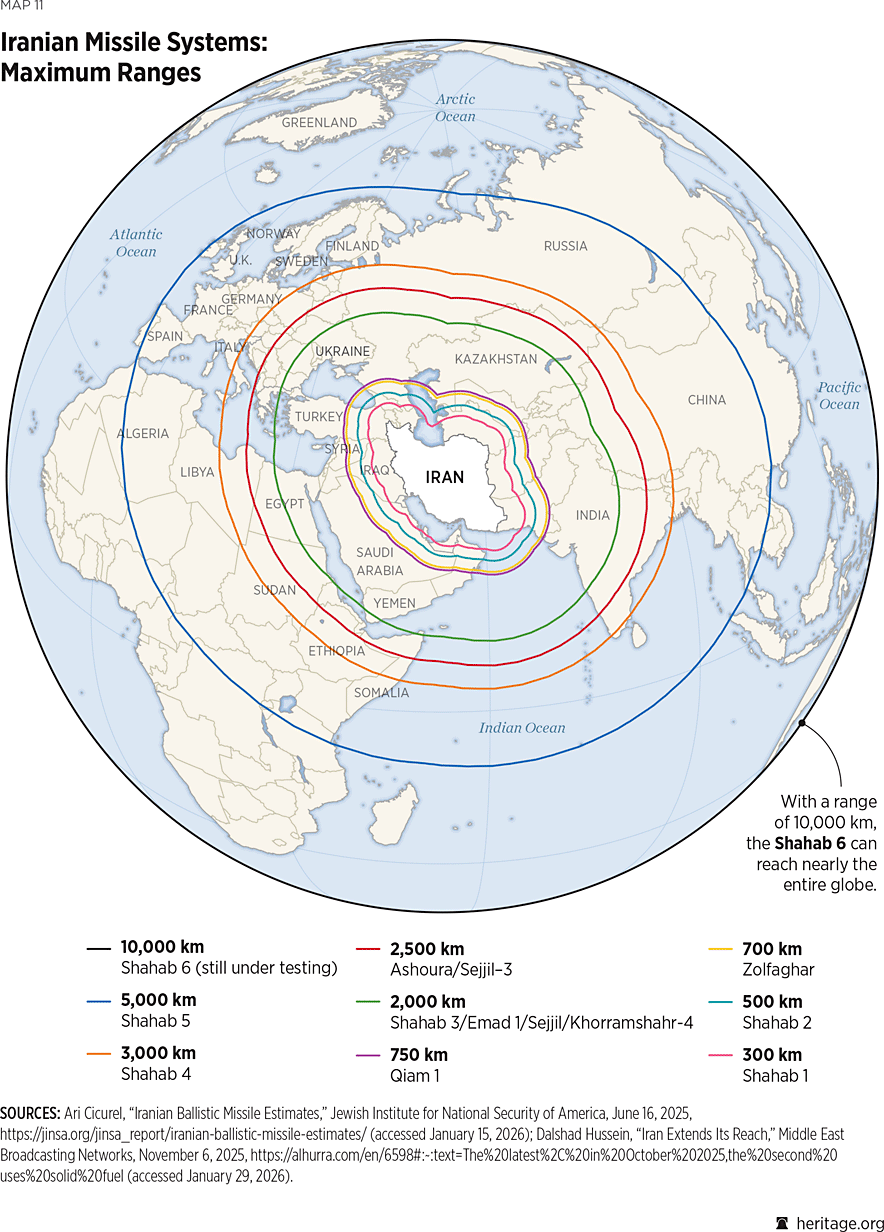
Ballistic Missiles. By 2025, Iran’s ballistic missile force remained a centerpiece of its conventional deterrent and power-projection strategy. Operated principally by the Islamic Revolutionary Guard Corps–Aerospace Force (IRGC–AF), the program combines a large and diverse missile inventory and a growing national industrial base for missile production with an operational doctrine that integrates missiles with drones, naval forces, and proxy partners across the region. Iran’s missiles have been used both as strategic signals and, increasingly, as operational tools in the flare-ups that erupted in 2024 as well as in the Twelve-Day War of 2025. These launches and their consequences have shaped regional military postures and triggered international sanctions by the U.S. and its allies as well as additional Israeli sabotage countermeasures.
Iran’s missile effort traces back to the 1980s and has matured into a layered force with several distinct missions: Deter attacks on the homeland; threaten adversary infrastructure (bases, ports, energy nodes); and provide asymmetric strike options against regional opponents. The IRGC–AF is the lead service for medium-range and short-range ballistic missiles (MRBMs and SRBMs); the regular army has limited ballistic capabilities. Doctrine emphasizes massed salvoes, distributed launchers, mobile road-based and rail-based launch systems, and concealment in hardened and underground facilities to complicate preemption. These operational choices reflect lessons that Iran drew from fighting in the region and from international attempts to degrade its programs.[REF]
Iran’s arsenal in 2025 consisted predominantly of solid-propellant and liquid-propellant SRBMs and MRBMs with ranges from a few hundred kilometers up to roughly 2,000–2,500 km for the longest-range systems tested or advertised. The inventory included indigenous designs (Shahin/Scud variants, Fateh-series, Zolfaghar, Dezful, Sejjil) and variants derived from foreign designs and adapted over decades.[REF] Iran also continued to expand its ability both to mount different payloads and submunitions and to improve accuracy through better guidance packages and terminal maneuvering—efforts aimed at improving effectiveness against hardened and mobile targets. Estimates of total missiles in inventory vary by source, and intense combat in 2024–2025 affected short-term stock levels.[REF]
The direct Israel–Iran confrontation in 2024 and 2025 brought Tehran’s ballistic missile capability from deterrence into frequent operational use. Heavy barrages launched against Israel in April and October 2024 and during the June 2025 exchanges demonstrated Iran’s capacity to mass-fire and the limits of missile defenses. The exchanges tested multi-layered air defenses and revealed trade-offs for defenders (what most needs to be protected) and for attackers (rate of fire vs. sustaining an arsenal). The combat period also showed that a portion of Iran’s missiles could penetrate sophisticated defenses while a significant percentage were destroyed on the launch pad or intercepted in the atmosphere—highlighting the potency and limits of the program in real operations.
It is estimated that before the Twelve-Day War, Iran possessed approximately 2,000–2,500 medium-range and intermediate-range ballistic missiles. Based on their expenditures and the number of those destroyed by Israeli strikes, that figure is likely fewer than 1,000.[REF] Additionally, estimates suggest that Israel’s strikes destroyed around one-third of Iran’s estimated 350 missile launchers, leaving Iran with approximately 100.[REF]
Iran claims that its missile stockpile did not suffer heavy damage and that its most powerful systems—including the newly developed Rastakhiz missile, which integrates nuclear and electromagnetic pulse strike capabilities—remained in reserve.[REF] An Iranian senior military advisor, Major General Yahya Rahim-Safavi, revealed that “several thousand missiles and drones had been stockpiled in fortified locations for rapid use in the event of any act of aggression.”[REF] Nevertheless, Iran did suffer losses, and efforts have been underway to restore its missile capabilities by rebuilding and modernizing Iran’s air defense systems.[REF]
China is a primary supplier of material to Iran for the production and reconstruction of its missile program. In recent months, intelligence sources have said that several shipments of sodium perchlorate, the main precursor in the production of the solid propellant that powers Iran’s mid-range conventional missiles, arrived from China at the Iranian port of Bandar Abbas at the end of September. Those sources say the shipments, which began to arrive on September 29, contained 2,000 tons of sodium perchlorate bought by Iran from Chinese suppliers in the wake of its 12-day conflict with Israel in June.[REF] The purchases are believed to be part of a determined effort to rebuild the Islamic Republic’s depleted missile stocks. Several of the cargo ships and Chinese entities involved are under sanctions from the United States.[REF]
Space. Iran’s space and rocket programs have given the country more data and experience when developing longer-range missiles, potentially to include ICBMs. “Why do they have a space program?” asked Secretary of State Marco Rubio in June 2025. “Is Iran going to go to the moon? No, they’re trying to build an ICBM so they can one day put a warhead on it.”[REF] In late September, Iran carried out an unannounced missile launch; Iranian parliamentarian Mohsen Zanganeh told Iranian state TV that “we tested one of the country’s most advanced missiles, which until now had not, so to speak, been trialed—and that test was successful…. In other words, I mean to say that even under these conditions we are conducting a security test of an intercontinental-range missile.”[REF]
The Iranians have also declared a desire to advance their capabilities in developing and launching satellites. Iran began its satellite launch program with a symbolic launch of a small satellite in 2009 and by 2020 had launched its first military satellite.[REF] Iran’s program has also suffered numerous failures. In 2019 and 2022, for example, Iran unsuccessfully launched satellites from its Imam Khomeini Space Center.[REF] However, in January 2024, Iran successfully launched its Mahda research satellite along with the Kayhan-2 and Hatef-1 communications and global positioning nanosatellites.[REF] In September, using a rocket developed by the IRGC, Iran carried out its second domestic satellite launch of 2024.[REF]
In addition to trying to develop and launch its satellites domestically, Iran has launched satellites in cooperation with other anti-American powers, particularly China and Russia. In 2022, Russia launched one Iranian-funded but Russian-manufactured optical imaging satellite.[REF] In February 2024, the Russians launched another Iranian-made imaging satellite.[REF] In October 2024, Iran sent a domestically produced imaging and communications satellite to Russia for launch.[REF] In July 2025, Russia launched another Iranian satellite into orbit.[REF] In mid-2024, Iran announced its interest in purchasing advanced Chinese-produced surveillance satellites.[REF] In August 2025, the Islamic Republic announced that it would move to adopt the Chinese BeiDou global positioning system.[REF]
Iran’s efforts in space further demonstrate a desire to develop a domestically capable program aimed at providing increased competence with rocket and missile technology. This drive coincides with Iran’s efforts to build systems that can provide better monitoring of Israeli, U.S., and other troop movements across the region. Iran’s continued partnership with and adoption of Russian and Chinese space systems and launch sites also demonstrate a continued desire to cooperate with anti-American actors.
Unmanned Systems. Iran’s advancement in unmanned systems (drone) technology also presents new threats beyond the Middle East. In April 2025, The Times of Israel reported that Spain, Germany, France, and the United Kingdom had dismantled a Hezbollah drone smuggling ring that was shipping material to Hezbollah that it could use to construct drones.[REF] Although the trade in smuggled drone parts was going to the Middle East, the access to parts and equipment demonstrated that Iran could attempt to manufacture drones covertly in the heart of Europe. Adding to this threatening climate, in July 2025, Mohammad Javed Larijani, an advisor to Supreme Leader Ali Khamenei, said that the “Europeans can no longer move about comfortably in their own countries…. It’s entirely possible that in the near future, five drones could strike a European city.”[REF]
Cheap, easy to produce and modify, Iranian drones such as the Shahed-129 and Shahed-136 are systems that have demonstrated their lethality across the Middle East and Europe.[REF] The proliferation of Iranian-designed drones has already made its mark in Eastern Europe. Russia has used thousands of Iranian-designed and Iranian-built drones to target Ukraine and in September 2025 used Iranian-designed drones to violate Polish and Romanian airspace.[REF]
The drone most frequently exported to Russia is the Shahed-136 loitering munition. Designed for simplicity and cost, the Shahed-136 is launched from a catapult that is often placed on a truck or mobile platform. It can travel 1,500 miles (2,500 km) at speeds of up to 125 miles per hour (200 km per hour) and loiter over a target until the most effective moment to strike. The Shahed-136 is a favored model as it is cost-effective and easy to mass-produce.[REF]
In June 2025, Iran unveiled a new drone, the Shahed-107, which appears to possess a more traditional design than the triangle configuration of the Shahed-136 and Shahed-131. Shahed drones are typically slow because of their propellers, are easily detected by air defense systems, and likely fly on pre-programmed routes, which makes them difficult to jam but also difficult to maneuver.[REF] Some of Iran’s other important drones are the Ababil-2, Ababil-3, Ababil-5, Arash, Fotros, Hamaseh, Kaman-12, Kaman-22, Karrar, Kian, Kian-2, Meraj-521, Mohajer-2, Mohajer-4, Mohajer-6, Mohajer-10, and Shahed-149 Gaza.[REF]
China has supported Iran’s drone industry, often by procuring parts on Tehran’s behalf.[REF] Since the Twelve-Day War, China has withheld official material aid despite Beijing’s rhetorical support for Iran and condemnation of Israel, but Israeli media, citing anonymous Western intelligence sources, have reported that China is rebuilding Iran’s missile arsenal.[REF] Iran’s alliance with China remains necessary, primarily because China purchases about 90 percent of Iran’s oil, which provides funding to Iran for the construction of missiles, nuclear weapons, and other military equipment.[REF] Additionally, China supports Iran’s missile production through the supply of sodium perchlorate, a precursor chemical that is used to produce ammonium perchlorate, a vital component of solid rocket fuel in missile production.[REF] In February 2025, Iran received a shipment of 1,000 tons of sodium perchlorate from China.[REF] Iran’s development, export, and production of UAV technology provide one of its more dangerous long-term capabilities.
Force Assessment: Conventional Capabilities
Iran’s conventional military forces, although relatively weak by Western standards, are large compared to those of Iran’s smaller neighbors. Iran’s armed forces remain dependent on major weapons systems and equipment that were imported from the U.S. before the country’s 1979 revolution. Western sanctions have also limited the regime’s ability to maintain or replace these aging weapons systems, many of which were depleted in the 1980–1988 Iran–Iraq war. Iran also has not been able to import large amounts of modern armor, combat aircraft, longer-range surface-to-surface missiles, or major naval warships.[REF]
Iran maintains one of the largest standing armed forces in the Middle East. Its conventional military consists primarily of the Artesh, which is composed of four main branches: Ground Forces (NEZAJA); Air Force (IRIAF); Navy (IRIN); and Air Defense Command (Khatam al-Anbiya). Over the past decade, Iran has invested modestly in modernizing its conventional capabilities, but it continues to rely heavily on domestically produced systems, refurbished legacy equipment, and doctrinal flexibility to offset technological inferiority.[REF]
The Artesh is focused on deterrence and territorial integrity but has increasingly expanded the range of its activities to include participating in maritime patrols in the Gulf of Aden and joint exercises with foreign powers like Russia and China. The Artesh maintains an estimated 350,000 active-duty personnel and 200,000 reservists, and the Ground Forces account for approximately 70 percent of that strength.[REF]
Ground Forces. The Ground Forces remain the backbone of Iran’s conventional military power. Numbers, domestic ingenuity, and terrain familiarity help the force to compensate for its lack (by Western standards) of modern armor or mechanized infantry equipment. The force includes an estimated 1,600 main battle tanks, including Soviet-era T-72s, T-55s, and domestically modified versions such as the Karrar tank, a heavily upgraded T-72 that features improved fire control, reactive armor, and Iranian-made optics.[REF] While still behind contemporary models like the M1A2 Abrams or Leopard 2A7, the Karrar represents Iran’s push for modernization of indigenous weapons.[REF]
Iran’s ground forces deploy a wide range of self-propelled artillery, multiple rocket launchers (MRLs), and short-range ballistic missiles (SRBMs). Domestically produced systems such as the Fajr-5 and Dezful provide the army with deep-strike capabilities up to 300 km, blurring the line between conventional and strategic forces.[REF] Mechanized and motorized infantry units rely on BMP-1/2 IFVs, locally built Boragh APCs, and a growing number of indigenous light tactical vehicles like the Aras and Talaeiyeh series.[REF] Mountain and border brigades are optimized for Iran’s rugged terrain, providing strong defensive depth.
Naval Forces. The Islamic Republic of Iran’s Navy (IRIN) has two main bases: southern fleet command at Bandar Abbas and northern fleet command at Bandar Anzali.[REF] Its fleet includes ships and submarines including Kilo-class submarines produced in Russia.[REF] Iran operates some newer anti-ship missile systems that include anti-ship ballistic missiles, cruise missiles, and anti-radar missiles. Many are domestic copies of Chinese models.[REF] In 2006, Hezbollah used an Iranian copy of the Chinese C-802 missile to strike the Israeli INS Hanit off the coast of Lebanon.[REF] Beyond the missile threats, Iran could repurpose its drone fleet and use them as anti-ship weapons systems.
Iran’s IRGC-Navy also operates dozens of small, manned vessels that could swarm commercial and military vessels. These boats have been used in maneuvers to harass U.S. ships in the Gulf. Iran’s naval doctrine centers on asymmetric disruption.[REF] Iran routinely threatens drone boat attacks on U.S. ships near Bahrain or Qatar as well as coastal missile strikes from IRGC positions along the Strait of Hormuz.
Air Force. The Islamic Republic of Iran Air Force (IRIAF), constrained by sanctions and decades of embargoes on advanced aircraft and spare parts, is the most challenged branch of the Artesh. Nevertheless, through domestic maintenance programs and strategic procurement from allies, the IRIAF has retained operational capability far longer than many expected.
Iran’s fighter fleet consists of a mix of aging Western and Soviet-era platforms that include U.S.-made F-14 Tomcats, F-4 Phantoms, and F-5 Tigers acquired before 1979; Soviet-designed MiG-29 Fulcrums and Su-24 Fencers obtained in the 1990s; and newly reported acquisitions of Su-35s from Russia, deliveries of which are ongoing as of 2025.[REF]
Iran has pursued several domestic projects to bolster the IRIAF. They include Kowsar, a locally produced jet trainer and light fighter derived from the F-5 design, and Qaher-313 (F-313), a prototype stealth fighter unveiled for propaganda value, although its operational status remains doubtful.[REF] The IRIAF also operates Su-24s for deep-strike missions as well as a variety of transport and tanker aircraft. Iran’s emphasis on air defense rather than air superiority has shifted resources toward surface-to-air missile (SAM) systems and radar networks.
Air Defense Command. The Khatam al-Anbiya Air Defense Base now operates separately from the IRIAF, controlling such long-range systems as Bavar-373 (Iran’s indigenous equivalent of the S-300) and Sayyad-4 and Khordad-15 SAMs that are powered by Russian S-300PMU-2 batteries.[REF] This network integrates radar coverage across much of Iran’s territory, posing a credible threat to air operations over Iran. Israeli airstrikes in October 2024 and Operation Rising Lion destroyed much of Iran’s air defense capacity. The Air Defense Command has started to rebuild, but the level of progress remains unclear.[REF]
Threat to the Region
Threats to American Military Facilities and Diplomatic Missions. The United States maintains a significant presence in the region. Iran has launched missile attacks on U.S. military bases in the region on several occasions including in 2020, 2024, and 2025.[REF] In January 2024, an Iranian proxy group in Iraq launched an attack on an American base in Jordan, killing three soldiers.[REF] In July 2024, an Iranian drone launched by the Houthis targeted the U.S. embassy branch office in Tel Aviv.[REF] The Al Udeid base in Qatar and the U.S. 5th Fleet in Bahrain remain key targets for Iranian aggression and fall well within reach of Iran’s missile program, as does the Al Asad base in Iraq. Iran has not hesitated to attack these bases in the past and can easily do so again in the future.
Threat to the Global Commons: Sea. America’s primary strategic interests in the Middle East are to ensure the free flow of energy and commerce through the region. The Strait of Hormuz is the world’s most important oil transit chokepoint. “In 2022,” according to the U.S. Energy Information Administration, “its oil flow averaged 21 million barrels per day (b/d), or the equivalent of about 21% of global petroleum liquids consumption.”[REF] China is the largest consumer of Middle Eastern oil, followed by India, South Korea, and Japan, and more than 80 percent of oil exports through the Strait is destined for Asian markets.[REF] A large percentage of international trade also transits through the Middle East.
Iranian threats to international shipping lanes have remained a constant since the country’s war with Iraq in the 1980s. During that conflict, in the so-called Tanker War, Iraqi and Iranian forces struck oil tankers and threatened port facilities throughout the Persian Gulf. In 1987, following the delivery of Chinese-made Silkworm anti-ship missiles, the Iranians targeted a U.S.-flagged tanker in the Gulf, and the U.S. retaliated by striking Iranian sites and naval shipping in the Gulf.[REF] Iran increased its acquisition and domestic development of anti-ship systems and in mid-2025, following the joint U.S.–Israel strikes on Iran’s nuclear facilities, once again threatened to close the Strait, although it did not act on that threat.[REF]
The Red Sea is another chokepoint that is increasingly used by Iran through its proxies to put pressure on international trade and U.S. partners and allies. In 2023, about 12 percent of global trade volumes passed through the Red Sea.[REF] In addition, with 40 percent of trade from Asia to Europe passing through it, including large amounts of oil and other fuels, Egypt is reliant on the currencies it earns allowing ships to go through the Suez Canal.[REF]
Iran’s backing of Yemen’s Houthis demonstrated their threat to the commons throughout 2025. In November 2023, using a helicopter and smaller vessels, the Houthis seized the Galaxy Leader cargo ship. The crew was released from Houthi captivity in January 2025.[REF] This was followed by more than 100 missile and drone attacks against commercial vessels from late in 2023 through the middle of 2025.[REF] These attacks resulted in the rerouting of hundreds of ships and their cargoes, which cost shippers, manufacturers, and consumers significant revenue. In Germany, Tesla had to shut down a factory due to the slowdown of its supply chains that passed through the Red Sea.[REF]
Threat to the Global Commons: Air. Iran has shot down civilian aircraft during crises. Following the killing of IRGC-QF commander Qasim Suleimani on January 3, 2020, Iranian air defenses accidentally shot down a civilian airliner. On January 8, 2020, Ukrainian International Airlines Flight 752 was hit by two missiles fired by the IRGC, and 176 people were killed. To deter potential counterstrikes from the U.S. following the Suleimani killing, Iran kept its civilian airports open and flights on schedule.[REF]
The belligerency of Iran and its proxies also has had unintended consequences. On October 27, 2023, a drone launched at Israel by the Houthis hit Nuweiba in Egypt.[REF] Later, a missile launched by the Houthis hit Taba, Egypt, injuring six people.[REF] In October 2024, Iranian missiles launched at Israel struck Palestinians that Iran claimed to be “defending.”[REF]
Nuclear Proliferation. Iran’s pursuit of nuclear capabilities threatens to create a domino effect of regional proliferation. Saudi Arabia has vowed that if Iran does build nuclear weapons, it will do so as well.[REF] The United Arab Emirates established its own nuclear program under the 123 Agreement signed in 2009.[REF] Saudi Arabia is currently seeking a similar program, and other countries would likely follow suit.[REF] Egypt is currently constructing a nuclear program similar to the UAE’s but with Russian support.[REF] Bahrain, because of similar fears, recently signed an agreement with the United States on civilian nuclear cooperation.[REF]
Regional Partners: Israel. Israel and Iran had close diplomatic relations until the overthrow of the Shah’s government in 1979. In addition to embassies and direct flights, the two countries cooperated in trade, tourism, and much more. Ever since the Ayatollah regime took power, however, Iran has openly sought Israel’s destruction. This is the only case in which one U.N. member state has called outright for the destruction of another. Iran has used nearly every method it has available to attack Israel, both directly and through its proxies. It has threatened Israel on almost every front, and Supreme Leader Ali Khamenei has denounced Israel as a “malignant cancer.”[REF]
Nor does this stop with Israel. According to the Iranian regime, Israel is merely the “Little Satan;” the United States is the “Great Satan.” The Ayatollah regime believes in reestablishing the Islamic Caliphate and that the Western world is an obstacle that must be overcome if it is to achieve this goal. It therefore wishes to eradicate Western society as a whole, destroy modernity, and replace it with its brand of medieval Islamic theology. Israel is an obstacle for the regime because it represents a Western outpost in the heart of the Islamic world. The State of Israel has not been shy about warning the world of the Iranian threat and exposing it. Israel understands the threat that Iran poses to its very existence, and no country has acted as repeatedly as Israel has to deter Iran. Many other countries have been more passive toward Iranian aggression, but Israel has acted defensively and taken preventive measures against Iran and its proxies whenever it deemed such action to be necessary. Israel’s defensive actions against Iran in 2024 and 2025 weakened the Iranian regime in unprecedented ways, but Iran still maintains its radical ideology and will continue to threaten Israel.
Regional Partners: Saudi Arabia. Since 1979, Iran has maintained a generally hostile stance toward most members of the Saudi-led Gulf Cooperation Council (GCC).[REF] In a sectarian sense, Saudi Arabia is one of the region’s leading Sunni powers and stands in opposition to the radical Shi’ism proffered by Iran. The Saudis also control both of Islam’s holiest sites, Mecca and Medina.
Saudi Arabia’s Shia population lives primarily in its Eastern Province, which has been a center of Iranian provocations. Iran supported local pro-Hezbollah movements there in the 1980s. One of these groups, Hezbollah fi al-Hejaz (also known as Saudi Hezbollah) attacked the U.S. barracks in Khobar, Saudi Arabia, in 1996, killing 19 American airmen.[REF] Following the Arab Spring of 2011–2012, large-scale protests and the growth of small militant sections resulted in Saudi crackdowns. By 2017, the Saudi Shia town of Awamiya saw protests and then fighting between Saudi security forces and Shia militants.[REF] Tensions have eased over the years, but radical elements, some with links to Iran, still inhabit Saudi Arabia’s oil-rich Eastern Province.
The Saudis have also fought such Iranian-backed groups as Yemen’s Houthis. For their part, the Houthis have repeatedly launched rockets, missiles, and drones into Saudi Arabia. In one case, they hit the Islamic holy city of Mecca. In July 2017, the Houthis targeted Saudi oil facilities using missiles. In 2019, they claimed responsibility for targeting major Saudi oil sites in Abqaiq.[REF] However, some analysts and U.S. government officials have said the attack actually originated in Iran and that the Houthis took responsibility to obscure Iranian involvement.[REF] In 2021, Reuters reported that the “Houthis have fired 430 missiles, 851 drones at Saudi Arabia since 2015.”[REF] In 2023, the Saudis drew down their involvement in Yemen and, in a Chinese-brokered deal, cautiously began a rapprochement with Iran. The Houthis ceased their missile and drone attacks against the Saudis around that time, but in April and September of 2025, failed Houthi attacks on Israel resulted in missiles falling within Saudi territory.[REF]
While a level of calm may have been reached among the Houthis, Saudi Arabia, and Iran, this does not mean that the possibility of future conflict has disappeared. From 1987–1990, diplomatic ties between Saudi Arabia and Iran were severed. Diplomatic links were renewed in 1991 and persisted until 2016. However, during that period, Iran continued to back anti-Saudi proxies and attacks against targets in Saudi Arabia (the 1996 Khobar Towers attack) and against individual Saudis (such as the 2011 plot to assassinate Saudi ambassador to the U.S. Adel al-Jubeir in a Washington, D.C., restaurant).[REF]
Regional Partners: United Arab Emirates. Despite regional tensions, the UAE has maintained diplomatic relations and has pursued trade and economic relationships with Iran.[REF] Diplomatic visits have also taken place over the years, and there are direct flights and tourism for both countries.[REF] The UAE is nonetheless cautious in dealing with the Iranians and has suffered attacks from its proxies, most prominently the Houthis.[REF]
The UAE was early to warn the world about the threat that emerged from the Iranian-backed Houthis in the 2000s. It is also believed that the 2024 assassination of a rabbi who lived and worked in the UAE was sponsored and coordinated by Iran.[REF] This was the only such terrorist attack on UAE soil in decades, and the suspects were quickly caught and sentenced to death.[REF]
The UAE has dealt with the Iranian threats quietly but efficiently and for the most part has not ceased to communicate with the regime through official channels as have other countries in the region. However, in strategic areas, the UAE has offered its defense cooperation against Iran. During the 2024–2025 Iranian missile attacks on Israel, as part of CENTCOM, the UAE was helpful in intercepting missiles over its airspace.[REF]
Regional Partners: Bahrain. Home to the U.S. Navy’s 5th Fleet, Bahrain has served as one of many regional flash points that demonstrate heightened Iranian threats against U.S. and Gulf regional partners. With a Shia majority population and a leadership that is predominantly Sunni, and with the failure of Arab Spring protests in 2011–2012, Bahrain has provided a fertile ground for Iran’s machinations. In 1981, the Iran-backed Islamic Front for the Liberation of Bahrain attempted a coup in the island country.[REF] The attempt failed, but it reflects Iran’s early and continued links to Bahraini militant groups. The fact that Bahrain is a signatory to the 2020 Abraham Accords is another source of tension between the two countries.[REF]
In the wake of the 2011 Arab Spring protests and the crackdowns that later ensued, some Bahraini Shia became increasingly militant against the Bahraini state and the United States. A series of Iran-backed Bahraini Shia militant groups began to grow in 2012 and reached their apex in 2015–2016. Bahrain cut off diplomatic relations with Tehran in 2016, and despite some attempts to restart them, relations remain icy.[REF]
Iran-backed Bahraini groups have carried out dozens of bombings and shooting attacks targeted at infrastructure, security forces, and Bahraini leaders.[REF] They have also threatened U.S. forces on the island, particularly the 5th Fleet in Juffair.[REF] When relations between Bahrain and Israel were normalized in 2020, these groups threatened to attack U.S. and Bahraini government sites. Fortunately, U.S. security cooperation with Bahrain and the actions of the Bahraini internal security apparatus have helped to diminish the power of many of these Iran-backed networks.
Even though networks of Iran-backed Shia militants were rolled back in Bahrain from 2013–2018, however, elements of these groups have increased their cooperation and networking with Iran-backed Iraqi groups and with Iran.[REF] Saraya al-Ashtar, designated by the U.S. Department of State as a Foreign Terrorist Organization, has continued to make threats and claim attacks. In May 2024, after years of general silence, the group claimed to launch a drone attack against the Israeli city of Eilat.[REF] On June 19, 2025, three days before the U.S. bombing of Iranian nuclear facilities, the previously unknown Bahraini group Rijal Allah (Men of God) threatened “Zionist and American interests in Bahrain” if Iranian Supreme Leader Ali Khamenei was harmed.[REF]
Despite Bahrain’s success in dismantling local militant groups, Iran and the remaining networks remain deeply linked. The potential to use these networks still presents an active threat both in Bahrain and within Shia-majority zones in neighboring eastern Saudi Arabia.
Syria. By 2025, what remained for Iran in Syria was a crumbling shell of what it had constructed from 2012–2024. Despite deploying thousands of foreign Shia militiamen to Syria and establishing dozens of native militia groups, and despite the support of thousands of Revolutionary Guard Corps members, the groups Iran fostered in the country collapsed in the face of the November 2024 onslaught led by Hayat Tahrir al-Sham (HTS) and other Syrian rebel groups. With the December 2024 fall of Bashar al-Assad’s rule, Iran’s regional projection was made notably more difficult. However, this did not mean that Iran was without assets in Syria or that it would discontinue its destabilizing activities.
Iran had established a long-sought “land bridge” linking it to Lebanese Hezbollah through Iraq and Syria. Disruption of this land bridge was acknowledged by Hezbollah’s new secretary general Naim Qassem in December 2024 when he admitted, “Yes, Hezbollah has lost the military supply route through Syria,” adding that the group would investigate new ways to continue its trafficking of arms and supplies into Lebanon.[REF] Tribal networks with links to drug smuggling that had contributed members to Syrian militias and Lebanese Hezbollah and were often religiously Shia formed one body of elements that remained behind in Syria to advance Iran’s interests.[REF] In the Qusayr region on the Lebanon–Syria border, for example, Syrian Shia villagers aligned with Lebanese Hezbollah continued to engage in weapons smuggling, drug trafficking, and firefights with the new Syrian government. The area had contributed dozens of fighters to Hezbollah, including its elite Radwan unit.[REF] In early 2025, HTS-led Syrian government forces raided the Qusayr region, and the fighting expanded into Lebanon.[REF]
Using a strategy that involved the creation of online front groups, Iran created new organizations for Syria. Rallying pro-Iran Alawite minority leaders, formerly from Bashar al-Assad’s Syrian Arab Army and linked militias from Iran-backed sections of Assad’s Syrian Arab Army, Iran assisted in crafting small militant movements that eventually targeted HTS forces. The HTS response led to days of sectarian bloodletting. The ensuing violence resulted in around 1,500 civilians killed when Alawite villages were targeted by HTS forces.[REF]
Playing a spoiler role and doing so asymmetrically allowed Iran to sow chaos and frustrate hopes of further international recognition for the new authorities in Damascus. Blunted by the loss of Syria, Iran may continue to try to play a spoiler role in the country even if its capabilities are lacking. As Lebanese Hezbollah continues to run smuggling networks through Syria, the country may become a flash point in future incidents involving the HTS-led government in Damascus, Iran, and Iran’s proxies.
Africa: Sudan. Iran’s involvement in Sudan began to deepen in the late 1980s shortly after the rise of Sudanese Islamist leader Omar al-Bashir, backed by Hassan al-Turabi’s National Islamic Front. Both Tehran and Khartoum at that time sought to position themselves as leaders of an Islamic revivalist movement, albeit from different sectarian perspectives. However, by the mid-2020s, Sudan’s foreign policy had shifted dramatically, and in 2016, Khartoum cut ties with Tehran, which severed Iranian access to military bases and transit routes.[REF] In 2019, the Bashir regime was overthrown and replaced by the Transitional Sovereignty Council (TSC) led by General Abdel Fattah al-Burhan. Under Burhan, Sudan joined the Abraham Accords, ending the boycott of Israel. In return, Sudan’s designation in the United States as a state sponsor of terrorism was removed.[REF]
When the civil war between the Sudanese Armed Forces (SAF) and the Rapid Support Forces (RSF) escalated, intelligence reports noted that Iranian-made drones similar to systems supplied to the Houthis had found their way into Sudan’s battlefields.[REF] Frustrated by the lack of engagement from either Jerusalem or Washington, the Sudanese leadership accepted Iran’s offer to reestablish diplomatic relations and military cooperation.[REF] Given Sudan’s strategic location on the Red Sea, this renewed Iranian presence poses a threat to Africa, Israel, and the global commons.
Africa: The Polisario Front. In 2018, Morocco cut ties with Iran because of Iran’s assistance to the Polisario Front, which was provided by Hezbollah’s external operations units and the Iranian embassy in Algiers.[REF] This support included the training of Polisario fighters in guerrilla tactics and the use of advanced weaponry, transfer of man-portable air-defense systems (MANPADS) and other weapons via Lebanese or Algerian intermediaries, and assistance in developing drone capabilities.[REF] Western intelligence assessments have confirmed that some level of communication and technical transfer may indeed have taken place, particularly in the realm of drone know-how and tactical training.[REF]
In 2025, citing threats made by the Polisario to Morocco and the United States, Representatives Joe Wilson (R–SC) and Jimmy Panetta (D–CA) introduced bipartisan legislation to designate the Polisario Front as a Foreign Terrorist Organization.[REF] In 1988, Polisario missiles had brought down two U.S. Agency for International Development aircraft, killing five Americans—and the U.S. had failed to respond with sanctions.[REF] Designation of the Polisario Front as an FTO would help to weaken Iranian aggression and reduce the threats it poses both to Africa and to the world generally.
Threat to the U.S. Homeland
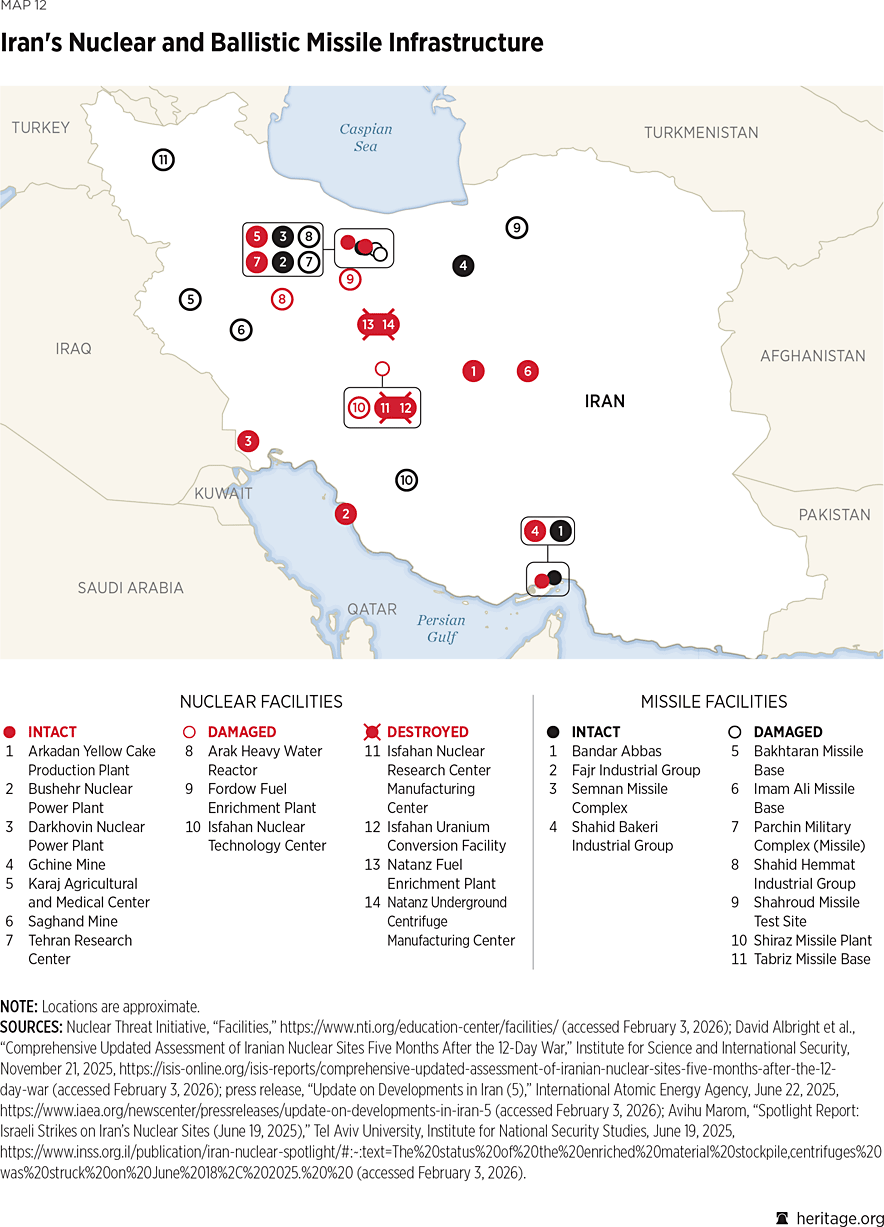
Nuclear. Tehran has invested tens of billions of dollars since the 1980s in a nuclear weapons program that it sought to conceal within its civilian nuclear power program. It built clandestine but subsequently discovered underground uranium enrichment facilities near Natanz and Fordow and a heavy-water reactor near Arak that would generate plutonium to give it a second potential route to nuclear weapons.[REF]
The July 2015 Iran nuclear agreement—formally known as the Joint Comprehensive Plan of Action—lifted nuclear-related sanctions on Iran in January 2016, gave Tehran access to approximately $100 billion in restricted assets, and allowed Iran to expand its oil and gas exports, the chief source of its state revenues.[REF] Relief from the burden of sanctions helped Iran’s economy and enabled Iran to enhance its strategic position, military capabilities, and support for surrogate networks and terrorist groups.
In 2018, President Trump decided to withdraw from the JCPOA and established the “maximum pressure campaign.”[REF] His decision to withdraw from the nuclear agreement marked a return to long-standing U.S. nonproliferation policy. However, during the Biden years, that pressure was lifted, and Iran’s nuclear program accelerated once again. In April 2021, Iran began to enrich its uranium to 60 percent, a short step away from the weapon-grade level of 90 percent.[REF] By June 2022, Iran’s breakout time had fallen to zero. It had acquired enough highly enriched uranium to arm a bomb within weeks if further enriched and could acquire enough for five bombs within six months.[REF] General Mark Milley, then chairman of the Joint Chiefs of Staff, testified before the House Appropriations Subcommittee on Defense on March 23, 2023, that “[f]rom the time of an Iranian decision…Iran could produce fissile material for a nuclear weapon in less than two weeks, and would only take several more months to produce an actual nuclear weapon.”[REF]
On June 12, 2025, the International Atomic Energy Agency’s Board of Governors adopted a resolution formally urging Iran to cooperate and effectively declared Iran to be in breach of its non-proliferation obligations.[REF] In accordance with the Non-Proliferation Treaty, President Trump made it clear in a Truth Social post that in any future deal with Iran, enrichment will not be permitted.[REF]
Later in June, Israel initiated Operation Rising Lion, followed by America’s Operation Midnight Hammer, which combined for the Twelve-Day War that targeted Iran’s ability to produce and launch ballistic missiles and develop its nuclear program. In these strikes, Iran’s three main nuclear facilities—Fordow, Isfahan and Natanz—were significantly damaged or destroyed.[REF] Israeli strikes on Arak, a heavy water reactor, destroyed the facility’s concrete dome and nearby laboratory, making its reconstruction difficult.[REF] This site was also where the headquarters of the SPND nuclear project was located and where Iran stored its nuclear archives.
However, Iran claimed that it took proactive measures to protect its nuclear material and may still possess more than 400 kilograms of near-bomb-grade highly enriched uranium that survived the attacks.[REF] Additionally, satellite imagery shows considerable movement and construction around Pickaxe Mountain, a hidden fortress under construction near Natanz and a suspected location of Iran’s hidden uranium stores. As of this writing, there has been no significant activity around Fordow or Isfahan according to satellite imagery.[REF] Construction on Pickaxe Mountain began in September 2025, but the facility may lack the planetary mixers that are needed to produce solid-fuel propellant.[REF]
Cyber. Iran’s cyberterrorism has long blended espionage, disruption, and psychological operations. By the mid-2020s, Tehran was using cyberspace increasingly to support proxy groups, exert coercive pressure on adversaries, and target civilian infrastructure in ways that blurred the line between cyber warfare and cyberterrorism. Although Iran seldom claims direct responsibility, its intelligence services—particularly the IRGC and the Ministry of Intelligence (MOIS)—have been linked repeatedly to operations intended to intimidate civilian populations, create social fear, or disrupt essential services.[REF]
Iran-linked groups have targeted water systems, power grids, medical networks, transportation systems, and municipal services in such countries as Israel, the United States, Bahrain, and Albania. While most attempts are thwarted, the intent to disrupt civilian life includes attacks attempting to alter water treatment chemical levels, ransomware deployed against hospitals and health networks, and denial-of-service attacks on emergency services or government portals.[REF]
Iran-linked groups have conducted operations aimed at public exposure of sensitive personal information. These leaks are often accompanied by online threats or mass messaging campaigns. Targets have included Iranian political dissidents abroad, U.S. and Israeli government employees, private citizens, and other influential figures. By weaponizing stolen data, attackers aim to intimidate both individuals and institutions such as was tried with the 2024 U.S. presidential election.[REF] Iran and its proxies also have conducted cyber intimidation campaigns such as defacement of government websites with threatening messages, localized attacks on energy or telecommunications providers, and phishing and surveillance targeting specific individuals of influence.[REF]
Iran-linked actors have frequently attempted disruptive intrusions into Israel’s civilian water and transportation systems. Similarly, though not large-scale, Tehran’s actions against Albania, including the shutdown of government services, have been intended to send a broader message: Supporting Iranian opposition groups may carry consequences for a country’s civilian population. Saudi Arabia, Bahrain, and the UAE have experienced recurring cyber disruptions aimed at financial institutions, airlines, and logistics-center sectors that are critical to public confidence and daily life.[REF]
Terrorist and Criminal Activities in the United States. Iran has sought the kidnapping or targeted assassination of political figures in the United States. In 2022, according to the U.S. Attorney’s Office for the Southern District of New York, Iran hired two “high-ranking members of an Azeri faction of the Russian Mob” and another member of the Russian Mob for $500,000 to kidnap or kill human rights activist Masih Alinejad.[REF] In September 2024, Naji Sharifi Zindashti, an Iranian drug lord operating with Iranian intelligence, paid two Canadian Hells Angels $350,000 to commit a contract killing of an IRGC defector living in Maryland.[REF]
In 2024, an Iranian agent named Farhad Shakeri promised to pay Carlisle Rivera and Jonathon Loadholt $100,000 to assist in surveillance and assassination plots assigned by Tehran.[REF] Chief among these plots was a plan to assassinate President Donald Trump. An Iranian dissident activist, Jewish Americans, and Israeli tourists were also on Shakeri’s hit list. Shakeri, formerly incarcerated in the U.S., recruited fellow criminals and ex-convicts for his assassination network.[REF] Other officials from the first Trump Administration also have received credible threats on their lives.[REF]
Iran has also funded civil unrest and protests across the United States since Hamas’s attack on Israel on October 7, 2023.[REF] According to the Director of National Intelligence:
Iranian government actors have sought to opportunistically take advantage of ongoing protests regarding the war in Gaza, using a playbook we’ve seen other actors use over the years. We have observed actors tied to Iran’s government posing as activists online, seeking to encourage protests, and even providing financial support to protesters.[REF]
Networks in the Western Hemisphere. In the broader Western hemisphere, Hezbollah has a growing presence throughout Latin America and supporters in Canada. The proximity of these networks to the U.S. also poses a threat to the homeland. Members of Hezbollah in Canada have been involved in activities linked to illicit financing for the group, including cigarette and weapons smuggling.[REF] In Latin America, Hezbollah’s networks, presence, and state support from countries such as Venezuela continues to pose an increasing and dynamic threat.
Hezbollah’s well-established presence in Latin America provides a series of safe havens—zones to aid the organization financially and potentially strike at the U.S. and American interests. According to the RAND Corporation, the tri-border region linking Argentina, Brazil, and Paraguay “hosts a substantial Lebanese-Muslim population” and “is home to individuals who sympathize with and facilitate the organization’s operations.”[REF] In South America, “the Venezuelan government has created an environment that allows Hezbollah to maintain active cells engaging in drug trafficking, money laundering, and illicit smuggling.”[REF] Writing for the Atlantic Council, Joseph M. Humire has noted that “[the] Lebanese terrorist group has helped to turn Venezuela into a hub for the convergence of transnational organized crime and international terrorism.”[REF] Mexican drug cartels also have worked closely with Hezbollah in the trafficking of drugs and as a means for Iran to attempt to assassinate dissidents and other foes in the United States.[REF]
Great-Power Partnership: Russia and China. Russia and China see Iran as a critical partner in their efforts to challenge Western influence: Russia views Iran as a key actor in consolidating its military and political reach across the Middle East, Africa, and Europe, and China sees Iran as a cornerstone of its Belt and Road Initiative (BRI) and a crucial energy supplier. The signing of the 25-year China–Iran Comprehensive Strategic Partnership in 2021 and Iran’s entry into the Shanghai Cooperation Organization (SCO) in 2022 formalized these trends, embedding Iran into a broader Eurasian bloc centered around Beijing and Moscow.[REF]
By 2025, the Tehran–Moscow relationship had matured into a robust strategic alliance, particularly in the military and energy sectors. Iran has supplied Russia with drones, including the Shahed-136 loitering munitions that have played a critical role in Russia’s operations in Ukraine.[REF] In exchange, Moscow has provided Iran with advanced air defense systems, satellite technology, and aircraft components. Intelligence cooperation has also expanded with both nations sharing surveillance data and electronic warfare techniques.[REF]
Iran and Russia have coordinated oil export strategies to manage global market disruptions caused by sanctions. Russian oil rerouting to Asia led to competition, but by 2025, both countries were working through informal mechanisms to prevent price undercutting. Joint ventures in the Caspian Sea and agreements to expand Iran’s nuclear energy capabilities through Rosatom have deepened the partnership.[REF]
In addition to purchasing Iranian oil, Chinese state-owned enterprises have continued to invest in Iranian transport, telecommunications, and industrial projects under the BRI.[REF] The development of the Chabahar–Zahedan railway and expansion of Iranian ports have integrated Iran further into China’s westward trade routes, making the country a logistical hub connecting Central Asia, the Persian Gulf, and Europe.[REF]
China has also assisted Iran in developing digital surveillance systems and internet infrastructure modeled on Beijing’s “Great Firewall.” This partnership has enhanced the Iranian regime’s internal control, especially amid waves of domestic unrest and conflicts with other countries.
Conclusion
Iran has faced pressure, suffered major leadership losses, and either used or lost much of its missile stocks. In addition, with the setback and potential loss of its nuclear program, a major element of Tehran’s ability to threaten its neighbors has been significantly diminished. Nevertheless, the regime has not relinquished its intent to dislodge any U.S. influence from the Middle East, destroy Israel, and bring other Middle Eastern states under its influence.
Decades of antagonistic relations with its Arab neighbors, active involvement in attacks on Israel, and continued involvement in attacks targeting U.S. forces demonstrate that the Islamic Republic will likely return to an aggressive posture once it believes it can gain enough time to rebuild its proxies and resupply its weapons stocks. In the near term, this could lead Iran to adopt terroristic methods that utilize more plausible deniability.
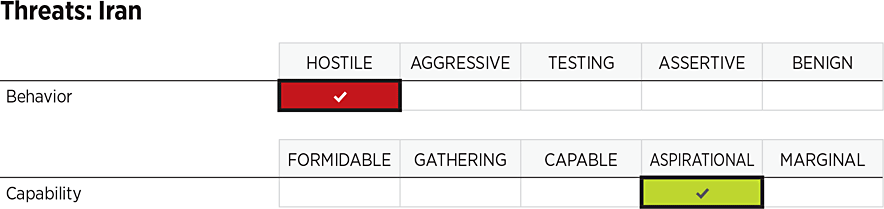
Iran’s overall capability, damaged from Israel’s 2024–2025 strikes along with the joint Israel–U.S. nuclear strikes, has been degraded and is rated “aspirational.” Iran’s 2025 behavior was still quite aggressive, with repeated missile attacks against Israel and its proxies also launching their own attacks. Iran also responded to the American and Israeli strikes on Iran’s nuclear facilities, although the response was smaller and more targeted. With the new regional dynamics settling in following the Twelve-Day War and the ceasefire in Gaza, Tehran’s current posture is rated “hostile.”
Endnotes
[1] Carole Nakhle, “Iran’s Oil Sector: Strategic Presence, Diminished Influence,” Geopolitical Intelligence Services, September 1, 2025, https://www.gisreportsonline.com/r/iran-oil-market- (accessed December 14, 2025).
[2] Graph, “Crude Oil Exports for Iran, Islamic Republic of (IRNNXGOCMBD),” Federal Reserve Bank of St. Louis, updated November 6, 2024, https://fred.stlouisfed.org/series/IRNNXGOCMBD (accessed December 14, 2025).
[3] Reuters, “China’s Heavy Reliance on Iranian Oil Imports,” June 24, 2025, https://www.reuters.com/business/energy/chinas-heavy-reliance-iranian-oil-imports-2025-06-24/ (accessed December 14, 2025).
[4] Max Meizlish and Saeed Ghasseminejad, “China Is Supercharging Iran’s Sanctions Evasion Strategy,” Foundation for Defense of Democracies Policy Brief, October 10, 2025, https://www.fdd.org/analysis/2025/10/10/china-is-supercharging-irans-sanctions-evasion-strategy/ (accessed December 14, 2025).
[5] Fact Sheet, “Sanctioning Entities Trading in Iranian Petroleum and Petrochemicals,” U.S. Department of State, October 9, 2025, https://www.state.gov/releases/office-of-the-spokesperson/2025/10/sanctioning-entities-trading-in-iranian-petroleum-and-petrochemicals (accessed December 14, 2025).
[6] Iran International, “Iran Faces 26% Oil Revenue Deficit Despite Surging Exports,” October 5, 2024, https://www.iranintl.com/en/202410059585 (accessed December 14, 2025).
[7] Reuters, “US Imposes New Sanctions on Iran’s Shadow Oil Fleet,” February 24, 2025, https://www.reuters.com/world/us-imposes-new-sanctions-irans-shadow-fleet-treasury-department-says-2025-02-24/ (accessed December 14, 2025).
[8] Press Statement by Secretary of State Marco Rubio, “Completion of UN Sanctions Snapback on Iran,” U.S. Department of State, September 27, 2025, https://www.state.gov/releases/office-of-the-spokesperson/2025/09/completion-of-un-sanctions-snapback-on-iran (accessed December 14, 2025).
[9] Iran International, “IRGC Officials Threaten Trump over Soleimani Killing,” January 1, 2025, https://www.iranintl.com/en/202501012274 (accessed December 14, 2025).
[10] Judith Miller, “Iran Is Still Trying to Kill American Officials,” Tablet Magazine, July 24, 2024, https://www.tabletmag.com/sections/news/articles/iran-still-trying-kill-american-officials (accessed December 14, 2025).
[11] David Gritten, “Seven Killed in Israel in Deadliest Hezbollah Rocket Strikes in Months,” BBC, November 1, 2024, https://www.bbc.com/news/articles/ce8yjr3zyz8o (accessed December 15, 2025).
[12] TOI Staff and Agencies, “‘Shredded to Pieces’: Druze Community Grieves After Hezbollah Strike Kills 12 Children,” The Times of Israel, July 28, 2024, https://www.timesofisrael.com/a-dark-day-for-majdal-shams-druze-community-grieves-after-hezbollah-strike-kills-12/ (accessed December 15, 2025).
[13] Associated Press, “Hezbollah Claims Responsibility for Drone Strike in Central Israel in Retaliation for Strikes on Beirut,” PBS News, October 13, 2024, https://www.pbs.org/newshour/world/hezbollah-claims-responsibility-for-drone-strike-in-central-israel-in-retaliation-for-strikes-on-beirut (accessed December 15, 2025).
[14] Gritten, “Seven Killed in Israel in Deadliest Hezbollah Rocket Strikes in Months.”
[15] Adam Rasgon and Gabby Sobelman, “Israel’s Displaced Want to Go Home. But Will Attacks on Hezbollah Offer That Path?” The New York Times, September 26, 2024, https://www.nytimes.com/2024/09/26/world/middleeast/israel-hezbollah-displaced.html (accessed December 15, 2025).
[16] Kareem Chehayeb and Jack Jeffery, “Who Were the 7 High-Ranking Hezbollah Officials Killed over the Past Week?” Associated Press, updated September 29, 2024, https://apnews.com/article/hezbollah-lebanon-nasrallah-israel-8b2ae56a54d641c6910a79e9e5699824 (accessed December 15, 2025).
[17] Barak Ravid, “How Israel Decimated Hamas and Hezbollah Leadership in Three Months,” Axios, October 20, 2024, https://www.axios.com/2024/10/20/israel-assassinations-sinwar-hamas-hezbollah (accessed December 14, 2025); Reuters, “Hashem Safieddine, Hezbollah’s New Leader?” September 28, 2024, https://www.reuters.com/world/middle-east/who-is-hashem-safieddine-hezbollahs-possible-new-leader-2024-09-28/ (accessed December 14, 2025).
[18] Matt Murphy and Joe Tidy, “What We Know About the Hezbollah Device Explosions,” BBC, September 20, 2024, https://www.bbc.com/news/articles/cz04m913m49o (accessed December 14, 2025).
[19] Associated Press, “A Year After Losing Its Longtime Leader, Hezbollah Is Beginning to Regroup,” September 27, 2025, https://wtop.com/world/2025/09/a-year-after-losing-its-longtime-leader-hezbollah-is-beginning-to-regroup/ (accessed December 15, 2025).
[20] Al Jazeera, “Hezbollah Says It Will Not Give up Weapons Despite US Proposal,” July 18, 2025, https://www.aljazeera.com/news/2025/7/18/hezbollah-chief-rejects-us-proposals-on-group-giving-up-weapons (accessed December 15, 2025).
[21] Counter Extremism Project, “Kata’ib Sayyid al Shuhada,” https://www.counterextremism.com/threat/kataib-sayyid-al-shuhada/report (accessed December 15, 2025).
[22] Press Statement by Secretary of State Antony Blinken, “Terrorist Designations of Iran-aligned Militia Groups,” U.S. Department of State, November 17, 2023, https://2021-2025.state.gov/terrorist-designations-of-iran-aligned-militia-groups/ (accessed December 15, 2025).
[23] Bridget Toomey, “US Designates 4 Iran-Backed Iraqi Militias as Foreign Terrorist Organizations,” Foundation for Defense of Democracies, FDD’s Long War Journal, September 18, 2025, https://www.longwarjournal.org/archives/2025/09/us-designates-4-iran-backed-iraqi-militias-as-foreign-terrorist-organizations.php (accessed December 15, 2025).
[24] Phillip Smyth, “The Shia Militia Mapping Project,” Washington Institute for Near East Policy, Policy Analysis, updated April 2020, https://www.washingtoninstitute.org/policy-analysis/shia-militia-mapping-project (accessed December 15, 2025).
[25] Press Statement, “Terrorist Designation of Harakat Ansar Allah al-Awfiya,” U.S. Department of State, June 17, 2024, https://2021-2025.state.gov/terrorist-designation-of-harakat-ansar-allah-al-awfiya-2/ (accessed December 15, 2025).
[26] Fact Sheet, “Terrorist Designations of Iran-Aligned Militia Groups,” U.S. Department of State, September 17, 2025, https://www.state.gov/releases/office-of-the-spokesperson/2025/09/terrorist-designations-of-iran-aligned-militia-groups/ (accessed December 15, 2025).
[27] Meir Amit Intelligence and Terrorism Information Center at the Israeli Intelligence Heritage and Commemoration Center, “Captured Documents Show Iranian Support for Hamas in the Gaza Strip,” November 18, 2024, https://www.terrorism-info.org.il/app/uploads/2024/11/E_235_24-3.pdf (accessed December 15, 2025).
[28] Press release, “U.S. and U.K. Target IRGC-QF Support to Hamas and Other Proxy Groups,” U.S. Department of the Treasury, December 14, 2023, https://home.treasury.gov/news/press-releases/jy1987 (accessed December 15, 2025).
[29] Fran Jakubowicz, “Money in the Bank: Examining Iran’s Relationship with Hamas,” Mideast Journal, February 5, 2024, https://www.mideastjournal.org/post/iran-supports-hamas (accessed December 15, 2025).
[30] Matthew Levitt, “The Hamas–Iran Relationship,” The Jerusalem Strategic Tribune, November 2023, https://www.jstribune.com/levitt-the-hamas-iran-relationship/ (accessed December 15, 2025).
[31] Jewish News Syndicate, “The Link Between Iran and the Missile Arsenals in Gaza,” May 13, 2021, https://www.jns.org/the-link-between-iran-and-the-missile-arsenals-in-gaza/ (accessed December 15, 2025).
[32] Summer Said, Dov Lieber, and Benoit Faucon, “Hamas Fighters Trained in Iran Before Oct. 7 Attacks,” The Wall Street Journal, updated October 25, 2023, https://www.wsj.com/world/middle-east/hamas-fighters-trained-in-iran-before-oct-7-attacks-e2a8dbb9 (accessed December 15, 2025).
[33] Gov.il, “October 7: The Deadliest Attack on Jews Since the Holocaust,” https://govextra.gov.il/mda/october-7/october7/ (accessed December 15, 2025).
[34] Abu Bakr Bashir and Itay Stern, “Israel Has Hunted Its Top Enemies Around the Middle East. What Has It Achieved?” NPR, September 11, 2025, https://www.npr.org/2025/09/11/g-s1-87959/israel-strikes-enemies-hamas-hezbollah-iran-houthis (accessed December 15, 2025).
[35] BBC, “What Happens Next in Gaza Ceasefire Plan After Hostage Release?” October 14, 2025, https://www.bbc.com/news/articles/cvgqx7ygq41o (accessed December 15, 2025).
[36] Isabel Vincent, “Inside Yemen’s Houthi Militants: What They Believe and How They Threaten the West as Part of Iran’s ‘Axis of Resistance,’” New York Post, May 8, 2025, https://nypost.com/2025/05/08/world-news/yemens-houthis-punch-above-their-weight-in-terror-fight/ (accessed December 15, 2025).
[37] Peter Salisbury, “Yemen: Stemming the Rise of a Chaos State,” Policy Commons, May 25, 2016, https://policycommons.net/artifacts/613684/yemen/1593754/ (accessed December 15, 2025).
[38] Center for Preventive Action, “Conflict in Yemen and the Red Sea,” Council on Foreign Relations Global Conflict Tracker, updated November 12, 2025, https://www.cfr.org/global-conflict-tracker/conflict/war-yemen (accessed December 15, 2025).
[39] U.S. Defense Intelligence Agency, “Seized at Sea: Iranian Weapons Smuggled to the Houthis,” information cutoff date April 30, 2024, p. 3, https://www.dia.mil/Portals/110/Documents/News/Military_Power_Publications/Seized_at_Sea.pdf (accessed December 15, 2025).
[40] U.S. Institute of Peace, “Houthi Explainer: Timeline of U.S. Seizures,” The Iran Primer, February 20, 2025, https://iranprimer.usip.org/blog/2021/may/12/seizures-iranian-weapons (accessed December 15, 2025).
[41] Gerald Feierstein, “Houthis Rise in Prominence Among Iran’s ‘Axis of Resistance,’” December 7, 2023, https://www.defensenews.com/outlook/2023/12/04/houthis-rise-in-prominence-among-irans-axis-of-resistance/ (accessed December 15, 2025).
[42] Foundation for Defense of Democracies, “Iran Unveils Latest Massive Underground Missile Facility,” Flash Brief, March 29, 2025, https://www.fdd.org/analysis/2025/03/29/iran-unveils-latest-massive-underground-missile-facility/ (accessed December 16, 2025).
[43] Daniel M. Gettinger and Clayton Thomas, “Iran’s Ballistic Missile Programs: Background and Context,” Congressional Research Service In Focus No. IF13035, June 17, 2025, https://s3.documentcloud.org/documents/25978908/irans-ballistic-missile-programs-background-and-context-june-17-2025.pdf (accessed December 16, 2025).
[44] Ari Cicurel, “Iranian Ballistic Missile Estimates,” Jewish Institute for National Security of America, June 26, 2025, https://jinsa.org/wp-content/uploads/2025/06/Iranian-Ballistic-Missile-Estimates-6-26-2025-6.pdf (accessed December 16, 2025).
[45] Amir Daftari, “Iran’s Missile Arsenal: What It Has Used and What It Could Deploy,” Newsweek, updated June 22, 2025, https://www.newsweek.com/iran-missile-stockpile-israel-conflict-2088520 (accessed December 16, 2025).
[46] Cicurel, “Iranian Ballistic Missile Estimates.”
[47] Silvia Boltuc, “Rastakhiz Missile Unveiling Signals Iran’s Renewed Military Readiness,” SpecialEurasia, August 13, 2025, https://www.specialeurasia.com/2025/08/13/iran-rastakhiz-mssile/ (accessed December 16, 2025).
[48] Amira El-Fekki, “Iran’s Army Gives Missile Update: Thousands Ready to Launch,” Newsweek, July 8, 2025, https://www.newsweek.com/iran-army-israel-us-nuclear-trump-missiles-2095833 (accessed December 16, 2025).
[49] Boltuc, “Rastakhiz Missile Unveiling Signals Iran’s Renewed Military Readiness.”
[50] Iran International, “Iran Steps up Imports of Missile Fuel Precursor from China—CNN,” October 29, 2025, https://www.iranintl.com/en/202510291662 (accessed December 16, 2025).
[51] Press release, “Treasury Disrupts Iran’s Transnational Missile and UAV Procurement Networks,” U.S. Department of the Treasury, November 12, 2025, https://home.treasury.gov/news/press-releases/sb0313 (accessed December 16, 2025).
[52] Sam Skove and Eric Bazail-Eimil, “Don’t Forget About Iran’s Space Program,” Politico, June 30, 2025, https://www.politico.com/newsletters/national-security-daily/2025/06/30/dont-forget-about-irans-space-program-00433637 (accessed December 16, 2025).
[53] Jon Gambrell, “Iran Has Likely Carried out an Undeclared Missile Test, Satellite Photos Analyzed by the AP Show,” Associated Press, September 26, 2025, https://www.ap.org/news-highlights/spotlights/2025/iran-has-likely-carried-out-an-undeclared-missile-test-satellite-photos-analyzed-by-the-ap-show/ (accessed December 16, 2025).
[54] Robert Tait, “Iran Launches First Domestically Produced Satellite,” The Guardian, February 3, 2009, https://www.theguardian.com/world/2009/feb/03/iran-satellite-launch-omid (accessed December 16, 2025); Julian Borger, “Iran Reportedly Launches First Military Satellite as Trump Makes Threats,” The Guardian, April 22, 2020, https://www.theguardian.com/world/2020/apr/22/iran-us-satellite-navy-boats-trump (accessed December 16, 2025).
[55] Geoff Brumfiel, “Iranian Rocket Launch Ends in Failure, Imagery Shows,” NPR, August 29, 2019, https://www.npr.org/2019/08/29/755406765/iranian-rocket-launch-ends-in-failure-images-show (accessed December 16, 2025); Jon Gambrell, “Satellite Photos Show Iran Had Another Failed Space Launch,” Associated Press, March 2, 2022, https://apnews.com/article/space-launches-technology-science-business-iran-4ed71f17a612e8aef2c9b58af4538183 (accessed December 16, 2025).
[56] Associated Press, “Iran Launches 3 Satellites into Space as Tensions Rise,” January 28, 2024, https://www.npr.org/2024/01/28/1227439493/iran-launches-three-satellites-into-space-as-tensions-rise (accessed December 16, 2025).
[57] Reuters, “Iran Sends Satellites to Russia for Rocket Launch, Tasnim Reports,” October 12, 2024, https://www.reuters.com/world/iran-sends-satellites-russia-rocket-launch-tasnim-reports-2024-10-12/ (accessed December 16, 2025).
[58] Ibid. and Associated Press, “Russian Rocket Launches Iranian Satellites into Orbit as Moscow and Tehran Expand Ties,” updated November 5, 2024, https://apnews.com/article/russia-iran-satellites-space-launch-944a6bc87aa2511e38acf58e37c02c28 (accessed December 16, 2025).
[59] Al Jazeera, “Iran Launches ‘Domestically Developed’ Imaging Satellite from Russia,” February 29, 2024, https://www.aljazeera.com/news/2024/2/29/iran-launches-domestically-developed-imaging-satellite-from-russia (accessed December 16, 2025).
[60] Reuters, “Iran Sends Satellites to Russia for Rocket Launch, Tasnim reports.”
[61] Associated Press, “Russia Launches an Iranian Communications Satellite into Orbit,” updated July 25, 2025, https://apnews.com/article/russia-iran-satellite-soyuz-vostochny-space-orbit-9062c3107e2a8ec00b3778de9a4eed45 (accessed December 16, 2025).
[62] Foundation for Defense of Democracies, “Iran Seeks Purchase of Advanced Spy Satellites from China,” Flash Brief, August 19, 2024, https://www.fdd.org/analysis/2024/08/19/iran-seeks-purchase-of-advanced-spy-satellites-from-china/ (accessed December 16, 2025).
[63] Jasim Al-Azzawi, “Iran’s Plan to Abandon GPS Is About Much More than Technology,” Al Jazeera, July 27, 2025, https://www.aljazeera.com/opinions/2025/7/27/irans-plan-to-abandon-gps-is-about-much-more-than-technology (accessed December 16, 2025).
[64] Stav Levaton, “Hezbollah-Linked Drone Smuggling Ring Uncovered in Europe—Report,” The Times of Israel, April 14, 2025, https://www.timesofisrael.com/hezbollah-linked-drone-smuggling-ring-uncovered-in-europe-report/ (accessed December 16, 2025).
[65] Iran International, “Drones Could Soon Strike a European City, Iranian Official Warns,” July 13, 2025, https://www.iranintl.com/en/202507134712 (accessed December 16, 2025).
[66] Suzan Quintaz, “Iranian Drones Threaten Europe,” January 6, 2023, https://en.majalla.com/node/283291 (accessed December 16, 2025).
[67] Reuters, “Ukraine Says Russia Launched 8,060 Iran-Developed Drones During War,” September 13, 2024, https://www.reuters.com/world/europe/ukraine-says-russia-launched-8060-iran-developed-drones-during-war-2024-09-13/ (accessed December 16, 2025); Adam Easton and Jaroslav Lukiv, “Poland Says It Shot down Russian Drones After Airspace Violation,” BBC, September 10, 2025, https://www.bbc.com/news/articles/c147065pzdzo (accessed December 16, 2025); Ian Casey and Alex Boyd, “Romania Becomes Second Nato Country to Report Russian Drone in Its Airspace,” BBC, September 14, 2025, https://www.bbc.com/news/articles/c80g7g5rmlno (accessed December 16, 2025).
[68] Chloe Anderson, “Shahed-136 Drone—The Kamikaze Drone Shaping Modern Warfare,” Defense Feeds, November 28, 2024, https://defensefeeds.com/military-tech/air-force/air-force-uavs/shahed-136-drone/ (accessed December 16, 2025).
[69] Seth J. Frantzman, “IRGC’s ‘Unique’ Shahed 107 Drone Still Fails to Penetrate IDF Defense—Analysis,” The Jerusalem Post, June 17, 2025, https://www.jpost.com/middle-east/iran-news/article-858021 (accessed December 16, 2025).
[70] U.S. Institute of Peace, “Roster of Iran’s Drones,” The Iran Primer, April 12, 2024, https://iranprimer.usip.org/blog/2024/feb/02/roster-iran%E2%80%99s-drones (accessed December 16, 2025).
[71] Janatan Sayeh, “U.S. Sanctions China-Based Front Companies Procuring Drone Components for Iran,” Foundation for Defense of Democracies Policy Brief, March 3, 2025, https://www.fdd.org/analysis/policy_briefs/2025/03/03/u-s-sanctions-china-based-front-companies-procuring-drone-components-for-iran/ (accessed December 16, 2025).
[72] Antonio Sigamony, “All About Iranian Nuclear Facilities & Capabilities,” The National Frontier, May 21, 2025, https://thenationalfrontier.com/2025/05/21/all-about-iranian-nuclear-facilities-capabilities/ (accessed December 16, 2025); Geoff Brumfiel, Brent Jones, and Alyson Hurt, “Obliterated? Damaged? Inoperable? What’s Known About Iran’s Nuclear Facilities,” NPR, June 26, 2025, https://www.npr.org/2025/06/26/nx-s1-5443666/obliterated-damaged-inoperable-iran-nuclear-facilities (accessed December 16, 2025); Jean-Loup Samaan, “Is the Cautious China–Iran Military Cooperation at a Turning Point?” Atlantic Council MENASource, August 29, 2025, https://www.atlanticcouncil.org/blogs/menasource/is-the-cautious-china-iran-military-cooperation-at-a-turning-point/ (accessed December 16, 2025).
[73] Reuters, “China’s Heavy Reliance on Iranian Oil Imports,” The Straits Times, June 24, 2025, https://www.straitstimes.com/asia/east-asia/chinas-heavy-reliance-on-iranian-oil-imports (accessed December 16, 2025); Craig Singleton and Jack Burnham, “China Sides with Tehran but Wields Little Influence in Iran–Israel War,” Foundation for Defense of Democracies Policy Brief, June 16, 2025, https://www.fdd.org/analysis/2025/06/16/china-sides-with-tehran-but-wields-little-influence-in-iran-israel-war/ (accessed December 16, 2025).
[74] Benham Ben Taleblu, “Ship Carrying Chemical for Missile Development Docks in Iran,” Foundation for Defense of Democracies Policy Brief, February 25, 2025, https://www.fdd.org/analysis/policy_briefs/2025/02/25/ship-carrying-chemical-for-missile-development-docks-in-iran/ (accessed December 16, 2025).
[75] Ibid.
[76] Dalga Khatinoglu, “Sanctions, Lack of Investments Ground Iran’s Shipping and Air Fleets,” Middle East Forum Observer, October 19, 2025, https://www.meforum.org/mef-observer/sanctions-lack-of-investments-ground-irans-shipping-and-air-fleets (accessed December 16, 2025).
[77] Seth J. Frantzman, “Iran Is Producing 90% of Its Own Weapons, Iranian Admiral Claims—Report,” The Jerusalem Post, February 13, 2025, https://www.jpost.com/middle-east/article-842044 (accessed December 16, 2025).
[78] Hossein Aryan, “The Artesh: Iran’s Marginalized and Under-Armed Conventional Military,” Middle East Institute, November 15, 2011, https://www.mei.edu/publications/artesh-irans-marginalized-and-under-armed-conventional-military (accessed December 16, 2025).
[79] Joanne Stocker, “Iran’s Military to Procure up to 800 Tanks as Part of Defense Modernization Plan,” The Defense Post, July 18, 2018, https://thedefensepost.com/2018/07/18/iran-army-irgc-800-karrar-tanks/ (accessed December 16, 2025).
[80] Vinay Prasad Sharma, “China, Russia, Pakistan: Which Country Leads the Combat Tank Fleet in 2025? India’s Rank Will Surprise You,” WION [World Is One, New Delhi], July 16, 2025, https://www.wionews.com/photos/china-russia-pakistan-which-country-leads-the-combat-tank-fleet-in-2025-india-s-rank-will-surprise-you-1752668523325/1752668523326 (accessed December 16, 2025).
[81] Army Recognition, “Iran Tests New German Skynex-Inspired Short-Range Air Defense System in Large-Scale Military Drills,” January 27, 2025, https://www.armyrecognition.com/news/army-news/2025/iran-tests-new-german-skynex-inspired-short-range-air-defense-system-in-large-scale-military-drills (accessed December 16, 2025).
[82] Admin, “Iran Reveals ‘Talaiyeh’ Cruise Missile: Hits Targets 1,000 KM Away,” Defence Security Asia, December 25, 2023, https://defencesecurityasia.com/en/iran-talaiyeh-cruise-missile/ (accessed December 16, 2025).
[83] Euronews Arabic, “Advanced Submarines, Strategic Bases: Here’s What We Know About Iran’s Naval Capabilities,” Euronews, updated June 23, 2025, https://www.euronews.com/2025/06/22/advanced-submarines-strategic-bases-heres-what-we-know-about-irans-naval-capabilities (accessed December 16, 2025).
[84] Fact Sheet, “Iran Submarine Capabilities,” Nuclear Threat Initiative, September 18, 2025, https://www.nti.org/analysis/articles/iran-submarine-capabilities/ (accessed December 16, 2025).
[85] Army Recognition, “Iran Expands Mini-Submarine and Missile Boat Force to Counter U.S. and Allied Powers in Gulf,” October 9, 2025, https://www.armyrecognition.com/news/navy-news/2025/iran-expands-mini-submarine-and-missile-boat-force-to-counter-u-s-and-allied-power-in-gulf (accessed December 16, 2025).
[86] Assaf Orion, “Strategic Partnership Ltd.: China–Iran Relations and Their Significance for Israel,” Institute for National Security Studies [Tel Aviv University], April 18, 2021, https://www.inss.org.il/publication/iran-china-cooporation/ (accessed December 16, 2025).
[87] Sam LaGrone, “Iranian Patrol Boat Harasses Pair of U.S. Warships, Says CENTCOM,” U.S. Naval Institute News, December 6, 2022, https://news.usni.org/2022/12/06/iranian-patrol-boat-harasses-pair-of-u-s-warships-says-centcom (accessed December 16, 2025).
[88] Admin, “Iran Confirms MiG-29 Arrival as Su-35 and HQ-9 Deliveries ‘Progress Extensively.’” Defence Security Asia, September 24, 2025, https://defencesecurityasia.com/en/iran-mig29-su35-hq9-airforce-modernisation-2025/ (accessed December 16, 2025).
[89] David Cenciotti, “Iran’s Infamous F-313 ‘Stealth Jet’ Makes a Comeback as a Naval Drone,” The Aviationist, February 6, 2025, https://theaviationist.com/2025/02/06/iran-f-313-stealth-jet-makes-a-comeback/ (accessed December 16, 2025).
[90] Army Recognition, “Exclusive: Iran Launches Next-Gen Air Defense Missile System Bavar 373-II with Extended Range and Autonomy,” March 3, 2025, https://www.armyrecognition.com/news/army-news/2025/exclusive-iran-launches-next-gen-air-defense-missile-system-bavar-373-ii-with-extended-range-and-autonomy (accessed December 16, 2025).
[91] Iran International, “Air Defenses Replaced After Damage in War with Israel, Iran Says,” July 20, 2025, https://www.iranintl.com/en/202507201402 (accessed December 16, 2025).
[92] Julian Borger and Patrick Wintour, “Missiles Launched by Iran Against US Airbases in Iraq,” The Guardian, January 7, 2020, https://www.theguardian.com/world/2020/jan/07/trump-iran-suleimani-threats-retaliation (accessed December 17, 2025); press release, “Iranian-Backed Militants Attack al-Asad Airbase, Iraq,” U.S. Central Command, January 20, 2024, https://www.centcom.mil/MEDIA/PRESS-RELEASES/Press-Release-View/Article/3651246/iranian-backed-militants-attack-al-asad-airbase-iraq/ (accessed December 17, 2025); Fardad Farahzad, “Iranian Missile Attack Struck Inside US Airbase in Qatar, Pentagon Confirms,” Iran International, July 11, 2025, https://www.iranintl.com/en/202507102661 (accessed December 17, 2025).
[93] C. Todd Lopez, “3 U.S. Service Members Killed, Others Injured in Jordan Following Drone Attack,” U.S. Department of Defense, January 29, 2024, https://www.war.gov/News/News-Stories/Article/Article/3659809/3-us-service-members-killed-others-injured-in-jordan-following-drone-attack/ (accessed December 17, 2025).
[94] Paul Goldman and Chantal Da Silva, “Drone Strike Near U.S. Embassy Office in Tel Aviv Leaves One Dead, Yemen’s Houthi Rebels Claim Attack,” NBC News, July 19, 2024, https://www.nbcnews.com/news/amp/rcna161846 (accessed December 17, 2025).
[95] U.S. Department of Energy, Energy Information Administration, “The Strait of Hormuz Is the World’s Most Important Oil Transit Chokepoint,” November 21, 2023, https://www.eia.gov/todayinenergy/detail.php?id=61002 (accessed December 17, 2025).
[96] Ibid. See also Max Zahn, “What Is the Strait of Hormuz and Why Does It Matter?” ABC News, June 23, 2025, https://abcnews.go.com/Business/strait-hormuz-matter/story?id=123114172 (accessed December 17, 2025).
[97] Harold Lee Wise, “One Day of War,” Naval History, Vol. 27, No. 2 (March 2013), https://www.usni.org/magazines/naval-history-magazine/2013/march/one-day-war (accessed December 17, 2025); R.J. Von Mayer, “This Day in History, October 19th, 2022—‘Operation Nimble Archer,’” SignalsAZ.com, October 19, 2022, https://www.signalsaz.com/articles/this-day-in-history-october-19th-2022-operation-nimble-archer/ (accessed December 17, 2025).
[98] Stav Levaton, “Its Missile Stock Is Depleted, but Iran’s Arsenal May Still Be a Threat,” The Times of Israel, June 24, 2025, https://www.timesofisrael.com/its-missile-stock-is-depleted-but-irans-arsenal-may-still-be-a-threat/ (accessed December 17, 2025); Elvia Limon, “Iran Reportedly Moves to Close Strait of Hormuz After US Attacks,” The Hill, June 22, 2025, https://thehill.com/policy/defense/5362973-iran-approves-closing-strait-of-hormuz/ (accessed December 17, 2025).
[99] Andres B. Schwarzenberg, “Red Sea Shipping Disruptions: Estimating Economic Effects,” Congressional Research Service In Focus No. IF12657, May 8, 2024, https://www.congress.gov/crs_external_products/IF/PDF/IF12657/IF12657.2.pdf (accessed December 17, 2025).
[100] Courtney Bonnell and David McHugh, “How Attacks on Ships in the Red Sea by Yemen’s Houthi Rebels Are Crimping Global Trade,” Associated Press, updated January 12, 2024, https://apnews.com/article/red-sea-yemen-houthis-attack-ships-f67d941c260528ac40315ecab4c34ca3 (accessed December 17, 2025).
[101] Jonathan Josephs and David Gritten, “Yemen’s Houthis Release Crew of Seized Cargo Ship Galaxy Leader,” BBC, January 22, 2025, https://www.bbc.com/news/articles/c9d5q0jn067o (accessed December 17, 2025).
[102] Foundation for Defense of Democracies, “Houthis Threaten to Target All Ships Belonging to Companies Conducting Commerce with Israel,” Flash Brief, July 28, 2025, https://www.fdd.org/analysis/2025/07/28/houthis-threaten-to-target-all-ships-belonging-to-companies-conducting-commerce-with-israel/ (accessed December 17, 2025).
[103] Bonnell and McHugh, “How Attacks on Ships in the Red Sea by Yemen’s Houthi Rebels Are Crimping Global Trade.”
[104] Lauren Leatherby, Denise Lu, Anjali Singhvi, James Glanz, and Niraj Chokshi, “Flights in and out of Tehran Continued After Missile Strikes and Plane Crash,” The New York Times, January 10, 2020, https://www.nytimes.com/interactive/2020/01/10/world/middleeast/iran-tehran-airport-crash-flights.html (accessed December 17, 2025).
[105] Australian Associated Press, “Missile and Drone ‘Intended for Israel’ Hit Egypt,” The Canberra Times, October 27, 2023, https://www.canberratimes.com.au/story/8403437/missile-and-drone-intended-for-israel-hit-egypt/ (accessed December 17, 2025).
[106] “Drones Hit Two Egyptian Red Sea Cities Highlighting Risk of Conflict Expansion,” The Arab Weekly, October 27, 2023, https://thearabweekly.com/drones-hit-two-egyptian-red-sea-cities-highlighting-risk-conflict-expansion (accessed December 17, 2025).
[107] Adam Rasgon, “Laborer from Gaza Is First Reported Fatality of Iran’s Missile Attack,” The New York Times, October 1, 2024, https://www.nytimes.com/2024/10/01/world/middleeast/gaza-palestinian-dead-iran-attack.html (accessed December 17, 2025).
[108] Julian Borger, “Crown Prince Confirms Saudi Arabia Will Seek Nuclear Arsenal if Iran Develops One,” The Guardian, September 21, 2023, https://www.theguardian.com/world/2023/sep/21/crown-prince-confirms-saudi-arabia-seek-nuclear-arsenal-iran-develops-one (accessed December 17, 2025).
[109] News release, “Presidential Memorandum Regarding Nuclear Agreement with the United Arab Emirates,” The White House, May 20, 2009, https://obamawhitehouse.archives.gov/the-press-office/presidential-memorandum-regarding-nuclear-agreement-with-united-arab-emirates (accessed December 17, 2025).
[110] Yousef Saba, “Explainer: Why Does Saudi Arabia Want a Civil Nuclear Deal with the US?” Reuters, May 8, 2025, https://www.reuters.com/world/why-does-saudi-arabia-want-civil-nuclear-deal-with-us-2025-05-08/ (accessed December 17, 2025).
[111] World Nuclear Association, “Nuclear Power in Egypt,” Country Profile, updated November 28, 2025, https://world-nuclear.org/information-library/country-profiles/countries-a-f/egypt (accessed December 17, 2025).
[112] Media note, “United States and Bahrain Sign Memorandum of Understanding Concerning Strategic Civil Nuclear Cooperation,” U.S. Department of State, July 16, 2025, https://www.state.gov/releases/2025/07/united-states-and-bahrain-sign-memorandum-of-understanding-concerning-strategic-civil-nuclear-cooperation (accessed December 17, 2025).
[113] i24News, “Khamenei Calls Israel ‘Malignant Cancer’ Guilty of ‘Shameless Crimes,’” September 22, 2024, https://www.i24news.tv/en/news/israel-at-war/artc-khamenei-calls-israel-malignant-cancer-guilty-of-shameless-crimes (accessed December 17, 2025).
[114] CSIS, “The History of Saudi-Iranian Competition,” July 27, 2020, https://www.csis.org/analysis/history-saudi-iranian-competition.
[115] Abdullah F. Alrebh, “Hezbollah al-Hejaz: A Saudi Shi’a Group Cloaked in Mystery,” Middle East Institute, June 2022, https://www.mei.edu/sites/default/files/2022-06/Hezbollah Al-Hejaz - A Saudi Shi’a Group Cloaked in Mystery.pdf.
[116] BBC, “Awamiya: Hundreds flee clashes in Saudi town,” August 2, 2017, https://www.bbc.com/news/world-middle-east-40800261.
[117] Ben Hubbard, Palko Karasz and Stanley Reed, “Two Major Saudi Oil Installations Hit by Drone Strike, and U.S. Blames Iran,” The New York Times, September 14, 2019, https://www.nytimes.com/2019/09/14/world/middleeast/saudi-arabia-refineries-drone-attack.html (accessed June 23, 2025)
[118] Frederick W. Kagan, “Attribution, Intent, and Response in the Abqaiq Attack,” American Enterprise Institute, Critical Threats Project, October 2019, https://www.aei.org/wp-content/uploads/2019/10/Attribution-Intent-and-Response-in-the-Abqaiq-Attack.pdf?x85095 (accessed December 17, 2025); Humeyra Pamuk, “Exclusive: US Probe of Saudi Oil Attack Shows It Came from North—Report,” Reuters, updated December 20, 2019, https://www.reuters.com/article/world/exclusive-us-probe-of-saudi-oil-attack-shows-it-came-from-north-report-idUSKBN1YN29E/ (accessed December 17, 2025).
[119] Reuters, “Houthis Have Fired 430 Missiles, 851 Drones at Saudi Arabia Since 2015—Saudi-led Coalition,” December 26, 2021, https://www.reuters.com/world/middle-east/houthis-have-fired-430-missiles-851-drones-saudi-arabia-since-2015-saudi-led-2021-12-26/ (accessed December 17, 2025).
[120] Jerusalem Post Staff, “Houthi Missile Hits Saudi Arabia En Route to Israel,” The Jerusalem Post, April 3, 2025, https://www.jpost.com/breaking-news/article-848804 (accessed December 17, 2025); TOI Staff, “Houthis Fire 2 Missiles at Israel that Fall Apart over Saudi Arabia; Drone Intercepted,” The Times of Israel, September 2, 2025, https://www.timesofisrael.com/houthis-fire-two-missiles-at-israel-that-fall-apart-over-saudi-arabia/ (accessed December 17, 2025).
[121] Press release, “Two Men Charged in Alleged Plot to Assassinate Saudi Arabian Ambassador to the United States,” U.S. Department of Justice, October 11, 2011, https://www.justice.gov/archives/opa/pr/two-men-charged-alleged-plot-assassinate-saudi-arabian-ambassador-united-states (accessed December 17, 2025).
[122] Dalga Khatinoglu, “The United Arab Emirates’ Pivotal Role in Reviving Iran’s Foreign Trade,” Middle East Forum Observer, July 3, 2025, https://www.meforum.org/mef-observer/the-united-arab-emirates-pivotal-role-in-reviving-irans-foreign-trade (accessed December 17, 2025).
[123] Leonardo Jacopo Maria Mazzucco, “Challenges Ahead for UAE–Iran Rapprochement,” Henry L. Stimson Center Commentary, February 20, 2025, https://www.stimson.org/2025/challenges-ahead-for-uae-iran-rapprochement/ (accessed December 17, 2025).
[124] Somayeh Malekian and Nasser Atta, “Houthi Missile Intercepted by UAE During Historic Israeli Visit Raises Tensions,” ABC News, February 2, 2022, https://abcnews.go.com/International/houthi-missile-intercepted-uae-historic-israeli-visit-raises/story?id=82618825 (accessed December 17, 2025).
[125] Ariel Kogan, “Iranian Involvement in Rabbi’s Murder in Dubai: A New Step in IRGC Terror,” i24News, November 24, 2024, https://www.i24news.tv/en/news/middle-east/the-gulf/artc-iranian-involvement-in-rabbi-s-murder-in-dubai-a-new-step-in-irgc-terror (accessed December 17, 2025).
[126] Menna AlaaElDin and Jana Choukeir, “UAE Sentences Killers of Israeli Rabbi to Death,” Reuters, March 31, 2025, https://www.reuters.com/world/middle-east/uae-sentences-killers-israeli-moldovan-citizen-death-2025-03-31/ (accessed December 17, 2025).
[127] Bradley Bowman, Ryan Brobst, and Mike Daum, “What We Can Learn from Iran’s Attack on Israel,” Foundation for Defense of Democracies Insight, April 16, 2024, https://www.fdd.org/analysis/2024/04/16/what-we-can-learn-from-irans-attack-on-israel/ (accessed December 17, 2025).
[128] Tariq Alhasan, “The Role of Iran in the Failed Coup of 1981: The IFLB in Bahrain,” The Middle East Journal, Vol. 65, Issue 4 (Autumn 2011), pp. 603–617.
[129] Seth J. Frantzman, “On Abraham Accords Anniversary, Iran Pushes Gulf Ties,” Foundation for Defense of Democracies, September 16, 2024, https://www.fdd.org/analysis/op_eds/2024/09/16/on-abraham-accords-anniversary-iran-pushes-gulf-ties/ (accessed December 17, 2025).
[130] Associated Press, “Iran and Bahrain Agree to Talk About How They Might Resume Diplomatic Relations Severed Since 2016,” updated June 24, 2024, https://apnews.com/article/iran-bahrain-diplomatic-ties-saudi-relations-4760151af427467171ef53c25e8b3de4 (accessed December 17, 2025).
[131] Phillip Smyth, “Saraya al-Karar: Bahrain’s Sporadic Bombers,” Jihadology, posted December 1, 2014, https://jihadology.net/2014/12/01/hizballah-cavalcade-saraya-al-karar-bahrains-sporadic-bombers/ (accessed December 17, 2025).
[132] Phillip Smyth, “The Shia Militant Response to Ayatollah Nimr al-Nimr’s Death Sentence,” Jihadology, posted October 21, 2014, https://jihadology.net/2014/10/21/Hezbollah-cavalcade-the-shia-militant-response-to-ayatollah-nimr-al-nimrs-death-sentence/ (accessed December 17, 2025).
[133] Ahmad Majidyar, “Bahrain Says It Dismantled Terrorist Cell with Links to Iran’s I.R.G.C.,” Middle East Institute, August 24, 2017, https://www.mei.edu/publications/bahrain-says-it-dismantled-terrorist-cell-links-irans-irgc (accessed December 17, 2025); Namo Abdulla, “What Is Bahrain’s Saraya al-Mukhtar Militia?” Voice of America, December 19, 2020, https://www.voanews.com/a/extremism-watch_what-bahrains-saraya-al-mukhtar-militia/6199751.html (accessed December 17, 2025); Phillip Smyth, Tim Michetti, and Owen Daniels, “Revolution Unveiled: A Closer Look at Iran’s Presence and Influence in the Middle East,” Atlantic Council, Brent Scowcroft Center on International Security, September 2017, https://www.atlanticcouncil.org/wp-content/uploads/2017/09/Revolution_Unveiled_web_0914.pdf (accessed December 17, 2025).
[134] Video, “al-muqawama al-islamiyyah fi al-bahrain tastahadaf maqr al-sharikat al-masuwla an al-naql al-bari fi eilat [The Islamic resistance in Bahrain targets the headquarters of the company responsible for land transport in Eilat],” Al-Mayadeen News, May 3, 2024, https://youtube/0eFOrEfJ6kk?si=KpQyFypToB7dG0pf (accessed December 17, 2025).
[135] Rijal Allah statement, X, June 19, 2025, https://x.com/rejal_allh313/status/1936019136095687066/photo/1. (accessed December 17, 2025).
[136] Reuters, “Hezbollah Chief Says Group Lost Its Supply Route Through Syria,” December 14, 2024, https://www.reuters.com/world/middle-east/hezbollah-chief-says-group-lost-its-supply-route-through-syria-2024-12-14/ (accessed December 17, 2025).
[137] Haian Dukhan and Ammar Alhamad, “Network of Influence Among Eastern Syrian Tribes,” Washington Institute for Near East Policy, Policy Analysis, April 6, 2021, https://www.washingtoninstitute.org/policy-analysis/irans-growing-network-influence-among-eastern-syrian-tribes (accessed December 17, 2025); Agence France-Press, “Drugs, Weapons in Syria Borderland Where Hezbollah held sway,” February 14, 2025, https://www.france24.com/en/live-news/20250214-drugs-weapons-in-syria-borderland-where-hezbollah-held-sway (accessed December 17, 2025).
[138] Phillip Smyth, “Lebanese Hezbollah’s Islamic Resistance in Syria,” Washington Institute for Near East Policy, PolicyWatch No. 2962, April 26, 2018, https://www.washingtoninstitute.org/policy-analysis/lebanese-hezbollahs-islamic-resistance-syria. (accessed December 17, 2025).
[139] Nada Maucourant Atallah, Lizzie Porter, and Mohamad Ali Harisi, “Why Have Clashes Erupted at the Lebanon–Syria border?” The National [Abu Dhabi], February 10, 2025, https://www.thenationalnews.com/news/mena/2025/02/10/why-have-clashes-erupted-at-the-lebanon-syria-border/ (accessed December 17, 2025).
[140] Nurit Yohanan, “Investigating Their Own Killings: Alawites Claim the New Regime Was Behind Massacre,” The Times of Israel, March 25, 2025, https://www.timesofisrael.com/investigating-their-own-killings-alawites-claim-the-new-regime-was-behind-massacre/ (accessed December 17, 2025).
[141] Agence France-Presse, “Why Has Sudan Ditched Iran in Favour of Saudi Arabia?” The Guardian, January 12, 2016, https://www.theguardian.com/world/2016/jan/12/sudan-siding-with-saudi-arabia-long-term-ally-iran (accessed December 17, 2025).
[142] Lauren Ploch Blanchard, “Sudan’s Removal from the State Sponsors of Terrorism List,” Congressional Research Service Insight No. IN11531, November 9, 2020, https://www.congress.gov/crs_external_products/IN/PDF/IN11531/IN11531.1.pdf (accessed December 17, 2025).
[143] Mojtaba Pourmohsen, “Revolutionary Guards-Operated Aircraft Delivered Weapons to Sudan Army,” Iran International, April 4, 2025, https://www.iranintl.com/en/202504032757 (accessed December 17, 2025).
[144] Ibid.
[145] Africanews, “Morocco Severs Ties with Iran over Supporting Western Sahara Independence Mov’t,” last updated August 13, 2024, https://www.africanews.com/2018/05/02/morocco-severs-ties-with-iran-over-supporting-western-sahara-independence-mov-t/ (accessed December 17, 2025).
[146] Adil Faouzi, “Final Nail in Polisario’s Coffin: Iran’s Terror Proxy Faces Global Extinction,” The Times of Israel, July 3, 2025, https://blogs.timesofisrael.com/final-nail-in-polisarios-coffin-irans-terror-proxy-faces-global-extinction/ (accessed December 17, 2025).
[147] Robert Greenway and Amine Ghoulidi, “Why the US Must Confront Terror Proxy Polisario Front,” The Daily Signal, May 21, 2025, https://www.dailysignal.com/2025/05/21/why-must-confront-terror-proxy-polisario-front/.
[148] H.R. 4119, Polisario Front Terrorist Designation Act, 119th Congress, introduced June 24, 2025, https://www.congress.gov/119/bills/hr4119/BILLS-119hr4119ih.pdf (accessed December 17, 2025).
[149] Faouzi, “Final Nail in Polisario’s Coffin: Iran’s Terror Proxy Faces Global Extinction.”
[150] Wisconsin Project on Nuclear Arms Control, Iran Watch, “Iran’s Nuclear Potential Before the Implementation of the Nuclear Agreement,” November 18, 2015, https://www.iranwatch.org/our-publications/articles-reports/irans-nuclear-timetable (accessed December 17, 2025).
[151] Fact Sheet, “The Joint Comprehensive Plan of Action at a Glance,” Arms Control Association, last reviewed February 2025, https://www.armscontrol.org/factsheets/JCPOA-at-a-glance (accessed December 17, 2025); Kali Robinson, “What Is the Iran Nuclear Deal?” Council on Foreign Relations Backgrounder, last updated October 27, 2013, https:// www.cfr.org/backgrounder/what-iran-nuclear-deal (accessed December 17, 2025).
[152] Fact Sheet, “Maximum Pressure Campaign on the Regime in Iran,” U.S. Department of State, April 4, 2019, https:// 2017-2021.state.gov/maximum-pressure-campaign-on-the-regime-in-iran/ (accessed December 17, 2025).
[153] David Albright, Sarah Burkhard, and Andrea Stricker, “Analysis of IAEA Iran Verification and Monitoring Report,” Institute for Science and International Security Report, February 25, 2021, https://isis-online.org/uploads/isis-reports/documents/IAEA_Iran_Verification_Report_Analysis_for_February_2021_Final.pdf (accessed December 17, 2025).
[154] David Albright and Sarah Burkhard, “Iranian Breakout Timeline Now at Zero,” Institute for Science and International Security Report, June 1, 2022, https://isis-online.org/uploads/isis-reports/documents/Current_Iranian_Breakout_Estimates_June_1_2022_Final.pdf (accessed December 17, 2025).
[155] Quoted in Laurence Norman and Michael R. Gordon, “Iran Could Produce Nuclear Weapon in Several Months if It Decides to Do So, Mark Milley Says,” The Wall Street Journal, March 23, 2023, https://www.wsj.com/articles/iran-could-produce-nuclear-weapon-in-several-months-if-it-decides-to-do-so-mark-milley-says-ecd38f07 (accessed December 17, 2025).
[156] Resolution, “NPT Safeguards Agreement with the Islamic Republic of Iran,” International Atomic Energy Agency, Board of Governors, GOV/2025/36, adopted June 12, 2025, https://www.iaea.org/sites/default/files/25/06/gov2025-38.pdf (accessed December 17, 2025).
[157] France 24, “Trump Says US Will Not Allow Iran to Enrich ‘Any’ Uranium Under Nuclear Deal,” June 3, 2025, https://www.france24.com/en/americas/20250602-trump-iran-uranium-enrichment-nuclear (accessed December 17, 2025).
[158] Phil Stewart and Steve Holland, “Trump Says Iran’s Key Nuclear Sites ‘Obliterated’ by US Airstrikes,” Reuters, June 22, 2025, https://www.reuters.com/world/middle-east/iran-israel-launch-new-attacks-after-tehran-rules-out-nuclear-talks-2025-06-21/ (accessed December 18, 2025).
[159] Emily Crane, “Iran’s Arak Heavy Water Reactor Revealed in Photos After Israel’s Punishing Airstrikes Leave Gaping Hole,” New York Post, June 19, 2025, https://nypost.com/2025/06/19/world-news/before-and-after-photos-of-irans-arak-heavy-water-reactor-following-israeli-airstrike/ (accessed December 18, 2025).
[160] Edwin Black, “Iran May Still Have 400 Kilograms of Highly Enriched Uranium. How Worried Should We Be?” The Times of Israel, July 20, 2025, https://www.timesofisrael.com/iran-may-still-have-400-kilograms-of-highly-enriched-uranium-how-worried-should-we-be/ (accessed December 17, 2025).
[161] Joseph Rodgers and Joseph S. Bermudez Jr., “CSIS Satellite Imagery Analysis Reveals Possible Signs of Renewed Nuclear Activity in Iran,” Center for Strategic and International Studies Commentary, October 27, 2025, https://www.csis.org/analysis/csis-satellite-imagery-analysis-reveals-possible-signs-renewed-nuclear-activity-iran (accessed December 17, 2025).
[162] William Jackson, “Iran Expands ‘Pickaxe Mountain’ Site near Natanz After June Strikes,” Straight Arrow News, September 26, 2025, https://san.com/cc/iran-expands-pickaxe-mountain-site-near-natanz-after-june-strikes/ (accessed December 17, 2025).
[163] Matt Murphy, Olga Robinson, and Shayan Sardarizadeh, “Israel–Iran Conflict Unleashes Wave of AI Disinformation,” BBC, June 20, 2025, https://www.bbc.com/news/articles/c0k78715enxo (accessed December 18, 2025).
[164] Press release, “Nine Iranians Charged with Conducting Massive Cyber Theft Campaign on Behalf of the Islamic Revolutionary Guard Corps,” U.S. Department of Justice, March 23, 2018, https://www.justice.gov/archives/opa/pr/nine-iranians-charged-conducting-massive-cyber-theft-campaign-behalf-islamic-revolutionary (accessed December 18, 2025).
[165] Kevin Collier, “Google Says It Observed Iran Trying to Hack the Trump and Biden–Harris Campaigns,” NBC News, August 14, 2024, https://www.nbcnews.com/tech/security/google-says-observed-iran-trying-hack-trump-biden-harris-campaigns-rcna166645 (accessed December 18, 2025).
[166] David Klepper, “Iranian-Backed Hackers Go to Work After US Strikes,” Associated Press, updated June 25, 2025, https://apnews.com/article/iran-trump-cybersecurity-hacking-9009bff8425d97366e9423b50fb52edf (accessed December 18, 2025).
[167] Gov.il, “Iran Is Cyber-Attacking Its Allies,” June 25, 2024, https://www.gov.il/en/pages/portnoy_cyber_week_24 (accessed December 18, 2025).
[168] Press release, “Two Eastern European Organized Crime Leaders Convicted of Murder-for-Hire Targeting U.S.-Based Journalist on Behalf of the Iranian Government,” United States Attorney’s Office, Southern District of New York, March 20, 2025, https://www.justice.gov/usao-sdny/pr/two-eastern-european-organized-crime-leaders-convicted-murder-hire-targeting-us-based (accessed December 18, 2025).
[169] Greg Miller, Souad Mekhennet, and Cate Brown, “Iran Turns to Hells Angels and Other Criminal Gangs to Target Critics,” The Washington Post, September 12, 2024, https://www.washingtonpost.com/world/2024/09/12/iran-criminal-gangs-target-dissidents/ (accessed December 18, 2025).
[170] Press release, “Justice Department Announces Murder-for-Hire and Related Charges Against IRGC Asset and Two Local Operatives,” U.S. Department of Justice, November 8, 2024, https://www.justice.gov/archives/opa/pr/justice-department-announces-murder-hire-and-related-charges-against-irgc-asset-and-two (accessed December 18, 2025).
[171] Associated Press, “DOJ Brings Charges in an Alleged Iranian Murder-for-Hire Plot Against Trump,” NPR, November 8, 2024, https://www.npr.org/2024/11/08/nx-s1-5184549/iran-donald-trump-murder-for-hire-plot-justice-department (accessed December 18, 2025).
[172] John Sakellariadis, “Iran Has a Hit List of Former Trump Aides. The U.S. Is Scrambling to Protect Them,” Politico, October 11, 2024, https://www.politico.com/news/2024/10/11/iran-trump-assassination-plans-00183488 (accessed December 18, 2025).
[173] U.S. Department of Homeland Security, National Terrorism Advisory System Bulletin, June 22, 2025, https://www.dhs.gov/sites/default/files/ntas/alerts/25_0622_S1_NTAS-Bulletin-508.pdf (accessed December 18, 2025).
[174] Press release, “Statement from Director of National Intelligence Avril Haines on Recent Iranian Influence Efforts,” Office of the Director of National Intelligence, July 9, 2024, https://www.dni.gov/index.php/newsroom/press-releases/press-releases-2024/3842-statement-from-director-of-national-intelligence-avril-haines-on-recent-iranian-influence-efforts (accessed December 18, 2025).
[175] Matthew Levitt, “Another Path to ‘Martyrdom,’” Washington Institute for Near East Policy, Policy Analysis, August 28, 2013, https://www.washingtoninstitute.org/policy-analysis/another-path-martyrdom (accessed December 18, 2025).
[176] Marzia Giambertoni, “Hezbollah’s Networks in Latin America,” RAND Corporation Expert Insights, March 31, 2025, p. 9, https://www.rand.org/pubs/perspectives/PEA3585-1.html (accessed December 18, 2025).
[177] Ibid., p. 10.
[178] Joseph M. Humire, “The Maduro–Hezbollah Nexus: How Iran-Backed Networks Prop up the Venezuelan Regime,” Atlantic Council Issue Brief, October 7, 2020, https://www.atlanticcouncil.org/in-depth-research-reports/issue-brief/the-maduro-hezbollah-nexus-how-iran-backed-networks-prop-up-the-venezuelan-regime/ (accessed December 18, 2025).
[179] Woodrow Wilson International Center for Scholars, “U.S. Designates Hezbollah and Drug Cartels as Top Threats,” Insight & Analysis, October 18, 2018, https://www.wilsoncenter.org/article/us-designates-hezbollah-and-drug-cartels-top-threats (accessed December 18, 2025).
[180] Foundation for Defense of Democracies, “Iran Becomes Full Member of Shanghai Cooperation Organization,” Flash Brief, July 6, 2023, https://www.fdd.org/analysis/2023/07/06/iran-becomes-full-member-of-shanghai-cooperation-organization/ (accessed December 18, 2025).
[181] Howard Altman and Tyler Rogoway, “Russia Now Using Iranian Shahed-107 Drones to Strike Beyond the Front Lines,” The War Zone, November 18, 2025, https://www.twz.com/air/russia-now-using-iranian-shahed-107-drones-to-strike-beyond-the-front-lines (accessed December 18, 2025).
[182] Paul Iddon, “Shaheds for What? Russia Drone Deal May Have Given Iran Seller’s Remorse,” Forbes, updated August 11, 2025, https://www.forbes.com/sites/pauliddon/2025/08/10/shaheds-for-what-russia-drone-deal-may-have-given-iran-sellers-remorse/ (accessed December 18, 2025).
[183] David Dalton, “Russia and Iran Have ‘Finalised Agreement’ for Eight More Nuclear Plants,” NucNet, November 3, 2025, https://www.nucnet.org/news/russia-and-iran-have-finalised-agreement-for-eight-more-nuclear-plants-11-1-2025 (accessed December 18, 2025).
[184] Zenel Garcia and Ali Oskrouchi, “Beyond Geopolitics: The Domestic Drivers of China–Iran Cooperation on the Belt and Road Initiative,” The Diplomat, May 22, 2025, https://thediplomat.com/2025/05/beyond-geopolitics-the-domestic-drivers-of-china-iran-cooperation-on-the-belt-and-road-initiative/ (accessed December 18, 2025).
[185] WANA [West Asia News Agency], “Chabahar: Iran’s Launchpad to the Heart of Eurasia’s Economy,” November 2, 2025, https://wanaen.com/chabahar-irans-launchpad-to-the-heart-of-eurasias-economy/ (accessed December 14, 2025).