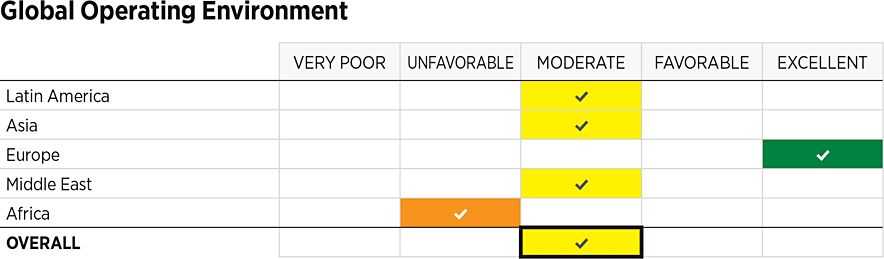
Conclusion: Scoring the Global Operating Environment
Because the United States is a global power with interests in various parts of the world, threats to those interests can emerge from a number of regions, to include the Western Hemisphere, East Asia, Europe, or the Middle East. The U.S. military must be prepared to operate in a variety of regions, even while maintaining strategic focus on the regions that matter most and must account for a range of conditions that it might encounter when planning for potential military operations. These considerations necessarily inform the military’s decisions about the types and amounts of equipment it procures (especially to transport and sustain the force); the locations from which it might operate; and how easily it can project and sustain combat power during conflict.
Aggregating the five regional scores provides a global operating environment score of “moderate” in the 2026 Index.

Western Hemisphere/Latin America. After years of military, economic, and political cooperation with the United States, the Latin American operating environment is broadly supportive of U.S. relations and military activities, but it also is under stress. Illegal immigration, drug cartels, and the malign influence of the People’s Republic of China have strained both regional stability and relations between many countries and the United States. The activities of the Venezuelan regime in particular, as well as those of Cuba, have exacerbated destabilization in the region, but the removal of Venezuelan President Nicolás Maduro could significantly mitigate some of these trends. We assess Latin America as “moderate” with respect to U.S. interests in terms of alliances, overall political stability, and military threats. The United States has neglected the security of the Western Hemisphere for decades, and the actions taken by the second Trump Administration in 2025 and 2026 are an outstanding first step toward fixing this and setting things in order in America’s backyard.
Asia. The Asian strategic environment includes half of the planet and is characterized by a variety of diverse nations. American conceptions of Asia and the Indo-Pacific must recognize the physical limitations imposed by the tyranny of distance and the need to move forces to respond to Chinese and North Korean aggression. The need to prioritize the Indo-Pacific in defense planning is clear and the United States will need to shift forces to the Indo-Pacific, invest greater resources, and prioritize Indo-Pacific operations and systems relevant to deterring China across the board.
The lack of a regional alliance structure such as NATO makes the defense of U.S. security interests in Asia challenging. However, the United States has strong relations with allies and partners in the region and their willingness to host bases helps offset the vast distances that must be covered.
The militaries of Japan and the Republic of Korea are larger and more capable than European militaries and both are interested in developing missile defense capabilities that will be essential in combatting the regional threats posed by China and North Korea. In Japan, public awareness of the need to adopt a more “normal” military posture in response to China’s increasingly aggressive actions continues to grow. Nevertheless, the continued growth of China’s military and its aggression in the region as U.S. military posture and infrastructure have weakened prompt a downgrade of the region’s overall stability from “favorable” to “moderate.”
Europe. Overall, the European region remains a stable, mature, and friendly operating environment. Russia remains the primary military threat to Europe, both with conventional and nuclear forces, and its invasion of Ukraine marks a serious escalation of its efforts to exert influence in the region. China continues its efforts to expand its presence in Europe through propaganda, influence operations, and financial investments. By mitigating the effect of sanctions and supporting Russia’s war in Ukraine, it also has significantly enhanced and deepened its relationship with Russia. Both NATO and non-NATO European countries should be increasingly concerned about the neo-imperialist ambitions of Russia and China. European nations will need to take primary responsibility for the conventional defense of Europe as America by necessity shifts resources to the Indo-Pacific to deter China.
In the 2024 Index, we noted a strengthening of alliance relationships. NATO placed renewed emphasis on logistical matters and the extent to which it could respond to emergent crises. In 2025, U.S. prodding and leadership have had a galvanizing effect on European political establishments, causing them to focus on increasing their defense expenditures and on reinvesting in their defense industrial base. The 2025 Hague Summit resulted in an alliance-wide shift with nations pledging to spend a minimum of 5 percent of their gross domestic product on defense spending. However, significant work remains to be done if Europe is to assume the lead for the conventional defense of Europe.
This overall picture has led us to score Europe’s political stability as “excellent” once again in the 2026 Index. It is difficult to predict whether NATO’s renewed emphasis on collective defense and its reinvigorated defense spending will continue over the long term or are merely short-term responses to Russia’s aggression in Ukraine. Given the potential for Russia to replace its battlefield losses, NATO defense spending on capability will be an important issue, both in the medium term and over the long term.
Scores for Europe remained largely steady this year as they have in previous years. The 2026 Index assesses the European operating environment as “excellent” overall.
The Middle East. The Middle East will remain an area of concern for U.S. military planners because of the interests involved and the region’s historical and continuing volatile nature. The Middle East region is now significantly more stable both because of Israel’s successful military operations against Hamas and Hezbollah and because of U.S. efforts to destroy Iran’s nuclear weapons infrastructure and capabilities. Further, successful operations against the Houthis in Yemen have reduced threats to U.S. interests and to broader global economic shipping.
In the Middle East, the United States benefits from operationally proven procedures that leverage bases, infrastructure, and the logistical processes needed to maintain a large force that is forward deployed thousands of miles away from the homeland. America’s relationships in the Middle East are based on shared security and economic concerns. As long as these issues remain relevant to both sides, the United States will be able to act with decisiveness when its national interests require.
The 2026 Index assesses the Middle East operating environment as “moderate,” but the region’s political stability continues to be “unfavorable.”
Africa. Africa is an enormous region of great complexity. Its operating environment is multifaceted, and U.S. interests there vary based on military infrastructure, terrorist threats to the homeland, illegal immigration, unfavorable trade practices, and the destabilizing effects of Russian and Chinese influence. We assess Africa as “moderate” with respect to U.S. interests in terms of political stability but “unfavorable” overall because of alliance, infrastructure, and U.S. military posture challenges.
Summarizing the condition of each region enables us to get a sense of how they compare in terms of the difficulty that would be involved in projecting U.S. military power and sustaining combat operations in each one. As a whole, the global operating environment remains broadly stable with the United States able to project military power anywhere in the world to defend its interests without substantial opposition or high levels of risk. However, increased activities by China cause the overall global environment to be downgraded from “favorable” to “moderate” in the 2026 Index.