Europe
Jordan Embree
Europe has been the central pillar of America’s alliance network since World War II. Under American leadership and through American financial, political, and military support, Europe rebuilt itself and became a bastion of freedom opposing Communist tyrants. As Americans watched the Berlin Wall crumble and the Iron Curtain fall, they rejoiced, welcoming millions more to freedom, and sought by example and material support to speed their embrace of democracy, free speech, and national sovereignty.
The transatlantic relationship has endured and grown over the past eight decades on the foundation of those shared interests. The standout historical moments of the past 80 years—from President John F. Kennedy’s Ich bin ein Berliner address to President Ronald Reagan’s demand that “Mr. Gorbachev tear down this wall” to the many North Atlantic Treaty Organization (NATO) allies standing alongside America to fight terrorism after 9/11—revolve around those interests.
Yet as the 20th century faded into the 21st, this historical foundation wore thin, and the transatlantic community’s unity wobbled. Cracks appeared soon after the initial unified response to 9/11 as then-Secretary of Defense Donald Rumsfeld spoke of “new Europe” and “old Europe” while contrasting allied support for the U.S.-led war in Iraq in Eastern Europe with allied opposition in Western Europe.[REF] Perhaps even more important, the Soviet Union’s collapse lulled leaders on both sides of the Atlantic, but particularly in Europe, into thinking traditional military power unnecessary given the much-hyped “end of history” heralding the triumph of liberal values worldwide.
As a result, throughout the 2010s, most NATO countries failed to meet their defense spending promises despite repeated entreaties by American Presidents and defense officials. Germany even built the Nord Stream 2 gas pipeline to funnel Russian gas to German businesses despite Moscow’s record of weaponizing energy resources.[REF] American lawmakers reacted forcefully against this strategic blunder, which breached a fundamental NATO principle of “keep[ing] the [Russians] out,” by sanctioning companies involved with the pipeline.[REF] Nord Stream 2 was finally foreclosed by Russia’s full-scale invasion of Ukraine in February 2022 (and subsequent sabotage).[REF] In addition, Ukraine has declined to renew its gas transshipment deal with the Russian Federation during wartime,[REF] thereby at least temporarily re-establishing a transatlantic energy posture that is less reliant on Russia.
Recently, NATO has trended in an even more positive direction. Consistent pressure from President Donald Trump in both of his Administrations in concert with Russia’s invasion of Ukraine finally convinced European NATO members to meet their 2 percent of GDP spending target in 2025.[REF] The June 2025 NATO summit in The Hague built on this initial step through a modernized minimum defense spending level of 5 percent of GDP. The spending level was divided between 3.5 percent outlays for core defense spending and an additional 1.5 percent for critical national security infrastructure. NATO Secretary General Mark Rutte credited President Trump, and President Trump again reaffirmed his commitment to Article 5 of the North Atlantic Treaty, NATO’s founding document, which “provides that if a NATO Ally is the victim of an armed attack, each and every other member of the Alliance will consider this act of violence as an armed attack against all members and will take the actions it deems necessary to assist the Ally attacked.”[REF]
Germany epitomizes this policy renewal through its commitment to a renewed defense role. Germany is NATO’s second-largest national economy by GDP,[REF] and its rearmament is critical for NATO deterrence. Germany’s Zeitenwende, a sea change in German thinking on national security, resulted in defense spending that brought expenditures to 2 percent of GDP in 2024.[REF] The coalition government under Chancellor Friedrich Merz supports continuing this rebuild and aims to reach the 3.5 percent goal by 2029, well ahead of schedule.[REF] As its rearmament proceeds, Germany should focus on deterring the Russians through steps like armored deployments, air defense improvements, and deep-strike missile procurement. By so doing, Germany will help to rebalance transatlantic burden-sharing and revitalize deterrence ahead of Russia’s reconstitution by taking its place as a leader in European conventional deterrence.[REF]
For its part, America remains central to NATO’s deterrence at the strategic and tactical levels.[REF] This is not likely to change anytime soon, and support for the NATO Alliance remains high, both among Americans generally and among Members of Congress.[REF] Europe still holds a special place in American esteem as the birthplace of Western civilization, as a genealogical origin point for millions of Americans, and as the modern proving ground for national sovereignty during the Cold War. On top of these connections, trade flows between Europe and the United States are nearly $1 trillion a year.[REF]
Yet discord has emerged in recent years over transatlantic values. While acknowledging different political systems and historical contexts, Washington is increasingly worried by perceived moves against free speech, especially those characterized as necessary to fight disinformation. Americans deeply believe that the solution to problematic speech is not censorship but an open marketplace of ideas in which the truth will win out. However, both domestically and abroad, anti-disinformation measures have twisted from presenting facts to propping up governmental narratives. At the same time, both America and its transatlantic allies have confronted massive migratory inflows in a frontal assault on national sovereignty. These have included adversary efforts to weaponize migration to destabilize European societies.[REF] To ensure that the transatlantic Alliance endures for the next 75 years, both America and its partners across the Atlantic must recommit to the fundamental values of freedom of religion, assembly, and speech and belief enshrined in the Helsinki Final Act[REF] and other transatlantic statements from across the 20th century.
To revitalize transatlantic ties in the 21st century, America, Canada, and their European partners must also take stock of today’s alarming threat environment. Russia’s invasion of Ukraine returned active warfare to Europe and highlighted broader global fissures. First, of course, is Russia and China’s no-limits partnership, which has been an invaluable source of dual-purpose goods to fuel the Russian war machine even as some limits do exist beneath the rhetorical surface.[REF] Additionally, the Chinese Communist Party continues to undertake threatening military actions, such as a massive nuclear buildup, and undercut global peace and stability through regular hostile activities menacing Taiwan and Taiwanese commerce.[REF]
Elsewhere, Iran’s ruling elite retains an abiding hatred for the West and remains unwilling to curb its nuclear program even following devastating strikes on Iran’s nuclear and command-and-control infrastructure by the United States and Israel. Faced by this recalcitrance, America and its European partners must remain wary of Iran’s efforts to double down on its support for proxies across the Middle East from Hezbollah to the Houthis in ways that directly harm European commerce and economic stability.[REF]
Despite these challenges, the NATO Alliance remains a force for deterrence and stability. With a formidable concentration of military power and a history of interoperability and joint operations, NATO can continue to ensure the transatlantic region’s security and stability, provided that European nations fund defense capabilities and recommit themselves to upholding the defining values of the transatlantic community.
U.S. Security Alliances in Europe: NATO as Primary Security Actor
Founded in Washington, DC, on April 4, 1949, NATO has served for 77 years as the principal transatlantic security guarantor in defense of “the principles of democracy, individual liberty and the rule of law.”[REF] Intensive consultations across the decades have led allies to “develop their individual and collective capacity to resist armed attack” to undergird their agreement that “an armed attack against one or more of them in Europe or North America shall be considered an attack against them all.”[REF] Courtesy of NATO, the United States’ security posture in Europe is intertwined with these allies for interoperability and planning purposes. Despite premature declarations of NATO’s demise,[REF] the organization is still the most effective Euro-Atlantic security institution.
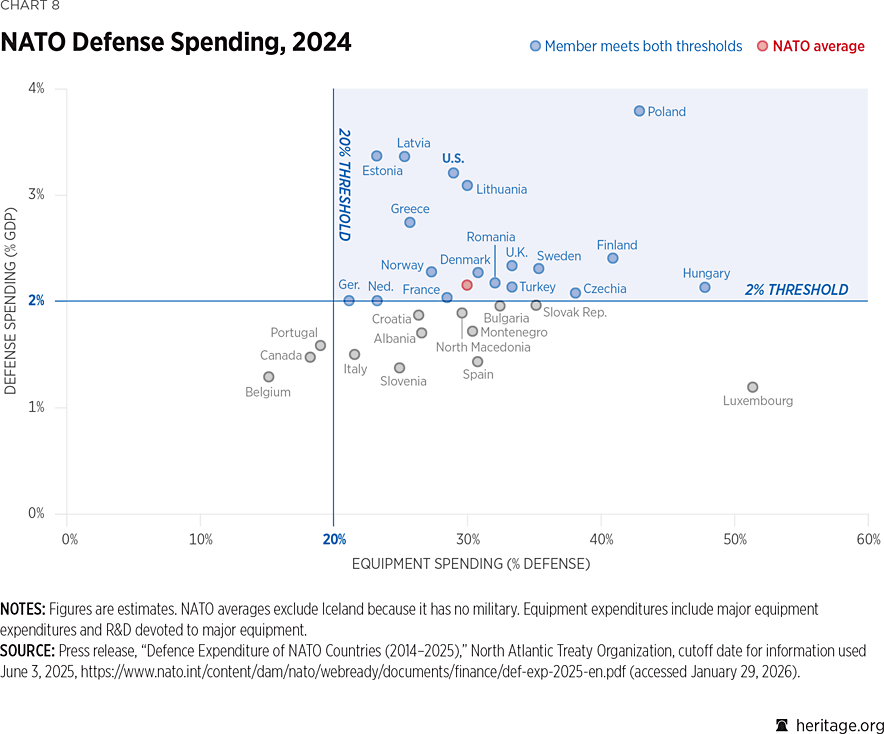
NATO Spending Shortfalls Since Wales. When reviewing NATO’s defense spending over the past decade, the data paint a stark picture of drastically unequal investments in collective defense. Despite the 2014 Wales Summit’s commitment to spending at least 2 percent of GDP on defense, most members failed to hit this target. Although NATO members finally reached 2 percent in 2025, the average NATO member averaged just 1.59 percent over the past decade.[REF] However, careful analysis reveals striking geographic disparities. While Eastern European nations—particularly Poland and the Baltic States—have prioritized defense spending in Hresponse Hto Russia’s aggression, Western European countries continue to lag behind despite the clear indicators and warnings since Russia’s 2014 annexation of Crimea.[REF] With the Ukraine war’s fourth anniversary now past, NATO allies must step up and fund critical capabilities.
Overall, from 2014 to 2024, NATO allies missed the 2 percent defense spending targets by $827.91 billion (adjusted to 2024 dollars).[REF] This cumulative shortfall nearly equals the United States’ annual defense budget.[REF] NATO’s collective equipment deficit since 2014 stands at roughly $70 billion when adjusted for the 2 percent minimum. This funding gap led to critical shortfalls in armored formations, long-range artillery, air defense, ammunition stockpiles, and logistics infrastructure—all of which are key to NATO’s deterrence architecture. Encouragingly, European NATO allies are increasing their defense spending, but capability gaps remain. As NATO refines its Regional Defense Plans—the planning for how to protect Alliance territory from attack in specific regions across the Alliance in a range of contexts from full-scale war to a limited incursion—NATO allies should concentrate on expanding their capabilities to deter Russia with a focus on national advantages.[REF]
Active NATO Operations. Aligned with NATO’s force planning are multiple ongoing operations and initiatives in the land, air, and sea domains alongside several multinational support initiatives. The longest active NATO operation is the Kosovo Force (KFOR), which began in June 1999 pursuant to United Nations Security Council Resolution 1244 following NATO air operations against the Federal Republic of Yugoslavia.[REF] Kosovo declared its independence in 2008, but it has not been recognized by Serbia and remains the major divide in their bilateral relations. In 2023, increased tensions in Kosovo resulted in injuries to 25 KFOR soldiers;[REF] the result was a temporary increase in KFOR troops that remains in place. At present, KFOR has deployed approximately 5,249 soldiers (of which 690 are American) from 33 nations to Kosovo.[REF] KFOR is the third responder after the Kosovo Police and the European Union (EU) Rule of Law Mission in Kosovo (EULEX).
NATO Integrated Air and Missile Defense (IAMD) provides the framework for all airspace operations split into the ongoing NATO Air Policing and NATO Ballistic Missile Defense (BMD) missions. It is commanded by the Supreme Allied Commander Europe (SACEUR), who is always from the United States and is currently General Alexus G. Grynkewich. NATO IAMD covers the airspace of all 81 million square kilometers of the Alliance using financial support and assets from across the Alliance.[REF] NATO’s Allied Air Command, headquartered at Ramstein Air Force Base, oversees NATO IAMD missions and is always led by a U.S. Air Force General.[REF] The current commander of NATO’s Allied Air Command, U.S. Air Forces in Europe, and U.S. Air Forces in Africa (which is now a three-star position) is Lieutenant General Jason Hinds.[REF]
NATO’s Air Policing mission has two Combined Air Operations Centres to coordinate airspace monitoring: one at Torrejón, Spain (for southern Europe), and one in Uedem, Germany (for northern Europe).[REF] NATO Air Policing houses five regional missions with varying ratios of American and other Allied forces beyond the monitoring headquarters. These missions are the Baltic States, Enhanced Air Policing on NATO’s eastern flank, the Eastern Adriatic and Western Balkans, Iceland, and the Benelux countries.
Begun in 2004 to ensure airspace security for Alliance members that lacked sufficient independent forces,[REF] Baltic Air Policing serves as a frontline defense and deterrence operation that frequently intercepts Russian Federation aircraft that are not following communications and safety protocols. Given the Baltic nations’ position between Russia and Kaliningrad, combined with Russian tensions, NATO air forces scrambled jets more than 300 times in 2024 in support of this mission.[REF] Backed by rotational air forces from NATO members based in Lithuania and Estonia, Baltic Air Policing is carried out by the Italian, French, and Dutch air forces.[REF]
Enhanced Air Policing was part of NATO’s 2014 Assurance Measures to boost deterrence along the eastern flank in response to Russia’s claimed annexation of Crimea.[REF] This included a second detachment of forces in Estonia and provided additional voluntary national detachments to support the Romanian and Bulgarian governments’ national air policing missions. At the moment, Spain is the main supporter of NATO’s Enhanced Air Policing mission in Romanian airspace, and Sweden deployed a Gripen fighter squadron to Poland in June 2025 to support Enhanced Air Policing there.[REF] The mission in Poland received intense media attention in September 2025 after it downed Russian drones that had flown deep into Polish territory.[REF]
The remaining air missions in the Eastern Adriatic and Western Balkans, Iceland, and the Benelux countries operate in a calmer environment to secure airspace and maintain interoperability. NATO’s Air Policing mission over the Eastern Adriatic and the Western Balkans secures Allied airspace with minimal air assets and is covered jointly by the Italian, Greek, and Hungarian air forces.[REF] Though staffed for decades by U.S. forces, the Icelandic Air Policing mission now consists of deploying fighters from NATO members for three to four weeks three times a year.[REF] Since Iceland has no military, this is the only way to ensure air surveillance. The Benelux Air Policing mission is a pooling of assets among the air forces of Belgium, the Netherlands, and Luxembourg to provide economies of scale in airspace security by pooling air assets and responsibilities.[REF]
Conceived during the first George W. Bush Administration and agreed to in principle under the second Bush Administration, NATO’s final permanent mission in the air is Ballistic Missile Defense, which is carried out with U.S. assets funded for deployment to bases across NATO.[REF] NATO BMD relies on a combination of radar and interceptor assets including BMD-capable naval assets deployed to Rota, Spain; Aegis Ashore sites in Romania and Poland; and radar and command and control in Turkey and Germany as built out by America’s European Phased Adaptive Approach.[REF] NATO BMD declared initial operational capability at the 2016 Warsaw Summit and enhanced operational capability at the 2024 Washington Summit, although full operational capability remains in the uncertain future as new and existing BMD assets including national Patriot and SAMP/T batteries are networked with the system.[REF] Thus, despite all of the above missions, air defense remains an area characterized by critical NATO capability gaps.
NATO has several active naval operations that are overseen by the Allied Maritime Command (MARCOM) in Northwood, United Kingdom, including Operation Baltic Sentry, Operation Sea Guardian, and maritime support in the Aegean Sea.[REF] In January 2025, Operation Baltic Sentry deployed frigates and maritime patrol aircraft to the Baltic Sea in response to critical infrastructure and shipping safety concerns with forces provided primarily by littoral states.[REF] Launched in November 2016 as the successor to Operation Active Endeavor, Operation Sea Guardian performs maritime security, domain awareness, and counterterrorism missions in the Mediterranean Sea. It conducts “five to six focused operations in specific areas of interest in the Mediterranean” each year with a combination of direct support assets under NATO command and associated support assets that remain under national commands.[REF] Since 2016, NATO has utilized rotations of ships from Standing NATO Maritime Group 2 to provide enhanced domain awareness and support to Greece, Turkey, and Frontex (the EU’s border enforcement agency) for out-of-area migration flows across the Aegean. This support provides enhanced awareness and coordination for national partners to address the humanitarian and security concerns posed by mass migration.[REF] Finally, NATO maintains two Standing NATO Maritime Groups (SNMG1 and SNMG2) to provide on-call rapid reaction naval forces under NATO command to deal with unexpected evolutions of the strategic environment as well as two Standing NATO Mine Countermeasures Groups (SNMCMG1 and SNMCMG2) to perform explosive ordnance disposal to secure open sea lanes.[REF]
NATO’s remaining ongoing operations concern out-of-area cooperation in Iraq and with the African Union (AU). NATO Mission Iraq started in October 2018 following an Iraqi government request to train Iraqi security forces. Focused initially on the military, it subsequently expanded to include Iraqi law enforcement agencies. NATO soldiers’ training activities are entirely non-combat and advisory, limited to those that are requested and permitted by the Iraqi government.[REF]
The NATO–AU relationship has developed over time since initial assistance requests in 2005. Their cooperation in 2025 focused on operational support, training support, and structural assistance, all underpinned by liaison work. Operational support related to strategic airlift and sealift provided to the AU’s mission in Somalia; training support included access to training at NATO institutions and a mobile training delegation in Africa, upon request; structural assistance consisted of advisors provided by request to the AU on an annual basis with a recurring focus on improving the AU’s African Stand-by Force Concept.[REF]
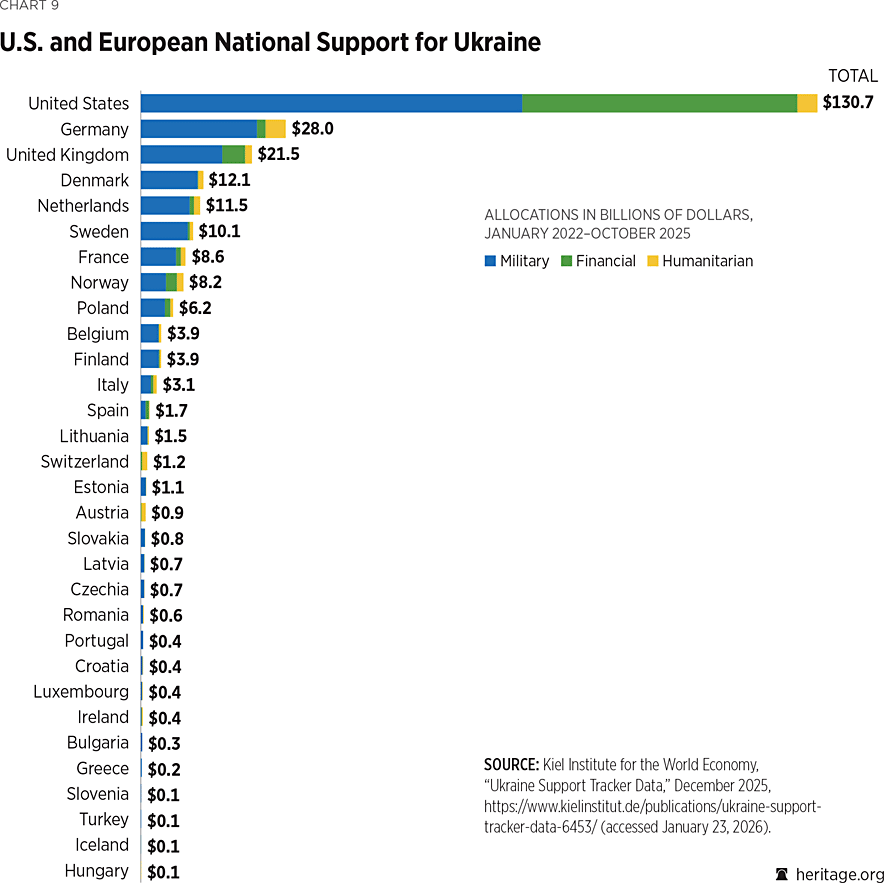
Finally, NATO has expansive ongoing efforts to support Ukraine in its fight against Russia with a particular focus on arms provision, training, and general funding organized under the framework of the Comprehensive Assistance Package (CAP) for Ukraine.[REF] Chart 9 breaks down funding to Ukraine by the United States and each European ally with a further delineation among types of aid; much of the NATO aid has been coordinated within CAP structures. While the United States has provided the largest single-nation share of support to Ukraine so far, ongoing balancing of the figures is occurring thanks to the NATO Prioritized Ukraine Requirements List (PURL) initiative launched after the June 2025 Hague Summit to establish an organized pathway for European allies to support Ukraine by paying the United States for delivery of prioritized weapons systems and other capabilities.[REF]
European Political Shifts
Recent European elections have featured political shifts. Voters turned to the right in the June 2024 European Parliament elections as the European People’s Party finished in pole position, and the European Conservatives and Reformists and other conservative party groupings gained seats. German voters continued this trend in February 2025 as the Christian Democratic Union/Christian Social Union (CDU/CSU) won elections in Germany, heralding increased defense spending.[REF]
However, while political change in Europe has been a constant, not all shifts have been toward the right or even toward functional government. In the United Kingdom (U.K.), Labour’s Keir Starmer beat the incumbent Conservative Party in July 2024 elections, and France’s snap elections settled into a deadlocked hung parliament with a progressive alliance of parties taking first place despite the conservative National Rally having its best night ever.[REF] This result presaged the fall of multiple French governing coalitions in 2025. Broadly, there is increased seriousness about defense capabilities and spending across Europe, but electoral tumult strengthens allied politicians’ incentives to play to their domestic bases, which can result in decreased alignment with Washington’s defense priorities.[REF] The following sections analyze the military situations of European NATO allies within regional groupings, as geography often dictates threat and capabilities priorities.
Malign Chinese Influence in Europe
Regardless of geography, American policymakers are intent on curbing malign Chinese influence in Europe, which has risen over the past decades. With economic and trade ties in the hundreds of billions of euros annually, China is now a major trading partner for many European countries—and under investigation by the EU for unfair trade practices involving a variety of goods.[REF]
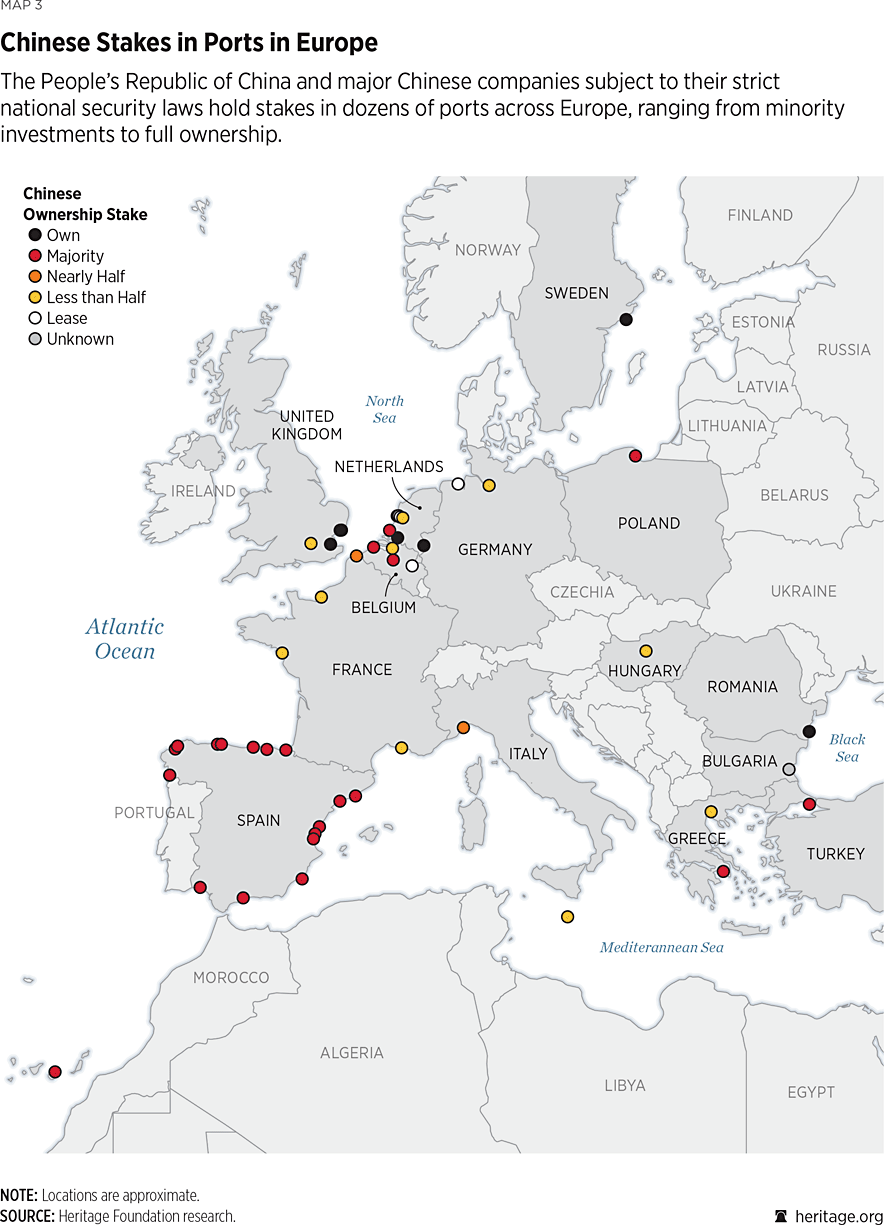
The United States remains Europe’s premier trading partner and investor, but Chinese investments continue to emerge across the continent. Encompassing sectors as diverse as ports, telecommunications, and car manufacturing, Chinese investment has penetrated a variety of critical sectors. The attractive financing terms have swayed some allies, as the true costs are hidden at the outset. An illustrative example is Poland’s port in Gdynia, where Hong Kong–based Hutchison Port Holdings controls a container terminal that Hutchison leveraged to deny the U.S. Army equipment unloading rights because of a slight protrusion into their port zone.[REF] With the extensive network of port investments and stakes detailed in Map 3, this raises concerning possibilities for wider problems if a conflict were to occur in Europe. Alternatively, with reference to telecommunications and cybersecurity, recent revelations that hackers linked to the Chinese government hit more than 80 countries should inspire vigilance.[REF] Yet many European countries still allow Chinese providers to service their national telecommunications networks.
While China’s malign activities are often covert, some have been more overt. Recent years have seen several high-profile Chinese espionage announcements, including charges of espionage involving a Huawei executive in Poland (2019); a warning of Chinese espionage targeting sensitive industries in the Netherlands (2024); espionage charges against two men in Britain (2024); and the September 2025 trial of a former aide to a member of the German Bundestag.[REF] China’s crowning subversive activity, however, is its support for Russia’s war in Ukraine, for which Chinese drone parts undergird Russian drone production lines and with Western officials alleging Chinese support for Russian explosives manufacturing as well.[REF] This all culminated in Chinese Foreign Minister Wang Yi’s telling European officials that “Beijing can’t accept Russia losing its war against Ukraine as this could allow the United States to turn its full attention to China.”[REF]
Nordic Allies: Denmark, Finland, Iceland, Norway, and Sweden. The Nordic nations are the northern bloc in NATO focused on Arctic, Baltic, and Russian border security. With Finland and Sweden now full members of the Alliance, NATO reaps the full benefit of their efforts. Finland’s 2024 Government Report on Finnish Foreign and Security Policy lays out the case:
Finland’s and Sweden’s NATO memberships and the increasingly close bilateral cooperation arrangements between the Nordic countries and the United States strengthens the stability and security in the Baltic Sea region and Northern Europe, reducing the risk of the use of military force in Finland’s neighboring areas. The accession of Finland and Sweden to NATO also helps deepen the cooperation between the Nordic and Baltic countries.[REF]
From coordinated Arctic Council actions to the Baltic Defender exercise and the Joint Expeditionary Force, America’s Nordic allies set the standard for Allied interoperability.[REF] In the air, Denmark, Finland, Norway, and Sweden have outlined a “Nordic Warfighting Concept for Joint Air Operations” to achieve unitary interoperability in the Nordic region.[REF] On the ground, Denmark, Finland, Norway, and Sweden all rely on BAE Systems’ Combat Vehicle 90 and are pursuing joint procurement for the next generation of infantry fighting vehicles to guarantee continued interoperability.[REF] Their interoperability and integration across all military domains were further enhanced by their planning, hosting, and participation in NATO’s Nordic Response 2024 exercise in which more than 20,000 soldiers from 13 Allied nations conducted joint operations in Finland, Norway, and Sweden on land, in the air, and at sea.[REF] Their extensive cooperation has been on display in Operation Baltic Sentry, conducted in response to repeated Russian and Chinese grey-zone warfare operations in the Baltic Sea.[REF] Sweden is working to open a NATO base in northern Finland by 2026 to forward posture forces and joint command and control for deterrence along Finland’s 830-mile border with Russia.[REF]
Each nation (except Iceland) is also pursuing national efforts to strengthen its security capabilities with geographic concentrations: Denmark is recapitalizing its Arctic naval forces, Finland is securing its land border with Russia, Norway is concentrating on Arctic navigation and maritime domain awareness, and Sweden is focused on defending Gotland. Norway’s effort is particularly significant, involving as it does a $13.5 billion contract signed with the U.K. to build five anti–submarine warfare (ASW) frigates.[REF] Under this program, Norway intends to procure five to six new anti–submarine warfare frigates with anti-submarine helicopters integrated for full combat readiness to support its role in delivering maritime domain awareness and control in the Arctic, including the hunting of Russian submarines.[REF]
Denmark. In February 2025, citing the Russian threat, the Danish government proposed a package to push its 2025 defense spending to more than 3 percent of GDP.[REF] The Danish Defense Minister had announced a package of at least $1.5 billion in December 2024 to increase security assets in and around Greenland, increase staffing at Denmark’s Arctic Command in Nuuk (Greenland’s capital), and upgrade one of Greenland’s civilian airports so that it could handle F-35 fighters.[REF] This was followed in February 2025 by a political agreement focused on the Arctic and North Atlantic in Copenhagen dedicating 14 billion Danish kroner (roughly $2.2 billion) to “[c]apabilities such as three new Arctic naval vessels, further long-range drones and satellites.…”[REF] All of this was capped by a $4.2 billion increase in defense spending in October 2025 to secure additional capabilities for Arctic security.[REF]
These three packages will enable Denmark to strengthen its protection of Greenland. All of these actions preceded Denmark’s accession to the Arctic Council’s chairmanship.[REF] These investments were coupled with the Danish-led Arctic Light 2025 NATO exercise held in Greenland from September 9–19, 2025, with several NATO partners,[REF] and the Arctic Endurance exercises that have begun in 2026.[REF]
Iceland. Iceland is a founding member of NATO but does not have a military. Holding a key geographic position astride transatlantic transit routes and the Arctic, Iceland contributed 0.0624 percent of NATO’s annual operating budget in 2024 per cost share arrangements, which works out to roughly €235.1 million ($254.5 million at average 2024 exchange rates) as its share of NATO’s overall 2024 budget.[REF] Since Iceland has no military forces, its coast guard interfaces with NATO forces operating in Iceland.[REF] Iceland spent 6.7 billion Icelandic krona ($52.2 million) on its coast guard in 2024.[REF]
Using its 2024 GDP figure of $32.2 billion,[REF] Iceland spent roughly 0.156 percent of GDP on defense if all of the above figures are included. Not even half of the NATO target, this would make Iceland the lowest NATO defense spender if the government considered these figures defense expenditures and reported them to NATO. However, Iceland is in a critical position with respect to defense of the Atlantic Bridge line of operation and military domain awareness, so its provision of access provides value to NATO that is not captured by its low spending.[REF] The U.K. leveraged this position in November 2025 when it deployed several P-8A Poseidon maritime patrol aircraft to Keflavik Air Base for patrols.[REF] The U.S. seized the Russian Bella 1 oil tanker off the Icelandic coast in January 2026.[REF]
Finland. Finland entered the Alliance as a model member in April 2023 and planned to spend €290 million ($334 million)—upwards of 2.5 percent of GDP—on defense in 2025.[REF] With an 830-mile border with Russia and a security situation that could “deteriorate quickly…[and] drag on for years” according to Finnish Defense Minister Antti Häkkänen, Finland is committed to a modernized and expanded military. The Finnish Defense Forces have 24,000 active-duty personnel that can scale to 280,000 troops in wartime, supported by a reserve force of about 870,000 troops.[REF]
Moreover, those troop levels are not just for show: Finland is taking on a leading regional role. For example, it was the first country to forcibly board an oil tanker suspected of deliberate sabotage of Baltic Sea cables, and although the tanker ship Eagle S was eventually released, Finnish authorities detained several crew members until legal proceedings were complete.[REF] Finland also has augmented security on land: closing its land border with Russia in late 2023, announcing a NATO brigade deployment and hosting Exercise Dynamic Front to practice live artillery fire command-and-control and interoperability with NATO partners in 2024, and announcing its withdrawal from the Ottawa Convention banning landmines to allow access to all necessary tools of defense.[REF]
Norway. Norway hit the 2 percent NATO spending target in 2024 and planned to increase its defense spending to 2.16 percent in 2025 with funding for additional personnel, air platforms like the F-35, and officer training improvements.[REF] Though now exceeding 2 percent of GDP on defense, Norway may fall short of rising targets as it aims to reach 3 percent by 2030.[REF] Nevertheless, Norway announced a 50 billion Norwegian kroner (NOK) (approximately $5.1 billion) increase in its support for Ukraine for a total 2025 allocation of NOK 85 billion (approximately $8.7 billion) to buttress Ukrainian defense industry output.[REF] From May 2023 to May 2025, Norway also chaired the Arctic Council, where it sought to promote Allied cooperation and sideline Russia because of the Ukraine war.[REF] Unfortunately, these efforts largely failed to reduce conflict with the Russians, who accused Norway in March 2025 of militarizing the Svalbard Archipelago, a claim that Norway denied, noting its adherence to the 1920 treaty establishing Norwegian sovereignty there.[REF]
Because of its border with Russia, Norway keeps a wary eye on Russia’s main submarine bases, strategic bomber bases, and nuclear weapons storage sites in the Kola Peninsula, and it amended its Defense Cooperation Agreement with the United States in February 2024 to grant access to eight additional areas concentrated in the northern part of the country.[REF] In furtherance of overall NATO cooperation, Norway hosted nine Allied nations for the Joint Viking 2025 Exercise in March 2025 to simulate a defense of Norway.[REF] Tensions with allies, America in particular, arose in 2025. Unnamed officials challenged the security of intelligence-sharing with the United States, and a Norwegian bunker fuel supplier refused to supply a U.S. nuclear submarine, which had to turn around mid-transit.[REF] Nevertheless, senior Norwegian officials publicly emphasize that their cooperation with the United States will continue.
Sweden. Sweden became a valuable addition to the NATO Alliance in March 2024 and has doubled down on its traditional seriousness about defense through a heightened military training tempo, increased capability development, and commitment to NATO integration. In October 2024, the government announced a Total Defense Bill for 2025 to 2030 that called for an increase of more than 170 billion Swedish kroner (more than $16 billion) above current military spending, which was already above 2 percent of GDP.[REF] This seriousness is paralleled in the Swedish military’s training, especially on the strategically vital island of Gotland in the middle of the Baltic Sea. Swedish forces run continual exercise rotations to prepare to repel an invasion and have constructed additional barracks.[REF] The Swedish military has also ramped up its Arctic training program while training U.S. forces to operate in the Arctic’s harsh conditions.[REF]
As another part of NATO integration, Sweden has opened its Visdel Test Range, Europe’s largest land proving ground, to partners. To commemorate Sweden’s first anniversary as a member of NATO, American B-52H Stratofortresses escorted by Swedish JAS 39 Gripen fighter jets carried out practice drops of GBU-30 joint direct attack munitions at Visdel.[REF] Additionally, Sweden has expanded the Esrange Space Center in its North as a unique launch facility for Europe and has begun to launch military communications satellites (the first was launched from California in August 2024).[REF] Finally, Sweden has been a stalwart supporter of Ukraine and signed a letter of intent about cooperating on air capabilities as a first step toward a major deal for the export of Gripen fighters.[REF]
Baltic Allies: Estonia, Latvia, and Lithuania. Russia presents a conventional military threat to Estonia, Latvia, and Lithuania that may be greater than the one it presents to any other NATO members. Accordingly, these three allied countries commit high percentages of their GDP to national defense (all are headed to 5 percent of GDP).[REF] Their prioritization of capabilities central to defense against Russian invasion and grey-zone aggression is illustrated by joint construction of the Baltic Defensive Line: a set of 600 bunkers and fortified positions along their border with Russia to shape future invasion routes.[REF] Purchases of relevant capabilities, from High Mobility Artillery Rocket Systems to National Advanced Surface-to-Air Missile Systems to Naval Strike Missiles, all increase the Baltic forces’ ability to impose significant costs on any potential Russian invasion in order to preserve battlespace for the inflow of allied reinforcements.[REF]
Finally, the recent 2025 joint public announcement by the Baltic and Polish defense ministers recommending that their nations withdraw from the Ottawa Treaty (which prohibits the production, stockpiling, and deployment of anti-personnel landmines) in order to capitalize on their Baltic Defensive Line indicates a recognition of the realities of their threat environment.[REF] Since the joint statement, Lithuania’s Ministry of Defense has announced a three-layer defensive scheme encompassing areas from Lithuania’s border with Russia to 50 kilometers inland. It is already under construction with minefields planned for the first layer.[REF]
Due to rising Russian threats and a lack of strategic depth in the Baltic States, NATO has deployed multinational battlegroups as tripwire forces to each of these three countries and Poland since 2017. Each battlegroup is led by a framework nation: The United Kingdom leads in Estonia (battlegroup total: 1,350 soldiers); Canada leads in Latvia (battlegroup total: 2,450 soldiers); and Germany leads in Lithuania (battlegroup total: 1,800 soldiers).[REF] Germany is continuing to expand its forces toward final deployment of its new 45th Armored Brigade by 2027.[REF]
Eastern Flank Allies: Bulgaria, Hungary, Poland, Romania, and Slovakia. In March 2022, then-NATO Secretary General Jens Stoltenberg announced NATO’s Enhanced Forward Presence (EFP) effort consisting of four new multinational NATO battlegroups deployed to Bulgaria, Hungary, Romania, and Slovakia (in addition to the existing four in the Baltic States and Poland).[REF] The United States is the framework nation in Poland; the multinational battlegroup in Bulgaria is a combined command between Bulgaria and Italy; Hungarian forces lead in Hungary with support from Croatia, Italy, and Turkey; and France leads the battlegroup in Romania.[REF] Personnel rotations are constant, but “battlegroups are not identical; their sizes and compositions are tailored to specific geographic factors and threats.”[REF]
Bulgaria. A member of NATO since 2004, Bulgaria continues to replace outdated Soviet gear with modern NATO standard equipment to enhance its military capabilities and interoperability. This process has slowed because of spending limitations over the past decade, although Bulgaria did spend more than 2 percent of GDP on defense in 2024.[REF] Significant events in 2025 included the initial delivery in April of eight F-16 fighter jets to replace aging MiG-29s with another eight F-16s scheduled to arrive by the end of 2027.[REF] In September 2025, Bulgaria enhanced readiness and NATO interoperability by hosting NATO’s 20th civil emergency response exercise.[REF] Regular emergency response exercises help to ensure smooth coordination in disaster and other emergency response, such as the NATO response to deadly earthquakes in Turkey.[REF]
Hungary. Hungary became a member of NATO in 1999 and has marked its own path within NATO over the past year by embracing economic openness to Russia and China while also approving Sweden’s accession to the NATO Alliance.[REF] Hungary has met the 2014 NATO Wales Summit 2 percent spending target since 2023; by contrast, “while the majority of NATO members finally reached the threshold in 2024, NATO members over the past decade averaged only 1.59 percent.”[REF] Given these complicating factors and Hungary’s position on NATO’s eastern flank, Prime Minister Viktor Orbán’s government sought freedom to limit Hungarian participation in all NATO actions outside the Alliance’s territorial borders, which was granted in a deal whereby Hungary agreed not to block NATO support to Ukraine.[REF] Despite these delineations, Budapest welcomed President Trump’s re-election and coordinates closely with Washington on Russia sanctions policy as demonstrated by a January 2025 reversal of a threatened veto and a November 2025 sanctions carve-out for Hungary.[REF]
Poland. Lauded by U.S. Secretary of War Pete Hegseth as a “model ally,”[REF] Poland has taken the lead in Europe on securing credible deterrence capabilities in support of its NATO obligations. On track to reach 5 percent of GDP on defense spending, Poland has secured critical capabilities from American F-35 jets to South Korean K2 Tanks to increasing Polish 155mm artillery shell production. Polish defense spending has been concentrated on combat capabilities.[REF] As a result, Poland has emerged as a bulwark of NATO deterrence.
Romania. Romania hit the 2 percent of GDP defense spending target for the third time in a decade in 2025 and envisions serious additional spending as it expands the Mihail Kogălniceanu NATO military base to 3,000 hectares, which will make it the largest NATO base by 2030.[REF] A key player in Black Sea security, Romania hosts an Aegis Ashore site as part of NATO’s IAMD mission.[REF] Romania’s geography, spending, and basing assets will make it a significant player in NATO for the foreseeable future, but concerns exist because of its decision to annul a presidential election, citing Russian influence operations.[REF]
Slovakia. Slovakia met the 2 percent NATO target in 2025 but has refused to commit to additional spending beyond “a slight increase of about a tenth of a percent.”[REF] Concerns about fiscal and strategic overextension also underpin Prime Minister Robert Fico’s public opposition to Ukrainian NATO membership and to sanctions on Russia.[REF] Another concern is that both Slovakia and Hungary continued to rely to a significant extent on Russian energy resources in 2025.[REF] On a more positive note, Prime Minister Fico survived an assassination attempt in the summer of 2024 and has returned to health without civil unrest or government collapse.[REF]
Balkan Allies: Albania, Croatia, Montenegro, North Macedonia, and Slovenia. All of NATO’s Balkan members acceded to NATO in the 21st century after NATO interventions in Bosnia and Kosovo in the late 20th century, seeking to build trust and cooperation among historically fractious nations. The process has advanced NATO values and promoted regional cooperation, but the contributions of these nations to European security have been commensurate with their smaller relative size.
Decades of regional integration produced a Joint Declaration on Strengthening Defense Cooperation in 2025 by Croatia, Albania, and Kosovo (a non-NATO member with NATO KFOR still on the ground) that has drawn furious protests from Serbia, which still regards Kosovo as a breakaway province.[REF] Croatia doubled down in August 2025 when it signed a defense agreement with Slovenia expanding their pre-existing ties to smooth joint production and exercises, which Serbia also strongly criticized.[REF] The degree of implementation and the possible effects on strategic stability in the Balkans remain to be seen.
Southern Allies: Greece, Italy, Portugal, Spain, and Turkey. For Southern European NATO allies, instability in the Middle East and Africa and Russian meddling in their backyard are the most pressing security threats. Nevertheless, the Mediterranean countries have not invested sufficiently in the defense capabilities needed to meet this challenge, and several have spent significant time below the prior 2 percent spending threshold. The lackluster defense spending in Italy, Portugal, Spain, and even France (which only recently reached 2 percent of GDP) stand in stark contrast to spending by their northern NATO partners
Greece. Greece’s commitment to defense spending has been steady, although this has been due largely to ongoing historic tensions with neighboring Turkey. These tensions came into the open in 2024 in disputes with Italy and France over defense deals with Turkey involving the air domain.[REF] These disputes led Greece to pursue technology modernization initiatives that integrate artificial intelligence (AI) and drone technology into its air defense systems; this is an Allied capability gap, but Greece’s plans currently remain focused on countering Turkey.[REF]
The Greek navy has increased its activities, particularly in the Red Sea, with Rear Admiral Vasileios Gryparis assuming operational command of the EU’s Operation Aspides, although he is hamstrung with only a handful of rotating frigates.[REF] Adding to naval force generation concerns, Greece has stuck to “balanced relations with China”[REF] in discordant counterpoint to the American approach. America, for example, has blacklisted China’s COSCO Shipping, which runs Greece’s Piraeus Port, and COSCO Shipping has refused to invest capital in the upgrading of Piraeus Port to meet modern standards.[REF] However, a recent investment agreement in Greece with the United States Development Finance Corporation signals a positive move to diversify port infrastructure for security.[REF]
Another threat is Russia’s aggressive and growing presence in the Mediterranean. Russia’s hypersonic missile tests in the eastern Mediterranean, provision of intelligence that helps Houthi terrorists to target commercial shipping in the Red Sea, and redeployment of forces from Syria to Libya are directly compounding instability and conflict.[REF] Redoubled Greek force generation and capabilities will be essential to addressing these worrying trends.
Italy. Prime Minister Giorgia Meloni has one of the best relationships with President Trump among NATO leaders,[REF] but Italy seems to lack political will when it comes to spending on defense. Military leaders have declared that “our commitment to the security of the Red Sea and other crisis areas must fund support through additional funding that goes beyond the scope envisaged with the recent approval of the budget law.”[REF] Instead, Italian politicians have been content to commit minimal Italian troops to NATO operations and have Italy serve as host for Allied Joint Force Command Naples.[REF]
Italy has been a leader in EU operations such as the anti-piracy Operation Atalanta off the Horn of Africa and Operation Irini, responsible for enforcing the United Nations arms embargo against Libya, but both operations strain under limited assets.[REF] Ideally, Italian operations related to Libya can give NATO leverage to deny Russian forces a new basing foothold to replace their location in Syria. Scattered strategic commitments and insufficient defense resourcing, if continued, will complicate Article 3 commitments that lie at the heart of NATO’s assurance of collective defense in the contested Mediterranean strategic environment.
Portugal. Portugal developed ties with the United States during World War II, when it granted America use of the Azores to move naval and air assets across the Atlantic, and after the war became a founding member of NATO.[REF] However, it has lagged behind most other European allies by spending only 1.55 percent of GDP on defense in 2024 and reaching 2 percent only in 2025.[REF] This is primarily the result of a disconnect between NATO’s focus on securing the eastern flank against Russian aggression and Portugal’s position on the far Western edge of Europe. However, as NATO Secretary General Rutte noted during his January 2025 visit to Portugal, NATO realizes it will need to deal with “challenges coming from the southern neighborhood,” and Russian ships and aircraft still lurk nearby.[REF]
Spain. Consistent with past practice, Spain spent only 1.43 percent of GDP on defense in 2024.[REF] Prime Minister Pedro Sánchez has promised to accelerate defense spending—a potential boon to the Alliance as Spain is the eurozone’s fourth-largest economy—but he faces political challenges from his hard-left coalition members.[REF] Confronted by rising allied pressures, Spain has announced a €2.08 billion ($2.4 billion) increase in defense procurement and a €1 billion ($1.15 billion) military assistance package to Ukraine for 2025 (this helped Madrid reach 2 percent in 2025).[REF] However, Spain has explicitly rejected the 5 percent defense spending target adopted at NATO’s June 2025 Hague Summit in favor of social spending.[REF] That lower budgets mean lower capabilities is perhaps best demonstrated in Spain’s case by its decision not to buy F-35 jet fighters, instead holding out for the sixth-generation European Future Combat Air System, which will not be operational until 2045.[REF]
Turkey. Turkey has been a pivotal ally for counterterrorism force projection by American and NATO forces into the Middle East but has clashed with NATO over Sweden’s accession to the Alliance, cooperation with Russia, and historic grievances with Greece. In January 2024, Turkey became the final NATO ally to ratify Sweden’s NATO accession, having used its leverage to force changes in Swedish anti-terrorism laws, compel extradition of wanted individuals to Turkey, and ensure new arms sales from Washington.[REF] U.S.–Turkey relations have improved with a sale of the latest Block 70 F-16s, but Ankara’s 2019 decision to purchase Russia’s S-400 air defense system led the United States to expel Turkey from the F-35 fighter jet program.[REF]
Tensions between Greece and Turkey have surged over the Greek government’s plans for a Greece–Cyprus–Israel power link, which Turkey claims will violate its territorial waters.[REF] Nevertheless, the fall of the Assad regime has raised the possibility of cooperation on security in Syria as Turkey seeks to establish stability on its southern border to permit the millions of Syrian refugees hosted by Ankara to return home.[REF] This could also build on cooperation by Turkey, Romania, and Bulgaria in the framework of a joint counter-mine task force in the Black Sea to ensure safe shipping.[REF] Despite significant pitfalls, if positive momentum can be sustained (or even expanded with a possible return of Russian S-400 systems[REF]), NATO cohesion could improve, and threats from the Alliance’s southern flank could be reduced.
Western and Central European Allies: Belgium, the Czech Republic, France, Germany, Luxembourg, the Netherlands, and the United Kingdom.
Belgium. Brussels is host to NATO’s headquarters, but Belgium has failed to meet NATO spending targets for more than a decade, although Prime Minister Bart De Wever and Defense Minister Theo Francken did raise Belgian defense spending to the Wales Summit goal of 2 percent in 2025.[REF] Connected to this increase, Belgium’s order of 34 F-35 jet fighters was scheduled to arrive in 2025, and the government is looking at new purchases of F-35s and an anti–submarine warfare frigate.[REF] The F-35s will be put to use as Belgium leads NATO’s Benelux Air Policing mission. Belgium also brings financial acumen to the Alliance as host to the Society for Worldwide Interbank Financial Telecommunications (SWIFT). SWIFT has been a critical part of coordinated Allied actions to punish Russia for aggression in Ukraine and is a keystone of Western economic leverage.[REF] Belgium is also shifting to investment in European defense firms to expand the allied defense industrial base.[REF]
The Czech Republic. The Czech Republic spent 2 percent of GDP on defense in 2024 and has announced plans to reach 3 percent of GDP by 2030.[REF] This increased focus on national security follows an October 2023 “Defence Strategy of the Czech Republic” in which Minister of Defence Jana Černochová acknowledged “a highly deteriorated security situation” while criticizing past “political apathy and chronic underfunding.”[REF] The Czech Republic has a long history of successful weapons manufacturing with domestic arms makers such as Česká zbrojovka a.s. helping to modernize Czech military equipment.[REF]
The government has backed its rhetoric on Ukraine with direct aid and coproduction support. The Czech ammunition initiative for Ukraine, for example, has won plaudits for delivering hundreds of thousands of 155 mm artillery rounds to Ukraine that it bought from world markets, and the initiative was extended into 2025.[REF] The Czech Republic also has signed agreements with the Ukrainian defense industry to produce its NATO-standard rifles for Ukraine’s soldiers in Ukraine, building up a long-term supply pipeline.[REF]
France. France is a unique NATO ally with its Gaullist streak of independence, status as a secondary NATO nuclear power, and tradition of maintaining an expeditionary force. France became a nuclear power in the 1960s and today maintains a force of nuclear-capable Rafale jets to launch ASMP-A nuclear-armed cruise missiles and a fleet of three Triomphant-class ballistic missile submarines with a set of M-51 submarine-launched ballistic missiles (SLBMs) with multiple independently targetable re-entry vehicles (MIRVs).[REF] France is not a member of NATO’s Nuclear Planning Group, but its nuclear capabilities complicate adversary calculations, as does France’s strategic ambiguity policy with respect to vital interests with European dimensions.[REF]
The French military has long guarded an independent expeditionary capability but is now undergoing a transition to focus on high-intensity warfare against more equal adversaries.[REF] Additionally, President Emmanuel Macron has proposed a force built from a coalition of the willing to monitor any ceasefire or peace deal in Ukraine pursuant to Washington’s insistence that American troops will not deploy.[REF] As part of its operational independence, the French navy retains a carrier group centered on the Charles de Gaulle aircraft carrier, which deploys worldwide, including to French territories in the Indo–Pacific.[REF] However, despite the Red Sea’s strategic importance in linking French territories, France declined to join America’s Operation Prosperity Guardian, relying instead on the “lowest common denominator of agreement” represented by the purely defensive operations conducted as part of Operation Aspides, a European Union mission to accompany EU nations’ vessels through the Red Sea.[REF]
Germany. Germany will necessarily play a central role in deterring Russian conventional aggression against NATO allies in Europe. Its Zeitenwende fund and current relaxing of debt limits for defense are valuable steps to rectify massive defense underinvestment. Additionally, Germany is the second-biggest contributor of military aid to Ukraine behind the United States. Germany is set to deploy an armored brigade permanently to Lithuania; an estimated 500 of an eventual 5,000 soldiers of the 45th Armored Brigade were deployed there in 2025, and the rest were scheduled to deploy by the end of the year.[REF]
Germany is leading the effort to close NATO air defense capability gaps through its Sky Shield initiative, which brings together 21 nations to procure and deploy short-range, medium-range, and long-range air defense systems to blunt missile threats from Russia as successfully demonstrated in Ukraine.[REF] In 2024, Germany broke ground on Europe’s first Patriot missile plant to ensure a steady supply of these critical air defense munitions.[REF] The German military is also planning to purchase an updated version of the German-produced Taurus long-range strike missiles to deepen alarmingly light precision munitions stockpiles in Europe.[REF] If Germany continues to augment its defense investments, NATO security will improve in the years ahead.
Luxembourg. Among the world’s smallest countries, Luxembourg has around 671,000 citizens though they are among the richest in the world at $132,800 per capita.[REF] Its economic vitality and status as a NATO founding member have not translated into meeting NATO defense spending commitments: Luxembourg has spent below 2 percent of GDP on defense every year since 2014, when NATO agreed on that minimum, before hitting 2 percent in 2025.[REF] Luxembourg has moved to modernize its armored vehicles for better joint operation of its 900-soldier army with Belgium, has joined the NATO SATCOM consortium to enhance secure satellite communications for the Alliance, and foresaw opportunities to strengthen NATO cybersecurity by leveraging private-sector expertise.[REF]
The Netherlands. The Netherlands did not meet NATO’s 2 percent of GDP defense spending guideline until 2024, but it occupies a vital place in U.S. strategy toward China through the compliance of ASML, a company that makes cutting-edge chip-manufacturing technology, with U.S. export restrictions on China.[REF] The Netherlands was set to reach 2 percent in 2025, but the conservative People’s Party for Freedom and Democracy (VVD) is having trouble convincing other political parties to agree to raise defense spending to 3.5 percent.[REF] However, all Dutch parties that won seats in the October 2025 national election support raising defense spending to meet targets from the 2025 NATO summit in The Hague.[REF] The government signed an agreement to buy four attack submarines from France to upgrade the current fleet and add cruise missile capability with Tomahawk missiles—a capability missing from the current submarine fleet but important to mission flexibility.[REF] This investment in strengthening NATO defense of vital sea lanes complements the central importance of the Port of Rotterdam in NATO’s defense planning for theater-level contingencies.
The United Kingdom. America has long had a special relationship with the United Kingdom. Like France, the U.K. is a secondary NATO nuclear power with a sea-based nuclear deterrent centered around the Vanguard-class submarine fleet with the future replacement Dreadnought-class submarine fleet under construction.[REF] Through the Mutual Defense Agreement (MDA), which was set on an “enduring basis” in 2024, the United States works closely with the U.K. on nuclear deterrence.[REF] In 2025, the U.K. and France issued the Northwood Declaration pledging joint coordination on nuclear weapons issues in an agreement between NATO’s non-U.S. nuclear powers.[REF]
In 2024, Prime Minister Keir Starmer initiated an independent “root and branch review of UK defence” led by former NATO Secretary General Lord Robertson “to ensure [that] Britain is secure at home and strong abroad.”[REF] Published on June 2, 2025, the Strategic Defence Review presented an extensive set of findings and recommendations stemming from an acknowledgement that “UK Armed Forces have begun the necessary process of change in response to this new reality. But progress has not been fast or radical enough.”[REF] Funding for recommended improvements will come from the promised rise to 2.5 percent of annual GDP spent on defense by April 2027 and an ambition to meet 3 percent of annual GDP sometime in the next parliament, although concerns remain about implementation hurdles sidelining reforms.[REF]
The United Kingdom’s two aircraft carriers, the Royal Navy’s HMS Queen Elizabeth and HMS Prince of Wales, have faced technical and maintenance problems in recent years that have led to speculation about their potential scrapping.[REF] Despite these concerns, both carriers have conducted up-tempo operations, and both were at sea in November 2024.[REF] To maximize Alliance presence beyond American naval assets, the U.K. and France agreed in 2023 to coordinate aircraft carrier deployments to “protect our shared values and interests around the globe” in an example of force multiplication through allied coordination.[REF] The U.K. is now Ukraine’s third-ranked nation-state supporter after the U.S. and Germany with more than €14 billion (about $16.3 billion) in aid.[REF] The U.K. also hosts the Allied Maritime Command (MARCOM), which oversees NATO maritime operations.[REF]
There are two major concerns about the U.K.’s contribution to European security: declining force generation and an isolated defense industrial base. While a detailed breakdown of U.K. military forces and their structures is beyond the scope of this study, the difficulties in force generation, both on the personnel side and on the technical side, are significant. Additionally, the European Union is set to place exclusionary hurdles in the way of U.K. arms manufacturers participating in the EU’s largest program to expand the NATO defense industrial base in Europe.[REF]
NATO Capability Gaps
European partners, finally awakening to a threatening global environment, are retooling their armed forces to deter Russia. The trend line is clear when one considers the more than 200 percent increase in arms imports from the United States from 2019 to 2023, nearly all NATO allies meeting 2 percent defense spending in 2025, and ongoing efforts across the continent to reopen shuttered production lines and build or expand production lines for such key capabilities as Patriot missiles.[REF] However, without careful planning, strategic urgency could devolve into strategic panic rather than strategic success. This concern is strengthened by Supreme Allied Commander Transformation Admiral Pierre Vandier’s statement indicating that “Allies are already 30% behind in delivering on existing capability targets.”[REF] It is therefore critical to focus on deterrence capabilities that lack sufficient bulk across the Alliance and often depend on American provision.
NATO has put significant effort into deterrence planning through implementation of the Deterrence and Defense of the Euro-Atlantic Area (DDA) Concept, but European NATO allies still lack numerous critical capabilities, some of which will likely not be available for years.[REF] These gaps break down into several broad categories: precision-strike capabilities; integrated air-missile defense; command, control, communications, computers, intelligence, surveillance, and reconnaissance (C4ISR); next-generation capabilities; and logistics across domains.
Europe currently lacks American capacity in rocket artillery and precision strike. The American M270 Multiple Launch Rocket System (MLRS) and M142 High Mobility Artillery Rocket System (HIMARS), paired with the Guided Multiple Launch Rocket System (GMLRS) or MGM-140 Army Tactical Missile System (ATACMS), have been the traditional rocket artillery solution across NATO, but many European allies are moving away from these systems.[REF] As a result, the United States’ next-generation long-range precision-strike missile (PrSM), designed to be fired from the MLRS and HIMARS platforms, is not interoperable with all NATO systems despite performance leads on current non-U.S. long-range missiles like Storm Shadow and Scalp, and future Anglo–French and German missiles will not be arriving until the late 2020s.[REF] To assure conventional deterrence against a potential Russian foe with active production lines focused on long-range strike missiles and drones, NATO must find ways to close the gap.
NATO allies in Europe are scrambling to procure sufficient air defense assets to counter short-range, medium-range, and long-range threats, but the capabilities gap is dire; as NATO Admiral Vandier has noted, “we can’t even say today that we are protecting our deployed soldiers satisfactorily.”[REF] America’s allies in Europe are concentrating on closing this gap through efforts like the European Sky Shield Initiative (21 nations led by Germany) that is pursuing air defense capabilities at each range. Germany has already signed contracts for the short-range Skyranger 30 system, the medium-range Infra-Red Imaging System-Tail/Thrust Vector Controlled (IRIS-T SLM), and Israel’s range-agnostic Arrow 3 system and is opening a Patriot missile production facility with production scheduled to begin in 2027.[REF] If all of the allies remain committed to procurement of air defense assets, this gap will likely begin to close for deployed forces before 2030.
U.S. assets have traditionally been the backbone of C4ISR systems within NATO, but global demands on these assets will require European partners to increase their contributions. On a positive note, NATO allies are now fielding F-35 Lightning II fifth-generation fighter aircraft with an expectation of more than 400 fighters across Europe by 2030, and the platforms’ initial test runs in Europe by U.S. squadrons have sent very positive signals about the significant increase in aerial ISR capabilities that they provide.[REF] Starlink has provided essential satellite communications and command-and-control (C2) capabilities to Ukraine in addition to supporting internet and communication access for civilian users independent of local power grids.[REF]
Europe’s dependence is similar, as no European capability can replace Starlink’s communications infrastructure, although several systems from companies like Eutelsat, SES, and Hispasat offer satellite connectivity, and the EU is developing the satellite constellation Infrastructure for Resilience, Interconnectivity and Security by Satellite (IRIS2) for government and military use with initial operational capability planned for 2031.[REF] In the larger view, Europe is looking to expand its space-based capabilities through new spaceports from Portugal’s Azores to Sweden’s Esrange.[REF] However, European competitors lag far behind American companies in the development of their rocket launch programs. A paradigmatic example occurred in March 2025 when a rocket, partially funded by NATO’s Innovation Fund, blasted off from Norway’s Andøya Space Center only to crash into the sea 30 seconds later.[REF] It is therefore imperative that Allied collaboration be improved and enhanced European satellite intelligence capabilities be secured.[REF]
“NATO has not changed for 30 years,” Admiral Vandier has complained, and this is reflected in delayed adoption of technology with incentives slanted in favor of legacy platforms, a dynamic that delays artificial intelligence and drone integration.[REF] Russia has surged drone production to around 1.4 million units a year since invading Ukraine and has integrated them into battlefield strategy, and Ukraine’s unmanned systems commander, Colonel Vadym Sukharevskyi, has warned that NATO nations are not ready for the challenges of mass and AI integration posed by Russian drone tactics and production.[REF] The United States has worked to increase its drone production, but concerns about effectiveness and production quantities persist.[REF] With respect to effectiveness, in another frontier technology, the United States maintains a lead relative to its European partners on the development of AI models and quantum computing on the technological frontier.[REF]
Finally, even if substantial gains are achieved in the above capabilities, as Senator Sam Nunn (D–GA) once observed, “at some point numbers do count,”[REF] and European NATO allies face alarming shortfalls in strategic airlift and infrastructure to move forces and assets to the Alliance’s borders. However, outstanding orders among Alliance members to procure A400M Transport Aircraft and A330 Multi-Role Tanker Transport planes will lend greater strategic airlift capacity.[REF]
With respect to military mobility over ground infrastructure, the picture is significantly worse. Emblematic of the physical issues are the bureaucratic issues: The European Court of Auditors, for example, found that granting authorization to move forces across national borders would take up to 45 days for the majority of countries.[REF] The “narrow roads, insufficient rail capacity, mismatched rail gauges, [and] limited data” that characterize Europe’s underfunded physical transport networks are another major issue.[REF]
U.S. Military Presence in Europe
U.S. military forces have access to many bases across Europe. With more than 20 American military bases on allied territory and numerous bilateral military access agreements in place, pure military access is not a problem for American forces in the European theater. Recent history, from the Gulf War to the wars in Afghanistan and Iraq to the withdrawal of U.S. and coalition forces from Afghanistan, demonstrates the value of access to military basing in Europe.[REF] This supporting foundation is strengthened by prepositioned stocks of U.S. military assets in U.S. European Command (EUCOM) to safeguard deterrence credibility with Army, Air Force, and Marine stocks present in theater.[REF] These stocks would come into play primarily after the initiation of hostilities with U.S. military forces already deployed to Europe engaging in initial combat activities.
As of September 2025, the United States had just over 67,500 military personnel deployed to EUCOM countries with 67,847 active-duty and 1,742 National Guard and Reserve personnel.[REF] Supplementing these permanently deployed forces since 2014 has been a steady flow of Operation Atlantic Resolve rotational forces to reassure European allies and build interoperability following Russia’s seizure of Crimea.[REF] Deployed sequentially in continuous replacement of the prior force, these military personnel span the branches and have been stationed primarily in Poland, although they have exercised and trained across NATO’s eastern flank as well as in Germany.[REF]
Critical U.S. Military Installations in Europe. American bases support EUCOM operations across the continent in addition to U.S. Africa Command (AFRICOM), but permanent forces are concentrated mostly in Germany, Italy, the United Kingdom, Spain, and Belgium.
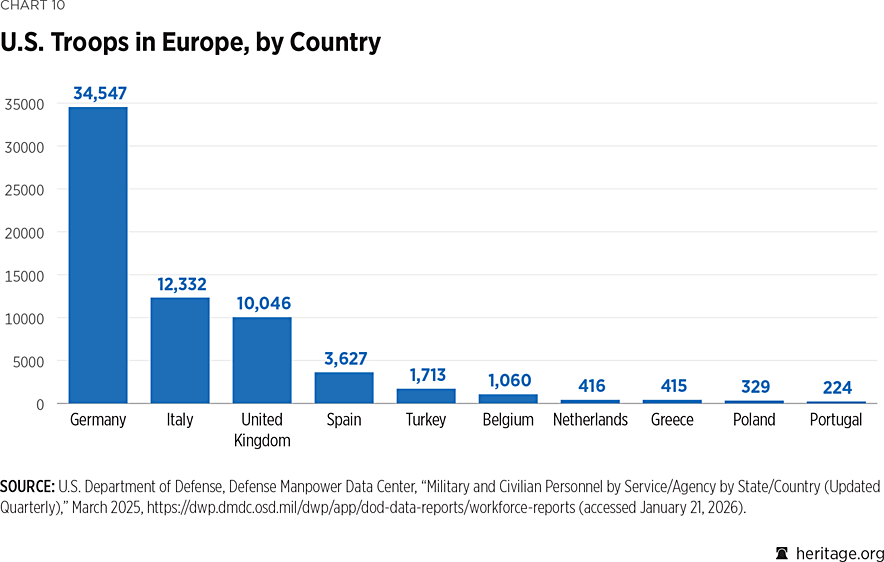
Germany. Germany hosts numerous American military facilities, notably Ramstein Air Base; U.S. Army Garrison (USAG) Bavaria; USAG Stuttgart; and USAG Rheinland-Pfalz (particularly Landstuhl). Ramstein Air Base is a linchpin for the American presence in EUCOM as the U.S. Air Force’s European headquarters hosting critical airlift resources run by the 86th Airlift Wing, including C-21, C-37, and C-130J aircraft backed by the 521st Air Mobility Operations Wing’s provision of command and control, maintenance, and air transportation services across the theater.[REF]
USAG Bavaria hosts thousands of U.S. troops, but its operational impact is channeled through three subordinate facilities: the Grafenwoehr Training Area, Joint Multinational Readiness Center (JMRC), and NATO School. Run by the 7th Army Training Command, the Grafenwoehr Training Area enables live, virtual, and constructive training across the full suite of capabilities from small arms to close air support and is the largest U.S. Army permanent training area in Europe.[REF] Also under 7th Army Training Command, the JMRC, located near Hohenfels, integrates multinational participation into every rotation of U.S. forces and can train groups as large as a Brigade Task Force across a 163 square km training ground where key NATO units have trained.[REF] The NATO School falls within USAG Bavaria’s remit and has been the key operational training facility for NATO since 1953, enhancing Alliance interoperability and cohesion.[REF]
USAG Stuttgart houses two combatant commands across its five installations and also serves as the primary hub for military cargo in theater.[REF] Headquartered at USAG Stuttgart’s Patch Barracks, EUCOM is the combatant command for U.S. military forces in Europe who “protect and defend the U.S. and its NATO Allies and partners through deterrence, peacekeeping and military operations.”[REF] Headquartered at USAG Stuttgart’s Kelley Barracks, AFRICOM is the combatant command for U.S. military forces in Africa and oversees a partner-focused strategy across an area of responsibility “of 53 African states, more than 800 ethnic groups, over 1,000 languages, vast natural resources, a land mass of 11.2 million square miles (three-and-a-half times the size of the U.S.), and nearly 19,000 miles of coastland.”[REF] Stuttgart Army Airfield in Filderstadt houses EUCOM’s and AFRICOM’s aviation arms and serves as the primary platform for military cargo, making it central to any in-theater operations.[REF]
USAG Rheinland-Pfalz provides support services for U.S. forces in Europe, but its critical subordinate entity is the Landstuhl Regional Medical Center.[REF] The only U.S. medical center in Europe, Landstuhl Regional Medical Center marked 70 years of successful operation in 2023 with a 99 percent survival rate for “wounded, injured and ill” troops.[REF] Landstuhl, the only verified Level II Trauma Center outside America, is the evacuation and treatment center for four combatant commands across three continents and has treated thousands of beneficiaries a month with no ready alternative.[REF] The critical operations occurring at these various facilities demonstrate why Germany has the highest U.S. troop deployments in EUCOM.
Italy. Italy hosts several U.S. military facilities, notably Naval Support Activity Naples and Naval Air Station (NAS) Sigonella. The Commander, U.S. Naval Forces Europe-Africa (NAVEUR-NAVAF), is headquartered at Naval Support Activity Naples, a crucial American military installation where the U.S. Navy Sixth Fleet is based.[REF] U.S. Sixth Fleet operates “hundreds of ships, submarines and aircraft” alongside additional NAVEUR-NAVAF forces across an area of responsibility that “covers more than 20 million square nautical miles of ocean, touches three continents and encompasses more than 67 percent of the Earth’s coastline, 30 percent of its landmass, and nearly 30 percent of the world’s population.”[REF] These operations include highly complex joint exercise carrier deployments in the Mediterranean Sea.[REF] Nicknamed the “Hub of the Med,” NAS Sigonella is a core pillar for U.S. operations across the European, African, and Central combatant commands with growing demands that make it a “strategic center of the Mediterranean and Near East.”[REF] The Iranian threat and ongoing military activity around the Red Sea ensure that NAS Sigonella will remain important to U.S. defense and deterrence.
The United Kingdom. The United Kingdom hosts significant U.S. military presence at several facilities, notably Royal Air Force (RAF) Alconbury, RAF Croughton, and RAF Lakenheath. RAF Alconbury has a history of intelligence activity, including Air Force imagery intelligence (IMINT) units with ties to the U.K.’s Joint Aerial Reconnaissance Intelligence Centre (JARIC), but has faced repeated efforts to close the base and consolidate forces.[REF] Following analysis in the early 2020s, the United States chose to retain forces at RAF Alconbury and “develop a master plan for long-term Joint Intelligence Analysis Center (JIAC) mission support” with intelligence and communications provisions worldwide and military support work across Europe, Africa, and the Middle East.[REF]
RAF Croughton is the headquarters of the 422nd Air Base Group, which “delivers worldwide communications” with public recognition that those communications include “approximately a third of all U.S. military communications in Europe.”[REF] RAF Lakenheath hosts the U.S. Air Force’s 48th Fighter Wing, which includes two F-15E Strike Eagle squadrons and two F-35 squadrons set to reach full operational capability in 2025.[REF] Contracts have been awarded to build the facilities necessary to store U.S. nuclear weapons at RAF Lakenheath, a mission it last held during the Cold War[REF] and one that would improve the security of NATO’s strategic deterrent through diversity of positioning. These diverse missions support essential elements of American power protection and adversary deterrence in Europe.
Spain. Spain hosts two U.S. bases, the primary one being Naval Station Rota, which oversees critical naval radar ships dedicated to NATO’s IAMD mission. Naval Station Rota is the headquarters of the Commander of Naval Activities Spain, who coordinates U.S. Navy activities across Spain and Portugal under NAVEUR-NAVAF direction from Naples.[REF] Naval Station Rota provides cargo, fuel, and logistics support from the largest weapons and fuel facilities in Europe to units transiting the region in support of U.S. and NATO operations.[REF] Four U.S. Navy Arleigh Burke–class destroyers equipped with Aegis Baseline 9 Ballistic Missile Defense systems are homeported in Rota as “a component of EUCOM’s regional missile defense strategies.”[REF] Through these activities, U.S. forces based at Naval Station Rota undergird EUCOM operations across the theater.
Belgium. The central U.S. military facility that Belgium hosts is U.S. Army Garrison Benelux–Supreme Headquarters Allied Powers Europe (SHAPE), which is the headquarters of NATO Allied Command Operations.[REF] SHAPE is the headquarters of the Supreme Allied Commander Europe (SACEUR) and his staff, who are responsible for all NATO operations including training and concepts and doctrine.[REF] Traditionally, SACEUR has been dual-hatted as EUCOM Commander, and therefore a U.S. military officer, and runs military planning, “including the identification of forces required for the mission,” and “makes recommendations to NATO’s political and military authorities on any military matter that may affect his ability to carry out his responsibilities.”[REF] These sweeping responsibilities and the integration with EUCOM forces make SACEUR a vital position for U.S. national interests and advocacy of increased allied contributions.[REF]
U.S. Unique Capability Backing in Europe
Ballistic Missile Defense (BMD). American capabilities are essential to the functioning of NATO BMD.[REF] The Alliance’s BMD systems include the NATO BMD command center (hosted at Ramstein Air Base); BMD radar at Kürecik (U.S. radar); Aegis Ashore sites at Deveselu Air Base and Redzikowo military base (Aegis Ashore is a U.S.-provided system with American military operators); four BMD-capable Aegis ships at Rota (all U.S. ships); and additional air and missile defense systems and ships (including Patriot systems of U.S. design, manufacture, and provision).[REF] Provision of these systems cost the United States approximately $2.3 billion from 2011 to 2023.[REF] NATO BMD is a critical capability in view of the threat posed by Iran’s ballistic missile program and nuclear enrichment efforts, but it features more limited allied buy-in than might be expected given its role in protecting European allies.
U.S. Nuclear Umbrella and Extended Deterrence. NATO has declared that “[a]s long as nuclear weapons exist, NATO will remain a nuclear alliance.”[REF] Three nuclear weapons states (France, the U.K., and the United States) are members of NATO, but the principal responsibility for the Alliance’s nuclear deterrent falls to the United States because of its larger nuclear stockpile, willingness and capability to deploy nuclear weapons forward, and history of countering the Kremlin’s nuclear designs in Europe.[REF] The NATO Nuclear Planning Group (NNPG) coordinates the Alliance’s nuclear deterrence missions and oversees the nuclear-sharing mission, which is divided into three separate but interconnected segments: storage of U.S. B-61 thermonuclear gravity bombs, hosting of Dual-Capable Aircraft (DCA) equipped to carry out a nuclear strike with B-61s, and the Conventional Support for Nuclear Operations (CSNO) mission (formerly SNOWCAT).[REF]
The U.S. distributes tactical nuclear weapons at various bases throughout Europe. Poland has expressed a desire to join the NATO nuclear mission by hosting American nuclear weapons, which some U.S. experts think could strengthen NATO’s nuclear posture.[REF] However, no decision has been publicly announced.
Several U.S. allies that employ DCA are equipped to carry out a strike with B-61 nuclear bombs.[REF] On June 24, 2025, the United Kingdom announced that it will purchase 12 F-35As and join NATO’s DCA mission, building on the U.K.’s current submarine-only nuclear deterrent.[REF] However, Turkey’s purchase of a Russian S-400 air defense system led the U.S. to exclude it from the F-35 program, so Turkey will have no access to the most cutting-edge DCA platform. Notably, Poland has already received the first of 32 F-35 jet fighters that are on order, which would allow a smoother entry into nuclear-sharing arrangements.[REF] The rollout of the fifth-generation F-35 is welcome news for nuclear deterrence in Europe, but the technical sufficiency of older platforms that still serve as the primary DCA fleet, including F-15s, F-16s, and Tornados, remains a matter of concern, especially because of life-cycle maintenance and air defense vulnerability issues.[REF]
Conventional Support for Nuclear Operations, broadened from SNOWCAT to include a variety of support domains, is carried out by seven allies: the Czech Republic, Denmark, Greece, Hungary, Norway, Poland, and Romania.[REF] Further details of this mission are not public because of its sensitivity and the no-acceptable-failure nature of its task, but it is possible that, in view of recent U.S.–Swedish escort missions displaying bilateral cooperation in the air, Sweden could join as a new ally.[REF]
Ultimately, however, NATO’s nuclear deterrent is dependent on America’s provision of extended deterrence. It is settled U.S. Air Force doctrine that, “[r]egardless of how they are used, the employment of nuclear weapons yields effects at the strategic level,” and “only the President can authorize strategic attack employing nuclear weapons.”[REF] With specific reference to NATO, Air Force doctrine is clear: “The sole authority to transfer US nuclear weapons for NATO employment remains with the US President.”[REF] This doctrine is reinforced by NATO structures and secured operationally by two requirements: The North Atlantic Council would have to vote in favor of employing the B-61 bombs, provided by America, in a nuclear strike, and such a mission would be within the purview of the Supreme Allied Commander Europe, who is always a U.S. military officer partly for this reason.[REF] Technically, all U.S. nuclear weapons are secured through Permissive Action Links (PALs) with redundant coded switch systems that render the weapons unusable without permissions provided by the U.S. President through nuclear command and control.[REF]
Intelligence, Surveillance, and Reconnaissance (ISR). ISR is a multifaceted combination of numerous information sources that is used to provide a comprehensive battlefield picture and is most often carried out in the military domain through a mix of crewed and uncrewed aircraft coupled with satellite platforms. The United States dominates the provision of ISR within the Alliance. “[T]he bulk of the ISR employed [in Ukraine],” for example, “has been provided by the United States.”[REF]
NATO continues to depend on American ISR operations because of past low investment by European partners. Non-U.S. NATO countries, for example, have only 11 signals intelligence (SIGINT) aircraft in service, while the U.S. Air Force has an inventory of 17 “big wing” SIGINT aircraft. This reliance is further demonstrated by the NATO ISR Force’s reliance on variants of U.S. company Northrop Grumman’s Global Hawk unmanned aerial vehicle (UAV), American UAVs being the only low-observable variants within NATO.[REF] Capping this capabilities gap is the military satellite constellations gap with 246 acknowledged U.S. military satellites in the sky compared to 49 for European NATO members as of May 2023.[REF] European efforts are underway with European companies under contract to develop and procure comparable systems to shoulder part of the ISR burden, but those capabilities will not begin to arrive until later in this decade.
Strategic Air: Transport and Tanker Aircraft. NATO has affirmed the value of “strategic airlift capabilities that enable forces to be quickly deployed to wherever they are needed.”[REF] However, American assets play an outsized role in backstopping this central capability. As of 2025, the United States maintained an active fleet of 605 tanker aircraft (75 percent of worldwide share) and 918 transport aircraft (21 percent of worldwide share) for strategic air purposes.[REF] NATO allies also possess tanker and transport aircraft, but the quantity possessed by the NATO ally with the second-highest number (France) is far lower: 16 tanker aircraft and 119 transport aircraft, and non-U.S. NATO allies account for less than 50 percent of the top 10 rankings in both categories.[REF] Given current and projected requirements, the total fleet remains too small even though NATO’s Support and Procurement Agency (NSPA) in June 2025 “announced the order of two additional Airbus A330 Multi Role Tanker Transport (MRTT) aircraft, bringing the total number in the multinational MRTT fleet (MMF) to 12.”[REF]
Long-Range Strike. With deeper missile stockpiles and more varied options, American long-range strike capabilities are currently the backbone of NATO capabilities as allies rush to catch up.[REF] The tip of the spear in this area is the Army’s 2nd Multi-Domain Task Force (MDTF). Activated in Wiesbaden, Germany, in 2021, the 2nd MDTF will start to deploy long-range fires capabilities in 2026 with an eye toward future permanent stationing of capabilities that include SM-6, Tomahawk, and hypersonic weapons.[REF] Unfortunately, European NATO allies do not have access to similar national capabilities to reinforce the MDTF deployment’s deterrent effect; the “bulk of the current European arsenal is provided by limited numbers of air-launched cruise missiles with maximum ranges of about 500 kilometers,” and these allies so far are only signing letters of intent to develop a long-range strike missile, indicating a likely years-long gap.[REF]
Conclusion
Overall, Europe is a well-developed operating environment for countering Russian forces, but Russia’s security pressure on the continent casts light, directly and indirectly, on the need to close transatlantic capability gaps. Despite those gaps, however, the positive growth trajectory in defense spending should translate into enhanced military capabilities across domains. The next year will witness an effort—an effort without Cold War precedent—to craft a deterrence plan from the strategic level to the tactical level with resilient, redundant strategic enablers as the United States repostures its forces to confront problems in multiple theaters. For now, Russian forces are bogged down in Ukraine, and Ukraine’s fight, supported by NATO’s Prioritized Ukraine Requirements List (PURL) with Europeans taking the lead,[REF] provides time to build and deploy credible forces in NATO territory.
NATO’s seriousness about the threat is demonstrated by the swift creation and deployment of multinational force constructs in Operation Baltic Sentry and Operation Eastern Sentry, which has led to decreased Russian grey-zone aggression in those sub-regions. Nevertheless, when confronted by force, Moscow has continually pivoted into new hybrid warfare approaches whether it is in the cyber domain, in the air with drones and jamming, or through more traditional direct covert actions such as sabotage.[REF] Simultaneously, American forces across the continent retain smooth access validated by NATO exercises from the north to the south with recently expanded access to Sweden’s and Finland’s territory now that the two countries are members of the Alliance.
European political divisions, from Spain’s refusal to hike defense spending to EU efforts to develop independent capabilities against, rather than in concert with, U.S. efforts, do weaken deterrence credibility. Additionally, a cycle of frequent government collapses with inconclusive snap election results in many sharply divided societies has been repeated in recent years. This cycle, with its conflicting or absent political signals and budgeting delays, limits progress and coherence in rebuilding derelict military forces and defense industrial bases. By contrast, conservative governments with a transatlantic orientation have seen additional victories since publication of the 2024 Index.
Scoring the European Operating Environment
Various considerations must be taken into account in assessing the regions within which the United States may have to conduct military operations to defend its vital national interests. Our assessment of the operating environment utilized a five-point scale ranging from “very poor” to “excellent” conditions and covering four regional characteristics of greatest relevance to the conduct of military operations:
- Very Poor. Significant hurdles exist for military operations. Physical infrastructure is insufficient or nonexistent, and the region is politically unstable. The U.S. military is poorly placed or absent, and alliances are nonexistent or diffuse.
- Unfavorable. A challenging operating environment for military operations is marked by inadequate infrastructure, weak alliances, and recurring political instability. The U.S. military is inadequately placed in the region.
- Moderate. A neutral to moderately favorable operating environment is characterized by adequate infrastructure, a moderate alliance structure, and acceptable levels of regional political stability. The U.S. military is adequately placed.
- Favorable. A favorable operating environment includes good infrastructure, strong alliances, and a stable political environment. The U.S. military is well placed in the region for future operations.
- Excellent. An extremely favorable operating environment includes well-established and well-maintained infrastructure; strong, capable allies; and a stable political environment. The U.S. military is exceptionally well placed to defend U.S. interests.
The key regional characteristics consist of:
- Alliances. Alliances are important for interoperability and collective defense, as allies are more likely to lend support to U.S. military operations. Various indicators provide insight into the strength or health of an alliance. These include whether the U.S. trains regularly with countries in the region, has good interoperability with the forces of an ally, and shares intelligence with nations in the region.
- Political Stability. Political stability brings predictability for military planners when considering such indicators as transit, basing, and overflight rights for U.S. military operations. The overall degree of political stability indicates whether U.S. military actions would be hindered or enabled and considers such questions as whether transfers of power are generally peaceful and whether there have been any recent instances of political instability in the region.
- U.S. Military Positioning. Having military forces based or equipment and supplies staged in a region greatly enhances the ability of the United States to respond to crises and presumably achieve success in critical “first battles” more quickly. Being routinely present in a region also helps the U.S. to maintain familiarity with its characteristics and the various actors that might try to assist or thwart U.S. actions. With this in mind, we assessed whether the U.S. military was well positioned in the region. Again, indicators included bases, troop presence, prepositioned equipment, and recent examples of military operations (including training and humanitarian) launched from the region.
- Infrastructure. Modern, reliable, and suitable infrastructure is essential to military operations. Airfields, ports, rail lines, canals, and paved roads enable the United States to stage, launch operations from, and logistically sustain combat operations. We combined expert knowledge of regions with publicly available information on critical infrastructure to arrive at our overall assessment of this metric.
For Europe, we arrived at these average scores (rounded to the nearest whole number):
- Alliances: 5—Excellent.
- Political Stability: 5—Excellent.
- U.S. Military Positioning: 4—Favorable.
- Infrastructure: 4—Favorable.
- Aggregating to a regional score of: Excellent.
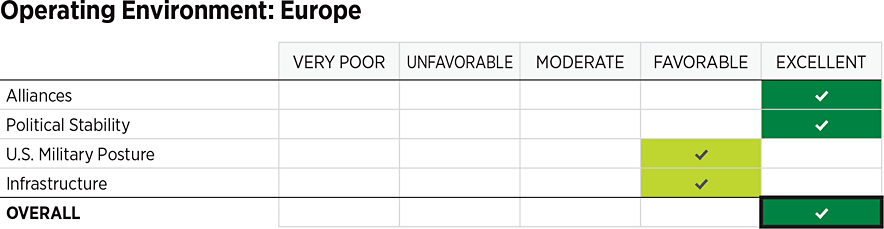
Endnotes
[1] News transcript, “Secretary Rumsfeld Briefs at the Foreign Press Center,” U.S. Department of Defense, January 22, 2003, https://web.archive.org/web/20140228200949/http:/www.defense.gov/transcripts/transcript.aspx?transcriptid=1330 (accessed January 11, 2026).
[2] Martin Russell, “The Nord Stream 2 Pipeline: Economic, Environmental and Geopolitical Issues,” European Parliament Briefing, July 2021, https://www.europarl.europa.eu/RegData/etudes/BRIE/2021/690705/EPRS_BRI(2021)690705_EN.pdf (accessed January 11, 2026).
[3] SWJ Staff, “Lord Ismay, Restated,” Small Wars Journal Blog, November 19, 2010, https://smallwarsjournal.com/2010/11/19/lord-ismay-restated/ (accessed January 11, 2026); Paul Belkin, Michael Ratner, and Cory Welt, “Russia’s Nord Stream 2 Natural Gas Pipeline to Germany Halted,” U.S. Congressional Research Service In Focus No. IF11138, updated March 10, 2022, https://www.congress.gov/crs_external_products/IF/PDF/IF11138/IF11138.19.pdf (accessed January 11, 2026).
[4] Bojan Pancevski, “A Drunken Evening, a Rented Yacht: The Real Story of the Nord Stream Pipeline Sabotage,” The Wall Street Journal, August 14, 2024, https://www.wsj.com/world/europe/nord-stream-pipeline-explosion-real-story-da24839c (accessed January 11, 2026).
[5] Georgi Kantchev and Laurence Norman, “Russian Gas to Europe Stops Flowing After Ukraine Refuses to Renew Pipeline Deal,” The Wall Street Journal, January 1, 2025, https://www.wsj.com/world/europe/russian-gas-to-europe-stops-flowing-after-ukraine-refuses-to-renew-pipeline-deal-02e0eb30 (accessed January 11, 2026).
[6] Press release, “Defence Expenditure of NATO Countries (2014–2025),” North Atlantic Treaty Organization, cutoff date for information used June 3, 2025, p. 7, https://www.nato.int/content/dam/nato/webready/documents/finance/def-exp-2025-en.pdf (accessed January 11, 2026).
[7] Wilson Beaver, “The 2025 NATO Summit,” Heritage Foundation Issue Brief No. 5386, August 7, 2025, https://www.heritage.org/defense/report/the-2025-nato-summit.
[8] CountryEconomy.com, “NATO—North Atlantic Treaty Organization,” https://countryeconomy.com/countries/groups/nato (accessed January 18, 2026).
[9] Press release, “Defence Expenditure of NATO Countries (2014–2024).”
[10] Kirsten Ripper and Euronews with Associated Press, “CDU’s Friedrich Merz Secures Billion-Euro Deal for Germany’s Military and Infrastructure,” Euronews, updated May 3, 2025, https://www.euronews.com/my-europe/2025/03/04/cdus-friedrich-merz-secures-billion-euro-deal-for-germanys-military-and-infrastructure (accessed January 18, 2026); Wilson Beaver, “Next Steps for Germany’s National Security Zeitenwende,” Heritage Foundation Backgrounder No. 3900, March 26, 2025, https://www.heritage.org/defense/report/next-steps-germanys-national-security-zeitenwende.
[11] Ketrin Jochecová, “Russia Could Start a Major War in Europe Within 5 Years, Danish Intelligence Warns,” Politico, February 11, 2025, https://www.politico.eu/article/russia-war-threat-europe-within-5-years-danish-intelligence-ddis-warns/ (accessed January 18, 2026); Ott Ummelas, “Norway Army Chief Sees Short Window to Boost NATO’s Defenses,” Financial Post, June 4, 2024, https://financialpost.com/pmn/business-pmn/norway-army-chief-sees-short-window-to-boost-natos-defenses (accessed January 18, 2026); “Russia May Be Ready to Attack NATO in 5–8 Years, German Official Says,” Reuters, updated April 18, 2024, https://www.reuters.com/world/europe/russia-may-be-ready-attack-nato-5-8-years-german-official-says-2024-04-18/ (accessed January 18, 2026).
[12] North Atlantic Treaty Organization, “NATO’s Nuclear Deterrence Policy and Forces,” updated June 24, 2025, https://www.nato.int/en/what-we-do/deterrence-and-defence/natos-nuclear-deterrence-policy-and-forces (accessed January 18, 2026); Rudy Ruitenberg, “Mind the Gaps: Europe’s to-Do List for Defense Without the US,” Defense News, February 25, 2025, https://www.defensenews.com/global/europe/2025/02/25/mind-the-gaps-europes-to-do-list-for-defense-without-the-us/ (accessed January 18, 2026).
[13] Lydia Saad, “Americans’ Foreign Policy Priorities, NATO Support Unchanged,” Gallup, March 4, 2025, https://news.gallup.com/poll/657581/americans-foreign-policy-priorities-nato-support-unchanged.aspx (accessed January 18, 2026); H.R. 2670, National Defense Authorization Act for Fiscal Year 2024, Public Law 118-31, December 22, 2023, § 1250A, https://www.congress.gov/118/plaws/publ31/PLAW-118publ31.pdf (accessed January 18, 2026).
[14] Table, “2024: U.S. Trade in Goods with European Union,” in U.S. Department of Commerce, U.S. Census Bureau, “Trade in Goods with European Union,” https://www.census.gov/foreign-trade/balance/c0003.html (accessed January 18, 2026).
[15] George Scutaru and Andrei Pavel, “Weaponization of Migration: A Powerful Instrument in Russia’s Hybrid Toolbox,” Hoover Institution, The Caravan, September 17, 2024, https://www.hoover.org/research/weaponization-migration-powerful-instrument-russias-hybrid-toolbox (accessed January 18, 2026).
[16] U.S. Department of State, Office of the Historian, Milestones: 1969–1976, “Helsinki Final Act, 1975,” https://history.state.gov/milestones/1969-1976/helsinki#:~:text=The%20Helsinki%20Final%20Act%20dealt,and%20freedom%20of%20the%20press (accessed January 19, 2026).
[17] Ian Talley and Anthony DeBarros, “China Aids Russia’s War in Ukraine, Trade Data Shows,” The Wall Street Journal, February 4, 2023, https://www.wsj.com/articles/china-aids-russias-war-in-ukraine-trade-data-shows-11675466360 (accessed January 19, 2026); China Aerospace Studies Institute, “In Their Own Words: Joint Statement of the Russian Federation and the People’s Republic of China on the International Relations Entering a New Era and the Global Sustainable Development,” February 4, 2022, p. 10, https://www.airuniversity.af.edu/Portals/10/CASI/documents/Translations/2022-02-04%20China%20Russia%20joint%20statement%20International%20Relations%20Entering%20a%20New%20Era.pdf (accessed January 19, 2026); Andrei Dagaev, “The Arctic Is Testing the Limits of the Sino–Russian Partnership,” Carnegie Endowment for International Peace, Carnegie Russia Eurasia Center, Carnegie Politika, February 18, 2025, https://carnegieendowment.org/russia-eurasia/politika/2025/02/russia-china-arctic-views?lang=en (accessed January 19, 2026).
[18] Andrew J. Harding, Madelyn Heaston, and Robert Peters, “China 2035: Three Scenarios for China’s Nuclear Program,” Heritage Foundation Backgrounder No. 3882, January 6, 2025, https://www.heritage.org/china/report/china-2035-three-scenarios-chinas-nuclear-program; Brent Sadler, “China’s Largest Naval Exercise in Decades: Why Send 90 Warships Near Taiwan?” Heritage Foundation Commentary, December 20, 2024, https://www.heritage.org/china/commentary/chinas-largest-naval-exercise-decades-why-send-90-warships-near-taiwan.
[19] Alessandro Panaro, “Euro-Mediterranean Ports and the Impacts of the Red Sea Crisis: Insights and Key Data,” Italian Institute for International Political Studies, November 24, 2024, https://www.ispionline.it/en/publication/euro-mediterranean-ports-and-the-impacts-of-the-red-sea-crisis-insights-and-key-data-191220 (accessed January 19, 2026); U.S. Defense Intelligence Agency, “Yemen: Houthi Attacks: Placing Pressure on International Trade,” information cutoff date April 5, 2024, p. 3, https://www.dia.mil/Portals/110/Images/News/Military_Powers_Publications/YEM_Houthi-Attacks-Pressuring-International-Trade.pdf (accessed January 19, 2026); Luca Longhi, “How Much Does the ‘Red Sea Crisis’ Weigh on Italy?” Banca Generali, January 24, 2024, https://www.bancagenerali.com/en/blog/crisi-mar-rosso#maincontent (accessed January 19, 2026).
[20] North Atlantic Treaty Organization, “The North Atlantic Treaty,” April 4, 1949, https://www.nato.int/en/about-us/official-texts-and-resources/official-texts/1949/04/04/the-north-atlantic-treaty (accessed January 19, 2026).
[21] Ibid., Article 3 and Article 5.
[22] “Emmanuel Macron Warns Europe: NATO Is Becoming Brain-Dead,” The Economist, November 7, 2019, https://www.economist.com/europe/2019/11/07/emmanuel-macron-warns-europe-nato-is-becoming-brain-dead (accessed January 19, 2026).
[23] Miles Pollard and Jordan Embree, “NATO’s Underspending Problem: America’s Allies Must Embrace Fair Burden Sharing,” Heritage Foundation Backgrounder No. 3903, March 31, 2025, https://www.heritage.org/defense/report/natos-underspending-problem-americas-allies-must-embrace-fair-burden-sharing.
[24] Press release, “Defence Expenditure of NATO Countries (2014–2025).”
[25] Pollard and Embree, “NATO’s Underspending Problem: America’s Allies Must Embrace Fair Burden Sharing.”
[26] Robert Greenway, Wilson Beaver, Robert Peters, Alexander Velez-Green, John Venable, Brent Sadler, and Jim Fein, “A Conservative Defense Budget for Fiscal Year 2025,” Heritage Foundation Special Report No. 281, April 2, 2024, https://www.heritage.org/defense/report/conservative-defense-budget-fiscal-year-2025.
[27] North Atlantic Treaty Organization, “NATO 2022 Strategic Concept,” updated March 3, 2023, https://www.nato.int/en/about-us/official-texts-and-resources/strategic-concepts/nato-2022-strategic-concept (accessed January 19, 2026).
[28] United Nations, “Resolution 1244 (1999),” adopted by the Security Council on June 10, 1999, https://unmik.unmissions.org/sites/default/files/old_dnn/Res1244ENG.pdf (accessed January 19, 2026).
[29] Radul Radovanovic and Llazar Semini, “25 NATO-Led Peacekeepers Injured in Kosovo in Clashes with Serbs Outside Municipal Building,” Associated Press, May 29, 2023, https://apnews.com/article/kosovo-serbia-tension-eu-us-cf2637072cd88f3bcf0d902236d3631b (accessed January 19, 2026).
[30] North Atlantic Treaty Organization, Allied Joint Force Command Naples, Kosovo Force, “About Us: Contributing Nations,” https://jfcnaples.nato.int/kfor/about-us/welcome-to-kfor/contributing-nations (accessed January 19, 2026).
[31] North Atlantic Treaty Organization, “NATO Integrated Air and Missile Defence,” updated February 13, 2025, https://www.nato.int/en/what-we-do/deterrence-and-defence/nato-integrated-air-and-missile-defence (accessed January 19, 2026).
[32] NATO Allied Air Command, “Headquarters,” https://ac.nato.int/about/headquarters (accessed January 19, 2026).
[33] Stephen Losey, “Pentagon Downgrades Leadership Role for Air Forces–Europe to 3-Star,” Defense News, October 2, 2025, https://www.defensenews.com/air/2025/10/02/pentagon-downgrades-leadership-role-for-air-forces-europe-to-3-star/ (accessed January 19, 2026); news release, “Lt Gen Hinds Assumes Command of NATO’s Allied Air Command,” North Atlantic Treaty Organization, Allied Air Command, November 3, 2025, https://ac.nato.int/archive/2025-2/hinds-assumption (accessed January 19, 2026).
[34] North Atlantic Treaty Organization, “NATO Air Policing,” updated October 24, 2025, https://www.nato.int/en/what-we-do/deterrence-and-defence/nato-air-policing (accessed January 19, 2026).
[35] North Atlantic Treaty Organization, Allied Air Command, “Baltic Air Policing,” https://ac.nato.int/missions/air-policing/baltics (accessed January 19, 2026).
[36] George Allison, “Russian Military Aircraft Intercepted by NATO Jets,” UK Defence Journal, February 23, 2025, https://ukdefencejournal.org.uk/russian-military-aircraft-intercepted-by-nato-jets/ (accessed January 19, 2026).
[37] News release, “NATO’s Air Policing Mission: A Steadfast Commitment by the Alliance,” North Atlantic Treaty Organization, Allied Air Command, March 4, 2025, https://ac.nato.int/archive/2025-2/natos-air-policing-mission-a-steadfast-commitment-by-the-alliance- (accessed January 19, 2026).
[38] North Atlantic Treaty Organization, Allied Air Command, “Enhanced Air Policing,” https://ac.nato.int/missions/air-policing/enhanced (accessed January 19, 2026).
[39] News release, “Spain Swaps Fighter Jets on Schedule, Continuing NATO Air Policing Mission in Romania,” North Atlantic Treaty Organization, Allied Air Command, December 5, 2024, https://ac.nato.int/archive/2024/spain-swaps-fighter-jets-on-schedule--continuing-nato-air-policing-mission-in-romania (accessed January 19, 2026); “Sweden Bolsters NATO Air Defense in Poland with More JAS 39 Gripen Fighters,” 19FortyFive, June 1, 2025, https://www.19fortyfive.com/2025/06/sweden-bolsters-nato-air-defense-in-poland-with-more-jas-39-gripen-fighters/ (accessed January 19, 2026).
[40] Thomas Grove, Karolina Jeznach, and Daniel Michaels, “NATO Planes Shoot Down Russian Drones Deep Inside Poland,” The Wall Street Journal, September 10, 2025, https://www.wsj.com/world/europe/poland-russia-drones-nato-territory-692452e8 (accessed January 19, 2026).
[41] North Atlantic Treaty Organization, Allied Air Command, “Air Policing over the Western Balkans,” https://ac.nato.int/missions/air-policing/western-balkans (accessed January 19, 2026).
[42] North Atlantic Treaty Organization, Allied Air Command, “Icelandic Air Policing,” https://ac.nato.int/missions/air-policing/iceland (accessed January 19, 2026).
[43] North Atlantic Treaty Organization, Allied Air Command, “Air Policing over Benelux,” https://ac.nato.int/missions/air-policing/benelux (accessed January 19, 2026).
[44] North Atlantic Treaty Organization, Allied Air Command, “We Protect Territory, Populations and Forces: Ballistic Missile Defence,” https://ac.nato.int/missions/bmd (accessed January 19, 2026).
[45] Fact Sheet, “The European Phased Adaptive Approach at a Glance,” Arms Control Association, https://www.armscontrol.org/factsheets/Phasedadaptiveapproach (accessed January 19, 2026).
[46] North Atlantic Treaty Organization, Allied Air Command, “We Protect Territory, Populations and Forces: Ballistic Missile Defence.”
[47] North Atlantic Treaty Organization, “What We Do: Operations and Missions: NATO’s Maritime Activities,” updated March 10, 2025, https://www.nato.int/en/what-we-do/operations-and-missions/natos-maritime-activities (accessed January 19, 2026).
[48] News release, “NATO Launches ‘Baltic Sentry’ to Increase Critical Infrastructure Security,” North Atlantic Treaty Organization, January 14, 2025, https://www.nato.int/cps/en/natohq/news_232122.htm (accessed January 19, 2026).
[49] North Atlantic Treaty Organization, “What We Do: Operations and Missions: Operation Sea Guardian,” updated May 26, 2023, https://www.nato.int/en/what-we-do/operations-and-missions/operation-sea-guardian (accessed January 19, 2026).
[50] North Atlantic Treaty Organization, “Assistance for the Refugee and Migrant Crisis in the Aegean Sea,” updated January 17, 2023, https://www.nato.int/en/what-we-do/operations-and-missions/assistance-for-the-refugee-and-migrant-crisis-in-the-aegean-sea (accessed January 19, 2026).
[51] North Atlantic Treaty Organization, “What We Do: Operations and Missions: NATO’s Maritime Activities.”
[52] North Atlantic Treaty Organization, “What We Do: Operations and Missions: NATO Mission Iraq,” updated June 3, 2025, https://www.nato.int/cps/en/natohq/topics_166936.htm (accessed January 19, 2026).
[53] North Atlantic Treaty Organization, “What We Do: Operations and Missions: Cooperation with the African Union,” updated April 27, 2023, https://www.nato.int/en/what-we-do/operations-and-missions/cooperation-with-the-african-union (accessed January 19, 2026).
[54] North Atlantic Treaty Organization, “What We Do: Partnerships and Cooperation: Comprehensive Assistance Package (CAP) for Ukraine,” updated June 20, 2025, https://www.nato.int/en/what-we-do/partnerships-and-cooperation/comprehensive-assistance-package-cap-for-ukraine (accessed January 19, 2026).
[55] News release, “NATO Secretary General Highlights New Opportunity for Support at Ukraine Defence Contact Group Meeting,” North Atlantic Treaty Organization, July 21, 2025, https://www.nato.int/en/news-and-events/articles/news/2025/07/21/nato-secretary-general-highlights-new-opportunity-for-support-at-ukraine-defence-contact-group-meeting (accessed January 19, 2026).
[56] Jordan Embree, “German Voters Demand Structural Reform,” The Daily Signal, February 24, 2025, https://www.dailysignal.com/2025/02/24/german-voters-demand-structural-reform/.
[57] Andrew Macaskill, Elizabeth Piper, and Alistair Smout, “Starmer Pledges to Stabilise UK as Labour Win Huge Majority,” Reuters, July 5, 2024, https://www.reuters.com/world/uk/uks-labour-win-massive-election-majority-exit-poll-shows-2024-07-04/ (accessed January 19, 2026); John Leicester, Lori Hinnant, and Sylvie Corbet, “French Vote Gives Leftists Most Seats over Far Right, But Leaves Hung Parliament and Deadlock,” Associated Press, updated July 7, 2024, https://apnews.com/article/france-elections-far-right-macron-08f10a7416a2494c85dcd562f33401d1 (accessed January 19, 2026).
[58] Gregoria Sorgi, Jacopo Barigazzi, and Giovanna Faggionato, “EU Slams the Door on US in Colossal Defense Plan,” Politico, March 19, 2025, https://www.politico.eu/article/eu-freeze-us-multi-billion-defense-plan-arm-makers/ (accessed January 19, 2026).
[59] European Commission, “Trade Defence Investigations: Ongoing Investigations,” last update January 16, 2026, https://tron.trade.ec.europa.eu/investigations/ongoing (accessed January 19, 2026).
[60] Jeremy Van der Haegen and Wojciech Kość, “Chinese Presence in a Polish Port Triggers Security Fears,” Politico, April 3, 2024, https://www.politico.eu/article/hong-kong-based-chinese-company-presence-polish-port-creates-security-worries-nato/ (accessed January 19, 2026).
[61] Tim Starks, “Salt Typhoon Hacking Campaign Goes Beyond Previously Disclosed Targets, World Cyber Agencies Say,” CyberScoop, August 27, 2025, https://cyberscoop.com/salt-typhoon-hacking-campaign-goes-beyond-previously-disclosed-targets-world-cyber-agencies-say/ (accessed January 19, 2026).
[62] Drew Hinshaw, Dan Strumpf, and Yaroslav Trofimov, “Chinese Huawei Executive Is Charged with Espionage in Poland,” The Wall Street Journal, updated January 11, 2019, https://www.wsj.com/articles/chinese-huawei-executive-is-charged-with-espionage-in-poland-11547201100?mod=article_inline (accessed January 19, 2026); Reuters, “Chinese Spies Target Dutch Industries to Strengthen Military, Intelligence Agency Says,” April 18, 2024, https://www.reuters.com/world/china/chinese-spies-target-dutch-industries-strengthen-military-intelligence-agency-2024-04-18/ (accessed January 19, 2026); Reuters, “UK Police Charge Two Men with Spying for China,” April 22, 2024, https://www.reuters.com/world/uk/uk-prosecutors-authorise-charges-against-two-men-over-spying-china-2024-04-22/ (accessed January 19, 2026); Bethany Bell, “German Spy Trial of Far-Right MP’s Former Aide Begins,” BBC, August 5, 2025, https://www.bbc.com/news/articles/ckgj282lxqgo (accessed January 19, 2026).
[63] “China Has Become the Most Important Enabler of Russia’s War Machine,” The Economist, June 19, 2025, https://www.economist.com/china/2025/06/19/china-has-become-the-most-important-enabler-of-russias-war-machine (accessed January 19, 2026).
[64] Nick Paton Walsh, “China Tells EU It Can’t Accept Russia Losing Its War Against Ukraine, Official Says,” CNN, July 4, 2025, https://www.cnn.com/2025/07/04/europe/china-ukraine-eu-war-intl (accessed January 19, 2026).
[65] Finnish Government, Ministry for Foreign Affairs of Finland, Government Report on Finnish Foreign and Security Policy, 2024, p. 11, https://julkaisut.valtioneuvosto.fi/server/api/core/bitstreams/6fd3dcd6-b479-40a1-bb5c-63953a15d4b6/content (accessed January 19, 2026).
[66] Arctic Council, “Arctic Council: Our Work: How We Work: International Cooperation in the Arctic,” https://arctic-council.org (accessed January 19, 2026); Dzirhan Mahadzir, “NATO Launches Baltic Sentry Mission in Baltic Sea,” U.S. Naval Institute News, January 15, 2025, https://news.usni.org/2025/01/15/nato-launches-baltic-sentry-mission-in-baltic-sea (accessed January 19, 2026); “Finland to Host Conference of Baltic Sea NATO States,” TVP World [Warsaw, Poland], January 8, 2025, https://tvpworld.com/84418774/finland-to-host-conference-of-baltic-sea-nato-states (accessed January 19, 2026); Helen Wright, “Swedish PM: JEF 2.5% GDP Defense Spending Goal ‘Too Little,’” ERR News [Estonian Public Broadcasting news service], December 17, 2024, https://news.err.ee/1609553659/swedish-pm-jef-2-5-gdp-defense-spending-goal-too-little (accessed January 19, 2026).
[67] “Nordic Air Commanders’ Intent: Nordic Warfighting Concept for Joint Air Operations,” March 2023, https://ilmavoimat.fi/documents/1951206/2016335/ILMAV_(U)-Nordic-Air-Commanders-Intent_23032023.pdf/ (accessed January 19, 2026); Howard Altman, “Nordic Air Defense Pact Combines Forces of Hundreds of Fighter Aircraft,” The War Zone, March 24, 2023, https://www.twz.com/nordic-air-defense-pact-combines-forces-of-hundreds-of-fighter-aircraft (accessed January 19, 2026).
[68] Tim Martin, “Exclusive: 4 Nordic Nations in Talks for Joint Procurement of Infantry Fighting Vehicles,” Breaking Defense, October 16, 2024, https://breakingdefense.com/2024/10/exclusive-4-nordic-nations-in-talks-for-joint-procurement-of-infantry-fighting-vehicles/ (accessed January 19, 2026).
[69] Forsvaret [Norwegian Armed Forces], “Exercises and Operations: Exercises: Nordic Response 2024,” updated December 20, 2024, https://www.forsvaret.no/en/exercises-and-operations/exercises/nr24 (accessed January 19, 2026).
[70] Karoline Rosenkrantz Paasch, “Swedish Police Boards: New Developments in the Yi Peng 3 Investigation,” ScandAsia, December 20, 2024, https://scandasia.com/swedish-police-boards-new-developments-in-the-yi-peng-3-investigation/ (accessed January 19, 2026); Baltic News Network, “NATO to Send Fleet to Guard Baltic Sea Cables,” January 8, 2025, https://bnn-news.com/nato-to-send-fleet-to-guard-baltic-sea-cables-263873#google_vignette (accessed January 19, 2026).
[71] Ibid.
[72] Dominic Chopping, “U.K. Secures $13.5 Billion Deal to Supply Warships to Norway,” The Wall Street Journal, September 1, 2025, https://www.wsj.com/world/europe/u-k-secures-13-5-billion-deal-to-supply-warships-to-norway-bc4624bf (accessed January 18, 2026).
[73] Ellie Cook, “NATO Nations to Hunt Russian Submarines in ‘Historic’ Defense Deal,” Newsweek, December 3, 2025, https://www.newsweek.com/nato-nations-to-hunt-russian-submarines-historic-deal-11149291 (accessed January 19, 2026).
[74] News release, “Government Proposes 50 Billion DKK Package to Accelerate the Build-Up of the Danish Defence,” Danish Ministry of Defence, February 19, 2025, https://www.fmn.dk/en/news/2025/government-proposes-50-billion-dkk-package-to-accelerate-the-build-up-of-the-danish-defence/ (accessed January 19, 2026).
[75] Robert Greenall and Paul Kirby, “Denmark Boosts Greenland Defence After Trump Repeats Desire for US Control,” BBC, December 24, 2024, https://www.bbc.com/news/articles/ckgzl19n9eko (accessed January 19, 2026).
[76] News release, “New Agreement Strengthens the Presence of the Danish Defence in the Arctic and North Atlantic Region,” Danish Ministry of Defence, January 27, 2025, https://www.fmn.dk/en/news/2025/new-agreement-strengthens-the-presence-of-the-danish-defence-in-the-arctic-and-north-atlantic-region/ (accessed January 19, 2026).
[77] Stuart Lau and Danny Aeberhard, “Denmark to Boost Arctic Defence with New Ships, Jets and HQ,” BBC, October 10, 2025, https://www.bbc.com/news/articles/cy9n790j878o (accessed February 4, 2026).
[78] News release, “Kingdom of Denmark Takes over Chairship of the Arctic Council from Norway,” German Arctic Office, May 12, 2025, https://www.arctic-office.de/en/news/kingdom-of-denmark-takes-over-chairship-of-the-arctic-council-from-norway/ (accessed January 19, 2026).
[79] News release, “Danish-Led Arctic Light 2025 Strengthens Allied Readiness in High North,” North Atlantic Treaty Organization, Allied Air Command, September 18, 2025, https://ac.nato.int/archive/2025-2/danishled-arctic-light-2025-strengthens-allied-readiness-in-high-north- (accessed January 19, 2026).
[80] Press release, “Arctic Endurance Continues Throughout 2026,” Danish Defence, January 23, 2026, https://www.forsvaret.dk/en/news/2026/arctic-endurance-fortsatter-i-hele-2026/ (accessed February 4, 2026).
[81] North Atlantic Treaty Organization, “Funding NATO,” updated December 18, 2024, https://www.nato.int/en/what-we-do/introduction-to-nato/funding-nato (accessed January 19, 2026); European Central Bank, “US dollar (USD),” https://www.ecb.europa.eu/stats/policy_and_exchange_rates/euro_reference_exchange_rates/html/eurofxref-graph-usd.en.html (accessed January 19, 2026); North Atlantic Treaty Organization, “NATO Agrees 2024 Budgets, Demonstrating Allied Solidarity in Addressing Shared Security Challenges,” Sarajevo Times, December 13, 2023, https://sarajevotimes.com/nato-agrees-2024-budgets-demonstrating-allied-solidarity/ (accessed January 19, 2026).
[82] Jim Dolbow, “Icelandic Coast Guard Is a Player in NATO,” U.S. Naval Institute Proceedings, Vol. 144/7/1,385 (July 2018), https://www.usni.org/magazines/proceedings/2018/july/icelandic-coast-guard-player-nato#:~:text=The%20Icelandic%20Coast%20Guard%20(ICG,motto%20is%20%E2%80%9CAlways%20Prepared.%E2%80%9D (accessed January 19, 2026).
[83] International Institute for Strategic Studies, The Military Balance 2024: The Annual Assessment of Global Military Capabilities and Defence Economics (London: Routledge, 2024), p. 104.
[84] Statista, “Iceland: Gross Domestic Product (GDP) in Current Prices from 1987 to 2030,” https://www.statista.com/statistics/398966/gross-domestic-product-gdp-in-iceland/?srsltid=AfmBOoqPSqMJSDsuyhYaLC8nCFWoleMyhUCrXNccGtW-w7tYpHr1M3Rw (accessed January 19, 2026).
[85] Government of Iceland, “Diplomatic Missions: Permanent Delegation of Iceland to NATO: Iceland and NATO,” https://www.government.is/diplomatic-missions/permanent-delegation-of-iceland-to-nato/iceland-and-nato/ (accessed January 19, 2026).
[86] Press release, “Largest ever Deployment of RAF Poseidon Maritime Aircraft Supporting NATO in Iceland,” Royal Air Force, November 24, 2025, https:// www.raf.mod.uk/news/articles/largest-ever-deployment-of-raf-poseidon-maritime-aircraft-supporting-nato-in-iceland/ (accessed January 19, 2026).
[87] Lex Harvey, “What We Know About the US Seizure of a Russian-Flagged Oil Tanker,” CNN, updated January 8, 2026, https://www.cnn.com/2026/01/08/us/russia-oil-tanker-seizure-what-we-know-intl-hnk (accessed February 4, 2026).
[88] Chart, “Defence Expenditure as a Percentage of GDP,” in Finnish Ministry of Defence, “Defence Budget,” https://www.defmin.fi/en/ministry_of_defence/economy_and_activities/defence_budget#9a2854a8 (accessed January 19, 2026).
[89] Gerard O’Dwyer, “Finland Eyes Defense-Spending Boost Well Past NATO Mark,” Defense News, December 27, 2024, https://www.defensenews.com/global/europe/2024/12/27/finland-eyes-defense-spending-boost-well-past-nato-mark/ (accessed January 19, 2026); DA Staff, “Overview of the Finnish Defence Forces,” Defense Advancement, December 27, 2024, https://www.defenseadvancement.com/resources/finnish-defence-forces/ (accessed January 19, 2026).
[90] Anne Kauranen, “Baltic Sea Sabotage Crew Were Poised to Cut More Cables When Caught, Finland Says,” Reuters, January 13, 2025, https://www.reuters.com/world/europe/oil-tanker-sabotage-crew-were-poised-cut-more-cables-when-caught-finland-says-2025-01-13/ (accessed January 19, 2026); “Finland Releases Tanker but Detains Three Crew from December Cable Incident,” The Maritime Executive, March 3, 2025, https://maritime-executive.com/article/finland-releases-tanker-but-detains-three-crew-from-december-cable-incident (accessed January 19, 2026).
[91] Astri Edvardsen (text) and Birgitte Annie Hansen (translation), “Finland Closes Border to Russia on Thursday,” November 29, 2023, https://www.highnorthnews.com/en/finland-closes-border-russia-thursday (accessed January 19, 2026); Liliana Oleniak, “Finland to Deploy 4–5 Thousand NATO Troops Near Russian Border, Media Says,” RBC-Ukraine, August 22, 2024, https://newsukraine.rbc.ua/news/finland-to-deploy-4-5-thousand-nato-troops-1724357117.html (accessed January 19, 2026); Liliana Oleniak, “Finland to Deploy 4–5 Thousand NATO Troops Near Russian Border, Media Says,” RBC-Ukraine, August 22, 2024, https://newsukraine.rbc.ua/news/finland-to-deploy-4-5-thousand-nato-troops-1724357117.html (accessed January 19, 2026); Eye on the Arctic, “Finland Leaves Ottawa Mine Ban Treaty, Citing Geopolitical Security Concerns,” The Barents Observer, April 3, 2025, https://www.thebarentsobserver.com/security/finland-leaves-ottawa-mine-ban-treaty-citing-geopolitical-security-concerns/427766 (accessed January 19, 2026).
[92] News story, “The National Budget 2025: The Norwegian Government Proposes a 19 Billion (NOK) Increase in Defence Spendings,” Norwegian Ministry of Defence, July 10, 2024, https://www.regjeringen.no/en/aktuelt/the-norwegian-government-proposes-a-19-billion-nok-increase-in-defence-spendings/id3056071/ (accessed January 19, 2026).
[93] Joshua Posaner, “Norway Cool on Trump’s Demand for a Massive Defense Spending Increase,” Politico, January 20, 2025, https://www.politico.eu/article/norway-donald-trump-demand-defense-spending-increase/ (accessed January 19, 2026).
[94] Press release, “Norway to Increase Its Support to Ukraine by NOK 50 Billion,” Office of the Prime Minister and Ministry of Finance, June 3, 2025, https://www.regjeringen.no/en/aktuelt/norway-to-increase-its-support-to-ukraine-by-nok-50-billion/id3090689/ (accessed January 19, 2026).
[95] Espen Barth Eide, “Norway’s Chairship, 2023–2025,” Arctic Council, https://arctic-council.org/about/norway-chair-2/ (accessed January 19, 2026).
[96] Reuters, “Norway Denies Russian Accusation of Militarising Svalbard Arctic Islands,” March 14, 2025, https://www.reuters.com/world/europe/russia-accuses-norway-militarising-svalbard-arctic-islands-2025-03-14/ (accessed January 19, 2026).
[97] Astri Edvardsen (text) and Birgitte Annie Hansen (translation), “Norway’s Parliament Agrees to Give the US Access to New Military Areas in the North,” High North News, updated June 3, 2024, https://www.highnorthnews.com/en/norways-parliament-agrees-give-us-access-new-military-areas-north (accessed January 19, 2026).
[98] Forsvaret [Norwegian Armed Forces], “Exercises and Operations: Exercises: Joint Viking 2025,” updated March 15, 2025, https://www.forsvaret.no/en/exercises-and-operations/exercises/jv25 (accessed January 19, 2026).
[99] Jacob Wulff Wold, “Norwegian Officials Fear US May Share Its Intel with Russia, Local Media Reports,” Euractiv, March 6, 2025, https://www.euractiv.com/section/politics/news/norwegian-officials-fear-us-may-share-its-intel-with-russia-local-media-reports/ (accessed January 19, 2026); Rishabh Sharma, “Norwegian Firm Refuses Fuel to US Warships over Trump’s Snub to Zelenskyy,” Business Standard, last updated March 2, 2025, https://www.business-standard.com/world-news/norway-haltbakk-bunkers-fuel-us-warships-ukraine-russia-trump-zelenskyy-125030200211_1.html#goog_rewarded (accessed January 19, 2026).
[100] Press release, “New Total Defence Resolution for a Stronger Sweden,” Government Offices of Sweden, Ministry of Defence, October 15, 2024, https://www.government.se/press-releases/2024/10/new-total-defence-resolution-for-a-stronger-sweden/ (accessed January 19, 2026).
[101] Video, “How Sweden’s Military Is Training for a Russian Invasion,” The Wall Street Journal, March 3, 2025, https://www.youtube.com/watch?v=Tz3Lz-SVDuQ (accessed January 19, 2026).
[102] Video, “How Sweden’s Most Elite Train for Next-Gen Arctic Warfare,” The Wall Street Journal, March 20, 2025, https://www.youtube.com/watch?v=zxxR8MUbnDk (accessed January 19, 2026).
[103] Stephen Losey, “B-52s Train over Scandinavian Countries to show NATO Support,” Defense News, March 14, 2025, https://www.defensenews.com/air/2025/03/14/b-52s-train-over-scandinavian-countries-to-show-nato-support/?utm_source=sailthru&utm_medium=email&utm_campaign=dfn-enr (accessed January 19, 2026).
[104] Expando, “Sweden Enters the Space Defense Era: Expando’s Role in Military Satellite Advancements,” February 5, 2025, https://expando.se/news/sweden-strengthens-space-defense/#:~:text=The%20rise%20of%20Swedish%20military,enhance%20Sweden%27s%20strategic%20defense%20position (accessed January 19, 2026).
[105] Press release, “Sweden and Ukraine Deepen Air Force Cooperation,” Government Offices of Sweden, Prime Minister’s Office, October 22, 2025, https://www.government.se/press-releases/2025/10/sweden-and-ukraine-deepen-air-force-cooperation/ (accessed January 19, 2026).
[106] Christian D. Orr, “Estonia and Lithuania to Meet Trump’s 5% Defense Spending Target,” The National Interest, The Buzz Blog, February 25, 2025, https://nationalinterest.org/blog/buzz/estonia-and-lithuania-to-meet-trumps-5-defense-spending-target (accessed January 19, 2026); TVP World [Warsaw, Poland], “Latvia Aims to Spend 5% of GDP on Defense by 2028, Says President,” February 25, 2025, https://tvpworld.com/85277102/latvia-aims-to-spend-5-of-gdp-on-defense-by-2028 (accessed January 19, 2026).
[107] Lee Ferran, “Baltic Defensive Bunker Line Not Meant to Stop Russian Attack, but ‘Shape’ It: General,” Breaking Defense, July 1, 2024, https://breakingdefense.com/2024/07/baltic-defensive-bunker-line-not-meant-to-stop-russian-attack-but-shape-it-general/ (accessed January 19, 2026).
[108] Jacob Myers, “US–Baltic Defense Partnerships: A Return on Investment,” Foreign Policy Research Institute Analysis, February 3, 2025, https://www.fpri.org/article/2025/02/us-baltic-defense-partnerships-a-return-on-investment/ (accessed January 19, 2026).
[109] “A Statement by the Estonian, Latvian, Lithuanian, and Polish Ministers of Defence on the Withdrawal from the Ottawa Convention,” https://kaitseministeerium.ee/sites/default/files/4_ministers_statement_on_ottawa_convention.pdf (accessed January 19, 2026). The statement was signed on March 18, 2025. “Baltic States and Poland Withdraw from Ottawa Treaty on Anti-Personnel Mines, Finland Still Considering,” The Baltic Sentinel, March 18, 2025, https://balticsentinel.eu/8215935/baltic-states-and-poland-withdraw-from-ottawa-treaty-on-anti-personnel-mines-finland-still-considering (accessed January 19, 2026).
[110] Peter Felstead, “Lithuanian MND Outlines Plan for Three-Layer Defensive Line Against Russia,” European Security & Defence, August 22, 2025, https://euro-sd.com/2025/08/major-news/45970/lithuania-border-defence-plans/ (accessed January 19, 2026).
[111] Figure 2, “NATO Enhanced Forward Presence in the Baltic States.” In Derek E. Mix, “Estonia, Latvia, and Lithuania: Background and U.S.–Baltic Relations,” Congressional Research Service Report for Members and Committees of Congress No. R461369, January 7, 2025, p. 14, https://www.congress.gov/crs_external_products/R/PDF/R46139/R46139.9.pdf (accessed January 19, 2026).
[112] Brendan Cole and Shane Croucher, “Germany Deploys Troops on Russia’s Doorstep for First Time Since World War II,” Newsweek, April 1, 2025, https://www.newsweek.com/germany-deploys-troops-russias-doorstep-first-time-since-world-war-ii-2053614 (accessed January 19, 2026).
[113] Transcript, “Press Conference by NATO Secretary General Jens Stoltenberg Following the Extraordinary Summit of NATO Heads of State and Government,” North Atlantic Treaty Organization, March 24, 2022, https://www.nato.int/cps/en/natohq/opinions_193613.htm (accessed January 19, 2026).
[114] North Atlantic Treaty Organization, Multinational Corps Northeast, “NATO Multinational Battlegroups,” https://mncne.nato.int/forces/nato-enhanced-forward-presence#:~:text=Established%20as%20battalion%2Dsize%20units,Latvia%2C%20and%20Germany%20in%20Lithuania (accessed January 19, 2026); North Atlantic Treaty Organization, “NATO’s Multinational Battlegroup in Bulgaria Reaches Full Capability,” Defence Industry Europe, December 16, 2022, https://defence-industry.eu/natos-multinational-battlegroup-in-bulgaria-reaches-full-capability/ (accessed January 20, 2026); Video, “NATO Multinational Battlegroup in Romania RO Gets to Work,” North Atlantic Treaty Organization, May 27, 2022, https://www.youtube.com/watch?v=QBnZ0rgZn0w#:~:text=NATO%20multinational%20battlegroup%20in%20Romania.%20The%20gravity,with%20France%20as%20the%20framework%20nation%20supported (accessed January 19, 2026).
[115] North Atlantic Treaty Organization, “Operations: Enhanced Forward Presence (eFP),” https://lc.nato.int/operations/enhanced-forward-presence-efp (accessed January 20, 2026.)
[116] Press release, “Defence Expenditure of NATO Countries (2014–2024).”
[117] Associated Press, “The First of 16 New F-16 Fighter Jets from the US Land in Bulgaria,” Associated Press, updated April 2, 2025, https://apnews.com/article/bulgaria-us-nato-f16-fighter-jet-d3dbcb3754e3a829942a00f231b47b6e (accessed January 20, 2026).
[118] News release, “NATO’s Emergency Management Exercise ‘BULGARIA 2025’: Allies and Partners Trained to Work Better Together in Case of Crisis,” North Atlantic Treaty Organization, September 12, 2025, https://www.nato.int/cps/en/natohq/news_237591.htm (accessed January 20, 2026).
[119] Anadolu Agency, “NATO Sets up Shelters for 4,000 Quake Survivors in Türkiye’s Hatay,” Daily Sabah, March 16, 2023, https://www.dailysabah.com/politics/diplomacy/nato-sets-up-shelters-for-4000-quake-survivors-in-turkiyes-hatay (accessed January 25, 2026).
[120] Christopher Condon, “How Orban Put Hungary Between China, Russia and the West,” Bloomberg, May 4, 2024, https://www.bloomberg.com/news/newsletters/2024-05-04/bloomberg-new-economy-how-orban-put-hungary-between-china-russia-and-the-west (accessed January 20, 2026); Paulin Kola, “Hungary’s Parliament Clears Path for Sweden’s Nato Membership,” BBC, February 26, 2024, https://www.bbc.com/news/world-europe-68405893 (accessed January 20, 2026).
[121] Pollard and Embree, “NATO’s Underspending Problem: America’s Allies Must Embrace Fair Burden Sharing,” p. 5.
[122] Marton Dunai, “Hungary Seeks to ‘Redefine’ Its Nato Membership over Ukraine,” Financial Times, May 24, 2024, https://www.ft.com/content/08b7a3e1-8ca5-40d7-9cf4-6feed8d6cfd9 (accessed January 20, 2026); Radio Free Europe/Radio Liberty, “Stoltenberg Says Hungary Agrees Not to Block NATO Support to Ukraine,” June 12, 2024, https://www.rferl.org/a/nato-chief-visits-hungary-amid-tensions-ukraine/32989322.html (accessed January 20, 2026).
[123] Jean-Baptiste Chastand, “Orban Rejoices at Trump’s Election: ‘On the Road to a Beautiful Victory,’” Le Monde, November 6, 2024, https://www.lemonde.fr/en/international/article/2024/11/06/orban-rejoices-at-trump-s-election-on-the-road-to-a-beautiful-victory_6731809_4.html (accessed January 20, 2026); Gabriel Gavin, “Trump Will Make—or Break—Europe’s Russia Sanctions,” Politico, March 17, 2025, https://www.politico.eu/article/donald-trump-europe-russia-moscow-goods-energy-oil-latvia/ (accessed January 20, 2026); Kelly Norways, “US Exempts Hungary from Russian Energy Sanctions,” S&P Global, November 7, 2025, https://www.spglobal.com/energy/en/news-research/latest-news/refined-products/110725-us-exempts-hungary-from-russian-energy-sanctions (accessed January 20, 2026).
[124] Matthew Olay, “Hegseth Lauds U.S.–Poland Alliance, Reemphasizes Call for NATO Countries to Increase Defense Spending,” U.S. Department of Defense, February 14, 2025, https://www.defense.gov/News/News-Stories/Article/Article/4068503/hegseth-lauds-us-poland-alliance-reemphasizes-call-for-nato-countries-to-increa/ (accessed January 20, 2026).
[125] John Vandiver, “Pentagon Chief Lauds Poland as Model Ally as High-Stakes Europe Visit Concludes,” Stars and Stripes, February 14, 2025, https://www.stripes.com/theaters/europe/2025-02-14/hegseth-poland-visit-16830487.html (accessed January 20, 2026); Editorial Staff, “Poland Moves Ahead with $6.2 Billion Purchase of 180 South Korean K2 Tanks,” Military Watch Magazine, March 9, 2025, https://militarywatchmagazine.com/article/poland-moves-ahead-purchase-180-skorean-k2-tanks (accessed January 20, 2026); Jaroslaw Adamowski, “Poland Readies $740 million Fund to Jump-Start Ammunition Production,” Defense News, November 29, 2024, https://www.defensenews.com/global/europe/2024/11/29/poland-readies-740-million-fund-to-jump-start-ammunition-production/ (accessed January 20, 2026).
[126] Press release, “Defence Expenditure of NATO Countries (2014–2025); Madalin Necsutu, “Romania to Host Largest NATO Military Base in Europe,” Balkan Insight, March 21, 2024, https://balkaninsight.com/2024/03/21/romania-to-host-largest-nato-military-base-in-europe/ (accessed January 20, 2026).
[127] Fact Sheet, “U.S. Security Cooperation with Romania,” U.S. Department of State, Bureau of Political-Military Affairs, January 20, 2025, https://www.state.gov/u-s-security-cooperation-with-romania/#:~:text=Romania%27s%20Partnership%20with%20NATO,the%20United%20States%20and%20NATO (accessed January 20, 2026).
[128] Andrew Higgins and Matei Barbulescu, “Romanian Court Annuls Presidential Election Results and Orders a New Vote,” The New York Times, December 6, 2024, https://www.nytimes.com/2024/12/06/world/europe/romania-election-court.html (accessed January 20, 2026).
[129] Natália Silenská, “Slovakia Still Hesitant to Boost Defence Spending,” Euractiv, February 27, 2025, https://www.euractiv.com/section/politics/news/slovakia-still-hesitant-to-boost-defence-spending/ (accessed January 20, 2026).
[130] Lucy Davalou, “Slovakia’s Fico: ‘Ukraine Will Not Be Invited to Join NATO,’” Euronews, December 18, 2024, https://www.euronews.com/2024/12/18/slovakias-fico-ukraine-will-not-be-invited-to-join-nato (accessed January 20, 2026).
[131] Kelly Norways and Elza Turner, “Slovakia, Hungary Draw More Crude Oil from Russia’s Tatneft After Lukoil Sanctions,” S&P Global, September 6, 2024, https://www.spglobal.com/commodity-insights/en/news-research/latest-news/refined-products/090624-slovakia-hungary-draw-more-crude-oil-from-russias-tatneft-after-lukoil-sanctions (accessed January 20, 2026).
[132] Reuters, “Slovak PM Fico Eyes Return to Work After Shooting,” June 5, 2024, https://www.reuters.com/world/europe/slovak-pm-fico-eyes-possible-return-work-this-month-2024-06-05/ (accessed January 20, 2026).
[133] Vuk Tesija and Xhorxhina Bami, “Serbia Angered by Defence Pact Linking Croatia, Albania and Kosovo,” Balkan Insight, March 20, 2025, https://balkaninsight.com/2025/03/20/serbia-angered-by-defence-pact-linking-croatia-albania-and-kosovo/ (accessed January 20, 2026).
[134] KosSev, “Croatia and Slovenia Signed a Declaration on Military Cooperation: ‘The World Has Changed,’” September 7, 2025, https://kossev.info/en/hrvatska-i-slovenija-potpisale-deklaraciju-o-vojnoj-saradnji-svet-se-promenio/ (accessed January 20, 2026); Talha Ozturk, “Serbia Voices Concern over Croatia–Slovenia Defense Deal,” Anadolu Agency, September 8, 2025, https://www.aa.com.tr/en/europe/serbia-voices-concern-over-croatia-slovenia-defense-deal/3681548 (accessed January 20, 2026).
[135] TNH Staff, “Greece Upset with Italy, France Arms, Defense Deals with Turkey,” The National Herald, February 10, 2025, https://www.thenationalherald.com/greece-upset-with-italy-france-arms-defense-deals-with-turkey/ (accessed January 20, 2026).
[136] Derek Gatopoulos, “Greece Vows to Spend $27B on Armed Forces Overhaul Centered on High-Tech Warfare Technology,” Associated Press, updated April 2, 2025, https://apnews.com/article/greece-defense-technology-turkey-israel-f0a96590823e5fc3e263473912fe4844 (accessed January 20, 2026).
[137] Cinzia Bianco and Emily Tasinato, “Taking Stock of ‘Aspides’: A Step Forward in Europe’s Geopolitical Role in the Red Sea?” Brussels International Center, EU–Gulf Connect Series Policy Brief, May 2024, https://www.bic-rhr.com/sites/default/files/inline-files/EU%20Gulf%20Connect_Cinzia%20Bianco_May2024_0.pdf (accessed January 20, 2026).
[138] News release, “Allied Legislators Highlight Greece’s Strategic Role in Southeast Europe and Mediterranean Security,” NATO Parliamentary Assembly, October 23, 2024, https://www.nato-pa.int/news/allied-legislators-highlight-greeces-strategic-role-southeast-europe-and-mediterranean (accessed January 20, 2026).
[139] Jonathan Saul, Yannis Souliotis, and Renee Maltezou, “Greece Examines Impact of US Blacklisting of Piraeus Port Owner COSCO—Sources,” Reuters, January 10, 2025, https://www.reuters.com/world/greece-examines-impact-us-blacklisting-piraeus-port-owner-cosco-sources-2025-01-10/ (accessed January 20, 2026); Paul Antonopoulos, “China’s Cosco Shipping Refuses to Upgrade Pireaus Port to Modern Standards,” Greek City Times, April 10, 2025, https://greekcitytimes.com/2025/04/10/chinas-cosco-shipping-piraeus-port/ (accessed January 20, 2026).
[140] U.S. Development Finance Corporation, “Modernizing a Greek Shipyard Critical to U.S. Strategic Interests,” https://www.dfc.gov/investment-story/modernizing-greek-shipyard-critical-us-strategic-interests (accessed February 4, 2026).
[141] Luis Martinez, “Russian General Warned US About Hypersonic Missile Test in Mediterranean: Exclusive,” ABC News, December 4, 2024, https://abcnews.go.com/International/russian-general-warned-us-hypersonic-missile-test-mediterranean/story?id=116463590 (accessed January 20, 2026); Foundation for Defense of Democracies, “Russia Provides Targeting Support to Houthi Attacks on Commercial Shipping,” Flash Brief, October 26, 2024, https://www.fdd.org/analysis/2024/10/26/russia-provides-targeting-support-to-houthi-attacks-on-commercial-shipping/ (accessed January 20, 2026); Benoit Faucon and Lara Seligman, “Russia Withdraws Air-Defense Systems, Other Advanced Weaponry from Syria to Libya,” The Wall Street Journal, December 18, 2024, https://www.wsj.com/world/russia-air-defense-bases-syria-libya-25810db0 (accessed January 20, 2026).
[142] Alessia Peretti, “Meloni’s Visit to Washington and the Trump Meeting that Didn’t Happen,” Euractiv, January 22, 2025, https://www.euractiv.com/section/politics/news/melonis-visit-to-washington-and-the-trump-meeting-that-didnt-happen/ (accessed January 20, 2026).
[143] Luca Peruzzi, “Italy’s Contribution to the Nascent EU Operation Aspides,” Naval News, February 8, 2024, https://www.navalnews.com/naval-news/2024/02/italys-contribution-to-the-nascent-eu-operation-aspides/ (accessed January 20, 2026).
[144] Gabriele Natalizia and Matteo Mazziotti di Celso, “Beyond NATO’s 2 Percent Threshold: How Can Italy Meet the Challenge?” Atlantic Council, New Atlanticist, December 18, 2024, https://www.atlanticcouncil.org/blogs/new-atlanticist/beyond-natos-2-percent-threshold-how-can-italy-meet-the-challenge/ (accessed January 20, 2026); North Atlantic Treaty Organization, Allied Joint Force Command Naples, “About Us: What Is JFC Naples?: Mission,” https://jfcnaples.nato.int/page631257 (accessed January 20, 2026).
[145] News release “Italy Assumes Command of Operation Atalanta’s Force,” EU Naval Force (EUNAVFOR) Operation Atalanta, February 12, 2024, https://eunavfor.eu/news/italy-assumes-command-operation-atalantas-force (accessed January 20, 2026); EU Naval Force–Mediterranean (EUNAVFOR MED) Operation Irini, “Assets: Deployed Units: All Types—All Nations,” https://www.operationirini.eu/media_category/assets/ (accessed January 20, 2026).
[146] William Chislett, “Fiftieth Anniversary of Portugal’s Revolution, Not to Be Confused with Spain’s Transition to Democracy,” Real Instituto Elcano [Elcano Royal Institute], April 23, 2024, https://www.realinstitutoelcano.org/en/commentaries/fiftieth-anniversary-of-portugals-revolution-not-to-be-confused-with-spains-transition-to-democracy/#:~:text=Spain%2C%20more%20of%20a%20pariah,for%20its%20aircraft%20and%20ships (accessed January 20, 2026).
[147] Joao Lima, “Portugal to Change Public Procurement Rules for Defense Orders,” Bloomberg, April 1, 2025, https://www.bloomberg.com/news/articles/2025-04-01/portugal-to-change-public-procurement-rules-for-defense-orders (accessed January 20, 2026).
[148] Transcript, “Joint Press Statements by NATO Secretary General Mark Rutte with the Prime Minister of Portugal, Luís Montenegro,” North Atlantic Treaty Organization, January 27, 2025, https://www.nato.int/cps/en/natohq/opinions_232562.htm (accessed January 20, 2026).
[149] “Spain’s Terrible Record on Defence Spending,” The Economist, March 13, 2025, https://www.economist.com/europe/2025/03/13/spains-terrible-record-on-defence-spending (accessed January 20, 2026).
[150] Suman Naishadham, “Spain Told European Allies It Would Spend More on Defense, Faster. Back Home, It’s a Harder Sell,” Associated Press, updated March 14, 2025, https://apnews.com/article/spain-nato-defense-russia-ukraine-eu-6b460d7ac0aa108fb4985e611f776c15 (accessed January 20, 2026).
[151] Reuters, “Spain to Up Defence Spending by $2.3 Billion as NATO Pressure Grows,” April 8, 2025, https://www.reuters.com/world/europe/spain-up-defence-spending-by-23-billion-nato-pressure-grows-2025-04-08/ (accessed January 20, 2026); President’s News, “Pedro Sánchez Announces in Kyiv a New Military Assistance Package for Ukraine Worth €1 billion in 2025,” Government of Spain, February 24, 2025, https://www.lamoncloa.gob.es/lang/en/presidente/news/paginas/2025/20250224-summit-support-ukraine.aspx#:~:text=In%20this%20regard%2C%20it%20has,1%20billion%20granted%20last%20year (accessed January 20, 2026).
[152] Lara Jakes and José Bautista, “Why Spain Is Reluctant to Spend Even a Little More on Security,” The New York Times, July 24, 2025, https://www.nytimes.com/2025/07/24/world/europe/spain-nato-spending-weapons.html (accessed January 20, 2026).
[153] Ulrike Franke, “The Trouble with FCAS: Why Europe’s Fighter Jet Project Is Not Taking Off,” European Council on Foreign Relations Commentary, December 1, 2025, https://ecfr.eu/article/the-trouble-with-fcas-why-europes-fighter-jet-project-is-not-taking-off/#:~:text=FCAS%20is%20stuck-,Europe%20needs%20to%20build%20up%20its%20strategic%20sovereignty%2C%20and%20France,on%20said%20demonstrator%20has%20begun (accessed January 20, 2026).
[154] Reuben Silverman, “Why Turkey Took Its Time on Sweden,” Foreign Policy, January 28, 2024, https://foreignpolicy.com/2024/01/28/turkey-sweden-nato-erdogan-foreign-policy-history-us-europe-west/ (accessed January 20, 2026).
[155] Aaron Spray, “Turkey Renews Offer to US for F-35s & Adjusts F-16 Commitment,” Simple Flying, November 27, 2024, https://simpleflying.com/turkey-renews-offer-us-f-35s-adjusts-f-16-commitment/ (accessed January 20, 2026).
[156] Tovima.com, “Turkiye: Tensions Rise in Turkish Diplomatic Circles over Greece–Cyprus Power Link,” April 7, 2025, https://www.tovima.com/politics/turkiye-tensions-rise-in-turkish-diplomatic-circles-over-greece-cyprus-power-link/ (accessed January 25, 2026).
[157] Ömer Özkizilcik, “What Does Turkey Gain from the Rebel Offensive in Syria?” Atlantic Council, MENASource Blog, December 5, 2024, https://www.atlanticcouncil.org/blogs/menasource/syria-turkey-rebel-offensive/ (accessed January 20, 2026).
[158] Cem Devrim Yaylali, “Three NATO Allies Activate Black Sea Task Force,” Defense News, July 2, 2024, https://www.defensenews.com/naval/2024/07/02/three-nato-allies-activate-black-sea-task-force/ (accessed January 20, 2026).
[159] Bloomberg, “Erdogan Asks Putin to Take Back Missiles to Win US Favor,” December 17, 2025, https://www.bloomberg.com/news/articles/2025-12-17/erdogan-asks-putin-to-take-back-missiles-in-bid-to-win-us-favor (accessed January 20, 2026).
[160] Press release, “Defence Expenditure of NATO Countries (2014–2025).”
[161] Rudy Ruitenberg, “NATO Laggard Belgium Vows Defense Boost with More F-35s, Third Frigate,” Defense News, February 10, 2025, https://www.defensenews.com/global/europe/2025/02/10/nato-laggard-belgium-vows-defense-boost-with-more-f-35s-third-frigate/ (accessed January 18, 2026).
[162] Christian Perez, “What Does Russia’s Removal from SWIFT Mean for the Future of Global Commerce?” Foreign Policy, March 8, 2022, https://foreignpolicy.com/2022/03/08/swift-sanctions-ukraine-russia-nato-putin-war-global-finance/ (accessed January 20, 2026).
[163] Sudip Kar-Gupta, “Belgian Financial Firm Belfius to Invest in NATO Defence Companies,” Reuters, March 18, 2025, https://www.reuters.com/business/aerospace-defense/belgian-financial-firm-belfius-invest-nato-defence-companies-2025-03-18/ (accessed January 20, 2026).
[164] Giulia Bernacchi, “Czech Republic to Increase Defense Budget to 3% of GDP by 2030,” The Defense Post, March 11, 2025, https://thedefensepost.com/2025/03/11/czech-defense-budget-3-gdp/ (accessed January 20, 2026).
[165] Jana Černochová, Minister of Defence, Czech Republic, “Foreword,” in “Defence Strategy of the Czech Republic,” approved October 4, 2023, p. [1], https://acr.mo.gov.cz/assets/en/ministry-of-defence/basic-documents/defence-strategy-of-the-czech-republic_2023_final.pdf (accessed on January 20, 2026).
[166] Česká zbrojovka a.s., “Our History,” https://www.czub.cz/en/about-us-history/ (accessed January 20, 2026).
[167] Giulia Bernacchi, “Czech Republic Extends Ammunition Supply Effort for Ukraine,” The Defense Post, February 18, 2025, https://thedefensepost.com/2025/02/18/czech-republic-ammunition-ukraine/ (accessed January 20, 2026).
[168] Rojoef Manuel, “Ukraine, Czech Company to Locally Assemble NATO-Standard Rifles,” The Defense Post, February 28, 2024, https://thedefensepost.com/2024/02/28/ukraine-local-nato-rifle-assembly/ (accessed January 18, 2026).
[169] Polina Sinovets and Adérito Vicente, “‘Nuclear Spring Is Coming’: Examining French Nuclear Deterrence Response to Russia’s Actions in Ukraine,” Fondation pour la Recherche Strategique [Foundation for Strategic Research] Note No. 8/24, March 11, 2024, https://www.frstrategie.org/sites/default/files/documents/publications/notes/2024/202408.pdf (accessed January 18, 2026); Kyle Mizokami, “Why France’s Nuclear Weapons Still Matter,” The National Interest, The Buzz Blog, January 23, 2020, https://nationalinterest.org/blog/buzz/why-frances-nuclear-weapons-still-matter-116346 (accessed January 18, 2026).
[170] North Atlantic Treaty Organization, “Nuclear Planning Group (NPG),” updated May 9, 2022, https://www.nato.int/en/about-us/organization/nato-structure/nuclear-planning-group-npg (accessed January 18, 2026)French National Assembly, “Minutes of Meeting No. 31–National Defence and Armed Forces Committee,” 16th Legislature Session 2022–2023, filed February 16, 2023, https://www.assemblee-nationale.fr/dyn/16/comptes-rendus/cion_def/l16cion_def2223031_compte-rendu (accessed January 18, 2026).
[171] Olivier Schmitt and Elie Tenenbaum, “Caught Between a Rock and a Hard Place: The French Army, Expeditionary Warfare, and the Return of Strategic Competition,” Chapter 17 in Advanced Land Warfare: Tactics and Operations, ed. Mikael Weissmann and Niklas Nilsson (Oxford, UK: Oxford University Press, 2023), pp. 353–371, https://academic.oup.com/book/45784/chapter/400601714 (accessed January 18, 2026).
[172] Paige Bruton, “Macron Announces Plan for Ukraine ‘Reassurance Force,’ but Europe Remains Split over Security,” Semafor, updated March 27, 2025, https://www.semafor.com/article/03/27/2025/european-leaders-gather-for-paris-security-summit-in-shadow-of-us-signal-leak (accessed January 18, 2026).
[173] Martin Manaranche, “More Details on the French Navy’s Clemenceau 25 Deployment to the Indo–Pacific,” Naval News, November 18, 2024, https://www.navalnews.com/naval-news/2024/11/more-details-on-the-french-navys-clemenceau-25-deployment-to-the-indo-pacific/ (accessed January 18, 2026).
[174] Ibrahim Jalal, “Operation Aspides, or the Peril of Low Expectations in Yemen,” Carnegie Endowment for International Peace, Malcolm H. Kerr Carnegie Middle East Center, November 2024, https://carnegie-production-assets.s3.amazonaws.com/static/files/Jalal%20-%20Yemmen%20and%20Gaza.pdf (accessed January 18, 2026).
[175] Chris Lunday, “Germany Launches Permanent Troop Deployment on NATO’s Eastern Flank,” Politico, April 1, 2025, https://www.politico.eu/article/germany-launch-permanent-troop-deployment-lithuania-nato-eastern-flank-russia-ukraine/ (accessed January 18, 2026).
[176] Anna Desmarais, “How Sky Shield, Europe’s Proposed Iron Dome, Would Work and Why It’s Becoming Controversial,” Euronews, July 28, 2024, https://www.euronews.com/next/2024/07/28/how-sky-shield-europes-proposed-iron-dome-would-work-and-why-its-becoming-controversial (accessed January 18, 2026).
[177] Matthew M. Burke, “First Patriot Missile Facility Outside US Starts Up in Germany,” Stars and Stripes, December 2, 2024, https://www.stripes.com/theaters/europe/2024-12-02/construction-begins-patriot-facility-germany-16032845.html (accessed January 18, 2026).
[178] Thomas Newdick, “Germany Plans to Buy Advanced New Taurus Cruise Missiles: Report,” The War Zone, October 25, 2024, https://www.twz.com/air/germany-plans-to-buy-advanced-new-taurus-cruise-missiles-report (accessed January 18, 2026).
[179] U.S. Central Intelligence Agency, The World Factbook, “Luxembourg,” page last updated January 14, 2026, https://www.cia.gov/the-world-factbook/countries/luxembourg/#people-and-society (accessed January 18, 2026).
[180] Pollard and Embree, “NATO’s Underspending Problem: America’s Allies Must Embrace Fair Burden Sharing”; Aurélie Pugnet, “Luxembourg Strikes Special Deal on NATO Defence Spending Target,” Euractiv, last updated June 6, 2025, https://www.euractiv.com/section/defence/news/luxembourg-strikes-special-deal-on-nato-defence-spending-target/ (accessed January 18, 2026).
[181] Army Recognition, “Luxembourg Strengthens NATO Role with €2.6 Billion Modern Armored Vehicles Program,” August 27, 2025, https://armyrecognition.com/news/army-news/army-news-2024/luxembourg-strengthens-nato-role-with-2-6-billion-modern-armored-vehicles-program (accessed January 18, 2026); news release, “Luxembourg and Spain Join NATO SATCOM Consortium,” North Atlantic Treaty Organization, April 4, 2025, https://www.ncia.nato.int/newsroom/news/luxembourg-and-spain-join-nato-satcom-consortium (accessed January 18, 2026); Guillaume Meyer, “Defence: Luxembourg Does Not Want to Spend for Spending’s Sake,” Delano, March 19, 2025, https://delano.lu/article/defence-luxembourg-does-not-want-to-spend-for-spendings-sake (accessed January 18, 2026).
[182] Pollard and Embree, “NATO’s Underspending Problem: America’s Allies Must Embrace Fair Burden Sharing”; Kim Mackrael, “China’s Tech Still Constrained by Export Controls, ASML’s CEO Says,” The Wall Street Journal, February 3, 2025, https://www.wsj.com/tech/chinas-tech-still-constrained-by-export-controls-asmls-ceo-says-380f7a04 (accessed January 18, 2026).
[183] “VVD Calls for Boosting Dutch Defense Spending to at Least 3.5 percent of GDP,” NL Times, March 18, 2025, https://nltimes.nl/2025/03/18/vvd-calls-boosting-dutch-defense-spending-least-35-percent-gdp (accessed January 25, 2026).
[184] Herman Quarles van Ufford, “Dutch Masters: The Art of Renewing the Centre,” European Council on Foreign Relations Commentary, October 31, 2025, https://ecfr.eu/article/dutch-masters-the-art-of-renewing-the-centre/ (accessed January 18, 2026).
[185] Rudy Ruitenberg, “Dutch Submarine Buy from France to Spark $1.1 Billion in Offsets,” Defense News, September 30, 2024, https://www.defensenews.com/global/europe/2024/09/30/dutch-submarine-buy-from-france-to-spark-11-billion-in-offsets/ (accessed January 18, 2026).
[186] UK Ministry of Defence and Defence Nuclear Organisation, “The UK’s Nuclear Deterrent: What You Need to Know,” last updated October 6, 2025, https://www.gov.uk/government/publications/uk-nuclear-deterrence-factsheet/uk-nuclear-deterrence-what-you-need-to-know (accessed January 18, 2026).
[187] UK Parliament, House of Commons Library, “Amendments to the UK–US Mutual Defence Agreement,” September 6, 2024, https://commonslibrary.parliament.uk/research-briefings/cbp-10086/ (accessed January 18, 2026)
[188] Press release, “Northwood Declaration: 10 July 2025 (UK–France Joint Nuclear Statement,” UK Prime Minister’s Office and The Right Honorable Sir Keir Starmer KCB KC MP, July 10, 2025, https://www.gov.uk/government/news/northwood-declaration-10-july-2025-uk-france-joint-nuclear-statement (accessed January 18, 2026).
[189] Press release, “New Era for Defence: Government Launches Root and Branch Review of UK Armed Forces,” UK Ministry of Defence and The Right Honorable John Healey MP, July 16, 2024, https://www.gov.uk/government/news/government-launches-root-and-branch-review-of-uk-armed-forces (accessed January 25, 2026).
[190] UK Ministry of Defence, Strategic Defence Review: Making Britain Safer: Secure at Home, Strong Abroad, June 2, 2025, p. 14, https://assets.publishing.service.gov.uk/media/683d89f181deb72cce2680a5/The_Strategic_Defence_Review_2025_-_Making_Britain_Safer_-_secure_at_home__strong_abroad.pdf (accessed January 18, 2026).
[191] News release, “Prime Minister Sets Out Biggest Sustained Increase in Defence Spending Since the Cold War, Protecting British People in New Era for National Security,” Prime Minister’s Office, Ministry of Defence, and The Right Honorable Sir Keir Starmer KCB KC MP, February 25, 2025, https://www.gov.uk/government/news/prime-minister-sets-out-biggest-sustained-increase-in-defence-spending-since-the-cold-war-protecting-british-people-in-new-era-for-national-security (accessed January 18, 2026); Matthew Savill, “The Strategic Defence Review and the Challenge of Turning Ambition into Action,” Royal United Services Institute Commentary, June 9, 2025, https://www.rusi.org/explore-our-research/publications/commentary/strategic-defence-review-and-challenge-turning-ambition-action (accessed January 25, 2026).
[192] Caleb Larson, “The Royal Navy’s Queen Elizabeth-Class Aircraft Carriers: Scrapped, Sold or Retired?” 19FortyFive, April 7, 2025, https://www.19fortyfive.com/2025/04/the-royal-navys-queen-elizabeth-class-aircraft-carriers-scrapped-sold-or-retired/ (accessed January 18, 2026).
[193] George Allison, “Britain Now Has Two Aircraft Carriers at Sea,” UK Defence Journal, November 12, 2024, https:// htttps://ukdefencejournal.org.uk/britain-now-has-two-aircraft-carriers-at-sea-2/ (accessed January 18, 2026).
[194] George Allison, “Britain and France to Coordinate Aircraft Carrier Deployments,” UK Defence Journal, March 10, 2023, https://ukdefencejournal.org.uk/britain-and-france-to-coordinate-aircraft-carrier-deployments/ (accessed January 18, 2026).
[195] Kiel Institute for the World Economy, “Ukraine Support Tracker,” February 14, 2025, https://www.ifw-kiel.de/topics/war-against-ukraine/ukraine-support-tracker/ (accessed January 18, 2026).
[196] North Atlantic Treaty Organization, “Allied Maritime Command,” https://mc.nato.int/ (accessed January 18, 2026).
[197] Alistair Smout and Andrew Gray, “Britain Says Talks to Join EU Defence Fund have Broken Down,” Reuters, November 28, 2025, https://www.reuters.com/business/aerospace-defense/britain-says-talks-join-eu-defence-fund-have-broken-down-2025-11-28/ (accessed January 18, 2026).
[198] Pieter D. Wezeman, Katarina Djokic, Mathew George, Zain Hussain, and Siemon T. Eezeman, “Trends in International Arms Transfers, 2023,” Stockholm International Peace Research Institute, SIPRI Fact Sheet, March 2024, https://www.sipri.org/sites/default/files/2024-03/fs_2403_at_2023.pdf (accessed January 18, 2026); press release, “Defence Expenditure of NATO Countries (2014–2025)”; Sune Engel Rasmussen and Alistair MacDonald, “Europe’s Quest to Rearm Runs into Red Tape, Lack of Cash—and Meditation,” The Wall Street Journal, updated September 29, 2024, https://www.wsj.com/world/europe/europes-quest-to-rearm-runs-into-red-tape-lack-of-cashand-meditation-9de9b887?mod=Searchresults_pos2&page=1 (accessed January 18, 2026); Burke, “First Patriot Missile Facility Outside US Starts Up in Germany.”
[199] Rudy Ruitenberg, “NATO to Ask Allies for 30% Capability Boost, Top Commander says,” Defense News, March 14, 2025, https://www.defensenews.com/global/europe/2025/03/14/nato-to-ask-allies-for-30-capability-boost-top-commander-says/ (accessed January 25, 2026).
[200] C. Todd Lopez, “SACEUR Provides Update on Deterrence, Defense of Euro-Atlantic Area,” U.S. Department of Defense, May 10, 2023, https://www.defense.gov/News/News-Stories/Article/Article/3391802/saceur-provides-update-on-deterrence-defense-of-euro-atlantic-area/ (accessed January 20, 2026); Ruitenberg, “Mind the Gaps: Europe’s to-Do List for Defense Without the US.”
[201] Christopher F. Foss, “Divergent Paths—How NATO Members Are Abandoning Standardisation for Artillery Rockets,” Shephard Media, January 17, 2024, https://plus.shephardmedia.com/analysis/decisive-edge-divergent-paths-how-nato-is-abandoning-standardisation-for-artillery-rockets/ (accessed January 20, 2026).
[202] News release, “U.S. Army Awards Lockheed Martin Up to $4.94 Billion for PrSM Production,” Lockheed Martin, March 31, 2025, https://news.lockheedmartin.com/2025-03-31-u-s-army-awards-lockheed-martin-up-to-4-94-billion-for-prsm-production#:~:text=DALLAS%2C%20March%2031%2C%202025%20%E2%80%93,provide%20the%20warfighter%20with%20unparalleled (accessed January 20, 2026); Fabrice Deprez and Christopher Miller, “Military Briefing: Ukraine to Run Out of US Weapons by Summer,” Financial Times, March 4, 2025, https://www.ft.com/content/b4393738-c7da-47ca-82db-99c2c052afec (accessed January 20, 2026); Lotje Boswinkel, “Europe, Deterrence, and Long-Range Strike,” War on the Rocks, March 20, 2025, https://warontherocks.com/2025/03/europe-deterrence-and-long-range-strike/ (accessed January 20, 2026).
[203] Ruitenberg, “NATO to Ask Allies for 30% Capability Boost, Top Commander Says.”
[204] Linus Höller, “Germany Buys Rheinmetall’s Skyranger to Reinstate Mobile Air Defenses,” Defense News, February 28, 2024, https://www.defensenews.com/global/europe/2024/02/28/germany-buys-rheinmetalls-skyranger-to-reinstate-mobile-air-defenses/ (accessed January 20, 2026); Desmarais, “How Sky Shield, Europe’s Proposed Iron Dome, Would Work and Why It’s Becoming Controversial”; Burke, “First Patriot Missile Facility Outside US Starts Up in Germany.”
[205] Rachel S. Cohen, “The US Air Force Sent F-35s to Defend NATO. Here’s What It Learned.” Air Force Times, March 31, 2023, https://www.airforcetimes.com/news/your-air-force/2023/03/31/the-us-air-force-sent-f-35s-to-defend-nato-heres-what-it-learned/ (accessed January 18, 2026).
[206] Theo Burman, “Elon Musk’s Starlink Signs Major Deal with Ukraine,” Newsweek, December 30, 2024, https://www.newsweek.com/elon-musk-satellite-company-starlink-urkaine-2007405 (accessed January 18, 2026).
[207] “Could Europe Replace Starlink if America Pulls the Plug?” The Economist, March 13, 2025, https://www.economist.com/international/2025/03/13/could-europe-replace-starlink-if-america-pulls-the-plug (accessed January 18, 2026).
[208] Le Monde with Agence France-Presse, “Spectrum, the First Orbital Rocket Launched from Continental Europe, Crashes Seconds After Blast-Off,” Le Monde, March 30, 2025, https://www.lemonde.fr/en/europe/article/2025/03/30/spectrum-the-first-orbital-rocket-launched-from-continental-europe-crashed-after-a-few-seconds_6739666_143.html#:~:text=In%20parallel%20with%20the%20development,be%20the%20first%20to%20launch (accessed January 20, 2026).
[209] Isabella Kwai, “Orbital Rocket Crashes After First Launch from Continental Europe,” The New York Times, March 30, 2025, https://www.nytimes.com/2025/03/30/us/orbital-rocket-crash-europe.html (accessed January 20, 2026).
[210] Alexander Bollfrass, Ester Sabatino, and Chelsey Wiley, “Space Capabilities to Support Military Operations in the European Theatre,” International Institute for Strategic Studies, January 2025, https://www.iiss.org/globalassets/media-library---content--migration/files/research-papers/2025/01/space-capabilities-to-support-military-operation/pub25-004-space-capabilities-military-ops-in-europe.pdf (accessed January 20, 2026).
[211] “NATO’s Race Against Russia to Rearm,” The Economist, March 12, 2025, https://www.economist.com/international/2025/03/12/natos-race-against-russia-to-rearm (accessed January 20, 2026).
[212] Pascale Davies, “NATO Explores New Drone Technology as ‘Pandora’s Box’ Opened in Russia’s War in Ukraine,” Euronews, updated September 23, 2024, https://www.euronews.com/next/2024/09/21/nato-explores-new-drone-technology-as-pandoras-box-opened-in-ukraine-russia-war (accessed January 20, 2026); Max Hunder, “NATO Armies Unprepared for Drone Wars, Ukraine Commander Warns,” Reuters, March 5, 2025, https://www.reuters.com/world/nato-armies-unprepared-drone-wars-ukraine-commander-warns-2025-03-05/ (accessed January 20, 2026).
[213] Kelley M. Sayler, “DOD Replicator Initiative: Background and Issues for Congress,” Congressional Research Service In Focus No. IF12611, updated December 2, 2024, https://www.congress.gov/crs-product/IF12611 (accessed January 20, 2026).
[214] Henrik Larsen, “European Defense Depends on Tech,” Center for European Policy Analysis Bandwidth, March 17, 2025, https://cepa.org/article/european-defense-depends-on-tech/ (accessed January 20, 2026).
[215] Hearings, Department of Defense Authorization for Appropriations for Fiscal Year 1981, Committee on Armed Services, U.S. Senate, 96th Congress, 2nd Session, Part 2, Nuclear Forces Report, Army Programs, Navy–Marine Corps Programs, Air Force Programs, Navy Shipbuilding Program, February 20, 26, 27, March 3, 11, April 17, 1980, p. 994, https://www.google.co.uk/books/edition/Department_of_Defense_Authorization_for/vJDL1d6tLx0C?hl=en&gbpv=1&dq=%22At+some+point+numbers+do+count%22&pg=PA994&printsec=frontcover (accessed January 20, 2026).
[216] Colin Wall and John Christianson, “Europe’s Missing Piece: The Case for Air Domain Enablers,” Center for Strategic and International Studies Brief, April 2023, https:// csis-website-prod.s3.amazonaws.com/s3fs-public/2023-04/230417_Wall_European_Enablers.pdf?VersionId=iUbPOX8mfPa.UiJqPIb.PWItCb08sjur (accessed January 20, 2026).
[217] Hans Uwe Mergener, “EU Court of Auditors Criticises Shortcomings in Action Plan for Military Mobility,” European Security & Defence, February 7, 2025, https://euro-sd.com/2025/02/major-news/42477/eu-military-mobility-woes/#:~:text=A%20central%20point%20of%20criticism,overcome%20the%20fragmentation%20of%20projects (accessed January 20, 2026).
[218] Arno Van Rensbergen, “How Bureaucracy and Underfunding Undermine EU Military Mobility,” The Parliament Magazine, February 17, 2025, https://www.theparliamentmagazine.eu/news/article/bureaucracy-and-underfunding-undermine-eu-military-mobility#:~:text=While%20NATO%20is%20chiefly%20responsible,limited%20data%20and%20mismatched%20bureaucracy (accessed January 20, 2026).
[219] William Butler, “Desert Storm: USEUCOM Contribution to Victory,” U.S. European Command, https://www.eucom.mil/about-the-command/history-of-useucom/desert-storm-useucom-contribution-to-victory (accessed January 20, 2026); Roland Eggleston, “Germany: U.S. Troops Using Bases, Despite Berlin’s Firm Antiwar Pledge,” Radio Free Europe/Radio Liberty, March 11, 2003, https://www.rferl.org/a/1102474.html (accessed January 20, 2026); news release, “USEUCOM Supports Operation Allies Refuge,” U.S. European Command, August 23, 2021, https://www.eucom.mil/article/41512/useucom-supports-operation-allies-refuge (accessed January 20, 2026).
[220] Cameron M. Keys, “Defense Primer: Department of Defense Pre-Positioned Materiel,” Congressional Research Service In Focus No. IF11699, updated December 12, 2024, https://www.congress.gov/crs_external_products/IF/PDF/IF11699/IF11699.9.pdf (accessed January 20, 2026).
[221] U.S. Department of Defense, Defense Manpower Data Center, “Military and Civilian Personnel by Service/Agency by State/Country (Updated Quarterly),” September 2025, https://dwp.dmdc.osd.mil/dwp/app/dod-data-reports/workforce-reports (accessed January 23, 2026).
[222] U.S. Army Europe and Africa, “Atlantic Resolve,” https://www.europeafrica.army.mil/AtlanticResolve/ (accessed January 23, 2026).
[223] Kathleen J. McInnis, Brendan W. McGarry, and Paul Belkin, “United States European Command: Overview and Key Issues,” Congressional Research Service In Focus No. IF11130, updated March 30, 2022, https://sgp.fas.org/crs/natsec/IF11130.pdf (accessed January 23, 2026).
[224] Ramstein Air Base, “Ramstein Air Base Units,” https://www.ramstein.af.mil/About/Units/#:~:text=Ramstein%20Air%20Base%2C%20Germany%2C%20serves,Spain%2C%20Belgium%2C%20and%20Portugal (accessed January 23, 2026).
[225] 7th Army Training Command, “Grafenwoehr Training Area,” https://www.7atc.army.mil/GTA/ (accessed January 23, 2026).
[226] 7th Army Training Command, “Joint Multinational Readiness Center,” https://www.7atc.army.mil/JMRC/ (accessed January 23, 2026).
[227] U.S. Army Garrison Bavaria, “Communities: USAG Bavaria—Grafenwoehr/Vilseck Community,” https://home.army.mil/bavaria/communities#:~:text=%3E-,NATO%20School,as%20personnel%20from%20partner%20nations (accessed January 23, 2026).
[228] U.S. Army Garrison Stuttgart, “About: Joint Service Military Community,” https://home.army.mil/stuttgart/about (accessed January 23, 2026).
[229] United States European Command, “About the Command,” https://www.eucom.mil/about-the-command (accessed January 23, 2026).
[230] United States Africa Command, “About the Command,” https://www.africom.mil/about-the-command (accessed January 23, 2026).
[231] U.S. Army Garrison Stuttgart, “About: Joint Service Military Community.”
[232] U.S. Army Garrison Rheinland-Pfalz, “About: History,” https://home.army.mil/rheinland-pfalz/about/history (accessed January 23, 2026).
[233] Marcy Sanchez, “Sole American Medical Center in Europe to Celebrate 70 years,” U.S. Army, April 4, 2023, https://www.army.mil/article/265460/sole_american_medical_center_in_europe_to_celebrate_70_years (accessed January 23, 2026).
[234] Landstuhl Regional Medical Center, “About Us,” last updated September 25, 2023, https://landstuhl.tricare.mil/About-Us (accessed January 23, 2026).
[235] News release, “French Navy Leadership Visits NAVEUR-NAVAF HQ,” U.S. Naval Forces Europe and Africa/U.S. Sixth Fleet, April 3, 2024, https://www.c6f.navy.mil/Press-Room/News/Article/3728660/french-navy-leadership-visits-naveur-navaf-hq/#:~:text=Headquartered%20in%20Naples%2C%20Italy%2C%20NAVEUR,(USAFRICOM)%20areas%20of%20responsibility (accessed January 23, 2026).
[236] News release, “Anderson Relieves Ishee as Commander, U.S. Sixth Fleet,” U.S. Navy, September 23, 2004, https://www.navy.mil/Press-Office/News-Stories/Article/3914296/anderson-relieves-ishee-as-commander-us-sixth-fleet/ (accessed January 23, 2026); U.S. Naval Forces Europe and Africa/U.S. Sixth Fleet, “About Us: Areas of Responsibility,” https://www.c6f.navy.mil/About-Us/ (accessed January 23, 2026).
[237] News release, “U.S. Sixth Fleet Conducts Bilateral, Dual-Carrier Operations in Eastern Mediterranean Sea,” U.S. Naval Forces Europe and Africa/U.S. Sixth Fleet, November 3, 2023, https://www.c6f.navy.mil/Press-Room/News/News-Display/Article/3578705/us-sixth-fleet-conducts-bilateral-dual-carrier-operations-in-eastern-mediterran/ (accessed January 23, 2026).
[238] Petty Officer 2nd Class Sebastian Portieleslopez, “A Mediterranean Birthday—NAS Sigonella Celebrates 65 Years,” Defense Visual Information Distribution Service, June 7, 2024, https://www.dvidshub.net/news/473220/mediterranean-birthday-nas-sigonella-celebrates-65-years (accessed January 23, 2026); Commander, Navy Region Europe, Africa, Central, “Installations: NAS Sigonella: Operations and Management,” https://cnreurafcent.cnic.navy.mil/Installations/NAS-Sigonella/Operations-and-Management/#:~:text=NAS%20Sigonella%20provides%20consolidated%20operational,tenant%20organizations%20and%20support%20units (accessed January 23, 2026).
[239] Robert G. Stiegel, “The Origin and Evolution of the Joint Analysis Center at RAF Molesworth,” Studies in Intelligence, Vol. 62, No. 1 (Extracts, March 2018), pp. 33–35, https://www.cia.gov/resources/csi/static/Origin-Evolution-Joint-Analysis.pdf (accessed January 23, 2026).
[240] Media release, “RAF Alconbury to Remain as a Base for the US Visiting Forces,” 501st Combat Support Wing, March 22, 2021, https://www.501csw.usafe.af.mil/News/Article-Display/Article/2545509/raf-alconbury-to-remain-as-a-base-for-the-us-visiting-forces/ (accessed January 23, 2026).
[241] 501st Combat Support Wing, “422d Air Base Group,” https://www.501csw.usafe.af.mil/Units/422d-ABG/ (accessed January 23, 2026); Phillip Walter Wellman, “UK Spending Millions to Improve Road Safety Around US Air Force Bases,” Stars and Stripes, April 26, 2024, https://www.stripes.com/branches/air_force/2024-04-26/road-safety-uk-bases-13666925.html (accessed January 23, 2026).
[242] Unshin Lee Harpley, “USAF F-35 Squadrons at Lakenheath Near Full Readiness,” Air & Space Forces Magazine, April 5, 2025, https://www.airandspaceforces.com/lakenheath-f-35-squadrons-near-full-readiness/ (accessed January 23, 2026).
[243] Matt Precey, “RAF Lakenheath: Plans Progress to Bring US Nuclear Weapons to Suffolk,” BBC, January 29, 2024, https://www.bbc.com/news/uk-england-suffolk-68129189 (accessed January 25, 2026).
[244] Commander, Navy Region Europe, Africa, Central, “Installations: NAVSTA Rota: About,” https://cnreurafcent.cnic.navy.mil/Installations/NAVSTA-Rota/About/ (accessed January 23, 2026).
[245] Commander, Navy Installations Command, “MWR Rota Spain: About NAVSTA Rota,” https://www.navymwrrota.com/about-us (accessed January 23, 2026).
[246] Luke A. Nicastro and Andrew Tilghman, “U.S. Overseas Basing: Background and Issues for Congress,” Congressional Research Service Report for Members and Committees of Congress No. R48123, July 10, 2024, p. 45, https://www.congress.gov/crs_external_products/R/PDF/R48123/R48123.3.pdf (accessed January 23, 2026).
[247] U.S. Army Garrison Benelux, “Communities: Chièvres Air Base (USAG Benelux Headquarters/SHAPE),” https://home.army.mil/benelux/about/communities (accessed January 23, 2026).
[248] North Atlantic Treaty Organization, Supreme Headquarters Allied Powers Europe, “About Us: What Is SHAPE? 1990 Onwards,” https://shape.nato.int/about-us/what-is-shape/1990-onwards (accessed January 23, 2026).
[249] North Atlantic Treaty Organization, “Supreme Allied Commander Europe (SACEUR),” updated July 4, 2025, https://www.nato.int/cps/en/natohq/topics_50110.htm (accessed January 23, 2026).
[250] Testimony of General Christopher G. Cavoli, USA, Commander United States European Command and Supreme Allied Commander Europe, and General Michael E. Langley, USMC, Commander United States Africa Command, in stenographic transcript of hearing To Receive Testimony on the Posture of United States European Command and United States Africa Command in Review of the Defense Authorization Request for Fiscal Year 2026 and the Future Years Defense Program, Committee on Armed Services, U.S. Senate, April 3, 2025, https://www.armed-services.senate.gov/imo/media/doc/4325fulltranscript1.pdf (accessed January 23, 2026).
[251] See “Active NATO Operations,” supra.
[252] North Atlantic Treaty Organization, “Ballistic Missile Defence,” updated August 1, 2024, https://www.nato.int/en/what-we-do/deterrence-and-defence/ballistic-missile-defence (accessed January 23, 2026).
[253] Shaan Shaikh, “Three Visions for NATO Air and Missile Defense,” War on the Rocks, August 12, 2024, https://warontherocks.com/2024/08/three-visions-for-nato-air-and-missile-defense/ (accessed January 23, 2026).
[254] North Atlantic Treaty Organization, “NATO 2022 Strategic Concept,” Adopted by Heads of State and Government at the NATO Summit in Madrid, June 29, 2022, p. 1, https://www.nato.int/strategic-concept/ (accessed January 23, 2026).
[255] Factsheet, “NATO’s Nuclear Sharing Arrangements,” February 2022, https://msconcerned.org/wp-content/uploads/2025/01/NATO-FACT-SHEET.pdf (accessed January 23, 2026).
[256] North Atlantic Treaty Organization, “Nuclear Planning Group (NPG),” updated May 9, 2022, https://www.nato.int/en/about-us/organization/nato-structure/nuclear-planning-group-npg (accessed January 23, 2026); Hans M. Kristensen, Matt Korda, Eliana Johns, and Mackenzie Knight-Boyle, “Nuclear Weapons Sharing, 2023,” Bulletin of the Atomic Scientists, Vol. 79, No. 6 (2023), pp. 393–406, https://www.tandfonline.com/doi/epdf/10.1080/00963402.2023.2266944?needAccess=true (accessed January 23, 2026).
[257] Robert Peters, “Time to Update NATO’s Nuclear Posture,” 19FortyFive, September 7, 2023, https://www.19fortyfive.com/2023/09/time-to-update-natos-nuclear-posture/ (accessed January 23, 2026).
[258] Michael Marrow, “EXCLUSIVE: F-35A Officially Certified to Carry Nuclear Bomb,” Breaking Defense, March 8, 2024, https://breakingdefense.com/2024/03/exclusive-f-35a-officially-certified-to-carry-nuclear-bomb/ (accessed January 23, 2026).
[259] Press release, “UK to Purchase F-35As and Join NATO Nuclear Mission as Government Steps up National Security and Delivers Defence Dividend,” Prime Minister’s Office, The Right Honorable Sir Keir Starmer KCB KB MP and The Right Honorable John Healey MP, June 24, 2025, https://www.gov.uk/government/news/uk-to-purchase-f-35as-and-join-nato-nuclear-mission-as-government-steps-up-national-security-and-delivers-defence-dividend (accessed January 23, 2026).
[260] Michael Marrow, “‘Game Changer’: Lockheed Unveils Poland’s First F-35,” Breaking Defense, August 28, 2024, https://breakingdefense.com/2024/08/game-changer-lockheed-unveils-polands-first-f-35/ (accessed January 23, 2026).
[261] Richard P. Carver, Lieutenant Colonel, U.S. Air Force, “Signaling the End of Deterrence Afforded by Dual Capable Aircraft,” A Research Paper Submitted to the Faculty, Air University, Air War College, April 6, 2017, https://apps.dtic.mil/sti/pdfs/AD1038233.pdf (accessed January 23, 2026).
[262] Center for Arms Control and Non-Proliferation, “U.S. Nuclear Weapons in Europe,” https://armscontrolcenter.org/wp-content/uploads/2021/08/NATO_NSNW_factsheet.pdf (accessed January 23, 2026).
[263] News release, “A Close Friendship in Close Formation: Sweden and the US Mark the First Anniversary of Swedish Accession to NATO,” North Atlantic Treaty Organization, Supreme Headquarters Allied Powers Europe, March 10, 2025, https://shape.nato.int/news-archive/2025/SWE-US-BTF (accessed January 23, 2026).
[264] U.S. Air Force, Air Force Doctrine Publication 3-72, “Nuclear Operations,” August 4, 2025, p. 4, https://www.doctrine.af.mil/Portals/61/documents/AFDP_3-72/3-72-AFDP-NUCLEAR-OPS.pdf (accessed January 23, 2026).
[265] Ibid., p. 9.
[266] North Atlantic Treaty Organization, Supreme Headquarters Allied Powers Europe, “Why SACEUR Has Always Been an American Officer?” [sic], https://shape.nato.int/page214845858 (accessed January 23, 2026).
[267] See Steven M. Bellovin, “Permissive Action Links, Nuclear Weapons, and the History of Public Key Cryptography,” Columbia University, Department of Computer Science, October 21, 2005, https://web.stanford.edu/class/ee380/Abstracts/060315-slides-bellovin.pdf (accessed January 23, 2026).
[268] James Hackett and Ben Schreer, eds., Building Defence Capacity in Europe: An Assessment, International Institute for Strategic Studies Strategic Dossier, November 2024, p. 23, https://www.iiss.org/globalassets/media-library---content--migration/files/publications---free-files/strategic-dossier/pds-2024/iiss_building-defence-capacity-in-europe-an-assessment_112024.pdf (accessed January 23, 2026).
[269] Douglas Barrie, “Europe’s Air of Dependence,” International Institute for Strategic Studies, Military Balance Blog, March 3, 2025, https://www.iiss.org/online-analysis/military-balance/2025/03/europes-air-of-dependence/ (accessed January 23, 2026).
[270] Ruitenberg, “Mind the Gaps: Europe’s to-Do List for Defense Without the US.”
[271] North Atlantic Treaty Organization, “NATO’s Role in Capability Development,” updated June 26, 2025, https://www.nato.int/en/what-we-do/deterrence-and-defence/natos-role-in-capability-development (accessed January 23, 2026).
[272] Flight International in Association with Embraer, “World Air Forces 2025,” pp. 6 and 7, https://www.flightglobal.com/download?ac=106507 (accessed January 23, 2026).
[273] Ibid.
[274] “NATO Expands Multinational MRTT Fleet as Sweden and Denmark Join Programme,” AviTrader, June 25, 2025, https://avitrader.com/2025/06/25/nato-expands-multinational-mrtt-fleet-as-sweden-and-denmark-join-programme/ (accessed January 23, 2026).
[275] Timothy Wright and Douglas Barrie, “The Return of Long-Range US Missiles to Europe,” International Institute for Strategic Studies Online Analysis, August 7, 2024, https://www.iiss.org/online-analysis/online-analysis/2024/08/the-return-of-long-range-us-missiles-to-europe/ (accessed January 23, 2026).
[276] Andrew Feickert, “The Army’s Multi-Domain Task Force (MDTF),” Congressional Research Service In Focus No. IF11797, updated April 14, 2025, https://www.congress.gov/crs_external_products/IF/PDF/IF11797/IF11797.20.pdf (accessed January 23, 2026).
[277] Alexander Graef and Tim Thies, “Missiles on the Move: Why US Long-Range Missiles in Germany Are Just the Tip of the Iceberg,” Bulletin of the Atomic Scientists, August 12, 2024, https://thebulletin.org/2024/08/missiles-on-the-move-why-us-long-range-missiles-in-germany-are-just-the-tip-of-the-iceberg/#:~:text=For%20European%20NATO%20members%2C%20however,350%20in%20Germany%20and%20Spain (accessed January 23, 2026); Lee Ferran, “Let It Go (Long): France Joins Germany, Italy and Poland in New ELSA Long-Range Missile Project,” Breaking Defense, July 12, 2024, https://breakingdefense.com/2024/07/let-it-go-long-france-joins-germany-italy-and-poland-in-new-elsa-long-range-missile-project/ (accessed January 23, 2026).
[278] News release, “Secretary General Welcomes First Package of U.S. Equipment for Ukraine Funded by the Netherlands Under New NATO Initiative,” North Atlantic Treaty Organization, August 4, 2025, https://www.nato.int/cps/en/natohq/news_237128.htm (accessed January 23, 2026).
[279] Mike Eckel, “Report: Russian Sabotage Operations in Europe Have Quadrupled Since 2023,” Radio Free Europe/Radio Liberty, August 20, 2025, https://www.rferl.org/a/russia-sabotage-europe-hybrid-attacks/33508179.html (accessed January 23, 2026).