There were two springs, back when my brother and I were still boys of that gawky middle-school age, when my grandparents, Nina and Papa, gathered us up and carried us west. I have come to think of those two trips as a single, long unspooling of memory.
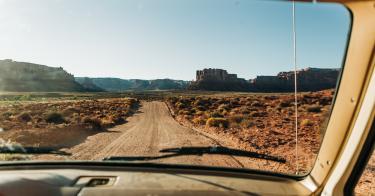
The first took us to Arizona. We saw the Grand Canyon, that impossible gash in the earth, and the Painted Desert beyond it, striped like something bruised and beautiful. We bounced along in the backs of jeeps that kicked up desert dust. We stayed at a hotel in Flagstaff, where the mornings came on white with snow and the afternoons turned hot and dry as a stovetop, as though the day couldn’t decide what season it wanted to be.
The second spring we went to Jackson Hole, to the Tetons standing up out of the earth like something out of scripture, and there we stayed in a log cabin, where the rangers warned us, upon arrival, of a moose grown ill-tempered from guests who wouldn’t leave him be. Naturally, I took this admonition as an invitation. While Nina sat rocking on the porch, drinking in the view with a contentment only a woman of her years could summon, I crept beneath the floorboards and began to stomp and snort and generally conjure, as best I understood it, the sound of an enraged and antlered beast.
She shrieked; I laughed.
>>> Poe, the Pandemic and a Halloween Lesson for Catholics and Protestants
From there we went to Yellowstone, to Old Faithful and the moose that actually behaved themselves. I remember, at the geyser, an old man off to the side smoking a pipe, the smoke curling up thin and blue against all that steam, and Papa remarking, almost wistfully, on how good it smelled. Nina said he ought to have one himself if he wanted it so badly, then waved the thought away before it could take root.
It was only later that I learned the truth of it: that Papa had given up his pipe before his own sons were born—my uncles, twins, identical down to the part in their hair—because he hadn’t wanted them growing up believing it an admirable habit. This was long before anyone had made a campaign of such things. He had simply decided it, alone, the way men of his generation did, and never smoked again.
We went white-water rafting down the Snake River, my brother and I giddy with anticipation, having not yet learned to factor our grandparents’ ages into our adventures. It turned out to be less a plunge through rapids than a gentle float past serene banks, the water flat and shining as poured glass. And it was later that day, pulled over at some highway overlook to admire the view, that the bikers came: a great, leather-clad, tattooed gang of them, thundering up out of nowhere until it was only them and us. My brother and I did the arithmetic of our own mortality and did not like the sum.
But Nina—devout as she was, pious in a manner that never once announced itself—had already seen the little fish symbol stamped on one of the motorcycles, and before either of us could stop her, she was walking straight toward them, unhurried, as if she’d been expecting them all along. We were certain she would die.
>>> A Very Merry Southern Christmas
Instead, within moments, she was praying with them, the whole rough, tattooed circle of them bowed together on the roadside, and then there was laughter, and embracing, and finally—this being the age of disposable cameras—photographs, Nina beaming in the middle of hairy, greasy men who just before had looked to us like the end of the world.
That photograph exists somewhere still, I have to believe, though my grandmother died last year, and it has not yet turned up.
Adam Smith, in closing his Theory of Moral Sentiments, observed something of how swiftly we render our verdicts upon strangers, how a glance, a coat, a scar, a rough voice, can convict a man in an instant, long before he has said a word in his own defense. It’s sympathy alone, he thought, that corrects the error, the strange and sudden capacity to feel our way into another’s situation and find, waiting there, not the stranger we feared but the neighbor we hadn’t yet recognized.
I think of my grandmother on that roadside, walking toward the very thing my brother and I had already convicted, carrying no evidence but a small fish stamped in chrome—and finding exactly what Smith promised was always there to be found, if only someone was brave enough, or faithful enough, to go looking for it before the verdict came.
This piece originally appeared in The Freeman