

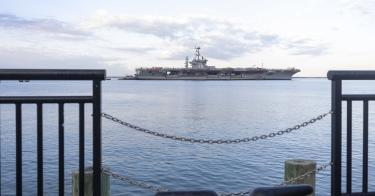
“When word of crisis breaks out in Washington, it’s no accident that the first question that comes to everyone’s lips is, where is the nearest carrier?” President Bill Clinton said that to the crew of the USS Theodore Roosevelt in 1993, but it’s just as true today. Aircraft carriers have long played a crucial role in our Navy’s ability to project power globally.
But they must adapt as threats and technology change. To fight China, the U.S. Navy will need more air power at sea, given the susceptibility of fixed airfields to missile strikes and the limited number of logistics and resupply ships available to sustain those bases under threat. This point has been made explicit with the evacuation under missile attack of the Fifth Fleet’s headquarters in Bahrain during the current conflict with Iran.
The “Golden Fleet” is the Navy’s latest 30-year shipbuilding plan, and it must address this need for naval aviation while also delivering more shipbuilding capacity. Building a modern escort carrier at a new shipyard can accelerate production of these critical ships. It would be an iterative design intended to maximize airpower for air dominance.
>>> To Build Golden Fleet Frigate Fast, Two Shipyards Are Needed
By the outset of World War II, the US Navy fielded an active fleet of 71 escort carriers; these smaller, mass-produced aircraft carriers were intended to move aircraft to the front across the Pacific and support land forces. These ships provided essential support to American forces throughout the Pacific. The performance of the Navy’s escort carriers in engagements like the Battle of Leyte Gulf and island-hopping campaigns demonstrated their indispensable role in establishing air dominance and providing close air support for amphibious forces.
Too few carriers today means that conducting screening operations (scouting, covering military forces’ air defense and/or drawing away hostile forces from the main effort) for expeditionary forces can be too risky but still necessary. Moreover, the Nimitz-class and Ford-class carriers are optimized for sustained long-range strike operations.
An escort carrier would be optimized to achieve local air superiority and secondarily support amphibious operations within the First Island Chain. The current America-class amphibious assault ships come close but, without key capabilities, fall short of what a modern escort carrier would be. In the interim, the Navy must proceed with building America-class ships.
To succeed as an air dominance platform, a new class of escort carrier would employ a mixed air wing of manned and largely unmanned aircraft. It would pair a squadron of F-35s or future F/A-XXs with unmanned aircraft utilizing technologies proven on the Ford-class. As such, escort carriers would free legacy carriers for strike operations and, in the mid- to long-term, augment today’s fleet of amphibious assault ships by providing close air support to the Marine Corps and Army forces in the First Island Chain in the Pacific.
The case for more carriers became clearest most recently with the saga of the USS Abraham Lincoln. The carrier’s 10-month deployment is emblematic of the impact operational loads are having on the current fleet of 11 carriers, strained by increased demand and too few warships.
As China continues its military buildup, the Heritage Foundation has consistently asserted that a force of 15 carriers will be required to address threats. Aircraft carrier construction is currently limited to the Newport News shipyard, which has periodically faced labor shortages and significant industrial capacity constraints. A second carrier-building shipyard is needed to mitigate the risks of potential supply chain and labor disruptions at this single shipyard.
>>> Maritime Legislation: Explainer and Next Steps
Add to this the impending decommissioning of the USS Nimitz next year, which begins an accelerating retirement of the aging Nimitz-class of carriers, with the USS Eisenhower following in 2030. This increases the urgency of building new aircraft carriers (nuclear-powered supercarriers known as CVNs). The Navy’s 2026 shipbuilding plan anticipates fielding 10 CVNs in 2030, one less than the congressionally mandated threshold of 11. Building escort carriers at a new shipyard without disrupting other shipbuilding programs can, in time, grow the carrier fleet and expand needed shipbuilding capacity.
Doing this would require picking a shipyard (new or refurbished) for this new carrier’s construction distant (greater than 50 miles) from current major naval shipbuilding activity (eg Newport News, Virginia) and using design teams not currently supporting existing naval shipbuilding programs. This would ensure the new carrier could be built with new supply chains. To be clear, this addresses a generational need for more shipbuilding capacity and naval platforms.
That said, to speed the effort, the escort carrier design must focus on proven technologies and include developing an associated supply chain that complements and grows today’s defense industrial base. Meanwhile, the Navy needs to do a better job presenting performance data for several novel systems (eg, EMALS) being proven in combat on the Ford and their utility on an escort carrier.
That said, the mission will dictate what off-the-shelf technologies are needed while operating along the First Island Chain. Taking the fight to and sustaining the war across the vast expanse of the Pacific will hinge largely on naval air power. A modern escort carrier will help bring that force to bear.
This piece originally appeared in The National Interest


