

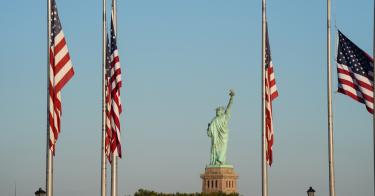
As we mark the 25th anniversary of the 9/11 attacks next month, and the fifth anniversary of the Kabul Airport bombing this month, let’s not forget the goal of the perpetrators of these atrocities: to spark a religious war intended to destroy what America is and what it represents—a free and prosperous society.
It’s an important time to remember that ensuring America’s promise of liberty for future generations has never been free. As the Irish orator John Philpot Curran noted in 1790, “The condition upon which God hath given liberty to man is eternal vigilance.”
While the 9/11 attacks didn’t spark a religious war, they did excite a Global War on Terror that was pursued often with an almost religious zeal. Quick military successes in Afghanistan and later in Iraq led to an exuberance not unlike the early post-Cold War “end of history” sentiments that dulled America’s vigilance against the rise of China. That exuberance bred hubris, which fueled a zeal for nation-building and an attempt to transplant American notions and institutions of democracy into Iraq and Afghanistan.
Throughout this costly (estimated at $8 trillion) war, the US military made sacrifices (over 61,000 casualties, of which 5,473 were killed in hostile action). It adapted novel tactics, ushering in an era of drone warfare since perfected on the battlefields of Ukraine.
>>> America Is Sailing Through the Taiwan Strait Less. Does It Matter?
After two decades of combat, many previously unknown places became household names: Kandahar, Fallujah, Kirkuk, and many more. As costly as this was, the burden was worthy—though incomplete—for defeating the forces of radicalism and terrorism.
Driving this zeal and inspiring numerous presidents is the phrase “we shall be as a city upon a hill, the eyes of all people are upon us…” uttered in 1630 by the Puritan leader John Winthrop aboard the sailing ship Arabella as it headed to America. Such sentiments have at times inspired missionary zeal in our nation’s history, sometimes at great cost.
There is no clearer picture of the failure of nation-building than the images of the chaos at Kabul airport in 2021. The lesson here is that a people must want and make theirs the liberty which America inspires—not have it imposed. Case in point: post-war Japan and Germany both returned to democratic legacies under American occupation and remain steadfast allies today.
But America cannot afford to be a passive player in a dangerous world. When it is in our nation’s interest, America has been most successful when it acts decisively and quickly as the situation dictates.
An example of not doing this was when we missed the signs that Russian President Vladimir Putin was massing an army to invade Ukraine in late 2021, then responded too slowly. That failure took options away from the president and needlessly led to a long war of attrition in Ukraine. Boots on the ground were never realistic there, but decisive US action would have prevented that war.
Nonetheless, enduring peace is possible only when popular will here and abroad supports action when needed. That was clear throughout World War II and is clear today with continuing attacks on those inspired by Al Qaeda or the mullahs in Tehran.
>>> The Nuclear Force of Necessity: Force Design for the Near-Term Deterrence Crisis
Not every freedom cause necessitates American blood be levied. Still, when a grave violation is perpetrated that meaningfully tarnishes the inspiration for or threatens the endurance of American liberty, we must act.
The Global War on Terror woke the nation to this threat, and our police agencies have proven adept at defending us. But we must address a new actor: the Chinese Communist Party and its United Front. It has turned elected officials into its agents, hosted Americans who enable the funding of domestic radicalism here, and terrorizes Chinese-Americans with a new ethnic unity law making them targets of reprisal by the Communist regime. Today, the Chinese Communist Party is the most prolific and sophisticated perpetrator of transnational repression.
The dangers of today’s world, informed by the lessons of over 20 years of warfare in Afghanistan and Iraq, are that Americans must remain vigilant, or else lose the comforts our freedoms make possible. So as many of us reflect on the attacks 25 years ago, we should celebrate that our nation has produced and inspired the lives of many heroes—and be as ready as they were to take action.
This piece originally appeared in The National Interest.



