The United States and the world are in a period of acute danger. The risk of near-term aggression by Russia, China, North Korea, or Iran is high. Russia launched a full-scale invasion of Ukraine in 2022 and continues its aggression. China grows increasingly belligerent toward its neighbors. North Korea continues to expand its nuclear arsenal, threatening to use it against America’s regional allies. Iranian-backed terrorists struck U.S. citizens three times in 2023.[REF]
Collectively, these trends suggest that the United States’ adversaries are growing more confident and are increasingly willing to threaten or use military force to achieve their revisionist aims. Aggression by just one of the United States’ adversaries could incentivize aggression by the others, as the United States and its allies could be forced to stretch their resources progressively thinner while responding to multiple contingencies simultaneously.[REF]
Indeed, the largest military buildup in the world is taking place not in the democracies of North America, Europe, or East Asia, but in China, Russia, and North Korea. China is building more naval surface combatants, fifth-generation fighters, and missiles than the United States, Japan, South Korea, and Australia combined.[REF] Russia, despite taking real losses in its war against Ukraine, has retooled its economy to one focused on defense production and has benefited from recent spikes in oil prices.[REF] North Korea, despite being an economic backwater, is fielding ever more capable conventional forces and a larger and more diversified nuclear force.[REF]
This is not to say that the United States and its European and Pacific allies are doing nothing in response. Indeed, they are rapidly expanding their defense industrial bases, placing multi-year block buys of ships, planes, and munitions needed to defend themselves.[REF] From Japan to Korea to the U.S. homeland to France, Germany, Sweden, and the Czech Republic, states and private companies are building traditional platforms and systems as well as newer capabilities, such as autonomous systems. The early 2030s will see far more deep-penetrating strike missiles rolling off the assembly lines, significant numbers of next-generation B-21 stealth bombers flying, more attack submarines and new autonomous naval surface combatants entering the fleets of the allies, and more missile interceptors across the free world. These systems will incorporate cutting-edge defense technologies with proven legacy platforms, resulting in highly capable militaries.
However, the benefits of this defense production renaissance will accrue gradually over several years. While new factories are built, production lines are expanded, and human capital is trained, the United States’ autocratic rivals in Beijing, Moscow, and Pyongyang have already made such investments and are already reaping the associated benefits.
That makes the next five years quite dangerous.
Beijing may decide that if it seeks to forcibly conquer Taiwan or seize other disputed islands in the South China Sea or East China Sea, it must do so before improved and expanded U.S. and allied capabilities arrive in the mid-2030s. Moscow may believe that any opportunities for it to retake former Soviet republics, be they in the Baltics, Moldova, or the Caucasus, will close once the United States and its NATO allies field the requisite capabilities to rapidly engage and destroy Russian ground forces.
In short, while there has been much discussion among U.S. defense planners and strategists about the 2027 “Davidson window,” in which then-Commander of U.S. Indo–Pacific Command Admiral Phil Davidson postulated that China was preparing to be able to seize Taiwan by 2027, the United States’ adversaries may perceive a “reverse Davidson window,” in which they must undertake military aggression before the American-led military coalition gains the upper hand in the correlation of forces.[REF]
In Europe, Russia may likewise believe that its substantial, flexible arsenal of non-strategic nuclear weapons—and roughly 10-to-one advantage over NATO’s non-strategic arsenal—gives it the ability to escalate a conflict to the nuclear threshold at acceptable risk, should it find itself on the losing end of a conventional conflict with NATO.[REF] Such an advantage could embolden Russia to attempt a fait accompli attack against NATO’s most vulnerable members—Latvia, Lithuania, and Estonia—in an attempt to break the Alliance.
At the same time, as much of Europe remilitarizes through expanded defense budgets and revitalized defense industrial bases, Russia may believe that its best opportunity to strike the Baltic states is before NATO begins to field large numbers of military capabilities that could deny and defeat a Russian invasion.[REF] In this sense, Russian leadership may believe that it, too, has a closing window, after which it will be unable to secure objectives militarily. While Russia will almost certainly be reluctant to attack NATO after unsuccessfully struggling to subdue Ukraine for over four years, it may believe that it has a once-in-50-years window of opportunity to retake the Baltic states, made more enticing if the United States is already tied down in regional conflicts elsewhere. Once NATO completes its process of rearmament, however, such a window will likely close.
History is replete with examples of states launching offensive wars to stave off what their leaders perceive as closing windows of opportunity.[REF] The same logic may grip the Chinese Communist Party in Beijing or the siloviki (sometimes called “securocrats”) in Moscow in the near future.
Regional Nuclear Forces’ Role in Deterrence
Theater nuclear forces can help the United States to meet these challenges in this critical time period before additional conventional investments start bringing more capabilities online. Procuring or developing additional theater nuclear forces would necessarily make the United States’ nuclear arsenal more flexible, making a U.S. deterrent threat of limited nuclear use more credible.[REF] Such nuclear forces enhance deterrence by providing a President with additional options to tailor deterrence signals and respond flexibly at an acceptable level of cost and risk should deterrence fail. Adversaries may perceive the United States as more willing to use theater nuclear forces in a local contingency and therefore be more reluctant to run that risk by starting a war. This dynamic is analogous to the “downdraft effect of ‘strategic nuclear instability’” described by Vipin Narang in the context of damage limitation capabilities;[REF] by increasing the credibility of nuclear threats in the minds of its adversaries, the United States may be less likely to engage in the kind of aggression that could catalyze a local nuclear response.
This downdraft reinforces conflict deterrence overall by undermining adversaries’ nuclear theories of victory. By fielding credible capabilities to restore deterrence after an adversary engages in regional nuclear escalation, the United States can decrease adversaries’ perception that regional nuclear use could enable them to achieve their objectives. This could further limit adversary incentives to launch a regional war if the given adversary saw limited nuclear escalation as a backstop for its broader military campaign. Adversaries that might depend on coercive nuclear use to salvage a stymied conventional campaign, like China or Russia, might therefore be more cautious about starting a conventional war in the first place.
For instance, Chinese leaders might recognize that uncertainty is inherent in conventional military operations. Though they might prefer to take Taiwan by conventional force alone, Chinese leaders may view their theater nuclear forces as a hedge against such a campaign falling short. They might calculate that limited nuclear use could either provide battlefield gains necessary to secure the island or induce restraint on the part of the United States and its allies, or both. By fielding credible forces it can use to respond to such an escalation, the United States undermines that theory of victory by denying China a nuclear trump card.
Moreover, flexible regional nuclear forces can prosecute adversary conventional and regional nuclear forces more credibly than U.S. central deterrence forces, decreasing adversaries’ capabilities for limited nuclear warfighting. As Victor Utgoff and Michael Wheeler explain, such counterforce capabilities can “prevent potential adversaries from reaching at least higher U.S. nuclear damage thresholds [required for effective coercion].”[REF] Limiting the damage the United States and its allies might bear in a regional nuclear exchange both decreases the United States’ burden in a competitive intrawar bargaining dynamic and increases the size of the regional nuclear force the given adversary must field to attempt coercive employment.[REF] If intrawar deterrence dynamics are understood as a competitive tacit bargaining process, fielding capabilities that allow the United States to impose cost at relatively less risk can enhance Washington’s leverage over its adversaries. There is, of course, no guarantee that an adversary will fight a nuclear war according to such strictures or Washington’s preferences, but, as Colin Gray observed, “the United States should endeavor to maximize [adversary] incentives to be restrained.”[REF]
Desirable Operational Characteristics for Regional Nuclear Options
A near-term regional nuclear deterrence capability for the United States must accomplish two goals. First, it must credibly inflict planning and operational costs on adversaries, contributing to deterrence of conflict initiation by conventional forces. Second, it must provide Washington with flexible options that can deter strategic attack, including nuclear use, amid an ongoing conventional conflict or restore deterrence after adversary strategic attack. These objectives require different nuclear force characteristics.
Contributing to deterrence of conflict initiation by imposing planning and operational costs with nuclear weapons depends on achieving optimal instability—sufficient to make an adversary reluctant to start a conflict without undercutting crisis stability.[REF] While the United States’ strategic nuclear force posture contributes to optimal instability because of its damage limitation capability, theater nuclear weapons can make this instability more salient for adversary decisionmakers if they are based forward.[REF] Of course, there is no guarantee that central deterrence will hold after regional nuclear employment, but the authors of this Backgrounder assume that the tremendous disincentives associated with escalation to strategic exchange will exert some restraining effect on the regional war.
Some ambiguity about where forward-based weapons are deployed can further enhance adversary perceptions of risk by inducing additional unknowns into their decision calculi. If, for example, the U.S. Navy deployed an unspecified number of nuclear-armed sea-launched cruise missiles (SLCM-N) on several Virginia-class attack submarines (SSNs), an adversary might be forced to assume that any SSN in the given theater has a nuclear-strike capability. An adversary might therefore be forced to divert more attention from its principal conventional war aims to tracking and holding at risk U.S. SSNs in theater, complicating its war planning. To contribute to deterrence of conflict initiation, some number of theater nuclear weapons should be forward deployed on a continuous basis and be capable of holding adversary nuclear and conventional forces at risk on relevant timelines.[REF] This is not to say that additional capabilities cannot be visibly or non-visibly generated amid a conflict. Rather, forward deployment conveys stake and capability before a conflict erupts, thereby ideally lessening the chances of a conventional conflict to begin with.
Credibly holding critical adversary nuclear and conventional forces at risk requires several additional force characteristics. Theater nuclear forces must be capable of penetrating adversary integrated air and missile defense systems on a reliable basis.[REF] Strike weapons that travel along non-ballistic trajectories can be less predictable and therefore more difficult for adversaries to intercept. Moreover, adversary anti-access/area-denial (A2/AD) capabilities and reconnaissance-strike complexes can hold non-stealthy strike platforms at risk, so some portion of the theater nuclear force ought to be deployable on survivable platforms and designed to be fired at long ranges.[REF]
The weapons in question should also be capable of complicating adversary theories of victory. In practice, this means responsiveness, the ability to generate a nuclear strike after the given unit is ordered to do so, and promptness, the ability to strike a target in a minimal amount of time after launch. The United States should be able to execute the given theater nuclear option on extremely short notice to decrease the probability that an adversary can achieve a fait accompli. If, for example, executing a theater nuclear response took several hours, an adversary might calculate that achieving its objectives rapidly would in turn decrease the probability of a U.S. nuclear response because the United States would be unable to restore the status quo ante. Likewise, prompt weapons employment can hold at risk the time-sensitive, mobile assets essential for rapid maneuver campaigns. Fielding prompt theater nuclear forces may therefore force an adversary to divert some of its conventional and nuclear forces to hedge against that weapon’s employment—by dispersing those forces or keeping them in hardened shelters farther from the area of operations—in turn decreasing the number of available assets for the conventional campaign.
Intrawar deterrence maneuver is likely to be more challenging than deterring conflict initiation. This is so because intrawar deterrence comes into play after an adversary has already chosen to start a war, likely indicating a relatively higher level of risk tolerance. Intrawar deterrence can be separated into two tasks—deterrence of escalation before a strategic attack, and restoration of deterrence after strategic attack. Deterring nuclear employment amid a conventional conflict requires convincing an adversary that has already accepted the risk inherent in conventional warfare that the additional risk incurred by using nuclear weapons would be too great. Compelling the cessation of adversary nuclear use after it has already begun to do so is probably more difficult because the adversary will already have assumed the high levels of risk inherent in nuclear use.
Deterring nuclear use amid an ongoing conventional war has many of the same requirements as those identified for deterring conflict initiation. It is important, additionally, that some portion of the theater nuclear weapons available have low-yield warheads, as retaliating with such weapons is likely more credible than escalating to multi-megaton strikes generated from central deterrence forces. An adversary may thus be less likely to assess that it could get away with a limited nuclear strike amid an ongoing war.
Some portion of the available theater nuclear force should be equipped with relatively higher-yield warheads to attempt to compel cessation of adversary strategic attacks, however. If an adversary makes the decision to employ nuclear weapons in a limited fashion, that adversary may have priced a retaliatory strike—perhaps against the launcher or airbase from which the adversary strike was generated—into its initial risk calculation. Restoring deterrence could require exceeding the hypothetical U.S. retaliatory strike that the adversary priced into its risk assessment, thus demonstrating resolve and introducing new risk and uncertainty into adversary decision making. Likewise, a weapon with minimal visible generation would be well-suited to the task of enhancing adversary uncertainty because such a weapon would be more conducive to tactical surprise than a strike that an adversary can observe as it is generated. Tactical surprise can enhance the effect described above whereby the United States’ response introduces new uncertainty, beyond the risk that the adversary initially factored into its decision calculus, into future adversary decisions.
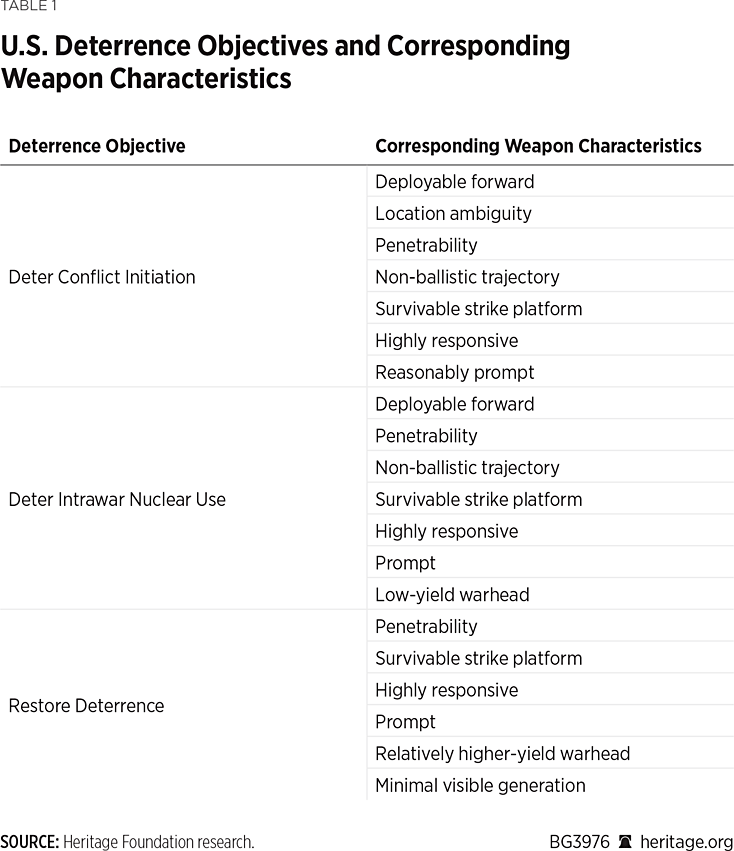
Though three different deterrence objectives ought to guide theater nuclear force design, each of the objectives implies many of the same desiderata for theater nuclear force design. Table 1 aggregates the weapon characteristics discussed in this section and assigns them to their respective deterrence objectives.
Force Structure Recommendations
Given the above issues, the authors of this Backgrounder suggest that the United States augment its theater nuclear capabilities not only to assure its allies—a central objective of U.S. nuclear policy—but also to deter potential adversary military aggression, including nuclear use, over the coming years of high global instability.
This instability is principally driven by the perception among the United States’ nuclear-armed, revisionist adversaries in Beijing and Moscow that a window of opportunity for quick, decisive military operations against the United States and its allies may be closing. As such, the United States and its allies must be prepared for a potential high-intensity conflict with China or Russia within the next five to 10 years. At present, it is far from certain who the winner of such a conflict might be.[REF] To deter and, if necessary, defeat near-term Chinese or Russian aggression, the United States must field a flexible regional nuclear deterrent. Doing so will both reinforce the United States’ existing conventional deterrents in Asia and Europe and provide Washington with the options needed to deter opportunistic nuclear escalation by Beijing or Moscow.
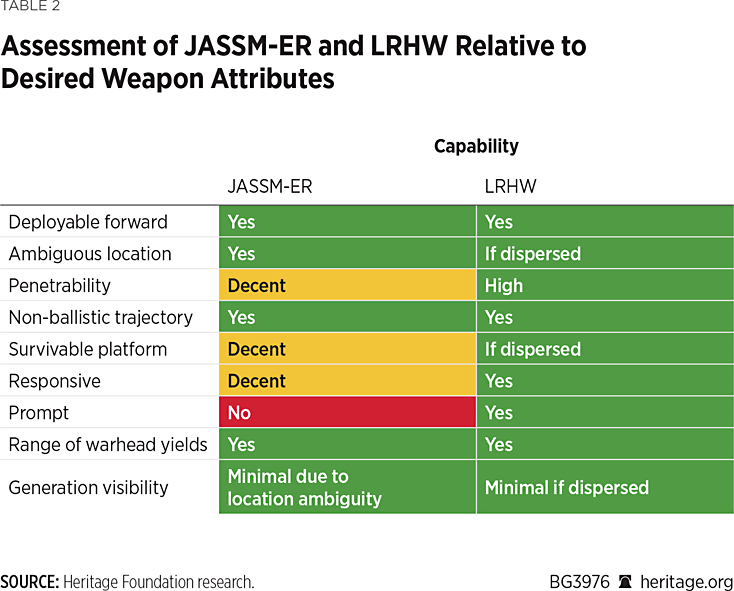
Given the desired characteristics needed for conflict deterrence, intrawar deterrence, and deterrence restoration, this Backgrounder identifies two existing conventional strike capabilities that, if modified to be nuclear-capable, could reinforce near-term deterrence: the Joint Air to Surface StandoffMissile-Extended Range (JASSM-ER) and the Long-Range Hypersonic Weapon (LRHW, or Dark Eagle). The JASSM-ER is a cruise missile that can be launched from a variety of air platforms, including bombers and F-35A fighter aircraft, while the LRHW is a land-based hypersonic weapon that uses rocket boosters to gain altitude and speed, but follows a boost-glide hypersonic trajectory after launch.[REF]
Both JASSM-ER, a cruise missile, and LRHW, a hypersonic glider, offer reliable penetrability and non-ballistic flight profiles. Furthermore, JASSM-ERs are air-launched, while LRHWs are ground-launched, so fielding nuclear variants of both would provide an optimally flexible and capable force mix. Given that the Joint Force fields both capabilities today, the Joint Force could also sidestep the lengthy lead time required for procuring new missile systems.
A nuclear-armed JASSM-ER (JASSM-ER-N) would also satisfy many of the other criteria identified in the previous section. JASSM-ER-Ns could be deployed forward at bases with F-35 wings in the Indo–Pacific or Europe if they receive the necessary infrastructure. Thus, any base capable of hosting dual-capable F-35A aircraft could become a potential launch site for theater nuclear weapons, providing specific location ambiguity and enhancing deterrence. JASSM-ERs can also be fired from standoff range, which enhances the survivability of the firing platform.
There are some drawbacks, however, that should inform the requirements for future Air Force air-launched capabilities. F-35s cannot carry JASSM-ERs internally and placing them on pylons trades off the fighter’s stealthiness. Moreover, the JASSM-ER is subsonic and therefore not well suited for striking time-sensitive targets.
Fortunately, a nuclear-capable LRHW (LRHW-N) would have important overlapping capabilities and address some of JASSM-ER’s shortcomings. LRHW batteries can be deployed forward, which makes them useful for signaling. Deploying the batteries forward moreover contributes to responsiveness because the missiles can be fired with minimal warning, whereas a fighter sortie would have to be generated and fly to a designated launch position. The missile itself should be more survivable than either JASSMs or F-35s in A2/AD environments, as it can maneuver at hypersonic speeds within the atmosphere. LRHW’s survivability is, to some extent, derived from its high speed, which makes it well-suited for engaging time-sensitive targets.
While ground-based missile batteries deployed forward might seem highly vulnerable to pre-emption, the war in Ukraine tells a different story. Despite Russia’s high-fidelity intelligence on the positions of Ukrainian air defense batteries before it launched the full-scale invasion in February 2022, Ukraine relocated its batteries quickly and blunted the initial Russian missile salvo’s effectiveness.[REF] After the initial salvo, Kyiv dispersed the batteries and used “shoot-and-scoot” tactics to stay ahead of Russian efforts to destroy its air defenses.[REF] Assuming LRHW batteries can replicate such maneuvers, they should be reasonably survivable in A2/AD environments.
The United States does not need tremendous numbers of either capability. The goal is not to win a limited, low-yield theater nuclear war with theater forces alone, but to deter such a war from breaking out. Should a limited theater nuclear war erupt, the United States may be forced to employ its central deterrence forces, if successive efforts to compel the cessation of adversary strategic attacks fail. These authors therefore deem a relatively modest uplift in near-term theater nuclear capability sufficient for the deterrence objectives delineated here; hundreds of such systems are not strictly necessary. Indeed, the United States could not field hundreds of JASSM-ER-Ns or LRHW-Ns without undermining its conventional capabilities. As such, 25 of each system deployed on a small number of U.S. and allied bases in the Pacific and European theaters, respectively, should be sufficient to hold at risk a score or so of enemy targets with nuclear weapons, enhancing the United States’ capabilities for conflict and intrawar deterrence. Converting 50 JASSMs and 50 LRHWs would thus provide a meaningful deterrent capability, without undermining the United States’ ability to prosecute a conventional conflict. This is not to say that the United States has no other theater options; the United States has between 100 and 200 Cold War–era B-61 gravity bombs deployed in Europe and the United States, primarily as part of NATO’s nuclear deterrence posture.[REF] While these are useful for assurance, they have very limited range and are not penetrating. The U.S. Navy also maintains a low-yield variant of its Trident D5 submarine-launched ballistic missile—the W76-2. This weapon, however, has a ballistic trajectory, would be generated from a central deterrence platform, and is likely fielded in very low quantities. As such, the W76-2 is a sub-optimal option compared to a JASSM-ER-N or an LRHW-N when it comes to regional deterrence missions. Indeed, launching a ballistic missile from a central deterrence platform carries a substantial escalation risk; that is, the adversary may believe that the ballistic missile is part of a strategic attack and respond with its own strategic capability. Such an outcome is undesirable, because it undercuts a submarine-launched ballistic missile’s credibility in regional deterrence scenarios.[REF]
Similarly, the future SLCM-N is a viable option that meets many of the characteristics identified here, but it is not slated to be delivered before the early to mid-2030s and cannot, therefore, address the heightened near-term dangers discussed above.[REF] As such, the United States needs stopgap solutions, such as a JASSM-ER-N and an LRHW-N, which could be fielded years before the SLCM-N is fielded at scale, given that the weapons themselves are already in stock and would only require swapping out conventional warheads for nuclear warheads.
Additionally, the bomber leg of the nuclear triad will, in the future, have a new nuclear-armed cruise missile, the long-range standoff weapon (LRSO), which could be used for regional deterrence. However, the LRSO is intended to backfill the retirement of air-launched weapons for central deterrence. The United States should therefore field additional options beyond the central deterrence program of record designed for a more benign security environment.
Significantly, the force structure adjustments proposed here are a stopgap measure for near-term challenges and not necessarily a long-term solution. At present, the United States is starting from a position of severe programmatic disadvantage. Washington’s great power adversaries field far more theater nuclear forces than it does and have superior capabilities to produce new nuclear warheads for these systems.[REF] Though the United States is now making real progress in restoring its defense industrial base and nuclear enterprise, its productive capacity remains slow and sclerotic.[REF] The Pentagon, the Department of Energy, and Capitol Hill must think intentionally about what kinds of theater capabilities will be necessary in 10 to 15 years and beyond, and they must lay a foundation that can support those programs in the future.
Conclusion
The United States and its allies are heading into a period of great uncertainty and instability that could well spill into open conflict. The West needs more conventional capabilities to deter potential adversary aggression. It also needs credible, theater-range nuclear capabilities that can backstop conventional denial by denying adversary theories of victory that depend on limited nuclear escalation. While the United States is in the process of revitalizing such forces, it must take steps to rapidly field existing conventional delivery systems mated with converted nuclear warheads drawn from the ready reserve stockpile. Doing so may be the best way to ensure that Washington has credible conventional and nuclear systems working in concert and deterring conflict in the near term.
Robert Peters is Acting Director of the Douglas and Sarah Allison Center for National Security at The Heritage Foundation. Eli Glickman is a master’s student in history of war at St. Hilda’s College at the University of Oxford.