

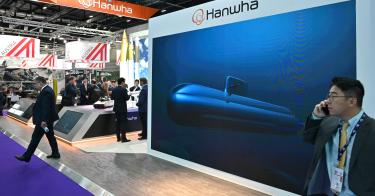
Nuclear power is cool once again and is all the rage in Asia. The North Koreans are getting in on the action with the rumored development of a nuclear-powered submarine. Not to be outdone, America’s allies, South Korea and Japan, are serious about having the capability for their future submarines. For America, having allies with lethal nuclear-powered submarines will bolster deterrence against China’s massively expanding modern navy.
Success is far from certain—a concern raised at the recent Hongneung Defense Forum in Seoul. Given diplomatic tensions and industrial and labor limitations, what could engender an allied shipbuilding revival and enhance deterrence could quickly falter. Navigating these challenges requires a plan—an optimum pathway.
Interest has been building for a while now. The Australia-U.K.-U.S. (AUKUS) nuclear submarine initiative announced in September 2021 has inspired other key American allies to go nuclear to power their advanced, indigenously built submarines. South Korea and Japan have also signaled an interest in building nuclear-powered subs, but it was the November 2025 summit of President Donald Trump and President Lee Jae-myung of South Korea that supercharged the idea.
In the months since, Seoul has worked to develop the requirements for its own nuclear submarine, including the use of low-enriched uranium (LEU) nuclear fuel, a decision seemingly inspired by an analysis by the Sejong Institute of the French nuclear naval program.
The French Navy uses LEU in its submarines, and for South Korea, its use addresses proliferation concerns but would require more frequent, costly refueling.
>>> A Strategic Industrial Plan to Realize the Golden Fleet
This eagerness by Seoul may not be as welcome with another key ally: Japan. Lingering tensions among allies Japan and South Korea, as well as industrial limitations, are conspiring to stifle the effort. Further complicating matters, the potential participants (South Korea, the U.S., and Japan) in this new nuclear submarine effort are facing labor shortages and reliance on migrants at their shipyards.
As with AUKUS, balancing these tensions requires an optimum pathway that all participants agree on and contribute to. If done well, South Korea, Japan, and the U.S. would come together to develop SMR technologies and to construct ships powered by these novel power plants in a so-called ROKJUS (Republic of Korea, Japan, U.S.) program.
On the financial front, there are favorable tailwinds. A ROKJUS optimum pathway will need to leverage the $150 billion of South Korean investments into the U.S. shipbuilding sector and align more Japanese investments to the endeavor as part of its own $550 billion pledge to invest in America. South Korea’s Hanwha has already moved into the U.S., purchasing the Philadelphia Shipyard in December 2024, with orders expected as the U.S. government budgets for orders for tankers vital to sustaining military operations.
These resources, paired with American expertise in naval nuclear propulsion, can accelerate the development of maritime small modular nuclear reactors (SMRs) with utility for both powering commercial ships and submarines. In this way, promised investments can serve key allies’ nuclear submarine aspirations while building on American nuclear know-how as a comparative advantage, potentially reviving their collective maritime industries.
Given the sometimes-tense relations between allies Japan and South Korea over historical animosities, a collaborative maritime SMR project would help unite them in a common cause. It would also allow for differentiation among the three nations in commercial applications of SMR technologies to regain global shipbuilding market share.
Why an SMR for submarines? (See the 2023 report A Revolution in Shipping for SMR use in commercial shipping.) Both Japan and South Korea are currently producing advanced large conventional submarines—the KSS III and the Taigei—which could be modified to accommodate an appropriately scaled-down commercial SMR. The operational case for the hybrid nuclear submarines was made in a December report, which was modest compared to existing conventional submarines in terms of on-station deployment time.
>>> The U.S. Navy Is Going To Shrink—at the Same Moment China’s Navy Is the Largest on Earth
However, an SMR back-fitted KSS III or Taigei would markedly enhance survivability, with greater power reserves for advanced SONAR systems and longer high-speed evasions without the need to come shallow and run diesel generators to recharge batteries.
This isn’t the first time such an idea has been pursued. In the 1980s, the Soviets, for similar reasons, modified a Juliet-class diesel submarine with a micro nuclear reactor (VAU-6). Similarly inspired, news broke in late 2024 that a new class of Chinese submarine had sunk pierside. U.S. officials later indicated China was suspected of attempting to install an SMR on its most advanced diesel submarine, the Yuan-class (Type-39).
Modifying an existing submarine under construction minimizes the impact on shipyards and workers while reducing the risk of design problems and cost overruns. In the case of Taigei and the KSS III, a hull cut and insertion of an SMR hull section are envisioned; a well-used technique in U.S. submarine construction (see the special mission boat Jimmy Carter and Virginia-class Block V modifications).
Such an iterative approach, while workable for Japan and South Korea, was not an option for AUKUS. As such, AUKUS accepted considerable costs with risks mitigated, with Australia initially procuring used American Virginia-class nuclear submarines after operating them for years.
Given the limited number of available American nuclear submarines and domestic shipbuilding capacity, expanding AUKUS to include Japan and/or South Korea is not feasible. Nor is it operationally necessary, given the shorter deployment distances involved in Northeast Asia.
This piece originally appeared in 1945.com


