


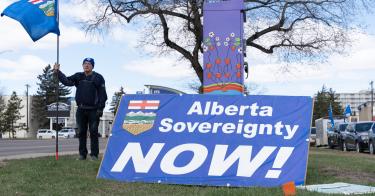
Canada’s Texas is threatening divorce, and it could eventually become the 51st state, with serious impacts on how much Americans pay for gasoline. The idea of energy giant province Alberta leaving Canada is moving from bumper sticker to reality as organizers say they’ve collected over 300,000 signatures for a referendum to leave Canada.
That’s almost twice the signatures needed, triggering a vote in October where Albertans can decide whether to leave Canada, along with a series of other questions, such as voter ID and limiting welfare to migrants, which have flooded Canada in recent years. According to prediction market Kalshi, odds of independence are now 1-in-4, up from 1-in-10 last December.
Alberta’s Oil Wealth and Conservative Politics Are Fueling the Independence Movement
Why do Albertans want to leave in the first place? And why is the movement gaining so much steam? It’s because Alberta is basically what happens if Texas married Wyoming and then got trapped in a Human Resources seminar run by Ottawa.
More importantly, Alberta is by far the richest province in Canada, thanks to roughly 160 billion barrels of oil, or about three times the reserves of the entire United States. That would make Alberta the fourth-largest oil reserve in the world, just behind Saudi Arabia.
>>> Why Congress Needs to Act Now on Permitting Reform
Massive oil and gas exports, mostly to the United States, are why Alberta accounts for a whopping 15 percent of Canada’s gross domestic product. In fact, the province is so wealthy that it basically funds the rest of the country to the tune of $15,000 a year per household.
This bothers Albertans, especially when the rest of Canada’s trying to kill Alberta’s golden goose, blocking pipelines and imposing carbon taxes to the point Alberta produces just one 11th of the ratio of oil reserves as the United States, despite having much more oil in the ground.
The other half is politics. Much of the rest of Canada, especially in the east, sees Albertans as toothless rednecks since Alberta is by far the most conservative province in Canada. Quebec looks down on Alberta the way California or New York looks down on Mississippi or North Dakota.
In the last election, Conservatives won 64 percent of the vote and over 90 percent of federal seats, putting Alberta at constant loggerheads with Ottawa, on everything from firearm ownership to free speech to religion.
The differences previously came to a head in the 2022 trucker protests against COVID restrictions. In Alberta, crowds lined highways, cheering the truckers. In Ottawa, former Prime Minister Justin Trudeau seized their bank accounts to try and starve them out while running down grandmothers with riot cops.
It’s getting worse with a bevy of federal hate-speech laws that target conservatives and Christians. Multiple pastors have been prosecuted for criticizing homosexuality, including a former school trustee fined $750,000 for calling transgenderism “biologically absurd.”
Another Alberta pastor was sentenced to 12 months’ house arrest for protesting Drag Queen events for children while Ottawa fought for the sexualization of children.
>>> Reject RGGI for Affordable Energy
Tribunals in British Columbia and Ontario have levied $10,000 fines on people for the crime of “misgendering,” while professor Jordan Peterson was infamously ordered to pay $25,000 and undergo pronoun re-education or lose his license. Between the social and economic oppression, it’s obvious why Albertans want out.
An Independent Alberta Could Reshape North American Energy Security
What might be less obvious is the impact of Alberta becoming the 51st state, with Kalshi showing 4-in-5 odds of an independent Alberta applying for statehood.
Although Alberta’s energy output has been hamstrung by the Canadian government, it has enormous upside potential. Sluffing off Ottawa’s shackles could mean producing at an order of magnitude greater than current levels, becoming the Saudi Arabia of the north.
Now imagine all that extra production in the United States, yielding not just energy independence or even energy superiority, but energy supremacy. In other words, when global energy shocks occur, such as the current Iran War, the United States would be able to simply increase production and counter the lost global supply.
At that point, Americans could no longer be held hostage by global energy markets. Instead, the United States would set the terms. Throw in energy derivatives like nitrogen fertilizer—with nearly all Canadian production being in Alberta—and you’re insulated from many other price shocks too. Energy security is national security.
This piece originally appeared in The National Interest



