

On July 23, 2026, Chinese research vessel Lanhai 201 completed a weeklong survey in waters east of Taiwan that Chinese authorities claimed was conducted to collect “biological and environmental data to support the conservation and sustainable management of fisheries.”[REF] Publicly available tracking data, however, suggest that the ship’s mission may have been less benign. Specifically, Lanhai 201 displayed abnormal speed and course changes throughout its cruise—abnormalities that are indicative of activities other than fisheries research.[REF]
Research vessels may be part of a new line of effort in what Taiwan calls “lawfare,” defined as activities that attempt to create a false impression of legal authority for China to operate around the island. Since June, Chinese vessel activities near Taiwan have surged by 83 percent, and there has been a noticeable uptick in the number of research vessels.[REF] This elevated maritime presence followed Beijing’s announcement of new “special maritime law enforcement operations,” which it claims are a response to talks by the Philippines and Japan to delimit their maritime boundaries east of Taiwan.[REF]
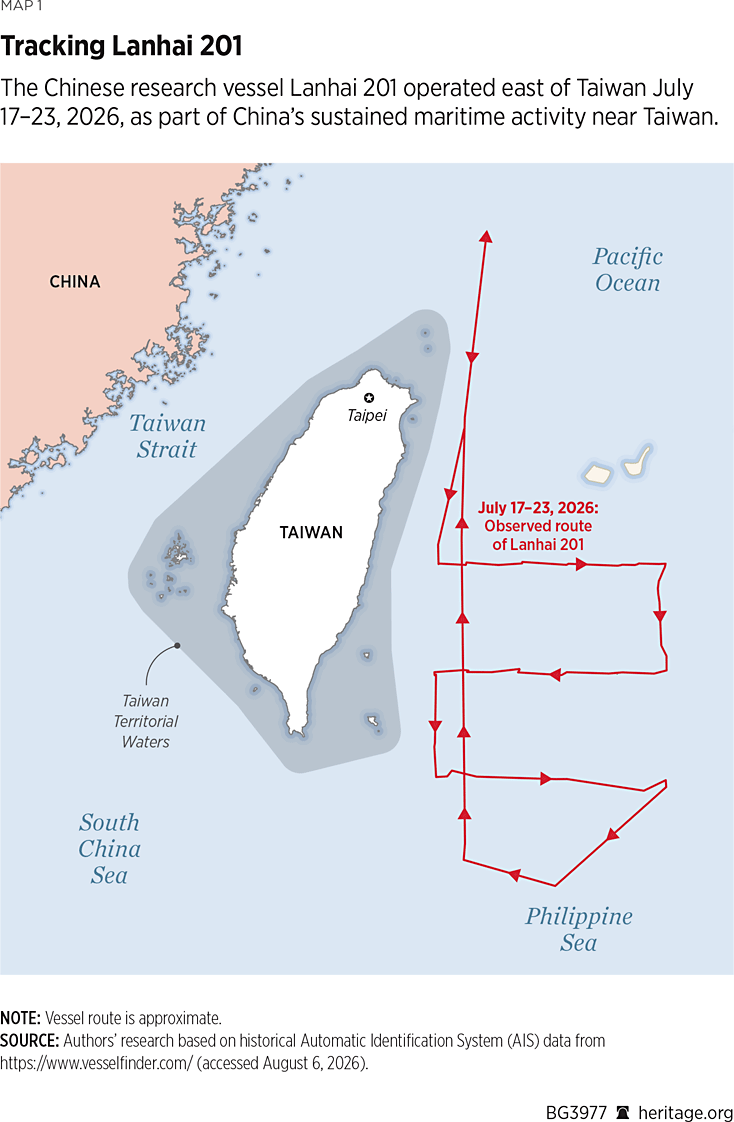
While Chinese government vessels are not an unusual sight around Taiwan, the growing presence of research vessels is somewhat surprising. The Chinese Coast Guard (CCG) and the People’s Liberation Army Navy (PLAN) are the principal maritime forces that conduct weekly combat patrols and, to a lesser extent, large-scale military exercises around Taiwan. Most research vessels, on the other hand, carry limited military capabilities and generally are not equipped with combat platforms.[REF] Beijing insists that they only conduct civilian research.[REF]
That, however, is not the full picture. Research vessels are outfitted with specialized high-technology instruments that enable data collection on oceanic phenomena—information that can directly affect naval operations. In 2024, the Xiang Yang Hong 06 was monitored moving at unusually slow speeds in rigid lines along Taiwan’s east coast following a precise pattern, which naval experts say is consistent with the mapping of undersea features.[REF] Seabed topography can inform Beijing about where to place undersea sensors, where sensitive infrastructure like undersea cables is located, and which areas have the most suitable subsea conditions for the dispatch of submarines.[REF]
This report details the growing deployment of research vessels around Taiwan by the Chinese Communist Party (CCP). It (1) examines the state-run agencies that own these ships and the relationship between purported research offices and the People’s Liberation Army (PLA); (2) assesses the strategic functions of these vessels; and (3) considers the likely operational trends in the months and years to come.
Building a “World-Class” Military: A Strategy of Military–Civil Fusion
China’s Ministry of Natural Resources (MNR) operates the most vessels in the nation’s maritime research fleet, which is the largest in the world. The MNR’s institutional responsibility is to manage, regulate, and survey China’s geographical features and the natural resources that lie within them. It is a ministerial-level constituent department of the State Council and was formed in 2018 as part of reforms undertaken by the 19th CCP Central Committee to extend Party oversight over state institutions.[REF] The wave of reforms delegated greater responsibility to Party organizations, giving the Party and, by extension, the PLA some influence over the MNR’s decision-making process.
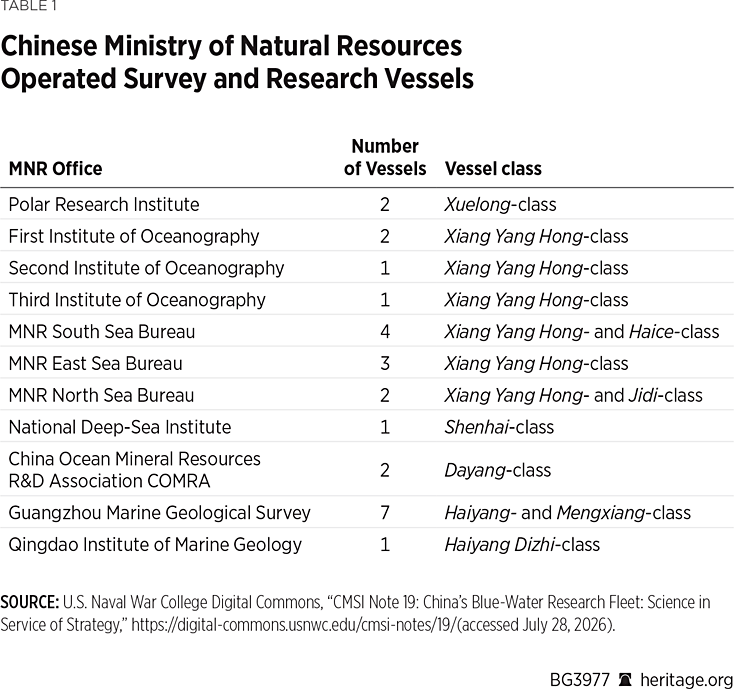
Within the MNR, 11 subordinate offices and research institutes own and supervise the operations of 26 research vessels.[REF] MNR offices use the vessels to perform ecological research and have published findings online.[REF] On June 16, pursuant to a directive of the MNR’s East China Sea Bureau, the oceanographic research vessel Xiang Yang Hong 22 conducted a marine survey in the waters east of Taiwan, ostensibly to “gain a comprehensive understanding of the natural ecological conditions in China’s jurisdictional waters to support marine ecological conservation efforts.”[REF] The relevant offices purport to engage in strictly nonmilitary research and make no mention of involvement, whether through their research or research vessels, in paramilitary or military missions.
However, these official statements obfuscate the MNR’s ties with the PLA. China’s State Oceanic Administration, which became part of the MNR following the 2018 reforms, signed a framework with the PLA in 2017 to “promote exchanges in the maritime field.”[REF] Some MNR scientists and engineers are known to have received military training from the PLA and have been subject to military tasking.[REF] The PLA has also supplied the MNR with certain research vessels: All 11 research vessels in the Xiang Yang Hong class, for instance, were originally registered with the PLAN and later transferred to civilian offices in the MNR that maintained close relations with the PLA.[REF] MNR-owned vessels have also been observed operating alongside the CCG and PLAN[REF] and have made port calls to military-affiliated facilities in China that have hosted PLAN warships.[REF]
The CCP also exercises considerable influence on the MNR through external and internal oversight mechanisms. Externally, the CCP controls research by approving grants and annual budgets. Research institutes must align their research with Party directives to receive continued state funding. Following approval of the 15th Five-Year Plan in March 2026, top Party leaders convened expert working groups to “systematically review” alignment with “major national strategic needs,” which unsurprisingly included efforts to contribute “to the building of a maritime power.”[REF] Internally, virtually all research centers are overseen by Party secretaries. The East China Sea Bureau, for instance, is managed by a “Party Leadership Group” headed by Bureau Director Yu Jian, which reports regularly on institutional initiatives to top Party leadership and hosts central-group sessions focused on Party discipline.[REF]
The interlocking relationships among the MNR, China’s oceanographic research centers, the PLA, and the CCP reflect Beijing’s broader campaign of “military–civil fusion” (MCF), an aggressive national strategy to transform Chinese forces into a “world-class military” by integrating China’s civilian and defense ecosystems.[REF] This approach makes possible the rapid incorporation of cutting-edge technology, enabling the CCP to translate economic heft into military power. To this end, research vessels fulfill a “dual-use” role: supplying maritime research that not only fuels commercial development, but also aids undersea warfare. In 2016, in the name of “military–civilian integration,” the Qingdao National Laboratory for Marine Science and Technology signed a strategic cooperation agreement with the China Shipbuilding System Engineering Research Institute.[REF] The latter has been praised for “remarkably contribut[ing] to China’s development of vessel equipment” and “functioning as the core pillar to modernize China’s navy equipment.”[REF]
MCF also empowers Beijing to claim that research activities are “purely civilian” in nature. Only under narrow grounds can coastal states deny the right to conduct marine scientific research, a crucial test being whether the research is conducted “exclusively for peaceful purposes.”[REF] However, the scale and content of Chinese marine data collection are often hard to gauge, and this can make it hard to distinguish between different uses. Compounding this complexity are intentional efforts to conceal unauthorized activities, which include vessels deactivating their automatic identification system signals or providing falsified identification data.[REF]
The Strategic Utility of Research Vessels
Chinese research vessels can carry out a range of strategic operations that are determined principally by the characteristics of the operating region and the objectives of the CCP. The nature of the deep-sea research and the role of vessels can change depending on:
- Whether Beijing maintains a hostile or constructive relationship with the coastal state,
- Whether the region offers an abundance of undersea resources,
- The administrative maritime zone in which the research takes place,
- Whether the region houses critical undersea infrastructure,
- Whether the region may become a staging ground for naval operations, and
- The individual capabilities and equipment that a vessel possesses.
China’s interests regarding Taiwan are chiefly about unification. Beijing has sought to compel Taiwan to accept unification by gradually ratcheting up maritime pressure and, if that should fail, being prepared to execute a military takeover of the island.[REF] In either scenario, Beijing is likely to face some degree of resistance from the U.S. and the broader U.S.-led coalition, forcing the PLA to plan for confrontation. China’s objectives, then, can reasonably be viewed as security-driven: pursuing unification while preparing for a possible military conflict.
Research vessels can support China’s security interests in four key ways.
By surveying seabed and water conditions for submarine warfare. In 2019, China updated its military strategic guidance in a Defense White Paper that emphasized the evolution of war “towards informationized warfare” and the PLA’s “urgent need of improving its informationization.”[REF] As early as 2004, Chinese doctrinal writings began to emphasize “informatized warfare” as the “development of future maritime wars,” placing a premium not only on the application of information technology, but also on the necessity of achieving “information dominance” to prevail against an adversary.[REF] In this view, Beijing can leverage research vessels to conduct survey operations on the underwater terrain, gathering data related to temperature, salinity, and currents that are crucial for submarine deployment and the preparation of antisubmarine warfare.[REF]
Ocean conditions significantly affect whether submarines can operate safely or avoid detection, enabling China to maximize the offensive capabilities of its submarine fleet and constrain the effective operation of adversarial vessels.[REF] One environmental factor that has been vigorously studied by Chinese researchers is the Kuroshio Current, a north-flowing warm ocean current just east of Taiwan.[REF] Changes in this current could greatly inhibit the PLA’s submarine warfare operations along the island’s eastern side, which houses several major Taiwanese military bases.[REF]
By sabotaging undersea fiber-optic cables. Research vessels can be tasked with locating or sabotaging the fiber-optic cables upon which Taiwan relies to remain connected to the rest of the world.[REF] Cutting or damaging these cables could cripple government and economic networks and plunge the island into a digital blackout. In February 2023, Taiwan accused China of severing two cables supplying the Matsu Islands, causing residents to lose access to internet services for weeks.[REF]
In 2025, the China Ship Scientific Research Center, a Chinese research institute ostensibly focused on marine scientific research, unveiled a “compact deep-sea cable-cutting device” capable of cutting digital lines at depths of up to 4,000 meters.[REF] Chinese scientists alleged that the device was intended to assist with “marine resource development,”[REF] but if such capabilities were employed in the event of an invasion or a blockade, China could rapidly degrade Taiwan’s defenses by relatively cheap means and isolate the island from international support.[REF] At present, Taiwan does not possess a dedicated cable-repair ship, and average repair times can exceed 40 days under normal conditions.[REF]
- By asserting unilateral claims of sovereignty. China rejects Taiwan’s maritime boundaries and claims that both the Taiwan Strait[REF] and waters around Taiwan are under its own jurisdiction.[REF] To demonstrate noncompliance, Chinese research vessels can deliberately engage in unauthorized survey activities. In late July 2026, Taiwan accused China of violating the island’s sovereignty after a scientific research vessel openly conducted a fisheries survey in Taiwan’s exclusive economic zone (EEZ).[REF] Contesting restricted waters is Beijing’s way of expressing administrative authority not only over maritime regions, but over Taiwan itself.
- By conducting intelligence, surveillance, and reconnaissance (ISR) against adversarial forces. China regularly employs its maritime militia—a purportedly civilian fleet—to operate in waters of geostrategic importance to help “fill in blind spots.”[REF] These units function as regular fishing fleets, but they can also be activated by PLA leadership to “report[] intelligence as it arises.”[REF] Analysts believe that research vessels can perform similar roles because they are also perceived as “nonmilitary” and less provocative compared to traditional PLA assets.[REF] The latent ISR capacities can be leveraged to track movements and military exercises by adversarial forces. The U.S. and Taiwanese coast guards, for instance, sometimes conduct joint exercises without publicizing the location and date of their drills.[REF] A Chinese research vessel could be stationed nearby to monitor and collect information on these exercises.
Operational Trends: 2026 and Beyond
Since Beijing’s announcement of “special law enforcement operations” on June 6, at least six research vessels have operated in the waters around Taiwan. None of them has surveyed the Taiwan Strait, but they have been spotted to Taiwan's north along the Okinawa Trough, to its east along the Huatung Basin, and to its south along the Luzon Trough and the Manila Trench.
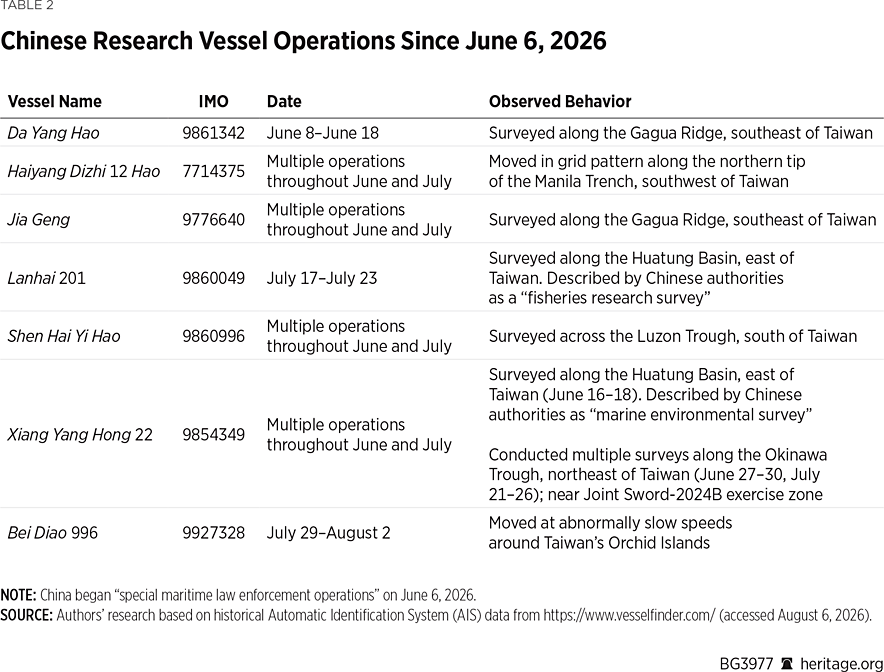
In the near term, Chinese research vessels are another means by which Beijing can exercise coercive power. From June 2025 through June 2026, for example, sightings of Chinese government vessels around Taiwan rose by 120 percent.[REF] Several factors appear to have driven this increase. The most obvious is the effort by the Philippines and Japan to negotiate new maritime boundaries, which Beijing has branded as “an internationally wrongful act.”[REF] Beijing claims jurisdiction over sections of the overlapping Japan–Philippines boundaries and argues that its exclusion from the discussions annuls the talks: The intensified patrols signal its dissatisfaction.
China may perceive that conditions are opportune and use the boundary discussions as a pretext to establish a regular presence in the waters east of Taiwan similar to the new baseline levels set after then-U.S. House Speaker Nancy Pelosi’s visit to the island in 2022, which the PLA used to justify incursions across the median line and large-scale military drills around the island.[REF] This time, however, the PLA may be attempting to normalize a permanent presence. Early in July 2026, for the first time, the CCG began to rotate law enforcement patrols and increased the number of research vessels operating in the area.[REF]
Another factor affecting Beijing’s calculus is the United States. Some analysts believe that the ongoing fighting in Iran is “distracting” Washington as American assets are pulled toward the Middle East.[REF] While this concern is not unreasonable, the U.S. military posture in the Indo-Pacific is largely unchanged: The alliance network remains strong, and the U.S. maintains access to critical forces and capabilities in theater. However, some U.S. military activities have slowed, including publicly announced naval transits in the Taiwan Strait, the frequency of which has declined by over 50 percent since the start of 2025.[REF]
Like other forms of “gray-zone” activities that fall below the threshold of lethal force but are provocative in nature, research vessels may be another coercive maneuver that Taipei may struggle to address proportionally. Research ships are not overtly military. If Taipei responds too forcefully, Beijing will seize on this as an excuse to escalate further. Responding weakly or not at all, however, could embolden Beijing to fix a “new normal.” Beijing is already pushing the limits of the status quo through new claims of maritime governance.[REF] In the coming months, the extent of Taiwan’s response and how it is perceived by Beijing will influence whether China’s maritime aggression is sustained.
In the long run, the uptick could portend planning for a blockade or an invasion. The Global Times, a CCP mouthpiece, proclaimed in June that China’s control of waters east of Taiwan had entered a “new phase.”[REF] Chinese maritime authorities confirmed completion of the first hydrographic survey operation east of Taiwan to “fill in previously incomplete seabed mapping data for the area.”[REF] According to the China Global Television Network, this will be “part of a regular survey program, indicating a move towards more systematic and long-term monitoring.”[REF] Separately, the CCG has begun to demand that commercial vessels in Taiwanese waters provide information on their points of origin and destination. Some analysts warn that this could be the pretext for an eventual quarantine: The regularity of these operations could enable China eventually to shorten the steps it takes to impose a quarantine.[REF] Taken together, these operations suggest that Beijing is exerting pressure on Taiwan and the entire first island chain.
Interestingly, analysts have long regarded Taiwan’s east coast, where most of China’s special maritime operations have taken place, as the “rear area” of the island’s defense and a relatively low-pressure zone.[REF] Taiwan’s east contains mountainous geography that would complicate an amphibious assault.[REF] Maritime operations east of the island may therefore represent an expansion of Beijing’s encirclement posture around the island.[REF]
U.S. intelligence assessments appear to support this possibility, concluding that an invasion is not likely to take place in 2027.[REF] The PLA, the assessments further note, will continue to “develop military plans and capabilities for attempting to achieve unification using military force.”[REF] Survey and enforcement operations may be the first operational steps toward realizing that objective, but much can change in the long run, depending on how forcefully Taiwan and other nations respond. If left unaddressed, this behavior is likely to continue with Beijing testing new boundaries and eventually ratcheting up the intensity of its operations.
Allen Zhang is Research Assistant in the Asian Studies Center at The Heritage Foundation.



