
Madison Marino Doan
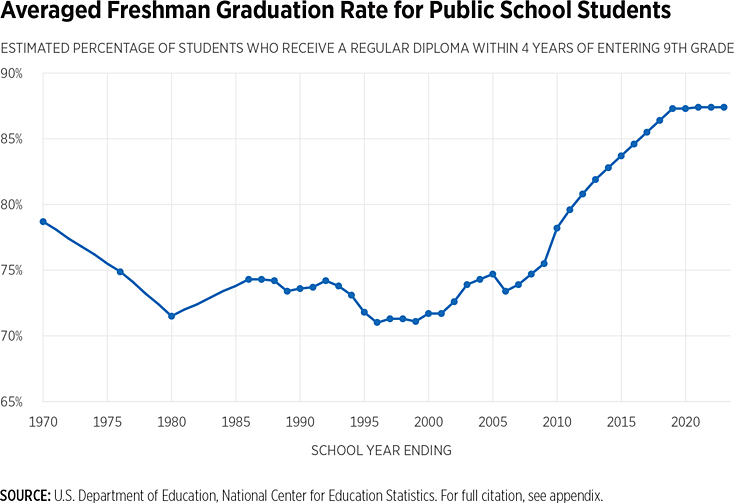
Public high school graduation rates have risen steadily for almost two decades, but this trend, while commendable, is not without its concerns. In the early 2000s, several states began to reduce their graduation requirements; New York, for example, took significant steps as early as 2003.
In November 2024, the New York State Education Department announced that, beginning in 2027, students will be required to take but no longer required to pass the Regents Examinations—a series of statewide standardized tests in core high school subjects—in order to earn a diploma.[REF] In 2015, California similarly eliminated its requirement that students must pass the high school exit exam, a test designed to ensure students’ proficiency in mathematics and English by assessing middle school–level math concepts and basic high school English skills, in order to graduate.[REF]
As of December 2024, only six states—Florida, Ohio, Louisiana, New Jersey, Texas, and Virginia—were enforcing compulsory exit exams for high school graduates.[REF] This represents a significant departure from the 24 states that administered an exit exam or graduation assessment during the 2013–2014 school year according to the National Center for Education Statistics.[REF]
The fact is that higher graduation rates do not always correlate with student success. “Graduation rates alone,” as a former Heritage Foundation analyst has noted, “are not a reliable indicator of a quality education and future success; it could be that while completion rates have increased slightly, the value of a high school degree has not.”[REF] This is reflected in the number of college students who are placed in remedial courses because of inadequate preparation in high school. According to The Hechinger Report, 96 percent of 911 two-year and four-year colleges analyzed in the 2014–2015 school year enrolled students who required remedial courses, and at least 209 of these institutions placed more than half of their incoming students in at least one remedial class.[REF]
State-level data further underscore the issue. In Nevada, 58 percent of the state’s recent high school graduates were placed in remedial courses in 2014, and in Delaware, more than half of public high school graduates required enrollment in remediation courses upon entering the state’s public colleges and universities in the same year.[REF] A report from Maryland that included data from Baltimore City Public Schools found that 96 percent of students who enrolled at Baltimore City Community College in 2011 needed remedial math courses, and 67 percent needed remedial writing courses.[REF] At the Community College of Baltimore County, 89 percent of 2011 graduates tested into remedial math classes, and 49 percent tested into remedial writing courses.[REF] These two institutions alone accounted for more than 60 percent of Baltimore’s graduates during this period.
Rising graduation rates may seem like a sign of progress, but they should be viewed with caution. Because many states have removed exit exam requirements over the past two decades, these higher graduation rates cannot necessarily be assumed to reflect student preparedness. A far more reliable indicator is the need for growing numbers of high school graduates to be placed in remedial courses upon entering two-year or four-year colleges and universities.
Endnotes
- Alex Zimmerman, “New York to Ditch Regents Exam Graduation Requirement by Fall 2027,” Chalkbeat New York, November 4, 2024, https://www.chalkbeat.org/newyork/2024/11/04/new-york-plans-to-end-regents-exam-requirement-by-2027-2028-school-year/#:~:text=New%20York%20students%20will%20no,timeline%20state%20officials%20unveiled%20Monday (accessed April 7, 2026). ↩
- Fermin Leal and Theresa Harrington, “Governor Signs Bill Allowing Diplomas for Students Who Failed Exit Exam,” EdSource, October 7, 2015, https://edsource.org/2015/governor-signs-bill-allowing-diplomas-for-students-who-failed-exit-exam/88698 (accessed April 7, 2026). ↩
- Briana Mendez-Padilla, “As States Show Graduation Exams to the Exit, What’s Next?” K–12 Dive Brief, December 11, 2024, https://www.k12dive.com/news/if-graduation-exams-are-out-whats-next/735182/ (accessed April 7, 2026). ↩
- Table 2.9, “Types of Promotion and Graduation Practices Based on Statewide Exit and End-of-Course Exams, by state: 2013,” U.S. Department of Education, Institute of Education Sciences, National Center for Education Statistics, State Education Practices (SEP), https://nces.ed.gov/programs/statereform/tab2_9.asp#f2 (accessed April 7, 2026). ↩
- Mary Clare Reim [Amselem], “Barriers to High School Completion Create Barriers to Economic Mobility,” Heritage Foundation Center for Policy Innovation Discussion Paper No. 17, May 15, 2014, p. 5, https://www.heritage.org/education/report/barriers-high-school-completion-create-barriers-economic-mobility#_ftn21. ↩
- Sarah Butrymowicz, “Most Colleges Enroll Many Students Who Aren’t Prepared for Higher Education,” The Hechinger Report, January 30, 2017, https://hechingerreport.org/colleges-enroll-students-arent-prepared-higher-education/ (accessed April 7, 2026). ↩
- Ibid. ↩
- Faith Connolly et al., “Indicators of College Readiness: A Comparison of High School and College Measures,” Baltimore Education Research Consortium, September 2014, https://baltimore-berc.org/wp-content/uploads/2014/09/IndicatorsReportSept2014.pdf (accessed April 7, 2026). ↩
- Ibid. ↩
Sources
- “Table 219.10. High School Graduates, by Sex and Control of School; Public High School Averaged Freshman Graduation Rate (AFGR); Public High School 4-Year Adjusted Cohort Graduation Rate (ACGR); and Total Graduates as a Ratio of 17-Year-Old Population: Selected School Years, 1869–70 through 2022–23,” in U.S. Department of Education, National Center for Education Statistics, Digest of Education Statistics, 2024, https://nces.ed.gov/programs/digest/d24/tables/dt24_219.10.asp (accessed May 10, 2026).