The U.S. Defense Industrial Base
Jim Fein
Introduction
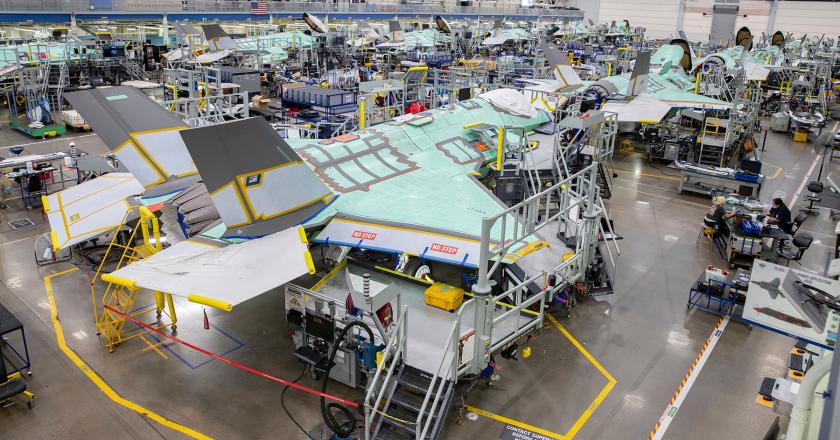
The U.S. defense industrial base (DIB) does not have the capacity to meet the worst threat environment since World War II. During the Second World War, the United States was the arsenal of democracy, supplying Allied forces with massive amounts of military equipment. From its entry into the war in 1941 until the war’s end in 1945, the United States produced 17 fleet carriers, 300,000 planes, and 50,000 Sherman tanks.[REF] The defense industrial base moved quickly, developing the first operational U.S. jet fighter in just 143 days.[REF]
Today, the DIB has the capacity to produce 156 F-35s and “1.2 to 1.3” Virginia-class submarines per year.[REF] In 2023, 125 Standard-6 missiles were produced per year, and production is projected to increase “to 200 per year by FY 2028.”[REF] Shipbuilding programs are behind schedule by as much as three years,[REF] and The Heritage Foundation reported in July 2024 that “[t]he Los Alamos National Lab [would] begin to produce plutonium pits at a small scale in late 2024—14 years after the modernization program began—and the Savannah River site’s ability to produce plutonium pits in any meaningful quantity is approximately a decade away.”[REF]
Decline of the Defense Industrial Base
No one factor explains the decline of the U.S. defense industrial base. During the Cold War, the DIB was healthy. While output was less than it was in World War II—which is to be expected because mass mobilization of commercial resources for defense production was an emergency measure—it was still a robust military resource capability. Despite huge leaps in technological complexity during the Cold War, production of aircraft, ships, and munitions during the Cold War continued at a higher rate than is the case today.
The United States produced over 1,000 nuclear weapons per year annually into the 1970s.[REF] The U.S. only recently certified production of the first nuclear pit, a crucial element in building new nuclear weapons, in October of 2024—14 years after the start of the nuclear modernization plan in 2010.[REF]
Between 1976 and 1996, American shipyards built an average of more than three Los Angeles-class attack submarines per year.[REF] Its replacement, the Virginia-class submarine, has a production rate of just 1.2–1.3 submarines per year.[REF]
It took an average of five years to build a Nimitz-class aircraft carrier during the Cold War.[REF] Construction on the second Gerald R. Ford–class aircraft carrier, the Nimitz-class’s successor, began in 2011.[REF] Scheduled for delivery in 2024, it has yet to be delivered.
When the end of the Cold War ushered in a so-called peace dividend, military resources were reduced and often repurposed to domestic spending. Output declined in parallel with reductions in defense spending, especially spending on procurement.[REF] Simultaneously, defense producers went through a series of mergers that the Department of Defense (DOD, now the Department of War) believed were necessary in light of decreased spending. At a 1993 dinner, now known as “The Last Supper,” Secretary of Defense Les Aspin and Deputy Secretary of Defense William J. Perry advised defense industry leaders, whose companies derived most of their revenue from the DOD rather than from a combination of government and private-sector spending, that defense spending was going to decline and that defense producers should merge and consolidate in order to survive in a market that was no longer large enough to sustain them all.[REF]
During the 1990s, defense contractors followed this advice. Through a series of mergers over the past three decades, 51 defense producers consolidated into five.[REF] The munitions market is now dominated by just three companies (Raytheon, Lockheed Martin, and Boeing) versus 13 in 1990.[REF] Currently, only two companies are building surface combatant ships versus eight in 1990, and the U.S. can call upon three companies that build fixed-wing aircraft rather than the eight that were available in 1990.[REF]
In 2025, the United States no longer faces the same threat environment that it faced in the immediate aftermath of the Cold War. Since the conclusion of the global war on terrorism, the primary challenge has been sustained great-power competition rather than counterinsurgency; the U.S. defense industrial base must evolve again to meet this new reality.
Revitalizing the Defense Industrial Base
In evaluating the challenges facing the U.S. defense industrial base, it is first necessary to define what constitutes a healthy DIB and how it can be measured. A strong defense industrial base is characterized by sufficient infrastructure and workforce capacity to generate the output necessary to equip our warfighters, an acquisitions and procurement process that aids in efficient production, and secure and resilient supply chains. By this standard, the current U.S. defense industrial base falls dramatically short. It lacks sufficient infrastructure and suffers from an inadequate workforce, a slow and cumbersome procurement process, and highly vulnerable supply chains. These shortcomings stem from several interrelated causes, including inconsistent demand signals, insufficient capital investment, adverse macroeconomic conditions and overregulation, cumbersome acquisition rules and practices, and a persistent failure to align resources with national strategy.
Inadequate Infrastructure. Infrastructure underpins the entirety of the defense industrial base. In order to make complex military equipment, production facilities need to be built and equipped with complex tooling. This requires high levels of upfront cost and capital expenditure, especially to build facilities with higher degrees of automation.
To justify that capital investment, defense producers and their suppliers need a sustained demand signal above their current capacity so that profits from production are greater than the cost of capital investment. Put simply, contracts and orders dictate capacity. As historian Arthur Herman has put it, “[a]ll you had to do was put in the orders, finance the plant expansion, then stand back and let things happen.”[REF]
The two categories of obstacles holding back higher order quantities are limited resources for procurement and high costs. Intuitively, the more money the U.S. Department of War has, the more ships, planes, munitions, and other defense equipment it can order. With topline defense spending relatively flat until the One Big Beautiful Bill Act (OBBBA),[REF] demand signals have been declining for more than a decade.
This is especially true of procurement spending. During the 1980s, procurement spending was roughly 2.5 times higher than funding for research, development, test, and evaluation (RDT&E).[REF] In 2025, RDT&E enacted funding was approximately $141.2 billion[REF] versus approximately $174.2 billion for procurement.[REF] This is a multiple of roughly 1.2 and a ratio less than half of the level at the height of the Cold War. Because procurement funding constitutes orders, its decline relative to funding for RDT&E has contributed to the lack of DIB infrastructure investment.
Foreign military sales (FMS), on the other hand, have grown in recent years. In 2021 and 2022, foreign procurement from U.S. industry averaged $45 billion. In fiscal year (FY) 2023, FMS jumped to almost $81 billion, and in FY 2024 leaped to almost $118 billion,[REF] increasing orders by more than 50 percent of the $204 billion that would be spent on U.S. procurement in 2025.[REF] These FMS sales resulted in a jump in new capacity, further illustrating the connection between capacity and orders. Lockheed Martin, for example, cited increased demand as an explanation for investment in new Patriot Advanced Capability-3 Missile Segment Enhancement (PAC-3 MSE) production.[REF] Similarly, roughly 40 percent of the $1.5 billion in funding for production lots 39 and 40 announced in April 2025 and dedicated to advanced medium-range air-to-air missile (AMRAAM) production is devoted to FMS.[REF] Considering that U.S. AMRAAM procurement is flat, the new capacity is directly attributable to FMS.
Examples also extend beyond munitions. Domestic capacity for F-35 production stands at 156 jets in large part because of FMS. U.S. military procurements stood at 86 and 74 jets, respectively, in 2024 and 2025,[REF] which is approximately half of capacity.
While FMS has been increasing, the process itself is cumbersome with a bureaucratic structure that goes beyond what is mandated by statute. The Arms Export Control Act (AECA)[REF] created the International Traffic in Arms Regulations (ITAR), which in turn created the bureaucratic structure that currently governs FMS. That structure includes input from the U.S. Department of State and multiple components of the U.S. Department of War (the Defense Security Cooperation Agency, Defense Technology Security Administration, and service branches, among others), all of which can either formally or de facto delay or block sales. Congress may also be involved, depending on the value of the sale.
The AECA does not specify that each Department of War component that currently takes part of the FMS process must do so; it mandates only that the State Department, Department of War, and (sometimes) Congress take part. Executive branch revisions can therefore help to speed up the process without legislative action—something that is in fact occurring. On April 9, 2025, the Trump Administration issued Executive Order 14268, which calls for reorganization of the FMS process to prioritize speed and efficiency.[REF] Increasing procurement spending by shifting money within the Department of War budget and increasing FMS are ways to increase resources and therefore procurement quantities.
A second approach to increasing order quantities is to cut unit costs so that procurement dollars buy more units. In addition to inflationary challenges brought about by the Biden Administration, there are several government policies that increase costs, including the permitting process and other regulatory mandates.
During the Biden Administration, inflation accelerated beyond ~2 percent per year, reaching more than 8 percent in 2022.[REF] The National Defense Industrial Association (NDIA) calculated the deadly impact: $42 billion in reduced buying power attributable to inflation from FY 2022 to FY 2023 as represented by a combination of the Gross Domestic Product: Chain-type Price Index (GDPCTPI) and Consumer Price Index for All Urban Consumers (CPI-U). From 2021 to 2023, the cumulative loss in buying power as a result of inflation stood at an even more staggering $110 billion.[REF]
Anecdotal reports from defense producers that link inflation to higher costs further support the assertion that inflation particularly impacts procurement. For example, Northrop Grumman reported $1.56 billion in losses, mostly attributable to inflation, in costs associated with the B-21 program.[REF] Likewise, the Navy requested $1.95 billion for two Virginia-class submarines in addition to its original request as an adjustment for inflation, primarily for labor costs; Huntington Ingalls, one of the most important naval shipbuilders in the U.S., deemed it to be not enough.[REF]
Beyond its direct impact on prices, inflation provided a reason for the Federal Reserve to raise interest rates. Starting at 0.08 percent in February 2022, the Federal Reserve increased the benchmark rate to 5.33 percent in September 2023. As of September 2025, the federal funds rate remained above 4 percent, a level last seen in 2008.[REF] Higher interest rates make it more expensive to borrow money—a necessity for high-dollar capital expenditure on new facilities. Higher interest rates therefore have an adverse impact on efforts to build additional DIB capacity, especially for smaller defense firms that lenders consider riskier.[REF] The end result of Biden-era inflation and Federal Reserve interest rate hikes was the same: degraded DOD buying power.
Another obstacle facing both the defense industrial base and the broader economy is the permitting process. Building nuclear-powered aircraft carriers is difficult, but it is made even more difficult by the regulatory barriers that accompany it, most notably the permitting process. Federal permitting can involve dealing with more than a dozen agencies before construction can begin, and the process can be confusing, expensive, and time-consuming.[REF] Compliance with the National Environmental Policy Act (NEPA) requirement for major projects to have approved Environmental Impact Statements (EIS) took an average of 2.2 years in 2024.[REF] It is often far worse for the most critical projects.
In 2021, environmental groups filed a lawsuit to hold up construction at the Savannah River nuclear site, arguing that the National Nuclear Security Administration was in violation of NEPA. A judge ruled in January 2025 that a newer and more comprehensive EIS was needed and should be completed within 2.5 years—more than six years after the lawsuit was filed. Further down in the supply chain, as of July 2025, the Resolution Copper Mine in Arizona had yet to be approved—almost 10 years after the permitting process began. This case has even attracted the attention of President Trump.[REF]
Recent legislative efforts, such as the 2025 budget reconciliation bill,[REF] are designed to reduce federal NEPA process timelines. However, companies are still vulnerable to lawsuits, and it is unclear how much of an impact such efforts will have in practice.[REF] They also do not address other permitting requirements such as the National Historic Preservation Act and state-level requirements such as the California Environmental Quality Act (CEQA). Other executive orders, such as Executive Order 14154, “Unleashing American Energy,” have similarly attempted to expedite the permitting process, but they are also vulnerable to litigation and changes in Administration unless codified in law.[REF]
Labor Shortages. The defense industrial base as a whole faces severe labor shortages in key categories of workers. An NDIA study reported shortages in skilled trade workers, STEM workers, and workers with clearances across small, medium, and large defense producers.[REF] Naval architects and welders have long been cited as categories with significant worker shortages.[REF] The shortage also extends beyond quantity and into quality. After the COVID-19 pandemic, many skilled tradesmen retired, leaving behind a less experienced labor force that is more prone to mistakes.[REF]
The most frequently cited reason for the labor shortages is uncompetitive wages. In March 2025, expert testimony before the House Armed Services Committee revealed that the wages of some welders working in shipyards were comparable to those of fast-food workers.[REF]
The impact of uncompetitive wage regulations is exacerbated by inconsistency. Because employment is linked with procurement, inconsistent procurement means that industry does not maintain a stable workforce, instead hiring and laying off workers based on the contracts companies receive.[REF] Working on programs with high degrees of employment uncertainty is less attractive than working in the commercial sector where one’s livelihood is less dependent on Congress’s year-to-year appropriations.
The defense industrial base is not alone in facing a workforce shortage. It also affects the broader industrial base. A cultural change that increased the cultural value of a four-year college degree at the expense of other education choices is partially to blame, but government policy is also responsible. For example, Tax-Preferred 529 College Savings Plans are limited to funding college degrees and may not be used for other post-secondary educational pathways. By making it relatively easier to afford a college degree in comparison to other in-demand educational options, bias introduced by the federal government has had a direct impact on America’s ability to arm itself.
Acquisition Rules and Practices. The congressional appropriations process and the Department of War’s antiquated requirements process also degrade the U.S. defense industrial base. Because Congress appropriates funds on a year-to-year basis, program funding is subject to continual uncertainty. Procurement funding for a given program can change significantly from one year to another, making it unclear whether new capacity—if it is ever built—will be utilized. This is most apparent in naval shipbuilding where, despite more available funding, calls for a larger Navy, and tens of billions of dollars in capital expenditures on shipyards and suppliers by the Navy, the service is requesting fewer warships in 2026 than in 2025.
In turn, the inconsistency (or lack) of orders makes it hard for businesses to justify investment in new capacity through private capital markets, especially for small and medium-size businesses in a prime contractor’s supply chain. As a result, Congress must often resort to direct investment by, for example, funding a contractor to build and equip a facility or providing a pool of funds to support suppliers, attempting to solve the capacity problem by paying for it directly—the approach taken in the OBBBA. For highly complicated end-items, direct investment also does not necessarily account for the corresponding supply chain, which requires an additional pool of funds for supply chain investment.[REF] This direct investment can solve capacity issues if done at a large enough scale, but it also puts the risk of low utilization onto taxpayers, avoiding the underlying issue of inadequate or inconsistent orders and the procurement and contracting process.
Fixing the underlying problem means lowering the cost of investment while putting in consistent orders—something Congress is doing increasingly through multi-year procurement (MYP).[REF] MYP authority allows the War Department to sign procurement contracts that last from two to five years rather than just one.[REF] By including a cancellation penalty that covers defense producer’s fixed-costs,[REF] the War Department reduces investment risks caused by demand uncertainty. It also has been shown to save as much as 15 percent relative to year-to-year appropriations,[REF] thereby providing additional benefits to taxpayers.
The Department of War’s requirements procedure worsens the impact of the congressional appropriations process on the defense industrial base. The requirements process has led to delays and cancellations in prominent and important major acquisition programs. For example:
- In the early 2000s, the U.S. Army’s Future Combat Systems program resulted in $20 billion wasted without any significant systems produced before it was cancelled in 2009.[REF]
- When first conceived, the M10 Booker was supposed to be an easily transportable, air-droppable infantry fighting vehicle. It ended up as a not-air-droppable light tank that weighed nearly as much as a Russian T-90 Main Battle Tank.[REF]
- The Constellation-class frigate was supposed to be 85 percent similar to the European multi-purpose frigate (FREMM), its parent design, but is now only 15 percent similar, the Navy having changed the frigate’s platform requirements after construction began.[REF] The problem is so severe that, according to Senator Roger Wicker (R–MS), Chairman of the Senate Armed Services Committee, “[a]lmost 70 percent of the requirements have changed since the Navy signed a contract.”[REF] Moreover, changes in functional and capabilities requirements involve more than second-order impacts beyond cost overruns and delays; adding capabilities can add weight to a ship, thereby impacting performance in other areas and requiring even more design changes.
Every program that has delays as a result of the requirements process reduces defense industrial base output. Inherently, when development is longer than it needs to be and changes need to be made after construction begins, output is lower than it otherwise would be. Cancelled programs that result in minimal or no output drain on time and funding that could be used to increase output for successful programs.
Problems with the requirements process have been broadly identified. The Constellation-class frigate program, which is among the most poorly managed major acquisitions programs, resulted in a widely read GAO report that excoriated the Navy for not using leading shipbuilding practices.[REF] The Air Force, on the other hand, has shown that changes can do more than make sense on paper; they can work in practice. The B-21 program is on schedule and on budget[REF] despite its immense complexity. Not coincidently, it is a stable design: The only person who can change program requirements is the Chief of Staff of the Air Force.[REF]
The Pentagon’s procurement problems are worsened by its contracting processes, which are far too slow and cumbersome. An NDIA survey of defense contractors found that 64 percent of respondents believe the procurement and contracting process is one of the biggest issues facing the defense industrial base.[REF] After “unclear or changing requirements” (58 percent), respondents cited “burden of acquisition process and paperwork” (57 percent) and “inflexible contract vehicles” (45 percent) as reasons why the procurement and contracting process is inefficient.[REF] It does not take long to find why this is so.
- According to the GAO, from FY 2019–FY 2022, the median time from contract solicitation to award for “definitive contracts and orders” valued at from $50 million to less than $250 million was 213 days, and the median time for contracts valued at $250 million or more was 322 days.[REF]
- For Major Defense Acquisition Systems, it takes an average of roughly 12 years to get initial capability.[REF] By the time a program is complete, parts may be obsolete.
- Defense producers often must set up a War Department–compliant accounting system that they would not otherwise use in order to contract with the department on cost-plus contracts.
- The labyrinth of documents governing acquisitions includes a 1,462-page Defense Federal Acquisitions Regulation that imposes significant costs on businesses seeking to navigate the contracting process.[REF]
Each time the contracting process is unnecessarily burdensome, it costs firms and taxpayers time and money, but it also reduces competition. Relatively small or new firms lack the resources of larger or more established companies and cannot afford to wait for hundreds of days (or longer) to find out whether they have won a contract while also expending resources on regulatory compliance in case they do win.
Supply Chains. The defense industrial base exists to supply American warfighters with the equipment they need to fight and win. The ability to produce that equipment rests on elaborate supply chains that are brittle, opaque, and vulnerable.
Many components are “sole source” with only a single manufacturer able to supply the part. For example, Virginia-class submarines have more than 16,000 suppliers, and the Congressional Research Service reports that “70% of the critical suppliers are sole-source suppliers.”[REF] Sole-source suppliers increase cost by eliminating competition and are a single point of failure in completion of the end-item.
The general trend remains negative with continued decline or at best stagnation in supplier count. A 2022 DOD report on the state of competition within the defense industrial base found that the number of small businesses in the DIB had “shrunk by over 40%” over the preceding decade.[REF] According to the U.S. Small Business Administration, the number of small businesses contracting directly with DOD between 2022 and 2024 continued to decline, but at a slower rate.[REF]
While single points of failure are bad, the defense industrial base’s reliance on China is even worse. Research from the commercial supply chain analytics firm Govini determined that roughly one of every 10 first-tier suppliers is Chinese,[REF] and Raytheon‘s CEO has stated that Raytheon has thousands of Chinese suppliers.[REF] Moreover, even though defense procurement rules are written to prevent the inclusion of some Chinese parts and ban procurement of some U.S. defense gear from some Chinese Communist Party sources,[REF] procurement of significant amounts of resources, especially for non-critical parts and raw materials, is still allowed.
There are a number of critical minerals for which China either is the sole source or has an overwhelming market share. For example, China controls just under 100 percent of global gallium production and possesses 90 percent of the world’s rare-earth mineral processing capacity,[REF] making it indispensable in the rare-earth supply chain, which is vital to the production of all major weapons systems and semiconductors. Until domestic sources are found and processing capacity is built, the U.S. faces a bad choice: Buy from China or don’t build.
Chinese control of key elements is to blame for some of the supply chain’s weakness, but so is opacity. Making final products often requires suppliers that are both broad and deep. An F-35 is constructed from multiple components, and those components are made of other components, and so on. Prime contractors do not have full visibility of their supply chains, which are often five suppliers deep or more.[REF] This presents a real danger: Lockheed Martin was unaware of Chinese-origin alloy used in magnets in its engines until Honeywell (which was also not aware) informed it, causing delays.[REF]
The executive branch and Congress have led several efforts to strengthen supply chains through increased domestic content[REF] requirements and direct funding to support suppliers.[REF] A rule enacted in 2022 raised the domestic content requirement from 60 percent at the time of passage to 65 percent in 2024 and 75 percent in 2029. Congress also has passed the OBBBA, which includes billions of dollars in funding to strengthen supply chains.[REF]
Policy Recommendations
- Increase the ratio of procurement spending to RDT&E in the budget. In 1983, procurement funding equaled more than 250 percent of RDT&E funding. Now procurement is barely more than RDT&E. This reflects an imbalance in priorities between the two that affects the amount of money available for the generation of defined, useful output from the industrial base: Fewer dollars for procurement means lower procurement quantities, which in turn disincentivizes investment in new production capacity. Moving money from RDT&E into procurement can help to give the DIB a larger demand signal to increase production capacity.
- Reform ITAR. The International Traffic in Arms Regulations (ITAR) process currently serves as a significant barrier to entry for companies trying to break into defense contracting for the first time. The process is both byzantine and expensive. In order to comply, DIB producers must hire expensive law firms and consultants and dedicate huge numbers of working hours to navigating the process, which must be done before contracting. The U.S. should streamline the bureaucracy involved in the ITAR process, especially at the Department of War, by reducing the number of parties involved in the approval process. In addition, Congress should amend the Arms Export Control Act to enable the executive branch to enter into conditioned mutual recognition agreements with allies: If allies adopt export and security protections equivalent to those in the U.S., the U.S. should treat trusted allied producers as having complied with U.S. regulations.
- Expand the use of block buys and multi-year procurement. Block buys and multi-year procurement increase certainty by creating a resourced demand signal. DIB producers see their production level uncertainty reduced, and this decreases the risk of investing in production capacity. Block buys and MYP can also lead to lower costs by creating economies of scale. According to the Congressional Research Service, programs proposed for MYP can reduce weapon procurement costs by as much as 15 percent. By enabling contractor optimization of workforce and production facilities and enabling economic order quantity (EOQ) purchases of long lead-time components, MYP allows manufacturers to take advantage of economies of scale.
- Implement permitting reforms. An enormous headwind facing manufacturers, especially defense-related manufacturers, is the federal permitting process. Prospective manufacturers must navigate the NEPA process through more than a dozen federal agencies and must navigate through the processes of state agencies as well, all of which imposes tremendous costs on producers. The U.S. could decrease costs and increase efficiency for defense manufacturers by creating a streamlined permitting process that provides a one-stop-shop process in which one agency would shepherd a permitting application through the system. By narrowly defining what constitutes adverse impact, the streamlined process would ensure that this process is expedited with a firm and short timeline and protection from frivolous lawsuits. In the event of government failure to meet the requirements of this expedited process, the default response to a permit application should be approval.
- Reduce the number of requirements and reform the contracting process. The Department of War requirements process is costly and cumbersome. Some of these requirements pertain not only to function, but also to micromanagement of that function’s construction. Other requirements are unnecessary, and limit production flexibility. The Department of War should limit requirements to functionality while increasing its use of Other Transactions Authority (OTA).
- Increase the utilization of dual-use technologies. One of the most impactful ways to leverage the commercial sector is to increase the use of dual-use technology in military procurement. When delivered defense articles use defense-specific components that are not used in commercial end products, the production of those parts depends solely on the War Department. This has several adverse impacts. Because production capacity is based solely on the department’s needs, companies have no ability to shift parts from commercial use to defense use, creating surge capacity.
- Second, increasing the utilization of dual-use technology reduces single points of failure. When a defense end product’s components utilize defense-specific components, there is often only one supplier; there is limited demand, so there is not much market desire to compete for that demand. When dual-use technology is incorporated into end products, there generally are multiple commercial off-the-shelf products that can fulfill component needs. Thus, if one company goes out of business, another exists that can supply the necessary component. This also implies competition, which limits the potential for cost inflation. Mil-spec components should be used where necessary, but the Department of War should look to maximize the inclusion of commercial off-the-shelf components and technology wherever it does not affect functionality.
Conclusion
The current U.S. defense industrial base lacks the capacity needed to meet the demands of 21st century great-power competition and possible war. Since the end of the Cold War, decreased procurement expenditures have led to industry consolidation, a reduction of competition, and a decrease in capacity. Broader economic trends, including a decrease in the number of workers in manufacturing, and a tax code that punishes manufacturers have exacerbated the issue. Failure to provide stable requirements to industry, in combination with the frequent use of cost-plus contracting, has resulted in cost overruns and frequent delays. Supply chains lack transparency and are brittle, and cooperation with allies is unnecessarily difficult.
These difficulties must be remedied if the U.S. wants to retain a dominant military force capable of securing its national interests. Structural reform of the acquisitions process, workforce development, and economic incentive structures will be required to maintain American security over peer and near-peer competitors. Most important, fixing these issues requires a commitment to the better alignment of budget with strategy. To increase capacity, industry must receive orders for more ships, planes, and munitions than are currently authorized by Congress and the Pentagon. Without large and consistent orders of the right military equipment, significant improvement of the defense industrial base is not possible, and the U.S. government will be unable to equip our troops with the platforms and munitions they need to win in the 21st century.
Endnotes
[1] “War Production,” The War, PBS, https://www.pbs.org/kenburns/the-war/war-production/ (accessed October 28, 2025); 247patrick, “The Most Mass-Produced Tanks in US History,” 24/7 Wall St. Special Report, July 19, 2023, https://247wallst.com/special-report/2023/07/19/the-most-produced-tanks-in-us-history/ (accessed October 28, 2025); Robert Greenway, Jim Fein, Richard Stern, Wilson Beaver, Madison Doan, Rachel Greszler, Jordan Embree, and Robert Peters, “A Strategy to Revitalize the Defense Industrial Base for the 21st Century,” Heritage Foundation Special Report No. 314, April 7, 2025, https://www.heritage.org/defense/report/strategy-revitalize-the-defense-industrial-base-the-21st-century.
[2] Lockheed Martin, “The P-80 Redefines Fast—In the Air and on the Assembly Line,” October 1, 2020, https://www.lockheedmartin.com/en-us/news/features/history/p80.html (accessed October 28, 2025).
[3] Stephen Losey, “Pentagon Clears F-35 for Full-Rate Production,” Defense News, March 13, 2024, https://www.defensenews.com/air/2024/03/13/pentagon-clears-f-35-for-full-rate-production/ (accessed October 28, 2025); Ronald O’Rourke, “Navy Virginia-Class Submarine Program and AUKUS Submarine (Pillar 1) Project: Background and Issues for Congress,” Congressional Research Service Report for Members and Committees of Congress No. RL32418, March 28, 2025, https://www.congress.gov/crs_external_products/RL/PDF/RL32418/RL32418.288.pdf (accessed October 28, 2025).
[4] Exhibit P-40, “Advance Procurement Budget Line Item Justification: PB-2024 Navy, Appropriation / Budget Activity / Budget Sub Activity: 1507N: Weapons Procurement, Navy / BA 02: Other Missiles / BSA 2: Tactical Missiles, P-1 Line Item Number / Title: 2234 / Standard Missile,” in U.S. Department of Defense, Department of Defense Fiscal Year (FY) 2024 Budget Estimates, Navy, Justification Book Volume 1 of 1, Weapons Procurement, Navy, March 2023, p. 138, https://www.secnav.navy.mil/fmc/fmb/Documents/24pres/WPN_Book.pdf (accessed October 29, 2025); Exhibit P-40, “Advance Procurement Budget Line Item Justification: PB 2024 Navy, Appropriation / Budget Activity / Budget Sub Activity: 1507N: Weapons Procurement, Navy / BA 02: Other Missiles / BSA 2: Tactical Missiles, P-1 Line Item Number / Title: 2234 / Standard Missile,” in U.S. Department of Defense, Department of Defense Fiscal Year (FY) 2026 Budget Estimates, Navy, Justification Book Volume 1 of 1, Weapons Procurement, Navy, June 2025, p. 138, https://www.secnav.navy.mil/fmc/fmb/Documents/26pres/WPN_Book.pdf (accessed October 29, 2025).
[5] Megan Eckstein, “US Navy Ship Programs Face Years-Long Delays amid Labor, Supply Woes,” Defense News, April 2, 2024, https://www.defensenews.com/naval/2024/04/02/us-navy-ship-programs-face-years-long-delays-amid-labor-supply-woes/ (accessed October 28, 2025); Shelby S. Oakley, Director, Contracting and National Security Acquisitions, U.S. Government Accountability Office, “U.S. Navy Shipbuilding Is Consistently Over Budget and Delayed Despite Billions Invested in Industry,” Government Accountability Office WatchBlog: Following the Federal Dollar, posted April 8, 2025, https://www.gao.gov/blog/u.s.-navy-shipbuilding-consistently-over-budget-and-delayed-despite-billions-invested-industry (accessed October 28, 2025).
[6] Robert Peters, “A Nuclear Posture Review for the Next Administration: Building the Nuclear Arsenal of the 21st Century,” Heritage Foundation Special Report No. 287, July 30, 2024, https://www.heritage.org/defense/report/nuclear-posture-review-the-next-administration-building-the-nuclear-arsenal-the-21st.
[7] U.S. Department of Energy, Office of Environment, Health, Safety and Security, Office of History and Heritage Resources, “Summary of Declassified Nuclear Stockpile Information, United States Department of Defense and Department of Energy, Declassified Stockpile Data 1945 to 1994,” https://www.osti.gov/opennet/forms?formurl=document/press/pc26tab1.html (accessed October 29, 2025).
[8] U.S. Department of Energy, National Nuclear Security Administration, “2024 Year in Review: Making Our Vision a Reality,” https://www.energy.gov/sites/default/files/2024-12/2024%20NNSA%20Year%20in%20Review_508.pdf (accessed October 28, 2025).
[9] Kyle Mizokami, “Los Angeles-Class Submarines May Be Aging but They’re Not Getting Any Less Dangerous,” The National Interest, The Reboot Blog, August 30, 2021, https://nationalinterest.org/blog/reboot/los-angeles-class-submarines-may-be-aging-theyre-not-getting-any-less-dangerous-192625 (accessed October 28, 2025).
[10] Ronald O’Rourke, “Navy Virginia-Class Submarine Program and AUKUS Submarine (Pillar 1) Project: Background and Issues for Congress,” Congressional Research Service Report for Members and Committees of Congress No. RL32418, March 28, 2025, https://www.congress.gov/crs_external_products/RL/PDF/RL32418/RL32418.288.pdf (accessed October 28, 2025).
[11] GlobalSecurity.org, “CVN-68 Nimitz-Class—Design,” https://www.globalsecurity.org/military/systems/ship/cvn-68-design.htm (accessed December 10, 2025).
[12] Fact Sheet, “Aircraft Carriers,” Newport News Shipbuilding, February 2023, https://hii.com/wp-content/uploads/2023/03/Fact-File-NNS-February-2023.pdf (accessed October 29, 2025).
[13] World Bank Group, “Military Expenditure (% of GDP)—United States,” World Bank Development Indicators, https://data.worldbank.org/indicator/ms.mil.xpnd.gd.zs?locations=us (accessed October 29, 2025); Wilson Beaver, Robert Peters, John Venable, and James Di Pane, “Prioritizing Procurement over Research and Development,” Heritage Foundation Backgrounder No. 3804, January 10, 2024, https://www.heritage.org/defense/report/prioritizing-procurement-over-research-and-development.
[14] John A. Tirpak, “The Distillation of the Defense Industry,” Air & Space Forces Magazine, July 1, 1998, https://www.airandspaceforces.com/article/0798industry/ (accessed October 29, 2025).
[15] U.S. Department of Defense, Office of the Under Secretary of Defense for Acquisition and Sustainment, Department of Defense Report: State of Competition Within the Defense Industrial Base, February 2022, pp. 1 and 4, https://media.defense.gov/2022/Feb/15/2002939087/-1/-1/1/STATE-OF-COMPETITION-WITHIN-THE-DEFENSE-INDUSTRIAL-BASE.PDF (accessed October 29, 2025).
[16] Table 1, “Fewer Contractors Exist for Major Weapons Categories,” in ibid., p. 5.
[17] Ibid.
[18] Arthur Herman, Freedom’s Forge: How American Business Produced Victory in World War II (New York: Random House, 2013), p. 337.
[19] H.R. 1, One Big Beautiful Bill Act, Public Law 119-21, 119th Congress, July 4, 2025, https://www.congress.gov/119/plaws/publ21/PLAW-119publ21.pdf (accessed October 29, 2025). Cited hereinafter as Public Law 119-21.
[20] Chart 1, “Department of Defense Outlays,” in Beaver et al., “Prioritizing Procurement over Research and Development,” p. 2.
[21] Exhibit R-1, “Exhibit R-1, FY 2026 President’s Budget, Total Obligational Authority (Dollars in Thousands),” in U.S. Department of Defense, Office of the Under Secretary of Defense (Comptroller), Department of Defense Budget Fiscal Year 2026, RDT&E Programs (R-1), June 2025, pp. 6, 7, and 8, https://comptroller.defense.gov/Portals/45/Documents/defbudget/FY2026/FY2026_r1.pdf (accessed October 29, 2025).
[22] Exhibit P-1, “Total Obligational Authority, DoD Component Summary (Dollars in Thousands),” in U.S. Department of Defense, Office of the Under Secretary of Defense (Comptroller), Department of Defense Budget Fiscal Year 2026, Procurement Programs (P-1), June 2025, p. 2, https://comptroller.defense.gov/Portals/45/Documents/defbudget/FY2026/FY2026_p1.pdf (accessed October 29, 2025).
[23] Fact Sheet, “Fiscal Year 2024 U.S. Arms Transfers and Defense Trade,” U.S. Department of State, Bureau of Political-Military Affairs, January 24, 2025, https://www.state.gov/fiscal-year-2024-u-s-arms-transfers-and-defense-trade (accessed October 29, 2025).
[24] Exhibit P-1, “Total Obligational Authority, DoD Component Summary (Dollars in Thousands),” in U.S. Department of Defense, Office of the Under Secretary of Defense (Comptroller), Department of Defense Budget Fiscal Year 2026, Procurement Programs (P-1), p. 2
[25] Lockheed Martin, “Enhancing Naval Missile Defense Capability, PAC-3 MSE and Aegis,” April 7, 2025, https://www.lockheedmartin.com/en-us/news/features/2025/enhancing-naval-missile-defense-capability-pac-3-mse-and-aegis.html (accessed October 29, 2025).
[26] U.S. Department of War, “Contracts for July 31, 2025,” https://www.war.gov/News/Contracts/Contract/Article/4261297/ (accessed October 29, 2025).
[27] Table, “F-35 Joint Strike Fighter,” in U.S. Department of Defense, Office of the Under Secretary of Defense (Comptroller/Chief Financial Officer), United States Department of Defense Fiscal Year 2026 Budget Request, Program Acquisition Cost by Weapon System, July 2025, p. 1-2, https://comptroller.war.gov/Portals/45/Documents/defbudget/FY2026/FY2026_Weapons.pdf (accessed October 29, 2025).
[28] 22 U.S.C. § 2778, https://www.law.cornell.edu/uscode/text/22/2778 (accessed October 29, 2025).
[29] President Donald J. Trump, Executive Order 14268, “Reforming Foreign Defense Sales to Improve Speed and Accountability,” April 9, 2025, Federal Register, Vol. 90, No. 71 (April 15, 2025), pp. 15631–15633, https://www.govinfo.gov/content/pkg/FR-2025-04-15/pdf/2025-06464.pdf (accessed October 29, 2025).
[30] Graph, “Inflation, Consumer Prices for the United States,” Federal Reserve Bank of St. Louis, https://fred.stlouisfed.org/series/FPCPITOTLZGUSA (accessed October 29, 2025).
[31] The Hon. Dr. John E. Whitley, The Hon. David L. Norquist, and The Hon. Lisa S. Disbrow, “How Inflation Hurts America’s National Defense and What We Can Do About It,” National Defense Industrial Association White Paper, September 2022, pp. 4 and 5, https://www.ndia.org/-/media/sites/ndia/policy/documents/unfunded-inflation/how-inflation-hurts-americas-national-defensev13.pdf?download=1?download=1 (accessed December 10, 2025).
[32] John A. Tirpak, “Northrop Grumman Eats $1.56 Billion Loss on First B-21 Bomber Lots,” Air & Space Forces Magazine, January 25, 2024, https://www.airandspaceforces.com/northrop-grumman-1-56-billion-loss-b-21/ (accessed October 29, 2025).
[33] Mallory Shelbourne, “Submarine Funding Anomaly Insufficient to Get Boats the Navy Wants, Says HII CEO,” U.S. Naval Institute News, January 9, 2025, https://news.usni.org/2025/01/09/submarine-funding-anomaly-insufficient-to-get-boats-the-navy-wants-says-hii-ceo (accessed October 29, 2025).
[34] Graph, “Federal Funds Effective Rate,” Federal Reserve Bank of St. Louis, https://fred.stlouisfed.org/series/fedfunds (accessed October 29, 2025).
[35] See, for example, U.S. Department of Defense, Office of the Under Secretary of Defense for Acquisition and Sustainment, Defense Pricing and Contracting, Contract Finance Study Report, April 2023, p. 128, https://www.acq.osd.mil/asda/dpc/pcf/docs/finance-study/FINAL%20-%20Defense%20Contract%20Finance%20Study%20Report%204.6.23.pdf (accessed October 29, 2025).
[36] David R. Burton, “End the War on Manufacturing: An Agenda to Restore Industrial Production in the United States,” Heritage Foundation Special Report No. 318, May 9, 2025, pp. 18 and 28, https://www.heritage.org/government-regulation/report/end-the-war-manufacturing-agenda-restore-industrial-production-the.
[37] Table 1, “Median Completion Time and Percent of EISs Completed in Two Years or Less by Year from 2019 to 2024,” in Executive Office of the President, Council on Environmental Quality, “Environmental Impact Statement Timelines (2010–2024),” January 13, 2025, p. 3, https://ceq.doe.gov/docs/nepa-practice/CEQ_EIS_Timeline_Report_2025-1-13.pdf#:~:text=Looking%20at%20the%20most%20recent%20data%2C%20for%20final,the%20median%20time%20was%203.6%20years%20%2843%20months%29 (accessed October 29, 2025).
[38] United States Department of Agriculture, Tonto National Forest, “Resolution Copper Project and Land Exchange Environmental Impact Statement,” https://www.resolutionmineeis.us/project-overview# (accessed October 29, 2025); Jay Caruso, “Trump Blasts Appeals Court for Halting Resolution Copper Land Transfer,” Fox Business, August 19, 2025, https://www.foxbusiness.com/politics/trump-blasts-appeals-court-halting-resolution-copper-land-transfer (accessed October 29, 2025).
[39] Public Law 119-21.
[40] Ian M. Stevenson, “Interior Wants to Do NEPA Reviews in 28 Days. Is That Even Possible?” E&E News by Politico, May 15, 2025, https://www.eenews.net/articles/interior-wants-to-do-nepa-reviews-in-28-days-is-that-even-possible/ (accessed October 29, 2025).
[41] “Fact Sheet: President Trump Is Delivering Historic Permitting Wins Across the Federal Government,” June 30, 2025, https://www.whitehouse.gov/fact-sheets/2025/06/fact-sheet-president-trump-is-delivering-historic-permitting-wins-across-the-federal-government/ (accessed October 29, 2025); President Donald J. Trump, Executive Order 14154, “Unleashing American Energy,” January 20, 2025, Federal Register, Vol. 90, No. 18 (January 29, 2025), pp. 8353–8359, https://www.govinfo.gov/content/pkg/FR-2025-01-29/pdf/2025-01956.pdf (accessed October 29, 2025).
[42] National Defense Industrial Association, NDIA Vital Signs 2025: The Health and Readiness of the Defense Industrial Base, February 2025, https://www.ndia.org/-/media/sites/ndia/policy/vital-signs/2025/vitalsign_2025_final.pdf?download=1?download=1 (accessed October 29, 2025).
[43] John Grady, “Pay ‘Number One Issue’ in Growing U.S. Shipbuilding Workforce, Panel Tells HASC,” U.S. Naval Institute News, March 11, 2025, https://news.usni.org/2025/03/11/pay-number-one-issue-in-growing-u-s-shipbuilding-workforce-panel-tells-hasc#:~:text=“The%20remaining%20prime%20shipbuilders%20and%20subcontractors%20face%20shortages,critical%20components%2C%20and%20associated%20cost%20and%20schedule%20challenges (accessed October 29, 2025).
[44] Steve Walsh, “HII CEO Says Wage Increases Are Beginning to Ease the Labor Shortage at Newport News,” WHRO [Norfolk, Virginia] Public Media, July 31, 2025, https://www.whro.org/military-veterans/2025-07-31/hii-ceo-says-wage-increases-are-beginning-to-ease-the-labor-shortage-at-newport-news (accessed October 29, 2025).
[45] Grady, “Pay ‘Number One Issue’ in Growing U.S. Shipbuilding Workforce, Panel Tells HASC.”
[46] John A. Tirpak, “Lockheed Anticipates Stable F-35 Production for Next Five Years,” Air & Space Forces Magazine, February 15, 2024, https://www.airandspaceforces.com/lockheed-stable-f-35-production-next-five-years/ (accessed October 29, 2025).
[47] Megan Eckstein, “The US Navy Is Spending Billions to Stabilize Vendors. Will It Work?” Defense News, September 8, 2023, https://www.defensenews.com/naval/2023/09/08/the-us-navy-is-spending-billions-to-stabilize-vendors-will-it-work/ (accessed October 29, 2025).
[48] Other approaches such as Advance Procurement and Advance Appropriations are also utilized.
[49] 10 U.S.C. § 3501(k), https://www.law.cornell.edu/uscode/text/10/3501 (accessed October 29, 2025).
[50] 48 C.F.R. 52-217-2, https://www.law.cornell.edu/cfr/text/48/part-52/subpart-52.2 (accessed October 29, 2025).
[51] Ronald O’Rourke, “Multiyear Procurement (MYP) and Block Buy Contracting in Defense Acquisition: Background and Issues for Congress,” Congressional Research Service Report for Members and Committees of Congress No. R41909, updated December 19, 2024, p. 2, https://sgp.fas.org/crs/natsec/R41909.pdf (accessed October 29, 2025).
[52] Sydney J. Freedberg Jr., “Total Cost to Close Out Cancelled Army FCS Could Top $1 Billion,” Breaking Defense, June 19, 2012, https://breakingdefense.com/2012/06/total-cost-to-close-out-cancelled-army-fcs-could-top-1-billion/ (accessed October 29, 2025).
[53] Maya Carlin, “M10 Booker: Get Ready for the U.S. Army’s New ‘Light Tank,’” The National Interest, The Buzz Blog, September 23, 2024, https://nationalinterest.org/blog/buzz/m10-booker-get-ready-us-armys-new-light-tank-211147 (accessed October 29, 2025); Federico Velardo, “T-90 obr.1992 (Object 188),” The Online Tank Museum, 2025 Tank Encyclopedia, October 9, 2024, https://tanks-encyclopedia.com/modern/russia/t-90-obr-1992-object-188/ (accessed October 29, 2025).
[54] Mallory Shelbourne and Sam Lagrone, “Constellation Frigate ‘Unplanned Weight Growth’ Could Limit Service Life, Says GAO,” U.S. Naval Institute News, May 29, 2024, https://news.usni.org/2024/05/29/constellation-frigate-unplanned-weight-growth-could-limit-service-life-says-gao (accessed October 29, 2025); Joseph Trevithick, “First Constellation Frigate Only 10% Complete, Design Still Being Finalized,” The War Zone, April 10, 2025, https://www.twz.com/sea/first-constellation-frigate-only-10-complete-design-still-being-finalized (accessed October 29, 2025).
[55] Joseph Trevithick, “Navy’s New Constellation Class Frigate Is a Mess,” The War Zone, May 30, 2024, https://www.twz.com/sea/navys-new-constellation-class-frigate-is-a-mess (accessed October 29, 2025).
[56] U.S. Government Accountability Office, Navy Shipbuilding: Increased Use of Leading Design Practices Could Improve Timeliness of Deliveries, GAO-24-105503, May 2024, https://www.gao.gov/assets/d24105503.pdf (accessed October 29, 2025).
[57] Maya Carlin, “The Air Force’s B-21 Raider Stealth Bomber Is Ahead of Schedule,” The National Interest, The Buzz Blog, March 25, 2025, https://nationalinterest.org/blog/buzz/the-air-forces-b-21-raider-stealth-bomber-is-ahead-of-schedule (accessed October 30, 2025).
[58] John A. Tirpak, “Much About the Air Force’s New B-21 Bomber Remains Unanswered Following Reveal,” Air & Space Forces Magazine, December 2, 2022, https://www.airandspaceforces.com/much-about-the-air-forces-new-b-21-bomber-remains-a-secret-following-reveal/?utm_source=chatgpt.com (accessed October 30, 2025).
[59] National Defense Industrial Association, NDIA Vital Signs 2025: The Health and Readiness of the Defense Industrial Base, p. 11.
[60] Ibid., p. 12.
[61] Figure 6, “Median Procurement Administrative Lead Times and Number of Definitive Contracts and Orders by Total Contract Value Ranges, Fiscal Years 2019–2022,” in U.S. Government Accountability Office, Defense Contracts: Better Monitoring Could Improve DOD’s Management of Award Lead Times, GAO-24-106528, March 2024, https://www.gao.gov/assets/gao-24-106528.pdf (accessed December 10, 2025).
[62] Shelby S. Oakley, Director, Contracting and National Security Acquisitions, U.S. Government Accountability Office, “Defense Acquisition Reform: Persistent Challenges Require New Iterative Approaches to Delivering Capability with Speed,” testimony before the Subcommittee on Military and Foreign Affairs, Committee on Oversight and Government Reform, U.S. House of Representatives, GAO-25-108528, June 11, 2025, pp. 2 and 4, https://www.gao.gov/assets/gao-25-108528.pdf (accessed October 30, 2025).
[63] Defense Federal Acquisition Regulation, issued fiscal year 2020, Vol. III, Parts 201 to 253, https://www.acquisition.gov/sites/default/files/current/dfars/pdf/DFARS.pdf (accessed October 30, 2025). “The Federal Acquisition Regulation (FAR) was established to codify uniform policies for acquisition of supplies and services by executive agencies. It is issued and maintained jointly, pursuant to the Office of Federal Procurement Policy (OFPP) Reauthorization Act, under the statutory authorities granted to the Secretary of Defense, Administrator of General Services and the Administrator, National Aeronautics and Space Administration. Statutory authorities to issue and revise the FAR have been delegated to the Procurement Executives in Department of Defense (DoD), GSA and National Aeronautics and Space Administration (NASA).” U.S. General Services Administration, “Acquisition Regulations: Federal Acquisition Regulation,” last updated October 21, 2025, https://www.gsa.gov/policy-regulations/policy/acquisition-policy/acquisition-regulations (accessed October 30, 2025).
[64] O’Rourke, “Navy Virginia-Class Submarine Program and AUKUS Submarine (Pillar 1) Project: Background and Issues for Congress,” p. 5.
[65] U.S. Department of Defense, Office of the Under Secretary of Defense for Acquisition and Sustainment, State of Competition Within the Defense Industrial Base, p. 14.
[66] U.S. Small Business Administration, “SBA Vendor Counts,” https://oppl.certify.sba.gov/Vendor_Counts#sba-vendor-counts (accessed October 30, 2025).
[67] Sydney J. Freedberg Jr, “Nearly One in 10 ‘Tier 1’ Subcontractors to Defense Primes Are Chinese Firms: Report,” Breaking Defense, June 27, 2025, https://breakingdefense.com/2025/06/nearly-one-in-10-tier-1-subcontractors-to-defense-primes-are-chinese-firms-report/ (accessed October 29, 2025).
[68] Russell Flannery, “Pentagon Faces Questions From Left, Right On U.S. Defense Imports,” Forbes, updated July 22, 2025, https://www.forbes.com/sites/russellflannery/2023/07/21/pentagon-faces-questions-from-left-right-on-us-weapon-imports/ (accessed October 29, 2025).
[69] Covington & Burling, “New Law Appears to Restrict Defense Contractors from Retaining Consultants Who Lobby for Chinese Military Companies,” Alert, January 6, 2025, https://www.cov.com/en/news-and-insights/insights/2025/01/new-law-appears-to-restrict-defense-contractors-from-retaining-consultants-who-lobby-for-chinese-military-companies (accessed October 29, 2025).
[70] U.S. Department of the Interior, U.S. Geological Survey, Mineral Commodity Summaries 2024, p. 75, https://pubs.usgs.gov/periodicals/mcs2024/mcs2024.pdf (accessed October 30, 2025); Pascale Massot, “The China Challenge in Critical Minerals: The Case for Asymmetric Resilience,” The Diplomat, June 6, 2025, https://thediplomat.com/2025/06/the-china-challenge-in-critical-minerals-the-case-for-asymmetric-resilience/ (accessed October 29, 2025).
[71] Howard Altman, “F-35 Deliveries Halted After Chinese Alloy Discovered in Key Component (Updated),” The War Zone, September 7, 2022, https://www.twz.com/f-35-deliveries-halted-after-chinese-alloy-discovered-in-key-component?utm_source=chatgpt.com (accessed October 29, 2025).
[72] Maiya Clark, “Chinese F-35 Part Shows the Pentagon Needs to Fix Its Supply Chain Visibility Problem,” RealClearDefense, September 17, 2022, https://www.realcleardefense.com/articles/2022/09/17/chinese_f-35_part_shows_the_pentagon_needs_to_fix_its_supply_chain_visibility_problem_854118.html (accessed October 29, 2025).
[73] Within the statutory definition, domestic sources include select allies in addition to the United States.
[74] Matthew McMullan, “Biden Announces a Tougher New Rule for Federal Buy America Procurement,” Alliance for American Manufacturing, March 4, 2022, https:// www.americanmanufacturing.org/blog/biden-announces-a-tougher-new-rule-for-federal-buy-america-procurement/ (accessed October 29, 2025).
[75] Public Law 119-21, Section 20004.
