Introduction
As currently postured, the United States military is at significant risk of being unable to defend America’s vital national interests. Decades of underfunding, prolonged deployments, inconsistent appropriations, poor discipline in program execution, and a lack of urgency across the national security establishment have made the U.S. military unable to respond effectively to the range of growing threats.
The theme of the 2026 Index—“Restoring Peace Through Strength”—supports a renewed focus on warfighting and lethality and the prioritization of those programs essential to establishing deterrence and, if required, defeating all threats to our nation. The 2026 Index assessment determined that substantial increases in major warfighting platforms, a revitalized defense industrial base, expanded munitions production, increased logistical and fuel support, and the prioritization of essential programs to build long-term resilience for a prolonged conflict were critically needed. The Trump Administration is arresting the decline of successive Administrations and building on the progress made in its first term. The passage of the One Big Beautiful Bill Act (OBBBA) and the President’s call for a $1.5 trillion defense budget have arrested a decade of decline and provide a path forward toward restoration of the world’s greatest military, but significantly more must be done.
Restoring Peace Through Strength
The Heritage Foundation’s 2026 Index of U.S. Military Strength is the only independent, comprehensive diagnostic analysis of the United States military that assesses the state of the armed forces of the United States in the context of the global operating and threat environment. Its analysis looks at the capacity, capability, and readiness of the U.S. military and determines their overall ability to operate simultaneously in two MRCs set against the conditions of a protracted conflict. It also considers logistical, fuel, and industrial capacity as well as budgetary, programmatic, and leadership factors.
The theme of this year’s Index is “Restoring Peace Through Strength,” which is a strategic doctrine that is concerned with how and when to use military force abroad as much as it is with the U.S. military’s ability to deter opponents and, if required, defeat them in armed conflict. It also reflects a recognition that, as the 2024 Index made clear, after a “decade of decline” and although much more still needs to be done, the U.S. military is starting to rebuild its strategic strength. As noted, passage of the OBBBA and the President’s advocacy of a $1.5 trillion defense budget—an increase of approximately $500 billion over current figures—demonstrate this greater focus on resourcing military strength. This approach also emphasizes the core security interests of the United States instead of foreign policy distractions of the sort that drained U.S. resources as strategic opponents built their arsenals.
The 2026 Index builds on the analytical work of the previous 10 volumes and expands its scope in service analysis, regional focus, and assessments. In part as a recognition of the Trump Administration’s 2025 National Security Strategy and the 2026 National Defense Strategy, the Index has expanded its regional focus to include Latin America and Africa. These regions, in addition to Asia, Europe, and the Middle East, form the core of the Global Operating Environment section of the 2026 Index. These expanded areas recognize that great-power competition is occurring globally and that the malign influence of adversaries needs to be assessed as much as the need to bolster the abilities of friends and allies.
The Threats to Vital U.S. Interests section continues its focus on the PRC, Russia, Iran, and North Korea by assessing the behavior and capabilities of these adversaries. Analysis has been updated to reflect the two years since the 2024 Index was published as well as the foreign and defense policy decisions of the first year of the Trump Administration. The analysis of the PRC’s capabilities, military operations, and strategic posture significantly informs the overall analysis of the 2026 Index and influences Heritage’s assessments of the U.S. military. This focus buttresses the key insights of Heritage’s TIDALWAVE initiative, an artificial intelligence–enabled model and computer simulation to replicate an extended escalation scenario between the United States and China in the Indo-Pacific. This effort identified gaps and deficiencies and corresponding solutions to resolve anticipated shortfalls in the ability of the United States to project and sustain forces and to exploit adversary vulnerabilities in order to degrade their ability to conduct military operations. Its key findings are as follows:
- In a conflict with China, the United States culminates (becomes incapable of continuing operations because of a lack of platforms, ammunition, and/or fuel) in less than half the time it takes China to reach the same state. The result: catastrophic defeat.
- The United States is neither equipped nor arrayed to protect and sustain the Joint Force in a conflict with China in the Indo-Pacific.
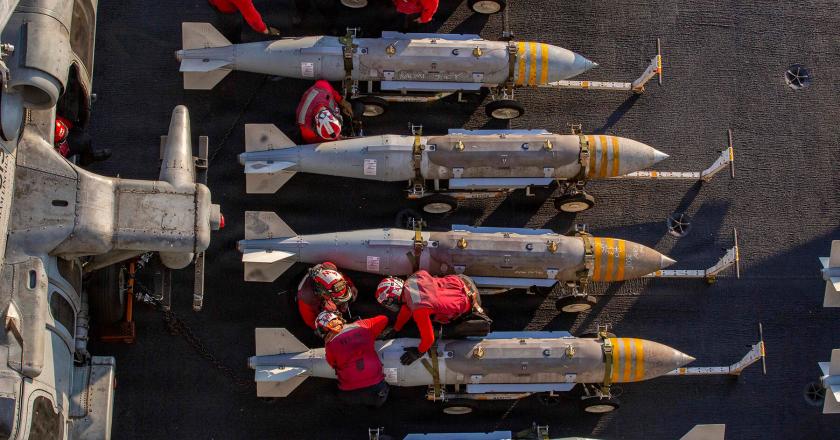
- Critical U.S. munitions begin to be unavailable within five–seven days and are completely exhausted within 35–40 days across most scenarios.
- People’s Liberation Army (PLA) ammunition stockpiles of critical munitions begin to be depleted after 20–30 days of major combat operations, but substitutes extend munitions sustainment by months.
However much additional budgetary resources are necessary to restore credible deterrence, an expedited sense of urgency must also be pursued to expand munition production, logistical and fuel support, and overall resiliency in the defense industrial base.
The U.S. Military Power section, which forms the core of the Index, has also expanded its focus to include the U.S. Coast Guard and U.S. Merchant Marine. These two services were included partly to reflect the need to understand all available sea assets that may need to be called upon in a protracted conflict, especially one in the Indo-Pacific, and partly because of their value as part of a comprehensive strategy of great-power competition and, quite possibly, great-power confrontation. Their respective capabilities require significant increases in resources, capabilities, and—frankly—attention. Consistent with past Indices, this section also assesses the U.S. Army, Navy, Air Force, Marine Corps, Space Force, and nuclear arsenal and missile defense capabilities. These assessments evaluate the capacity, capabilities, and readiness of the services and are conducted against the requirements of each service’s role in addressing two major regional contingencies (MRCs) simultaneously (the Marine Corps is assessed against a one-MRC standard).
The 2026 Index of U.S. Military Strength’s theme of “Restoring Peace Through Strength” reflects the growing need for strategic prioritization of those capabilities within the U.S. military arsenal that are essential to credible deterrence and available for conflict if deterrence fails. It also reflects the recognition that after years of underinvestment, a moribund defense industrial base, and strategic confusion, the U.S. military is not postured for victory in one major regional contingency—let alone two MRCs.
