Latin America and the Caribbean
Andrés Martínez-Fernández
Regional Overview
With President Donald Trump’s return to the White House in 2025, few issues have risen to prominence on Washington’s agenda as rapidly and dramatically as U.S. policy toward Latin America and the Caribbean. This shift marks a major break with Washington’s long-standing lack of attention to the nations with the most geographic proximity to the United States. President Trump has laid out and pursued a vision of U.S. national security that appropriately raises the prominence of the Western Hemisphere’s stability. Decades of disengagement have had dramatic consequences for both the U.S. and the hemisphere, facilitating the proliferation of narco-terrorism and narco-dictatorships, the uncontested surging presence of actors like China and Russia, and destabilizing waves of mass migration, but during 2025 and early 2026, the Trump Administration has demonstrated the game-changing effects of concerted U.S. effort andd attention to these challenges.
Latin America and the Caribbean have a contradictory identity: They are a region of long-standing peace and at the same time of deep and entrenched violence. For more than 30 years, Latin America has been free of the outbreak of interstate war, but its homicide rate eclipses those of other regions of the world with some countries seeing more violence than nations at war see.
The driving factor behind this regional reality is the prevalence of armed non-state actors, including transnational criminal organizations and foreign terrorist organizations. Countries across Latin America are plagued by many of the world’s deadliest and most powerful transnational criminal organizations. Fueled by revenue from drug trafficking, human trafficking, and nearly every other imaginable illicit activity, these armed criminal organizations are equipped with military-grade equipment and resources that surpass those of many of the world’s armed forces. Just one of Brazil’s multiple drug trafficking gangs, for example, is reported to have more members than Portugal has active-duty military personnel.[REF]
Geographic and economic realities, among others, leave the United States uniquely exposed to security threats from Latin America and the Caribbean. The illicit and violent actions of armed groups in the Americas dramatically affect both the well-being of the American people and the overall security, strength, and prosperity of the United States. Mexico’s powerful drug cartels kill tens of thousands of Americans each year through their deadly fentanyl trade. Gangs and human trafficking organizations cause and accelerate mass illegal migration that destabilizes U.S. cities. Regional authoritarian regimes such as those of Cuba, Nicaragua, and Venezuela threaten U.S. security directly, amplifying these criminal threats through direct support while empowering U.S. adversaries around the world.
Additionally, despite its long absence, the specter of interstate military conflict now looms over Latin America. For example, increasingly bellicose rhetoric and actions from Venezuela’s narco-dictatorship against neighboring Guyana showcase the ongoing and rising threat of war in the Western Hemisphere. Less overtly, interstate conflict in the Americas rapidly grows more realistic with the growing encroachment and influence of America’s extra-hemispheric adversaries. The presence of such countries as China, Russia, and Iran has surged in the Western Hemisphere and includes clear strategic and military components, including the establishment of dual-use infrastructure and intelligence facilities, all of which threaten to draw Latin American nations, however unwittingly, into larger potential armed conflicts.
Recognizing the severity and implications of these security threats in Latin America, the United States has long engaged with regional governments to support their security efforts. However, these partnerships and regional efforts are more and more being eclipsed by the deadly threat of transnational organized crime, anti-American authoritarian regimes, and hostile extra-hemispheric powers.
Quality of Armed Forces in Latin America
There is significant variation in the strength and capacity of Latin America’s militaries: Some countries like Costa Rica and Panama simply lack traditional militaries. Historical, economic, and political realities drive the often stark contrasts in regional military capacities and roles. Daunting security threats across the Americas are pressing more governments to reevaluate the role of their militaries with an eye to increasing their power and responsibilities, but regional governments and military leaders generally face an uphill battle when it comes to restoring the effectiveness of their militaries.
The role of military forces varies significantly across the region when it comes to domestic security threats like organized crime. The legal frameworks governing Latin American militaries have developed and diverged over time in response to differing domestic circumstances, including the severity of security threats and in some cases the past presence of a military dictatorship. For example, countries like Chile, Uruguay, and Argentina have placed significant legal restrictions on the role of their militaries domestically in favor of civilian security forces; militaries in Colombia, Peru, and Mexico, on the other hand, play a substantial, even leading role in combatting their countries’ powerful organized criminal threats.
However, there is a recent and clear trend among Latin American governments of expanding the domestic roles of their militaries. In countries like Mexico, Argentina, and Ecuador, for example, this shift toward the military has generally been prompted by the increasingly deadly organized criminal threats across the region, including the expansion of powerful drug trafficking gangs into previously stable parts of Latin America, which has overwhelmed civilian security forces.
Generally, Latin America’s underlying economic realities, including generally stagnant growth and limited fiscal resources, undermine funding and the quality of regional armed forces. Even when accounting for the divided role between regional militaries and security forces, overall funding levels in Latin America are lower than they are in the rest of the world.
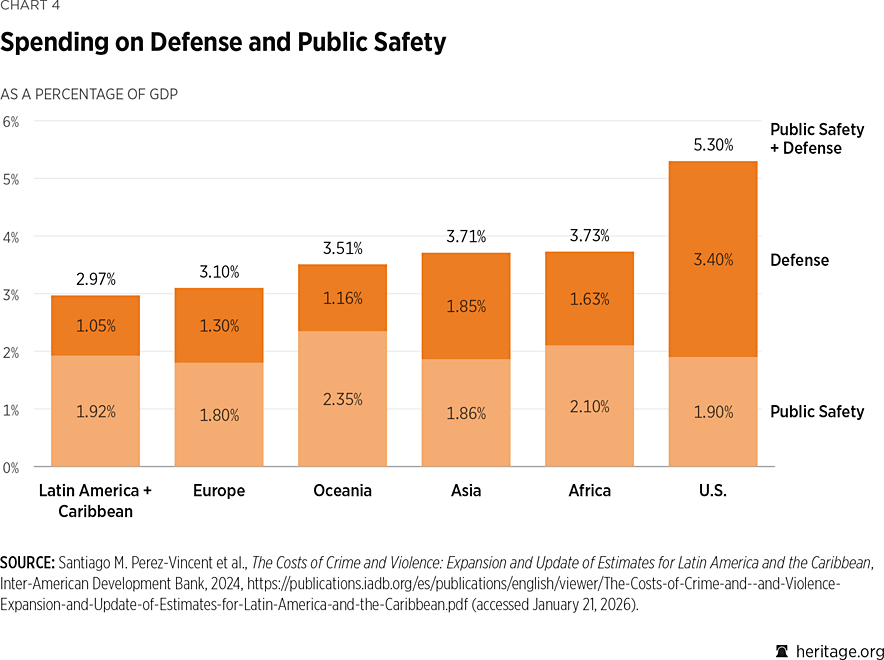
Support and funding for regional militaries have also become political and ideological issues in parts of Latin America, in some cases tying military capacity directly to electoral shifts. Under the modern Peronist movement, the political left in Argentina significantly and purposefully restricted funding for the military as well as the scope of its responsibilities in the realm of security.[REF] Colombia, under far-left President Gustavo Petro, has similarly restricted the military even as armed criminal organizations gain in strength. During the late 2000s, Ecuador’s far-left former President Rafael Correa also targeted and punished the military, in part because of its working partnerships with the United States against narco-trafficking threats.
While political support for militaries at times falls along consistent ideological lines, in some countries, this is not the case. For example, the rise of the leftist Morena party in Mexico has brought about unprecedented expansion of power and funding for the Mexican military. Notably, regional authoritarian regimes in Cuba and Venezuela have coopted their militaries instead of merely marginalizing them. These militaries face significant resource limitations because of their regimes’ failed economic models, but they are nonetheless prioritized and empowered as core pillars of authoritarian support.
Corruption is another major impediment to the quality and effectiveness of Latin America’s armed forces. From the top leadership of some regional militaries to local police officers and deployed soldiers, the corrupting influence of drug traffickers and criminal organizations continues to dull and undermine regional security forces. For authoritarian regimes in particular, criminality and corruption are features of their militaries. This is most clearly exemplified in the Venezuelan military’s direct and well-substantiated role in narco-trafficking activity.
A general sense that there is an absence of credible threats of interstate war has left many regional militaries inadequately resourced, particularly with respect to their capacity to defend against hostile state threats. A worrying dynamic is that regional anti-American dictatorships are the militaries that have put more significant resources into bolstering their capacities to wage war against a foreign military. Weak military control by regional democracies creates a growing asymmetry not only relative to regional authoritarian regimes, but also against growing threats to sovereign control against extra-hemispheric powers. It is unclear, for example, whether the Peruvian military would be capable of retaking control of its dual-use mega-infrastructure projects that are controlled by China.
Finally, historical U.S. support and cooperation have proven to be a determinative factor in the quality of regional militaries. This is exemplified by the superior capacity of the armed forces of Colombia, among other top U.S. security partners. However, the steady reduction of and increasing restrictions on U.S. military training of and support for Latin American militaries have degraded regional military capacities and limited recent efforts by some nations to rebuild their military capacities in the face of very serious security threats.
U.S. Military Presence in Latin America
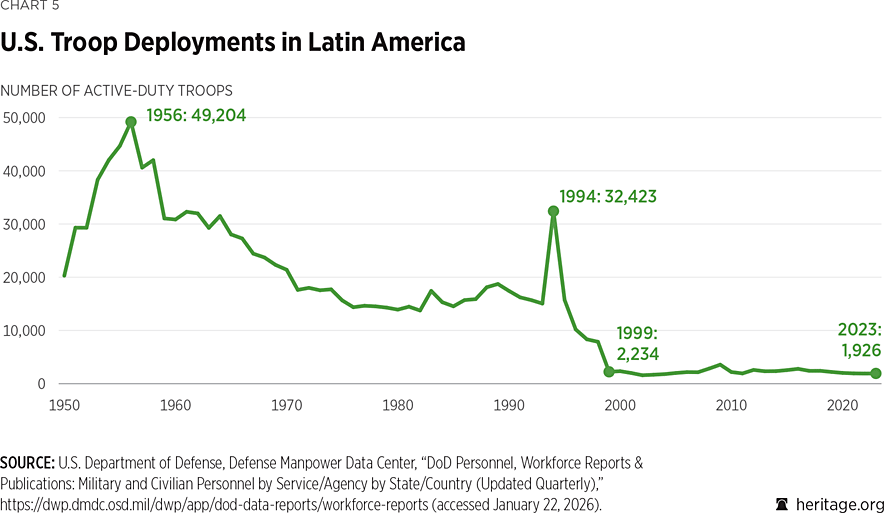
The 1990s marked a substantial, broad-based reduction of the U.S. military presence in Latin America and the Caribbean and a steady shift away from core security—particularly military—cooperation. Pushed forward by the rise of anti-American leaders in the region and disengagement by Washington, this reduced U.S. security presence contributed to the resurgence of narco-trafficking threats and increased strategic positioning of China and other hostile powers within the Western Hemisphere.
Actions by the Trump Administration have shown an intent to reverse this general shift, and the Administration appears poised to restore a more substantial focus on core security cooperation and confronting narco-threats in the Americas. President Trump has taken several steps to restore the central role of U.S. military and security operations in America’s regional policy. This has included a renewed central role for the U.S. military in border security and planning as well as preparation for potential direct U.S. military action against Mexican cartels.[REF] Nonetheless, reversing the long-standing decline both in funding and in operational focus on hemispheric security threats presents a daunting task.
In 2025, the Trump Administration shifted substantial U.S. military assets and personnel into the Western Hemisphere. These assets included numerous military aircraft such as F-22 and F-35 jets and a U.S. carrier strike group that was redeployed to the Caribbean. Through Operation Southern Spear, these assets have targeted narco-terrorist threats at sea and confronted the criminal activity of the former Maduro regime, among other threats, particularly in the Caribbean and northern Pacific.[REF]
In this process of refocusing U.S. military assets against threats within the Western Hemisphere and working with regional partners, the Trump Administration will have to contend with the challenging consequences of a decades-long decline of U.S. military engagement in the Western Hemisphere. This engagement is particularly low compared to our engagement in other parts of the world. The U.S. military has more active-duty forces stationed in Greece, for example, than it has on the entire continent of South America.[REF] Until recently, the United States has had only two military bases across Latin America and the Caribbean: the U.S. Naval Base in Guantanamo Bay, Cuba, and the Soto Cano Air Base in Honduras. A third, the recently reactivated Roosevelt Roads Naval Station in Puerto Rico, has been crucial in recently surging operations in the Caribbean. There are no U.S. military bases on the continent of South America. In the past, the U.S. military has had a much more robust presence across the Americas, but it ceded this presence because of regional pushback and Washington’s growing focus on the Middle East in the 2000s.
The United States generally followed Latin America’s post–Cold War trend of reducing the role of the military in the region in favor of civilian law enforcement. At times, regional political decisions forced the exit of the United States military. The wave of anti-American far-left leadership during the 2000s made the U.S. military a prime populist target with leaders such as Venezuela’s Hugo Chávez and Ecuador’s Rafael Correa ending cooperation agreements with the U.S. military. In 2004, for instance, Chávez evicted U.S. military personnel from liaison offices on Venezuelan bases; in 2005, he ended a 35-year military exchange program with the United States. In 2009, Correa withdrew the lease for the U.S. military’s Manta Air Base, which had focused on counternarcotics operations; the U.S. withdrew from the base in September.[REF]
Anti-American leaders succeeded in expelling the U.S. military from multiple Latin American nations, and in many cases, these actions have outlasted the regional leaders that implemented them: The U.S. military presence and security cooperation have not yet returned to a significant degree. More broadly, the ousting of the U.S. military reinforced a parallel shift in U.S. foreign policy emphasizing civilian law enforcement cooperation and economic development aid in Latin America.
The shuttering of U.S. military bases in Panama in 1999, Puerto Rico in 2004, and Ecuador in 2009, among others, marked the substantial decline of the U.S. military presence in our own hemisphere. This has left Guantanamo Bay and Soto Cano as America’s only main operating bases in the region, and even the future of these two bases has been brought into question by recent political developments. As President Trump took office in January 2025, Honduran President Xiomara Castro issued a thinly veiled threat to oust the U.S. military from Soto Cano Air Base because of U.S. deportation efforts.[REF]
Through diplomatic agreements and engagement, the U.S. military has secured non-permanent access to roughly 75 cooperative service locations, strategic facilities, and other sites in regional partner nations. Facilities conditionally available to the U.S. military include airfields, radar sites, military training centers, military offices, and cooperative security locations in Latin America and the Caribbean.[REF] Geographically, these bases are heavily concentrated in Central America, Colombia, and Peru; U.S. military access is far more limited in Mexico and much of South America. These facilities typically support training activities, counternarcotics, disaster response, and intelligence-related activities.[REF]
The U.S. and regional militaries also conduct a series of recurring military exercises to improve cooperation. Outside of Mexico, U.S. Southern Command (SOUTHCOM) has a central role in the U.S. military’s regional presence across 31 countries. SOUTHCOM deploys its three main joint task forces to occupy accessible bases and coordinate with militaries in the region. At the same time, many of these exercises are geared toward humanitarian and disaster relief operations.
As indicated above, the principal U.S. military bases in Latin America and the Caribbean are:
- Soto Cano Air Base, Honduras. Soto Cano is the U.S. military’s only main operating base in Central and South America. Located some 60 miles from the Honduran capital, Tegucigalpa, Soto Cano houses SOUTHCOM’s Joint Task Force–Bravo, whose operations are focused on transnational organized crime, humanitarian assistance, and partner capacity-building.[REF] The 612th Air Base Squadron maintains Soto Cano’s airfield, which includes a 24-hour C-5 Galaxy–capable runway and serves as a critical strategic airlift hub for the U.S. military.[REF] Soto Cano also hosts the Honduran Air Force Academy.
- Guantanamo Bay Naval Station, Cuba. Naval Station Guantanamo Bay in southeastern Cuba is the United States’ oldest overseas military installation, dating back to 1903, and operates pursuant to a permanent lease signed with the Republic of Cuba. The Naval Station serves as a crucial forward operating base for the U.S. military as well as an operational and logistical hub for maritime security, humanitarian assistance, and joint regional operations. The base includes a facility that has been used to detain U.S. military prisoners, including some captured during the global war on terrorism. The Trump Administration is also using and expanding these facilities to manage the criminal migration threat in the United States, particularly by temporarily holding members of criminal and terrorist groups like Tren de Aragua.
- Roosevelt Roads Naval Station, Puerto Rico. Roosevelt Roads encapsulates the Trump Administration’s refocus on the Western Hemisphere after decades of U.S. disengagement. Located on Puerto Rico’s eastern coast, Roosevelt Roads operated for decades as one of the largest U.S. naval facilities in the Caribbean and served as a major support hub for Atlantic Fleet operations. It functioned as a base during World War II and was redesignated as a naval station in 1957. Local protests led to the base’s closure in March 2004 as interest on the part of the U.S. military waned. The facilities and land remained largely abandoned until President Trump’s 2025 surge of U.S. military forces to the Caribbean and off the coast of Venezuela on a sustained counternarcotics mission. Since then, Roosevelt Roads has been fully reactivated and now hosts Navy carrier strike groups, F-35 and F-22 jets, Marine Corps helicopters, and C-5 Galaxy and C-17 cargo aircraft.[REF] Roosevelt Roads now serves as a crucial base of operations for the U.S. military’s newly prioritized Caribbean operations, supporting military strikes against narco-terrorist targets at sea as well as operations focused on Venezuela, including the capture of narco-dictator Maduro in January 2026 by U.S. forces.
General U.S. military engagement with and support for the region has similarly declined over the past several years. Landmark U.S. security initiatives in the region, such as the Merida Initiative with Mexico, have been abandoned by regional leaders while others such as Plan Colombia and the Caribbean Basin Security Initiative have wound down or been starved of resources despite the persistence and even growth of regional security threats.
The decline in U.S. military presence and resources in Latin America raises particularly pressing concerns in a period of growing threats to U.S. national security from within the Western Hemisphere that include fentanyl trafficking networks, weaponized mass migration, and China’s dual-use infrastructure and powerful drug trafficking organizations. Efforts by the Trump Administration to revitalize hemispheric security initiatives offer a path to confronting these daunting threats. At the same time, regional attitudes toward the U.S. and the military appear to create a more welcoming environment for this shift in Washington.
Spiking violence and insecurity in Latin America have also led to new calls, including calls from regional leaders, for renewed engagement by the U.S. military. Ecuador’s President Daniel Noboa has called publicly for the reestablishment of a U.S. military base as his country struggles to combat surging narco-violence.[REF] Similarly, there have been serious discussions in Washington about possible U.S. military action against the Mexican drug cartels as their illicit activities cause record overdose deaths and instability in the United States. Even the newly bolstered role of the U.S. military at the U.S.–Mexico border sparks little controversy given the severity of the illegal migration and narcotrafficking threats.
Primary Security Threats
The lines between public security and defense have long been blurred in Latin America, not only because of the domestic role of some regional militaries, but also because of the nature of the region’s security threats. Hostile foreign powers leverage Latin America’s transnational organized criminal and terrorist organizations as tools of asymmetric warfare against the United States and its partners. Tren de Aragua’s numerous direct links to Venezuela’s narco-dictatorship, dating back to Chávez’s rule, have provided material support to Colombian narco-terrorist organizations.[REF] Similarly, illicit fentanyl produced and managed by Mexican cartels is fueled directly and purposefully by China and the Chinese Communist Party (CCP).[REF] Access to massive illicit resources and state backing have empowered Latin America’s criminal and terrorist organizations to rival and surpass the capacities of regional security forces and militaries.
With few exceptions, resurgent security threats in Latin America and the Caribbean are a growing threat to U.S. national security. Existing transnational criminal organizations like the Mexican cartels are rapidly extending their footprint into new countries, and illicit drug production in Colombia is surging to unprecedented levels as armed groups reassert control of ungoverned spaces and bring about new waves of political violence that are reminiscent of the 1980s. At the same time, new criminal groups are spreading like wildfire with new gangs from Venezuela, Ecuador, and elsewhere growing to be dominant criminal forces.
The Venezuelan Regime. Under Nicolás Maduro’s leadership, Venezuela posed a dynamic and multifaceted threat to hemispheric and U.S. national security by acting as a militaristic threat to its neighbors, embracing and weaponizing transnational criminal threats and migration, and offering a staging ground for malign extra-hemispheric powers. From a security perspective, Venezuela is best understood as a criminal-military dictatorship under which the armed forces have been turned largely into tools of social control, propaganda, and organized criminal activity.
Recognizing the nature of this threat, President Trump began a concerted pressure campaign against Venezuela in 2025, and in January 2026, a highly targeted U.S. military operation captured Maduro for trial in the United States. On January 3, Operation Absolute Resolve directed U.S. military aircraft and forces into Venezuelan territory with ground operations led by Delta Force and coordinated strikes launched against Venezuelan air defense systems.[REF] Within a matter of hours, U.S. forces had captured Maduro and withdrawn him from Venezuelan territory without suffering a single casualty. This highly successful operation showcased not only the capabilities of the U.S. military, but also the deep weakness and incapacities of the Venezuelan military.[REF]
By removing Maduro and maintaining pressure against the remnants of his regime, President Trump aims for a stable and sustainable transition in Venezuela—a prospect that is more realistic today than it has been at any other point since the regime’s rise under Hugo Chávez. Nonetheless, the remnants of the Maduro regime, including its corrupt military leadership, remain in place for the moment, leaving remaining challenges to be addressed in such a transition.
Despite Venezuela’s long-standing economic crisis, its military remains a significant force by regional standards. With a reported 150,000 active-duty forces, the Venezuelan military is a central pillar of the dictatorship’s regime. To consolidate and maintain control of Venezuela, the regime shifted much of the military’s operational focus to maintaining domestic control, primarily through violence against domestic actors and displays of public-facing propaganda against supposed external threats.
Venezuela’s armed forces are fundamentally different from those of other military dictatorships in that the Maduro regime has converted the military into an extension of its criminal activities and networks. Numerous indictments and investigations have shown that Hugo Chávez and now Nicolás Maduro have put Venezuela’s military and other institutions to the explicit task of flooding the United States with illegal drugs and otherwise cooperating with narco-trafficking organizations.[REF] Over time, the Venezuelan military has developed direct and deepening involvement in the drug trade, securing illicit enrichment for its top leaders, the so-called Cartel de los Soles. This has included direct partnerships with Colombian narco-guerrilla groups and trafficking gangs like Tren de Aragua, as well as the military’s own direct involvement in a range of transnational criminal activities. These illicit gains have bolstered the military and help to sustain its allegiance to the Maduro regime even during Venezuela’s deep socioeconomic crisis.
The past several years have seen the Venezuelan military deployed most often against public protests and demonstrations while targeting opposition political figures. This is done in active cooperation with local armed groups and actors that serve as part of the military’s repressive apparatus against the public. The regime also dedicates some attention to defense against imagined foreign military intervention, although these initiatives appear to be primarily propagandistic with underlying capacity and resources clearly deteriorating. Venezuela’s high-profile and televised Bolivarian Shield exercises, for example, are nationwide military–police exercises ostensibly to secure “borders, towns, coasts, cities and vital elements of the country.”[REF]
In capacity and equipment, Venezuela’s armed forces are noted for their capabilities in aviation, anti-missile systems, and tank squadrons.[REF] However, because of the economic crisis and international sanctions, access to new equipment is so limited that the military is forced to rely increasingly on partial repairs of aging Soviet-era equipment.[REF]
Venezuela’s military has exhibited significant deficiencies in its operational readiness and capacity. In an embarrassing 2020 incident, a Venezuelan naval ship capsized during a confrontation with a cruise ship that supposedly encroached on Venezuelan waters.[REF] The uncontrolled rise of armed criminal organizations and illicit activity in Venezuela is also revelatory with respect to the degraded operational capacity of the country’s military.
Venezuela’s regime has long coordinated proactively with such criminal organizations as Colombian narco-guerrillas as a way to enhance its power and secure illicit financial revenue.[REF] In recent years, however, the military reportedly has lost control of surging unsanctioned criminal activity within its borders, including illegal mining, the presence of rival Colombian drug trafficking organizations, and widespread border smuggling. Concerted operations by the Venezuelan military to control growing illegal mining activity in the Amazonas region, for example, have reportedly failed and left the regime cut off from this stream of illicit revenue.[REF]
Venezuela’s top military and security partners are Russia and China, which provide inconstant access to military equipment, training, and resources. Notably, Russian and Chinese air-defense systems were easily bypassed and disabled by U.S. forces during the operation to capture Maduro. This highlights the limited capacities of the Venezuelan military even with Russian and Chinese military technology. The success of the U.S. operation also adds further support to the long-standing view that the benefits of aid to the military from Beijing and Moscow may be more symbolic than operational.
The Cuban dictatorship has also played a central role in Venezuela’s security apparatus, deploying thousands of intelligence officers to monitor and ensure the Venezuelan military’s loyalty to the regime. In Operation Absolute Resolve, U.S. forces were confronted directly by Cuban agents who played a primary role in protecting Maduro; U.S. forces dispatched these Cuban agents, leaving 32 Cuban casualties in Caracas.[REF]
Cuba. At its core, Cuba’s Communist dictatorship is also a military dictatorship. Raul Castro led the armed forces for nearly 50 years, strengthening its position of privilege in Cuba relative to other institutions in the dictatorship. Today, the Cuban military remains the most powerful and well-resourced entity within the regime, maintaining control of key industries. Like Cuba itself, however, the Cuban military has degraded dramatically under the Castro regime.
Today, the Cuban Revolutionary Armed Forces (FAR) include an estimated 49,000 active personnel and 39,000 reserve personnel, representing only a fraction of the fighting strength they possessed in the 1980s. The Cuban military suffers from its reliance on outdated Soviet equipment, underinvestment, and an increasingly amorphous mission.
The loss of Soviet funding following the end of the Cold War also cut Cuba off from weapons and equipment as well as strategic support, which in turn drove an increasingly sharp decline in operational capacity. Even with Venezuela’s patronage, there appears to have been little investment in the Cuban military’s warfighting capabilities since the conclusion of the Cold War. Because of poor maintenance, of the hundreds of aircraft the Cuban Air Force received during the Cold War, including fleets of Russian MIGs, fewer than 50 are thought to be operational, and the lack of pilot training has further reduced Cuba’s aerial capacity.
This underinvestment in the Cuban military belies the reality that the military sits on substantial wealth, derived through its direct control of tourism and nearly any other profitable industry in Cuba. Leaked documents indicate that the Cuban military-run umbrella subsidiary, Grupo de Administración Empresarial S.A. (GAESA), has accumulated as much as $18 billion in reserves.[REF] This substantial wealth appears to be directed primarily toward enriching Cuba’s military leadership and reinvesting in GAESA’s business ventures rather than supporting military readiness.
Despite degraded military capabilities, Cuba remains a national security threat to the United States and hemispheric security more broadly. The regime’s efforts to prop up destabilizing forces beyond its borders, acting as a key pillar of strategic support for Venezuela’s narco-dictatorship, underscore these efforts. At the same time, Cuba continues to serve as a proactive partner for U.S. adversaries seeking to bolster their strategic presence in the Western Hemisphere. Cuba’s housing of Chinese intelligence facilities and reception of Russian warships as recently as last year showcase this hostile posture, echoing the regime’s willingness to receive Soviet nuclear missiles during the Cold War.[REF]
Transnational Organized Crime. Transnational organized crime is a long-standing threat to U.S. and hemispheric security, making it easy for some to dismiss it as a manageable or foreign challenge. However, the criminal threat across the Americas is far from static and instead is growing and multiplying at a rapid pace as a wide array of criminal organizations seize and create illicit economies and networks that stretch around the globe. As transnational criminal organizations experience nearly unrestricted growth in the Americas, their impact on U.S. national security and the safety of the American people quickly grows to intolerable levels.
Mexican Drug Cartels. In many ways, Mexico’s drug cartels present the most significant and urgent threat to U.S. national security from within Latin America, claiming the lives of some 100,000 Americans each year through the fentanyl trade.[REF] Additionally, Mexican cartels are intimately involved in driving mass migration to the United States through human smuggling activity.[REF] For too long, however, the need to confront the drug cartel threat has not received the attention it deserves as one of Washington’s urgent priorities. This has facilitated the dangerous decline and dilution of the U.S.–Mexico security relationship.
Despite long-standing efforts by the United States and Mexico to combat drug cartels, these criminal networks have grown steadily in power and influence. Driving this illicit growth is the ability of the cartels to tap into massive illicit revenue streams from drug trafficking while also diversifying into extortion and human trafficking, among other criminal activities. Mexico’s drug cartels annually generate an estimated $30 billion in illicit revenue, rivaling the gross domestic products (GDPs) of multiple European economies, including those of Albania and Georgia. Drug cartels are also one of Mexico’s largest employers. According to one study, “by 2022 cartels [had] between 160,000 and 185,000 units”—far more than the estimated number of combatants for groups like Hezbollah and even ISIS at its peak.[REF] Mexico’s cartels are also equipped with military-grade weaponry and equipment that allows them to rival Mexican security forces, bringing to bear armored vehicles, anti-aircraft weapons, and such advanced technologies as drones.[REF]
Complicating the challenge, these cartels are far from a monolithic threat. As recently as 2019, the Mexican government had identified as many as 37 distinct drug cartels operating throughout the country.[REF] These criminal organizations engage in open conflict among themselves as they compete for illicit routes and resources across Mexico.
Another key factor driving the growth of the cartels is their ability to operate with impunity in Mexico amid the collapse of U.S.–Mexico security cooperation. For more than a decade, the Mexican government has shifted away from efforts to confront the cartels as corruption and resignation increasingly define the country’s security institutions. A testament to the growth of Mexico’s drug cartels under these conditions is their expanded global footprint further south. This includes increasing violence and trafficking activity in Guatemala, Colombia, and once-peaceful Ecuador as Mexican criminal organizations consolidate their control of global illicit supply routes.[REF]
The rise of synthetic drugs and the fentanyl crisis have seen an exponential increase in the deadliness of the cartel threat to the American people. U.S. opioid overdose deaths in 2023 alone eclipsed the number of U.S. casualties seen during the entire Vietnam War.
Surging drug deaths in the United States and record high levels of homicides in Mexico demonstrate the dangerous consequences of tacitly accepting the permanence of the cartel threat. New actions by the Trump Administration to bolster the U.S. military’s presence at the border and press the Mexican government to take action against the cartels demonstrate renewed efforts to confront this dire threat.
Colombian Drug-Trafficking Organizations. Colombia’s guerrilla groups have deeply political origins as Marxist movements seeking to overthrow the government, but they have largely left these motivations behind to focus instead on maximizing their criminal enterprises, including drug trafficking and illegal mining.
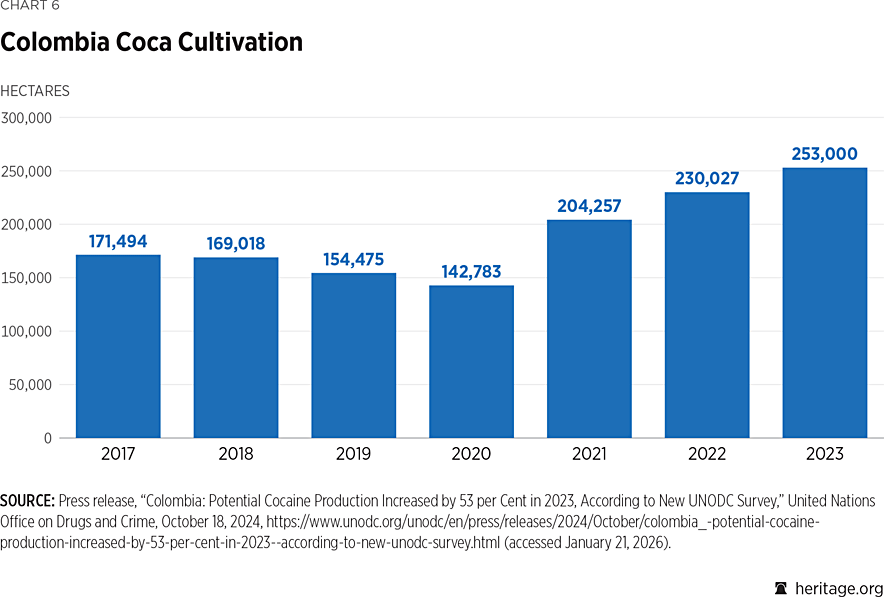
Following the Colombian government’s highly successful offensive during the 2000sof the Colombian government, with support from the U.S. through Plan Colombia, the country’s narco-guerrilla threat was greatly reduced, marginalizing these armed groups to a primarily criminal threat rather than a military one. Nonetheless, this criminal threat remains dramatic, with record drug production and profits bolstering the criminal landscape in Colombia. To preserve their existence and operations, Colombia’s criminal groups have taken advantage of the country’s complex and large geography, including remote mountainous and jungle regions where the government struggles to project its presence.
Venezuela’s narco-dictatorship has also acted as a crucial lifeline to Colombia’s guerrilla groups and criminal threats. Under Hugo Chávez and then Nicolás Maduro, Venezuela’s government actively supported Colombian guerrilla groups like the Revolutionary Armed Forces of Colombia–People’s Army (FARC) and the National Liberation Army (ELN), offering them safe haven from Colombian security forces and providing material support through partnership in the drug trade. At the same time, the broader criminal environment across the Andean region has been accelerated by instability and lawlessness in Venezuelan territory.
Under the presidency of Gustavo Petro, the Colombian government has greatly reduced efforts to confront Colombian guerrilla groups militarily. This has greatly expanded the ability of criminal organizations to operate within territory previously denied by security forces. This has led to an expansion of violence and drug trafficking activity within Colombia as well as in neighboring Ecuador.[REF]
Brazilian Drug Gangs. Brazil’s deadly narco-trafficking gangs such as the First Capitol Command, Red Command, and Family of the North are a less prominent but still highly powerful criminal threat. These organizations have seized control of the lucrative criminal landscape in Latin America’s largest nation and economy, thereby accelerating the hemispheric spread of organized crime and instability. Brazilian gangs not only drive violence and criminality in Brazil, but also have grown to become the driving force behind the European drug trade.[REF]
Within Brazil, gangs liberally employ violence against each other and the public, managing sophisticated drug trafficking, extortion networks, kidnapping, and organized theft rings. They also engage in domestic drug trafficking and dealing, targeting Brazil’s large and increasingly wealthy population.
Despite the prominence and power of Brazilian criminal organizations, geography and economic realities have limited their direct criminal linkages to the United States. Brazil’s distance from and limited trade flows with the United States offer fewer opportunities to conceal clandestine drug shipments among legal exports to North America. Brazil’s more substantial economic ties with Europe, which represents nearly twice as much of Brazil’s exports than the United States does, have driven the bulk of Brazilian drug trafficking activity to Europe.
Nonetheless, the rapid expansion of Brazilian gangs has made them some of the world’s largest non-state armed groups, empowering organized criminal networks across the Western Hemisphere and beyond. For instance, linkages with Brazilian gangs have fueled illicit drug production in neighboring Bolivia and Peru, contributing to the growth and resilience of these neighboring criminal landscapes.
Tren de Aragua. Tren de Aragua’s exponential growth in recent years is a testament to the surging rise of transnational organized crime. In less than a decade, Tren de Aragua has grown from a minor prison gang in Venezuela to become one of the Western Hemisphere’s largest and most expansive transnational criminal organizations—a criminal organization with a substantial foothold across major U.S. cities.
Tren de Aragua’s growth was undeniably accelerated by the migration crisis and open-border policies of the Biden Administration, which bolstered the profitability and criminal opportunities that flow from tapping into human trafficking, migrant smuggling, and other related illicit activity. By exploiting the mass migration crisis through human and drug trafficking activity, Tren de Aragua gained access to substantial illicit revenue while weak border policies, both in the United States and across the region, also allowed members of the gang to establish a presence spanning the Western Hemisphere. Another undeniable driving force behind the spread of Tren de Aragua has been the Venezuelan narco-dictatorship, which has weaponized migration against the United States and the broader hemisphere.[REF] Politically motivated assassinations carried out by Tren de Aragua outside of Venezuela have been directly linked to the Venezuelan dictatorship.[REF]
With Tren de Aragua’s rapid growth, law enforcement agencies in the United States and across Latin America have struggled to respond rapidly to this new criminal threat; however, renewed action and coordination have begun to take effect.[REF]
Malign Extra-Hemispheric Powers
Recognizing the geopolitical importance of a presence in the Western Hemisphere, top global U.S. adversaries including China, Russia, and Iran have increased their regional engagement and positioning. Seizing on a lack of attention and engagement from the United States, they have accomplished this by means of dual-use infrastructure, political influence, economic power, criminal activity, and military-to-military relations.
Over the past two decades, China has made a particularly aggressive push into the Western Hemisphere, taking advantage of its economic power to build political influence and secure Chinese control of Latin American maritime ports, telecommunications networks, and other critical infrastructure throughout the region. This engagement has spilled into the military realm as well.
China’s weaponization of fentanyl in collaboration with Mexico’s cartels is the most destructive and dangerous means of Beijing’s hemispheric encroachment. China’s facilitating of the flow of precursor chemicals to Mexican cartels has driven the fentanyl crisis to its deadly current levels.[REF] Chinese businesses, brokers, and criminal organizations all play critical and active roles in illegal fentanyl trafficking to the United States, while Chinese entities and financial systems also facilitate laundering of the profits to evade U.S. detection. Through subsidies and non-enforcement, the CCP tacitly supports China’s central role in the fentanyl crisis.
Additionally, China engages in broader threatening positioning within the Western Hemisphere through its economic influence and investments. Among the most concerning developments is China’s accumulated control of critical infrastructure such as ports and energy production plants. Beyond the political influence that this investment provides Beijing over regional governments, much of this infrastructure has a worrying potential for weaponization to destabilize the United States and the region. Dual-use infrastructure such as China’s new deep-water megaport in Chancay, Peru, and its deep space base in Southern Argentina exemplify the military component of China’s nominally economic projects. The deep-water megaport in Peru, for example, is completely controlled by China’s COSCO shipping company, and the facilities are uniquely capable of receiving Chinese warships.[REF]
China’s presence around critical trade infrastructure such as the Panama Canal also raises urgent concerns about its ability to disrupt these vital trade routes, which could destabilize the U.S. economy and the U.S. military’s ability to reposition maritime assets in a conflict situation. Chinese illegal fishing activity also tests the boundaries and capacities of maritime territory while accelerating criminality and instability in the Western Hemisphere.
Although less developed, China’s military-to-military relations in Latin America have also notably increased in recent years. As the United States has reduced funding and placed increased restrictions on U.S. training exchanges and weapons sales for Latin American security forces, Beijing has offered more of this engagement, even developing joint exercises with Western Hemisphere countries.
The growing influence and presence of these extra-hemispheric powers increases the risk of interstate conflict’s returning to Latin America. On one hand, their military and financial support for authoritarian regimes like Venezuela’s encourages the belligerence of those regimes toward neighboring democracies. On the other hand, China’s control of critical infrastructure, including dual-use ports that are capable of receiving warships, threatens to bring any potential armed conflict between the United States and China into the Western Hemisphere.
Like China, Iran also leverages the Western Hemisphere’s criminal networks as a strategic tool. This centers on the engagement of Iranian proxies, particularly Hezbollah, in narco-trafficking, counterfeiting, and money laundering activity in South America. Much of this presence and engagement centers around the Brazil–Argentina–Paraguay tri-border area, which is home to a substantial Lebanese diaspora. There are also concerning reports and examples of an increasingly operational Hezbollah presence beyond the tri-border region that includes intelligence collection and targeted assassinations.
Russia’s significant presence in the Western Hemisphere continues the Soviet-era prioritization of Latin America as a strategic region. However, without Beijing’s economic heft to buy influence, Russia’s engagement strategy generally leverages high-level political support and military-to-military relations, including weapons sales. Russia has generally approached Latin America with a prioritized emphasis on anti-American leadership. This has led to a significant Russian presence in Cuba, Venezuela, and Nicaragua. Beyond these anti-American regional dictatorships, Russia also built up significant and enduring ties to democratic nations like Ecuador and Argentina during the 2000s when their leadership was hostile to U.S. influence.
Important Alliances and Bilateral Relations
Cooperation with partner nations in Latin America and the Caribbean is fundamental to U.S. national security. In the absence of direct U.S. military and law enforcement action, regional partners have made great sacrifices to confront deadly narco-trafficking groups and other shared security threats. However, political shifts in regional leadership and inconstant U.S. engagement have taken a toll on the effectiveness of U.S. security relationships in Latin America in meeting core security threats.
Argentina. The relevance and importance of Argentina and its military are raised by geopolitical realities, including the deepening of the U.S.–Argentina relationship under the two countries’ current administrations. At the same time, China’s accumulated influence in Argentina makes this a strategically important relationship for both the United States and Beijing.
The recent sale of American-made F-16 fighter jets to Argentina’s Air Force marked a major turning point as the Argentine military turned down China’s offering of its JF-17 aircraft.[REF] President Javier Milei continues to prioritize engagement with the United States, particularly as his administration seeks to restore the capacity of its armed forces. Discussions of future defense acquisitions and even co-production of equipment like Stryker armored vehicles and drones are ongoing.[REF]
In recent decades, Argentina’s military has suffered from the country’s broader financial crisis and the political stigmatizing of the armed forces because of the military dictatorship of the 1970s and 1980s. This has generally starved Argentina’s armed forces of funding while political leadership from the left has reduced the military’s responsibilities in the realm of security.
Antarctic security is another issue that enhances Argentina’s strategic importance. As China’s ambitions in the Antarctic region increase, Argentina’s positioning and facilities like its naval base in Ushuaia become more operationally vital.[REF]
Despite the Milei government’s clear preference for partnership with the United States, China’s substantial financial and economic influence in Argentina continue to pose a challenge. Additionally, past concessions to China by the administration of Cristina Kirchner have granted Beijing a worrying military presence in Argentina that includes the shadowy deep space station in Neuquén province.[REF]
Brazil. Despite its distance from the United States, Brazil’s strategic importance both hemispherically and globally is driven in large part by its size and economic weight. Brazil is not only the largest country in Latin America, but also the world’s seventh-largest country in terms of population and fifth-largest in terms of geographic territory. A top 10 global economy, Brazil also has the region’s most developed defense industrial base, particularly its aerospace industry. Brazil’s size also makes it an important hub for drug trafficking activity and transnational criminal organizations. The Brazilian military shares responsibility for domestic security with civilian police forces.
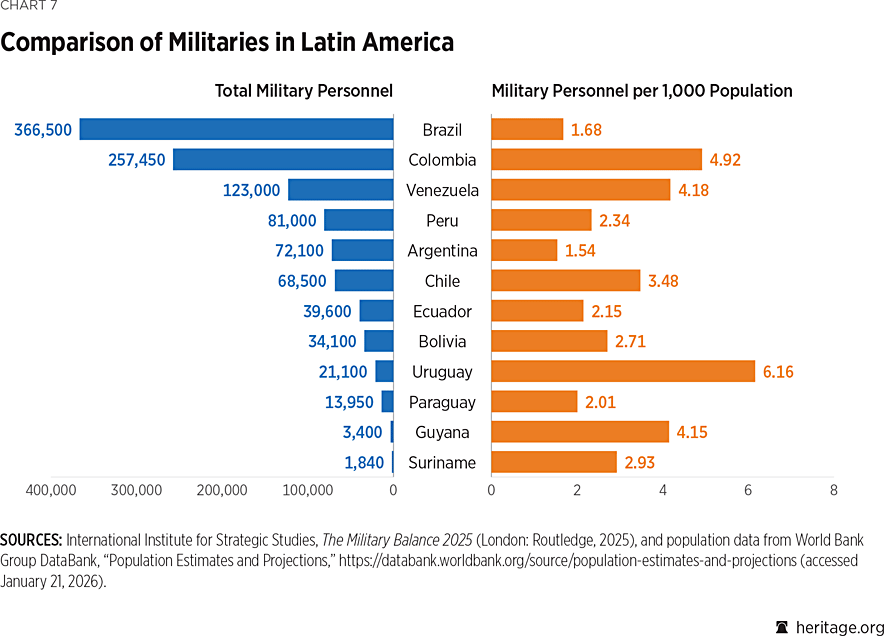
Brazil’s military spending is roughly 1.1 percent of GDP and supports approximately 360,000 active-duty armed forces personnel, making Brazil’s military the second-largest in the Western Hemisphere.[REF] Brazil’s recent defense budgets hover around $25 billion, which significantly exceeds the defense budgets of Colombia ($10.2 billion), Chile ($5.6 billion), and Argentina ($4.7 billion) in 2024. One of the military’s apparent strategic priorities is advancement of Brazil’s positioning as a leading global actor.[REF] Much of this is reflected in the development of Brazil’s military–industrial base and procurement as the government pursues a proposed $11 billion public investment program for production of nuclear submarines, frigates, and new armored vehicles among other systems.[REF] As a result of these initiatives, Brazil recently commissioned production of its two first Centauro II BR armored combat vehicles.[REF]
Brazil is not a major drug-producing country, but it is the second-largest consumer of cocaine and a transit hotspot for illicit drugs. Criminal organizations like Red Command and First Capital Command have increased their transnational operations in Brazil and beyond. In response, the government has expanded Brazil’s security presence along the harsh 9,767-mile border that it shares with 10 other countries. Brazil deploys security forces and equipment like unmanned aerial vehicles to monitor illicit activity along borders and in the Amazon.
In 2018, the U.S. and Brazil launched the Permanent Forum on Security with the aim of fostering bilateral cooperation on security challenges including arms and drug trafficking, cybercrime, financial crimes, and terrorism.[REF] The designation of Brazil as a major non-NATO ally in 2019 under President Trump offered Brazil access to U.S. defense industry and increased joint military exchanges, exercises, and training.[REF]
Overall, security cooperation between the U.S. and Brazil is substantial, particularly with reference to narco-trafficking threats. However, this relationship is increasingly being undermined by divergent political alignment under the administration of Lula da Silva.
Colombia. The Republic of Colombia is the closest and most successful U.S. security partner in the Western Hemisphere. U.S. partnership and capacity-building during the 1990s and 2000s empowered Colombia’s efforts to retake the country from its existential narco-terrorist threats. Nevertheless, surging narco-trafficking and the increasingly destabilizing activities of Venezuela’s authoritarian regime continue to pose serious threats to Colombia’s security.
By 2001, Colombia had lost control of roughly 40 percent of its territory to narco-guerrilla insurgents and was on the brink of becoming a failed state. However, a surge in U.S. intelligence and military support for and cooperation with Colombia’s security forces has restored general stability. Threats from narco-guerillas were pushed to the margins, although substantial security challenges persist.
Beyond its historical security ties with the U.S., extensive experience combatting guerrilla threats has helped Colombia’s military to become one of the world’s and one of the region’s most capable. Colombia has some 300,000 active-duty military personnel and an additional 150,000 national police.[REF] On a per-capita basis, Colombia maintains one of the world’s largest active-duty security forces. However, although its armed forces are highly capable and effective, limited access to new technological capabilities such as drones complicates efforts to confront resilient and well-resourced narco-trafficking threats.
As a core U.S. security partner, Colombia has generally taken a proactive approach in confronting narco-trafficking activity, but security policies have shifted under the administration of President Gustavo Petro. Since taking office in 2022, Petro has blasted the so-called drug war and delivered punishing reductions to military funding while liberally using permissive ceasefire agreements with Colombia’s narco-trafficking groups. These policies are bringing about a dramatic regression of the country’s hard-fought security gains and have led to a period of resurgence for Colombia’s armed groups.
In the final months of President Petro’s mandate, the government has adjusted its approach somewhat, ending its permissive ceasefires, but the resurgence of armed groups requires a more aggressive recommitment to the military’s efforts to confront these threats. Even though guerrilla groups and narco-traffickers no longer credibly threaten the existence of the state, violence continues to plague ungoverned spaces in Colombia, and illicit coca production continues at record high levels. At the same time, new illicit activities such as illegal mining have proliferated, offering new revenue streams for Colombia’s transnational criminal organizations.
A key factor driving the persistent armed threat in Colombia is the Venezuelan narco-regime which shares a roughly 1,400-mile border with Colombia. For the United States, Colombia is also strategically important when it comes to confronting Venezuela’s regional criminal destabilization. However, as with narco-trafficking, Colombia’s approach to Venezuela under the Petro administration has frequently been counterproductive. Looming elections in 2026 are likely to bring a return to Colombia’s more traditional security policies, but confronting the increasingly empowered criminal threat in the country will require redoubled efforts from both the United States and Colombia.
Dominican Republic. In many ways, the Dominican Republic is the linchpin of U.S. counternarcotics cooperation in the Caribbean. It is the largest Caribbean nation and, with some 50,000 active-duty forces, has the region’s the largest military. The Dominican Republic is therefore a crucial U.S. partner in maritime interdiction operations against drug smuggling activity and illegal migration, as well as in countering the encroachment of China and other hostile powers into the Caribbean. As narco-trafficking and geopolitical threats increase, they are further amplified and complicated by the deepening crisis in Haiti.
Under President Luis Abinader, the U.S.–Dominican Republic security relationship has solidified and grown through active partnership.[REF] The Trump Administration has taken important steps to further this engagement; the Dominican Republic, for example, was part of Secretary of State Marco Rubio’s first trips abroad.[REF]
The Dominican Republic’s role in countering flows of narcotics may become even more crucial with the shift in hemispheric security dynamics. The porous U.S.–Mexico border has been an attractive route for much of the drug trafficking to the United States, particularly the fentanyl trade. However, increasingly successful actions to secure the border and confront the Mexican cartels are likely to push more of the drug trade through Caribbean smuggling routes.
With both nations located on the island of Hispaniola, the deepening crisis in Haiti also raises increasingly dire security threats to the Dominican Republic and regional stability. The near-total collapse of the Haitian government has left much of Haiti’s territory, including most of the capital, Port-au-Prince, under the exclusive control of violent drug gangs.[REF] The crisis has also led to massive population displacement as Haitians flee—primarily to the Dominican Republic—to escape attacks by violent gangs. Cognizant of the significant threat to the Dominican Republic that this collapse represents, the U.S. has not intervened directly; instead, it has focused on ramping up border security measures and seeking international action to stabilize Haiti.
Guatemala. Guatemala’s geographic position and extensive border make it a strategically important Central American security partner for the United States as it seeks to combat the flow of illegal drugs and mass migration, among other threats. Latin America’s narco-trafficking and illegal mass migration networks pass directly through Guatemala on their way to the United States.
In 2025, Mexico’s cartels saw a period of growth within Mexico, aided by their lucrative fentanyl and human smuggling activity as well as by limited pressure from the Mexican state. This has led to an increased cartel presence in Guatemala and elsewhere in Central America. The cartels’ expanded outreach has grown with the inclusion of illicit fentanyl and drug trafficking as well as migrant smuggling networks.[REF]
As security partners, the U.S. and Guatemala have developed a substantial relationship around border security, counternarcotics, and migration. However, the security relationship has also been subject to political shifts, including from the United States. Under the Biden Administration, the U.S. withheld substantial law enforcement and security cooperation resources from the bilateral relationship during the term of Guatemala’s conservative president.[REF] U.S. prioritization of development aid and so-called root-causes approaches to crime and insecurity have failed to deliver substantive progress in combatting these criminal threats, and limiting the resources for core security cooperation has negatively affected the government’s ability to deal with them effectively.[REF]
Nonetheless, the Guatemalan government has taken commendable action to confront narco-migration threats more aggressively. This includes recently enhanced patrols by Guatemala along its borders with Mexico, Honduras, and El Salvador. Renewed deployments to the border and increased funding for the police helped to drive a tripling of drug seizures from 2023 to 2024.[REF] Nevertheless, Guatemala struggles to confront the Western Hemisphere’s surging narco-threats passing through its territory. Efforts to secure the country’s 200-nautical-mile economic zone against drug trafficking, for example, are undermined by the country’s limited naval and air force capabilities.[REF]
Mexico. Mexico is the top U.S. trading partner, is the second-largest country in Latin America, and shares a 2,000-mile border with the United States. Its importance for U.S. national security therefore cannot be overstated. Nonetheless, the threats posed by drug cartels and illegal migration networks in Mexico have surged in recent years as security cooperation between the United States and Mexico has largely collapsed.
With nearly 300,000 active-duty personnel, Mexico’s military is likely the most important and well-resourced regional security institution. This is due in no small part to its leading role in Mexican defense and security, including domestic operations against drug cartels. Successive Mexican administrations have shifted law enforcement responsibilities and resources to the military. President Andrés Manuel López Obrador (2018–2024) took unprecedented action to empower the Mexican military, both politically and economically, while shielding it from oversight.
Corruption is a determinative reality in Mexico’s security landscape and has long cast a shadow on U.S.–Mexico security cooperation. Narco-corruption in particular has compromised Mexico’s public security institutions, particularly local and civilian police forces. This reality has pushed the Mexican military into a more prominent role in domestic security against the cartel threat. However, Mexico’s armed forces, including senior leaders, have not been immune to the cartels’ corrupting influence. In a 2020 incident, for example, the Mexican government responded to U.S. law enforcement’s arrest of a then-former Defense Minister by dramatically escalating diplomatic threats against the United States. Upon securing his release, the Mexican government pursued no criminal action against the former senior defense official.
This incident and broader corruption challenges mixed with political dynamics in Mexico have reinforced the trend of restricting U.S.–Mexico security cooperation, particularly during the administration of President López Obrador. This ultimately led to Mexico’s 2021 decision to end the Merida Initiative, which had long served as the framework for Mexico’s bilateral security relationship with the United States. Since then, cooperation between U.S. and Mexican security forces has been minimal despite surging levels of fentanyl deaths, violence, and illegal migration.
In an attempt to end the status quo, the Trump Administration has strengthened the U.S. military presence at the border while bringing economic and political pressure to bear to persuade the Mexican government to take effective action against the cartels. With the threat of direct U.S. military action against the cartels looming, Mexico under the leadership of President Claudia Sheinbaum faces unprecedented pressure to act.
Peru. The United States and Peru have a long-standing security relationship centered around shared challenges that include narco-trafficking and guerrilla activity. As a top global producer of critical minerals and cocaine as well as one of the largest territories in Latin America, Peru has significant strategic importance as a U.S. security partner. Additionally, Peru has become a focal point for geopolitical competition between Beijing and Washington, and China’s presence in the Andean nation, especially with respect to critical dual-use infrastructure, has surged in recent years.
During the 1990s and 2000s, the U.S.–Peru security relationship was a significant source of support for Peru’s efforts to confront the Shining Path narco-guerrilla threat; today, Shining Path is all but eliminated. However, Peru’s narco-trafficking threats persist as varied drug-trafficking organizations continue to operate. Additionally, criminal activity in the mining sector, particularly by transnational criminal organizations, has increased to a notable extent with the advent of illegal wildcat mining in Peru. The violence and organized criminal activity that the spread of illegal mining has brought with it has created an increasingly daunting security challenge.
The U.S.–Peru security relationship has faced notable limiting challenges, many of which have stemmed from U.S. human rights concerns. In 2001, in response to an incident in which the Peruvian military mistakenly targeted a civilian aircraft, the United States responded by ending its Air Bridge Denial Program. This denied the Peruvian government the intelligence and equipment that it needed to combat the widespread use of drug smuggling flights by narco-traffickers. In 2024, the U.S. and Peru reached an agreement that restored some U.S. support against drug flights in Peru. However, the U.S. maintains a prohibition on Peru’s ability to use lethal force against drug flights despite rising narco-threats across the hemisphere.
The inauguration of a Chinese megaport in Chancay in 2024 has reemphasized the global geopolitical dimensions of U.S.–Peru relations.[REF] The potentially dual-use port is uniquely suited to receive Chinese warships, and China’s COSCO shipping company has been granted abnormally exclusive control of the facilities. The dangers of this arrangement are exacerbated by concerns about Peru’s inability to provide proper oversight on critical infrastructure. The importance of this issue is indicated by the pervasive narco-trafficking and criminal activity that passes through such facilities. At the same time, the increasingly substantial political influence that China enjoys in Peru as a result of its investments and political engagement has enhanced Beijing’s increasingly opaque regional presence.
Conclusion
The Trump Administration has rightly identified Latin America and the Caribbean as regions of outsized interest for the United States. Geography and connectedness leave the American people and U.S. national security substantially vulnerable to the impact of these realities within our hemisphere. In recent years, both regions have become more dangerous as surging instability, the resurgence of narco-terrorism, and destabilizing mass migration have led to the drug deaths of hundreds of thousands of Americans, assaults on the U.S. border, and instability across U.S. cities. Additionally, adversaries have capitalized on their ability to threaten the United States from within our hemisphere by increasing their presence and control of critical dual-use infrastructure and developing malign influence with both regional rogue regimes and democratic states.
These dangerous realities are the result of decades of neglect and disengagement by Washington and the U.S. military in our own hemisphere. The drawing down of operational presence in the region and the watering down of our cooperation and engagement laid the groundwork for criminal groups to make a dramatic comeback and created an opening for U.S. adversaries to buy influence through corruption and false promises.
However, President Trump’s reengagement with the Western Hemisphere is already having a serious impact. Deployments to the Caribbean have secured what was once a primary narco-trafficking route to the United States, and the U.S. military operation that successfully captured Nicolás Maduro has opened the door to ending what has been a dramatic threat to hemispheric security and stability. Continued and deepened efforts—efforts that are based on a strong U.S. commitment and partnerships with regional leadership that is increasingly aligned with the United States against these threats—will be needed to fully undo the damage of past decades.
Scoring the Latin America/Caribbean Operating Environment
As noted at the beginning of this section, various regional considerations facilitate or inhibit the ability of the U.S. to conduct military operations to defend its vital national interests against threats. Our assessment of the operating environment uses a five-point scale that ranges from “very poor” to “excellent” conditions and covers four regional characteristics of greatest relevance to the conduct of military operations:
- Very Poor. Significant hurdles exist for military operations. Physical infrastructure is insufficient or nonexistent, and the region is politically unstable. The U.S. military is poorly placed or absent, and alliances are nonexistent or diffuse.
- Unfavorable. A challenging operating environment for military operations is marked by inadequate infrastructure, weak alliances, and recurring political instability. The U.S. military is inadequately placed in the region.
- Moderate. A neutral to moderately favorable operating environment is characterized by adequate infrastructure, a moderate alliance structure, and acceptable levels of regional political stability. The U.S. military is adequately placed.
- Favorable. A favorable operating environment includes adequate infrastructure, strong alliances, and a stable political environment. The U.S. military is well placed for future operations.
- Excellent. An extremely favorable operating environment includes well-established and well-maintained infrastructure, strong and capable allies, and a stable political environment. The U.S. military is well placed to defend U.S. interests.
The key regional characteristics consist of:
- Alliances/Partnerships. Alliances are important for interoperability and collective defense, as allies are more likely to lend support to U.S. military operations. Indicators that provide insight into the strength or health of an alliance include whether the U.S. trains regularly with countries in the region, has good interoperability with the forces of an ally, and shares intelligence with nations in the region.
- Political Stability. Political stability brings predictability for military planners when considering such things as transit, basing, and overflight rights for U.S. military operations. The overall degree of political stability indicates whether U.S. military actions would be hindered or enabled and reflects, for example, whether transfers of power are generally peaceful and whether there have been any recent instances of political instability in the region.
- U.S. Military Positioning. Having military forces based or equipment and supplies staged in a region greatly facilitates the ability of the United States to respond to crises and presumably to achieve success in critical “first battles” more quickly. Being routinely present in a region also helps the U.S. to remain familiar with its characteristics and the various actors that might either support or try to thwart U.S. actions. With this in mind, we assessed whether or not the U.S. military was well positioned in the region. Again, indicators included bases, troop presence, prepositioned equipment, and recent examples of military operations (including training and humanitarian) launched from the region.
- Infrastructure. Modern, reliable, and suitable infrastructure is essential to military operations. Airfields, ports, rail lines, canals, and paved roads enable the U.S. to stage, launch, and logistically sustain combat operations. We combined expert knowledge of regions with publicly available information on critical infrastructure to arrive at our overall assessment of this metric.
Overall, the U.S. enjoys limited military-to-military relationships with many Latin American and Caribbean countries; for the past several years, for example, much U.S. cooperation has been focused on humanitarian relief and related activities rather than operational counternarcotics efforts. With pro-U.S. leadership winning elections across the region, many regional governments could be more disposed to act as pro-active partners in confronting shared security threats such as narco-trafficking, but these partnerships need to be reinvigorated after decades of declining U.S. engagement.
Substantial political shifts are commonplace in much of Latin America and the Caribbean and have led to the rise of anti-American populists in the past. Electoral and regional trends suggest that the wave of anti-Americanism has largely dissipated with the failures of socialist leaders in Venezuela, Argentina, and beyond. Nonetheless, these underlying risks can still impede progress.
The redeployment of substantial U.S. military assets to the Caribbean during 2025 brought a surge in positioning to the Western Hemisphere, but beyond the Caribbean, the long-standing U.S. trend of regional disengagement has left the military with a very limited network of facilities and bases in Latin America and the Caribbean. Notably, there is no U.S. base in the entire continent of South America. This reality will complicate efforts to broaden and deepen U.S. security cooperation across the hemisphere.
The region’s infrastructure suffers from complex geography and limited financing and development for large-scale projects such as ports. Nevertheless, in most populated areas, infrastructure receives more substantial funding and attention, and this provides more reliability.
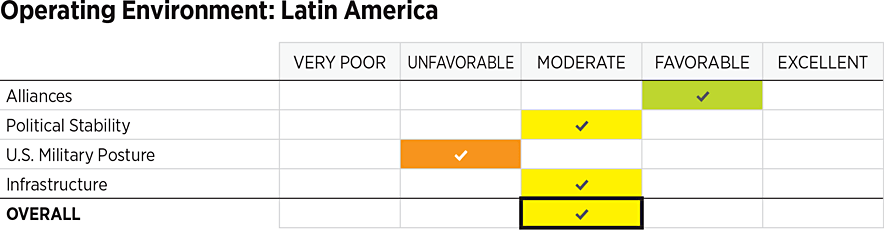
With these considerations in mind, we arrived at these average scores for Latin America and the Caribbean (rounded to the nearest whole number):
- Alliances/Partnerships: 4—Favorable.
- Political Stability: 3—Moderate.
- U.S. Military Positioning: 2—Unfavorable.
- Infrastructure: 3—Moderate.
Aggregating to a regional score of: Moderate.
Endnotes
[1] “Brazil’s Biggest Drug Gang Has Gone Global.” The Economist, November 23, 2023, https://www.economist.com/the-americas/2023/11/23/brazils-biggest-drug-gang-has-gone-global (accessed January 25, 2026).
[2] Lucy Hale, “Defending Argentina,” Woodrow Wilson International Center for Scholars, Latin America Center, Weekly Asado Blog, January 15, 2021, https://www.wilsoncenter.org/blog-post/defending-argentina (accessed January 25, 2026).
[3] Dan Gooding, “Trump Signs Directive that Could Deploy US Military in Mexico: Report,” Newsweek, August 8, 2025, https://www.newsweek.com/trump-military-directive-cartels-mexico-venezuela-2110960 (accessed January 27, 2026).
[4] Press release, “Maritime Interdiction Operation, Jan. 9, 2026,” U.S. Southern Command, January 9, 2026, https://www.southcom.mil/News/PressReleases/Article/4374298/maritime-interdiction-operation-jan-9-2026/ (accessed January 25, 2026).
[5] USAFacts, “Where Are US Military Members Stationed?” updated June 23, 2025, https://usafacts.org/articles/where-are-us-military-members-stationed-and-why/ (accessed January 25, 2026).
[6] MercoPress, “Last US Forces Abandon Manta Military Base in Ecuador,” September 19, 2009, https://en.mercopress.com/2009/09/19/last-us-forces-abandon-manta-military-base-in-ecuador (accessed January 27, 2026).
[7] Marlon González, “Honduras Suggests Ending US Military Cooperation over Trump Mass Deportation Threat,” Associated Press, updated January 3, 2025, https://apnews.com/article/honduras-trump-military-castro-65e94d6e0047ac8d02578e7fa48b8415 (accessed January 27, 2026).
[8] Benjamin Kurylo, “Comparative Analysis of U.S., Russian, and Chinese Military Cooperation with Latin America and the Caribbean,” Military Review Online Exclusive, July 2024, https://www.armyupress.army.mil/Portals/7/military-review/Archives/English/Online-Exclusive/2024/Kurylo-Comparative-Analysis/Comparative-Analysis-ua.pdf (accessed January 26, 2026).
[9] See, for example, Nicholas Slayton, “The US Military’s Plan to Revive Old Bases in Latin America,” Task & Purpose, November 14, 2025, https://taskandpurpose.com/news/us-bases-latin-america-revived/ (accessed January 27, 2026), and Sophia Davis, “Reawakening the Past: The US Military’s Daring Move to Reestablish Bases in Latin America,” The American News, January 1, 2026, https://theamericannews.net/america/ecuador/reawakening-the-past-the-us-militarys-daring-move-to-reestablish-bases-in-latin-america/#google_vignette (accessed January 27, 2026).
[10] Joint Task Force–Bravo, Soto Cano Air Base, Honduras, “Welcome Guide,” https://www.jtfb.southcom.mil/Portals/14/2023%20Welcome%20Guide%20-%2022%20Sept.pdf (accessed January 27, 2026).
[11] Joint Task Force–Bravo, “612th Air Base Squadron,” https://www.jtfb.southcom.mil/Units/612th-Air-Base-Squadron/ (accessed January 27, 2026).
[12] Chris Gordon, “US Airpower Paved the Way for Delta Force to Capture Venezuela’s Maduro,” Air & Space Forces Magazine, January 3, 2026, https://www.airandspaceforces.com/us-airpower-paved-the-way-for-delta-force-to-capture-venezuelas-maduro/ (accessed January 26, 2026).
[13] Andrés Martínez-Fernández, “With U.S. Support, Ecuador’s New Leader Can Combat a Daunting Narco-Crisis,” Heritage Foundation Commentary, August 11, 2025, https://www.heritage.org/americas/commentary/us-support-ecuadors-new-leader-can-combat-daunting-narco-crisis.
[14] Anastasia Moloney, “Colombia–Venezuela Rift Grows as Chávez Appears to Confirm Support for FARC,” World Politics Review, January 18, 2008, https://www.worldpoliticsreview.com/colombia-venezuela-rift-grows-as-chavez-appears-to-confirm-support-for-farc/ (accessed January 26, 2026).
[15] Andrés Martínez-Fernández and Andrew J. Harding. “Holding China and Mexico Accountable for America’s Fentanyl Crisis,” Heritage Foundation Backgrounder No. 3851, September 9, 2024, https://www.heritage.org/china/report/holding-china-and-mexico-accountable-americas-fentanyl-crisis.
[16] Matthew Olay, “Trump Announces U.S. Military’s Capture of Maduro,” U.S. Department of War, January 3, 2026, https://www.war.gov/News/News-Stories/Article/Article/4370431/trump-announces-us-militarys-capture-of-maduro/ (accessed January 26, 2026).
[17] Robert Peters and Andrés Martínez-Fernández, “How the US Military Demonstrates It’s Tactically Flawless,” The Daily Signal, January 7, 2026, https://www.dailysignal.com/2026/01/07/how-the-us-military-demonstrates-its-tactically-flawless/.
[18] Press release, “Nicolás Maduro Moros and 14 Current and Former Venezuelan Officials Charged with Narco-Terrorism, Corruption, Drug Trafficking and Other Criminal Charges,” U.S. Department of Justice, March 26, 2020, https://www.justice.gov/archives/opa/pr/nicol-s-maduro-moros-and-14-current-and-former-venezuelan-officials-charged-narco-terrorism (accessed January 27, 2026); Joshua Goodman and Aritz Parra, “Spain Arrests Venezuelan Spymaster Wanted on US Drug Charges,” Associated Press, September 9, 2021, https://apnews.com/article/europe-venezuela-caribbean-arrests-spain-27f9c219820c9911513327eaa48ac10c (accessed January 27, 2026).
[19] Prensa Latina, “Venezuelan Armed Forces Launch Exercise Bolivarian Shield 2025,” January 22, 2025, https://www.plenglish.com/news/2025/01/22/venezuelan-armed-forces-launch-exercise-bolivarian-shield-2025/ (accessed January 27, 2026). Prensa Latina is Cuba’s official state news agency.
[20] Alonso Moleiro, “The Warlike Power of Chavismo,” El País, January 27, 2025, https://english.elpais.com/international/2025-01-27/the-warlike-power-of-chavismo.html (accessed January 27, 2026).
[21] Lachlan Williams, “Venezuela Upgrades Old Tanks and Armored Vehicles to Boost Army Strength,” The Rio Times, June 23, 2025, https://www.riotimesonline.com/venezuela-upgrades-old-tanks-and-armored-vehicles-to-boost-army-strength/#:~:text=By%202021%2C%20the%20Army%20had%20finished%20upgrading,to%20international%20sanctions%20and%20a%20tight%20budget (accessed January 27, 2026).
[22] BBC, “Venezuela Navy Vessel Sinks After ‘Ramming Cruise Ship,’” April 3, 2020, https://www.bbc.com/news/world-latin-america-52151951 (accessed January 27, 2026).
[23] News release, “15 Current, Former Venezuelan Officials Charged with Narco-Terrorism, Corruption, Drug Trafficking and Other Criminal Charges,” U.S. Department of Homeland Security, U.S. Immigration and Customs Enforcement, March 27, 2020, https://www.ice.gov/news/releases/15-current-former-venezuelan-officials-charged-narco-terrorism-corruption-drug (accessed January 27, 2026).
[24] InSight Crime, Venezuela Investigative Unit, “Anti-Mining ‘Crackdown’ Shifts Ops Elsewhere in Venezuela,” March 7, 2020, https://insightcrime.org/news/anti-mining-crackdown-shifts-ops-elsewhere-in-venezuela/ (accessed January 27, 2026).
[25] Andrea Rodrígez, “Cuba Says 32 Cuban Officers Were Killed in US Operation in Venezuela,” Associated Press, January 3, 2026, https://apnews.com/article/cuba-us-venezuela-maduro-e66899b41f0b84cf83f77a69d399b486 (accessed January 27, 2026).
[26] Nora Gamez Torres, “Where Is Cuba’s Money? Secret Records Show the Military Has Massive Cash Hoard,” Miami Herald, August 6, 2025, https://www.miamiherald.com/news/nation-world/world/americas/cuba/article311488962.html (accessed January 27, 2026).
[27] Patrick Oppmann, AnneClaire Stapleton, Natasha Bertrand, Haley Britzky, Sergey Gudkov, and Sophie Tanno, “Russian Ships Arrive in Cuba as Cold War Allies Strengthen Their Ties,” CNN, updated June 12, 2024, https://www.cnn.com/2024/06/12/americas/russian-navy-cuba-intl (accessed January 27, 2026).
[28] Martínez-Fernández and Harding. “Holding China and Mexico Accountable for America’s Fentanyl Crisis.”
[29] Robert Greenway, Andrés Martínez-Fernández, and Wilson Beaver, “How the President Can Use the U.S. Military to Secure the Border with Mexico,” Heritage Foundation Special Report No. 309, January 27, 2025, https://www.heritage.org/border-security/report/how-the-president-can-use-the-us-military-confront-the-catastrophic-threat.
[30] Rafael Prieto-Curiel, Gian Maria Campedelli, and Alejandro Hope, “Reducing Cartel Recruitment Is the Only Way to Lower Violence in Mexico,” Science, Vol. 381, No. 6664 (September 22, 2023), p. 1312, https://arxiv.org/pdf/2307.06302 (accessed January 27, 2026).
[31] Robert J. Bunker, John P. Sullivan, David A. Kuhn, and Alma Keshavarz, “Mexican Cartel Tactical Note #46: Weaponized Drones (Aerial Improvised Explosive Devices) Deployed by CJNG in Tepalcatepec, Michoacán,” Small Wars Journal, October 5, 2020, https://archive.smallwarsjournal.com/jrnl/art/mexican-cartel-tactical-note-46-weaponized-drones-aerial-improvised-explosive-devices (accessed January 27, 2026).
[32] Jorge Monroy, “Reconoce Gobierno la Operación de 37 Cárteles del Narco, en el País [Government Recognizes the Operation of 37 Drug Cartels in the Country],” El Economista, May 19, 2019, https://www.eleconomista.com.mx/politica/Gobierno-admite-existencia-de-37-carteles-en-Mexico-20190519-0035.html (accessed January 27, 2026).
[33] Andrés Martínez-Fernández, “With U.S. Support, Ecuador’s New Leader Can Combat a Daunting Narco-Crisis,” Heritage Foundation Commentary, October 31, 2023, https://www.heritage.org/americas/commentary/us-support-ecuadors-new-leader-can-combat-daunting-narco-crisis.
[34] Staff Writer with Agence France-Presse, “Ecuador Says 11 Troops Killed in Attack by FARC Dissidents,” The Defense Post, May 10, 2025, https://thedefensepost.com/2025/05/10/ecuador-attack-farc-dissidents/ (accessed January 27, 2026).
[35] Defense.info Analysis Team, “Brazil’s Drug Gangs: From São Paulo Streets to Global Cocaine Empire,” Defense.info, August 18, 2025, https://defense.info/highlight-of-the-week/brazils-drug-gangs-from-sao-paulo-streets-to-global-cocaine-empire/ (accessed January 27, 2026).
[36] Joseph M. Humire, “Derailing the Tren de Aragua,” Heritage Foundation Backgrounder No. 3876, December 5, 2024, https://www.heritage.org/border-security/report/derailing-the-tren-de-aragua.
[37] Antonio Maria Delgado, “Venezuela Wanted a Dissident Dead and Hired Tren de Aragua Gang to Kill Him, Chile Says,” Miami Herald, January 23, 2025, https://www.miamiherald.com/news/nation-world/world/americas/venezuela/article299042200.html (accessed January 27, 2026).
[38] Fact Sheet, “Designation of International Cartels,” U.S. Department of State, February 20, 2025, https://www.state.gov/designation-of-international-cartels (accessed January 27, 2026).
[39] Martínez-Fernández and Harding, “Holding China and Mexico Accountable for America’s Fentanyl Crisis.”
[40] Lu Chen, Li Rongqian, and Denise Jia, “Peru Amends Law Allowing Cosco Shipping to Retain Exclusive Rights to Operate Chancay Port,” Caixin Global, June 8, 2024, https://www.caixinglobal.com/2024-06-08/peru-amends-law-allowing-cosco-shipping-to-retain-exclusive-rights-to-operate-chancay-port-102204435.html (accessed January 27, 2026).
[41] Peter Suciu, “China and Russia Lost a Big Fighter Sale Thanks to the F-16 Fighting Falcon,” 19FortyFive, December 19, 2024, https://www.19fortyfive.com/2024/12/china-and-russia-lost-a-big-fighter-sale-thanks-to-the-f-16-fighting-falcon/ (accessed January 27, 2026).
[42] David Vergun, “Argentina Increases Military Ties to the United States,” U.S. Southern Command, July 2, 2025, https://www.southcom.mil/MEDIA/NEWS-ARTICLES/Article/4234454/argentina-increases-military-ties-to-the-united-states/ (accessed January 27, 2026).
[43] Mar Centenera, “The US Sets Its Sights on Antarctica in Pushback Against China,” El País, May 1, 2025, https://english.elpais.com/international/2025-05-01/the-us-sets-its-sights-on-antarctica-in-pushback-against-china.html (accessed January 27, 2026).
[44] Cassandra Garrison, “China’s Military-Run Space Station in Argentina Is a ‘Black Box,’” Reuters, January 8, 2024, https://www.reuters.com/article/world/chinas-military-run-space-station-in-argentina-is-a-black-box-idUSKCN1PP0HQ/ (accessed January 27, 2026).
[45] U.S. Central Intelligence Agency, The World Factbook 2025–2026, “Brazil: Military and Security,” https://www.cia.gov/the-world-factbook/countries/brazil/#military-and-security (accessed January 27, 2026).
[46] Lachlan Williams, “Strengthening the Shield: Brazil’s Ambitious Military Modernization,” The Rio Times, August 6, 2024, https://riotimesonline.com/strengthening-the-shield-brazils-ambitious-military-modernization/ (accessed January 27, 2026).
[47] Naiara Galarraga Gortázar, “A Year After the Attempted Coup in Brazil, Lula’s Relationship with the Military Remains Tense,” El País, January 8, 2024, https://english.elpais.com/international/2024-01-08/a-year-after-the-attempted-coup-in-brazil-lulas-relationship-with-the-military-remains-tense.html (accessed January 27, 2026).
[48] Defense Forces, “Brazilian Army Commissions First Centauro II BR Armored Vehicles,” May 24, 2025, https://www.defenseforces.com/2025/05/24/brazilian-army-commissions-first-centauro-ii-br-armored-vehicles/ (accessed January 27, 2026).
[49] Peter J. Meyer, “Brazil: Background and U.S. Relations,” Congressional Research Service Report for Members and Committees of Congress No. R46236, updated February 24, 2020, https://www.congress.gov/crs_external_products/R/PDF/R46236/R46236.3.pdf (accessed January 27, 2026).
[50] Ibid.
[51] Camilo Jaimes, “¿Cuántos Militares Tiene Colombia? Así Se Compara Con Los Gigantes Globales Y Sus Vecinos Latinoamericanos [How Many Soldiers Does Colombia Have? This Is How It Compares to Global Giants and Their Latin American Neighbors],” 360 Radio, June 30, 2025, https://360radio.com.co/cuantos-militares-tiene-colombia-asi-se-compara-con-los-gigantes-globales-y-sus-vecinos-latinoamericanos/187125/ (accessed January 27, 2026).
[52] Wilson Beaver and Andrés Martínez-Fernández, “Florida Has a Drug Problem on Its Shores,” Heritage Foundation Commentary, June 7, 2024, https://www.heritage.org/homeland-security/commentary/florida-has-drug-problem-its-shores.
[53] Transcript, “Secretary of State Marco Rubio and Dominican President Luis Abinader at a Joint Press Availability,” U.S. Department of State, February 6, 2025, https://www.state.gov/secretary-of-state-marco-rubio-and-dominican-president-luis-abinader-at-a-joint-press-availability (accessed January 26, 2026).
[54] “Haiti’s Gangs Have ‘Near-Total Control’ of the Capital,” NPR, July 3, 2025, https://www.npr.org/2025/07/03/nx-s1-5455540/haiti-gangs-capital-port-au-prince-violence (accessed January 26, 2026).
[55] Alex Papadovassilakis, “The Jalisco Cartel’s Quiet Expansion in Guatemala,” InSight Crime, May 18, 2022, https://insightcrime.org/news/the-jalisco-cartels-quiet-expansion-in-guatemala/ (accessed January 27, 2026).
[56] Victoria Coates and Mike Gonzalez, “Biden–Harris Spurned Offers from Latin American Leaders to Help Close the Border,” Fox News, September 12, 2024, https://www.foxnews.com/opinion/biden-harris-spurned-offers-from-latin-american-leaders-help-close-border (accessed January 26, 2026).
[57] Andres Martinez-Fernandez, “Democrats Shouldn’t Be So Sanguine About Kamala’s ‘Root Causes’ Strategy,” The Hill, September 7, 2024, https://thehill.com/opinion/4866441-vice-president-harris-root-causes/ (accessed January 26, 2026).
[58] Lorena Baires, “Guatemala Beefs Up Borders as Part of Commitment to Regional Security,” Diálogo Américas, May 2, 2025, https://dialogo-americas.com/articles/guatemala-beefs-up-borders-as-part-of-commitment-to-regional-security/ (accessed January 26, 2026).
[59] R. Evan Ellis, “Guatemala’s Security Challenges and the Government’s Response,” Florida International University, Steven J. Green School of International & Public Affairs, Jack D. Gordon Institute for Public Policy, The Policy Spotlight, July 23, 2024, https://gordoninstitute.fiu.edu/news-events/the-policy-spotlight/2024/guatemalas-security-challenges-and-the-governments-response.html (accessed January 27, 2026).
[60] R. Evan Ellis, “Strategic Implication of the Chinese-Operated Port of Chancay,” China and Latin America Network: Multidisciplinary Approaches, Geopolitics and Geostrategy Axis, REDCAEM Working Paper Series, No. 42, November 2024, https:// chinayamericalatina.com/wp-content/uploads/2024/11/WP42-November-2024-REDCAEM.pdf (accessed January 26, 2026).
