

In August 2025, Chinese Communist Party (CCP) Secretary General Xi Jinping unveiled (again) his vision for a new world order at the Shanghai Cooperation Organization (SCO) Summit in Tianjin, China. Xi made clear China is leading a move away from the Western world order to an audience of 20 world leaders, many self-identifying as part of the so-called Global South.REF China is waging this competition using economic statecraft, education grants, media influence, and military presence. As a self-professed Global South leader, China sees itself as leading over 40 developing countries encompassing Latin America and Africa, many home to critical minerals, strategic energy reserves, and rapidly growing populations.REF This competition is anything but prosaic, involving as it does a mosaic of interests and dangers—for example, the scourge of narcotics trafficking—that are not limited to these countries and regions.
On September 2, 2025, the U.S. recommitted to prevailing in the decades-long war on drugs by sinking a boat that was trafficking narcotics in international waters and killing 11 members of the Tren de Aragua (TdA) gang.REF Legal considerations aside, this act illustrates the seriousness the U.S. affords the threat of illegal drugs—a seriousness that is shared in varying degrees by partners in Europe, Africa, and Latin America. Moreover, since that initial strike, additional boats carrying narcotics have been attacked.REF That these attacks will continue is demonstrated by the Administration’s designation of drug cartels as foreign terrorists and expansion of lethal attacks on cartel drug boats in the Pacific.REF Combating these cartels, however, will require a sustained maritime effort to sever them from primary narcotics markets in Europe and America.
This dedication to drug-free waters provides a chance for a fresh look at how America approaches the maritime expanse between Latin America and Africa and creates an opportunity to further U.S. interests in this important region that spans the mid-Atlantic between the Tropics of Cancer and Capricorn. Interdiction of cartel shipments in international waters simplifies the diplomatic and operational challenges and attacks the cartels’ business model where it is most exposed.
On top of the despair left in the wake of narcotics trafficking is the economic loss from illegal fishing by massive Chinese fishing fleets, often in the same waters that the narco-traffickers use to move their products. China benefits from the chaos sewn by narco-cartels that leverage pliable governments and political leaders while reaping windfalls by poaching fish stocks in lightly patrolled waters. Disrupted economies and weakened governance provide an opportunity to exploit further using strings-attached largesse without viable alternatives that too often nations succumb to Beijing’s debt diplomacy.
Severing the cartels from their markets across international waters and air necessarily requires enhanced maritime security, which also serves to improve the policing of illegal fishing. Freeing the region from these scourges can trigger increased economic activity and investment such as offshore energy development and trade—an undertaking for which an expanded Prosper Africa program, with its demonstrated ability to enhance interregional economic activity, can be particularly useful.
Addressing the Threat of Narco-Cartels at Sea Is Most Effective
Latin America and Africa are being hit hard by drug cartels and the addiction and chaos that they cause. This point has been made repeatedly in United Nations World Drug Reports.REF And business is booming: The cartels make more than $782.9 billion a year from the illegal drugs trade.REF
Their fastest-growing product is cocaine, which they sell in nearly equal volume to both North America and Europe.REF China helps the cartels by selling them the precursor chemicals they need to make fentanyl.REF These profits fuel the cartels’ malign influence, further weakening local governments in Latin America, and the cartels and Chinese criminal gangs like the Bang Group compound the problem by taking advantage of this weakness.REF A good example is Venezuela where the Maduro regime, under economic pressure, had turned increasingly to China, Russia, and the cartels.REF In March 2020, Venezuela’s unrecognized President, Nicolás Maduro, was indicted in the United States and charged with “running, together with his top lieutenants, a narco-terrorist partnership with the FARC [Revolutionary Armed Forces of Colombia] for the past 20 years.”REF On January 3, 2026, the U.S. military acted decisively to arrest and extract President Maduro to face U.S. justice.REF Yet, this narco-regime is far from being eliminated as long as current head of the National Constituent Assembly Diosdado Cabello Rondón and Minister of Defense Vladimir Padrino Lopez, both indicted and charged with narco-terrorism along with Maduro, are still in place.REF
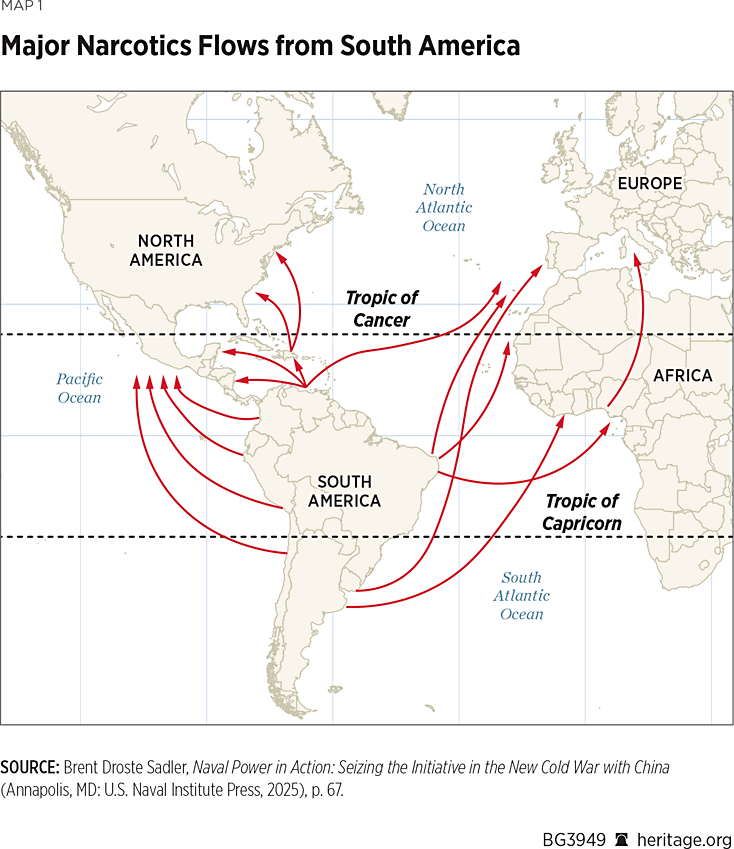
To disrupt this lucrative trade, the U.S. and its partners will have to destroy the logistics that underpin the cartels’ business model. This can best be done by creating obstacles in international waters and airspace for the shipping of fentanyl precursor chemicals, as well as for human trafficking, and cracking down on the illegal fishing and smuggling that the Chinese Communist Party (CCP) ignores. The TdA incident shows that the war on the cartels is receiving renewed, dedicated attention, but America is not alone in this fight; European countries have a stake in it as well. Countries like the Netherlands, Italy, France, Spain, and the United Kingdom, are directly affected by the drug trafficking and human smuggling that originates from the region. Furthermore, a resilient drug trade deters other investment into emerging markets, preventing the sort of commercial engagement that can encourage durable economic and social development.
Today, the cartels rely on several sea routes to move an overwhelming amount of their drugs. The most important routes cross the Pacific to Mexico and into the U.S., ferrying precursor chemicals from China to Mexican cartel fentanyl production sites as well as cocaine from South America. They also rely on stops in other countries before moving into the United States or through French Guiana to European Union nations, making French Guiana in effect Europe’s most porous border.REF Smugglers are drawn to French Guiana because once they are inside, they can use local drug mules to fly directly to Europe with fewer customs and immigration checks. This reliance on international shipping or airfreight routes is a weakness for the cartels.
As a potential starting point, the U.S. could focus on key countries that are currently committed to fighting the cartels and illegal fishing and also seeking to expand their trade with the U.S. The U.S. would establish or deepen its security coordination with countries that share its sense of urgency about restoring peace and security—for example, El Salvador, which has been aggressive in stopping smugglers at sea and is coordinating with the Joint Interagency Task Force South (JIATF-South). There also are opportunities with countries like Argentina, Guinea, Sierra Leone, and Guinea-Bissau to enforce maritime rights by targeting illegal Chinese fishing.
The JIATF-S was established in 1989 and has had some success in stopping the illegal trade in narcotics—specifically cocaine—but it has not been able to eliminate it. Officials estimate that because of insufficient numbers of Coast Guard cutters and aircraft, only about 10 percent of this trade has been stopped.REF In past years, interdiction near America’s shores was enough to force the cartels to adapt. The cartels then began to use Mexico and overland routes to move narcotics into the U.S., eventually paying the Mexican drug mules in narcotics instead of cash—in effect passing on the risk of moving product to market and leaving a trail of addiction and chaos.
With respect to fentanyl specifically, Chinese Triads used Mexican cartels to smuggle the drug into the U.S. By 2019, President Trump and China’s Xi Jinping agreed to stop the flow of the drug—but not the drug’s precursor chemicals that today fuel an epidemic of drug overdoses that claimed almost 74,000 American lives in the 12 months ending in April 2025.REF To make a real difference, an expanded JIATF-S mandate is needed to sanction interdiction of all illegal cartel trade routes on the high seas. The U.S. also needs to be mindful of China’s fishing fleets, which are often suspected of smuggling things like counterfeit cigarettes and worse.
Safer waters also point to stronger commercial development, and any increase in maritime security can create new trade relationships between the United States and Latin America and Africa.
China’s Scramble for the Global South
Bounded by the two tropics, Cancer and Capricorn, is a region that faces similar threats and offers significant opportunity: the so-called Global South. China has been waging a 20-year campaign to win over this region. For China, the Global South is a region that offers easy access to cheap natural resources and more secure energy. The CCP attempts to make common cause with the wider Global South as a champion against their colonial past, but today’s realities make this issue less compelling than it may have been during the Cold War. Each country in the trans-Atlantic corridor between the Tropic of Cancer and Tropic of Capricorn has its own colonial past and history, and each has its own national interests and aspirations. Taking a maritime approach in this corridor would give the United States an opportunity to counter China’s influence and unite the region around shared interests like maritime security and trade. Moreover, a maritime-focused counter-narcotics campaign would hit the cartels where they are most vulnerable in conducting their illicit trades.
Both African and Latin American countries are aware of great-power games and their not-so-distant colonial past, but unlike the wider Global South, the nations of Latin America and Atlantic coastal Africa are connected by language, history, and shipping routes. There is good reason to believe that an offshore approach focusing on common maritime interests can strengthen U.S. security and economic interests that are at risk from growing Chinese influence and presence in the same region. Such an approach critically acts without triggering memories of the past while providing real benefits for the people of the region and for American citizens.
Contesting China’s Debt Diplomacy and Massive Illegal Fishing Fleets
China’s strategy has centered around massive infrastructure projects, elite capture through graft, predatory lending, and lopsided trade deals. However, this approach often alienates the local community, which benefits only rarely from China’s presence as local political leaders bow for short-term Chinese favors. Africa has seen many such efforts fail, has suffered under debt diplomacy, and has seen its natural resources exploited. One notable example is Uganda’s renegotiating the tough terms of a 2015 deal with China to expand and modernize its Entebbe Airport for $200 million.REF Latin America is not far behind.
In June 2025, China’s state-owned COSCO started operations at Chancay Port in Peru, a $3.5 billion Chinese project to build a modern, highly automated shipping hub.REF Construction continues despite local concerns about labor and environmental impacts. It has long been suspected that these ports projects are being used for nefarious purposes. Christopher Hernandez-Roy of the Center for Strategic and International Studies, for example, raised this concern in a September 2023 article titled “Are Chinese Ports in Latin America Preferred by Organized Crime?”REF
China’s influence goes beyond trade and big infrastructure projects. Its fishing fleets often poach in places like the Gulf of Guinea, around the Galapagos Islands, and off the coast of Argentina.REF In June 2025, Argentine forces blocked about 300 Chinese fishing boats from entering Argentina’s exclusive economic zone (EEZ) where Argentina, like other coastal states, retains the right to all of the natural resources within it, including the seabed.REF This ongoing standoff has become a regular occurrence and led to the sinking of a Chinese trawler in 2016 and the firing of warning shots by Argentine forces again in 2019.REF Africa has faced challenges from a predatory Chinese fishing fleet in its waters as well.
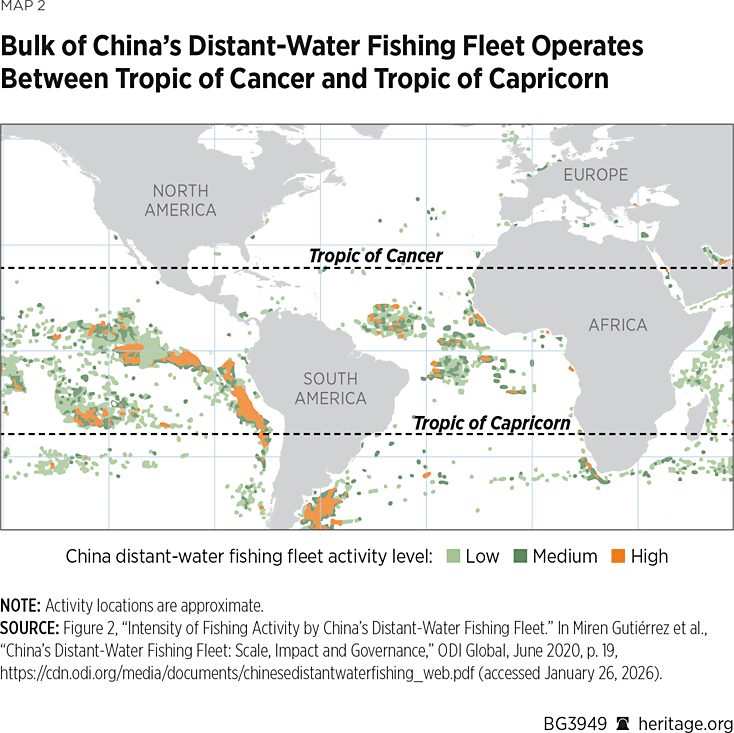
To address lawlessness at sea, Gulf of Guinea countries have been working together since 2011 in an annual maritime security exercise called Obangame Express. Led by the U.S., 30 nations participated in the most recent iteration, which was held from May 13–16, 2025.REF This exercise has helped to improve regional maritime security against piracy, illegal fishing, and other crimes. The investment in regional maritime awareness, for example, contributed to the capture of a Chinese fishing vessel, Hai Lu Feng, in 2020.REF It was discovered that Chinese fishing fleets used registration and location data for multiple ships to avoid licensing fees, duties, and limits on fishing. This allowed them to overfish, thereby harming the interests of local fishermen. The discovery of this activity was partly due to U.S. maritime capacity-building and skills practiced at Obangame Express.
The region is also a transit route for narcotics from Latin American cartels to markets in Europe.REF If the above maritime interdiction skills were applied on a trans-Atlantic scale, they could disrupt the activities of the cartels as well. Narcotics-related deaths peaked in the 12-month period ending in July 2023 with nearly 113,000 Americans killed.REF
Energizing Economic Resilience
After three years of war in Ukraine, Europe is still relying on Russia for energy,REF and this is making it harder to get Russia to agree to a ceasefire. Erasing this dangerous reliance on Russian energy is compelling European nations to look for alternate sources of energy in areas like Western Africa and Latin America. Italy is already looking to trade more energy with North African countries as part of Italian Prime Minister Giorgia Meloni’s Mattei Plan.REF It also is trying to deal with the issues of illegal migration and drug trafficking.
Europe will need more energy deals than are currently on the table if it is to meet its energy needs without relying on Russian petroleum. Also, fully weaning Europe and Asian allies from dependence on Russian oil will require getting American liquefied natural gas (LNG) and crude oil to market with a new fleet of commercial tankers.REF The trade in Russian petroleum from NATO nations in the month of December 2025 alone was nearly $4 billion, conveyed overwhelmingly on sanctioned shipping.REF Sanctioned shipping is also increasingly vulnerable to an American-led maritime offensive as demonstrated by Russia’s failed attempt to prevent the seizure of tanker Bella 1.REF
As allies look for new sources of petroleum, one potential new source is the offshore energy reserves of Guyana, a country that is still under threat from its neighbor Venezuela.REF In March 2025, a Venezuelan patrol boat threatened vessels working for ExxonMobil in Guyanese waters.REF In addition, after a years-long military buildup, Venezuela is claiming Guyana’s Essequibo region. This threat puts Guyana’s estimated 11 billion barrels of untapped offshore crude oil at risk. Guyana is already the world’s third-largest non-OPEC oil producer, and according to the U.S. Energy Information Administration, these petroleum reserves offer an alternative to Russian energy.REF
There also are opportunities to reduce our dependence on China such as finding new sources of rare earth minerals, expanding trade, and developing new industries. For example, the U.S. helped Congo and Rwanda to end a long and bloody war.REF Key to this peace is a minerals development deal brokered by the White House that opens them to American investment in mining their mineral resources, especially copper and cobalt.
Latin America and Africa could also provide great alternatives to Chinese manufacturers. According to a July report by ISS Africa Futures, developing energy generation with American investment could unlock the potential of Africa’s vast mineral reserves.REF In Latin America, Argentina is shaking off years of currency controls and economic volatility and is booming: GDP grew by an estimated 4.6 percent in 2025 after a 1.7 percent contraction in 2024 according to the World Bank.REF
America already has an economic framework that has yielded tangible results. Established by the Trump Administration in late 2018, Prosper Africa has facilitated over 800 deals with 45 African countries worth an impressive $50 billion.REF This initiative helped to connect small and medium enterprises, which created seven out of 10 new jobs according to the World Bank. This approach is a stark contrast to China’s elite-focused approach, and it benefits the widest populations in both American and African markets. The U.S. government should expand this to include Latin America as a viable alternative to China’s debt diplomacy.
Actualizing a Cancer-to-Capricorn Strategic Framework
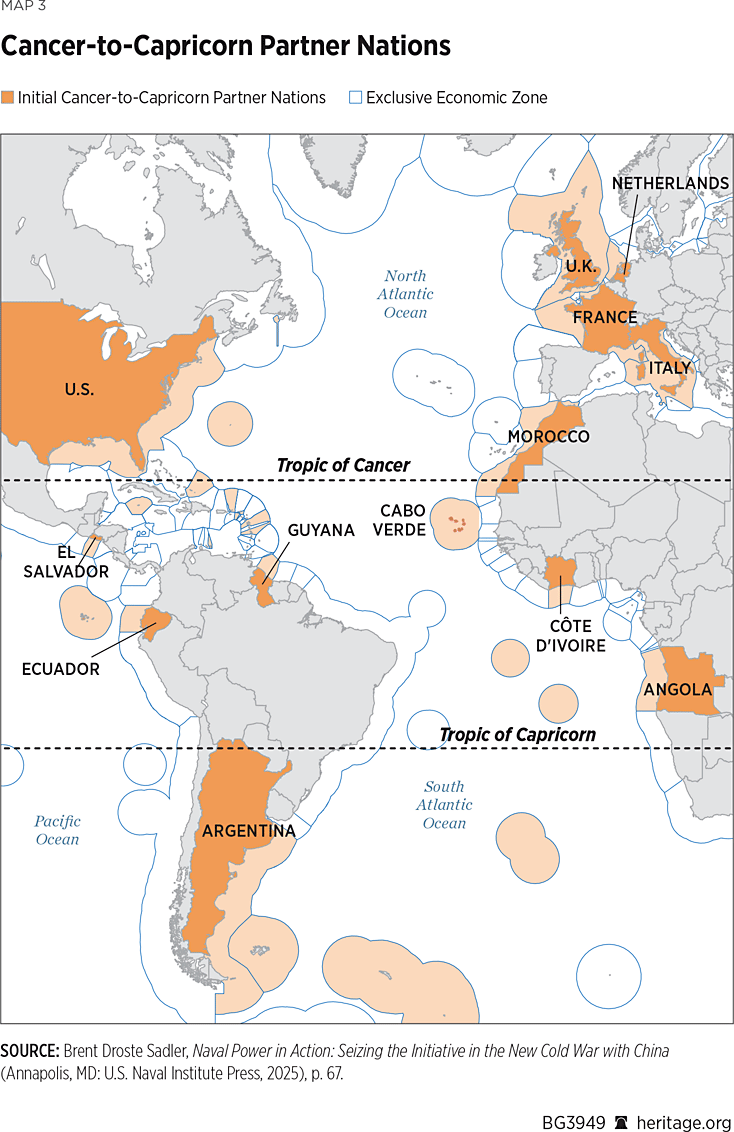
Current approaches have failed to secure American interests in the highly contested space known as the Global South. What America needs instead is a smarter approach that avoids triggering negative regional reactions while attracting likeminded partners in a common cause: bankrupting the cartels, enhancing economic resilience, and securing maritime rights. One way to accomplish this would be through a new Cancer-to-Capricorn Strategic Framework. To this end:
- The Secretary of State should host a “Cancer-to-Capricorn” conference. This inaugural event would be held in conjunction with a Western Hemisphere conference that The Heritage Foundation is planning to hold early in early 2026. The agenda would be to formalize participant nations and agree to a charter. This charter would include commitments to enhancing mutually beneficial economic development, protection of maritime rights, and enhanced countermeasures against illicit maritime activities such as illegal fishing and narcotics trafficking.
- Congress should draft legislation to expand the JIATF-S mandate. The laws establishing the JIATF-S (the National Defense Authorization Act for fiscal year 1989 and Anti-Drug Abuse Acts of 1986 and 1988) focus only on routes from Latin America to the United States.REF This has prevented broader interdiction on a scale that would seriously threaten the cartels’ bottom line and constrain wider participation in even more effective interdictions. Fixing this will require reframing the JIATF-S’s current mandate to focus on cutting all the sea routes on which the cartels rely across the Atlantic and the Eastern Pacific.
- The Secretary of Commerce should be designated as Executive Agent for a Prosper Atlantic program. This office, working closely with the Departments of State and War, would oversee all government economic development activities with participating nations in this region. To ensure wide government coordination across security, diplomatic, and economic lines of effort, a National Security Council team of specialists should be established to facilitate the formation of the Cancer to Capricorn Office and begin to deliver on its mandate. That mandate is to focus the activities, such as those by the Development Finance Corporation and Millenium Challenge Corporation, to encourage economic partnerships with American firms and investors that can grow American businesses while enhancing regional economic resilience. The successes of Prosper Africa would be incorporated into a wider regional program called Prosper Atlantic.
Conclusion
Between the Tropic of Cancer and Tropic of Capricorn, there are people with a common interest in fighting the cartels, protecting natural maritime resources such as fish stocks and seabed resources, and making our economies more resilient. It is time to forge a new trans-Atlantic partnership made up of secure and resilient economies that stretch from the Galapagos Islands to the Gulf of Guinea.
China’s debt diplomacy strategy of resource extraction, poaching resources where it can and enabled by elite capture, is inherently flawed. China has teamed with the cartels and unleashed their worst behavior on those who are too weak to resist and currently have no viable alternative to which they can turn unless the U.S. can energize resistance and collaboration for the common good.
A maritime Cancer-to-Capricorn strategic economic and security framework could deliver results for the U.S. and likeminded partners in Africa, Latin America, and Europe. Success would create a freer and more prosperous future for everyone, not just Americans—a reality the CCP would find it difficult to influence. The first step is to collaborate with select partners in the Cancer-to-Capricorn corridor. Working together to advance a select maritime set of priorities, the countries involved in this effort can finally and effectively challenge China’s plan for the Global South on terms that are fair and beneficial to everyone.
Brent D. Sadler is Senior Research Fellow for Naval Warfare and Advanced Technology in the Douglas and Sarah Allison Center for National Security at The Heritage Foundation.


