
The American Way of War
Douglas and Sarah Allison Center for National Security
“The American tradition has always been that once our troops are committed to battle, the full power and means of the nation should be mobilized and dedicated to fight for victory—not for stalemate or compromise.”
—General Douglas MacArthur, U.S. Army
Introduction
The United States is at a unique strategic inflection point. Our nation is simultaneously taking stock of the mixed legacy and unintended consequences of its wars in Afghanistan and Iraq, and the global war on terrorism more broadly, while also thinking through what the return of great-power competition and possible high-intensity war with the People’s Republic of China (PRC) might mean. As the United States strengthens its deterrence against China’s aggressive actions in the Indo-Pacific and beyond, it is also examining how it would fight the PRC if deterrence failed.
Much of the discussion about a potential war with the PRC concerns matters of quantity (e.g., how many ships, missiles, or bullets) and quality (e.g., exquisite weapon systems), but a broader discussion about how the United States traditionally fights its wars is also needed. The United States must also consider carefully when to employ force. Policymakers and elected officials must avoid costly and damaging strategic distractions while they concentrate on deterring and, if necessary, defeating threats to America’s core national security interests. The United States should especially seek to avoid nation-building projects that drain American resources and lack war-termination conditions. Finally, as the United States reorients to the Indo-Pacific as the primary theater of overseas operation and focuses its efforts on deterring aggressive Chinese actions, it must apply the central lessons of past combat experiences.
In short, the United States should not engage in specious military actions that serve only to distract policymakers and elected officials from pursuing and securing core national interests—and waste precious blood and treasure in the process. Nor should the United States retreat into a “fortress America” mindset. There are times when America should—and must—exert military power to protect the Republic, defend the rights of American citizens, aid allies, or even (in limited instances) support American ideals, but it must exert this force sparingly, with judiciousness and decisiveness, and always in pursuit of American national interests.
Legacy and Renewal
The legacies of the U.S. interventions in Afghanistan and Iraq serve as cautionary lessons about the limits of U.S. power and must inform contemporary strategic decision-making and thinking. Poorly conceived initial war plans, unclear or nonexistent conditions for successful conflict termination, an incomplete understanding of the cultures and requirements for long-term stability in both nations, and the failure of military and civilian institutions to adapt to the unique requirements of counterinsurgency led to disastrous long-term occupations and strategic mission creep. The costs of these interventions in terms of casualties, readiness, and lost opportunities, and as distractions from the rise of strategic competitors, have created significant challenges for the U.S. Department of War (DOW) as it confronts the realities and implications of great-power competition. The U.S. government’s decision to engage in these protracted conflicts also undermined the public’s trust in its leaders and hastened the end of America’s unipolar moment after victory in the Cold War, leaving the U.S. forced to operate in a far less stable security environment.
Both conflicts were also instructive in terms of other aspects of the American way of war and provide useful insights into how civil–military institutions function in a wartime environment as well as the broader methods of how the United States wages war. In many respects, the U.S. tends to fight long wars with short-term strategies, often throws resources at problems in place of institutional design considerations, has separate civil–military approaches, focuses on actions in capitals versus the countryside, embraces high-technology instead of mixed high-tech/low-tech solutions, and initially misconceptualizes conflicts but eventually learns how to fight them more effectively. These characteristics have been central to the American way of war during the past 25 years but are not always considered when discussions of great-power competition turn to issues of strategy and resource allocation.
To be competitive against China and Russia, the United States must understand these shortcomings and overcome them. It must renew itself if it is to survive the threats posed by China and Russia over the next half-century.
Historical Foundations of American Military Power
Since its founding in 1776, the United States has used its military forces for a broad spectrum of activities in the service of its political objectives. As the U.S. has expanded across the North American continent and grown to become a regional, hemispheric, and then global power, the use of its military has been driven by several key imperatives.
The central driver of U.S. war aims has been the security of the Republic, its people, and its institutions. Whether it is the depredations of frontier raiding parties, the preservation of the Union during the Civil War, attacks by Imperial Japan during World War II, or the attacks by al-Qaeda terrorists on September 11, the United States has often—but not always—used its military to protect the nation. For every employment of the Army to secure America’s southern border from attacks by Mexican bandits in the run-up to the First World War, there is a peace-keeping or humanitarian operation in Somalia based on an ideological pursuit that is unrelated to America’s vital national security interests.
America’s armed forces are also used to advance other interests such as market access (e.g., Commodore Matthew Perry’s opening of Japan’s ports to American trade); diplomatic and political goals such as the support of key allies and partners (e.g., support of Great Britain during World War II); narrowly defined political objectives to protect the homeland and American citizens (e.g., interdiction of illegal drug shipments or suppressive efforts against Pancho Villa); and support for overseas forces as they fight against America’s mortal opponents (e.g., support for anti-Communist forces in Latin America or Southeast Asia during the Cold War).
A third justification for the use of military force is protection of America’s rights as a nation. Examples include (among others) the U.S. response to British impressment efforts against U.S. sailors leading up to the War of 1812 and, more recently, freedom of navigation missions around Taiwan.
Finally, there are wars of choice in the pursuit of ideological goals, including humanitarian interventions and wars to spread democracy. This is perhaps the most potentially dangerous justification for employing force, as the pursuit of an ideal can be and frequently is a task that never ends. Using the military for the forcible promotion of democracy and human rights in regions and among cultures that have little to no tradition of either is a questionable and potentially costly reason to employ force. Historically, elements of all of these motives have influenced U.S. decisions about when to use military force, how to use it, and what proper political objectives the Republic should pursue.
The means by which the United States utilizes its military forces are also elements of the American way of war. The Republic’s strength grew from its founding as economic growth expanded U.S. power and influence. Over decades, local militias evolved into volunteer forces and from there into sustained regular military forces and then large-scale professional forces. With this evolution, the ability of the United States to wage war improved and expanded. Similarly, as U.S. industrial capacity grew, the defense industrial base grew as well. This growth enhanced both America’s capacity to meet its military objectives and the scope of U.S. power globally. As the U.S. Department of Defense (now Department of War) grew during the latter half of the 20th century, its abilities strengthened U.S. political and diplomatic power and, in conjunction with American economic and cultural dominance, enabled the United States to become the preeminent and, by 1989, unchallenged world power.
U.S. civil–military structures similarly evolved as the Republic grew, military capabilities expanded, Americans gained experience with war, and allied military planning efforts were initiated. The interaction between civilian political leaders and uniformed military leaders advising and eventually leading military forces in the service of political decisions is also central to an understanding of the American way of war.
The establishment of the Joint Chiefs of Staff system, in part an outgrowth of allied planning with the British during World War II, and its legal codification in the National Security Act of 1947 and the act’s 1949 amendments, which created the Chairman of the Joint Chiefs of Staff position, greatly influenced U.S. military strategic planning and the implementation of military objectives. The promotion of integrated operations, development of the Joint Force, and increases in appropriations, in addition to a large and sustained military planning capability and bureaucracy, influenced American military performance. Planning became more thorough, the combined effects of the various services became better coordinated and integrated, and the ability to conduct sustained operations increased thanks to a large, standing military force as opposed to the temporary growth of forces in prior conflicts.
Subsequent reforms, such as the U.S. Department of Defense Reorganization Act of 1958, removed the Joint Chiefs of Staff from the chain of command and created modern civilian control of the military. The 1986 Goldwater–Nichols Act advanced service integration, codified and expanded the unified combatant command system, bolstered the organizational capabilities of the Joint Chiefs, and created a Vice Chairman of the Joint Chiefs of Staff position. These reforms influenced the relationship between civilian and military leaders by providing a more professional and joint force, better planning, and greater, sustained resources for power projection, but they also narrowed the range of military advice to civilian leaders by taking the Joint Chiefs of Staff out of the chain of command.
Additionally, as outlined in the Federalist Papers, the U.S. Congress serves as a check on military power (e.g., control of funding, appointments, promotions, and investigations), which in turn affects how the U.S. military is used. The legislature is entitled to the unvarnished advice of the uniformed military and can compel—through investigations, hearings, funding decisions, and amplification of issues through the shaping of public opinion—changes in military strategy and the means by which it is implemented.
An additional consideration—and one that is universally a factor in military decision-making—is that initial military objectives can change as deeper knowledge of the enemy leads to adjustments in strategy and shifts in domestic political opinion. Also, although the U.S. military is well organized to fight conventional wars, it is not well designed to combat insurgencies and implement counterinsurgency strategies. The inherently political nature of these types of conflicts and poor understanding of this type of warfare can easily lead to a mismatch between the tools used to implement strategy (i.e., conventional) and what is required (i.e., unconventional/counterinsurgency). This disconnect between means and objectives or strategy and structure is frequently driven by civilian political leaders, but it is also true that military advice can be unknowingly misguided and seen through the prism of military careerism or a conventional military lens, all of which can complicate more pragmatic considerations of national interest and security.
Finally, a sense of crisis engendered by an event like the 9/11 terrorist attacks can override a more deliberate approach to strategy, causing a country’s initial strategy to be changed even though the war has commenced and the strategy is supported politically. Such revised strategies are often insufficiently thought out and prove unsuccessful in the end. In these and similar situations, how quickly military bureaucracies can adapt to change, often driven by enemy violence, can dictate success or failure. The need to cultivate well-defined political objectives that will then influence the military means by which they are implemented is central to success. Profound mismatches between them, frequently driven by political decisions and poor understanding of the problem, can easily lead to prolonged and unsuccessful military campaigns.
Neither “Empire” nor “Fortress America”
The United States emerged from the Cold War with the world’s most powerful military by a wide margin. American forces enjoyed clear if not decisive advantages in key theaters and were expected to be able to defeat multiple adversaries simultaneously.
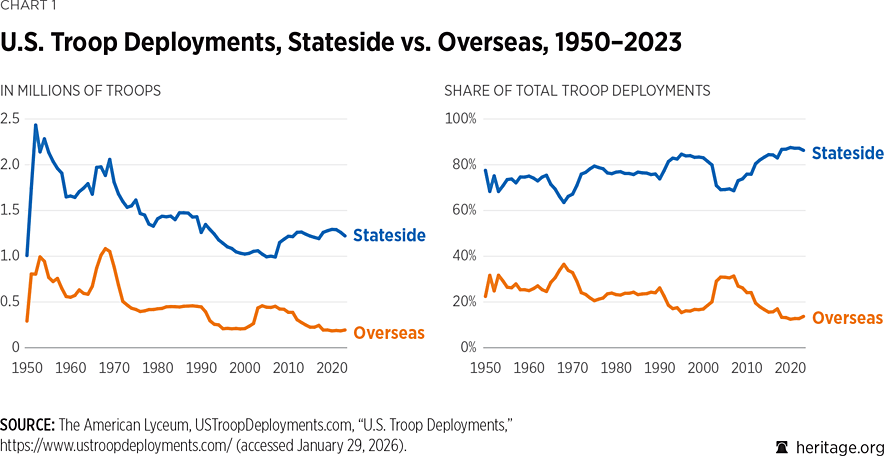
That is no longer the case. After decades of war and mismanagement, U.S. forces are stretched thin around the world. Many of them suffer from readiness challenges—including recruiting shortfalls, weapons shortages, and maintenance backlogs—and delayed modernization. As a result, the American military no longer enjoys many of the advantages that it enjoyed when the Soviet Union fell. Today, for instance, the United States has a very strong interest in preventing China from dominating the Indo-Pacific, but it is no longer clear that the United States will be able to deter Beijing. Worse still, if deterrence fails, there is a real chance that China will be able to defeat the United States in a war, particularly one that begins over Taiwan.
After more than a decade of decline, the American military is sized to fight and win only one major war at a time. Consequently, if U.S. forces went to war in one theater, our opponents might use this as an opportunity for aggression in other theaters, whether in coordination with one another or on their own initiative. This would be less troubling if allies and partners could reliably fill in for U.S. forces, but decades of underinvestment have left many of them unable to do so. Although this trend is now being reversed in both Europe and Asia, our allies in those regions have a significant way to go before they can rebuild long-dormant military capabilities. As a result, if the United States was drawn into a major conflict, there would be significant risk of cascading escalation across theaters, potentially culminating in a third world war.
The American homeland is also increasingly vulnerable. As tensions rise abroad, there is increased risk of enemy nuclear use against the United States. The risk of enemy non-nuclear missile strikes or destructive cyberattacks against U.S. targets is also rising. Meanwhile, America’s borders have faced overwhelming flows of migrants and narcotics, including foreign nationals who could threaten U.S. national security and drugs that are responsible for tens of thousands of American deaths each year.
These are difficult times, to be sure—but the future is not yet written. The United States has overcome periods of great danger before, and it can do so again. But until the United States and its allies in Asia and Europe can rebuild sufficient military force to credibly deter—and, if necessary, defeat—multiple adversaries in multiple theaters simultaneously as part of a two-war force construct, this will require prioritizing. Therefore, the United States must deploy its military forces where they are needed most, consistent with America’s interests, while strengthening allied and partner burden-sharing in other areas.
In practical terms, the United States must focus U.S. forces on defending the American homeland and denying China’s imperial ambitions, most urgently by deterring Beijing from invading Taiwan. Moreover, credible options must be presented to the President if deterrence fails. These are the most important missions the military must accomplish to preserve Americans’ security, prosperity, and freedom. Consequently, they must be America’s top defense priorities.
This does not mean that the United States should abandon other theaters or allies: far from it. Instead, the United States must find ways to defend its interests in those theaters without jeopardizing the ability of U.S. forces to defend the homeland and deny China’s imperial ambitions. To that end, Washington should empower allies and partners to lead efforts to defend against Russia, Iran, and North Korea with critical but more limited U.S. support. This would allow the U.S. to avoid cascading escalation by ensuring that allies and partners can deter opportunistic aggression even if key U.S. forces are drawn away from their respective regions. It also would leave U.S. alliances and partnerships far stronger than they have been at any time in the post–Cold War era.
The United States must resist the temptation to get drawn into strategic distractions through the application of military power to carry out missions that are not tied directly to American national security interests (such as peacekeeping operations in far-flung parts of the world or nation-building efforts in non-critical theaters). Far too often, such operations expend precious resources for little to no gain for the American people. At the same time, however, the United States must recognize that its interests also lie beyond the American homeland. American well-being must be secured both at home and in East Asia and Europe. Navigating a path between “Empire” and “Fortress America” may not be easy, but it is absolutely vital if our nation is to secure its core national security interests both at home and abroad without depleting American blood and treasure.
The 2026 Index of U.S. Military Strength therefore suggests that the United States pursue military modernization through a lens of “Restoring Peace Through Strength.” To do so, we must learn what worked during—and why we failed in—past military operations.
America’s Wars: Learning from Success
The three decisions of (1) whether to go to war, (2) what the war’s political goals are, and (3) how best to use the military to meet the political objectives of civilian political leaders have influenced every campaign undertaken by the United States. While it has officially declared war five times (the War of 1812, Mexican–American War, Spanish–American War, World War I, and World War II), the United States has used force for a multitude of reasons, employing a variety of means, over nearly two-and-a-half centuries. In addition to conventional wars like World Wars I and II, missions other than conventional war have included deterrence patrols (U.S. military activity off the coast of Taiwan during the Eisenhower presidency); shows of force (U.S. Navy ships off the coast of Venezuela); limited regime change (removal of Manuel Noriega from Panama or Nicolas Maduro in Venezuela); degradation of military capabilities (limited strikes on Iranian nuclear infrastructure); unconventional warfare (the invasion of Afghanistan after 9/11); and counterinsurgency (the Iraq and Afghanistan campaigns).
With respect to large-scale, conventional warfare, at least five best practices have facilitated U.S. success and should be considered as military and civilian leaders contemplate deterrent and war plans in response to current threats.
- Clear Political Objectives. Military action should be taken only in the service of clear political objectives as enumerated by the President and informed by the U.S. Congress using the advice of the uniformed military. A clear goal clarifies strategic choices, forces resource decisions, helps responsible leaders to balance competing priorities, and defines success or failure. As learning takes places against an enemy and some political goals shift, it is also imperative that political clarity is maintained as combat continues.
- Sustained Lethality. Although the outbreak of war is never perfectly predicted, a conventional war based on attrition must entail sustained lethality in a combined manner that is dynamic, prolonged, and quickly mobilized for effect. This approach requires both a current force that can quickly address a conventional opponent and the ability to sustain operations until total military victory is achieved. This in turn requires both robust warfighting capabilities (large armies, navies, air forces, etc.) and deep stores of munitions in addition to a focus on destroying the enemy’s military fighting ability.
- Mobilization of the Economy and the Defense Industrial Base. The ability to fully marshal the resources and people of the United States for conventional war has served as a vital strength of U.S. warfighting efforts. The industrial might of the U.S. and size of its population have long served as the decisive components of victory in conventional war. The ability to overwhelm the capabilities and sustainability of enemy strategies has given the U.S. an incomparable advantage in sustained combat.
- Allies and Partners. While planning for sustained operations against a conventional warfare opponent is prudent, the United States has often been successful working in concert with allies and partners. Cultivating relationships before conflict takes place is essential for sustained support once conflict begins. Allies and partners can provide not just needed manpower and warfighting capabilities, but also economic, political, and diplomatic support for sustained success.
- Sustainable Peace. A unique aspect of the American way of war is the ability of U.S. leaders to eschew short-term power considerations and see the long-term development of defeated opponents as future partners. This has often led to a “just peace,” such as the occupation of Germany and Japan after World War II. Both countries are now among America’s most important allies.
Other factors such as strategy, the will to fight, and political systems also clearly contribute to U.S. military success in conventional war, but these five key attributes have often served the U.S. as the central drivers of victory. As the United States reviews its experiences in the military campaigns of Afghanistan and Iraq and focuses its strategic attention on the challenge of the People’s Republic of China, it must take account of these factors and prioritize those that deter China’s aggressive military instincts most effectively—and avoid those actions that have led to costly and bloody failures or strategic distractions.
Peace Through Strength
As the assessments, analysis, and recommendations of the 2026 Index of U.S. Military Strength make clear, a return to strategic clarity necessitates prioritization of those military capabilities that can be most effective in deterring and defeating aggression. However, deterrence works only if a viable “war winning” strategy and set of capabilities also exist; one cannot endure without the other. A strategy of “Peace Through Strength” requires clear thinking about U.S. security concerns, interests, and rights set against the capabilities of the Joint Force today and what can be mobilized in the future. It requires soberly evaluating U.S. interests, both short-term and long-term, and ruthlessly prioritizing U.S. resource decisions so that we employ those that deter the strategies of our opponents most effectively. As the 2024 Index made clear, a decade of decline in these capabilities and strategic thinking, in part as a result of our focus on the conflicts in Afghanistan and Iraq, has left the United States—and the U.S. Department of War in particular—in a difficult strategic position.
The United States is trying to deter Chinese aggression while also grappling with the reality that it could face a kinetic conflict with the People’s Republic of China (and possibly with Russia, Iran, and North Korea as well) as it rushes to build the capabilities and capacity it needs to prevail. While past efforts to refocus the department on the threat posed by China never reached fruition, the first Trump Administration (2017–2021) eventually altered the strategic priorities of the Department of War and the U.S. government more broadly as it focused on the Indo-Pacific. This has led to a more determined focus on the region and China, but changing priorities, resource choices, leadership, and doctrine require a determined effort.
Enactment of the One Big Beautiful Bill Act has started the process of reallocating resources to promote peace through strength, but more must be done to achieve the strategic priorities of the National Defense Strategy. The theme of this year’s Index—“Restoring Peace Through Strength”—indicates that the United States is starting to turn the tide to meet the requirements of strategic sanity and clarity, but it also reflects the reality that after a decade of decline, this mission requires additional effort and sustained attention.
