U.S. Merchant Marine
Salvatore R. Mercogliano, PhD
Introduction
On June 12, 1775, the British armed sloop HMS Margaretta found herself pursued by the citizens of Machias, Maine. Following the Battles of Lexington and Concord in Massachusetts, American Captain Jeremiah O’Brien, on board the sloop Unity, followed by another sloop, Falmouth Packet, aimed to seize and arrest British sloop-of-war commander Midshipman James Moore. The capture of Moore’s Margaretta, while only a small footnote in the Revolutionary War, is seen as the beginning of the American Merchant Marine.[REF]
Two hundred and fifty years later, the U.S. Merchant Marine is ranked as the world’s 22nd largest merchant marine.[REF] In January 2025, the U.S. Maritime Administration identified only 188 ships of over 1,000 gross tons in the active fleet.[REF] That placed the United States commercial fleet at only 0.55 percent of the world’s fleet by deadweight tonnage. In terms of shipbuilding, the United States pales in comparison with nations like China (54.57 percent of world shipbuilding); South Korea (28.02 percent); and Japan (12.56 percent); in fact, as of December 2, 2025, the United Nations Conference on Trade and Development’s “Maritime Profile” entry for the United States says only “No value reported or collected.”[REF]
With a small commercial fleet and a diminutive commercial shipbuilding infrastructure, the United States finds itself in the strange position of being the most significant naval power in the world while also lacking the key commercial component to make it a true maritime power. This is a strategic vulnerability that leaves the U.S. exposed to economic coercion by China.
On April 9, 2025, President Donald Trump signed Executive Order 14269, “Restoring America’s Maritime Dominance,” which announced his new shipping strategy:
Section 1. Purpose. The commercial shipbuilding capacity and maritime workforce of the United States has been weakened by decades of Government neglect, leading to the decline of a once strong industrial base while simultaneously empowering our adversaries and eroding United States national security. Both our allies and our strategic competitors produce ships for a fraction of the cost needed in the United States. Recent data shows that the United States constructs less than one percent of commercial ships globally, while the People’s Republic of China (PRC) is responsible for producing approximately half.
Rectifying these issues requires a comprehensive approach that includes securing consistent, predictable, and durable Federal funding, making United States-flagged and built vessels commercially competitive in international commerce, rebuilding America’s maritime manufacturing capabilities (the Maritime Industrial Base), and expanding and strengthening the recruitment, training, and retention of the relevant workforce.
Sec. 2. Policy. It is the policy of the United States to revitalize and rebuild domestic maritime industries and workforce to promote national security and economic prosperity.[REF]
The President’s action was preceded by issuance of the United States Trade Representative’s Report on China’s Targeting of the Maritime, Logistics, and Shipbuilding Sectors for Dominance and reintroduction of the Shipbuilding and Harbor Infrastructure for Prosperity and Security (SHIPS) for America Act, sponsored by Senators Mark Kelly (D–AZ) and Todd Young (R–IN) and Representatives John Garamendi (D–CA) and Trent Kelly (R–MS), on April 30, 2025.[REF]
These three actions represent the most significant reform in American maritime legislation since the Merchant Marine Act of 1970. Moreover, the reconciliation budget enacted in the summer of 2025, the so-called One Big Beautiful Bill, allocated limited resources to the commercial maritime sector—$450 million “for maritime industrial workforce development programs” and $600 million “for the lease or purchase of new ships through the National Defense Sealift Fund”—but within defense spending and not for the lead agency, the U.S. Maritime Administration.[REF] As the assessment in this chapter will make clear, more resources will be required.
The Fall of the American Maritime Sector
The United States Merchant Marine and maritime infrastructure finds itself in this situation as a result of a series of actions dating back to the end of the Second World War. During World War II, the United States transformed itself into the Arsenal of Democracy, but it was the U.S. Merchant Marine and the American maritime sector that allowed for delivery from the home front to the battle front. That victory did not come without a cost: The United States lost 733 ships and approximately 9,500 American merchant mariners. With the defeat of Germany and Japan, the United States found itself with a Navy and Merchant Marine that were second to none. United States ships delivered 63 percent of the cargo for the Allies in the Second World War, and the U.S. Maritime Commission, the precursor to the modern Maritime Administration (MARAD), oversaw the construction of 5,777 ships and the training of nearly 250,000 merchant mariners.[REF]
At the end of the Second World War, the United States was in a position akin to that of the British Empire before the First World War with a massive Navy, a worldwide network of bases, and a commercial fleet that could transport the products from its factories to a world devastated by war in 1945. However, from the beginning, the United States adopted a series of policies to minimize its commercial dominance, and these policies in turn undermined the ability of the U.S. to sustain its maritime infrastructure.
- The Ships Sale Act of 1946 provided Allied merchant marines with 1,113 replacement vessels to repopulate their fleets.
- The General Agreement on Tariffs and Trade (GATT) lowered American tariffs but allowed for higher reciprocal tariffs against the United States to foster industries overseas.
- Before its entry into World War II, the United States used the Panama registry to avoid neutrality laws, particularly the transportation of 100-octane fuel to the United Kingdom. The use of these open registries proliferated with creation of the Liberian Registry by the U.S. in 1948. The aim was to provide one of the few independent states in Africa with an income source (registration fees) with lower regulatory thresholds to provide a registry for low-cost ocean transportation for emerging nations around the world.
- The Marshall Plan of 1949 provided loans to nations to restore their industry—in this case, to rebuild their shipyards using the pre-fabrication methods adopted in American shipyards by American industrialist Henry J. Kaiser, who brought assembly-line manufacturing techniques to shipbuilding.
- In 1949, the new U.S. Department of Defense (DOD) created its own military merchant marine, the Military Sea Transportation Service (renamed Military Sealift Command in 1970), which would manage the transportation of DOD cargo but still relied on the U.S. Merchant Marine for its crews and sustainment during times of war.
- The Federal-Aid Highway Act of 1956 led to the creation of the Interstate Highway System and shifted coastal cargo off of ships and onto shore. This had the effect of reducing demand for domestic U.S. shipping.
- The introduction of the Boeing 707 and McDonnell Douglas DC-8 jetliner freed space on intercontinental rail lines for more cargo.
- The Colonial Pipeline in 1962 diminished the need for tanker transportation between the U.S. Gulf Coast and East Coast.[REF]
- The Vietnam War demonstrated the need for a commercial merchant marine to meet initial demands in 1965, but the prolonged nature of the war required the breakout of ships from the National Defense Reserve Fleet, using ships left over from the Second World War (largely the Victory class) to free commercial ships to return to commercial service.
- In 1981, it was decided that the construction differential subsidy, which had been initiated under the Merchant Marine Act of 1936 to offset the higher costs of building American merchant ships involved in international trade, should be ended. This led to the shifting of commercial ship construction to nations in Europe, Japan, and Korea. (For a time in the 1980s, the U.S. Navy’s goal of building and maintaining a 600-ship fleet to counter the Soviet Union did keep domestic shipyards busy.)[REF]
All of these issues led to the overall decline of the U.S. merchant fleet from its commanding position in 1945. The U.S. Merchant Marine continued its significant fall, accelerating downward in the 1990s and early 2000s as the nation chased a supposed Cold War “peace dividend.” This occurred despite the emergence of China’s military to challenge America’s former maritime dominance.
Composition and Functions of U.S. Merchant Marine Fleets
The Merchant Marine Act of 1920, commonly referred to as the Jones Act—one of its authors was Senator Wesley Jones (R-WA)—laid out the purpose and policy of the United States toward its merchant marine:
It is necessary for the national defense and for the proper growth of its foreign and domestic commerce that the United States shall have a merchant marine of the best equipped and most suitable types of vessels sufficient to carry the greater portion of its commerce and serve as a naval or military auxiliary in time of war or national emergency, ultimately to be owned and operated privately by citizens of the United States; and it is declared to be the policy of the United States to do whatever may be necessary to develop and encourage the maintenance of such a merchant marine, and, insofar as may not be inconsistent with the express provisions of this act, the Secretary of Transportation shall, in the disposition of vessels and shipping property as hereinafter provided, in the making of rules and regulations, and in the administration of the shipping laws keep always in view this purpose and object as the primary end to be attained.[REF]
This statement lays out both the American Merchant Marine’s national security role and its commercial role. In 2025, both are in question because of the size, age, and infrastructure needed to sustain the service.
There are four different categories of fleets that make up the U.S. Merchant Marine:
- The Maritime, Tanker, and Cable Security Fleets,
- The Jones Act/Cabotage Fleet,
- The Military Sealift Command Fleet, and
- The Ready Reserve Force.
The three security fleets—Maritime, Tanker, and Cable—maintain a fleet of commercially viable, military useful merchant ships that are active in international trade. These fleets would be available to the U.S. Department of War (DOW) in times of conflict or national emergency. Established on October 8, 1996, the Maritime Security Program (MSP) resurrected the operational differential subsidy from the Merchant Marine Act of 1936, which had been phased out in the 1980s and early 1990s. The initial contracts were for 47 ships, which was later expanded to 60[REF] as depicted in Table 1.
Maritime Security Program (MSP). The Maritime Security Fleet provides a worldwide presence for U.S.-flagged ships and taps into the commercial networks of some of the largest shipping companies in the world, including Maersk, CMA CGM, HAPAG-Lloyd, Hoegh Autoliners, and Wallenius Wilhelmsen. The 60 ships are all built overseas, under 25 years of age, and engaged in commercial service. They are also available and in many cases under contract to transport DOW cargo, either as part of their scheduled voyages or when chartered for exclusive use by the DOW. The ships provide nearly 2,000 at-sea billets for American licensed merchant mariners. Their presence on all the world’s oceans gives the armed services the ability to move critical equipment and supplies. The MSP has three types of vessels: roll-on/roll-off ships (ro/ro); containerships (both non-sustaining and self-sustaining); and heavy-lift ships.[REF]
The MSP’s 20 roll-on/roll-off ships are operated by American Roll-on Roll-off Carrier (ARC); US Ocean; Farrell Lines; and Liberty Global Logistics.[REF] They cover the globe with services from the United States to Europe, the Middle East, and Asia including some round-the-world voyages. These ships are commonly used for military resupply and deployments to Europe in support of the North Atlantic Treaty Organization (NATO) and provide 3.5 million square feet of military useful capacity to the nation on a ready basis.
The 35 containerships include ships operated by Maersk Lines from the U.S. East Coast to Europe and the Middle East. Since Yemen’s Houthi attacks against ships in January 2024, U.S.-flagged ships have avoided the Red Sea and the Bab el-Mandeb Strait and instead have routed around the Cape of Good Hope. Other operators include APL, a subsidiary of the French-owned CMA CGM. APL recently swapped its six ships for newer ones and operates in the Pacific. Plans are for CMA CGM to transfer more ships to the U.S. registry, but those ships will operate under the CMA CGM banner, and it is unclear whether the MSP will be expanded to include them. HAPAG recently shifted their ships from Europe to the Pacific. Seven of the 35 containerships have cranes that allow them to operate in ports without shore cranes and operate around Africa and Asia. These ships are important if the ship-to-shore (STS) cranes in ports are damaged by combat, weather, or cyberattacks. Overall, the containerships provide the capability to transport 131,147 20-foot-equivalent units (TEUs) and are utilized to move DOW sustainment equipment and material around the world.
The final segment of the MSP consists of the five heavy-lift ships of US Ocean, LLC. These ships feature heavy-lift cranes with a maximum lifting capacity of 900 tons, a ro/ro ramp capacity of 150 metric tons, and the ability to carry watercraft. The ships demonstrated their versatility when they transported Army LCU-2000s back to the United States from Gaza relief operations in 2024.[REF] The ships also have the highest ice ratings, which makes them ideal for the yearly supplies to McMurdo Station in Antarctica and Pituffik Space Base in Greenland. All five of these ships were built in yards across China.
Tanker Security Program (TSP). In 2022, Congress approved funding for a 10-ship Tanker Security Program.[REF] Prior to creation of the TSP, there were two tankers in the MSP that the State Department used to transport fuel to Israel. The TSP was created to ensure that a core fleet of U.S.-based product tankers can operate competitively in international trade and enhance U.S. supply chain resiliency for liquid fuel products. Each ship receives an annual stipend of up to $6 million. Unlike the MSP containerships, which operate on set routes, TSP tankers, much like the ro/ros and heavy-lift ships of the MSP, depend on individual charters and voyages. The TSP targeted Medium Range (MR) product tankers of between 30,000 and 60,000 deadweight tons with a fuel capacity of 230,000 barrels. For comparison, a new John Lewis–class Military Sealift Command oiler can carry 156,000 barrels.[REF]
The initial contract was for nine tankers, evenly split among three companies. Crowley, in conjunction with Stena Bulk, reflagged Stena Immaculate, Stena Imperative, and Stena Impeccable. Overseas Shipping Group (OSG) added one tanker to the two that were in the MSP to make three: Overseas Santorini, Overseas Mykonos, and Overseas Sun Coast. The final company, TORM, teamed up with Seabulk and reflagged the ships Torm Thunder, Torm Thor, and Torm Timothy. The tenth ship, Shenandoah Trader, came from US Marine Management.[REF]
The 10-ship program did not remain in place long. The provisions of the TSP prevented the ships from being chartered by the U.S. Department of Defense for longer than 180 days. This meant that when Military Sealift Command advertised contracts for U.S.-flagged tankers, these ships were excluded if the terms went beyond half a year.[REF] Overseas Mykonos was withdrawn from the TSP so that OSG could charter the ship to MSC. On March 10, 2025, Stena Immaculate, on a short-term contract to Military Sealift Command to haul U.S. Air Force fuel to the United Kingdom, was rammed by the MV Solong, a Portuguese-flagged containership under the command of a Russian master. Stena Immaculate survived a massive fire, and all of the crew were saved, but one on board Solong perished. It is unclear whether Stena Immaculate will be able to return to service, leaving just eight ships operational in the TSP.[REF]
Plans to increase the TSP to 20 ships will depend on the global tanker market, the availability of MR tankers on the open market, and whether future contracts will allow for longer charters to the U.S. Department of War. With the closing of the Red Hill fuel facility in Hawaii and the need for distributed logistics across the Indo-Pacific theater, the growing demand for floating tanker storage means growing demand for TSP tankers.[REF]
Cable Security Program (CSP). The final security fleet is comprised of the cable security ships. Recent anchor drags in the Baltic Sea have highlighted the danger to undersea telecommunication, power, gas, and fuel pipelines and cables. The Military Sealift Command has operated just one cable repair ship since the 1980s, USNS Zeus (T-ARC 7). The CSP added two ships to the U.S. registry: MV Decisive and MV Dependable, both of which were built in Singapore in 2003 and 2002, respectively. In August 2024, then-Secretary of Transportation Peter Buttigieg announced plans to cut the $10 million in funding for the CSP, but the ships remain under U.S. registry.[REF]
The protection of U.S. coastal trade has always been of vital importance. The second law adopted by the First Congress in 1789 imposed “a duty on goods, wares, and merchandizes, imported into the United States” and was followed by an act imposing “duties on tonnage.” In 1817, following the War of 1812 with Great Britain, the U.S. passed legislation to prohibit foreign shipping from operating in the coastwise trade. Since then, most famously with Section 27 of the Merchant Marine Act of 1920, protection of domestic transportation or cabotage has been the law.[REF] Under its current version, “a vessel may not provide any part of the transportation of merchandise by water, or by land and water, between points in the United States to which the coastwise laws apply, either directly or via a foreign port” unless it “is wholly owned by citizens of the United States for purposes of engaging in the coastwise trade.”[REF]
In January 2025, the Maritime Administration identified 92 of the 188 ships over 1,000 gross tons and engaged in carrying cargo between U.S. ports as “Jones Act Eligible” (although certain sectors and ships are omitted). Freighters (a combination of containerships, general cargo, and ro/ro) and tankers make up the 92-ship fleet.
Freighters are used to move cargo between the continental United States and its non-contiguous states and territories. Matson Navigation Company operates in the Pacific, principally between the U.S. West Coast, Hawaii, and Alaska, but also Guam, China, and Okinawa. PASHA operates between Hawaii and the Mainland; TOTE operates between the U.S. and Alaska and between the continental U.S. and Puerto Rico and the Caribbean; and Crowley services Puerto Rico. Coastal Transportation and Trident Seafoods operate exclusively in and around Alaska in the fishing trade.[REF]
The second major group of ships in the Jones Act are the 55 tankers owned and operated by a variety of firms: Fairwater—a joint venture between SEACOR Holdings and Crowley—and Maritime Partners, OSG, BP Exploration, and Polar Tankers. They operate between Alaska and the U.S. West, Gulf, and East Coasts. Some haul crude oil directly to refineries in the mid-Atlantic from the Gulf, and others sail to Florida because the state is not serviced by pipelines. All of these tankers are double hulled, having been replaced following the Oil Pollution Act of 1990.[REF]
The other component of the Jones Act fleet are those directly involved in the inland waters of the United States. These include the tugs and barges along the coasts and inland water, and the Great Lakes cargo fleet that operates between March and January. According to the Lake Carriers’ Association, U.S.-flagged Great Lake freighters moved 78.2 million tons, including sand, salt, iron, grain, coal, cement, and limestone, in 2024.[REF] The replacement of U.S. Coast Guard icebreakers on the Great Lakes has been delayed, and the current 140-foot icebreaking tugs are now beyond their 40-year life cycle. The one positive aspect has been the continued progress on the new Sault Ste Marie (Soo) lock in Michigan. Currently, only the Poe Lock can handle the largest Lakers, which means that a crucial component of our national economic security is reliant on a single piece of infrastructure.[REF]
Military Sealift Command (MSC). The third major fleet in the U.S. Merchant Marine is operated by the Navy’s Military Sealift Command. Created in 1949, as the Military Sea Transportation Service (MSTS), MSC is the largest single employer of merchant mariners with more than 5,500 directly employed by the U.S. Department of War as civil service mariners and another 1,500 on contract operated ships. When MSTS was created at the beginning of the Cold War, its mission was to transport troops, fuel, and cargo for the U.S. military. Over its 75-year history, MSC has adopted new missions such as oceanographic surveys and support to missile defense, and its current fleet reflects that evolution.[REF]
In 1972, the Navy oiler USS Taluga was redesignated as the United States Naval Ship (USNS) Taluga (T-AO 62), and its crew of naval sailors was replaced by civilian merchant mariners. The ship was the first oiler transferred to MSC and proved that civilians could support the underway replenishment mission of refueling vessels off the coast of Vietnam.[REF] By the 2010s, MSC operated all of the U.S. Navy’s auxiliary vessels, including several with hybrid crews (a combination of civil service mariners and U.S. Navy sailors). By 2025, one out of every five ships in the U.S. Navy had civil service mariners on board, and many of the ships were integrated into the force structure and operation of the fleet.[REF]
Combat Logistics Force. The first of MSC’s five major missions is that of the Combat Logistics Force. They are the descendants of Taluga and are broken into three groups. Two of the Supply-class fast combat support ships—USNS Supply (T-AOE 6) and USNS Arctic (T-AOE 8)—are based on the East Coast. Both ships recently proved their value in supporting the deployments of the Eisenhower and Truman strike groups to the Red Sea against the Houthis.[REF] All of the civilian-manned U.S. Navy replenishment ships are unarmed and defenseless and could well be at serious risk in a future peer-to-peer conflict on the world’s oceans.
The largest group in the Combat Logistics Force is comprised of the fleet replenishment oilers. The mainstay of the fleet is the aging Henry J. Kaiser class. The first of these ships, which are capable of hauling 180,000 barrels of fuel at 20 knots, entered service in the mid-1980s, so they are approaching the end of their operational life. The plan is to retire them as new John Lewis–class oilers come online from the National Steel and Shipbuilding Company (NASSCO).[REF] However, delays in production of the first three ships necessitated prolonged post-delivery availability: USNS John Lewis (T-AO 205) conducted its first deployment in mid-2025.
In September 2024, the oiler USNS Big Horn (T-AO 198) ran aground while supporting the Lincoln strike group off Oman. The ship suffered flooding of its engine room and damage to the propellers and rudders. Towed back to the United States, Big Horn was withdrawn from service. The loss of Big Horn demonstrated the vulnerability of naval logistics when a single oiler was tasked to support an aircraft carrier and its escorts. The Lincoln group had to dispatch several of its escorts into the Red Sea to refuel, and a commercial tanker, fitted to conduct underway replenishment, had to refuel the carrier.[REF]
The last of the Combat Logistics Force are the 14 ships of the Lewis and Clark–class dry cargo/ammunition ships. As the name implies, the Lewis and Clark ships marry the capabilities of store ships (AFS) and ammunition ships (AE), into a composite T-AKE ship. Two of the ships are allocated to the afloat prepositioning force, and the other 12 are based around the world to support the Navy. Typically, two are forward deployed in the Persian Gulf: USNS Alan Shepard (T-AKE 3) and USNS Amelia Earhart (T-AKE 6). Some are based in the western Pacific and rotate between Singapore, the Philippines, Korea, and Japan. The remaining are on the West and East coasts with the latter being deployed to Europe and the Mediterranean as needed.[REF]
Special Missions. Special Missions dates to 1958 and involves survey ships exploring the ocean depths and range instrumentation vessels such as USNS Howard O. Lorenzen (T-AGM 25) and SBX-1 monitoring ballistic missile tests by China, Russia, and North Korea. Seven ships provide a unique form of ocean surveillance by towing passive and active sonar arrays. The five MSC T-AGOS operate in the western Pacific amid the First Island Chain to monitor Chinese submarines, and the two commercial ships are on the U.S. East Coast. The venerable cable ship USNS Zeus completed its last mission in early 2024, and the chartered CS Global Sentinel has taken its place.[REF]
Prepositioning and Seabasing. The third area, Prepositioning and Seabasing, goes back to the early 1960s when U.S. Secretary of Defense Robert S. McNamara decided to load and preposition Victory ships near potential trouble spots around the world. Only three were activated, and all of them were offloaded in Vietnam in 1966. In 1979, the Rapid Deployment Joint Task Force, the forerunner of U.S. Central Command, needed shipping preloaded and prepositioned to marry with troops flying in from the United States. The Near Term Prepositioning Force, later the Afloat Prepositioning Force, took form in the anchorage of Diego Garcia in the Indian Ocean. By the time of the Persian Gulf War, the U.S. Marine Corps had three squadrons with a total of 13 ships stationed in the Atlantic, Indian, and Pacific Oceans. Another dozen ships carried equipment for the Navy, Air Force, and Army along with fuel and even water. By 2001, the Army had added its own brigade afloat along with the combat support and combat service support for an entire corps.[REF]
The concept of afloat prepositioning has largely fallen out of favor with the Department of War. From a high of four squadrons of ships—three Marine Corps and one Army—just a handful of ships remain. The Marine Corps operates a few ro/ros around Korea, Japan, and the Marianas. The Army decided to shift its afloat war reserves (AWR-3) to shore bases in western Asia and the Middle East. The Air Force, which once operated four containerships, has halved its program.
The newest element in prepositioning/seabasing consists of the new Lewis B. Puller–class expeditionary support bases (ESBs). The ESBs are designated as USS with a Navy O-6 in command but a civilian mariner crew to handle the engine room, navigation, and feeding for the ship. A modification of the commercial Alaska-class supertankers built by NASSCO, ESBs feature an immense landing platform and facilities for embarked personnel to launch and recover aerial and surface drones.[REF]
Fleet Support. This fourth area of the MSC fleet includes a host of specialized ships, both purpose-built and converted. They include many offshore support ships that are used to support the submarine force and special forces as well as some that are used for fleet experimentation. This second group includes the fleet’s two venerable hospital ships—USNS Mercy (T-AH 19) and USNS Comfort (T-AH 20)—along with rescue and salvage ships, which are about to be replaced by the new Navajo Nation–class salvage ships, and a fleet of fast transports. The fast transports were designated by the commander of Military Sealift Command, Rear Admiral Philip Sobek, and U.S. Fleet Forces for layup in order to free crews to support the ships in the Combat Logistics Force.[REF]
Chartered Ships. The final area is made up of ships chartered from the U.S. Merchant Marine and used to transport dry cargo and tankers. According to MSC, the latter category has grown with 10 tankers under charter as of December 2025. Many are used to distribute fuel to Defense Logistics Agency depots worldwide, but with the closing of Red Hill in Hawaii, the Indo-Pacific Command required afloat storage for some of its fuel as part of distributed logistics.
Additionally, since 2015, MSC had returned to outfitting its leased tankers with the capability and requisite training to conduct Consolidating Operations (CONSOLs) with ships of the Combat Logistics Force, and those warships were fitted with underway replenishment rigs. It was one of these ships, MV Overseas Mykonos (the ship that withdrew from the Tanker Security Program), that was dispatched to provide needed fuel to USS Abraham Lincoln (CVN 73). The tankers in the MSC charter fleet are a mix of vessels and demonstrate one of the reasons why the United States needs once again to begin constructing commercial tankers.[REF]
Ready Reserve Force (RRF). The fourth U.S. Merchant Marine fleet is designated not as a fleet, but as the Ready Reserve Force. Following the Vietnam War, the U.S. Department of Defense realized it needed a pool of vessels that would be available when the Merchant Marine was unable to respond. In 1965, the U.S. commercial fleet answered the call, but as the war progressed, the shipping lines needed their ships to return to their normal service. In their place, 172 ships were activated from the National Defense Reserve Fleet, but those ships were poorly maintained, took weeks if not months to activate, and were excessively costly while reliability was low. In 1977, the RRF was created, and in January 2025, it consisted of 51 ships: 45 ro/ros, four crane ships, and two aviation logistics support ships.[REF]
The RRF was maintained in a five-day reduced operating status with the ships operated by commercial shipping firms on a 10-year contract. Ships were berthed evenly among the U.S. West, Gulf, and East Coasts. The heart of the fleet was the 45 ro/ros, which provided over 10 million square feet of cargo space. The ships were a mix of designs, and the majority were foreign built with propulsion varying from steam boilers to gas turbines and diesels. Their average age was 45 years. In 2019, during a massive readiness exercise—Turbo Activation 19—28 ships received no-notice orders to activate. Of these, 23 activated, just below the required 85 percent threshold, but the test demonstrated some other major issues.[REF]
In the fleet, 22 ships were in a non-mission capable status, meaning they could not meet the five-day activation if alerted. This reduced the RRF’s overall capability by 3.7 million square feet. The ships that were activated and did not sail experienced a myriad of issues. The final finding was the most damning: When all factors were considered, including the performances and tests conducted on the ships that did activate, the RRF’s overall rating was 40.7 percent.
This poor performance in 2019 and again in 2021 pushed the need to accelerate the RRF Recapitalization Program. Since its inception, seven ro/ros—have joined the RRF, but the reflagging of the first two (Cape Arundel and Cape Cortes) ran into difficulties with the U.S. Coast Guard, which is ironic as the ships had previously been U.S.-flagged. As new ships entered the fleet, older ships were retired, including the venerable Fast Sealift ships and several ships in some of the major classes, to provide parts.[REF] It is expected that some of the LMSRs (Large, Medium-Speed Roll-On/Roll-Offs) used in the Marine Corps and Army prepositioning programs will join the RRF, but efforts to revitalize the surge sealift force have just barely maintained the status quo.
Scoring the U.S. Merchant Marine
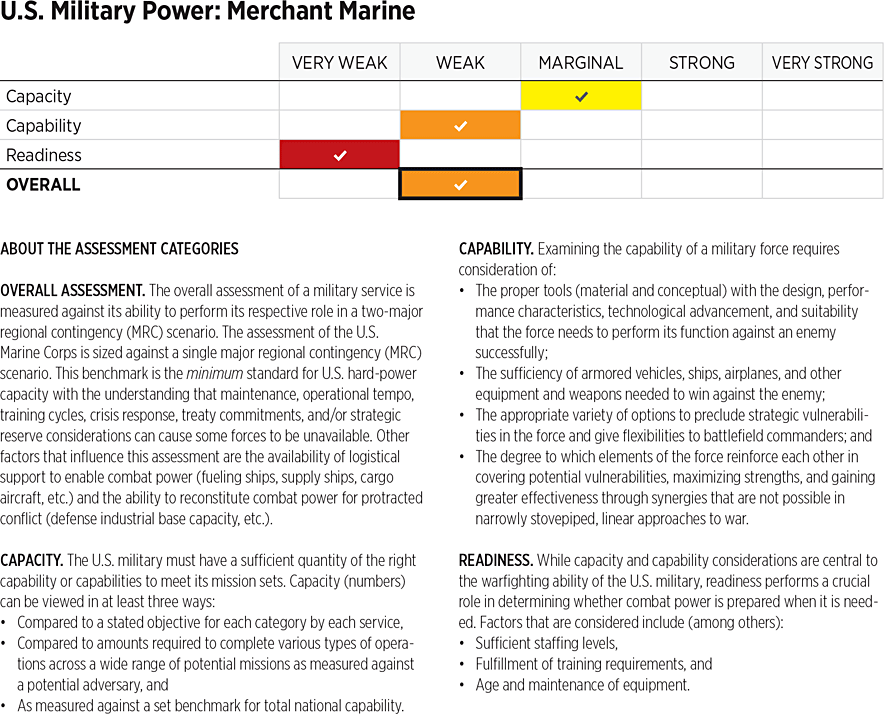
Capacity Score: Marginal
The current size of the U.S. Merchant Marine—188 commercial ships (those in the security fleets and cabotage trade), over a hundred ships in the Military Sealift Command, and 51 ships in Ready Reserve Force—along with the personnel and maritime infrastructure, is not sufficient to support the U.S. military and economy adequately including, when required, in a protracted conflict. Despite current efforts to reverse this trend, such as the SHIPS for America Act and the President’s executive order on shipbuilding, the aging of the surge sealift fleet and reduction in the number of active ships in the MSC fleet because of critical crewing issues cause the U.S. Merchant Marine’s capacity to be rated as “marginal.”
Capability Score: Weak
The current Merchant Marine, Military Sealift Command, and surge sealift fleets meet the requirements as set out by the U.S. Department of War and commercial needs. Issues with delayed entry of replacement vessels, such as the Lewis-class replacing the Kaiser-class oilers, have further strained the fleet. However, the reduced overall size of afloat prepositioning and the age of the surge sealift fleet cause the ability of the Merchant Marine to meet its required capabilities to be rated as “weak.”
Readiness Score: Very Weak
It is in readiness that the U.S. Merchant Marine scores lowest. The loss of USNS Big Horn while supporting the Abraham Lincoln battlegroup and the collision involving MT Stena Immaculate demonstrate the vulnerability of afloat support for naval and military forces around the world. Tests involving the Ready Reserve Force have highlighted concerns about readiness, and issues remain with respect to whether there are adequate personnel to fully crew the RRF in an emergency lasting more than six months. The Merchant Marine’s overall readiness is therefore rated as “very weak.”
Overall U.S. Merchant Marine Score: Weak
With a Merchant Marine ranked as 22nd in the world, the reduced readiness of 17 ships in the MSC fleet, and the aging of the Ready Reserve Force and inability to keep up vessel replacement versus retirement, the overall capacity and capability of the U.S. Merchant Marine are clearly in decline. Given the lack of current shipbuilding—the shipyard in Philadelphia is the only one building any commercial vessels for the merchant marine—the fleet will likely continue to age without adequate replacements. These issues have an impact on direct support to the Navy; on maritime infrastructure as shipyards and repair facilities have no commercial alternatives to sustain them; and on the U.S. Department of War as any deployments will be forced to rely on a shrinking and aging fleet and workforce that are potentially unable to support them at required levels. The U.S. Merchant Marine’s overall score is therefore “weak.”
Policy Recommendations
The U.S. Merchant Marine serves as a crucial auxiliary for the military in time of war and national emergency while providing an essential service in the transportation of goods in the coastwise cabotage trade. A potential peer-to-peer conflict would severely strain the Merchant Marine’s capabilities, and the shifting of ships from domestic and international trade into military support missions would have a disruptive effect on the American economy.
Several studies that have been conducted point to a significant deficit in American sealift; one report commissioned by the Maritime Administration remains embargoed a year after its conclusion in late 2024. Nevertheless, several reviews that are publicly available and a workshop hosted at The Heritage Foundation with industry and military experts confirm the need for approximately 1,300 commercial ships to mitigate Chinese maritime dominance. Specifically, the nation will need the following U.S.-flagged and U.S.-crewed vessels, augmented perhaps with allied assured sealift, for a total of 1,315 ships of six different classes:
- 960 containerships;
- 122 tankers;
- 33 liquefied natural gas (LNG) carriers;
- 77 roll-on/roll-off ships;
- 106 bulk carriers;
- Seven heavy-lift ships (four for military damage repairs and three for cargo that can be delivered only on this class of ships); and
- 10 cable-laying and repair ships.
This total represents a conservative estimate that still assumes significant risk of Chinese interference.[REF] Regarding wartime sealift needs, ongoing TIDALWAVE wartime campaign simulations being conducted by The Heritage Foundation validate a need for no fewer than 45 oilers (TAO): As of December 26, 2025, the Navy had only 20.
The sealift capacity of the Military Sealift Command and the Maritime Administration’s Ready Reserve Force is adequate based on current estimates, but the readiness, age of the fleet, and personnel for any conflict lasting more than six months are in serious question. Not factored into the current fleet are any attrition or losses and how to replace such displacements. In the First World War, this was accomplished through the seizure of the interned German fleet; the chartering of neutral shipping; and, in a final instance, the seizing of the neutral Dutch merchant marine in American harbors in March 1918. In the Second World War, the United States initiated a building program before the outbreak of the war through the Merchant Marine Act of 1936 and then used a series of emergency construction programs to produce the Liberty-class and Victory-class freighters.
In terms of international trade, the diminutive size of the U.S. Merchant Marine means that about 2 percent of imports and exports is handled on board U.S.-flagged ships, the majority of which are in the Maritime or Tanker Security Program fleets. This small amount—less than 1 percent of world trade—would clearly not be enough if the United States were to suffer disruptions from conflict or boycotts from major shipping lines. U.S. operation of ships with higher costs to build, crew, and maintain against ships employing foreign mariners and in open registries would be cost prohibitive. However, national registries do not merely provide reserves of ships to carry trade; they employ mariners and maintain the maritime industrial base with shipyards, repair facilities, and the supply chain.
The diminutive and aging workforce also presents a challenge because the U.S. Department of War relies on the surge ships to transport forces overseas. With only one-third of the required crew personnel on board, the shortfall must be drawn from the commercial merchant marine. This does not factor in crew reliefs or casualties in a protracted conflict. With graduates from the U.S. Merchant Marine Academy, along with the state maritime academies and union schools, the nation can produce mariners, but issues with credentials and certifications have led many mariners to leave the profession, and there is a lack of senior licensed and unlicensed personnel.
Beyond the current programs that support the Merchant Marine, new programs such as revised cargo preferences that would require a certain percentage of American goods to be shipped on U.S.-flagged ships could increase the demand for domestic shipping: Cargo is king. Current proposals such as the U.S. Trade Representative’s port fees for Chinese-built and Chinese-owned ships, the SHIPS Act, and President Trump’s executive order can produce a new framework of maritime laws akin to the Merchant Marine Acts of 1920, 1936, and 1970.
There remain many challenges for and criticisms of the U.S. Merchant Marine. Open registries overseas with fewer regulatory costs and oversight, offshore corporations, foreign mariners, and heavily subsidized shipbuilding programs make an American alternative appear non-competitive. New legislation and reforms must address this, but it should be clear that a truly level playing field is likely not achievable without forceful federal action. However, U.S.-flagged vessels do come with the advantage of U.S. government support and the protection of the U.S. military. What is currently needed is proactive action to address these issues, not more reactive policies like those that have been present since 1970.
Overall, the aging ships and personnel, limited global market share, higher operating costs, and lack of readiness make the U.S. Merchant Marine a liability in any potential situation, both today and in the future. Proposals by the Trump Administration have aimed to address these challenges, but actions to address them adequately have yet to be taken. Plans to resume building LNG carriers domestically constitute a positive development, but it will be years before they yield the desired results. Proposals to reflag ships in the U.S. Merchant Marine by CMA CGM and other shipping firms are a good initial step.
Nevertheless, 2025 marked the most significant year in U.S. Merchant Marine development and action in more than 50 years. The United States appears to be awakening from its period of sea blindness toward commercial shipping. This is attracting nearly $200 billion in new investments in America’s waterfront communities from allies like South Korea and Japan; notable is the purchase and $5 billion of renovations begun by Hanwha shipbuilder in Philadelphia.[REF] Events like the grounding of Ever Given in the Suez Canal, the backlog of ships off the ports of Los Angeles and Long Beach, and the closing of the port of Baltimore after Dali struck the Francis Scott Key Bridge have highlighted the vital role of commercial shipping. Naval shipbuilding issues have also demonstrated the need for work in domestic yards to maintain personnel and infrastructure as government contracts wane.
Endnotes
[1] Harry Schenawolf, “Battle of Machias: First Naval Battle of the American Revolution,” Revolutionary War Journal, January 11, 2024, https://revolutionarywarjournal.com/battle-of-machias-first-naval-battle-of-the-american-revolution/ (accessed January 8, 2026).
[2] Table II. 5, “Leading Flags of Registration by Dead Weight Tons, as of 1 January 2024,” in United Nations Conference on Trade and Development, 2024 Review of Maritime Transport: Navigating Maritime Chokepoints, October 2024, p. 49, https://unctad.org/system/files/official-document/rmt2024_en.pdf (accessed January 8, 2026).
[3] U.S. Department of Transportation, Maritime Administration, “United States-Flag Privately-Owned Merchant Fleet Report: Oceangoing, Self-Propelled Vessels of 1,000 Gross Tons and Above that Carry Cargo from Port to Port,” January 7, 2025, https://www.maritime.dot.gov/sites/marad.dot.gov/files/2025-06/DS_USFlag-Fleet_2025_JAN.pdf (accessed January 8, 2026).
[4] United Nations Conference on Trade and Development, Data Hub, “Maritime Profile,” generation date December 2, 2025, https://unctadstat.unctad.org/CountryProfile/MaritimeProfile/en-GB/004/index.html (accessed January 8, 2026).
[5] President Donald J. Trump, Executive Order 14269, “Restoring America’s Maritime Dominance,” April 9, 2025, Federal Register, Vol. 90, No. 71 (April 15, 2025), p. 15635, https://www.govinfo.gov/content/pkg/FR-2025-04-15/pdf/2025-06465.pdf (accessed January 8, 2026).
[6] Executive Office of the President, Office of the U.S. Trade Representative, Section 301 Investigation: Report on China’s Targeting of the Maritime, Logistics, and Shipbuilding Sectors for Dominance, January 16, 2025, https://ustr.gov/sites/default/files/enforcement/301Investigations/USTRReportChinaTargetingMaritime.pdf (accessed January 8, 2026); H.R. 3151, Shipbuilding and Harbor Infrastructure for Prosperity and Security for America (SHIPS for America) Act of 2025, 119th Congress, 1st Session, introduced May 1, 2025, https://www.congress.gov/119/bills/hr3151/BILLS-119hr3151ih.pdf (accessed January 8, 2026).
[7] H.R. 1, An Act to Provide for Reconciliation Pursuant to Title II of H. Con. Res. 14., Public Law No. 119-21, 119th Congress, July 4, 2025, §§ 20002(13) and 20002(22), https://www.congress.gov/119/plaws/publ21/PLAW-119publ21.pdf (accessed January 8, 2026).
[8] See, for example, E. S. Land, Administrator, War Shipping Administration, The United States Merchant Marine at War, Report of the War Shipping Administration to the President, January 15, 1946, https://www.maritime.dot.gov/sites/marad.dot.gov/files/docs/outreach/history/vessels-maritime-administration/9761/theunitedstatesmerchantmarineatwar.pdf (accessed January 8, 2026); Stephanie Hinnershitz, “Supplying Victory: The History of Merchant Marine in World War II,” National WWII Museum, February 7, 2022, https://www.nationalww2museum.org/war/articles/merchant-marine-world-war-ii (accessed January 17, 2026); and Brian Potter, “How the US Built 5,000 Ships in WWII,” Construction Physics, May 7, 2025, https://www.construction-physics.com/p/how-the-us-built-5000-ships-in-wwiii (accessed January 17, 2026).
[9] The development of highways, introduction of jet airliners, and construction of pipelines had a severe impact on the U.S. coastal fleet in the protected cabotage trade. The protection of domestic transportation services within a nation for economic and security reasons is a common practice among governments.
[10] Video, “What’s Going on with Shipping: 10 Reasons for the Decline of the Merchant Marine | Shipping 101,” YouTube, March 7, 2025, https://youtu.be/mGr0MR1_6n4 (accessed January 8, 2026).
[11] 46 U.S. Code App. 861, “Purpose and Policy of United States,” https://uscode.house.gov/view.xhtml?req=granuleid:USC-2000-title46a-chapter24-section861&num=0&edition=2000 (accessed January 8, 2026).
[12] U.S. Department of Transportation, Maritime Administration, “Maritime Security Program (MSP),” last updated January 7, 2026, https://www.maritime.dot.gov/national-security/strategic-sealift/maritime-security-program-msp (accessed January 8, 2026).
[13] Table, “Maritime Security Program Fleet (MSP) January 2024,” U.S. Department of Transportation, Maritime Administration, https://www.maritime.dot.gov/sites/marad.dot.gov/files/2024-01/MSP%20Fleet%20%202024-01.pdf (accessed January 8, 2026).
[14] American Roll-On Roll-Off Carrier, “Fleet: ARC Vessels,” https://www.arcshipping.com/ocean-services/fleet/ (accessed January 8, 2026); US Ocean, “Our Fleet,” https://www.usocean.com/our-fleet/ (accessed January 8, 2026); Farrell Lines, “The Leading US Flag Roll-on, Roll-off Transportation Solutions Partner,” https://www.farrelllines.com/ (accessed January 8, 2026); Liberty Global Logistics, “Commercial Shipping: View Our Fleet,” https://libertygl.com/fleet (accessed January 8, 2026).
[15] Sam LaGrone, “Final U.S. Army Watercraft Used in Gaza Pier Operation Heading Home,” U.S. Naval Institute News, October 22, 2024, https://news.usni.org/2024/10/22/photos-final-u-s-army-watercraft-used-in-gaza-pier-operation-heading-home (accessed January 8, 2026).
[16] U.S. Department of Transportation, Maritime Administration, “Tanker Security Program,” last updated July 11, 2025, https://www.maritime.dot.gov/national-security/strategic-sealift/tanker-security-program (accessed January 8, 2026).
[17] U.S. Navy, Military Sealift Command, 2025 Handbook, information as of February 2025, p. 28, https://www.msc.usff.navy.mil/Portals/43/Publications/Handbook/MSCHandbook2025.pdf (accessed January 8, 2026).
[18] Mike Schuler, “MARAD Enrolls First Nine Ships in New Tanker Security Program,” gCaptain, July 25, 2023, https://gcaptain.com/marad-enrolls-first-nine-ships-in-new-tanker-security-program/ (accessed January 8, 2026); Mike Schuler, “MARAD Announces Full Enrollment in Maritime and Tanker Security Programs,” gCaptain, October 17, 2023, https://gcaptain.com/marad-full-enrollment-maritime-tanker-security-programs/ (accessed January 8, 2026).
[19] U.S. Department of Transportation, Maritime Administration, “Tanker Security Program.”
[20] Mike Schuler, “Solong and Stena Immaculate Interim Report: MAIB Reveals Details of Deadly Collision Off U.K. Coast,” gCaptain, April 3, 2025, https://gcaptain.com/solong-and-stena-immaculate-interim-report-maib-reveals-details-of-deadly-collision-off-u-k-coast/ (accessed January 8, 2026).
[21] “Final Tanker Leaves Pearl Harbor with the Last of Red Hill’s Fuel,” The Maritime Executive, December 21, 2023, https://maritime-executive.com/article/final-tanker-leaves-pearl-harbor-with-the-last-of-red-hill-s-fuel (accessed January 8, 2026).
[22] gCaptain, “MARAD to Divert Critical Maritime Security Funding to DEI Initiatives,” August 10, 2024, https://gcaptain.com/marad-to-divert-critical-maritime-security-funding-to-dei-initiatives/ (accessed January 8, 2026).
[23] See Charlie Papavizas, Journey to the Jones Act: U.S. Merchant Marine Policy 1776–1920 (Jacksonville, FL: Fortis, 2024).
[24] 46 U.S. Code §§ 55102 and 55102(b), “Transportation of Merchandise,” https://www.law.cornell.edu/uscode/text/46/55102 (accessed January 8, 2026).
[25] U.S. Department of Transportation, Maritime Administration, “United States-Flag Privately-Owned Merchant Fleet Report.”
[26] H.R. 1465, Oil Pollution Act of 1990, Public Law No. 101-380, 101st Congress, August 18, 1990, https://www.govinfo.gov/content/pkg/STATUTE-104/pdf/STATUTE-104-Pg484.pdf (accessed January 8, 2026).
[27] Lake Carriers’ Association, “The Laker: The 2024 Annual Report of the Lake Carriers’ Association,” p. [4], https://lcaships.com/wp-content/uploads/2025/01/2024-THE-LAKER-FINAL.pdf (accessed January 8, 2026).
[28] Ibid., p. [5].
[29] U.S. Navy, Military Sealift Command, 2024 in Review, 2024, https://www.msc.usff.navy.mil/Press-Room/Publications/ (accessed January 8, 2026).
[30] U.S. Navy, Naval History and Heritage Command, “Dictionary of American Naval Fighting Ships: Taluga,” published September 25, 2025, https://www.history.navy.mil/research/histories/ship-histories/danfs/t/taluga.html (accessed January 8, 2026).
[31] U.S. Navy, Military Sealift Command, 2024 in Review.
[32] Sam LaGrone, “Crew of Oiler USNS Arctic Praised for Difficult Red Sea Deployment,” U.S. Naval Institute News, July 21, 2025, https://news.usni.org/2025/07/21/crew-of-oiler-usns-arctic-praised-for-difficult-red-sea-deployment (accessed January 8, 2026); Mike Schuler, “USNS Supply Crew Honored for Exceptional Service in Red Sea Operations,” gCaptain, September 5, 2024, https://gcaptain.com/usns-supply-crew-honored-for-exceptional-service-in-red-sea-operations/ (accessed January 8, 2026).
[33] For details, see Ronald O’Rourke, “Navy John Lewis (TAO-205) Class Oiler Shipbuilding Program: Background and Issues for Congress,” Congressional Research Service Report for Members and Committees of Congress No. R43546, updated July 30, 2025, https://www.congress.gov/crs_external_products/R/PDF/R43546/R43546.116.pdf (accessed January 8, 2026).
[34] Sal Mercogliano, “For Want of an Oiler: The Fragile State of America’s Afloat Logistics Fleet,” December 2, 2024, https://gcaptain.com/for-wanT-of-an-oiler-the-fragile-state-of-americas-afloaT-logistics-fleet/ (accessed January 8, 2026).
[35] Review of Marine Traffic AIS locations, https://www.marinetraffic.com/en/ais/home/centerx:-14.9/centery:47.1/zoom:4 (accessed January 8, 2026).
[36] U.S. Navy, Military Sealift Command, Special Mission (PM2), https://www.msc.usff.navy.mil/Ships/Special-Mission-PM2/ (accessed January 8, 2026).
[37] Salvatore R. Mercogliano, “Semper Sealift–Second Prize, 2015 Naval History Essay Contest: Marine Corps Actions Shaping History,” Naval History, Vol. 30, No. 2 (April 2016), https://www.usni.org/magazines/naval-history-magazine/2016/april/semper-sealift-second-prize-2015-naval-history-essay (accessed January 8, 2026).
[38] U.S. Navy, Military Sealift Command, “Prepositioning (PM3),” https://www.msc.usff.navy.mil/Ships/Prepositioning-PM3/ (accessed January 8, 2026).
[39] Sam LaGrone, “Navy Could Sideline 17 Support Ships Due to Manpower Issues,” U.S. Naval Institute News, updated August 26, 2024, https://news.usni.org/2024/08/22/navy-could-sideline-17-support-ships-due-to-manpower-issues (accessed January 8, 2026).
[40] U.S. Transportation Command, “Fueling the Fight: Integration with Commercial and Allied Vessels,” https://www.ustranscom.mil/cmd/panewsreader.cfm?ID=26EC8E3E-BE96-79C1-FF63411C898604D5&yr=2024 (accessed January 8, 2026).
[41] U.S. Department of Transportation, Maritime Administration, “The Ready Reserve Force (RRF),” last updated December 11, 2025, https://www.maritime.dot.gov/national-defense-reserve-fleet/ndrf/maritime-administration%E2%80%99s-ready-reserve-force (accessed January 8, 2026).
[42] U.S. Transportation Command, USTRANSCOM J37, United States Transportation Command Comprehensive Report for TURBO ACTIVATION 19-PLUS, December 16, 2019, https://www.ustranscom.mil/foia/docs/USTRANSCOM%20Turbo%20Activation%2019-Plus%20AAR.pdf (accessed January 8, 2026).
[43] U.S. Department of Defense, Inspector General, (U) Evaluation of U.S. Navy Efforts to Recapitalize Surge Sealift Vessels, June 20, 2025, https://media.defense.gov/2025/Jun/24/2003742493/-1/-1/1/DODIG-2025-116_SURGE%20SEALIFT_REDACTED.PDF (accessed January 8, 2026).
[44] Brent Droste Sadler, “Reviving America’s Maritime Strength: Comprehensive by Necessity,” Heritage Foundation Backgrounder No. 3918, July 24, 2025, pp. 2–3, https://www.heritage.org/sites/default/files/2025-07/BG3918.pdf.
[45] Press release, “Hanwha Announces $5 Billion Philly Shipyard Investment as Part of South Korea’s Commitment to US Shipbuilding Growth,” Hanwha Group, August 27, 2025, https://www.hanwha.com/newsroom/news/press-releases/hanwha-announces-5-billion-philly-shipyard-investment-as-part-of-south-koreas-commitment-to-us-shipbuilding-growth.do (accessed January 8, 2026).
