Russia
Paul McCarthy
Regional Overview
In the years since President Vladimir Putin’s failed attempt to capture Ukraine swiftly in February 2022, the conflict has devolved into a grinding war of attrition. Russian forces have leveraged their advantage in manpower and general control of the skies to make steady territorial gains. However, these advances have come at a steep cost: Some estimates suggest that Russia has lost up to a million soldiers along with significant numbers of tanks, ships, and aircraft. Further compounding these losses are systemic military weaknesses that include a rigid command structure, a depleted corps of professional troops, and tactics that have resulted in exceptionally high casualty rates.
Now in its fourth year, the war in Ukraine has revealed weaknesses in Russia’s armed forces and significantly diminished its short-term ability to threaten U.S. and European interests in Europe, but it also has shown the depth of Russia’s stockpiles of equipment, munitions, and supplies as well as the Putin government’s willingness to continue to commit troops and resources to the conflict. Despite gathering economic problems and its losses in Ukraine, Moscow continues to prioritize military spending and funding for its military operations abroad. Support from China, North Korea, and Iran has complemented Russia’s massive budgetary commitments and helped to offset the impact of Western sanctions. Russia’s energy position in Europe has been seriously degraded by destruction of the Nord Stream 1 and 2 pipelines and Europe’s transition away from Russian energy sources, but losses in energy sales to Europe have been offset by higher prices for energy in general and increases in sales to non-European countries including India and China.
The war in Ukraine reflects Putin’s broader goal of restoring the prestige and global influence that he believes Russia lost after the collapse of the Soviet Union in 1991. It is also part of an effort in recent times to reassert control of former Soviet states such as Moldova and Georgia. Russia seeks to dominate the foreign, domestic, and economic policies of these countries while blocking influence from rival powers.
Although Russia poses a serious threat to U.S. allies, experts are divided with respect to whether it will engage in conflict directly with the North Atlantic Treaty Organization (NATO). Current U.S. assessments indicate that, despite the lethal aid that the West has provided to Ukraine, Russia is likely to avoid direct conflict with NATO, believing that it cannot win a conventional war against the Alliance. Nevertheless, Moscow retains significant asymmetric capabilities such as cyber and information warfare and poses an existential threat through its strategic nuclear forces, which can reach the U.S. homeland.
In addition to its nuclear arsenal, Russia maintains strong conventional military forces and remains the primary conventional threat to European security. Its aggressive actions in Ukraine, Georgia, the Balkans, various regions of Africa, and Syria continue to destabilize Europe and challenge U.S. interests. Overall, however, China’s capacity to challenge U.S. interests is far greater than Russia’s, and the U.S. national security strategy and budget must prioritize deterrence of Chinese aggression in the Indo-Pacific. European NATO members will need to assume responsibility for the bulk of conventional deterrence in Europe as the United States shifts resources to the Indo-Pacific.
Threats to U.S. Forces, Regional Allies, and Partners
Many U.S. allies view Russia as a serious threat. At times—for example, in its war against Ukraine—this threat is military. At other times, it takes the form of less conventional tactics including cyberattacks, the use of energy resources as political leverage, covert assassination efforts, and propaganda. Russia also seeks to cement influence through agreements and treaties that aim to tie regional capitals more closely to Moscow: the Collective Security Treaty Organization, a military alliance of six post-Soviet states; the Eurasian Economic Union, which consists of five post-Soviet states; and BRICS, which now consists of 10 members: Brazil, Russia, India, China, South Africa, Egypt, Ethiopia, Iran, Saudi Arabia, and the United Arab Emirates.
Russia’s war in Ukraine has weakened its ability to use some of these tools. For instance, Europe is steadily reducing its dependence on Russian energy. However, many countries in the Global South view Russia through an anti-Western lens and are therefore indifferent to—or even supportive of—its actions. One of Moscow’s core objectives is to create an alternative to the U.S.-led global order. In pursuing this goal, Russia is increasingly leaning on alliances with China, Iran, and North Korea, all of which support its efforts in the war against Ukraine.
Sabotage and subversion have become increasingly important tools in Moscow’s war against the West. As the Intelligence Community reported in 2025:
Since at least January 2024, pro-Russian saboteurs have been linked to various arson, sabotage, and assassination plots against military and civilian targets in Europe, in a continued effort to undermine Western cohesion and support to Ukraine. Russia probably views a direct escalation against NATO as counterproductive to its war aims while the overall battlefield slowly trends in its favor, and will instead continue using covert action, information operations, cyber, and proxies in response to Western support for Ukraine.[REF]
Russia is conducting an escalating and violent campaign of sabotage and subversion against European and U.S. targets in Europe led by Russia’s military intelligence agency, the GRU. The number of Russian attacks “nearly tripled between 2023 and 2024.”[REF] Russia’s primary targets have included transportation, government, critical infrastructure, and industry, and its main weapons and tactics have included explosives, blunt or edged instruments (such as anchors), and electronic attack. Since Sweden and Finland joined NATO, undersea infrastructure damage has been on the rise, but “Western countries have not developed an effective strategy to counter these attacks.”[REF]
Russia also uses “all applicable sources of national power to advance its interests and…undermine the United States and its allies.” These efforts “range from using energy to try to coerce cooperation and weaken Western unity on Ukraine, to military and security intimidation, malign influence, cyber operations, espionage, and subterfuge.”[REF] Russia’s cyber operations include the “ability to target critical infrastructure, including underwater cables and industrial control systems, in the United States as well as in allied and partner countries.”[REF]
Pressure on Central and Eastern European NATO Members and the Nordic Countries
Moscow poses a security challenge to NATO members in Russia’s immediate neighborhood. Until recently, a conventional Russian attack against a NATO member was thought to be unlikely, but Russia’s assault on Ukraine and threats against NATO members that support Ukraine raise the possibility of a larger conflict involving NATO members, especially the Baltic States.[REF] This threat has increased since Sweden and Finland joined NATO in 2024. Finland has been closely monitoring Russia’s military activities near its eastern border ever since Finland’s armed forces and international media reported a Russian military buildup.[REF]
Western political and military leaders have long contended that Russian propaganda and disinformation are an extension of Russia’s military capabilities. In April 2025, General Christopher Cavoli, at the time Commander, U.S. European Command, and Supreme Allied Commander Europe, reemphasized this point:
Following the old Soviet playbook, Russia is engaging in a calculated destabilization campaign through cyberattacks on infrastructure, public sabotage, targeted violence, weaponized migration, election interference, and information operations. These activities have serious consequences for the freedoms and prosperity we enjoy in the United States. Taken together, they confirm the chronic threat that Russia poses to U.S. interests.[REF]
The Baltics are a special target of these Russian operations. “In 2024,” according to the Latvian State Security Service, “the aggressor state Russia remained the biggest threat to Europe’s security” and “continued testing the resilience and unity of the Western countries by using increasingly aggressive methods….”[REF] Specifically:
Russia extended not only discrediting disinformation campaigns but also physical malign activities against the North Atlantic Alliance (NATO), European Union (EU) and member countries of these international organisations, including Latvia. The main goal of sabotage acts and other malign activities was to create fear and insecurity in Western societies and decision-makers, as Russia tried to not to allow [sic] or at least delay imposing new sanctions against it as well as provision of additional support to Ukraine.[REF]
Russia also has sought to use disinformation to undermine NATO’s Enhanced Forward Presence (eFP) in Poland and the Baltics. This campaign typically aims to weaken public support for NATO deployments, sow divisions among allies, and portray NATO as a threat rather than as a protective force. Russia spreads narratives portraying NATO troops as occupiers, aggressors, and threats to local populations. These often include fabricated stories of misconduct by NATO personnel (such as criminal behavior and disrespect of local customs) to create resentment.[REF]
To undermine the resolve of NATO allies Poland and the Baltic States, Russia employs a narrative that blames these countries for stoking tensions in Russia’s neighborhood. For example, Russian Foreign Intelligence Service (SVR) Director Sergey Naryshkin recently stated that Poland and the Baltic countries “just can’t understand that it was the build-up of [Poland and the Baltic States’] military activity on the borders of Russia and Belarus that became…one of the reasons for the current large, acute, and very dangerous crisis on the European continent.” Echoing a familiar Kremlin line, Naryshkin contended that these countries “would be ‘the first to suffer’ in a direct conflict between NATO and the Russian Federation.”[REF]
Sweden and Finland have been subjected to similar campaigns in the lead-up to and aftermath of their accession to NATO:
Often threatening in tone, these narratives claimed that Finland was preparing armed aggression against Russia, even a “world war”. Finland would “repeat the destructive experience of the Baltic countries and Poland” and “inevitably turn into an anti-Russian springboard for the deployment of foreign troops”. Most Finns, the story went, understood that “neutrality” was the key to Finland’s security, and as a result most Finns were against NATO membership. So called “NATO elites”, however, were preventing them from expressing their views in a referendum.[REF]
The Russian narrative further contended that most Finns and Swedes understood that “‘neutrality’ was the key to Finland’s security” and therefore “were against NATO membership.” In addition, “Russia frames NATO enlargement as ‘expansion,’ removing agency from Finland and Sweden and attributing the Alliance’s enlargement not to their desire to join but to NATO’s determination to encircle Russia.”[REF]
Russia in Its “Near Abroad”
According to the U.S. Intelligence Community:
Since its full-scale invasion of Ukraine in 2022, Russia has gained the upper hand and is moving to seize greater leverage to press Kyiv and its Western backers to negotiate an end to the war that grants Moscow the concessions it seeks. Continuing the Russia–Ukraine war poses strategic risks to the United States including unintended escalation to large-scale war, the potential use of nuclear weapons, heightened insecurity among NATO Allies, particularly in Central, Eastern, and Northern Europe, and a more emboldened China and North Korea.[REF]
Putin remains firmly committed to achieving victory in Ukraine, and his primary goals—Ukrainian neutrality and further partitioning of the country—have remained largely unchanged since the war began. Unless a negotiated settlement is reached or the West significantly increases its support, the battlefield will likely continue to shift gradually in Russia’s favor as it has throughout 2025.[REF]
Russian forces have maintained incremental progress toward capturing portions of the Donetsk and Luhansk Oblasts. Russian forces have also been pushing north of Dvorichna in the Kharkiv region and have seized a settlement in the Sumy region.[REF] In late April 2025, Russia claimed to have completely expelled Ukrainian troops from the Kursk Oblast. To this end, Russia introduced more than 10,000 North Korean soldiers along the Kursk salient to support Russian offensive operations. Simultaneously, Russia is targeting critical Ukrainian infrastructure with a combination of one-way attack unmanned aerial vehicles (UAVs) and long-range missiles to degrade Ukraine’s national will to fight.[REF]
The Kremlin says it wants to negotiate, but only if Ukraine’s sovereignty and future ability to fight are severely restricted:
While affirming an openness to a negotiated settlement, Russia has remained largely steadfast in its demands for post-conflict Ukrainian neutrality, authority over the size of Ukraine’s armed forces, and a further partitioning of the Ukrainian state. Russia is likely to continue its strategy of attrition, focused on degrading Ukraine’s ability and will to resist through 2025, and allowing Russia to impose its preferred terms in any future negotiated settlement. Although Putin and his military leaders probably would prefer more rapid battlefield gains, Moscow seems comfortable with the current cost of its slow advances, calculating they can steadily drain Ukraine’s resources and will, and outlast the West’s support for Ukraine.[REF]
In addition to its war in Ukraine, according to General Cavoli, Russia is also undermining security in its “near abroad.” Specifically:
Russia is exploiting the volatility in high-risk regions of Europe to expand its influence at the expense of the United States. In Georgia, the pro-Russian Georgia Dream party has aligned Tbilisi closer to Moscow. In Moldova, Russian influence in the November 2024 presidential election intensified as Moscow engaged in fraudulent vote-buying, election related cyberattacks, and false bomb threats against polling stations, as well as employing trained agitators to incite disorder. Since the spring of 2024, Russia has been working to steer the Western Balkans away from Euro-Atlantic integration through key-leader rhetoric, information operations, diplomatic outreach, and economic influence. Russia also courted Serbian and Bosnian-Serb officials who moved closer into the Kremlin’s orbit following their participation at the October 2024 BRICS summit in Kazan, Russia.[REF]
Moldova. In Moldova, Russia backs the separatist region of Transnistria, perpetuating a frozen conflict that serves Moscow’s interests and amounts to the effective occupation of roughly 12 percent of Moldovan territory. Concerns that Russian troops stationed in Transnistria could be mobilized for the war in Ukraine persist.[REF] Moscow could also seek to invade Moldova using Russian troops based in the enclave.
Moldovan and U.S. officials have accused Russia of illicitly financing political parties, interfering in elections, and subverting democratic institutions in Moldova. Russian authorities allegedly interfered in Moldova’s 2024 elections with the aim of preventing pro-EU President Maia Sandu’s reelection and passage of an EU referendum. According to U.S. and Moldovan officials, Russia illicitly financed a major vote-buying operation on behalf of its ally, the oligarch Ilan Shor. Moldovan authorities alleged that at least $39 million was transferred from Russia to more than 135,000 bank accounts in Moldova in September and October of 2024 alone. Other alleged actions by Russia-connected actors included vandalism, preparations for postelection protests, and false bomb threats against expatriate voting sites in Europe. Authorities also accused Russia of disinformation operations seeking to subvert the legitimacy of the electoral process.[REF] In the end, Sandu was reelected to a second term in a runoff election held on November 3, 2024, but the European integration referendum and Sandu’s reelection were approved only by narrow margins.[REF]
The South Caucasus. The South Caucasus sits at a crucial geographical and cultural crossroads and has been strategically important, both militarily and economically, for centuries. Russia views the South Caucasus as part of its natural sphere of influence and stands ready to exert its influence by force if necessary.
Georgia. In August 2008, Russia invaded Georgia, coming as close as 15 miles to the capital city of Tbilisi. A decade later, several thousand Russian troops occupied the two Georgian regions of South Ossetia and Abkhazia. Under the control of the pro-Russia Georgian Dream party since 2012, the government has deepened its ties with Russia and China and has implemented policies, such as the law on “transparency of foreign influence,” that signal a shift away from Europe and the United States and toward Russia and China.
In the 2024 parliamentary elections, Russian influence was a significant factor, impacting the outcome and raising concerns about Georgia’s future trajectory. Georgian Dream won again with a clear message that cautioned against aligning with the West, which it argued could lead to Georgia’s fate mirroring that of Ukraine. This outcome, coupled with Russian interference through disinformation and hybrid warfare tactics, has led to accusations of a rigged election and a slide back into Russia's sphere of influence.[REF]
As in Moldova’s Transnistria region, Russia has deployed troops in Georgia, supporting the breakaway regions of South Ossetia and Abkhazia since 2008, and in 2024, satellite imagery revealed the construction of a new Russian naval base in Ochamchire.[REF] This development follows Ukraine’s successful attacks on Russia’s Black Sea Fleet, which prompted Russia to relocate some of its naval assets and establish a more secure base farther from potential Ukrainian strikes. The construction is seen as a strategic move by Russia to solidify its presence in the Black Sea region and potentially to expand its influence.[REF]
Nagorno–Karabakh. Another major source of regional instability has been the Nagorno–Karabakh conflict, which began in 1988 after Armenia asserted territorial claims over Azerbaijan’s Nagorno–Karabakh Autonomous Oblast. In the aftermath of a conflict in 2020, which ended with a Russian-brokered ceasefire, another war over the contested enclave was in the offing. Following Azerbaijan’s lightning offensive and occupation of Nagorno–Karabakh in September 2023, the ethnic Armenian enclave was officially dissolved on January 1, 2024.[REF] Faced with the prospect of rule by Azerbaijan, more than 100,000 people—almost all of Nagorno–Karabakh’s population—fled to Armenia in a single week. In August 2025, the two governments signed an “Agreement on the Establishment of Peace and Interstate Relations” to end the nearly 40-year conflict. Since the signing, there has been a notable reduction in border hostilities with reports of “uninterrupted calm” during this time period.
In the 2023 Armenia–Azerbaijan conflict over Nagorno–Karabakh, Russia’s role shifted from that of a mediator to that of a less decisive observer. While Russia brokered the ceasefire in 2020 and deployed peacekeepers, it did not intervene to stop the 2023 Azerbaijani offensive, ultimately contributing to Azerbaijan’s regaining control of Nagorno–Karabakh. Russia’s influence subsequently waned as Azerbaijan gained full control, leading Armenia to seek alternative security partners.[REF]
For decades, Russia has viewed the South Caucasus as a vital theater and has used military aggression, economic pressure, and the stoking of ethnic tensions to exert influence and control, usually to promote outcomes that are at odds with U.S. and NATO interests. It is certain that Russia will continue to try to exert its influence in the region, but the war in Ukraine has caused its power to decline in relative terms, at least temporarily.
The Western Balkans. Since the end of the Cold War, U.S. policy in the Western Balkans has focused on creating a secure and prosperous region that eventually will be part of the transatlantic community. Russia’s interests are at odds with this goal: Moscow alleges that NATO enlargement in the Balkans is one of the biggest threats to Russia. Moscow therefore seeks to sever the transatlantic bond forged with the Western Balkans by sowing instability and increasing its economic, political, and military footprint in the region.
Serbia. Russia’s goal in the Balkans is clear: to create difficulties for NATO and the EU in the region.[REF] Moscow seeks to keep the frozen conflict in the Balkans—like the one in Moldova—from thawing in ways that would undermine Russia’s interests.[REF]
While Serbia and Russia historically have maintained close ties, by 2025, Serbia was seeking to balance its relations with Russia with its desire to join the EU. Due to these aspirations, the country has come under pressure to join EU sanctions against Russia, something Serbia has so far refused to do. In October 2024, Serbian President Aleksandar Vučić stated that his country was determined to “accelerate” its efforts to become an EU member state. This nuanced policy toward the West has pushed Belgrade to distance itself from Russia’s defense industry, all the while awarding major military contracts to European companies. These include Serbia’s purchase of 12 Rafale fighter jets from France. In January 2025, Serbia canceled a number of contracts to purchase Russian weapons, underlining a possible realignment in military procurement.[REF]
Russia recently accused Serbia of supplying arms to Ukraine through third countries, potentially straining relations.[REF] According to the Russian Foreign Intelligence Service (SVR), Serbia furnished Ukraine with hundreds of thousands of shells for rocket launchers and howitzers as well as a million rounds of small-arms ammunition through mostly state-owned defense factories. The sales allegedly went through the Czech Republic, Poland, Bulgaria, and more recently through African countries.[REF] Russia’s SVR attacked Belgrade in a statement claiming that “Serbia’s military industry is trying to shoot Russia in the back…. The cover for anti-Russian actions is a simple scheme using fake end-user certificates and intermediary countries.”[REF]
Bosnia and Herzegovina. Russia is also active in Bosnia and Herzegovina—specifically, the ethnically Serb Republika Srpska, one of two substate entities inside Bosnia and Herzegovina that emerged from that country’s civil war in the 1990s. Moscow knows that exploiting internal ethnic and religious divisions among the country’s Bosniak, Croat, and Serb populations is the easiest way to prevent Bosnia and Herzegovina from entering the transatlantic community. Republika Srpska’s current unofficial leader, Milorad Dodik, has long advocated independence for the region and has enjoyed a very close relationship with the Kremlin. Dodik has long planned to withdraw Republika Srpska from Bosnia and Herzegovina’s state institutions.[REF] In June 2022, the Constitutional Court of Bosnia and Herzegovina ruled unconstitutional the Declaration on Constitutional Principles of Republika Srpska, which was passed by the entity’s national assembly in December 2021 and allowed “the establishment of an army at the entity level, the exit from the taxation system, and the establishment of the High Council of Judges and Prosecutors within the entity.”[REF]
Dodik continues to threaten to break Republika Srpska away from Bosnia and Herzegovina and refuses to recognize state-level institutions based in Sarajevo. In March 2025, a court in Sarajevo issued an international arrest warrant for Dodik following his order the previous month barring police representing Bosnia’s central authorities from operating in Republika Srpska. A defiant Dodik visited Moscow once again days after the warrant was issued.[REF] In April, an attempt by Bosnia’s state-level law enforcement agency to arrest Dodik on a warrant for violating constitutional order was blocked by his security and entity-level police.[REF] As of this writing, the situation remains at an impasse with Dodik continuing to reiterate Republika Srpska’s intention to move forward with the declaration despite the Constitutional Court’s rulings.[REF]
Kosovo. Another Balkan flashpoint is Kosovo. Russia has consistently opposed international recognition of Kosovo[REF] and has condemned Kosovo’s decision to establish its own armed force. Moscow aims to obstruct Kosovo’s integration with the West, frequently by exploiting grievances within the Serbian minority. Kosovo and its Western allies have long accused both Serbia and Russia of attempting to destabilize the country.
Tensions escalated in September 2023 when a group of armed Kosovo Serbs and Serbian militants ambushed Kosovo police units in the village of Banjska in northern Kosovo, killing one policeman and wounding two others. The Kosovo government denounced the assault as a “terrorist attack” and called for a thorough international inquiry into Serbian involvement in the violence.[REF] Serbian President Vučić denied any connection to the incident, pointing the finger instead at local Kosovo Serbs “who do not want to be ruled by Prishtina.” Belgrade has repeatedly accused Kosovo of oppressing Serb communities in the country’s North and has demanded more autonomy for them.[REF] Russia’s Foreign Ministry blamed Kosovo for the escalation, claiming that “[t]here is no doubt that yesterday’s bloodshed is a direct and immediate consequence of the course of the so-called ‘Prime Minister’ Albin Kurti to incite conflict.” Moscow warned that the situation could spiral out of control, pushing “the entire Balkan region to a dangerous precipice,” and that there “is a direct threat of the resumption of the ethnic cleansing previously practiced by Kosovo-Albanian radicals.”[REF]
Militarization of the Arctic
Russia considers the Arctic vital both to its economic interests and to its national security. For more than a decade, the Russian government has prioritized the region in its national security strategy, foreign policy, and economic planning. About 25 percent of Russia’s territory lies above the Arctic Circle, and 65 percent of its land is covered by permafrost. The Arctic holds key natural resources, hosts under-ice zones where Russian ballistic missile submarines operate, and contains a dense network of critical military infrastructure.[REF]
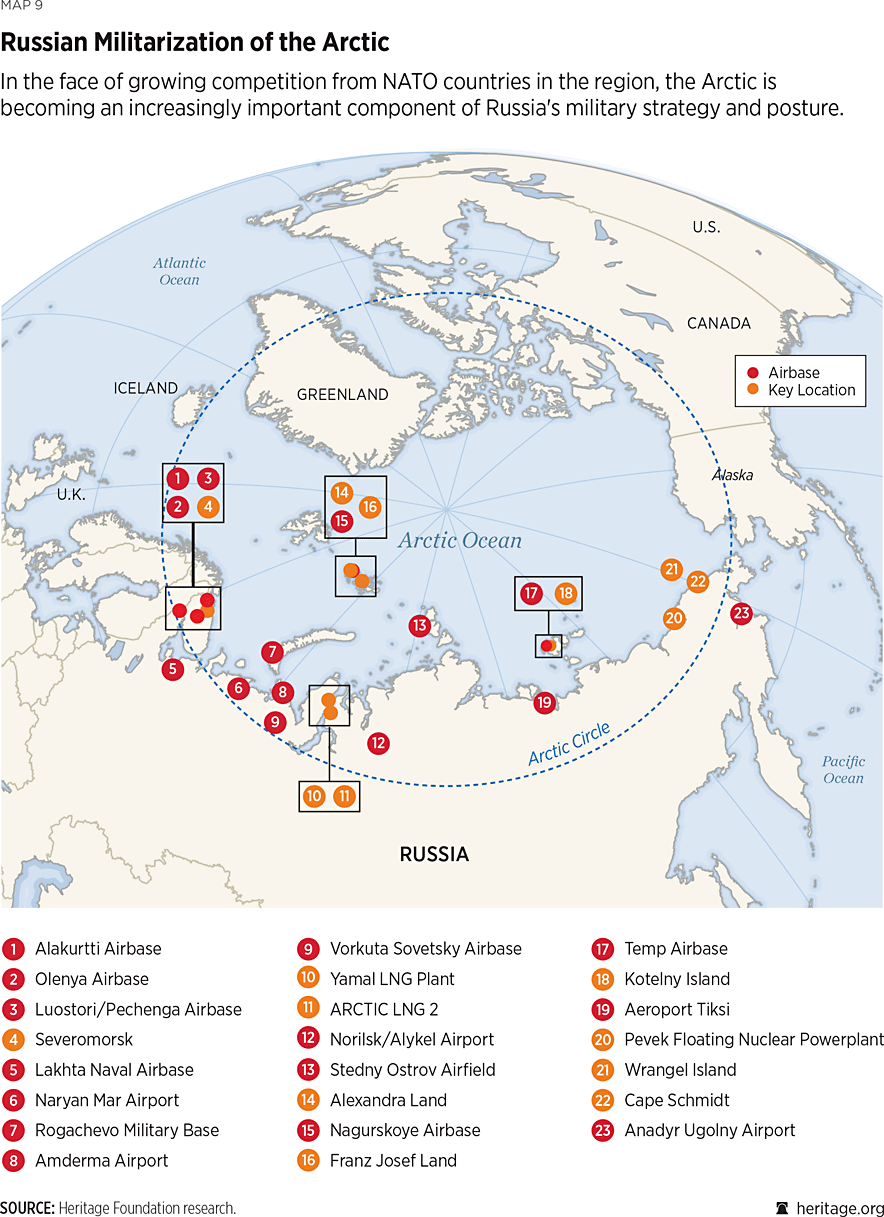
Russia is concerned about increasing competition from Western countries in the region, and its worries increased in 2023 and 2024 when NATO enlarged to include two previously nonaligned Arctic states, Finland and Sweden, respectively. Russia is interested in Greenland but mainly because of its “proximity to strategically important naval routes between the Arctic and Atlantic Oceans—including for nuclear-armed submarines—and the fact that Greenland hosts a key U.S. military base.”[REF]
According to the Defense Intelligence Agency’s 2025 Global Threat Assessment, the Arctic is becoming an increasingly important component of Russia’s military strategy and posture:
Russia aspires to improve its military posture in the Arctic to enhance its ability to defend against a strategic attack, and to respond to Western operations in the region. Much of Russia’s strategic nuclear and conventional forces are stationed on or near the Kola Peninsula, in some cases only a few miles from the Finnish border.
Though the war in Ukraine has heavily degraded specialized ground forces previously based in the Arctic, the rest of Russia’s naval, strategic air, and air defense forces stationed in the region are mostly intact.[REF]
However, the war in Ukraine has strained Russia’s finances and limited its military resources, hindering its Arctic ambitions. In response, Russia has sought closer cooperation with China and welcomed greater involvement from non-Western countries to counterbalance NATO’s perceived advantages. Both Russia and China are actively expanding their presence and infrastructure in the Arctic and aim to influence international norms in the region to advance their security and economic objectives.[REF]
In addition to pursuing military goals, Russia is focused on advancing its economic interests in the Arctic. The region holds vast, untapped reserves of oil and gas, and a large portion of these reserves lies within Russian territory. Moscow is particularly invested in developing the Northern Sea Route (NSR), which it aims to transform into a major global shipping corridor. By expanding its Arctic energy projects and enhancing maritime infrastructure, Russia seeks to capitalize on the anticipated surge in trade through the region.[REF]
Shipping and Energy. Russia is expanding oil and gas extraction and transportation facilities in the Arctic with a focus on projects like the Yamal LNG and Arctic LNG-2 plants, which are key exporters of liquefied natural gas (LNG). More than half of the cargo traffic along the NSR in 2024 consisted of LNG.[REF]
Military Bases. Russia has been actively modernizing and expanding existing military installations in the Arctic, including air bases, radar facilities, and naval bases, along its Arctic coastline. This infrastructure includes:
- Novaya Zemlya, equipped with air defense systems, including Bastion-P and Pantsir-S1, to defend against potential threats.
- Severomorsk (Kola Peninsula), home to the Northern Fleet, which is crucial for defending Russia’s Arctic coastline and nuclear assets.
- Franz Josef Land, a remote archipelago with a military base that potentially could serve as a launch point for operations in the high Arctic.
- Kotelny Island, equipped with air defense systems, contributing to a layered coastal defense system.[REF]
Additional bases are located on Wrangel Island, Cape Schmidt, and Alexandra Land.
Air Power. Air power in the Arctic is increasingly important to Russia, which has 14 operational airfields in the region. Upgrades in 2024 included a newly expanded and paved runway at the Temp Air Base at the western shore of Kotelny Island, part of the New Siberian Islands.[REF] Russia also has invested heavily in developing drones capable of operating in the High North. Specifically, “Russia has deployed drones such as the Orlan-10 and Inokhodets and they are also developing the S-70 Okhotnik, a plane-sized combat drone designed for attack and surveillance missions in Arctic conditions, though details about its technology remain highly secretive.”[REF]
In 2024 and 2025, Russia conducted a variety of military exercises in the Arctic, including exercises involving MiG-29K fighters, simulating real-world combat scenarios.[REF] The deployment of MiG-29Ks, including those based at Severomorsk-3, is seen as a demonstration of Russia’s commitment to modernizing its air power in the region. Long-range patrol flights by Russia’s Tu-160 strategic bombers over international Arctic waters have drawn Western attention and are part of a larger pattern of Russian military activity in the region.[REF]
The North American Aerospace Defense Command (NORAD) and NATO are closely monitoring Russian air activity in the Arctic, and fighter jets like F-16s and F-35s have been scrambled repeatedly to intercept or shadow Russian aircraft. In February 2025, it was reported that “[s]everal Russian strategic bombers and fighter jets were intercepted by North American air defense forces as they flew over international airspace near Alaska.” Russia subsequently confirmed that “two of its Tu-95MS strategic missile carriers had flown over the Bering Sea accompanied by Su-30 jets, and that it had made similar flights north of Norway and over international waters near Russia’s far east.”[REF]
Nuclear Power. In June 2022, Russia withdrew from an Arctic nuclear safety program, prompting Western concerns that the move signaled “a new period of heightened nuclear risks.”[REF] Russia has also deployed a floating nuclear power plant off the northern coast of Siberia near the town of Pevek to supply energy for nearby resource-extraction projects, including gold and tin mines. Russia’s state-owned nuclear company, Rosatom, plans to build four additional floating reactors in the area by 2030.[REF]
Naval Presence. Submarines form the core of Russia’s Northern Fleet, and the Knyaz Pozharsky—Russia’s newest Borei-A–class nuclear-powered ballistic missile submarine—is scheduled to join the fleet in June 2025. Moscow promotes the Borei-A class as one of its most advanced in both design and capability, positioning it as the foundation of Russia’s naval strategic nuclear forces for the coming decades. This development highlights Russia’s ongoing naval modernization, evolving approach to nuclear deterrence, and commitment to strengthening the Northern Fleet—especially in the context of growing military and economic competition in the Arctic.[REF]
Russia is also developing and deploying other naval assets in the Arctic, including Arctic patrol ships and nuclear icebreakers, as part of its efforts to enhance its capabilities in the region. According to a 2025 U.S. Naval Institute report:
Russia continues to expand its icebreaking and patrol capabilities in the waters of the far north, and it recently introduced the new Arktika-type Arctic patrol ships, also known as Project 23550. The lead ship, Ivan Papanin…conducted trials in the Gulf of Finland earlier this year…. Sea trials are expected to continue around Franz Josef Land at least through June 2025, with commissioning expected by the end of this year…. A second ship, to be named the Nikolay Zubov…is expected to join the fleet around 2027.[REF]
Increased Activity in the Mediterranean
Russia’s naval presence in the Mediterranean is not designed for a full-scale naval battle but rather for a “long game” of gradually expanding its influence, securing access to ports and bases, and contesting NATO’s dominance, according to the NATO Defense College.[REF] Another observer has pointed out that:
Russia’s strategy uses the Mediterranean’s geography to protect Russia’s southern flanks while seeking to challenge the naval supremacy of the North Atlantic Treaty Organization (NATO) and the United States in the eastern Mediterranean. Russia depends on maintaining and gradually expanding its naval presence in the Mediterranean while also securing expanded access to ports and bases, with the possibility of eventually contesting NATO’s dominance in the central Mediterranean as well.[REF]
Syria. Russia has maintained a military presence in Syria for decades, but in September 2015, it became the decisive force in the country’s civil war by preventing the overthrow of Bashar al-Assad and bolstering his military position. This intervention enabled Assad’s forces to reclaim territory lost during the conflict. While Assad aimed to reassert control over all of Syria, Russia’s primary objective was to secure and strengthen its influence in the region. Moscow used its support for Assad as a means to achieve that strategic goal.
The fall of the Assad regime in December 2024 to forces led by former al-Qaeda affiliate Hay’at Tahrir al-Sham (HTS) was a major setback to Moscow in its efforts to deepen Russia’s military footprint in Syria. Following the new Syrian government’s move to terminate the investment agreement that granted Russia the operation of Tartus Port for 49 years, Russia has begun to vacate the port.[REF]
The collapse of Assad’s regime could significantly weaken Russia’s geopolitical position in the region, undermining its ability to project power in the Mediterranean and Africa. For instance, Khmeimim Air Base has been central to Russia’s efforts in Africa where operations in the Sahel have expanded the country’s influence while “pressuring Europe (e.g., through strategic manipulation of migrant flows).”[REF] Using this platform, Russia has successfully diminished France’s influence in the region, causing France to withdraw from the Sahel. Furthermore, Africa is economically vital for Russia, particularly for the Wagner Group, because of mining contracts with countries in the region.[REF]
As of January 2026, Russia continued to maintain a military presence at Khmeimim Air Base and the Tartus naval base despite the Assad regime’s fall. While there were reports that equipment was being moved and preparations were being made for possible evacuation, especially after the Syrian opposition’s success in December 2024, the Russian military remained in control of both bases.[REF] Unconfirmed reports suggest that negotiations are already underway with Syrian fighters to maintain access to the bases at Tartus and Khmeimim.[REF] The Tartus base is Russia’s only replenishment and repair station in the Mediterranean Sea.[REF]
Egypt. Russia leverages its relationship with Egypt—the most populous country in the Middle East and North Africa—to reassert and strengthen its regional influence, directly challenging the long-standing primacy of the United States. Military cooperation and arms sales have been key instruments in Russia’s strategy. From 2016 to 2021, Russia overtook the United States as Egypt’s largest arms supplier with a peak in exports in 2017. These deals included surface-to-air missile systems, anti-ship missiles, and combat aircraft. However, Egypt’s efforts to acquire Russia’s advanced Su-35 fighter jets were ultimately thwarted by the United States.[REF] Referring to bilateral relations with Egypt, Russian Foreign Minister Sergei Lavrov has said that “[w]e continue to expand our strategic partnership in all areas, including the economy, trade, and the investment sector…. Military and military-technical ties occupy a very important place.”[REF]
Libya. The Wagner Group aided the failed efforts of Khalifa Haftar’s Libyan National Army to take control of Libya’s capital beginning in 2018. Since then, Russia has remained active in Libya as part of its broader strategy to project power in the Mediterranean and challenge Western influence in the region.[REF] The Wagner Group uses Libya as a forward operating base for its activities across the Sahel, particularly in Chad and Niger, and has established networks of influence with local communities and smuggling groups in southern Libya. Through these networks, Wagner has facilitated the transfer of weapons and in some cases has provided equipment and expertise for the extraction of gold and other valuable minerals. Following the collapse of the Assad regime in Syria, Russia evacuated many of its forces and undertook a significant redeployment of military assets to Libya.[REF] This has involved the redeployment of personnel and equipment to Haftar-controlled areas with a notable increase in the number of Russian personnel at Brak al-Shati air base.[REF] The U.S. is reevaluating its stance on Haftar because of Russia’s growing influence in the region.[REF]
Threats to the Commons
The situation with respect to the “commons,” particularly European airspace, has become more unpredictable since Russia’s second invasion of Ukraine.
Sea. Russia was originally thought to be behind the September 2022 sabotage of the Nord Stream 1 and 2 pipelines. While the investigations are ongoing, there is no conclusive evidence linking Russia directly to the sabotage. Investigations have identified evidence of explosives and a sailing yacht that may have been used in the attack, but no evidence adduced so far points directly to Russia’s involvement.[REF]
Russian threats to the maritime theater also include activity near undersea fiber-optic cables. In late 2024 and early 2025, multiple incidents of undersea cable disruptions in the Baltic Sea raised concerns about possible Russian involvement in hybrid warfare and sabotage. In November 2024, two telecommunication cables, the BCS East–West Interlink and C-Lion1, were disrupted; in December 2024, Estlink 2, a power cable connecting Finland and Estonia, and several telecom lines were damaged; and in January 2025, an incident involving a Sweden–Latvia telecom cable led to investigations and the seizure of a Maltese-flagged bulk vessel.[REF] While damage has been attributed to accidents like unintentional anchor drags, some incidents have sparked suspicion of intentional acts, and some Western intelligence officials believe the Chinese cargo ship Yi Peng 3 may have been involved in at least some of the incidents.[REF] However, in the absence of material evidence linking the incidents to either Russia or China, the current consensus among security services suggests that the damage was more likely to be the result of maritime accidents than it was to be the result of Russian sabotage.[REF]
Russia’s “shadow fleet” allows the country to circumvent sanctions and continue to export oil, thus funding its war effort. The EU has identified 342 vessels in Russia’s shadow fleet.[REF] These vessels transport Russian oil and are involved in ship-to-ship transfers using falsified documentation and other practices that make them difficult to monitor. They often utilize “flag states” with lax regulations, further obscuring their identity and operations.[REF]
Airspace. Russia has increasingly been conducting provocative, aggressive, and reckless military flights near U.S. and European airspace. These violations of NATO members’ sovereign airspace are deliberate actions meant to test the Alliance’s defenses and serve as practice for potential future conflicts. In 2024, NATO forces across Europe scrambled more than 400 times according to Allied Air Command. In the majority of cases, jets were scrambled when aircraft approached European borders without properly identifying themselves or communicating with air traffic control.[REF]
There have been several incidents involving Russian military aircraft flying in Europe without using their transponders. In September 2024, the Latvian Air Force reported that NATO fighter jets were scrambled to intercept five Russian military aircraft flying over the Baltic Sea without flight plans or active transponders.[REF] In February 2025, according to the Netherlands Ministry of Defence, two Dutch F-35 fighters intercepted a formation of three Russian military aircraft near Poland and “escorted the formation from a distance and handed over the escort to NATO partners.”[REF] The same month, two Royal Norwegian Air Force F-35 jets scrambled when two Russian TU-95 Bear H Bomber Aircraft escorted by two Flanker-Ds flew close to NATO airspace in the High North.[REF]
There have been incidents near North American airspace as well. In February 2025, two TU-95 Bear bombers, two SU-35 fighters, one TU-142 F/J, and one A-50 Mainstay flew over the Bering Sea for approximately two-and-a-half hours near Shemya Island in the western Aleutians.[REF] The Russian aircraft were flying in the Alaska Air Defense Identification Zone, which stretches out 150 miles from sovereign U.S. territory.
Cyberspace. Russian cyber capabilities are a sophisticated, active, and an ongoing threat to economic, social, and political targets around the world. Moscow also appears to be increasingly aggressive in its use of digital techniques, often employing only the slightest veneer of deniability in an effort to intimidate targets and openly defy international norms.
Ukraine is a consistent and sustained target of Russian cyberattacks. The scale of these attacks was magnified in the period leading up to Russia’s second invasion in February 2022. Russia sought to leverage overwhelming cyberattacks to advance its military offensive. According to the Center for Strategic and International Studies:
Russian cyberattacks on Ukraine surged by nearly 70% in 2024, with 4,315 incidents targeting critical infrastructure, including government services, the energy sector, and defense-related entities. Ukraine’s cybersecurity agency reported that attackers aimed to steal sensitive data and disrupt operations, with tactics such as malware distribution, phishing, and account compromises.[REF]
In October 2024, “Russian cybercriminals sent information-stealing malware to an unknown number of Ukrainian draft-age men to undermine Ukraine’s military recruitment efforts.”[REF]
After Russia’s 2022 invasion of Ukraine, criminal “hacktivists” pledged support for the Russian government and targeted the United States and other countries that were providing material support to Ukraine. Russian state-sponsored cyber actors continue to seek ways to improve their sophisticated ability to execute stealthy cyber operations and identify new vulnerabilities to leverage against a variety of critical infrastructure targets. In late 2023, these actors gained access to Microsoft Corporation’s internal emails, including those of its cybersecurity teams, which could provide them with unique insights for future campaigns and make it more difficult for victims to detect their activity. The operation was dubbed Midnight Blizzard.[REF] In January 2024, “pro-Russia criminal hacktivists disrupted multiple U.S. municipality water distribution systems, demonstrating criminal hacktivist intent and capability to disrupt US critical infrastructure entities.”[REF]
U.S. allies are also frequent targets of Russian cyberattacks. In May 2024, for example:
Germany accused Russian hackers of breaking into the emails of Germany’s Social Democrats, the leading party in its governing coalition, and recalled its ambassador from the country. The campaign started in March 2022 when hackers exploited vulnerabilities in Microsoft Outlook to target the party’s executive committee, as well as German defense and aerospace companies.[REF]
Also in May 2024, both Poland and the Czech Republic “accused Russian cyber spies of targeting government and infrastructure networks” at “around the same time Russian hackers attacked the German government. Hackers gained access by exploiting a Microsoft Outlook vulnerability, and the extent of the compromised data is currently unknown.”[REF]
Threats to the U.S. Homeland
Russia continues to be the only adversary in Europe that possesses the capability to threaten the U.S. homeland using both conventional and nonconventional means. Throughout the Russia–Ukraine conflict, Russia has threatened nuclear use and conducted military exercises to signal its resolve and deter Russia-perceived Western involvement in the conflict. However, according to a recent U.S. Intelligence Community assessment, “Russia is very unlikely to use nuclear weapons in the conflict unless Russian leadership judged it faced an existential threat to the regime.”[REF]
Although there does not currently appear to be a strong likelihood that Russia will use its nuclear capabilities against the United States directly, Putin continues to cast the war in Ukraine as an inevitable confrontation with the United States, which he accuses of threatening Russia by meddling in its backyard and enlarging the NATO military alliance.[REF] Russia’s most recent national security strategy does not mention NATO directly, but it does claim that the United States is planning to deploy “intermediate-range and short-range missiles in Europe and the Asia-Pacific region.”[REF]
In July 2024, the United States announced that it plans to deploy medium-range conventional missiles in Germany in 2026.[REF] In a November 21, 2024, televised address, Putin declared that:
Russia has voluntarily and unilaterally committed not to deploy intermediate-range and shorter-range missiles until US weapons of this kind appear in any region of the world…. I would like to emphasize once again that it was not Russia, but the United States that destroyed the international security system and, by continuing to fight, cling to its hegemony, they are pushing the whole world into a global conflict.[REF]
Strategic Nuclear Threat
With its massive nuclear arsenal, Russia is one of the few nations with the ability to destroy many targets in the U.S. homeland and in U.S.-allied nations as well as the capability to threaten and prevent free access to the commons by other nations. In early 2025, it was estimated that Russia has the world’s largest nuclear arsenal with an inventory of approximately 5,459 nuclear warheads, according to the Bulletin of the Atomic Scientists.[REF] Of these, roughly 1,718 are deployed, according to Congress.gov.[REF] The remaining warheads either are in reserve stockpiles or have been retired and are slated for dismantling.
Russia has both intercontinental-range and short-range ballistic missiles and a varied arsenal of nuclear weapons that can be delivered by sea, land, and air. It is also investing significant resources in modernizing its arsenal and maintaining the skills of its workforce. An aging nuclear workforce could impede this modernization, but modern weapons and equipment still allegedly constitute 95 percent of Russia’s nuclear triad.[REF]
In 2024, Russia published “Fundamentals of the State Policy of the Russian Federation in the Area of Nuclear Deterrence,” a new version of its nuclear doctrine.[REF] In this new version, Russia has lowered the threshold for its use of nuclear weapons.[REF] This is significant because Russia already had the world’s lowest threshold for nuclear weapons use.[REF] General Cavoli pointed out the risks of the new doctrine in his 2025 EUCOM posture statement: “Recently, the Kremlin updated its nuclear policy, which is intended to communicate a lower nuclear threshold and outlines the range of contingencies that could justify the use of nuclear weapons.”[REF] The new scenarios that lower the threshold for nuclear use and are potentially destabilizing include “aggression against the Russian Federation and/or the Republic of Belarus as members of the Union State with the use of conventional weapons, posing a grave threat to their sovereignty and/or territorial integrity” and “the receipt of reliable information about the massive launch (take-off) of aerospace strike capabilities (strategic and tactical aircraft, cruise missiles, unmanned, hypersonic, and other aircraft) and their crossing of the state border of the Russian Federation.”[REF]
Just as it is doing to deter Western support for Ukraine, Moscow has repeatedly threatened U.S. allies in Europe with nuclear deployments and even preemptive nuclear strikes.[REF] The Russians justify their aggressive behavior by pointing to deployments of U.S. missile defense systems in Europe.
Patriot systems were first deployed to Ukraine in 2023,[REF] and more systems have been provided since then. In early 2025, the United States decommissioned 90 interceptors from Israel and sent them to Ukraine.[REF] The Missile Defense Complex in Deveselu, Romania, has assumed an essential role for the security of the NATO Alliance. In addition, as of July 2024, a new U.S. ballistic missile defense site in Redzikowo, Poland, became operational. Dubbed “Aegis Ashore,” the sites are part of a NATO missile shield that is designed to detect, track, and intercept ballistic missiles in flight.[REF]
The U.S. withdrew from the Intermediate-Range Nuclear Forces (INF) Treaty in 2018 in response to Russian violations, and in 2023, Washington declared Moscow to be noncompliant with the New START Treaty and denounced Moscow’s invalid suspension of that treaty. In March 2023, Putin announced that Russia would deploy tactical nuclear weapons to Belarus, which had relinquished its nuclear weapons to Russia in the 1990s in exchange for security guarantees.[REF] However, according to Ukrainian reports, Russia has yet to deliver these nuclear weapons to Belarus.[REF] In December 2024, Russia announced that it will scrap a moratorium on deployment of intermediate and shorter-range nuclear-capable missiles because “the United States has deployed such weapons in various regions around the world.”[REF]
Russia’s large nuclear arsenal remains the only existential threat to the U.S. homeland originating from Europe and Eurasia. While the likelihood of its use is currently low, Moscow’s ongoing nuclear threats against Europe underscore the arsenal’s continued importance in Russian strategic planning. This significant nuclear capability will remain a key factor influencing both Russia’s military and political decisions as well as the intensity of its aggressive actions toward other nations.
Quality of Local Forces
Recently published data provide a sense of Russia’s current military strength in terms of materiel.[REF] Among the key weapons in Russia’s inventory are 5,580 nuclear warheads, 5,750 main battle tanks, 131,527 armored vehicles, and approximately 13,673 pieces of artillery (including both self-propelled and towed). The navy has one aircraft carrier (undergoing extensive refit); 63 submarines (including 14 ballistic missile submarines); 10 destroyers; 12 frigates; and 123 patrol and coastal combatants. The air force has 4,957 total aircraft.
In addition, Russia has one of the largest armies in the world. As of April 2025, Russia’s armed forces included approximately 1,320,000 active military personnel, of which 160,000 are conscripts.[REF] Russia also has a total reserve force of 2 million for all of its armed forces.[REF]
Russian Losses in Ukraine. The war in Ukraine has exposed major weaknesses in the Russian military and significantly diminished Russia’s short-term ability to threaten U.S. and European interests in Europe. However, it has also revealed the depth of Russia’s stockpiles of equipment, munitions, and supplies, as well as the Putin government’s continued willingness to invest both lives and resources in the conflict. As summarized by General Cavoli:
Despite extensive battlefield losses in Ukraine, the Russian military is reconstituting and growing at a faster rate than most analysts had anticipated. In fact, the Russian army, which has borne the brunt of combat, is today larger than it was at the beginning of the war—despite suffering an estimated 790,000 casualties. In December 2024, Moscow ordered the military to increase its strength to 1.5 million active service members and is recruiting approximately 30,000 troops per month. Russian forces on the frontlines of Ukraine are now at over 600,000, the highest level over the course of the war and almost double the size of the initial invasion force.[REF]
Personnel. Losses of Russian officers and crews vary widely. BBC Russian Service, in collaboration with Mediazona, analyzed open-source data including obituaries, cemetery records, and social media posts to identify Russian soldiers killed in action. The report says it confirmed the names of more than 106,745 Russian soldiers killed as of May 4, 2025.[REF] However, this analysis excludes casualties among pro-Russian separatist forces in the Donetsk and Luhansk regions, which could add another 21,000 to 23,500 deaths, potentially bringing the total to 185,000 to 260,700.
As of April 2025, U.S. officials estimate that Russia has suffered more than 790,000 casualties (both killed and wounded).[REF] Other estimates place Russian casualties as high as 900,000 and even one million.[REF] These numbers could reflect Russia’s continued use of high-casualty tactics—“including a reliance on massed personnel attacks and massed artillery fire—and limited operational-level flexibility. Casualty totals likely include mobilized personnel, volunteers, members of the Russian National Guard, recruited prison convicts, and personnel from Russian-occupied Ukrainian regions.”[REF] Many of these losses include Russia’s elite and professional soldiers in addition to its junior officer corps.[REF] Less experienced recruits replacing these troops have less training and are seemingly eroding the effectiveness of some Russian military units, which could have a long-term detrimental effect on Russia’s military capabilities.[REF]
Recruitment and Mobilization. Although Russia’s failure to take Kyiv in the early stages of its second invasion led to significant losses among its best soldiers, it has since rebuilt its forces using conscripts and private volunteer forces and now has the fifth-largest military force in the world.[REF] In September 2024, Putin ordered an increase in the size of the Russian military to 1.5 million active-duty troops.[REF] Russia’s draft budget for 2025–2027 allocates 30 billion rubles (about $370 million at then-current exchange rates) per year for sign-on bonuses.[REF] However, Russian authorities, probably fearing domestic opposition, have not ordered a large-scale mobilization since September 2022 when 300,000 were called up outside the regular draft.[REF]
The Russian defense ministry has prioritized the recruitment of contract soldiers to replenish ranks. Russian official sources report that these efforts have been a success: A recent spring recruitment drive netted “160,000 men between 18 and 30 [for] Russia’s armed forces—an increase of 10,000 on last year’s spring drive, and a rise of more than 15,000 compared to three years ago.”[REF]
Good pay and bonuses have been a major factor in attracting recruits. According to the Congressional Research Service (CRS):
Contract recruits may earn high salaries as well as sign-on bonuses offered by both regional and federal authorities. MoD [Ministry of Defense] salaries may be several times the average Russian monthly wage (including sign-on bonuses reportedly as high as 22 times the monthly wage), as well as additional payments should soldiers be killed or wounded. Since late 2024, Russia’s regional authorities have increased one-time signing bonuses and advertising campaigns to attract new recruits. These measures may indicate increased recruitment difficulties.[REF]
The Ministry of Defense also uses coercive conscription and recruitment methods that include “penalties for ignoring draft summons, pressure on conscripts to sign contracts, and punishments for canceling contracts.”[REF] In addition, “Russia has instituted a number of ‘stop-loss’ policies to prohibit soldiers from resigning and bolster the number of soldiers available, including by forcing wounded soldiers back to the front lines.”[REF]
General Cavoli testified in April 2025 that Russia “is recruiting approximately 30,000 troops per month” to replenish and rotate units.[REF] According to the CRS:
This rate is arguably sufficient to sustain Russia’s current scope of operations in Ukraine, but it may be insufficient to support large-scale offensive operations. Russian officials have claimed the military recruited almost 440,000 personnel in 2024, but some observers assert these figures are likely exaggerated and do not accurately reflect the often ad hoc nature of current Russian military recruitment. Additionally, reports suggest the training of recruits is often substandard and rushed, undermining the military’s ability to conduct complex offensive operations.[REF]
In recent years, Russia has increasingly relied on paid “volunteer” forces trained at special forces bases and often operating under the direction of Russian special forces units to minimize domestic political fallout from military casualties abroad. Moscow has used these forces in Ukraine, as well as in Libya and Syria, because they reduce costs, preserve “a degree of deniability,” and allow personnel losses to be concealed from public scrutiny.[REF]
The most infamous such mercenary unit, the Wagner Group, has undergone significant changes in structure and operations in the past two years since a failed mutiny by its members in 2023. Following the deaths of its founder, Yevgeny Prigozhin, and key leaders a few months after the mutiny, the group was largely dismantled and restructured under the Russian Ministry of Defense. This reorganization led to the emergence of a new entity known as the Africa Corps, which has assumed many of Wagner’s previous missions, particularly across the African continent.[REF] Wagner formally withdrew from Mali on June 12, 2025, as the Kremlin continued to transition control of its military operation in Africa to the Ministry of Defense–backed Africa Corps.[REF]
In July 2016, Putin signed legislation establishing the National Guard (Rosgvardia), a force of roughly 400,000 civilian and military personnel placed under his direct control.[REF] In response to internal security challenges such as the Wagner Group mutiny in 2023, Putin authorized the arming of Rosgvardia with heavy weaponry in order to bolster its capabilities both for internal security and for operations in Ukraine.[REF] Rosgvardia has incorporated former Wagner Group assault detachments into its structure, forming volunteer corps for deployments in Ukraine and Africa.
Rosgvardia remains actively involved in the war in Ukraine. Estimates suggest that more than 30,000 Rosgvardia personnel are currently deployed in Ukraine, a fact that highlights their significant role in Russia’s military campaign.[REF] Rosgvardia was initially deployed along with regular Russian forces during the 2022 invasion, and its role has expanded over time. Currently, it is engaged in both combat and occupation duties across various regions of Ukraine.[REF] Rosgvardia units are particularly active in the Zaporizhzhia and Kherson regions where they conduct combat missions that include the neutralization of Ukrainian drones. Their responsibilities encompass rear-area security, suppression of dissent in occupied territories, and direct combat operations.[REF]
Equipment. As with the human toll, Russian equipment losses in Ukraine have been considerable. U.S. officials estimate that Russia has lost more than 3,000 tanks—“a higher number than its pre-war active duty tank inventory.”[REF] Other heavy equipment losses include armored personnel carriers, artillery and rocket systems, helicopters, and naval vessels. According to the CRS:
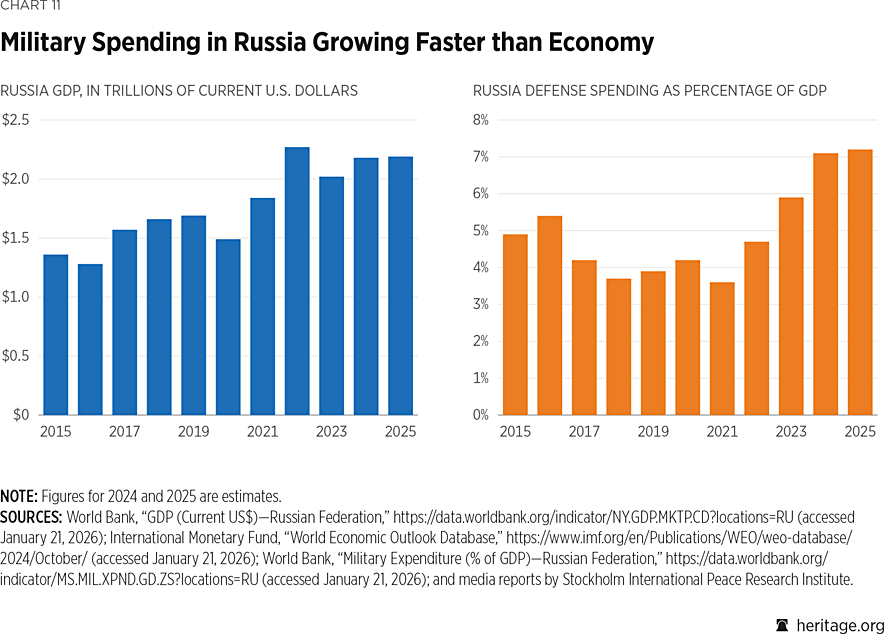
Russia has responded to these losses by mobilizing its economy to support the war effort. Among other actions, it has directed civilian enterprises to manufacture products with military applications; it has transitioned the defense industry to round-the-clock production; and it plans to spend 40% of its 2025 federal budget on the military and security services. Russia’s 2025 defense spending is estimated to be at 7.2 percent of GDP; some observers question whether the Russian government will be able to sustain such high levels of defense spending.[REF]
This production is not entirely for new equipment. According to the CRS, Russian defense production has been focused largely “on refurbishing old equipment rather than producing new versions, particularly in the face of sanctions restricting the import of critical components. It remains unclear whether the defense industry can produce advanced weapon systems or increase production over the long term.” Additionally, “U.S. officials assess that China is a crucial source of components for Russia’s defense industry. Iran’s supply of drones and North Korea’s large supply of artillery ammunition and troops have also proven crucial to supporting Russian military operations.”[REF] However, supply and labor shortages have proven to be a persistent problem.
Russia has steadily expanded its defense production capabilities, notably increasing its output of drones. However, limitations such as shortages of components and manufacturing tools, full factory capacity, and labor constraints have reportedly forced the Russian defense industry to focus on quantity over quality. This shift includes the use of dual-use items—generally less effective than military-specific components—and reactivation of Soviet-era tanks and artillery. According to U.S. officials, most of Russia’s replacement equipment comes from refurbished older models in storage rather than newly manufactured or modern systems. Some reports also suggest that Russia is building new factories to boost production capacity.[REF]
In 2024, Russia produced and refurbished more than 1,500 tanks and approximately 2,800 infantry fighting vehicles (IFVs) and armored personnel carriers (APCs), effectively compensating for that year’s losses. This replenishment relied heavily on reactivating older Soviet-era equipment from storage with about 70 percent of replacements coming from reserves and only 30 percent being newly manufactured.[REF]
Despite these efforts, Russia’s military industry faces significant challenges. Production of modern tanks like the T-90M remains limited with estimates suggesting that more than 200 T-90Ms have been delivered since the war began. Additionally, sanctions have hampered Russia’s ability to acquire essential components, leading to a reliance on older models such as the T-55 and T-62, which are less effective on the modern battlefield.[REF]
Command and Control. Despite attempts to decentralize leadership and increase autonomy, “the Russian military continues to operate with a Soviet-style centralized command.”[REF] This centralization has contributed to tactical and operational inflexibility that has resulted in failures like the unsuccessful attempt to seize Ukraine at the start of the war.
Following repeated military failures, in May 2024, Putin replaced Defense Minister Sergei Shoigu with an economics official, Andrei Belousov. Some observers believe that Belousov’s appointment “reflected the Russian leadership’s recognition that the war in Ukraine is a longer-term challenge and that managing economic and defense industrial resources is key to sustaining Russia’s war effort.”[REF]
The Economy
Following a downturn in 2022 as a result of international sanctions imposed on Russia for its invasion of Ukraine, the Russian economy rebounded in 2023, recording a GDP growth of 3.6 percent. This recovery was driven by increased government spending, particularly on defense, and a surge in exports to countries like China and India, which helped to offset the impact of Western sanctions. Additionally, Russia’s gross national income per capita reached $14,250, leading the World Bank to classify Russia as a high-income country for the first time since 2015.[REF]
In 2024, the Russian economy experienced robust growth with GDP expanding by 4.1 percent. The surge was largely fueled by substantial military spending and increased household consumption. However, this growth was accompanied by rising inflation, which reached 9.3 percent. Analysts cautioned that the economy’s heavy reliance on defense expenditures could pose risks to long-term stability.[REF]
Economic growth in Russia slowed to 1 percent in 2025. Factors contributing to this slowdown include labor shortages, persistent inflation, and the long-term effects of sanctions, particularly in the technology sector. Also, declining oil prices have strained the federal budget, increasing the risk of deficits and limiting the government’s ability to sustain high levels of military spending.[REF]
Military Spending
In 2024, Russia’s military expenditure reached an estimated $149 billion, which was 38 percent more than in 2023 and double the level in 2015.[REF] The country’s military spending in 2024 was equivalent to 7.1 percent of GDP and 19 percent of total government expenditure, making Russia one of the world’s top five nations in terms of defense spending.[REF] Russia plans to spend 40 percent of its 2025 federal budget on its military and security services, an increase of 25 percent from 2024.[REF] Analysts, however, caution about ascertaining exact expenditure numbers:
Russia’s military budget has become increasingly opaque since the full-scale invasion of Ukraine in early 2022. Around 30 per cent of budgetary spending was marked as classified in 2024. Russia’s actual military spending in 2024 is also likely to be higher than the $149 billion estimated here: the budget was further amended in October 2024 to bolster Russia’s war efforts, making it difficult to estimate total actual annual spending, and the military continued to receive additional contributions from regional budgets and extra-budgetary funding from other sources during the year.[REF]
Much of Russia’s military expenditure has been directed to funding new weapon systems for the Ukraine war and “subsidiz[ing] some arms producers that were reportedly on the brink of bankruptcy. Social support, including payments to military personnel, was another major expense, with spending reaching $9.4 billion by October 2024, surpassing the planned $5.7 billion in the initial budget.”[REF] The U.S. Intelligence Community has noted that:
Moscow’s massive investments in its defense sector will render the Russian military a continued threat to U.S. national security, despite Russia’s significant personnel and equipment losses—primarily in the ground forces—during the war with Ukraine. Russia’s air and naval forces, despite suffering some losses and expending substantial quantities of precision-guided munitions, remain capable of providing Moscow with regional and global power projection forces, while Russia’s nuclear and counterspace forces continue to provide it with strategic deterrence capability.[REF]
Nuclear Capabilities
With the world’s largest arsenal, Russia has prioritized the upgrading of its nuclear capabilities and in 2024 claimed that its nuclear trifecta was more than 95 percent of the way through its modernization from the Soviet era.[REF] Russia has been modernizing its strategic nuclear arsenal by replacing older ICBMs with newer models. According to a recent Japanese assessment:
21 ICBM regiments—16 of them mobile—underwent modernization over the past decade. As a result, the Soviet-era RS-12M Topol has been fully retired. The newer RS-24 Yars missile has become the backbone of the ground-based strategic force, with over 200 launchers deployed in both mobile and silo-based configurations. Several variants of the Yars, including the Yars-S and Yars-M, are believed to be in service…. Meanwhile, development is underway on a new ICBM known as Osina, expected to eventually replace the Yars series.[REF]
Hypersonic vehicles have also been in development: “Deployment of the Avangard system featuring hypersonic glide vehicles is also slowly moving forward, with two regiments reportedly being formed under the 13th Orenburg Rocket Division.”[REF] The Russian Navy’s strategic submarine fleet is likewise being upgraded:
While the number of nuclear-powered submarines capable of launching ballistic missiles (SSBNs) remains unchanged at around 11 or 12, older models like Project 667BDR (Delta III-class) and Project 667BDRM (Delta IV-class) are being phased out in favor of newer vessels, such as Project 955 Borei and Project 955A Borei-A…and future upgrades are expected to include Project 955AM Borei-AM, primarily in the Northern Fleet.[REF]
As a result of these efforts, more than half of the current SSBN force now consists of post-Soviet vessels.[REF]
The situation with respect to the RS-28 Sarmat, Russia’s next-generation heavy ICBM, is less certain: “As the aging RS-20V Voyevoda missiles are retired, a delay in introducing the Sarmat could temporarily reduce Russia’s ground-based strategic warhead count. An explosion during a test launch of a Sarmat ICBM at Plesetsk in 2024 highlighted reliability issues that could further postpone deployment.”[REF]
An additional risk factor is the Russian Strategic Rocket Forces’ (RSVN’s) apparent deployment of intermediate-range ballistic missiles (IRBMs) to Belarus.
In November 2024, Russia used a new ballistic missile called Oreshnik in a strike against Ukraine. Russian announcements describe it as a conventional IRBM to be operated by the RVSN. There are plans for it to be forward deployed to Belarus, but details on the scale and configuration of deployment are as yet unclear…. [I]if it were converted to carry nuclear warheads, it could also function as a tactical nuclear weapon.[REF]
The development of strategic bombers, on the other hand, has been slow, and the existing fleet is aging and shrinking. The development of next-generation PAK-DA stealth bombers, for example, has been subject to numerous delays. However, Russia is making efforts “to modernize and extend the life of existing aircraft, and production of the Tu-160 has resumed—though at a sluggish pace.” Overall “an abrupt [near-term] decline in the size of the bomber force is unlikely. All in all, Russia will likely maintain its strategic nuclear forces at current levels in quantitative terms while seeking qualitative modernization.”[REF]
Tanks
Although tanks were almost written off as obsolete before the war, both Russia and Ukraine have leaned heavily on tank forces in their battles for territory. Losses on both sides have been high as drones, mines, and a lack of an effective air force take their toll, but losses of Russian tanks have been especially high. According to recent figures from Kyiv, Moscow has lost more than 3,000 tanks since the war began. “Western estimates suggest that, with Moscow’s economy now on a war footing, it can manufacture 1,500 tanks a year, although a large portion of these is made up of refurbished older models.”[REF]
Russia has reportedly stepped up production of its T-90Ms, manufacturing nearly 300 T-90M tanks annually.[REF] However, many of these new units are being retained in Russia, possibly for future conflicts, with only a portion being deployed to Ukraine. The T-72B3, an upgraded version of the Soviet-era T-72, has been used extensively by Russian forces in Ukraine. In 2024, arms manufacturer Uralvagonzavod reportedly modernized approximately 200 T-72B and T-72B1 tanks to the T-72B3 standard.[REF]
Air Force
The Russian Air Force continues to rely on a combination of modern and legacy aircraft. While it remains one of the world’s largest air forces, ongoing conflicts, loss of planes, and production constraints pose challenges to maintaining and modernizing the fleet.
Russia has two families of fighter jets in production, the new Sukhoi Su-57 Felon and the Su-27 Flanker family of jets that includes the Su-30SM, the Su-34, and the Su-35. In 2024, the Russian Air Force received between 22 and 28 new aircraft, including Su-34s, Su-35s, Su-57s, and Yak-130 trainers. However, there also were approximately 23 irrecoverable aircraft losses due to combat and accidents—an indication that new production barely offset losses.[REF]
Moscow has been keen to keep its top-of-the-line, fifth-generation Su-57 stealth jets away from the front lines. Unlike other jets widely used in Ukraine, such as Russia’s Su-35, Su-57 fighters have not played a major role in the Kremlin’s air presence in Ukraine.[REF] The Tu-22M3 supersonic bomber remains a critical asset, although its numbers reportedly have dwindled. Ukrainian sources suggest that of the 57 bombers listed as being in service, only 27 were operable.[REF] In April 2024, Ukraine claimed to have shot down a Tu-22M3, marking another setback in Russia’s strategic bombing capability.[REF]
Ukraine’s Operation Spiderweb on June 1, 2025, when Kyiv was able secretly to truck in and deploy attack drones close to Russian strategic airbases, may have set the Russian Air Force back even further. Ukraine claims to have destroyed 40 aircraft in the operation. However, after-action assessments disagreed as to the degree of damage to the Russian fleet. NATO concurred with Ukraine that around 40 aircraft were damaged but said that only “10 to 13 aircraft were completely destroyed.”[REF] As reported by NBC News:
Satellite imagery…taken 2,500 miles away from Ukraine, in Russia’s Irkutsk oblast, on June 5, four days after the attack showed six aircraft at Belaya airfield that were completely destroyed in the Ukrainian attack.
Three were Tupolev Tu-95 strategic bombers, and three Tupolev Tu-22 supersonic bombers, all of which have been used to launch missiles at Ukraine.
At Olenya air base, 1,200 miles from Ukraine in Russia’s far north, fresh burn marks and rubble where planes had previously been parked were visible in satellite images taken the same day. They suggest that Ukraine had destroyed at least four Russian aircraft.
The images confirm that at least two were Tu-95s and another was a Tu-22. Social media video geolocated by NBC News to Olenya air base shows a man dressed in military fatigues filming a wall of flames also around a Tu-95 bomber.[REF]
Navy
Russia’s Maritime Doctrine, released in July 2022, explicitly names the United States as the country’s principal national security threat and signals that the Russian Navy will continue to prioritize capabilities designed to threaten U.S. forces.[REF]
While Kyiv claims to have destroyed one-third of Russia’s Black Sea Fleet by mid-2024,[REF] Russia has put serious effort into replacing and upgrading its naval capabilities. Key areas of focus have been upgrading the submarine fleet, strengthening surface combatant forces, and developing new technologies for naval air and electronic warfare. In April 2025, Putin announced a $100 billion investment in his naval forces over 10 years and indicated that nuclear forces will be a key component of this upgrade.[REF]
Submarines. Russia’s naval modernization continues to prioritize submarines. The previously noted Japanese study on Russia’s fleet is revealing:
The Russian Navy’s strategic submarine fleet is…being upgraded. While the number of nuclear-powered submarines capable of launching ballistic missiles (SSBNs) remains unchanged at around 11 or 12, older models like Project 667BDR (Delta III-class) and Project 667BDRM (Delta IV-class) are being phased out in favor of newer vessels, such as Project 955 Borei and Project 955A Borei-A. More than half of the current SSBN force now consists of post-Soviet vessels, and future upgrades are expected to include Project 955AM Borei-AM, primarily in the Northern Fleet.[REF]
Russia also has been modernizing its conventional submarine force with new Kilo-class submarines (also known as Varshavyanka-class submarines) that are armed primarily with torpedoes, mines, and Kalibr cruise missile systems.[REF]
Surface Combatants. Beyond submarines, Russia’s surface fleet is lagging behind. The Admiral Gorshkov–class frigate, a modern design equipped with anti-ship and land-attack missiles, represents progress, but only four are active with six more in development. These 5,400-ton vessels, costing around $400 million each, carry Zircon hypersonic missiles, which travel at Mach 9 and can challenge missile defenses.[REF]
Russia’s only aircraft carrier, the Admiral Kuznetsov, “has been plagued by mishaps and is undergoing a refit unlikely to be finished before 2027.”[REF] New carriers like the proposed Shtorm class remain in the planning stage. Infrastructure in Russia’s shipyards is outdated, and “Western sanctions have reportedly disrupted engine supplies, delaying projects like the Karakurt-class corvettes. With $100 billion spread over ten years, Russia could theoretically build 10 Borei-class submarines or 20 frigates, but historical delays suggest a narrower scope.”[REF]
Counter-Space/Counter-Satellite Capabilities
Russia’s anti-satellite (ASAT) capabilities have advanced significantly in recent years, reflecting a strategic emphasis on counterspace operations. These developments encompass kinetic weapons, electronic warfare systems, and directed-energy technologies.
Nuclear Anti-Satellite Weapons. Russia is reportedly developing a nuclear-armed satellite, Cosmos 2553, designed to disable or destroy other satellites by means of a nuclear detonation in orbit. Such an event could generate an electromagnetic pulse (EMP), potentially crippling global satellite infrastructure.[REF] U.S. intelligence assessments have raised concerns about this capability, noting that Cosmos 2553 has exhibited erratic behavior, including uncontrolled spinning, that suggests possible malfunctions.[REF]
Kinetic and Co-Orbital Systems. Russia continues to develop kinetic ASAT systems like the Nudol missile that are capable of intercepting satellites in low-Earth orbit. Additionally, satellites such as the Luch (Olymp) demonstrate co-orbital capabilities, performing rendezvous and proximity operations that could be used to disrupt or damage other satellites.[REF]
Directed-Energy Weapons (DEWs). The Peresvet laser system, operational since 2019, is designed to blind or damage optical sensors on reconnaissance satellites. Deployed alongside mobile intercontinental ballistic missile units, it serves both as a protective measure and a potential offensive tool against satellite-based surveillance.[REF]
Russia’s counterspace and counter-satellite capabilities are formidable. According to a recent assessment by the U.S. Intelligence Community, “Russia continues to train its military space elements and field new antisatellite weapons to disrupt and degrade U.S. and allied space capabilities. It is expanding its arsenal of jamming systems, DEWs, on-orbit counterspace capabilities, and ASAT missiles designed to target U.S. and allied satellites.”[REF]
Electronic and Cyber Warfare
Russia employs advanced electronic warfare (EW) techniques, including GPS jamming and spoofing, which have disrupted navigation systems and communications and notably affected both civilian aviation and military operations. Reports also indicate that Russian jamming has interfered with SpaceX’s Starlink satellite network, which is crucial for Ukrainian military communications.[REF]
Russia’s EW systems are among the world’s most sophisticated and are designed to disrupt enemy communications, navigation, and surveillance. Key systems include:
- Krasukha Series, mobile jamming systems capable of disrupting airborne radar and satellite communications over ranges up to 300 km. The Krasukha-4 variant can even affect low-Earth orbit satellites.[REF]
- Murmansk-BN, a long-range system mounted on KAMAZ trucks, designed to jam high-frequency communications over distances up to 8,000 km, targeting NATO’s high-frequency communications.[REF]
- Borisoglebsk-2, a multifunctional system mounted on MT-LBu vehicles, used to disrupt communications and GPS systems.[REF]
- Khibiny, an airborne electronic countermeasure system installed on aircraft like the Su-30SM, designed to jam enemy radar and missile guidance systems.[REF]
- Solyaris NS, a newer system reportedly in its final testing stages, designed to detect and suppress UAV control channels across a wide frequency range.[REF]
These systems have been deployed extensively in areas of conflict, notably in Ukraine, where they have been used to “create dense jamming zones, disrupting communications, GPS, and drone operations.”[REF] According to the Defense Intelligence Agency, “Russia is employing EW in offensive and defensive operations to disrupt Ukraine’s communications and weapons guidance. Russia designs its EW capabilities specifically to counter Western-supplied technologies.”[REF]
With respect to cyber capabilities, the Intelligence Community assesses that “Russia has demonstrated real-world disruptive capabilities during the past decade, including gaining experience in attack execution by relentlessly targeting Ukraine’s networks with disruptive and destructive malware.” In addition:
Russia’s advanced cyber capabilities, its repeated success compromising sensitive targets for intelligence collection, and its past attempts to pre-position access on U.S. critical infrastructure make it a persistent counterintelligence and cyber attack threat. Moscow’s unique strength is the practical experience it has gained integrating cyber attacks and operations with wartime military action, almost certainly amplifying its potential to focus combined impact on U.S. targets in time of conflict.[REF]
Unmanned Aerial Vehicles (Drones)
According to the Defense Intelligence Agency’s 2025 Worldwide Threat Assessment, “Russia’s use of UAVs in [Ukraine] has expanded dramatically as these systems have proven to be cost-effective tools to detect enemy movements, provide artillery targeting assistance, and conduct short-[range] and long-range strikes.”[REF]
Drones have become increasingly important in the battlefield since Russia’s invasion of Ukraine in 2022, and Moscow’s capabilities in drone technology have grown exponentially in the face of Ukraine’s gains in this field. In 2025, Russia aims to produce a massive number of drones, including 30,000 long-range drones and 30,000 decoy drones along with 2 million first-person view (FPV) drones.[REF] This represents a significant increase in drone production compared to previous years; Russia’s production of long-range drones in 2025 is reportedly twice as great as the number produced in 2024.[REF] In addition, Ukraine’s Strategic Industry Ministry has said that “Ukraine more than doubled its long-range drone output in 2024 compared to 2023—a 22-fold increase over 2022.”[REF] Russia’s drone production is also geographically diverse with key production centers located in different regions of the country.[REF]
Military Exercises
Russian military exercises, especially snap exercises, have masked real military operations in the past. Russia’s snap exercises are conducted with little or no warning and often involve thousands of troops and pieces of equipment.
In 2024, Russia conducted several military exercises, including the large-scale Ocean 2024 naval exercise in September 2024 with China.[REF] Other notable exercises that year included those with the Collective Security Treaty Organization (CSTO) member states, Joint Sea 2024 with China, and various bilateral naval exercises like the one with Indonesia in November 2024.[REF] These exercises typically involve significant personnel and equipment and are designed to enhance interoperability and evaluate military capabilities. Beyond training, they serve several purposes: projecting power, showcasing Russia’s allies, demonstrating equipment for potential buyers, and signaling Russia’s interest in a particular region.[REF]
Conclusion
The threat to the U.S. homeland from Europe remains low, but risks to American interests and allies in the region are significant, particularly because of Russia’s aggressive war in Ukraine. While Russia has the military—and nuclear—capability to threaten the United States directly, it has not shown a clear intent to do so.
Though no longer the global rival the Soviet Union was during the Cold War, Russia still challenges U.S. and allied interests. It maintains a broad array of capabilities—land, air, naval, space, and cyber—and the world’s largest nuclear arsenal. A nuclear strike on the United States is unlikely, but the potential for such a strike gives Russia strategic leverage in Europe. More immediate threats to U.S. interests come from Russian provocations below the nuclear threshold, particularly in Central and Eastern Europe, the Arctic, the Balkans, and the South Caucasus.
Russia has suffered significant losses in its war against Ukraine, and its economy is tipping into recession, but the decision by several countries to continue trading with Russia despite sanctions is ensuring a steady flow of funds into Russia’s accounts that Putin is using to continue funding his aggression. Russia will therefore continue to be a significant security concern for the United States, its NATO partners, and other allies.
In Ukraine, the Russian military appears to remain a resilient and capable adversary and is likely to sustain its operational tempo in the near term.[REF] According to the Defense Intelligence Agency:
Russian President Vladimir Putin regards the war in Ukraine as an existential struggle against the West that will determine Russia’s place in the world, Putin’s hold on power, and his historical legacy. Putin remains confident in Russia’s ultimate victory in Ukraine and is prepared to use military force at least through 2025. Putin also remains steadfast in his demand that Ukraine be permanently prohibited from joining the North Atlantic Treaty Organization (NATO) while insisting Kyiv withdraw all its military forces from Donetsk, Luhansk, Zaporizhzhia, and Kherson Oblasts.[REF]
Putin remains firmly committed to winning the war in Ukraine, and his main objectives—Ukrainian neutrality and further territorial division—have remained largely unchanged since the conflict began. Unless a negotiated settlement is reached or the West substantially increases its support, the battlefield is likely to tip gradually in Russia’s favor through 2025 and possibly beyond.
For these reasons, the Index of U.S. Military Strength continues to assess the threat from Russia as “aggressive” for level of provocative behavior and “gathering” for level of capability.
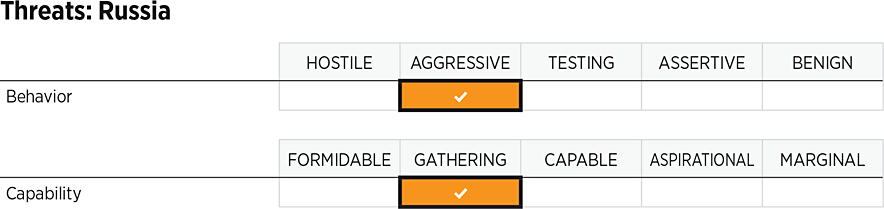
Endnotes
[1] Lieutenant General Jeffrey Kruse, U.S. Air Force, Director, Defense Intelligence Agency, “Defense Intelligence Agency 2025 Worldwide Threat Assessment,” statement before the Subcommittee on Intelligence and Special Operations, Committee on Armed Services, U.S. House of Representatives, prepared using information available as of May 11, 2025, p. 15, https://armedservices.house.gov/uploadedfiles/2025_dia_statement_for_the_record.pdf (accessed December 29, 2025).
[2] Seth G. Jones, “Russia’s Shadow War Against the West,” Center for Strategic and International Studies Brief, March 2025, pp. 1 and 9, https://csis-website-prod.s3.amazonaws.com/s3fs-public/2025-03/250318_Jones_Russia_Shadow.pdf?VersionId=LHamL2L7HJwLgZ7a_wq6xkTIwMh3TFpk (accessed December 29, 2025).
[3] Victor Jack, Lucia Mackenzie, and Sam Clark, “Europe’s New War with Russia: Deep Sea Sabotage,” Politico, April 7, 2025, https://www.politico.eu/article/russia-sabotage-undersea-cables-baltic-sea-europe-war/ (accessed December 29, 2025); Jones, “Russia’s Shadow War Against the West,” p. 1.
[4] Office of the Director of National Intelligence, “2024 Annual Threat Assessment of the U.S. Intelligence Community,” February 5, 2024, p. 14, https://www.dni.gov/files/ODNI/documents/assessments/ATA-2024-Unclassified-Report.pdf (accessed December 29, 2025). Emphasis in original.
[5] Ibid., p. 16.
[6] Jennifer Welch, “NATO Confronts Its Doomsday Scenario,” Bloomberg, June 24, 2025, https://www.bloomberg.com/news/newsletters/2025-06-24/nato-confronts-its-doomsday-scenario (accessed December 29, 2025).
[7] Agence France-Presse, “Europe Is on Edge as Russia Builds up Forces on Finland’s Border. Could This Frontier Be the Next Conflict Zone?” Fortune, May 23, 2025, https://fortune.com/europe/2025/05/23/europe-on-edge-russia-ramps-up-military-finland-border-conflict-zone-nato/ (accessed December 29, 2025).
[8] Statement of General Christopher G. Cavoli, United States Army, United States European Command, before the Committee on Armed Services, U.S. Senate, April 3, 2025, p. 2, https://www.armed-services.senate.gov/imo/media/doc/general_cavoli_opening_statements.pdf (accessed December 29, 2025).
[9] Latvian State Security Service (VDD), Annual Report 2024, February 2025, p. 4, https://vdd.gov.lv/uploads/materials/40/en/annual-report-2024.pdf (accessed December 29, 2025).
[10] Ibid.
[11] See, for example, Kateryna Odarchenko, “The Fight Against Disinformation: A Persistent Challenge for Democracy,” Foreign Policy Research Institute Analysis, January 24, 2025, https://www.fpri.org/article/2025/01/the-fight-against-disinformation-a-persistent-challenge-for-democracy/ (accessed December 29, 2025), and Wing Commander James Brown and Robert S. Hinck, “(Un)Powerful Propaganda: Russia’s Ineffective Use of Information Activities Against NATO’s Enhanced Forward Presence,” U.S. Air Force, Air University, Wild Blue Yonder Online Journal, October 5, 2023, https://www.airuniversity.af.edu/Wild-Blue-Yonder/Articles/Article-Display/Article/3521788/unpowerful-propaganda-russias-ineffective-use-of-information-activities-against/ (accessed December 29, 2025).
[12] Abbey Fenbert, “‘First to Suffer’—Russia Singles Out Poland, Baltics in Threat to NATO,” The Kyiv Independent, April 15, 2025, https://kyivindependent.com/first-to-suffer-russia-singles-out-poland-baltics-in-threat-to-nato/ (accessed December 29, 2025).
[13] EUvsDisinfo, “Three Kremlin Disinformation Narratives About NATO Enlargement,” June 25, 2024, https://euvsdisinfo.eu/three-kremlin-disinformation-narratives-about-nato-enlargement/ (accessed December 29, 2025).
[14] Ibid.
[15] Office of the Director of National Intelligence, “2025 Annual Threat Assessment of the U.S. Intelligence Community,” March 2025, p. 19, https://www.dni.gov/files/ODNI/documents/assessments/ATA-2025-Unclassified-Report.pdf (accessed December 29, 2025). Emphasis in original.
[16] Ibid.
[17] Daria Novikov, Angelica Evans, Olivia Gibson, Grace Mappes, Jennie Olmsted, Jessica Sobieski, and George Barros with Nate Trotter and William Runkel, “Russian Offensive Campaign Assessment, June 6, 2025,” Institute for the Study of War, https://understandingwar.org/backgrounder/russian-offensive-campaign-assessment-june-6-2025 (accessed December 29, 2025).
[18] Kruse, “2025 Worldwide Threat Assessment,” p. 12.
[19] Ibid., pp. 12–13.
[20] Cavoli statement, April 3, 2025, p. 7.
[21] “Mobilization in Unrecognized Transnistria Fails, but Threat Remains, Says Odesa Regional Governor,” The New Voice of Ukraine, May 30, 2022, https://english.nv.ua/nation/mobilization-in-unrecognized-transnistria-fails-50246217.html (accessed December 29, 2025).
[22] Sarah E. Garding and Cory Welt, “Moldova: An Overview,” Congressional Research Service In Focus No. IF10894, updated November 26, 2024, https://www.congress.gov/crs_external_products/IF/PDF/IF10894/IF10894.23.pdf (accessed December 29, 2025).
[23] Anna Harvey, “Understanding Russian Hybrid Warfare: Elections in Moldova and Georgia,” U.S. Army War College War Room, March 20, 2025, https://warroom.armywarcollege.edu/articles/russian-hybrid-warfare/#:~:text=In%20the%20fall%20of%202024,and%20advance%20its%20own%20agenda (accessed December 29, 2025).
[24] Center for Strategic and International Studies, Europe, Russia, and Eurasia Program, European Election Watch, “Georgia,” October 26, 2024, https://www.csis.org/programs/europe-russia-and-eurasia-program/projects/european-election-watch/2024-elections/georgia (accessed December 29, 2025).
[25] Kornely Kakachia and Salome Minesashvili, “Russia’s Intended Naval Base in Ochamchire: Implications for Georgian and Black Sea Security,” Program on New Approaches to Research and Security in Eurasia [PONARS Eurasia] Policy Memo No. 884, March 2024, https://bunny-wp-pullzone-a7uhvox9dj.b-cdn.net/wp-content/uploads/2024/02/Pepm_884_Kakachia_Minesashvili_March2024.pdf (accessed December 29, 2025).
[26] Sopo Gelava and Valentin Châtelet, “Russia Expands Its Strategic Footprint in Occupied Abkhazia,” Digital Forensic Research Lab, April 17, 2025, https://dfrlab.org/2025/04/17/russia-expands-its-strategic-footprint-in-occupied-abkhazia/ (accessed December 29, 2025).
[27] In 1991, the Azerbaijan SSR Parliament had dissolved the Nagorno–Karabakh Autonomous Oblast and divided the area among five rayons (administrative regions) in Azerbaijan.
[28] Walter Landgraf and Nareg Seferian, “A ‘Frozen Conflict’ Boils Over: Nagorno–Karabakh in 2023 and Future Implications,” Foreign Policy Research Institute, Eurasia Program, January 2024, https://www.fpri.org/wp-content/uploads/2024/01/a-22frozen-conflict22-boils-over-.pdf (accessed December 29, 2025).
[29] James McBride, “Russia’s Influence in the Balkans,” Council on Foreign Relations Backgrounder, last updated December 21, 2023, https://www.cfr.org/backgrounder/russias-influence-balkans (accessed December 29, 2025).
[30] Maxim Samorukov, “What’s Behind the Posturing of Russian Mercenaries in the Balkans?” Carnegie Endowment for International Peace, Carnegie Politika, April 6, 2023, https://carnegieendowment.org/politika/89463 (accessed December 29, 2025).
[31] Jaroslaw Adamowski, “Serbia Cancels Russian Arms Deals Amid Ukraine War, Western Sanctions,” Defense News, January 10, 2025, https://www.defensenews.com/global/europe/2025/01/10/serbia-cancels-russian-arms-deals-amid-ukraine-war-western-sanctions/ (accessed December 29, 2025).
[32] Jaroslaw Adamowski, “Russia Accuses Serbia of Backstabbing with Arms Sales to Ukraine,” Bloomberg, May 29, 2025, https://www.bloomberg.com/news/articles/2025-05-29/russia-accuses-serbia-of-backstabbing-with-arms-sales-to-ukraine (accessed December 29, 3025).
[33] Ibid.
[34] Ibid.
[35] Radio Free Europe/Radio Liberty Balkan Service, “Bosnian Serb Leader Says Secession Plan Delayed by War in Ukraine,” June 6, 2022, https://www.rferl.org/a/bosnia-herzegovina-dodik-secession-ukraine/31886186.html (accessed December 29, 2025).
[36] Mustafa Talha Öztürk, “Bosnian Court Rules Major Decisions Made by Republika Srpska Lawmakers Null and Void,” Anadolu Ajansi [Anadolu Agency], updated June 28, 2022, https://www.aa.com.tr/en/europe/bosnian-court-rules-major-decisions-made-by-republika-srpska-lawmakers-null-and-void/2624714 (accessed December 29, 2025).
[37] Radio Free Europe/Radio Liberty Balkan Service, “Bosnian Serb Leader Visits Moscow Days After Court Requests Arrest Warrant,” Radio Free Europe/Radio Liberty Balkan Service, March 31, 2025, https://www.rferl.org/a/bosnia-dodik-russia-moscow-putin-constitution-arrest-warrant/33365820.html (accessed December 29, 2025).
[38] Malek Fouda, “Bosnian Police Fail to Arrest Republika Srpska Leader Milorad Dodik,” Euronews, April 24, 2025, https://www.euronews.com/my-europe/2025/04/24/bosnian-police-fail-to-arrest-republika-srpska-leader-milorad-dodik (accessed December 29, 2025).
[39] Roshni Majumdar, “Bosnia Issues International Arrest Warrant for Milorad Dodik,” Deutsche Welle, March 27, 2025, https://www.dw.com/en/bosnia-issues-international-arrest-warrant-for-milorad-dodik/a-72060737 (accessed December 29, 2025).
[40] Milica Stojanovic, “Russian Ambassador to Serbia Denies Change in Putin’s Kosovo Policy,” Balkan Insight, April 29, 2022, https://balkaninsight.com/2022/04/29/russian-ambassador-to-serbia-denies-change-in-putins-kosovo-policy/ (accessed December 29, 2025).
[41] Euronews Albania, “Kosovo Seeks International Inquiry into Serbia’s Involvement in Banjska Attack,” September 28, 2023, https://euronews.al/en/kosovo-seeks-international-inquiry-into-serbias-involvement-in-banjska-attack/ (accessed December 29, 2025).
[42] Associated Press and Reuters, “Russia Blames Kosovo Government for ‘Bloodshed,’” Deutsche Welle, September 25, 2023, https://www.dw.com/en/russia-blames-kosovo-government-for-bloodshed/a-66915675 (accessed December 29, 2025).
[43] Ibid.
[44] Ronald O’Rourke, Laura B. Comay, John Frittelli, Emma Kaboli, Caitlin Keating-Bitonti, Anthony R. Marshak, Mariel J. Murray, Jonathan L. Ramseur, Lexir Ryan, and Pervaze A. Sheikh, “Changes in the Arctic: Background and Issues for Congress,” Congressional Research Service Report for Members and Committees of Congress no. R41153, updated June 18, 2025, https://www.congress.gov/crs-product/R41153 (accessed December 29, 2025).
[45] Office of the Director of National Intelligence, 2025 Annual Threat Assessment of the U.S. Intelligence Community, p. 18.
[46] Kruse, “2025 Worldwide Threat Assessment,” p. 34.
[47] Jim Garamone, DOD News, “China Increasing Interest in Strategic Arctic Region,” U.S. Department of Defense, December 5, 2024, https://www.defense.gov/News/News-Stories/Article/Article/3986308/china-increasing-interest-in-strategic-arctic-region/ (accessed December 29, 2025).
[48] Doğuş Sönmez, “Russia’s Changing Arctic Policy: From Economic Ambitions to Military Dominance,” The Loop, European Consortium for Political Research Political Science Blog, April 11, 2025, https://theloop.ecpr.eu/?s=Russia%27s+Changing (accessed December 30, 2025).
[49] Bellona Environmental Transparency Center, “Monthly Highlights from the Russian Arctic, February 2025,” publish date April 14, 2025, https://etc.bellona.org/2025/04/14/monthly-highlights-from-the-russian-arctic-february-2025/ (accessed December 30, 2025).
[50] Mathieu Boulègue, “Russia’s Arctic Military Posture in the Context of the War against Ukraine,” The Arctic Institute–Center for Circumpolar Security Studies, October 31, 2024, https://www.thearcticinstitute.org/russias-arctic-military-posture-context-war-against-ukraine/ (accessed December 30, 2025).
[51] Malte Humpert, “Russia Upgrades Key Arctic Military Base with Expanded Runway,” High North News, updated August 20, 2024, https://www.highnorthnews.com/en/russia-upgrades-key-arctic-military-base-expanded-runway (accessed December 30, 2025).
[52] Haye Kesteloo, “NATO and Russia Race to Develop Arctic-Capable Drones Amid Rising Tensions,” DroneXL, May 10, 2025, https://dronexl.co/2025/05/10/nato-and-russia-develop-arctic-drones/ (accessed December 30, 2025).
[53] Military Watch Magazine Editorial Staff, “Russia Deploys Top MiG-29 Fighter Unit for Arctic Exercises,” Military Watch, February 1, 2025, https://militarywatchmagazine.com/article/russia-top-mig29-unit-arctic-exercises (accessed December 30, 2025).
[54] Boyko Nikolov, “Russia Sends Carrier-Based MiG-29Ks to Arctic Without a Flattop,” BulgarianMilitary.com, February 1, 2025, https://bulgarianmilitary.com/2025/02/01/russia-sends-carrier-based-mig-29ks-to-arctic-without-a-flattop/ (accessed December 30, 2025).
[55] Reuters, “NORAD Intercepts Russian Bombers Near Alaska,” The Watch, updated July 2, 2025, https://thewatch-journal.com/2025/03/11/norad-intercepts-russian-bombers-near-alaska (accessed December 30, 2025).
[56] Katherine Fung, “Russia Withdraws from Nuclear Arctic Safety Program Amid Analysts’ Concerns,” Newsweek, June 2, 2022, https://www.newsweek.com/russia-withdraws-nuclear-arctic-safety-program-amid-analysts-concerns-1712362 (accessed December 30, 2025).
[57] Nastassia Astrasheuskaya, “Floating Nuclear Power Plant Fuels Russia’s Arctic Ambitions,” Financial Times, December 1, 2021, https://www.ft.com/content/f5d25126-94fc-41fc-bc35-341df0560f4d (accessed December 30, 2025).
[58] Anna J. Davis, “Russia Prepares to Add Newest Nuclear-Powered Submarine to the Northern Fleet,” Jamestown Foundation Eurasia Daily Monitor, May 30, 2025, https://jamestown.org/program/russia-prepares-to-add-newest-nuclear-powered-submarine-to-the-northern-fleet/ (accessed December 30, 2025).
[59] Eric Wertheim, “Russian Arctic Patrol Ships Prepare to Enter Service,” U.S. Naval Institute Proceedings, Vol. 151/6/1,468 (June 2025), https://www.usni.org/magazines/proceedings/2025/june/russian-arctic-patrol-ships-prepare-enter-service (accessed December 30, 2025).
[60] Giangiuseppe Pili, Alessio Armenzoni, Gary C. Kessler, and Diane M. Zorri, “Playing the Long Game: Russia in the Mediterranean,” North Atlantic Treaty Organization, NATO Defense College Outlook No. 3, February 2025, https://www.ndc.nato.int/download/playing-the-long-game-russia-in-the-mediterranean/?wpdmdl=6613&refresh=67ab6b211fefc1739287329 (accessed December 30, 2025).
[61] Dmitry Gorenburg, “Russia’s Naval Strategy in the Mediterranean,” George C. Marshall European Center for Security Studies, Security Insights No. 35, July 2019, p. [1], https://www.marshallcenter.org/sites/default/files/files/2019-09/SecurityInsights_35_Gorenburg_July2019.pdf (accessed December 30, 2025).
[62] Reuters, “Russia Establishing Permanent Presence at Its Syrian Bases: RIA,” December 26, 2017, https://www.reuters.com/article/us-mideast-crisis-syria-russia-bases/russia-establishing-permanent-presence-at-its-syrian-bases-ria-idUSKBN1EK0HD (accessed December 30, 2025); İhlas News Agency, “Russia Withdraws from Syria’s Tartus Port as 49-Year Lease Revoked,” Türkiye Today, January 24, 2025, https://www.turkiyetoday.com/region/russia-withdraws-from-syrias-tartus-port-as-49-year-lease-ends-110574/ (accessed December 30, 2025).
[63] John Feng and Ellie Cook, “Map Shows Syria’s Critical Role for Russia’s Africa Operations,” Newsweek, December 12, 2024, https://www.newsweek.com/syria-critical-role-russia-africa-operations-tartus-khmeimim-1998938 (accessed December 30, 2025).
[64] Robert Lansing Institute for Global Threats and Democracies Studies, “Africa’s New Overseers: Inside Russia’s Covert Gold Empire,” June 18, 2025, https://lansinginstitute.org/2025/06/18/africas-new-overseers-inside-russias-covert-gold-empire/ (accessed December 30, 2025).
[65] Tuvan Gumrukcu, Suleiman AlKhalidi, and Guy Faulconbridge, “Russia Pulling Back But Not out of Syria, Sources Say,” Reuters, December 14, 2024, https://www.reuters.com/world/russia-pulling-back-not-out-syria-sources-say-2024-12-14/ (accessed December 30, 2025).
[66] Robert Czulda, “The Fall of Bashar al-Assad’s Regime in Syria: The Impact on Putin’s Russia,” Defense.info, December 9, 2024, https://defense.info/global-dynamics/2024/12/the-fall-of-bashar-al-assads-regime-in-syria-the-impact-on-putins-russia/ (accessed December 30, 2025).
[67] Brendan Cole, “Russia Set to Lose Sole Mediterranean Base as Warships Leave Port,” Newsweek, December 9, 2024, https://www.newsweek.com/russia-set-lose-sole-mediterranean-base-warships-leave-port-1997514 (accessed December 30, 2025).
[68] Amr Hamzawy and Rain Ji, “Soviet and Russian Policies Toward Egypt: Two Snapshots,” Carnegie Endowment for International Peace, September 26, 2024, https://carnegieendowment.org/research/2024/09/egypt-russia-great-power?lang=en¢er=russiaeurasia (accessed December 30, 2025).
[69] Ibid.
[70] Alexis Arieff, Christopher M. Blanchard, Lauren Ploch Blanchard, and Andrew S. Bowen, “Russia’s Security Operations in Africa,” Congressional Research Service In Focus No. IF12389, updated January 2, 2025, https://www.congress.gov/crs-product/IF12389 (accessed December 30, 2025); Liam Karr, Kathryn Tyson, and Yale Ford, “Africa File, January 24, 2025: Russia Continues Pivot to Libya and Mali; SAF Advances in Khartoum; M23 Marches on Goma; IS Somalia Down but Not Out; AES Joint Force,” Institute for the Study of War, data cutoff January 24, 2025, https://www.criticalthreats.org/analysis/africa-file-january-24-2025-russia-continues-pivot-to-libya-and-mali-saf-advances-in-khartoum-m23-marches-on-goma-is-somalia-down-but-not-out-aes-joint-force (accessed December 30, 2025).
[71] Emadeddin Badi, “Russia Is Making a Fragile Pivot from Syria to Libya. The West Should Beware Falling into a New Trap,” Atlantic Council MENASource Blog, January 2, 2025, https://www.atlanticcouncil.org/blogs/menasource/russia-syria-haftar-libya (accessed December 30, 2025).
[72] Nosmot Gbadamosi, “After Assad’s Fall, Russia Looks to Libya and Sudan,” Foreign Policy, Africa Brief, February 19, 2025, https://foreignpolicy.com/2025/02/19/russia-putin-libya-sudan-naval-air-bases-syria-assad-fall/ (accessed December 30, 2025).
[73] The Soufan Center, “Libya Emerges as an Arena for U.S.–Russia Competition,” March 31, 2025, https://thesoufancenter.org/intelbrief-2025-march-31/ (accessed December 30, 2025).
[74] Shane Harris, John Hudson, Missy Ryan, and Michael Birnbaum, “No Conclusive Evidence Russia Is Behind Nord Stream Attack,” The Washington Post, December 21, 2022, https://www.washingtonpost.com/national-security/2022/12/21/russia-nord-stream-explosions/ (accessed December 30, 2025).
[75] “Europe: Two Baltic Subsea Cables Ruptured in Suspected Sabotage,” RANE Worldview Situation Report, November 19, 2024, https://worldview.stratfor.com/situation-report/europe-two-baltic-subsea-cables-ruptured-suspected-sabotage (accessed December 30, 2025); Reuters, “Finland Investigates Outage of Undersea Power Link to Estonia, Finnish PM Says,” December 25, 2024, https://www.reuters.com/world/europe/finland-investigates-outage-undersea-power-link-estonia-finnish-pm-says-2024-12-25/ (accessed December 30, 2025); Reuters, “Damage to Baltic Sea Telecoms Cable May Have Occurred in January, Operator Says,” February 24, 2025, https://www.reuters.com/world/europe/damage-baltic-sea-telecoms-cable-may-have-occurred-january-operator-says-2025-02-24/ (accessed December 30, 2025).
[76] Lauren Frias, “See the Chinese Cargo Ship Suspected of Sabotaging Critical Undersea Cables Between 4 NATO Countries,” Business Insider, November 27, 2024, https://www.businessinsider.com/chinese-cargo-ship-undersea-cables-sabotage-photos-2024-11 (accessed December 30, 2025).
[77] Greg Miller, Robyn Dixon, and Isaac Stanley-Becker, “Accidents, Not Russian Sabotage, Behind Baltic-Sea Undersea-Cable Breaks, U.S. and European Intelligence Officials Say,” The Washington Post, January 19, 2025, https://www.washingtonpost.com/world/2025/01/19/russia-baltic-undersea-cables-accidents-sabotage/ (accessed December 30, 2025).
[78] Editorial Team, “EU Hits Russia with Largest Sanctions Package to Date,” Safety4Sea, May 22, 2025, https://safety4sea.com/eu-hits-russia-with-largest-sanctions-package-to-date/ (accessed December 6, 2025).
[79] Press release, “Russia’s War of Aggression Against Ukraine: EU Agrees 17th Package of Sanctions,” Council of the European Union, May 20, 2025, https://www.consilium.europa.eu/en/press/press-releases/2025/05/20/russia-s-war-of-aggression-against-ukraine-eu-agrees-17th-package-of-sanctions/ (accessed December 30, 2025).
[80] Rudy Ruitenberg, “NATO Intercepts of Russian Aircraft Stable in 2024 Over Prior Year,” Defense News, January 13, 2025, https://www.defensenews.com/global/europe/2025/01/13/nato-intercepts-of-russian-aircraft-stable-in-2024-over-prior-year/ (accessed December 30, 2025).
[81] Flynn Nicholls, “NATO Fighter Jets Scrambled to Intercept Five Russian Military Aircraft,” Newsweek, updated September 24, 2024, https://www.newsweek.com/nato-scrambles-fighter-jets-intercept-six-russian-aircraft-1957470 (accessed December 30, 2025).
[82] Wilhelmine Preussen, “Dutch Jets Intercept Three Russian Military Planes near Poland, Ministry Says,” Politico, February 14, 2023, https://www.politico.eu/article/dutch-jet-f35-intercept-russia-military-aircraft-poland-ministry/ (accessed December 30, 2025).
[83] North Atlantic Treaty Organization, Allied Air Command Public Affairs Office, “Norwegian F-35 Intercept[s] Russian Bomber Task Force in the High North,” February 5, 2025, https://ac.nato.int/archive/2025-2/norwegian-f35-intercept-russian-aircraft-in-the-high-north (accessed December 30, 2025).
[84] Shelby Herbert, “NORAD Intercepts Six Russian Military Jets Near the Western Aleutians,” KUAC [Fairbanks, Alaska], April 15, 2025, https://fm.kuac.org/2025-04-15/norad-intercepts-six-russian-military-jets-near-the-western-aleutians (accessed December 30, 2025).
[85] Center for Strategic and International Studies, Strategic Technologies Program, “Significant Cyber Incidents,” https://www.csis.org/programs/strategic-technologies-program/significant-cyber-incidents#:~:text=December%202024:%20Russian%20hackers%20infiltrated,intelligent%20energy%20and%20digital%20information (accessed December 31, 2025).
[86] Ibid.
[87] Doron Karmi and Roei Sherman, “Microsoft Breach by Midnight Blizzard (APT29): What Happened?” Mitiga Security Inc., February 28, 2024, https://www.mitiga.io/blog/microsoft-breach-by-midnight-blizzard-apt29-what-happened-and-what-now (accessed December 31, 2025).
[88] U.S. Department of Homeland Security, Office of Intelligence and Analysis, Homeland Threat Assessment 2025, p. 23, https://www.dhs.gov/sites/default/files/2024-10/24_0930_ia_24-320-ia-publication-2025-hta-final-30sep24-508.pdf (accessed December 31, 2025).
[89] Center for Strategic and International Studies, “Significant Cyber Incidents.”
[90] Ibid.
[91] Kruse, “2025 Worldwide Threat Assessment,” p. 15.
[92] Guy Faulconbridge, “Russia Warns United States Against Sending More Arms to Ukraine,” Reuters, April 25, 2022, https://www.reuters.com/world/europe/russia-warned-united-states-against-sending-more-arms-ukraine-2022-04-25/ (accessed December 31, 2025).
[93] Vladimir Putin, President of the Russian Federation, Presidential Decree No. 400, “On the National Security Strategy of the Russian Federation,” Moscow, July 2, 2021, p. 12, https://paulofilho.net.br/wp-content/uploads/2021/10/National_Security_Strategy_of_the_Russia.pdf (accessed December 31, 2025).
[94] Jen Judson, “US to Send Tomahawks, Hypersonics, Other Long-Range Fires to Germany,” Defense News, July 10, 2024, https://www.defensenews.com/land/2024/07/10/us-to-send-tomahawks-hypersonics-other-long-range-fires-to-germany/ (accessed December 31, 2025).
[95] Le Monde with Agence France-Presse, “‘The Regional Conflict in Ukraine Provoked by the West Has Assumed Elements of a Global Nature.’ The Full Transcript of Vladimir Putin’s Speech,” Le Monde, November 22, 2024, https://www.lemonde.fr/en/international/article/2024/11/22/the-regional-conflict-in-ukraine-provoked-by-the-west-has-assumed-elements-of-a-global-nature-the-full-transcript-of-vladimir-putin-s-speech_6733687_4.html (accessed December 31, 2025). Putin delivered this address on November 21, 2024.
[96] Hans M. Kristensen, Matt Korda, Eliana Johns, and Mackenzie Knight, “Nuclear Notebook: Russian Nuclear Weapons, 2025,” Bulletin of the Atomic Scientists, Vol. 81, No. 3 (2025), pp. 207–208, https://www.tandfonline.com/doi/epdf/10.1080/00963402.2025.2494386?needAccess=true (accessed December 31, 2025).
[97] Anya L. Fink, “Russia’s Nuclear Weapons,” Congressional Research Service In Focus No. IF12672, updated May 22, 2025, https://www.congress.gov/crs_external_products/IF/PDF/IF12672/IF12672.10.pdf (accessed December 31, 2025).
[98] Hans M. Kristensen, Matt Korda, Eliana Johns, and Mackenzie Knight, “Nuclear Notebook: Russian Nuclear Weapons, 2024,” Bulletin of the Atomic Scientists, Vol. 80, No. 2 (2024), pp. 118–145, https://www.tandfonline.com/doi/epdf/10.1080/00963402.2024.2314437?needAccess=true (accessed December 31, 2025).
[99] “Fundamentals of the State Policy of the Russian Federation in the Area of Nuclear Deterrence,” Approved by Decree of the President of the Russian Federation on 19 November 2024, No. 991, trans. Anna Davis and Richard Moss, Russia Maritime Studies Institute, U.S. Naval War College, https://usnwc.edu/_images/portals/0/NWCDepartments/Russia-Maritime-Studies-Institute/20241119_ENG_RUS_Fundamentals-RF-Nuclear-Deterrence_FINALtxt6aeb.pdf (accessed December 31, 2025). For the strategy document that this document supersedes, see Vladimir Putin, Executive Order No. 355, “On Basic Principles of State Policy of the Russian Federation on Nuclear Deterrence,” June 2, 2020, https://hansdevreij.com/2022/03/06/basic-principles-of-state-policy-of-the-russian-federation-on-nuclear-deterrence/ (accessed December 31, 2025).
[100] Associated Press, “Putin Lowers the Threshold for Using His Nuclear Arsenal After Biden’s Arms Decision for Ukraine,” updated November 19, 2024, https://apnews.com/article/russia-nuclear-doctrine-putin-91f20e0c9b0f9e5eaa3ed97c35789898 (accessed December 31, 2025).
[101] Mark B. Schneider, “The Implications of Russia’s New Nuclear Doctrine,” National Institute for Public Policy Information Series No. 615, February 5, 2025, https://nipp.org/wp-content/uploads/2025/01/IS-615.pdf (accessed December 31, 2025).
[102] Cavoli statement, April 3, 2025, p. 3.
[103] “Fundamentals of the State Policy of the Russian Federation in the Area of Nuclear Deterrence,” pp. 5–6.
[104] David Reid, “Russia Threatens Military Response to Any NATO Action over Nuclear-Ready Missile,” CNBC, June 26, 2019, https://www.cnbc.com/2019/06/26/russia-threatens-response-to-nato-over-nuclear-ready-ssc-8-missile.html (accessed December 31, 2025); Jon Henley and Julian Borger, “Russia Warns of Nuclear Weapons in Baltic If Sweden and Finland Join NATO,” The Guardian, April 14, 2022, https://www.theguardian.com/world/2022/apr/14/russia-says-it-will-reinforce-borders-if-sweden-and-finland-join-nato (accessed December 31, 2025).
[105] Adam Pemble, “U.S.-Made Patriot Missile Systems Arrive in Ukraine,” PBS News, April 19, 2023, https://www.pbs.org/newshour/world/u-s-made-patriot-missile-systems-arrive-in-ukraine (accessed December 31, 2025).
[106] Barak Ravid, “Scoop: U.S. Sending Dozens of Patriot Missiles from Israel to Ukraine,” Axios, January 28, 2025, https://www.axios.com/2025/01/28/us-patriot-missiles-ukraine-israel (accessed December 31, 2025).
[107] North Atlantic Treaty Organization, “NATO Missile Defence Base in Poland Now Mission Ready,” July 10, 2024, https://www.nato.int/cps/en/natohq/news_227649.htm (accessed December 31, 2025).
[108] Jonathan Masters and Will Merrow, “Nuclear Weapons in Europe: Mapping U.S. and Russian Deployments,” Council on Foreign Relations In Brief, March 30, 2023, https://www.cfr.org/in-brief/nuclear-weapons-europe-mapping-us-and-russian-deployments (accessed December 31, 2025).
[109] Yuliia Taradiuk, “Belarus Has Nuclear Weapon Delivery Systems but No Russian Warheads, Ukrainian Intel Chief Says,” The Kyiv Independent, May 26, 2025, https://kyivindependent.com/belarus-has-nuclear-weapon-delivery-systems-but-no-russian-warheads-ukrainian-intel-chief-says/ (accessed December 31, 2025).
[110] Anton Kolodyazhnyy and Guy Faulconbridge, “Russia Will Abandon Its Unilateral Missile Moratorium, Lavrov Says,” Reuters, December 29, 2024, https://www.reuters.com/world/europe/russia-will-abandon-its-unilateral-missile-moratorium-lavrov-says-2024-12-29/ (accessed December 31, 2025).
[111] Table, “Comparison of the Military Capabilities of NATO and Russia as of 2025,” Statista, https://www.statista.com/statistics/1293174/nato-russia-military-comparison/ (accessed December 31, 2025).
[112] Statista, “Military Personnel in Russia 2025, by Type,” November 28, 2025, https://www.statista.com/statistics/1334413/military-personnel-in-russia-by-type/ (accessed December 31, 2025); Anna Chernova and Rob Picheta, “Putin Calls Up 160,000 Men to Russian Army in Latest Conscription Drive, at Crucial Moment in Ukraine War,” CNN, April 2, 2025, https://www.cnn.com/2025/04/02/europe/putin-russia-spring-conscription-ukraine-intl/index.html (accessed December 31, 2025).
[113] Statista, “Number of Military Personnel in Russia 2025, by Type.”
[114] Cavoli statement, April 3, 2025, pp. 2–3.
[115] Olga Ivshina, “How Russia Took Record Losses in Ukraine in 2024,” BBC, May 4, 2025, https://www.bbc.com/news/articles/c5yg4z6v600o (accessed December 31, 2025).
[116] Cavoli statement, April 3, 2025, p. 2.
[117] U.K. Ministry of Defence (@DefenceHQ), “Latest Defense Intelligence Update on the Situation in Ukraine–20 March 2025,” X, March 20, 2025, https://x.com/defencehq/status/1902662502334259284?s=51&t=otSvOfYwGkA4ONEZUezwdQ (accessed December 31, 2025); Illia Novikov, “Russia’s Military Casualties Top One Million in 3-Year-Old War, Ukraine Says,” Associated Press, June 12, 2025, https://apnews.com/article/russia-ukraine-war-drone-attacks-kharkiv-0869f159a0b1b0b073dd139a94cffdc1 (accessed December 31, 2025).
[118] Andrew S. Bowen, “Russian Military Performance and Outlook,” Congressional Research Service In Focus No. IF12606, updated May 28, 2025, https://www.congress.gov/crs_external_products/IF/PDF/IF12606/IF12606.5.pdf (accessed December 29, 2025).
[119] Pavel Luzin, “Russia Faces Significant Future Deficit in Officers Corps,” Jamestown Foundation Eurasia Daily Monitor, Vol. 21, Issue 135 (September 19, 2024), https://jamestown.org/program/russia-faces-significant-future-deficit-in-officers-corps/ (accessed December 31, 2025).
[120] Sinéad Baker, “Russia Is Stuffing an Elite Paratrooper Force with Poorly Trained Troops That Are Eroding Its Power, UK Intel Says,” Business Insider, November 30, 2023, https://www.businessinsider.com/russia-growing-elite-vdv-poor-troops-show-decline-uk-mod-2023-11 (accessed December 31, 2025).
[121] Bowen, “Russian Military Performance and Outlook.”
[122] Associated Press, “Putin Orders Military to Boost Troop Numbers by 180,000 to 1.5 Million as Ukraine Fighting Continues,” September 16, 2024, https://apnews.com/article/russia-ukraine-putin-military-numbers-9c5554302486adfe7b3d69cb297f8a98 (accessed December 31, 2025).
[123] Bowen, “Russian Military Performance and Outlook.”
[124] Ibid.
[125] Chernova and Picheta, “Putin Calls Up 160,000 Men to Russian Army in Latest Conscription Drive, at Crucial Moment in Ukraine War.”
[126] Bowen, “Russian Military Performance and Outlook.”
[127] Ibid.
[128] Ibid.
[129] Cavoli statement, April 3, 2025, p. 3.
[130] Bowen, “Russian Military Performance and Outlook.”
[131] Paul Stronski, “Implausible Deniability: Russia’s Private Military Companies,” Carnegie Endowment for International Peace Commentary, June 2, 2020, https://carnegieendowment.org/2020/06/02/implausible-deniability-russia-s-private-military-companies-pub-81954 (accessed January 1, 2026).
[132] ACLED [Armed Conflict Location & Event Data]. “The Wagner Group and Africa Corps,” https://acleddata.com/actor-profiles/the-wagner-group/ (accessed January 1, 2026). See also Ben Dalton, Candace Rondeaux, and Rafael Swit, “Paramilitary Paper Trails: Mapping the Wagner Group’s Ties to Russia with Personnel Data,” New America Brief, October 2, 2024, https://www.newamerica.org/future-frontlines/briefs/paramilitary-paper-trails/ (accessed January 1, 2026).
[133] Liam Karr and Kathryn Tyson, “Wagner Out, Africa Corps In: Africa File, June 12, 2025,” Critical Threats, June 12, 2025, https://www.criticalthreats.org/analysis/wagner-out-africa-corps-in-shabaab-central-somalia-africa-file-june-12-2025 (accessed January 1, 2026).
[134] International Institute for Strategic Studies, The Military Balance 2017: The Annual Assessment of Global Military Capabilities and Defence Economics (London: Routledge, 2017), p. 186.
[135] Ukrinform, “Kremlin Provides Heavy Weapons to Rosgvardia After Prigozhin’s Mutiny–British Intelligence,” August 8, 2023, https://www.ukrinform.net/rubric-ato/3745698-kremlin-provides-heavy-weapons-to-rosgvardia-after-prigozhins-mutiny-british-intelligence.html (accessed January 1, 2026); BFBS [British Forces Broadcasting Service] Forces News, “Russia Arming National Guard with Heavy Weaponry to ‘Ensure Regime Security’—UK,” August 8, 2023, https://www.forcesnews.com/russia/russia-arming-national-guard-heavy-weaponry-ensure-regime-security (accessed January 1, 2026).
[136] Stavros Atlamazoglou, “Russian National Guard Troops Are Fighting and Dying in Ukraine,” The National Interest, The Buzz Blog, July 22, 2024, https://nationalinterest.org/blog/buzz/russian-national-guard-troops-are-fighting-and-dying-ukraine-211972 (accessed January 1, 2026).
[137] Ellie Cook, “Putin Reinforces Rosgvardia Troops with Heavy Armor After Wagner Coup,” Newsweek, August 8, 2023, https://www.newsweek.com/russia-ukraine-rosgvardia-national-guard-vladimir-putin-wagner-group-mutiny-1818187 (accessed January 1, 2026).
[138] Kseniya Kirillova, “Russia Deploys Occupation Enforcers Close to Ukraine,” Center for European Policy Analysis, Europe’s Edge, February 8, 2022, https://cepa.org/article/russia-deploys-occupation-enforcers-close-to-ukraine/ (accessed January 1, 2026).
[139] Cavoli statement, April 3, 2025, p. 3; Andrew S. Bowen, “Russian Military Performance and Outlook,” Congressional Research Service In Focus No. IF12606, updated May 28, 2025, https://www.congress.gov/crs_external_products/IF/PDF/IF12606/IF12606.5.pdf (accessed January 4, 2026).
[140] Bowen, “Russian Military Performance and Outlook.” See also Pavel Luzin, “Russia Releases Proposed Military Budget for 2025,” Jamestown Foundation Eurasia Daily Monitor, Vol. 21, Issue 143 (October 3, 2024), https://jamestown.org/program/russia-releases-proposed-military-budget-for-2025/ (accessed January 1, 2026); Julian Cooper, “Preparing for a Fourth Year of War: Military Spending in Russia’s Budget for 2025,” Stockholm International Peace Research Institute, SIPRI Insights on Peace and Security No. 2025/04, April 2025, https://www.sipri.org/sites/default/files/2025-04/preparing_for_a_fourth_year_of_war-military_spending_in_russias_budget_for_2025_1.pdf (accessed January 1, 2026); and Vladislav Inozemtsev, “Russian Military Budget: Limits of Sustainability,” Riddle, May 12, 2025, https://ridl.io/russian-military-budget-limits-of-sustainability/ (accessed January 1, 2026).
[141] Bowen, “Russian Military Performance and Outlook.”
[142] Mark Trevelyan and Greg Torode, “Russia Refits Old Tanks After Losing 3,000 in Ukraine–Research Centre,” Reuters, February 13, 2024, https://www.reuters.com/world/europe/russia-relying-old-stocks-after-losing-3000-tanks-ukraine-leading-military-2024-02-13/ (accessed January 1, 2026); Kruse, “2025 Worldwide Threat Assessment,” pp. 12–13; Maria Tsvetkova, Polina Nikolskaya, Anton Zverev, and Ryan McNeill, “Russia Building Major New Explosives Facility as Ukraine War Drags On,” Reuters, updated May 9, 2025, https://www.reuters.com/investigations/russia-building-major-new-explosives-facility-ukraine-war-drags-2025-05-08/ (accessed January 2, 2026).
[143] Army Recognition, “Russia Refurbishes Armored Vehicles Following Heavy Losses in Ukraine,” November 15, 2024, https://armyrecognition.com/focus-analysis-conflicts/army/conflicts-in-the-world/ukraine-russia-conflict/russia-refurbishes-armored-vehicles-following-heavy-losses-in-ukraine (accessed January 2, 2026).
[144] Jan Starosta, “What Lies Ahead for Russia in 2025?” Institute of New Europe, February 2, 2025, https://ine.org.pl/en/what-lies-ahead-for-russia-in-2025/ (accessed January 2, 2026).
[145] Bowen, “Russian Military Performance and Outlook.”
[146] Ibid. See also Marc Galeotti, “What the Shoigu Reshuffle Means for Putin’s War Machine,” The Spectator, May 13, 2024, https://www.spectator.co.uk/article/what-the-shoigu-reshuffle-means-for-putins-war-machine/ (accessed January 2, 2026).
[147] World Bank Group, “Russia Was Classified as a High-Income Country,” Brief, July 2, 2024, https://www.worldbank.org/en/about/leadership/directors/eds23/brief/russia-was-classified-as-high-income-country (accessed January 2, 2026).
[148] Trading Economics, “Russia Full Year GDP Growth 2024,” https://tradingeconomics.com/russia/full-year-gdp-growth (accessed January 2, 2026).
[149] Interfax, “World Bank Raises Russia’s 2024 GDP Growth Outlook to 2.2% from 1.3%,” April 11, 2024, https://interfax.com/newsroom/top-stories/101308/ (accessed January 2, 2026).
[150] Stockholm International Peace Research Institute, “Unprecedented Rise in Global Military Expenditure as European and Middle East Spending Surges—Analysis,” Eurasia Review, May 1, 2025, https://www.eurasiareview.com/01052025-unprecedented-rise-in-global-military-expenditure-as-european-and-middle-east-spending-surges-analysis/ (accessed January 2, 2026).
[151] Ruslan Bortnik and Oksana Krasovska, “Economics of the Russian–Ukrainian War (2022–2024): Analytical Review,” Ukrainian Institute of Politics, https://uiamp.org/index.php/en/economics-russian-ukrainian-war-2022-2024-analytical-review (accessed January 2, 2026).
[152] Luzin, “Russia Releases Proposed Military Budget for 2025”; Max Seddon, “Russian Defence Spending to Rise by a Quarter in 2025,” Financial Times, September 30, 2024, https://www.ft.com/content/c91e1341-ea48-46e0-b87d-353ae113e5b9 (accessed January 2, 2026).
[153] Xiao Liang, Nan Tian, Diego Lopes da Silva, Lorenzo Scarazzato, Zubaida Karim, and Jade Guiberteau Riccard, “Trends in World Military Expenditure, 2024,” Stockholm International Peace Research Institute, SIPRI Fact Sheet, April 2025, p. 4, https://www.sipri.org/sites/default/files/2025-04/2504_fs_milex_2024.pdf (accessed January 2, 2026).
[154] Ibid., p. 5.
[155] Office of the Director of National Intelligence, 2025 Annual Threat Assessment of the U.S. Intelligence Community, p. 18. Emphasis in original.
[156] Reuters, “Putin Says 95% of Russia’s Nuclear Forces Have Been Modernised,” February 23, 2024, https://www.reuters.com/business/aerospace-defense/putin-says-95-russias-nuclear-forces-have-been-modernised-2024-02-23/ (accessed January 2, 2026).
[157] Yu Koizumi, “Key Changes in the Russian Military Since the Start of the War,” Sasakawa Peace Foundation, International Information Network Analysis, April 30, 2025, https://www.spf.org/iina/en/articles/koizumi_02.html (accessed January 2, 2026).
[158] Ibid.
[159] Ibid.
[160] StrategyPage, “Submarines: Russian SSBN Revival,” February 27, 2025, https://www.strategypage.com/htmw/htsub/articles/2025022702728.aspx (accessed January 2, 2026).
[161] Koizumi, “Key Changes in the Russian Military Since the Start of the War.”
[162] Ibid.
[163] Ibid.
[164] News Agencies, “Russia Ramps Up Weapons Production for Ukraine War,” Al Jazeera, May 1, 2024, https://www.aljazeera.com/news/2024/5/1/russia-ramps-up-weapons-production-for-ukraine-war (accessed January 2, 2026).
[165] Thomas Grove, “The Russian Military Moves That Have Europe on Edge,” The Wall Street Journal, April 27, 2025, https://www.wsj.com/world/russia/russia-military-nato-europe-finland-ff53b912 (accessed January 2, 2026).
[166] Defense Express, “How Many T-72 and T-90M Tanks UralVagonZavod Produced for the Russian Army in 2024,” January 4, 2025, https://en.defence-ua.com/industries/how_many_t_72_and_t_90m_tanks_uralvagonzavod_produced_for_russian_army_in_2024-13088.html (accessed January 2, 2026).
[167] Defense Express, “VKS of Russia Got Up to 24 New Aircraft in 2024, Lost 23 in the Meantime,” December 24, 2024, https://en.defence-ua.com/industries/vks_of_russia_got_up_to_24_new_aircraft_in_2024_lost_23_in_the_meantime-12966.html (accessed January 2, 2026).
[168] Ellie Cook, “What Are Russia’s Su-57 Felon Jets? The Plane Russia Is Terrified of Losing,” Newsweek, January 29, 2023, https://www.newsweek.com/russia-ukraine-su-57-fighter-jets-felon-british-ministry-defense-sergei-shoigu-1772157 (accessed January 2, 2026).
[169] Kathrine Frich, “Another Russian Tu-22M3 Bomber Crash: How Many Are Left?” Dagens.com, August 17, 2024, https://www.dagens.com/war/another-russian-tu-22m3-bomber-crash-how-many-are-left (accessed January 2, 2026).
[170] Cameron Manley, “Ukraine Says It Took Out One of Russia’s Supersonic Strategic Bombers for the First Time,” Business Insider, April 19, 2024, https://www.businessinsider.com/ukraine-shoots-down-russian-tu-22m3-supersonic-bomber-first-time-2024-4 (accessed January 2, 2026).
[171] Alexander Smith, Caroline Radnofsky, Tavleen Tarrant, and Keir Simmons, “Just How Much Damage Did Ukraine Do in Its ‘Spiderweb’ Drone Attack on Russia?” NBC News, June 7, 2025, https://www.nbcnews.com/world/ukraine/ukraine-spiderweb-drone-attack-russia-kyiv-moscow-osint-satellite-rcna211381 (accessed January 2, 2026).
[172] Ibid.
[173] “Maritime Doctrine of the Russian Federation,” Approved by the Decree of the President of the Russian Federation on 31 July 2022, No. 512, trans. Anna Davis and Ryan Vest, Russia Maritime Studies Institute, U.S. Naval War College, pp. 6–7, https://dnnlgwick.blob.core.windows.net/portals/0/NWCDepartments/Russia%20Maritime%20Studies%20Institute/20220731_ENG_RUS_Maritime_Doctrine_FINALtxt.pdf?sv=2017-04-17&sr=b&si=DNNFileManagerPolicy&sig=2zUFSaTUSPcOpQDBk%2FuCtVnb%2FDoy06Cbh0EI5tGpl2Y%3D (accessed January 2, 2026).
[174] Associated Press, “Ukraine Says a Third of Russian Warships in the Black Sea Have Been Destroyed or Disabled,” PBS News, March 26, 2024, https://www.pbs.org/newshour/world/ukraine-says-a-third-of-russian-warships-in-the-black-sea-have-been-destroyed-or-disabled (accessed January 2, 2026).
[175] Hugh Cameron, “Russia to Launch Massive $100 Billion Naval Expansion,” Newsweek, April 11, 2025, https://www.newsweek.com/vladimir-putin-russia-launches-100bn-naval-expansion-2058669 (accessed January 2, 2026).
[176] Koizumi, “Key Changes in the Russian Military Since the Start of the War.”
[177] Fact Sheet, “Russian Submarine Capabilities,” Nuclear Threat Initiative, August 28, 2024, https://www.nti.org/analysis/articles/russia-submarine-capabilities (accessed January 2, 2026).
[178] Boyko Nikolov, “Putin Reveals $100.54 Billion Push for Russian Navy Overhaul,” BulgarianMilitary.com, April 11, 2025, https://bulgarianmilitary.com/2025/04/11/putin-reveals-100-54-billion-push-for-russian-navy-overhaul/ (accessed January 2, 2026).
[179] Ibid.
[180] Ibid.
[181] Jonas Schneider and Juliana Süß, “Russian Nuclear Weapons in Space? Potential Destructive Consequences in Space, Escalation on Earth, and Damage to Arms Control,” Stiftung Wissenschaft und Politik (Science and Politics Foundation), May 15, 2025, https://www.swp-berlin.org/10.18449/2025C21 (accessed January 5, 2026).
[182] Ronny Reyes, “Russian Satellite Linked to Nuclear Weapons Program Is Spinning Out of Control,” New York Post, April 29, 2025, https://nypost.com/2025/04/29/world-news/russian-satellite-linked-to-nuclear-weapons-program-is-spinning-out-of-control/ (accessed January 5, 2026).
[183] Orbital Today, “Russian Space Weapon: A Real Threat or a Deterrent?” last updated November 13, 2025, https://orbitaltoday.com/2025/01/14/russian-space-weapon-a-real-threat-or-a-deterrent/#google_vignette (accessed January 5, 2026); Schneider and Süß, “Russian Nuclear Weapons in Space? Potential Destructive Consequences in Space, Escalation on Earth, and Damage to Arms Control.”
[184] Orbital Today, “Russian Space Weapon: A Real Threat or a Deterrent?”
[185] Office of the Director of National Intelligence, 2025 Annual Threat Assessment of the U.S. Intelligence Community, p. 20. Emphasis in original.
[186] Joey Roulette, “Russian Satellite Linked to Nuclear Weapon Program Appears Out of Control, U.S. Analysts Say,” Reuters, April 25, 2025, https://www.reuters.com/business/media-telecom/russian-satellite-linked-nuclear-weapon-program-appears-out-control-us-analysts-2025-04-25/ (accessed January 5, 2026); Anthony Cuthbertson, “Secretive Russian Satellite Appears to Be Spinning Out of Control,” The Independent, April 28, 2025, https://www.independent.co.uk/space/satellite-russia-out-of-control-cosmos-2553-b2740615.html (accessed January 5, 2026).
[187] Army Technology, “Krasukha Electronic Warfare (EW) System, Russia,” January 5, 2024, https://www.army-technology.com/projects/krasukha-electronic-warfare-ew-system-russia/?utm_source=chatgpt.com (accessed January 5, 2026).
[188] Army Recognition, “Murmansk BN Electronic Warfare,” January 1, 2026, https://www.armyrecognition.com/military-products/army/electronic-warfare/murmansk-bn-electronic-warfare-communications-jamming-system-data?highlight=WyJydXNzaWEiXQ%3D%3D (accessed January 5, 2026).
[189] Bohdan Tuzov, “Analysis: Russia’s Electronic Warfare Equipment,” Kyiv Post, May 11, 2024, https://www.kyivpost.com/analysis/32435 (accessed January 5, 2026).
[190] Defense Express, “Ukraine Captured Russian Aerial Electronic Warfare Pods for Aircraft,” September 13, 2022, https://en.defence-ua.com/weapon_and_tech/ukraine_captured_russian_aerial_electronic_warfare_pods_for_aircraft-4208.html (accessed January 2, 2026).
[191] Angelica Evans, Tetiana Trach, and Kateryna Stepanenko with Jessica Sobieski, “Russian Force Generation and Technological Adaptations Update May 7, 2025,” Institute for the Study of War, May 7, 2025, https://understandingwar.org/backgrounder/russian-force-generation-and-technological-adaptations-update-may-7-2025 (accessed January 2, 2026).
[192] Conflict Capital, “Main Trends in the Development of the Russian Military–Industrial Complex in the I Quarter of 2025,” Medium, April 24, 2025, https://medium.com/@conflict.capital/main-trends-in-the-development-of-the-russian-military-industrial-complex-in-the-i-quarter-of-2025-d1d1549ae392 (accessed January 2, 2026).
[193] Kruse, “2025 Worldwide Threat Assessment,” p. 14.
[194] Office of the Director of National Intelligence, 2025 Annual Threat Assessment of the U.S. Intelligence Community, pp. 19–20.
[195] Kruse, “2025 Worldwide Threat Assessment,” p. 14.
[196] Tim Zadorozhnyy, “Russia Plans to Produce 2 Million FPV Drones in 2025, Ukrainian Intelligence Says,” The Kyiv Independent, June 5, 2025, https://kyivindependent.com/russia-aims-to-produce-2-million-fpv-drones-in-2025-ukrainian-intelligence-says/ (accessed January 2, 2026).
[197] Geopolitical Futures, “Daily Memo: Russia’s Drone Push, Ukraine’s Overseas Production,” June 5, 2025, https://geopoliticalfutures.com/daily-memo-russias-drone-push-ukraines-overseas-production/ (accessed January 2, 2026).
[198] Zadorozhnyy, “Russia Plans to Produce 2 Million FPV Drones in 2025, Ukrainian Intelligence Says.”
[199] Geopolitical Futures, “Daily Memo: Russia’s Drone Push, Ukraine’s Overseas Production.”
[200] Tomasz Grotnik, “Ocean-2024—Russian Navy Flexes Its Muscles, China Assists,” Naval News, September 13, 2024, https://www.navalnews.com/naval-news/2024/09/ocean-2024-russian-navy-flexes-its-muscles-china-assists/ (accessed January 2, 2026).
[201] News release, “The Active Phase of the CSTO Trainings ‘Interaction-2024,’ ‘Search-2024’ and ‘Echelon-2024’ Was Completed in the Kyrgyz Republic,” Collective Security Treaty Organization, September 11, 2024, https://en.odkb-csto.org/news/news_odkb/v-kyrgyzstane-zavershilas-aktivnaya-faza-ucheniy-odkb-vzaimodeystvie-2024-poisk-2024-eshelon-2024/#loaded (accessed January 2, 2026); Dzirhan Mahadzir, “Joint Chinese, Russian Naval Drills Start in South China Sea,” U.S. Naval Institute News, July 15, 2024, https://news.usni.org/2024/07/15/joint-chinese-russian-naval-drills-start-in-south-china-sea (accessed January 2, 2026); VOA News, “Russia, Indonesia Begin Unprecedented Naval Drills,” Voice of America, November 4, 2024, https://www.voanews.com/a/russia-indonesia-begin-unprecedented-naval-drills/7851339.html (accessed January 2, 2026).
[202] Emily Ferris and Veerle Nouwens, “Russia’s Vostok 2022 Military Drills: Not Size or Tanks, but Context,” Royal United Services Institute for Defence and Security Studies Commentary, September 15, 2022, https://rusi.org/explore-our-research/publications/commentary/russias-vostok-2022-military-drills-not-size-or-tanks-context (accessed January 2, 2026).
[203] Bowen, “Russian Military Performance and Outlook.”
[204] Kruse, “2025 Worldwide Threat Assessment,” p. 12.
