North Korea
Robert Peters
Introduction
North Korea is the world’s last Stalinist state and a de facto monarchy. Ruled absolutely by the Kim family, now in its third generation of despotism, North Korea operates concentration camps, keeps its people enslaved, and regularly threatens the United States and its allies with nuclear annihilation. An economic dwarf, North Korea engages in large-scale counterfeiting, weapons sales, murder for hire, and narcotics distribution.[REF] Its conventional military is a relic of the Cold War and fields Soviet equipment from the 1970s and 1980s, but it also has a mature and capable missile and nuclear force that makes it a very significant threat both to America’s allies in East Asia and to the American homeland.
The Threat
North Korea’s ever-expanding nuclear weapons capability and maturing and increasingly capable missile force constitute a formidable threat to the United States and its forces, citizens, and bases in the Indo-Pacific as well as its allies in the region.
Conventional Forces. North Korea’s conventional capabilities—its navy, air forces, and ground forces—largely use Cold War–era equipment and are poorly trained. As an example, the backbone of the North Korean Air Force, the MiG-21, first flew in 1955.[REF] North Korea has an army of 1.3 million men and another 6 million men in reserve, but its T-34, T-55, and T-62 tanks are relics of the post–Korean War era.[REF] The most significant conventional threat posed by North Korea includes the thousands of Cold War–era long-range artillery pieces positioned on the Kaesong Heights, that can range—and cause significant damage to—Seoul.
North Korea has long sought and is ostensibly building submarines that can launch both cruise and ballistic missiles that could be armed with strategic or tactical nuclear weapons, but progress on such efforts remains slow, and these systems do not currently present a credible threat to the United States or its allies. It is unclear whether North Korea is able to get any significant number of attack submarines out to sea, much less a ballistic missile submarine that can launch a missile without either the missile or the submarine being destroyed.[REF]
In a conventional conflict with the South Korean military, North Korea’s forces would be outmatched. Pyongyang’s only asymmetric response to South Korea relies on its enormous quantities of Cold War–era artillery, its millions of reservists, and its nuclear weapons.[REF] Pyongyang’s history of provocation and intimidation is a consistent indicator of the regime’s intent to achieve its political objectives through the threat or execution of force—despite the fact that from a conventional perspective, it is qualitatively and decisively outgunned by South Korea.
Assessment: Weak.
Missiles. Since the beginning of his dictatorial rule approximately 15 years ago, Kim Jong-un has overseen an expansive diversification of North Korea’s nuclear arsenal and accelerated missile development. New weapons are more capable—and therefore more credible—than their predecessors and now pose a far greater threat to allied forces. In particular, the maturation of North Korean missiles creates ever greater challenges for existing missile defense systems.
Pyongyang’s continuing development of nuclear and missile programs—which include theater-range systems, cruise missiles, and intercontinental ballistic missiles capable of carrying multiple nuclear warheads—suggests that the regime is seeking an arsenal that will provide a nuclear warfighting capability, not just a strategic deterrent capability. This would further increase the military threat and could incentivize North Korea, believing that its actions were protected by a “nuclear shield,” to engage in ever more provocative behavior.
In 2025, the U.S. Intelligence Community assessed that “Pyongyang is expanding its capacity for coercive operations and using new tactics as it becomes more confident in its nuclear deterrent.”[REF] Pyongyang has repeatedly declared that it will never abandon its nuclear arsenal and that “only fools will entertain the delusion that we will trade our nuclear deterrent for petty economic aid.”[REF]
In September 2022, Pyongyang promulgated a law that codified long-standing nuclear doctrine but also disturbingly lowered the threshold for its use of nuclear weapons.[REF] The new law affirmed a decade of North Korean statements that threatened preemptive nuclear attacks on the United States and its allies in response even to perceived preparations for an attack. North Korea has warned that “any military conflict on the Korean Peninsula is bound to lead to an all-out [nuclear] war” that will be an “ultra-harsh war of reaction targeting the entire U.S. mainland.”[REF]
In January 2021, Kim Jong-un announced an ambitious five-year strategic plan to augment and refine North Korea’s nuclear and missile arsenals. He directed the regime to develop solid-fueled and multiple-warhead ICBMs, hypersonic glide warheads, tactical nuclear weapons, military reconnaissance satellites, and a long-range nuclear-powered submarine capable of launching nuclear strategic weapons.[REF] North Korea is currently seeking all of these capabilities.
ICBMs. North Korea has developed a series of ICBMs capable of attacking the entire continental United States. In November 2022, North Korea conducted the first successful test of the massive Hwasong-17, the world’s largest road-mobile ICBM. The Hwasong-17 may be capable of carrying up to four nuclear warheads.
In April 2023, North Korea tested the three-stage Hwasong-18 solid-fueled ICBM, which can be launched more quickly than liquid-fueled ICBMs.[REF] The regime’s depiction of a subsequent December 2023 missile firing as the “launching drill of an ICBM unit” indicates that Pyongyang now regards the Hwasong-18 ICBM system as operationally deployed.[REF]
Liquid propellant is highly corrosive and cannot be maintained in a missile; it can be loaded only after deployment to the field and shortly before launch. The fueling itself is an hours-long process. By contrast, the Hwasong-18’s solid fuel is loaded during manufacture, leaving the missile able to launch quickly. This shortens the time the missile is exposed and vulnerable to detection and targeting by allied forces. The fact that a solid-fueled missile does not require fuel and oxidizer trucks further reduces its observable signature to overhead satellites.
In October 2024, Pyongyang test-launched the Hwasong-19, an even larger solid-fuel ICBM.[REF] The solid-fuel Hwasong-18 can already target all of the United States, but a larger missile would also be able to carry multiple warheads and possibly penetration aids designed to confound missile defense systems. The regime declared that the Hwasong-19 would operate alongside the smaller Hwasong-18[REF] and, presumably, the liquid-fueled Hwasong-17.[REF]
Pyongyang has also revealed that it can indigenously produce large mobile ICBM transporter-erector-launchers. Previously, the number of ICBMs the regime could deploy had been constrained by the small number of large logging vehicles purchased from China and converted to carry missiles.[REF] In time, Pyongyang’s ability to deploy more missiles on mobile launchers with multiple warheads could overwhelm existing U.S. missile defenses meant to protect the American homeland.
Hypersonic Maneuverable Warheads. Since 2021, North Korea has tested several missile variants, particularly the Hwasong family of missiles, that are equipped with hypersonic maneuverable warheads. Hypersonic missiles fly at least five times the speed of sound.[REF] More important than the speed, however, is that many hypersonic missiles have detachable, maneuverable warheads that can fly at lower altitudes than standard ballistic missiles, which follow a more predictable parabolic trajectory. These characteristics make radar tracking more difficult and enable the weapons to evade allied missile defense interceptors. How effective and reliable these missiles are, however, is unknown given the unreliability of North Korean pronouncements of advanced technology.
Pyongyang has developed the Hwasong-12 liquid-fueled and Hwasong-16 solid-fueled intermediate-range ballistic missiles (IRBMs), each of which has variants with a hypersonic wedge-shaped maneuverable glide vehicle and a hypersonic conical maneuverable warhead. In 2024, North Korea conducted its first test of a MIRV using the first stage of a Hwasong-16.[REF] In June 2024, North Korea claimed the first successful test of MIRV technology using the first-stage engine of a solid-fuel hypersonic IRBM. Pyongyang announced that warheads were guided to three separate targets.[REF]
Assessment: Strong.
Nuclear Weapons. North Korea has conducted six tests of nuclear weapons over the past 20 years, including a test in 2017 of a powerful hydrogen bomb, but it is also seeking lower-yield theater-range non-strategic nuclear weapons for potential battlefield employment.[REF] In March 2023, Kim displayed what was reported to be 10 Hwasan-31 tactical nuclear weapons.[REF] A wall poster behind Kim claimed that the weapons are compatible with eight different types of delivery systems including short-range ballistic missiles, close-range ballistic missiles, the Haeil underwater nuclear system, and cruise missiles.[REF]
North Korea’s 2022 Nuclear Law indicates that, if the command and control of nuclear weapons becomes vulnerable to hostile forces, a nuclear strike “shall be launched automatically and immediately to destroy the hostile forces including the starting point of provocation and the command according to the operation plan decided in advance.”[REF] Pyongyang announced that an April 2024 missile exercise included testing of the Haekbangashoe (“nuclear trigger”) command-and-control system’s ability to switch rapidly to a nuclear counterattack.[REF] North Korea probably fields a total of 50 to 90 strategic and non-strategic nuclear weapons.[REF]
Assessment: Marginal.
Chemical and Biological Weapons. For decades, analysts have estimated that North Korea maintained between 2.5 and 5 metric tons of chemical weapons, including nerve, choking, blister, and blood agents, along with a suspected but never verified or otherwise substantiated biological weapons capability. Whether North Korea even has an active chemical weapons production capability is unclear, in addition to which these estimates are difficult and virtually impossible to confirm with any degree of precision. Moreover, given that most estimates assume that much of North Korea’s stock of chemical weapons is loaded into artillery shells and has a short lifespan, it is unlikely that North Korea’s chemical weapons pose much of a danger to anyone other than the North Korean military personnel who may be handling them.[REF]
Assessment: Weak.
Military Reconnaissance Satellite. In November 2023, North Korea launched its Malligyong-1 military reconnaissance satellite after two previous failures. The regime announced that the satellite surveilled U.S. military bases in Guam, including Andersen Air Force Base, and the U.S. Naval Station at Apra Harbor.[REF] While Pyongyang maintains a capable and diverse missile magazine, it lacks a sophisticated remote reconnaissance capability to identify, track, and target U.S., South Korean, and Japanese military assets. In public statements, Kim Jong-un emphasizes the importance of having “several reconnaissance satellites on different orbits [for] securing real-time information about the hostile forces’ military scenario and moves.”[REF]
Assessment: Weak.
Threat to the U.S. Homeland and Regional Allies
Pyongyang is producing a new generation of advanced mobile missiles that supposedly, in addition to being more accurate, mobile, and difficult to detect and target, have an enhanced ability to evade allied missile defenses. North Korea’s evolving nuclear and missile forces increasingly provide the regime with the ability to conduct a preemptive first strike, retaliatory second strike, and battlefield counterforce attacks. Pyongyang has an extensive and diversified military force that it could employ to attack targets in South Korea and Japan, U.S. bases in the Pacific, and the continental United States.
Targeting the U.S. Homeland. North Korea could use any number of its estimated ICBMs such as the Hwasong-17, armed with one or multiple independent warheads, to hit targets in the U.S. homeland.[REF] Such targets might include American cities, nuclear bases, or conventional military bases. In recent years, North Korea has expanded and refined manufacturing facilities for fissile material, nuclear weapons, missiles, mobile missile launchers, and reentry vehicles.
By 2027, according to a RAND analysis, “North Korea could have 200 nuclear weapons and several dozen intercontinental ballistic missiles (ICBMs) and hundreds of theater missiles for delivering the nuclear weapons.”[REF] However, several additional tests of longer duration and higher altitude will likely be needed before such capability is deployed. This is particularly true for ICBMs loaded with multiple independent warheads. Ensuring that an ICBM can get close to a target and shower it with survivable warheads that are able to detonate on target is no small feat. Before North Korea has a credible nuclear capability that can threaten the American homeland, it will likely test multiple ICBMs loaded with multiple dummy warheads that are able to get close to a target.
Attacking U.S. Bases in Guam. North Korea could use the Hwasong-12 liquid-fueled and Hwasong-16 solid-fueled IRBMs, each with two variants of maneuverable warheads, to conduct theater nuclear strikes against U.S. bases in Guam to prevent the flow of forces and logistics to the Korean Peninsula. Pyongyang could also use the Hwasal-1/2 long-range ground-launched cruise missile and Bulwhasal-3-31 sea-launched cruise missile.
In November 2023, as noted previously, North Korea successfully launched its first military reconnaissance satellite after two previous failures. Pyongyang announced that the satellite surveilled Andersen Air Force Base, Apra Harbor, and other major U.S. military bases in Guam.[REF]
Targeting South Korea. To prevent the United States from augmenting forces in South Korea during a conflict, North Korea could use nuclear weapons to attack South Korean ports and airfields to interrupt force flow. Alternatively, North Korea could try to use or threaten to use nuclear weapons against the American homeland in an attempt to decouple the United States from South Korea. Pyongyang could threaten South Korean leadership and military targets with a nuclear attack to coerce Seoul to surrender or abandon a counteroffensive attack on North Korea. U.S. bases in South Korea—such as Osan Air Force Base and the U.S. Army’s Camp Humphreys—would likely be high-priority targets.
The United States and its allies have assessed for a decade that North Korea has nuclear weapons for short-range and medium-range Scud and No-dong missiles that could target South Korea and Japan. In January 2021, Kim Jong-un declared that the regime had created “ultra-modern tactical nuclear weapons including new-type tactical rockets.”[REF] While it is unlikely that North Korean weaponeers have created unique breakthroughs in either weapons or rocket design, it is clear that North Korea has slowly but steadily been advancing its non-strategic nuclear capabilities, particularly over the past two years.[REF]
It should be remembered that most North Korean missiles would be conventionally armed to enable Pyongyang to saturate missile defenses with large numbers of conventionally armed missiles and make follow-on attacks with nuclear-tipped missiles. North Korea has demonstrated the ability to fire a mixed salvo of several types of missiles at once, which could overwhelm allied missile defense systems.[REF] The regime also has deployed more capable, longer-range artillery and multiple rocket launchers to augment missile attacks.
Removing Japan from the Equation. Pyongyang could threaten nuclear attacks to intimidate Tokyo into rejecting the use of Japanese ports, airfields, and bases for U.S. and U.N. Command operations against North Korea. In 2017, North Korea threatened to “reduce the U.S. mainland into ashes and darkness” and warned that “[t]he four islands of the [Japanese] archipelago should be sunken into the sea by [our] nuclear bomb…. Japan is no longer needed to exist near us.”[REF] North Korea also identified the Japanese cities of Tokyo, Kyoto, Nagoya, Osaka, and Yokohama as targets.[REF]
Collaboration with Russia
North Korea is fast becoming a weapons supplier of choice for malign actors around the world and almost certainly sees opportunity in a closer relationship with Russia. Such a relationship undoubtedly includes hard currency, food, and raw materials in exchange for North Korean weapons, but it could also include technical assistance with Pyongyang’s missile and nuclear weapons programs.
For decades, North Korea has sold military equipment to some of the world’s most unsavory actors, including Libya, the Palestine Liberation Organization, Zimbabwe, Sudan, Yemen, Hamas, and Hezbollah.[REF] Such exports have proved to be an important source of hard currency that has enabled the North Korean regime to maintain power on the peninsula. Over the past two decades, North Korea has expanded such exports and has become the arsenal of autocracies around the world. North Korea now counts China, Iran, Russia, and Syria among its most important trading and diplomatic partners. It is therefore not surprising that when Russia needed munitions to fuel its invasion of Ukraine, North Korea was willing to provide them.[REF]
By 2023, it had become clear that North Korean munitions were showing up in Russia by the tens of thousands. In February 2024, South Korean officials asserted that North Korean support to the Russian military had been considerable and included 6,700 containers of military equipment, which could accommodate more than 3 million rounds of 152 mm artillery shells or more than 500,000 rounds of 122 mm multiple rocket launchers.[REF] Such weapons may be produced by the approximately 300 military factories in North Korea that produce a variety of munitions.[REF] Additional evidence suggests that North Korea is expanding its military production lines so that it can increase its arms sales to Russia and potentially to other countries as well.[REF] There is also some evidence that the number of rounds North Korea has provided to Russia for use in Ukraine is well over 5 million.[REF] Such support goes to private military contractors employed by Russia, including the Wagner Group, in addition to Russia’s armed forces.[REF]
North Korea also could be providing Russia with large amounts of antiquated but still effective multiple rocket launchers, antitank and antiaircraft missiles, short-range ballistic missiles, tank artillery rounds, and field artillery pieces.[REF] In a sense, this would be a strategy of compensating for a lack of modern, high-quality weapons with large quantities of antiquated, low-quality systems from North Korea. There is strong evidence of the low quality of North Korean munitions, including reports that the munitions North Korea has provided do not operate at high levels of effectiveness. By some estimates, only half of the munitions provided by North Korea work according to military requirements; the other half end up as “duds” in some shape or composition.
With little to offer for legitimate trade, North Korea’s illicit weapons allow it to acquire hard currency that it can then funnel into its own weapons programs and, most critically, that the Kim regime can use to maintain control of North Korea. This trade of weapons for cash further allows the regime to expand its relationship with existing trading partners, seek new clients that it can support through expanded production lines, and gain access to restricted technologies. Part of the recent Kim Jong-un–Vladimir Putin summit occurred at a Russian spaceport,[REF] where Putin strongly suggested that there would be ever greater North Korean–Russian military cooperation and said that Kim showed a “big interest in rocket technologies.”[REF]
In addition to the hard currency, there is some evidence that Russia is providing raw materials and food support to North Korea, thereby enabling greater munitions production.[REF] Some reports suggest that Russia is providing thousands of tons of corn and wheat as part of a package of support for the regime.[REF] Much of this support would align with North Korea’s long-standing “second economy” with illicit transfers of weapons and capabilities in exchange for currency and food aid conducted through channels that lie outside normal global trade markets, which in many ways are cut off because of sanctions against North Korea.[REF]
Another benefit for North Korea is diplomatic support in the United Nations and beyond as Russia and North Korea seek not only to evade existing sanctions and produce “sanctions-proof trade” relationships, but also to provide mutual support in various international venues with the explicit goal of undermining existing sanctions.[REF] As one author has noted, “[t]he current China-Russia-DPRK trajectory, particularly as evidenced by Russia’s Panel of Experts veto at the UN Security Council and the Chinese abstention, indicates that coordinated operations to undermine the status quo in Northeast Asia are already well underway.”[REF]
One of the consequences of Kim’s newfound access to hard currency and diplomatic support is that North Korea may no longer want or even need improved relations with the United States, which it may well view as a power in decline while the autocrats in Beijing, Moscow, and Pyongyang are on the rise. An additional consequence could be a modernized military—especially more modern military hardware. Pyongyang almost certainly would like to upgrade its conventional military capabilities, which have languished since the end of the Cold War. In many ways, North Korea’s conventional military equipment is a relic of a bygone era. Logically, therefore, Pyongyang would seek more modern fighter aircraft, surface-to-air missiles, and armored vehicles, as well as missile production capabilities, in exchange for rockets, missiles, and mortars. Put another way, Pyongyang may be seeking to exchange older equipment in the short term for more modern (and more effective) Russian equipment in the longer term.
If the relationship between Russia and North Korea continues to progress, the two parties conceivably could sign a formalized mutual defense treaty. Such a treaty could well strengthen military and security cooperation between Moscow and Pyongyang and lay the foundation for long-term military cooperation beyond mere arms trades.[REF] Such longer-term military cooperation that resulted from a mutual defense treaty could include joint military drills and exercises, potentially on the peninsula itself.[REF]
In this way, the Cold War relationship of Beijing as the military guarantor of North Korea and Moscow as the economic guarantor of North Korea could be reversed: “China will stay on as Pyongyang’s primary economic benefactor and diplomatic protector, while Russia could play the part of the North’s main military partner. Moscow will be happy with such a role if only because it already has little to lose with Washington, Seoul and Tokyo.”[REF]
Of primary concern for the United States and South Korea is the likelihood that Russia could assist North Korea in developing the technologies it needs to advance its missile programs and nuclear warhead efforts. Specifically, there is concern that North Korea could receive technologies that would enable it to launch large quantities of maneuverable cruise missiles to overwhelm U.S. and South Korean missile defenses, miniaturize nuclear warheads to go on its ballistic or cruise missile inventory, and thereby field capabilities to target locations at a variety of ranges with accuracy and high rates of effectiveness by advancing its ICBM and submarine-launched ballistic missile (SLBM) programs.
Maneuverable Cruise Missiles. It is very possible that Russian assistance could include helping North Korea to develop and produce a new generation of maneuverable cruise missiles. In particular, Russia could provide assistance for the development of the next generation of the Hwasal family of “strategic” land-attack cruise missiles (LACMs). The North Koreans tested the Hwasal-2 in 2023 and described it as being capable of carrying “tactical nuclear weapons.”[REF] The LACM is a type of missile that, while capable of carrying small nuclear warheads, is itself small and can maneuver at low altitudes. Such capabilities augment North Korea’s ability to target South Korea and the United States with ballistic missiles.
Russia could help North Korea to mature its Hwasal family of LACMs by increasing the system’s range, speed, accuracy, and maneuverability. The Russian SS-N-30A (Kalibr), an LACM used extensively by Russia during the war in Ukraine, could be a useful source of technology for the North Koreans, as it can be launched from a surface ship or a submarine or modified to be a ground-launched system and has a claimed range of over 4,000 km.[REF] Alternatively, Russia could transfer technology from existing SSC-8 ground-launched cruise missiles (the system that triggered the American withdrawal from the Intermediate Nuclear Forces Treaty).[REF] In either case, Russia’s extensive and decades-long history of building effective and reliable missiles capable of carrying nuclear weapons could help North Korea to modernize its Hwasal family of missiles, which currently has an estimated range of only 1,500–2,000 km.[REF] A North Korean version of the Kalibr could be an additional, highly effective means of hitting targets in South Korea and Japan with a nuclear weapon.
Without question, South Korean and American missile defenses have matured in recent years with the deployment of Terminal High Altitude Area Defense (THAAD)[REF] to the region as well as with South Korea’s indigenous missile defenses. The ability to overwhelm these defenses depends in part on North Korea’s ability to launch large salvos of mixed ballistic and cruise missiles, which means that sheer quantities of missiles are useful, but more modern, accurate, and potentially maneuverable cruise missiles could also go far toward overcoming missile defenses stationed in South Korea. Consequently, Russian assistance could enable North Korea at least to make it harder for Seoul and Washington to limit its ability to hit targets in the region with a nuclear weapon. This would require that the United States put more emphasis on the threat of retaliation to deter a North Korean nuclear attack.
Warhead Miniaturization. The ability to miniaturize nuclear warheads so that they may be carried by North Korean cruise or ballistic missiles is another critical concern. There is modest evidence that North Korea has mastered the high degree of technical sophistication needed to miniaturize nuclear weapons to the point where they could fit on a missile—a breakthrough achieved by Russia decades ago.
According to two senior U.S. military commanders, General William Gortney and Admiral Cecil Haney, there is some evidence that North Korea may have the ability to miniaturize a nuclear weapon to the point at which it could be loaded onto a rocket or missile capable of hitting a number of targets in East Asia and potentially in North America.[REF] Until there is a test, an inspection, or some other, more recent public declaration by a knowledgeable U.S. authority, the national security community should maintain that North Korea may possibly have the ability to miniaturize a nuclear warhead for placement on a missile.
In recent years, Russia has invested heavily in producing miniaturized warheads capable of going onto cruise missiles, modernized ballistic missiles, and hypersonic boost glide vehicles such as the Avangard.[REF] In addition, Russia’s deployment of the SSC-8 LACM in the past decade is quite troubling and ultimately triggered the U.S. withdrawal from the Intermediate Nuclear Forces Treaty. The SSC-8 cruise missile, which can be fired from mobile launchers, each of which is able to carry six missiles, can carry a highly sophisticated miniaturized warhead. If Russia were to supply North Korea with the technology to develop and build a highly miniaturized warhead akin to what is carried on the SSC-8, the long-term implications for the security of Northeast Asia and North America would be significant:
By itself, North Korea now has the theoretical capacity to attempt to simultaneously deter the US with ICBMs—a capability Pyongyang continues to refine through continued missile and satellite launches—while compelling South Korea with shorter-range ballistic missiles and tactical nuclear weapons. All that is missing is a transformative change in the international order capable of creating a disruption to the US–ROK alliance—a strategic inflection point that would alter the status quo of international relations. This is where China and Russia come in. Together, the three nuclear-armed countries produce an asymmetric nuclear capability—strategic depth creating a potentially dominant position in a tit-for-tat escalation spiral—that could stretch US hub and spoke extended deterrence commitments with the ROK and Japan.[REF]
Although North Korea has tested and fielded increasingly reliable and accurate cruise and ballistic missiles in recent years, there is only modest evidence that it has succeeded in miniaturizing nuclear warheads to the point at which they could fit on top of ballistic or cruise missiles. Russia is ideally situated to aid North Korea in this endeavor, which would be the “crown jewel” of technology assistance that it could provide in exchange for North Korean munitions. Technically difficult, miniaturization that enabled Pyongyang to put a nuclear warhead on a modern cruise missile or multiple warheads on an ICBM would be what North Korea most desires from Russia, and Russia might not hesitate to transfer a technology it mastered decades ago in exchange for continued North Korean support in the Ukraine war.
If North Korea did receive this technical know-how from Russia, the security situation in Northeast Asia would change fundamentally because North Korea would be able to target sites across East Asia and North America with salvos of nuclear-tipped cruise and ballistic missiles. Such salvos, if initiated, would likely come after large numbers of cheap, conventionally armed ballistic and cruise missiles were fired at targets in South Korea, Japan, and the United States to overwhelm and exhaust allied missile defenses. Once these missile defenses were exhausted, combined salvos of nuclear-armed high-speed ballistic missiles and low-altitude maneuverable cruise missiles could target—and likely hit—key sites.
In this event, the deterrence dynamic would shift from one that is centered on deterrence by denial (through missile defenses that can intercept and destroy incoming missile threats) to one that is centered on deterrence by punishment (through offensive weapons capable of causing widespread destruction in North Korea). Such a dynamic in Northeast Asia might not be as stable as the one that exists today, which could mean that crises involving North Korea could escalate more rapidly and in more unforeseen ways than is the case today.
ICBM and SLBM Assistance. North Korea has been advancing its ICBM force in recent years. In 2017, Pyongyang demonstrated that its Hwasong-14 and Hwasong-15 missiles could range the continental United States. In 2020, North Korea revealed the massive Hwasong-17 missile, which is assessed to have the ability to carry three to four nuclear warheads.
In 2023, North Korea tested the Hwasong-18, a solid-fuel, road-mobile ballistic missile capable of hitting targets in North America. The Hwasong-18 is a three-stage missile and large enough to carry MIRVs, to include nuclear warheads.[REF] Over the past several months, it has become clear that the Hwasong-18 is a capable delivery vehicle that would create real dilemmas for the United States and South Korea. A road-mobile, solid-fuel missile gives North Korea a second strike capability that can be launched with little warning and few support vehicles, making it easy to conceal and highly reliable. It is a significant step and could become the backbone of North Korea’s strategic deterrent. North Korea’s continued production of ICBMs risks overwhelming the limited number of U.S. missile interceptors protecting the American homeland.
Russia could provide North Korea with additional technical assistance to build larger versions of the Hwasong missile, one that potentially can carry up to eight nuclear warheads to targets virtually anywhere in the Northern Hemisphere. If Russia did assist North Korea in building heavy, large-payload ICBMs, North Korea could credibly threaten the United States with large-scale attack, thus escalating any crisis or conflict almost from the outset.
Some U.S officials have speculated that Moscow could also provide North Korea with the technical know-how to build nuclear-capable submarines—a capability that Kim Jung-un has sought for more than a decade.[REF] There is some precedent for technology-sharing when it comes to submarines and ballistic missiles. North Korea’s Hero Kim Gun-ok submarine, launched in 2023, is a refurbished Soviet Romeo-class submarine capable of launching 10 ballistic missiles.[REF] It is possible that Russia could assist North Korea in building or fielding additional missile submarines that could launch nuclear-armed cruise or ballistic missiles.
Cybercrime. Because of North Korea’s isolation and relatively small economy, its cyber program is often underestimated, but from 2023–2025, Pyongyang continued to punch above its weight in cyberspace. North Korea’s cyber operations primarily serve two purposes: illicit revenue generation and disruptive espionage. U.S. Cyber Command (USCYBERCOM) reports that Pyongyang’s hackers focus heavily on cryptocurrency theft and financial cybercrime as ways to fund the regime’s nuclear weapons and missile programs. This was starkly demonstrated in 2023 when North Korean cyber thieves were implicated in the $600 million hack of a global cryptocurrency exchange, draining digital wallets in what cybersecurity experts called one of the largest heists on record. Such funds directly bolster Kim Jong-un’s strategic arsenal. North Korean hackers (often referred to as the Lazarus Group, APT38, etc.) also have targeted banks, the Society for Worldwide Interbank Financial Telecommunication (SWIFT) financial network, and even online gambling platforms, showing remarkable agility in finding new moneymaking avenues online.
North Korea has also engaged in cyberattacks against South Korean and U.S. defense networks. In 2023, a North Korean unit attempted to breach a major South Korean defense company’s email servers and was caught infiltrating a software supply chain used by South Korean government agencies. North Korea also deploys cyber for psychological operations; for example, it has planted fake bomb threats and hacking incidents to intimidate activists and defectors abroad.
While Pyongyang’s operations have not directly caused damage to U.S. critical infrastructure, the risk of escalation or miscalculation exists. A notable event occurred in 2024 when USCYBERCOM discovered North Korean malware on the network of a health care provider in the U.S. This discovery of what was probably an unintended spillover from a ransomware campaign triggered a rapid interagency response to ensure patient data safety and highlighted that even North Korea’s financially motivated hacks can impact U.S. citizens.
Given North Korea’s extreme isolation, cyber operations offer an attractive, deniable tool that the regime can use to project power and earn hard currency. The global threat environment therefore must account for Pyongyang’s continued forays, which USCYBERCOM counters through close collaboration with the FBI and Treasury to sanction and impede the regime’s cybercrime apparatus.
U.S. Force Presence
The United States maintains 28,500 military personnel on the peninsula in South Korea.[REF] These components include the U.S.-led United Nations Command; the Combined Forces Command, which controls U.S. and South Korean forces in times of war; and U.S. Forces Korea as well as smaller components such as the 8th Army and 7th Air Force.[REF] Impressive though they sound, these are primarily headquarters components, meant to command and control larger numbers of American forces as they flow into theater.
The majority of personnel assigned to combat operations are found in the 51st Fighter Wing at Osan Air Base (location of the Combined Air Operations Center) and the 8th Fighter Wing at Kunsan Air Base.[REF] The U.S. 2nd Infantry/South Korean Combined Division has one brigade’s worth of soldiers assigned to it, but its primary focus is the elimination of North Korean weapons of mass destruction rather than combat operations.[REF] In short, the U.S. Army’s Camp Humphreys and U.S. Air Force’s Osan and Kunsan Air Bases represent the infrastructure that can accommodate very large numbers of American ground and air forces, but they do not constitute large numbers of American combat power on the peninsula.
Overall Assessment
- Conventional Capabilities: Weak.
- Missile Capabilities: Strong.
- Nuclear Capabilities: Marginal.
- Chemical and Biological Capabilities: Weak.
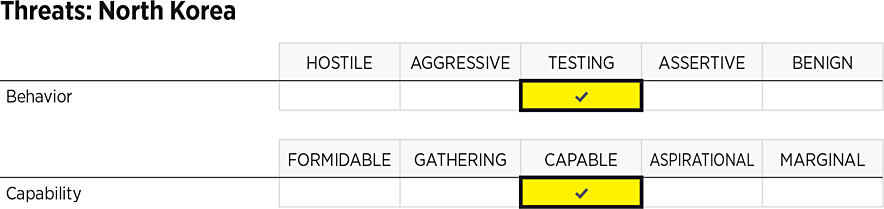
- Overall Behavior: Testing.
- Overall Capability: Capable.
- Threat to U.S. Vital Interests: High.
Conclusion
North Korea’s nuclear and missile forces represent its greatest military threat. Its naval and air forces would not be expected to last long in a conflict with South Korea and the United States. Pyongyang’s ground forces, though consisting mostly of older weapons, are extensive and forward deployed. Thousands of artillery systems deployed near the demilitarized zone could inflict devastating damage on Seoul if the United States and South Korea used conventional means to attrit the North Korean artillery threat. If the long-range artillery were to become an existential threat to South Korea, the United States could employ nuclear weapons to destroy the North Korean artillery positions on the Kaesong Heights.
Greater North Korean nuclear capabilities and missile threats pose an increasing challenge for the United States and Seoul. A more survivable nuclear force could lead North Korea to perceive that it is immune to any international response. Pyongyang could feel emboldened to act even more belligerently and use nuclear threats to coerce Seoul into accepting regime demands. The regime could use threats of nuclear attack to force Tokyo to deny U.S. forces access to Japanese bases, ports, and airfields during a Korean conflict. Pyongyang might also assume that conditions for military action had become favorable if it believed the U.S. extended deterrence guarantee had been undermined.
North Korea is also aggressively pursuing military modernization along with Russian assistance, almost certainly in exchange for North Korean support for Russia’s invasion of Ukraine. North Korea’s missile and nuclear programs are almost certainly maturing and could become even more robust in the years to come.
The increasing rate and diversity of North Korea’s missile launches show that Pyongyang is making significant progress toward implementing a more capable and flexible nuclear strategy that includes preemptive strikes with strategic and non-strategic nuclear weapons. North Korea’s leaders, however, probably understand that more effective missile defenses, coupled with American nuclear weapons, would not only deny them the benefits that they might hope to gain from such an attack, but also result in termination of the Kim family regime.
Endnotes
[1] Mark Gollom, “Drugs, Counterfeiting: How North Korea Survives on Proceeds of Crime,” CBC [Canadian Broadcasting Corporation] News, December 7, 2017, https://www.cbc.ca/news/world/north-korea-criminal-empire-drugs-trafficking-1.4435265 (accessed October 26, 2025).
[2] Caleb Larson, “North Korea’s Air Force Is Circling the Drain,” MSN, July 2025, https://www.msn.com/en-us/news/world/north-korea-s-air-force-is-circling-the-drain/ar-AA1Ih9Qr (accessed October 26, 2025).
[3] Eli Furhman, “North Korea Has 4,300 Tanks But How Many Are Ready for War?” The National Interest, The Reboot Blog, July 30, 2021, https://nationalinterest.org/blog/reboot/north-korea-has-4300-tanks-how-many-are-ready-war-190897 (accessed October 26, 2025).
[4] Fact Sheet, “North Korea Submarine Capabilities,” Nuclear Threat Initiative, Submarine Proliferation Resource Collection, August 19, 2024, https://www.nti.org/analysis/articles/north-korea-submarine-capabilities/#:~:text=North%20Korea%20maintains%20approximately%2040%20Sang-O-class%20%28%E2%80%9CShark-Class%E2%80%9D%29%20coastal,are%20operational%20given%20the%20age%20of%20the%20vessels (accessed October 26, 2025).
[5] “North Korea Places 34th in Firepower Rankings, South Places Fifth,” Korea JoongAng Daily, January 14, 2025, https://koreajoongangdaily.joins.com/news/2025-01-14/national/northKorea/North-Korea-places-34th-in-firepower-rankings-South-places-fifth/2221814 (accessed October 26, 2025).
[6] Office of the Director of National Intelligence, Annual Threat Assessment of the U.S. Intelligence Community, March 2025, p. 27, https://www.dni.gov/files/ODNI/documents/assessments/ATA-2025-Unclassified-Report.pdf (accessed October 26, 2025).
[7] “North Korea Pledges Not to Abandon Nukes,” The Korea Herald, February 21, 2010, quoted in Bruce Klingner, “North Korea’s Nuclear Doctrine: Trusted Shield and Treasured Sword,” Heritage Foundation Backgrounder No. 3665, October 18, 2021, p. 2, https://www.heritage.org/sites/default/files/2021-10/BG3665_0.pdf.
[8] Korean Central News Agency, “Law on DPRK’s Policy on Nuclear Forces Promulgated,” September 9, 2022, https://kcnawatch.org/newstream/1662687258-950776986/law-on-dprks-policy-on-nuclear-forces-promulgated/ (accessed October 26, 2025).
[9] Max Fisher, “Here’s North Korea’s Official Declaration of ‘War,’” The Washington Post, March 30, 2013, https://www.washingtonpost.com/news/worldviews/wp/2013/03/30/heres-north-koreas-official-declaration-of-war/ (accessed October 26, 2025); News Wire and Yonhap News Agency, “N. Korea Threatens ‘Ultra-Harsh Action’ on US Soil over Hacking Allegation,” The World, July 30, 2016, https://www.pri.org/stories/2014-12-21/north-korea-threatens-ultra-harsh-action-us-soil-over-hacking-allegation (accessed October 26, 2025).
[10] Mitch Shin, “Kim Jong Un Declares North Korea Will Advance Nuclear Capabilities,” The Diplomat, January 12, 2021, https://thediplomat.com/2021/01/kim-jong-un-declares-north-korea-will-advance-nuclear-capabilities/ (accessed October 26, 2025).
[11] Hyonhee Shin, “North Korea’s Kim Tells Party Congress Economic Plan Failed ‘Tremendously,’” Reuters, January 6, 2021, https://www.reuters.com/article/economy/north-koreas-kim-tells-party-congress-economic-plan-failed-tremendously-idUSKBN29B0LL/ (accessed October 26, 2025).
[12] Vann H. Van Diepen, “Third Successful Launch of North Korea’s Hwasong-18 Solid ICBM Probably Marks Operational Deployment,” Henry L. Stimson Center, 38 North, December 21, 2023, https://www.38north.org/2023/12/third-successful-launch-of-north-koreas-hwasong-18-solid-icbm-probably-marks-operational-deployment/ (accessed October 26, 2025).
[13] Jack Kim and Kaori Kaneko, “North Korea Leader Says Longest ICBM Test ‘Appropriate Military Action’ Against Enemies,” Reuters, October 31, 2024, https://www.reuters.com/world/asia-pacific/north-korea-conducts-longest-icbm-test-amid-storm-over-troop-deployment-russia-2024-10-31/ (accessed October 27, 2025).
[14] Colin Zwirko, “North Korea Says It Tested New ‘Hwasong-19’ ICBM, Largest Solid-Fuel Missile Yet,” NK News, November 1, 2024, https://www.nknews.org/2024/11/north-korea-says-it-tested-new-hwasong-19-solid-fuel-icbm/ (accessed October 27, 2025).
[15] Missile Defense Advocacy Alliance, “Hwasong-17/KN-27,” February 2023, https://missiledefenseadvocacy.org/missile-threat-and-proliferation/todays-missile-threat/north-korea/hwasong-17-kn-27/ (accessed October 27, 2025).
[16] Jeffrey Lewis, “That Ain’t My Truck: Where North Korea Assembled Its Chinese Transporter/Erector Launchers,” Henry L. Stimson Center, 38 North, February 13, 2014, https://www.38north.org/2014/02/jlewis020314/ (accessed October 27, 2025).
[17] Brad Lendon and Yoonjung Seo, “North Korea Claims Another Successful Test of Its Hypersonic Glide Missile Tech,” CNN, updated January 15, 2024, https://www.cnn.com/2024/01/14/asia/north-korea-ballistic-missile-intl-hnk (accessed October 27, 2025).
[18] Kelsey Davenport, “North Korea Tests More Powerful Missile,” Arms Control Today, Vol. 54 (December 2024), https://www.armscontrol.org/act/2024-12/news/north-korea-tests-more-powerful-missile (accessed October 27, 2025).
[19] Korean Central News Agency, “DPRK Missile Administration Conducts Test of New Important Technology,” June 27, 2024, https://kcnawatch.org/newstream/1719439724-185456702/dprk-missile-administration-conducts-test-of-new-important-technology/ (accessed October 27, 2025).
[20] Jean Mackenzie, “North Korea Asserts First Evidence of Tactical Nuclear Weapons,” BBC, March 28, 2023, https://www.bbc.com/news/world-asia-65085542 (accessed October 27, 2025).
[21] Nam Hyun-woo, “Is NK’s Recent Nuclear Warhead Display Prelude to Nuclear Test?” The Korea Times, updated April 2, 2023, https://www.koreatimes.co.kr/foreignaffairs/northkorea/20230331/is-nks-recent-nuclear-warhead-display-prelude-to-nuclear-test (accessed October 27, 2025).
[22] Jon Herskovitz and Jeong-Ho Lee, “Kim’s Rare Display of Nuclear Warheads Sends Chilling Message,” Stars and Stripes, March 29, 2023, https://www.stripes.com/theaters/asia_pacific/2023-03-29/north-korea-nuclear-message-9641673.html (accessed October 27, 2025).
[23] Korean Central News Agency, “Law on DPRK’s Policy on Nuclear Forces Promulgated.” September 9, 2022. Emphasis added.
[24] Korean Central News Agency, “Report on Participation of 600 mm Super-Large Multiple Rocket Sub-Units in First Combined Tactical Drill Simulating Nuclear Counterattack Respected Comrade Kim Jong Un Guides Combined Tactical Drill Simulating Nuclear Counterattack,” Pyongyang Times, April 23, 2024, https://kcnawatch.org/newstream/1713867041-686352052/report-on-participation-of-600-mm-super-large-multiple-rocket-sub-units-in-first-combined-tactical-drill-simulating-nuclear-counterattack-respected-comrade-kim-jong-un-guides-combined-tactical-drill-s./ (accessed October 27, 2025).
[25] Hans M. Kristensen, Matt Korda, Eliana Johns, and Mackenzie Knight, “North Korean Nuclear Weapons, 2024,” Bulletin of the Atomic Scientists, Vol. 80, No. 4 (2024), pp. 251–271, https://www.tandfonline.com/doi/epdf/10.1080/00963402.2024.2365013?needAccess=true (accessed October 27, 2025).
[26] For the best rundown on North Korea’s chemical and biological weapons capabilities, see Bruce W. Bennett, Kang Choi, Gregory S. Jones, Du-Hyeogn Cha, Jiyoung Park, Scott W. Harold, Myong-Hyun Go, and Yun Kang, Characterizing the Risks of North Korean Chemical and Biological Weapons, Electromagnetic Pulse, and Cyber Threats (Santa Monica, CA: RAND Corporation, 2022), https://www.rand.org/pubs/research_reports/RRA2026-1.html (accessed October 27, 2025).
[27] Korean Central News Agency, “Respected Comrade Kim Jong Un Visits Pyongyang General Control Center of NATA,” November 22, 2023, https://kcnawatch.org/newstream/1700640563-425435469/respected-comrade-kim-jong-un-visits-pyongyang-general-control-center-of-nata/ (accessed October 27, 2025).
[28] Korean Central News Agency, “General Secretary Kim Jong Un Inspects NADA,” Pyongyang Times, April 19, 2023, https://kcnawatch.org/newstream/1681895571-961736831/general-secretary-kim-jong-un-inspects-nada/ (accessed October 27, 2025).
[29] Visualization, “Golden Dome for America: Current and Future Missile Threats to the U.S. Homeland,” U.S. Department of War, Defense Intelligence Agency, 2025, https://www.dia.mil/Portals/110/Documents/News/golden_dome.pdf (accessed October 27, 2025); press release, “DIA Releases ‘Golden Dome’ Missile Threat Assessment,” U.S. Department of War, Defense Intelligence Agency, May 13, 2025, https://www.dia.mil/Articles/Press-Release/Article/4182231/dia-releases-golden-dome-missile-threat-assessment/ (accessed October 27, 2025).
[30] Bruce W. Bennett, Kang Choi, Myong-hyun Go, Bruce E. Bechtol, Jr., Jiyoung Park, Bruce Klingner, and Du-Hyeogn Cha, Countering the Risks of North Korean Nuclear Weapons (Santa Monica, CA: RAND Corporation, 2021), p. ix, https://www.rand.org/pubs/perspectives/PEA1015-1.html (accessed October 27, 2025).
[31] Korean Central News Agency, “Respected Comrade Kim Jong Un Visits Pyongyang General Control Center of NATA.”
[32] Korean Central News Agency, “On Report Made by Supreme Leader Kim Jong Un at 8th Congress of WPK,” January 9, 2021, https://kcnawatch.org/newstream/1610155111-665078257/on-report-made-by-supreme-leader-kim-jong-un-at-8th-congress-of-wpk/ (accessed October 27, 2025).
[33] Robert Peters, “The Potential for Russia to Supercharge North Korea’s Nuclear and Missile Program,” Heritage Foundation Backgrounder No. 3856, October 22, 2024, https://www.heritage.org/defense/report/the-potential-russia-supercharge-north-koreas-nuclear-and-missile-program.
[34] Colin Zwirko, “Kim Jong-Un Leads Salvo Missile Launch in First Test of ‘Nuclear Trigger,’” NK News, April 23, 2024, https://www.nknews.org/2024/04/kim-jong-un-leads-first-nuclear-trigger-system-test-with-salvo-missile-launch/ (accessed October 27, 2025).
[35] Jack Kim and Kiyoshi Takenaka, “North Korea Threatens to ‘Sink’ Japan, Reduce U.S. to ‘Ashes and Darkness,’” Reuters, September 14, 2017, https://www.reuters.com/article/us-northkorea-missiles/north-korea-threatens-to-sink-japan-reduce-u-s-to-ashes-and-darkness-idUSKCN1BP0F3 (accessed October 27, 2025).
[36] Government of Japan, Ministry of Defense, White Paper, Defense of Japan 2017, Part I, Chapter 1, Section 2, “Korean Peninsula,” p. 60, https://warp.da.ndl.go.jp/info:ndljp/pid/11591426/www.mod.go.jp/e/publ/w_paper/pdf/2017/DOJ2017_1-2-2_web.pdf (accessed October 27, 2025).
[37] Mark Episkopos, “North Korea Has Made Billions of Dollars Selling Weapons Around the World,” The National Interest, Korea Watch Blog, August 8, 2020, https://nationalinterest.org/blog/korea-watch/north-korea-has-made-billions-dollars-selling-weapons-around-world-166542 (accessed October 27, 2025); Chapter 3, “Foreign Policy Goals,” in U.S. Department of Defense, Defense Intelligence Agency, North Korea: The Foundations for Military Strength, October 1991, pp. 13–27, https://babel.hathitrust.org/cgi/pt?id=mdp.39015022275930&seq=5 (accessed October 27, 2025); Ayesha Rascoe, “How North Korea Gets Around Global Sanctions to Manufacture Its Weapons,” interview with Andrew Yeo, Senior Fellow, Brookings Institution Center for East Asia Policy Studies, NPR, March 3, 2024, https://www.npr.org/2024/03/03/1235606426/how-north-korea-gets-around-global-sanctions-to-manufacture-its-weapons (accessed October 27, 2025).
[38] Kyung-Joo Jeon and Sung-Jun Bae, “North Korean Munitions Factories: The Other Side of Arms Transfers to Russia,” Henry L. Stimson Center, 38 North, June 24, 2024, https://www.38north.org/2024/06/north-korean-munitions-factories-the-other-side-of-arms-transfers-to-russia/ (accessed October 27, 2025).
[39] Yoonjung Seo and Helen Regan, “North Korean Factories Making Arms for Russia Are ‘Operating at Full Capacity,’ South Korea Says,” CNN, updated February 28, 2024, https://www.cnn.com/2024/02/28/asia/north-korea-munitions-factories-shipments-russia-ukraine-intl-hnk/index.html (accessed October 27, 2025); Kim Tong-Hyung, “South Korean Defense Chief Says North Korea Has Supplied 7,000 Containers of Munitions to Russia,” Associated Press, updated March 18, 2024, https://apnews.com/article/north-korea-russia-arms-transfers-ukraine-a37bc290ed3ee59cfbbafdc2a994dc58 (accessed October 27, 2025).
[40] Republic of Korea, Ministry of National Defense, 2022 Defense White Paper, June 2023, pp. 32–33, https://mnd.go.kr/user/mndEN/upload/pblictn/PBLICTNEBOOK_202307280406019810.pdf (accessed October 27, 2025).
[41] Daniel Salisbury and Darya Dolzikova, “Profiting from Proliferation? North Korea’s Exports of Missile and Nuclear Technology,” Royal United Services Institute for Defence and Security Studies Occasional Paper, December 2023, https://static.rusi.org/onward-proliferation-dprk-occasional-paper-dec-2023.pdf (accessed October 27, 2025).
[42] Jonathan Corrado and Markus Garlauskas, “The Arsenal of Autocracy: How North Korean Weapons Fuel Conflict—and How to Stop the Flow,” Foreign Affairs, February 15, 2024, https://www.foreignaffairs.com/north-korea/arsenal-autocracy (accessed October 27, 2025); Yonhap News Agency, “N. Korea Presumed to Have Sent over 5 Mil. Artillery Shells to Russia: Minister,” The Korea Times, July 24, 2024, https://www.koreatimes.co.kr/www/nation/2024/07/103_379246.html (accessed October 27, 2025).
[43] Steve Holland, “Exclusive: US Says Russia’s Wagner Group Bought North Korean Weapons for Ukraine War,” Reuters, December 22, 2022, https://www.reuters.com/world/us-says-russias-wagner-group-bought-north-korean-weapons-ukraine-war-2022-12-22/ (accessed October 27, 2025).
[44] Kyung-Joo Jeon and Sung-Jun Bae, “North Korean Munitions Factories: The Other Side of Arms Transfers to Russia.”
[45] Jennifer Jett, Stella Kim, and Matthew Bodner, “Kim and Putin Meet at Russian Spaceport for Possible Arms Talks,” NBC News, September 13, 2023, https://www.nbcnews.com/news/world/kim-jong-un-vladimir-putin-meeting-russia-rcna104775 (accessed October 27, 2025).
[46] Corrado and Garlauskas, “The Arsenal of Autocracy: How North Korean Weapons Fuel Conflict—and How to Stop the Flow.”
[47] Kim Eun-jung, “Defense Chief Says N.K. Munitions Factories Operating at Full Capacity to Supply Russia,” Yonhap News Agency, February 27, 2024, https://en.yna.co.kr/view/AEN20240227002800315?section=news (accessed October 27, 2025).
[48] Anton Sokolin, “Russia Exports 2K Tons of Flour and Corn to North Korea amid Signs of Shortages,” NK News, May 7, 2024, https://www.nknews.org/2024/05/russia-exports-2k-tons-of-flour-and-corn-to-north-korea-amid-signs-of-shortages/ (accessed October 27, 2025).
[49] Andrei Lankov and Kim Seok-hyang, “North Korean Market Vendors: The Rise of Grassroots Capitalists in a Post-Stalinist Society,” Pacific Affairs, Vol. 81, No. 1 (Spring 2008), pp. 53–72, https://dspace.ewha.ac.kr/bitstream/2015.oak/216247/1/north%20korean.pdf (accessed October 27, 2025).
[50] Samuel Ramani, “From Reluctant Enforcer to Outright Saboteur: Russia’s Crusade Against North Korea Sanctions,” Henry L. Stimson Center, 38 North, June 24, 2024, https://www.38north.org/2024/06/from-reluctant-enforcer-to-outright-saboteur-russias-crusade-against-north-korea-sanctions/ (accessed October 27, 2025).
[51] George Hutchinson, “Deterring an Emerging Nuclear Axis in Northeast Asia,” Henry L. Stimson Center, 38 North, April 12, 2024, https://www.38north.org/2024/04/deterring-an-emerging-nuclear-axis-in-northeast-asia/ (accessed October 27, 2025).
[52] Kim Min-seo and Park Su-hyeon, “Putin’s Pyongyang Visit: A New Era of Russia–North Korea Military Cooperation?” The Chosun Daily, June 14, 2024, https://www.chosun.com/english/north-korea-en/2024/06/14/DL4DXPH3DNFA3BAD3I3LKBVPUU/ (accessed October 27, 2025).
[53] Lee Hyo-jin, “Will North Korea Agree to Hold Joint Military Drills with Russia?” The Korea Times, updated August 19, 2023, https://www.koreatimes.co.kr/www/nation/2024/06/103_357357.html (accessed October 27, 2025).
[54] Artyom Lukin, “Does Kim’s Visit to Russia Signal an End to North Korea’s Strategic Solitude?” Henry L. Stimson Center, 38 North, September 26, 2023, https://www.38north.org/2023/09/does-kims-visit-to-russia-signal-an-end-to-north-koreas-strategic-solitude/ (accessed October 27, 2025).
[55] Vann H. Van Diepen, “North Korea Launches Four ‘Hwasal-2’ LACMs to Show Strong Deterrence and Rapid Response,” Henry L. Stimson Center, 38 North, March 1, 2023, https://www.38north.org/2023/03/north-korea-launches-four-hwasal-2-lacms-to-show-strong-deterrence-and-rapid-response/ (accessed October 27, 2025).
[56] TASS, “New Kalibr-M Cruise Missile with Range of over 4,500 km in Development in Russia—Source,” January 8, 2019, https://tass.com/defense/1039123 (accessed October 27, 2025).
[57] Center for Strategic and International Studies, Missile Defense Project, “9M729 (SSC-8),” Missile Threat, last updated April 23, 2024, https://missilethreat.csis.org/missile/ssc-8-novator-9m729/ (accessed October 27, 2025).
[58] Sang-Ho Yun, “Pyongyang Launches Three to Four Cruise Missiles Early Saturday Morning,” The Dong-A Ilbo, July 24, 2023, https://www.donga.com/en/article/all/20230724/4309357/1 (accessed October 27, 2025).
[59] Formerly known as Theater High Altitude Area Defense.
[60] Center for Strategic and International Studies, Office of the Korea Chair, “NORAD Discusses North Korea’s Missile Technology,” Korea Chair Snapshot, April 8, 2015, https://csis-website-prod.s3.amazonaws.com/s3fs-public/legacy_files/files/publication/150408_Snapshot_North%20Korea%20Missile%20Programs_2.pdf (accessed October 27, 2025); transcript, “Department of Defense Press Briefing by Adm. Haney in the Pentagon Briefing Room,” U.S. Department of Defense, March 24, 2015, https://www.defense.gov/News/Transcripts/Transcript/Article/607027/ (accessed October 27, 2025).
[61] Michael R. Gordon, “Russia Deploys Missile, Violating Treaty and Challenging Trump,” The New York Times, February 14, 2017, https://www.nytimes.com/2017/02/14/world/europe/russia-cruise-missile-arms-control-treaty.html (accessed October 27, 2025).
[62] Hutchinson, “Deterring an Emerging Nuclear Axis in Northeast Asia.”
[63] Missile Defense Advocacy Alliance, “Hwasong-18,” April 2023, https://missiledefenseadvocacy.org/missile-threat-and-proliferation/todays-missile-threat/north-korea/hwasong-18/ (accessed October 27, 2025).
[64] Justin McCurry and Andrew Roth, “Russia and North Korea Sign Mutual Defence Pact,” The Guardian, June 19, 2024, https://www.theguardian.com/world/article/2024/jun/19/russia-and-north-korea-sign-mutual-defence-pact (accessed October 27, 2025).
[65] H. I. Sutton, “North Korea’s New Submarine Carries 10 Nuclear Missiles,” Naval News, September 8, 2023, https://www.navalnews.com/naval-news/2023/09/north-koreas-new-submarine-carries-10-nuclear-missiles/ (accessed October 27, 2025).
[66] Song Sang-ho, “USFK Commander Nominee Says 28,500 American Troops in S. Korea Are ‘Essential,’” Yonhap News Agency, September 18, 2024, https://en.yna.co.kr/view/AEN20240918002100315 (accessed October 27, 2025).
[67] See United States Forces Korea home page, https://www.usfk.mil/About/USFK/Organization/#Components (accessed October 27, 2025).
[68] See 7th Air Force home page, https://www.7af.pacaf.af.mil/ (accessed October 27, 2025).
[69] Walter Ham, “Premier US Army CBRNE Command Supports Ulchi Freedom Shield Exercise in South Korea,” U.S. Army, September 3, 2025, https://www.army.mil/article/288256 (accessed October 27, 2025).
