

Americans assume that when they pick up a prescription, an FDA quality control professional has verified that the contents are manufactured to rigorous agency standards. Unfortunately, that assumption is becoming harder to defend.
For decades, the FDA’s drug oversight model has depended on in-person inspections of the manufacturing practice and independent verification of product quality. The underlying principle was straightforward: companies seeking to profit from selling medicine to the American people would be held to strict and independently assessed FDA-enforced standards. However, that principle has recently been eroded.
During COVID, the FDA sharply curtailed—then mostly eliminated—routine in-person inspections as part of its “work at home” initiative. The repercussions are still being felt today. Manufacturers know that no FDA inspector will make an unannounced in-person inspection. Today, approximately 90% of FDA overseas inspections are announced in advance.
It Started Under Biden:
Beginning in January 2021, almost immediately following Biden’s presidential inauguration, FDA career employees quickly and quietly proposed an agency-wide “remote” inspection system for almost everything it regulated. Recalls began soaring, and continued to do so even after the FDA ended its work-from-home policy in March 2025.
Right before Trump was reelected in 2024, the FDA had an inspection backlog numbering in the thousands. Today, that FDA inspection backlog persists, placing Americans in perpetual danger from unsafe pharmaceuticals and medical devices.
>>> What the FDA Doesn’t Tell Women About Hormone Replacement Therapy
It’s to the point that even the US Government Accountability Office publicly scolded the FDA in February of 2026 about not effectively inspecting manufacturing plants. Hardly a weekday goes by without at least one FDA-announced recall.
It seems that America’s FDA leadership has significant “blind spots” to a surge in product recalls by allowing its “remote” inspection policy to continue as a permanent policy, including to this very day.
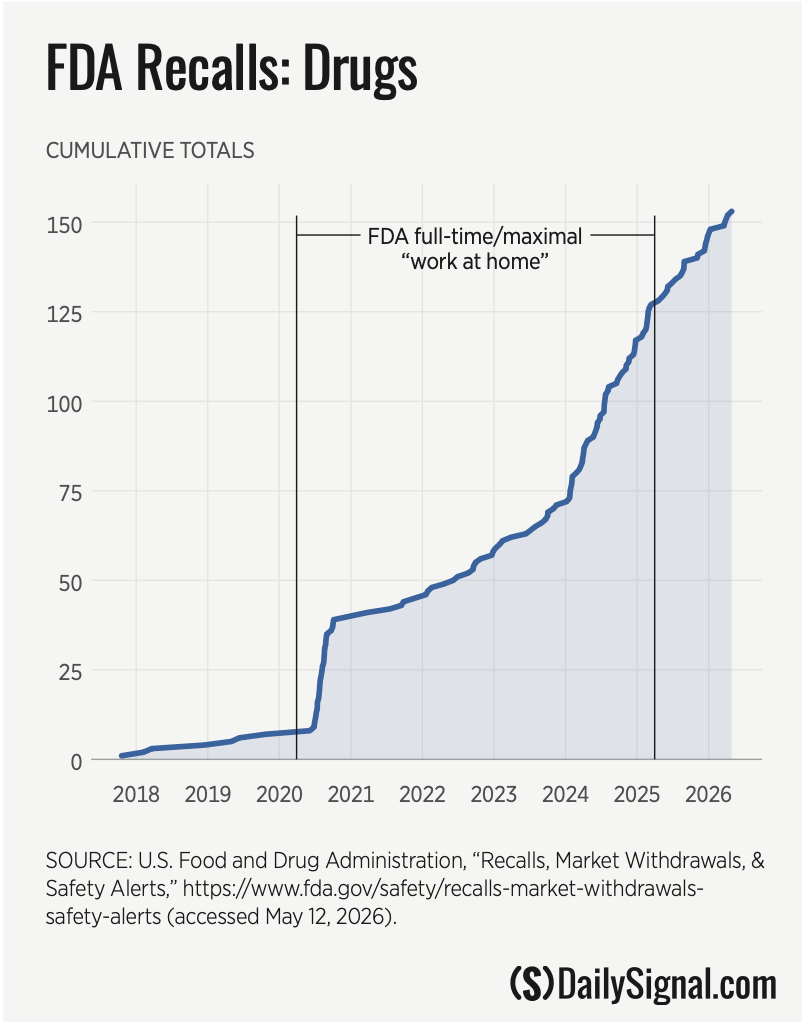
Drug recall data published by the FDA shows a rapid increase in the number of drug recalls since 2020, concurrent with the emergence of COVID, when no inspections occurred. That was followed by “announced” and “remote inspection” methodologies. Even worse: FDA recalls continued to climb with FDA’s “work at home” policies ending in March of 2025, illustrating the “remote inspection” policy failure. Note: The FDA does not share drug recall data prior to 2018 on its website.
Delayed Messaging to Patients by FDA:
Even more concerning than the increasing number of FDA products that remained on the market after deficiencies were discovered was the time that these recalled products remained on the market afterward. Recalled products may have remained available to consumers for weeks or months—but we don’t know, because the FDA does not always publicly detail that reporting delay. Bottom line: American patients are being placed at risk as a consequence of an objectively ineffectual FDA inspection regime.
Blind Trust on Complex Devices & Other FDA Products:
Drugs are not a product where quality can simply be assumed from a manufacturer’s self-submitted paperwork. Manufacturers have every financial motivation to curate their reporting to show the best possible results. When the FDA is reduced to pre-announced, scheduled and/or remote inspections, the opportunity for quality concealment and risk to the public expands considerably.
When it comes to making drugs, even tiny errors can produce catastrophic consequences. Findings have established an estimated 2—3σ (sigma) level of imprecision when it comes to pharmaceutical manufacturing. That corresponds to 66,807 to 308,537 defects per 1,000,000 opportunities, according to an article by FDA officials.
But the drugs we take are the most regulated products in the U.S., and newer and more complex pharmaceutical products could create more than 1,000,000 “opportunities” for error. A contaminated batch, an improper sterility protocol, or an undisclosed ingredient used to save money on the manufacturing process—causing even one minor structural shift in a molecule—have the potential to permanently injure or kill patients.
FDA-Regulated Device Recalls:
FDA Class 1 device recalls—those with the potential to cause serious injury or death—hit a 15-year high in 2022 and continued to balloon in 2024 and 2025.
The FDA device recall page has well over 150 recalls involving thousands of products for patients in 2024 alone. Although the FDA had a dedicated 2024 webpage for device recalls, the FDA appears to have stopped generating dedicated webpages for 2025 or 2026.
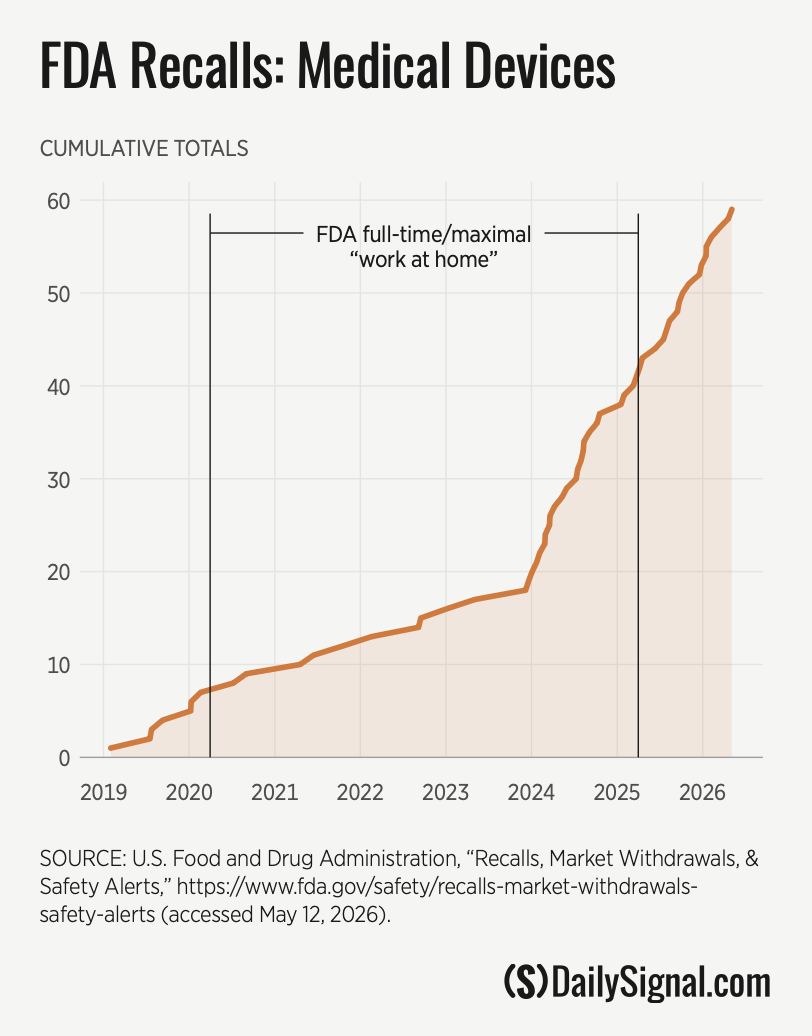
Medical device recall data from the FDA details a noteworthy increase in the number of recalls starting with the FDA’s “remote” and “announced inspections” policies implemented during COVID. Even worse: recalls continued to climb despite the FDA’s “work at home” policies terminating in March of 2025, further detailing the policy’s failure. Note: The FDA does not share device recall data prior to 2019 on its website.
FDA devices can range from syringes to molded implantable joints to hemodialysis systems. They may heavily rely on medical-grade pumps, sensors, complex hardware, synthetic materials, electronics and software, all of which must be manufactured to exacting specifications to be considered safe.
Yet the FDA rarely forces manufacturers to recall dangerous medical devices. Instead, they wait for device failure reports or deaths from physicians and patients.
A 2024 Government Accountability Office probe found that in 2022, the FDA received 3 million reports about malfunctioning devices—nearly 30 times more than in 2005. Nearly one-third described injuries and deaths. Still, the FDA doesn’t use its authority to force manufacturers to pull defective devices from the market, even though federal law empowers it to do so.
The Current FDA Inspection Policy Isn’t Adequately Protecting Americans:
The FDA’s current policy asks the public simply to trust for-profit drug manufacturers (even those with liability shields), which are primarily inspected during scheduled and announced intervals. Worse, these inspections do not occur frequently enough, and in most cases, are only conducted “remotely.”
Summary:
In conclusion, Trump’s (now exited) FDA leadership inherited an agency already weakened by pandemic-era disruptions, but it also inherited its historical obligation to enforce rigor to one of the most critical, consequential and historical functions when it comes to FDA oversight: safety.
>>> Don't Regulate Away America's Medical Device Sterilization Industry
Adding to the lack of misguided policy: each year, the FDA conducts approximately 12,000 manufacturing plant inspections in the U.S., but just 3,000 inspections across 90 other countries that, according to the FDA, “produce foods, essential medicines, and other medical products intended for American consumers and patients.” In addition to unfairly punishing domestic manufacturers with more inspections as compared to those overseas, this policy has not yielded a positive effect on the after-market recalls of drugs and medical devices.
The surge in recalls is only one issue amid other errand FDA priorities and perpetual personnel turnover, compounding and distracting from other critical strategic FDA reforms, far more difficult at precisely the moment they are most needed.
The FDA needs to restore its historical, robust and comprehensive in-person inspection methodology. It must increase transparency to Americans regarding inspection failures and quality concerns. It must actively prioritize independent verification over manufacturer self-reporting and ensure that enforcement actions occur before dangerous products reach American patients—not just passively “Tweet” about it on social media after the recall has taken place. Of note, that is currently what the FDA is doing, and has done over 7,400 times.
FDA leadership must immediately return to a valid inspection process that made the FDA’s historical quality verification the global gold standard. FDA leadership and its inspectors need to get back to work and do so quickly.
This piece originally appeared in the Independent Institute



