The Caribbean is the third and often-overlooked border of the United States, with both the potential benefits and security concerns that this entails.
President Donald Trump has moved quickly to stop the illegal trafficking of drugs and people across the U.S. border with Mexico, succeeding in sealing off the border and massively reducing cross-border trafficking. The Heritage Foundation outlined in a January 2025 Special Report how U.S. Department of War assets could play a critical role in assisting the U.S. Customs and Border Protection (CBP), Immigration and Customs Enforcement (ICE), and the Drug Enforcement Administration (DEA) in securing the border and removing illegal aliens from the U.S. interior. The profit incentive for the cartels to move larger amounts of illegal drugs into the United States, however, has not disappeared, and increased security at the border with Mexico has caused the cartels to pivot and move larger amounts of drugs in through other routes—the most obvious being through the Caribbean. Operation Southern Spear, in which the U.S. military is “detecting, disrupting, and degrading transnational criminal and illicit maritime networks,” has served as an effective early strategy to counter this pivot.[REF]
The Caribbean is pivotal to the Administration’s National Security Strategy as part of President Trump’s reassertion of American security interests in the Western Hemisphere. The United States seeks a hemisphere free of the malign foreign influence of adversaries like China and Russia and free of the destabilizing influence of the drug cartels that have taken root across the Americas. This effort requires the leveraging of significant American power, with increased economic and diplomatic engagement, security cooperation and assistance, and in some cases direct military action like the strikes on narco-terrorists and the successful action to arrest Nicolas Maduro in Operation Absolute Resolve. Military actions in the Caribbean to deal with threats to the U.S. homeland posed by narco-terrorists are inherently different from the nation-building projects of the past several decades elsewhere in the world, as they are clearly motivated by American national interests and deal with direct threats to the American homeland.
The United States has core national interests in preventing its third border from being infiltrated or occupied by adversarial powers, in disrupting the activities of cartels in the region to prevent the trafficking of drugs into the United States, and in not allowing adversarial powers or cartels to use Venezuela, Cuba, or Haiti as bases from which to threaten the United States.
Caribbean Security Concerns
The Caribbean region lies between the world’s largest narcotics production zone, South America, and the world’s largest narcotics market, the United States, making the Caribbean the highway between producer and consumer.
The rise in cocaine production in Colombia and Venezuela, and shipment to North America and Europe, fuels the transportation and distribution of drugs into the Caribbean. Law enforcement agencies frequently seize large cocaine loads transiting from Colombia to Puerto Rico and the U.S. Virgin Islands, with recent interdictions exceeding 1,000 kilograms (kg) per shipment.[REF] In the nations of the Caribbean, this increase in drug production and shipping contributes to the rise in violence by gangs who compete for control of illicit shipping routes and territory, with negative effects for the security and economic prosperity of the citizens of the Caribbean. Other transnational criminal organizations (TCOs), including armed gangs in Haiti, aggressively assert control over key infrastructure by using terror tactics to shut down shipping lanes, increasing the cost of shipping and jeopardizing regional supply chains.[REF]
Weapons trafficking also contributes to violence and rising criminal activity in the Caribbean. More than half the murders in the Caribbean involve guns that can be traced back to the United States. This has contributed to the rise in violent crime in the Caribbean and is justifiably a major concern of U.S. partners in the region. As such, the United States has both an obligation and national security interest to do more to prevent weapons from the U.S. from being trafficked to the Caribbean. From 2020 to 2022, 7,399 guns were recovered from crimes, of which 5,399 were determined to have originated in the United States. The financial incentive for TCOs to traffic arms is significant since a firearm can be sold at retail for $350 in the United States and illegally re-sold for $1,600.[REF]
The severity of drug trafficking in the Caribbean basin can be demonstrated by the dramatic drug seizures routinely carried out by U.S. Southern Command (SOUTHCOM). In March 2025, a single U.S. Coast Guard cutter offloaded 12,470 pounds of cocaine worth $141.4 million seized in the Caribbean.[REF] Unfortunately, U.S. and partnered law enforcement in the Caribbean are stopping only a small percentage of the total volume of drugs being shipped to the United States, although it is more than likely that these numbers have dropped as a result of President Trump’s strikes on trafficking boats. These strikes serve as a deterrent to cartels using the sea route and over time will have a serious effect on the cartels’ bottom lines. As Secretary of State Marco Rubio put it: “The United States has long, for many, many years, established intelligence that allows us to interdict and stop drug boats, and we did that and it doesn’t work…. What will stop them is when you blow them up, when you get rid of them.”[REF]
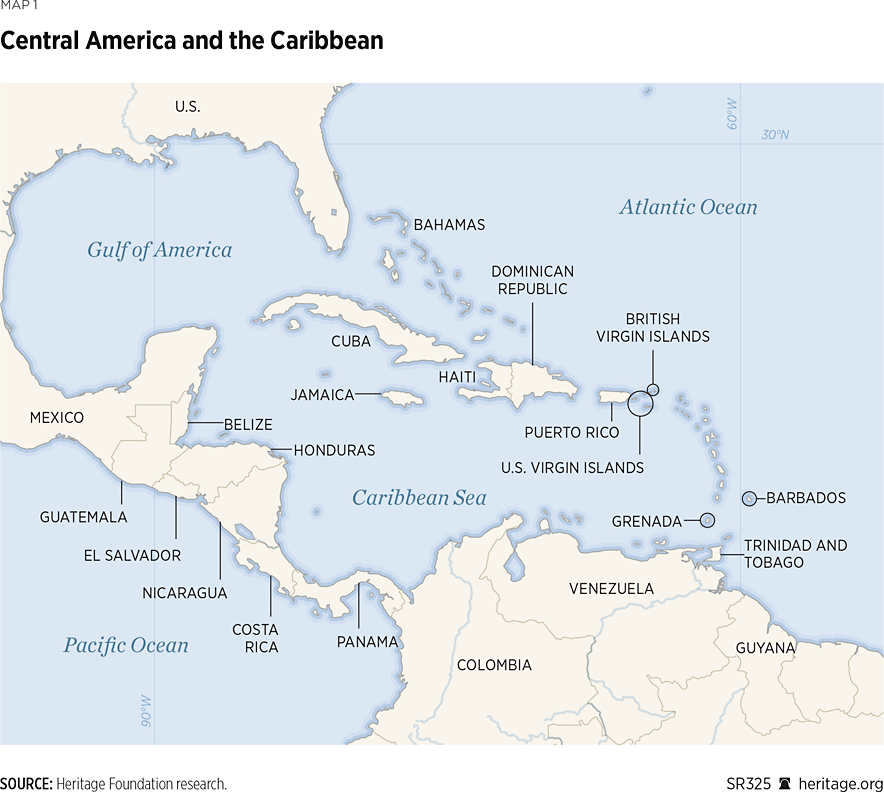
Criminal groups are infiltrating commercial operations of ports and cargo vessels to send large volumes of cocaine to Europe and the United States.[REF] In the Caribbean, drugs are transported by island hopping, in which large amounts of cocaine are trafficked from island to island in go-fast boats to reach large ports or airports, especially ones with routine routes to the U.S. mainland.[REF] Island hopping as a drug-trafficking technique complicates matters for security forces and law enforcement, with the traffickers often operating at night in small boats and using unpopulated parts of the islands. One common drug-trafficking route frequently used starts at Venezuela’s Port of Guiria, from where drugs are quickly and relatively easily trafficked into Trinidad and Tobago just miles away. The drugs are then transported to the Dominican Republic or Haiti for consumption or for further trafficking to the United States or Europe.
Mexican Cartels Creeping into the Caribbean. The Sinaloa and Jalisco New Generation (CJNG) cartels are the most dangerous TCOs in the world and continue to expand their reach throughout Latin America and the Caribbean at an alarming rate.[REF] Although smaller amounts of drugs are now arriving in the United States as a result of President Trump’s executive order on “Protecting the American People Against Invasion,”[REF] Mexican cartels will continue to seek new routes and methods to move drugs from their production sites in Latin America to the markets in the United States and Europe.
Historically, the Caribbean Sea has been a preferred route for both legal and illegal maritime trade and has recently regained prominence in drug trafficking. This route was heavily used by major Colombian and Mexican cartels in the 1970s and 1980s, but under pressure from U.S. authorities, traffickers shifted their operations to the Pacific and overland routes through Central America.
Venezuela, Colombia, and Mexico have been identified as the primary countries from which drugs are shipped to the Caribbean (and then to U.S. and European markets), using coastal drops, speed boats, semi-submersibles, and remotely operated submarines. In the case of Venezuela, traffickers have exploited the country’s long crisis and the complicity of the political and administrative apparatus to facilitate the transit to the Caribbean. With these trafficking tactics, Mexican and Colombian cartels divert shipments to the Caribbean—an attractive choice given the heightened surveillance, cooperation, and operational effectiveness in preventing the movement of large drug shipments by land and along the Pacific coast since the start of the second Trump Administration.[REF]
Many indications already show that the Mexican cartels are expanding their presence in the Caribbean. The Sinaloa Cartel has been found working with Dominican criminal groups to establish a Caribbean trafficking route, and Anibal de Castro, former Dominican Ambassador to the United States, stated that “[t]he Sinaloa Cartel is seeking to create a route to Europe using the Dominican Republic.”[REF] Former Assistant Secretary of State William Brownfield told a U.S. Senate subcommittee in November 2017 that “[t]he handwriting is on the wall. We can see the train. It is coming down the tracks. They [the cartels] will return” to the Caribbean. “We know we’re going to have to deal with this crisis again. It is in our interest, in fact it would be the height of folly and stupidity for us, not to prepare for it now in advance.”[REF]
Caribbean nations have reported record drug seizures in recent years. For instance, in May 2025, Dominican authorities announced two historic marijuana seizures,[REF] and in 2024 they seized record-breaking amounts of cocaine.[REF] In Jamaica, authorities also reported increased cocaine seizures, with larger and larger volumes of drugs being seized by authorities throughout the region.[REF]
The Sinaloa and CJNG cartels, with their violent tactics and ability to corrupt, have introduced a dangerous new element in the Caribbean. Elsewhere in the Western Hemisphere, the Ecuadorian security crisis illustrates this danger, since skyrocketing crime has been triggered by wars between gangs aligned with different Mexican cartels. Not only would this element threaten security for local populations were it to expand further to the Caribbean, but it could also threaten political stability, as shown by the murder in 2023 of Ecuadorian political candidate Fernando Villavicencio by CJNG-hired hitmen.[REF] As they look for alternative routes, traffickers could also increase their engagements with the gangs of Haiti, an easy target for trafficking and corruption given its failed political institutions and the wide control enjoyed by gangs.
Currently, Mexico is the leading provider of fentanyl to the U.S. (China serves as the primary source of precursor chemicals and India serves as the secondary source), although much of the production is outsourced by the cartels to criminal groups in Honduras, Bolivia, and Brazil.[REF] Once produced, most of the fentanyl is trafficked into the United States through the southern border, though a smaller amount is also brought through the Caribbean.[REF] President Trump has waged war on fentanyl with the Halt All Lethal Trafficking of Fentanyl (HALT Fentanyl) Act, which classifies fentanyl-related substances as a schedule one drug under the Controlled Substances Act.[REF] The immediate need for this act is demonstrated by the hundreds of thousands of Americans who have been killed by fentanyl in recent years, with annual deaths having peaked at 110,000 in 2022.[REF]
Adversarial Influence in the Caribbean. The Caribbean has always held strategic significance for U.S. national security. During World War II, for example, the region became the setting for one of the Allies’ most costly naval campaigns, the Battle of the Caribbean. Due to the importance of Venezuelan oil fields, Caribbean refineries, and Guianan bauxite for the Allied war effort, German submarines launched an aggressive campaign in 1942 and 1943 to torpedo merchant vessels and tankers in the area. While the Germans succeeded in sinking roughly 400 ships, by 1944 the Allies had managed to protect their ships through a convoy system, neutralizing the threat.[REF] U.S. partners and allies in the region were targeted as well, with German and Italian submarines sinking ships sailing from ports throughout the Caribbean, and even bombarding the Dutch island of Curaçao in an attempt to destroy the island’s petroleum storage facility.[REF]
The region again proved critical during the Cold War, with the most dramatic example being the Cuban Missile Crisis of October 1962. The presence of a communist regime on the doorstep of the U.S. and the threat posed by Cuba hosting Soviet medium- and intermediate-range ballistic missiles capable of striking the eastern United States within minutes was rightly deemed unacceptable by Washington. President John F. Kennedy responded by cordoning off Cuba using the U.S. Navy, forcing Soviet Premier Nikita Khrushchev to remove the missiles. A similar logic underpinned Operation Urgent Fury in 1983, launched after hardline Marxists overthrew the more moderate Prime Minister Maurice Bishop in Grenada. Given the threat to stability in the region, the threat to American students studying in Grenada, and the possibility that the USSR would use Grenada’s airstrips to deploy Soviet aircraft, President Ronald Reagan decided to intervene militarily and successfully removed the threat.
In the 21st century, China, Russia, and Iran have likewise continued to seek influence in the Caribbean as a way of contesting American preeminence in the region. All three nations have, to varying degrees, supported the governments of Cuba, Venezuela, and Nicaragua in their anti-American efforts.
The Caribbean is also the setting of a diplomatic battle between Taiwan and China. Taiwan has relied for many years on nations in Central America and the Caribbean to maintain its international legitimacy and has invested significant development aid to support the Central American and Caribbean nations that still recognize it. Nonetheless, China’s increasing wealth has allowed it to secure recognition in the region, flipping countries away from Taiwan in Costa Rica (2007), Panama (2017), El Salvador (2018), the Dominican Republic (2018), Nicaragua (2021), and Honduras (2023). The promise of Chinese infrastructure investments through the Belt and Road Initiative was instrumental in achieving this goal. Currently, of the 12 countries that recognize Taiwan worldwide, five are in the Caribbean: Belize, Haiti, Saint Kitts and Nevis, Saint Lucia, and Saint Vincent and the Grenadines. Of these, Haiti and Saint Lucia are potentially most at risk of shifting recognition to China: the former because of its urgent need for security, diplomatic, and development aid, and the latter because of the leftwing disposition of the current government and China’s aid offers. In this sense, it is important for Taiwan and the United States to engage with these nations and help them to meet their economic and security needs so that they do not see a need to welcome further Chinese engagement in the Caribbean.[REF]
Chinese investment and presence in the Caribbean are particularly concerning from a U.S. security perspective. For example, China has invested significant sums in the Bahamas, just 50 miles off the Florida coast, with billions of dollars invested in Bahamian critical infrastructure such as ports.[REF] Perhaps even more concerning is China’s interest in developing closer military ties with the Bahamas, with recent initiatives including the discussion of military exchanges and cooperation as well as the Chinese donation of military equipment to the Royal Bahamas Defence Force.[REF] China has also established a substantial presence in Antigua and Barbuda, including through the construction of a special economic zone that will have its own customs formalities, a shipping port, a dedicated airline, and even the ability to issue passports. China’s massive newly constructed embassy in St. Johns is suspected of being a regional intelligence center. In response to a Newsweek investigation of the substantial Chinese investment and build-up, a spokesman for SOUTHCOM stated: “We are aware that China may use its commercial and diplomatic presence for military purposes. In Asia, Africa and the Middle East, China has already abused commercial agreements at host-country ports for military aims; our concern is they may do the same in this region.”[REF] In the same article, diplomats from Europe and Asia are quoted as saying that, in light of increased U.S. attention on Cuba, the Chinese investments in Antigua and Barbuda may be considered as both an expansion and a “fall back” position for Chinese interests in the Caribbean.[REF]
Venezuela. The illegitimate government of Venezuela has been one of the primary causes of instability, violence, and encroaching extra-hemispheric adversarial influence in the Caribbean. All the security issues of the Caribbean and the Western Hemisphere converged and found expression in the Maduro regime in Venezuela: influence from China, Russia, and Iran; economic collapse and mass migration destabilizing the region; a drug-cartel-aligned government that favored trafficking narcotics to the United States; and the promotion of destabilizing radical leftist ideology in the region and in the United States.[REF]
Thanks to the Trump Administration’s decisive actions in late 2025 and early 2026, there is now a real possibility of positive long-term change in Venezuela. Following a months-long campaign of strikes against drug boats in the Caribbean and Pacific region through Operation Southern Spear, the United States launched Operation Absolute Resolve on January 3, 2026, in which a quick raid into Caracas culminated in the capture of the socialist tyrant Nicolas Maduro and his wife Cilia Flores.
Although the Chavista regime is still in place, led by acting President Delcy Rodriguez, Secretary Rubio has clearly expressed the Administration’s goal of leading Venezuela to re-establish democracy, after a proper period of stabilization and reforms.[REF] The ongoing presence of the U.S. military in the Caribbean should serve as sufficient coercion to force the Chavista regime to implement the necessary reforms and eventually accept free and fair elections. In a post-Iraq world, Americans are right to be skeptical when they hear the words “regime change.” Yet Venezuela is not a Middle Eastern quagmire. From 1958 until 1998, Venezuela was considered one of Latin America’s most stable democracies. In addition, this process requires no boots on the ground and no nation building or democracy building; the Venezuelan people already expressed their desire to remove Maduro from power in 2024, and, in this sense, U.S. action has merely assisted the expressed will of the Venezuelan people by removing and arresting a usurper and a violator of U.S. laws. The proximity of Venezuela and the existing negative effects the United States has experienced as a result of the Maduro regime’s actions also mean that improving the security situation in Venezuela is a national security interest of the United States.
Throughout the years, the Chavista regime openly courted Russia, China, and Iran for military support. Indeed, Venezuela has been the largest purchaser of Chinese weapons in Latin America. Since 2005, Venezuela has purchased light tanks, rocket launchers, anti-tank missiles, anti-ship missiles, armored personnel carriers, radar systems, and other weapons systems from China. This process of military cooperation culminated in 2023, when China elevated the relationship with Venezuela to the status of a “strategic partnership,” the highest-level partnership in Chinese diplomacy, indicating long-term cooperation across politics, trade, energy, and other areas. China has also constructed two satellite ground stations in Venezuela: El Sombrero Satellite Ground Station and Luepa Satellite Control Ground Station. According to one Chinese technician, Beijing can remotely access these stations.[REF]
Military relations between Venezuela and Russia have been even closer, with billions in weapons sales during the past 20 years. Between 2006 and 2026, Russia sold $3.85 billion in arms to Venezuela, representing 89 percent of Russia’s arms sales in the region. Russian equipment is the backbone of Venezuela’s air defense system, including Buk-M2E medium-range and S-300 long-range anti-air systems. (Although the dramatic success of Operation Absolute Resolve has called into question just how effective these systems are.)[REF] Iran has also engaged in military cooperation in Venezuela, selling arms, helping Venezuela to develop weapons systems, and even significantly influencing Venezuelan military doctrine.[REF]
Before President Trump’s intervention, Moscow even floated the prospect of deploying hypersonic missiles to Venezuela.[REF] Such a development would have represented an intolerable threat to U.S. strategic posture in the Western Hemisphere, akin to that posed during the Cuban Missile Crisis and leaving millions of Americans within striking range of adversarial powers. Venezuela’s neighbors, such as Guyana and Colombia, would struggle to counter such a deployment. Russian weapons in the Caribbean are not without precedent, and the successful conclusion of the Cuban Missile Crisis established a red line that once defined American deterrence. Since the end of the Cold War and until the second Trump Administration, however, Washington allowed China and Russia to act with impunity in South and Central America, expanding dual-use infrastructure and investing billions in oil, telecommunications, and satellite networks.
Maduro’s regime also openly threatened military action against Guyana over the oil-rich Essequibo region, defying internationally recognized borders that have stood since the 1899 arbitral award. Guyana is an important exporter of crude oil to Europe and the United States,[REF] and much of the oil is extracted by U.S. company ExxonMobil.[REF]
The Chavista regime, heavily indebted to Russia and China, exported roughly 90 percent of its crude oil to China and used that income to purchase weapons from Russia, with which it signed a cooperation agreement in May 2025, and also used discounted energy to prop up the communist regime in Havana.[REF] The United States has sufficient access to energy—but allowing China and Russia to assist autocratic regimes in its own hemisphere to sell oil back to themselves at discount rates in order to spread anti-American ideology, drugs, and illegal migration all while bankrupting themselves and thus failing their own people is unacceptable. Venezuela holds the largest proven oil reserves in the world (about 18 percent of global crude) and operates the massive Paraguana refining complex, the third largest on Earth.[REF] While gains would be modest at first, the Baker Institute estimates that with Western investment and a stable, pro-American government, Venezuela could expand oil production by 220,000 barrels to 250,000 barrels per day each year.[REF] Before the disastrous communist experiment, Venezuela was producing 3.4 million barrels per day, squandering a period of record oil prices through mismanagement and corruption. Before the modern socialist regime, Venezuela was one of Latin America’s wealthiest countries, and in the 1950s had the fourth-highest gross domestic product per capita on Earth.[REF] After a decade under a more competent and less despotic government, Venezuelan output could approach an estimated one-third of Saudi Arabia’s capacity and could flow to much friendlier markets, like elsewhere in Latin America, Europe, and the United States.
Finally, years of economic collapse have turned Venezuela into a haven for corruption, where generals and drug traffickers operate interchangeably. Millions have fled to Colombia and the United States. Restoring a government that will not starve its own people means giving those migrants a home to which to return. It also sends a clear message that the death and destruction wrought by the fentanyl trade in the United States and elsewhere in the Americas will not be tolerated.
Cuba. Just 90 miles from Florida, the communist regime in Cuba is the most long-standing security challenge to the United States in the Caribbean, as it has played host to adversarial extra-hemispheric powers seeking a strategic foothold on the front door of the United States since the 1960s, when Fidel Castro allowed the Soviet Union to station nuclear missiles in Cuba that would have been able to hit American cities in minutes.
Throughout the Cold War, the Soviet Union stationed troops in Cuba and Soviet ships routinely docked in Havana. The Castro regime attempted to export communism elsewhere in the Caribbean and Latin America and even deployed large numbers of troops to Angola to fight for the communist side in the Angolan Civil War in the 1980s. More recently, substantial numbers of Cuban volunteers have traveled to Russia to enlist in the Russian military and take part in the Russian invasion of Ukraine, presumably with the support of the Cuban government (although Havana denies direct encouragement or involvement). Russian ships still occasionally visit Havana, although the slow but steady decline of Russian naval power since the end of the Cold War means this threat has substantially decreased.
Cuba also presents a security challenge as a perennial economic basket case. The Soviet Union kept Cuba afloat through subsidies until its collapse in 1991, after which the inherent issues of the communist economic system began to take a far more apparent toll on the economy, infrastructure, and overall well-being of the island. Migrants routinely flee economic depression and political repression in Cuba by fashioning makeshift rafts and attempting to float to Florida.
The rise of socialism in Venezuela in the form of first Hugo Chavez and then Nicolas Maduro provided an economic lifeline that has kept Cuba afloat, with Venezuela providing Cuba with gas that it would not be able to afford otherwise. In return, Cuba exercised a degree of malign influence in Venezuela, as evidenced by the 32 Cuban soldiers killed in action in Caracas protecting Maduro during Operation Absolute Resolve in January 2026.[REF]
China has established a presence in Cuba, with at least four operational Signals Intelligence (SIGINT) sites.[REF] Three of these sites are clustered around Havana, approximately 90 miles from the southernmost tip of Florida and are a threat to the wide array of U.S. military installations in Florida. One site, Bejucal, infamous for once housing Soviet nuclear weapons, is potentially the home of the Cuban military intelligence’s radio-electronic brigade. Recently, satellite imagery revealed that a circularly disposed antenna ray (CDAA) is under construction at this site,[REF] a large addition to the already existing dish antenna fields. Bejucal most likely has the capabilities to track and intercept satellite communications and collect data on rocket launches from the Cape Canaveral Space Force Station and the Kennedy Space Center. At El Salao, a more recently discovered site, another CDAA is currently under construction.
In addition to these SIGINT sites, China likely has access to Cuban human intelligence (HUMINT) information.[REF] Cuban intelligence has been known to conduct successful HUMINT operations against the United States. Notable cases include Ana Montes, who spied for the Cubans while working as a senior analyst at the Defense Intelligence Agency before being arrested by the FBI in 2001, and, more recently, former U.S. Ambassador Manuel Rocha, arrested in 2023 for having worked as an intelligence asset for Cuba.[REF]
Cuban and Chinese collaboration extends beyond intelligence sharing. China’s People’s Armed Police (PAP) extensively trained the Brigada Especial Nacional, the unit responsible for suppressing the 2021 protests,[REF] and such training occurs frequently between the two nations.[REF]
Cuban foreign military collaboration still includes Russia as well. Recent reports suggest that anywhere from 1,000 to 5,000 Cuban mercenaries are fighting in Ukraine for Russia,[REF] and Cuba and Russia signed a military collaboration agreement in 2025.[REF] In 2024, a fleet of Russian naval ships visited Cuba for five days to conduct military drills.[REF]
Haiti. The Haitian security crisis is a major source of insecurity in the Caribbean. It is a tragedy and humanitarian catastrophe, as well as a major source of migration and trafficking in the region with the corresponding destabilizing effects. There is the risk that the gangs could become more organized and expand their activities into neighboring countries—a major concern of U.S. partners, especially the Dominican Republic. The situation also offers a political and security vacuum that could be exploited by extra-hemispheric powers or by Mexican drug cartels to expand their reach in the Caribbean.
Haiti has a long history of political and social instability and has therefore been a security concern of the United States for at least a century. In response to this chronic instability, the U.S. has intervened in Haiti several times over the past century, with varying degrees of short-term success but no long-term stability. The United States occupied Haiti between 1915 and 1934 in response to the country’s political instability and to safeguard U.S. financial interests. In fact, during the 1970s and 1980s, most of the cocaine arriving in the U.S. was trafficked through the Caribbean, much of it through Haiti. After the tumultuous 1980s, there was a brief democratic transition in 1990, and Jean-Bertrand Aristide emerged as the country’s leader. However, he was soon overthrown, and in 1994 the United States intervened (backed by the U.N. Security Council) with more than 20,000 troops to return Aristide to power. Aristide then dismantled the military and governed the country for several years. In 2004, a U.S.-led force intervened again to stabilize the country after a period of crisis, and then the U.N. sent a peacekeeping mission to the country.[REF]
Currently, Haiti is in the middle of a deep political, social, and security crisis. The immediate origins of this crisis can be tracked to the late 2000s, when a series of hurricanes and the 2010 earthquake further devastated the already poor and unstable nation. In 2017, Jovenel Moïse took office, but was plagued by a lack of legitimacy due to widespread allegations of voter fraud. This crisis culminated in 2021, when the president was assassinated. In the aftermath of the assassination, the country was left without a democratically elected leader and a weak state apparatus that controls only small parts of the country.
Since then, the security environment in Haiti has deeply degraded. Most of the country is under control of hundreds of highly violent gangs. The two main gang federations are G9 Family and Allies, and G-PEP, both of which have significant territorial control. While data from Haiti is unreliable, estimates indicate that the homicide rate has skyrocketed. Gangs engage in extortion, kidnapping, human trafficking, and drug and arms trafficking. They control public services and even carry out massacres to control the population and engage in violent attacks on the remaining state forces.[REF]
The Haitian government is unequipped to deal with the security crisis, as Haiti does not have armed forces. The main existing security institution is the Haitian National Police, which is ineffective, deeply corrupt, underfunded, and undertrained.[REF] The Haitian National Police only has around 13,000 officers,[REF] while the U.N. estimates that 38,000 police officers would be needed to stabilize the country.[REF] These officers are targeted by the gangs, with at least 33 police officers having been killed between June 2024 and June 2025.[REF] To make matters worse, the two main gang federations, which are historical rivals, recently reached an agreement to work together to fight the state forces.[REF]
The depth of the security and humanitarian crisis[REF] prompted the U.N. to back the creation of the Multinational Security Support Mission, now reauthorized as the Gang Suppression Force (GSF), to restore order. Most of the mission has been funded by the United States, along with a few Western allies, but the actual police force is comprised mostly of Kenyans and other Caribbean nations. However, as of 2025, the force that has been deployed is understaffed and underfunded, and is widely considered insufficient to address the crisis.[REF] There are clear indications the Trump Administration has an interest in increasing the security assets available to stabilize Haiti, including through supporting a September 2025 United Nations resolution to increase the multinational security support to a force of up to 5,500 uniformed personnel, including both police and soldiers. U.S. Ambassador to the U.N. Mike Waltz said the idea was to “transform the multinational security support (MSS) mission to the new gang suppression force, a mission five times larger than the size of its predecessor,” a substantial increase from the current deployment of 1,000 mostly Kenyan officers.[REF]
In March 2025, the Haitian government hired Blackwater founder Erik Prince to carry out anti-gang operations and restore security in Haiti. Given the long history of the U.S. government intervening in Haiti and how deeply unpopular a full-scale invasion along the lines of the one launched by President Bill Clinton in the 1990s would be, solutions like this make sense and could provide a workable short-term increase in security for the people of Haiti. Prince has spoken about practical, short-term security goals his organization can achieve in Haiti, saying: “For me, one of the main indicators of success will be to travel from Port-au-Prince to Cap-Haïtien in a light vehicle without being stopped by gangs.”[REF]
The U.S. should leverage multilateral institutions like the U.N. and the Caribbean Community (CARICOM), push other interested parties to contribute funding and troops, and leverage non-traditional private actors all in the effort to stabilize the situation in Haiti, a national security concern for the Caribbean region as a whole and for the United States.
Disaster Management. The ability to respond quickly and effectively to natural disasters, primarily hurricanes, is a major security concern in the Caribbean. Hurricanes routinely cause massive damage to infrastructure and livelihoods across the region, and providing aid and rebuilding in the aftermath of these natural disasters is one of the primary tasks of Caribbean militaries. Furthermore, many Caribbean economies are based on tourism, and the destruction caused by hurricanes can cause lasting economic damage to island economies.
The United States is the primary provider of aid to Caribbean countries affected by natural disasters and should continue to fulfill this role, both because it is the right thing to do and because the United States has a vested interest in the stability and economic well-being of the region. In 2025, the 22nd Marine Expeditionary Unit and Joint Task Force Bravo deployed to Jamaica 72 hours after Category 5 Hurricane Melissa made landfall there.[REF] This response force included nine aircraft which flew 133 flights transporting more than 779,000 pounds of lifesaving assistance.
Other notable examples of U.S. military disaster responses include the 2010 and 2021 Haitian earthquakes. The 2010 earthquake caused catastrophic damage with more than 200,000 dead and another 300,000 wounded. At its peak, the U.S. response to the 2010 earthquake included more than 22,000 service members, 23 ships, and 58 aircraft. The situation following the slightly larger 2021 earthquake was further complicated by Tropical Storm Grace, which made landfall two days after the earthquake struck. Despite these complications, the negative effects of this disaster were far fewer, although still tragic, with 2,000 dead and 12,000 injured. The U.S. response to this crisis included 587,950 pounds of aid delivered and 671 missions flown.[REF]
Existing U.S. and Multilateral Security Measures
Contemporary U.S. security cooperation in the Caribbean is focused on capacity building to help Caribbean governments to address high violent crime rates and to counter the trafficking of drugs through their region. Our engagement is underpinned by strategy documents like the State Department’s “U.S. Strategy for Engagement with the Caribbean” and key initiatives, such as the “Caribbean Basin Security Initiative,” the flagship foreign assistance program for the region. U.S. officials regularly meet with their Caribbean counterparts, although until recently the engagement has not been as high level as perhaps it needed to be. The second Trump Administration has taken a far greater interest in the region than most Administrations, as demonstrated by Secretary Rubio having visited the Dominican Republic, Jamaica, Guyana, and Suriname for meetings with these countries’ heads of state in his first two months as Secretary. During his visit to Jamaica, Secretary Rubio made clear the intent of U.S. assistance, stating that foreign aid “should be geared towards looking for opportunities to increase skill training…[and] for opportunities to expand on [Jamaica’s] own domestic intelligence capabilities.”[REF] Foreign aid efforts should be directed to strengthening U.S. allies’ capabilities in carrying out drug, weapons, and human trafficking interdiction operations.
The Caribbean Basin Security Initiative (CBSI). The CBSI is a foreign assistance program that began in 2009 and provides security assistance and funding to Antigua and Barbuda, the Bahamas, Barbados, Dominica, the Dominican Republic, Grenada, Guyana, Jamaica, Saint Kitts and Nevis, Saint Lucia, Saint Vincent and the Grenadines, Suriname, and Trinidad and Tobago. The CBSI has prioritized U.S. assistance in five areas: maritime and aerial security cooperation, law enforcement capacity building, border and port security and firearms interdiction, justice sector reform, and crime prevention.[REF]
From fiscal years 2010 through 2024, U.S. funding for the CBSI exceeded $942 million, and the United States currently allocates $88 million annually through 2029.[REF]
Given the scale of the challenges faced by the region, the importance of regional security to defending the border of the United States, and to how many countries the money is being distributed, the CBSI will need a major increase, roughly doubling the amount available to between $180 million and $200 million a year. Many of the countries of the Caribbean cannot afford the military systems they need for their own security, yet instead the United States prioritizes foreign military financing (FMF) and excess defense articles (EDA) donation for far wealthier regions, such as the Middle East and Europe. FMF and excess defense article donations would make more sense for countries in the United States’ own backyard that have a harder time affording the military equipment they need, and the U.S. should shift money and donations from both programs away from the Middle East and Europe and toward the Caribbean and the rest of the Western Hemisphere.
The Regional Security System (RSS). The RSS is a regional security organization and agreement among the governments of Barbados, Antigua and Barbuda, Dominica, Saint Lucia, Saint Vincent and the Grenadines, Saint Kitts and Nevis, Grenada, and Guyana—with Guyana having joined as the newest member in 2022. The RSS was created in 1982 out of a need for a collective response to security threats, especially the adversarial influence and instability that threatened the Caribbean region in the 1970s and 1980s.[REF]
The Caribbean RSS members that do not maintain militaries—Dominica, Grenada, Saint Lucia, and Saint Vincent and the Grenadines—rely on the RSS for their defense. These countries do maintain police forces for internal security, some of which have expanded roles in security operations to compensate for the lack of a military. The RSS has worked to strengthen border security and maritime surveillance mechanisms to counter the illegal trafficking of drugs, including through the establishment of an Air Wing to support counter-drug operations at sea.[REF]
The U.S. supports the militaries of the RSS through financial support and equipment donations. In 2025, the U.S. funded a new RSS Logistics Hub and Maritime Centre of Excellence in Barbados for training in engine maintenance, logistics, and diving, as well as maintenance and upkeep of vessels.[REF] In 2021, the U.S. donated a C-26A maritime patrol aircraft spare engine to the RSS Air Wing (along with other aviation equipment) through the CBSI, with the stated intent of supporting the RSS Air Wing’s operations in “counter-narcotics, disaster relief, search and rescue, fisheries and maritime pollution protection, and command and control.”[REF]
The 1983 U.S. invasion of Grenada to support the legitimate government and protect U.S. citizens in Operation Urgent Fury is one of the most recent examples of the U.S. employing hard power in pursuit of its interests in the Caribbean, and the RSS was instrumental in coordinating the participation of Caribbean nations in the successful operation. The militaries of Barbados and Antigua and Barbuda contributed troops to the operation (as did Jamaica from outside the RSS), and Saint Lucia, Saint Vincent and the Grenadines, Dominica, and Saint Kitts and Nevis contributed police and paramilitary forces.[REF] U.S. partners in these countries had then, as now, an interest in preventing Russia and Cuba from expanding their influence in the region.
The Caribbean Community (CARICOM). CARICOM, an intergovernmental organization encompassing much of the Caribbean, added Security as its fourth pillar in 2005, alongside the three existing pillars of Foreign and Community Relations, Trade and Economic Integration, and Functional Cooperation. Soon after, CARICOM established agencies and initiatives to better coordinate and implement regional security initiatives, including the CARICOM Implementation Agency for Crime and Security (IMPACS) based in Trinidad and Tobago, the Regional Intelligence Fusion Center (RIFC) also based in Trinidad and Tobago, and the Joint Regional Communications Center (JRCC) based in Barbados.
CARICOM IMPACS was established as the implementation arm to “manage CARICOM’s action agenda on crime and security.”[REF] The RIFC, a CARICOM IMPACS sub-agency, provides intelligence gathering, sharing, and analysis support to member and associate member states of CARICOM, with the stated goals of the prevention of criminal and terrorist activities, the detection and containment of persons of interest, and the profiling and tracking of persons entering or traversing the Caribbean region. The JRCC is the other sub-agency of CARICOM IMPACS and is responsible for the operations and management of the Advance Passenger Information System (APIS), which screens passengers traversing the Caribbean by air and sea. More recently, in 2022, CARICOM established the Crime Gun Intelligence Unit (CGIU) to investigate and prosecute gun-related crimes in the CARICOM region. The CGIU has seen some success in expanding the sharing of operational intelligence in the years since its establishment in 2022 and is supported by the U.S. Bureau of Alcohol, Tobacco, Firearms and Explosives (ATF), Homeland Security Investigations (HSI), Customs and Border Protection (CBP), and the Bureau of Industry and Security (BIS).[REF]
Operations and Exercises. The U.S. has multiple ongoing or recurring military operations and exercises to enhance security cooperation in the Western Hemisphere. Operation Tradewinds 2025, a multinational security exercise, commenced in late April and brought almost every nation in the hemisphere together with the goal of advancing efforts to safeguard international law and maintain a free and open maritime environment.[REF] Other exercises, such as Tropical Dagger, spearheaded by U.S. and Canadian special forces and hosted by Jamaica, prepare military personnel to combat crime and terrorism in jungle, maritime, and urban domains within the Caribbean.[REF] Besides annual operations, SOUTHCOM leads ongoing campaigns, such as Campaign Martillo, which targets illicit trafficking routes in coastal waters along the Central Isthmus. Campaign Martillo is led by the Joint Interagency Task Force South in cooperation with European and Latin American military forces to conduct interdiction operations and “deny Transnational Criminal Organizations the ability to exploit…transshipment routes.”[REF]
The State Partnership Program (SPP). The SPP, administered by the National Guard Bureau and guided by State Department foreign policy goals, builds bridges between the U.S. National Guard and partners and allies around the globe, conducting military-to-military engagements and training. In the Caribbean, the Florida National Guard and the Virgin Islands National Guard are partnered with the eight nations of the RSS through SPP, with the Florida National Guard having been paired with Guyana prior to it joining the RSS in 2022. Outside the RSS, Puerto Rico is partnered with the Dominican Republic, Rhode Island with the Bahamas, South Dakota with Suriname, Washington, DC, with Jamaica, and Louisiana with Belize and Haiti.
Other Caribbean Territories and Partners
The United States has a wide variety of Caribbean partners.
Puerto Rico and the U.S. Virgin Islands. The U.S. federal government needs to enhance security support with the governments of the two U.S. territories in the Caribbean, where the trafficking of drugs and migrants through Puerto Rico and the U.S. Virgin Islands contributes to violent crime that negatively affects the lives of the U.S. citizens living in the two territories. As U.S. territories, Puerto Rico and the U.S. Virgin Islands have no customs checks for goods shipped between them and the mainland United States, and once illegal drugs or migrants reach the U.S. Virgin Islands or Puerto Rico, it is difficult to prevent them from reaching the ports or mailboxes of the U.S. mainland.
The DEA designates Puerto Rico and the U.S. Virgin Islands as a High Intensity Drug Trafficking Area,[REF] where the secondary flow of drugs begins after they are initially sourced from further afield in Venezuela or Colombia.[REF]
Puerto Rico faces persistent and endemic violent crime, much of it tied to competition among criminal organizations for control of trafficking routes and street sales, particularly of cocaine. These rivalries frequently escalate into violent confrontations between gangs. In 2024, Puerto Rico recorded a 7 percent rise in homicides, an increase attributed to clashes between gangs over territory and trafficking routes.[REF]
President Trump’s January 2025 executive order “Protecting the American People Against Invasion” aims to bring agencies together to disrupt the illegal trafficking of drugs, weapons, and people through the establishment of Homeland Security Task Forces (HSTF) in all states.[REF] These HSTFs synchronize investigations, intelligence, and enforcement actions to create a more unified approach to the identified core task of disrupting trafficking. In November 2025, Homeland Security Investigations San Juan made Puerto Rico and the U.S. Virgin Islands among the first to follow through with the executive order through the establishment of HSTF San Juan.[REF]
To further deter illegal immigration, the U.S. should increase its law enforcement presence by expanding ICE field offices on U.S. territories in the Caribbean. Currently, Puerto Rico and the U.S. Virgin Islands share ICE’s facility in San Juan, and U.S. law enforcement presence in the Caribbean needs to expand, especially by opening or expanding facilities for ICE and CBP on the U.S. Virgin Islands, which will both increase capacity there and reduce the pressure on the facilities and personnel in Puerto Rico.[REF] Some of this funding could come from what was authorized by the One Big Beautiful Bill Act, under which ICE received $45 billion to build a network of immigrant detention facilities which will increase capacity from 41,000 to 100,000 people.
Puerto Rico has existing military infrastructure that allows the United States to project power throughout the Caribbean. U.S. interventions in the Dominican Republic, Grenada, Haiti, and Panama were partially enabled by forces launched from these bases in Puerto Rico. As the U.S. military continues to increase its operations in the Caribbean, President Trump has reopened two bases.[REF] The Ramey Air Force Base in Aguadilla and the Roosevelt Roads Naval Station in Ceiba were reactivated after 50 years and 22 years of inactivity, respectively. Although reactivated, the two bases require extensive work to return to full operability. These projects are critical to U.S. power projection in the Caribbean and Latin America, as seen during Operation Absolute Resolve, when U.S. air assets operated from a base in Puerto Rico that had been defunct for decades.[REF]
The Dominican Republic. The two main security issues that the Dominican Republic confronts are drug trafficking and control of the border with Haiti. Drugs are not produced at scale in the Dominican Republic, and the government is active in combating criminal organizations and drug trafficking. Dominican President Luis Abinader has been especially impressive in his commitment to combating regional drug trafficking, authorizing the United States to refuel aircraft and transport equipment through air bases in the Dominican Republic as part of the U.S.-led efforts against drug trafficking.[REF]
Yet, due to its geography and good relations with the United States, drug traffickers use the Dominican Republic as a key transit point to ship drugs from South America to U.S. and European markets.[REF] The Dominican Republic maintains a large and healthy trade relationship with the United States, with goods and people moving constantly between the two by ship and by air, reinforcing the Dominican Republic’s ideal situation as a transit point for drugs, weapons, and human trafficking. In 2022, the Dominican Republic reported an annual seizure of 27.7 tons of cocaine which is triple the amount seized in 2020.[REF] In 2024, Dominican authorities likewise reported record-breaking cocaine seizures.[REF]
The other major security threat for the Dominican Republic is the presence of violent gangs in Haiti, a threat accentuated by Haitian migration to the Dominican Republic. Securing the border with Haiti is one of the top priorities of the Dominican Armed Forces.[REF] In recent years President Abinader has worked on the construction of a wall along the Haitian border, which should reach 176 kilometers in length by 2026.[REF]
Dominican authorities and experts highlight that their security efforts have been largely successful in preventing infiltration and adverse activities by Haitian gangs and that, in comparison with elsewhere in the Caribbean, gang violence is not a major driver of violence in the Dominican Republic, which has one of the lowest homicide rates in the Caribbean.[REF] Dominican military capabilities are one of the most impressive in the Caribbean region. The Dominican Republic has approximately 56,800 active personnel across its army, navy, and air force, and has been increasing its defense spending, reaching approximately $1 billion in 2025.
The Dominican Navy (ARD) is one of the larger navies in the region with 11,200 active personnel.[REF] The ARD is challenged, however, by a lack of funding for fleet sustainment, tactical communication, and intelligence, surveillance, and reconnaissance (ISR) systems. This need for increased funding for naval capacity and readiness is crucial to protecting the long Dominican coastline and ports, such as Caucedo, which has the most container traffic among Caribbean countries and is the main transshipment hub for exports from across the Caribbean and beyond. Dominican and U.S. officials estimate that 90 percent of drugs entering the Dominican Republic exit by cargo containers through Caucedo where in 2021, officials seized seven to eight metric tons of cocaine.[REF] U.S. policymakers looking to assist Dominican security efforts should focus on support for maritime and port security operations.
Jamaica. Jamaica is a close partner of the United States, with one of the larger and more capable militaries in the Caribbean, and has contributed security forces to important security operations over the years, including Operation Urgent Fury and as peacekeepers in Haiti. Jamaican Prime Minister Andrew Holness and his government have had significant success in combating crime in Jamaica, and the United States has provided significant security support, including intelligence sharing, law enforcement training, and joint operations targeting transnational criminal organizations. The Trump Administration has taken a keen interest in increasing security collaboration with Jamaica, and in a press statement on August 6, 2025, Secretary Rubio congratulated Jamaica on its independence day and commended Jamaica’s “ongoing efforts to reduce violent crime and foster private-sector growth.”[REF]
The Jamaica Defense Force (JDF), inheritor of the traditions and history of the British West India Regiment, now has roughly 2,500 officers and soldiers in its active-duty component, consisting of two regular infantry battalions, an air wing, a coast guard, an engineer regiment, and a logistics battalion. Jamaica was the largest contributor of Caribbean troops serving along U.S. personnel in Operation Urgent Fury.
Jamaica hosts the Caribbean Military Academy, an academic institutional arm of the JDF established as a defense university in 2019. The Caribbean Military Academy provides educational programs in leadership, engineering, maritime security, aviation, and combat and security for Jamaican and other Caribbean military personnel.
The guns-for-drugs trade between Jamaica and Haiti is of particular concern for regional stability and for the safety of Jamaican citizens, and combating the illegal trade networks involved has been a major effort of the Jamaican authorities. As the director of Jamaica’s Firearms and Narcotics Investigation Division, Patrae Rowe, said after a major bust:
These drugs act as currency to arm criminals with weapons…. If not intercepted, this could have potentially placed more than 400 rifles or over 800 handguns into the hands of hardened criminals in Jamaica. That is why we have heightened vigilance and have enhanced our operations surrounding these drugs; they are traded for the weapons of choice in committing murders—firearms.[REF]
The JDF Coast Guard routinely seizes large amounts of narcotics being trafficked to Jamaica off the coastline, disrupting regional trafficking networks.[REF]
Trinidad and Tobago. One of the larger countries of the Caribbean and strategically located near key shipping routes, Trinidad and Tobago has a long and friendly history of diplomatic and security relations with the United States. In World War II, the United States stationed large numbers of troops in Trinidad and Tobago as part of its efforts to secure the Caribbean against Axis encroachment and to project power into the Atlantic.
Trinidad and Tobago has struggled with Islamist terrorist movements and has worked closely with the United States throughout the War on Terror to combat international terrorist organizations. In 1990, an Islamist group known as Jamaat al Muslimeen attempted a violent coup against the Trinidadian government and even kidnapped and injured the prime minister. In 2018, Islamist extremists planned to attack a Carnival event before Trinidadian and U.S. military forces worked together to apprehend them. In the 2010s, more than a hundred citizens of Trinidad and Tobago traveled to Syria and Iraq to join ISIS—one of the world’s highest volunteer rates.[REF] The government of Trinidad has proven a consistent partner of U.S. military, law enforcement, and intelligence services in combating the threat from Islamist terrorists.
The Trinidad and Tobago Defense Force is comprised of the Trinidad and Tobago Regiment, Coast Guard, Air Guard, and Defense Force Reserves. The Coast Guard element of the Trinidad and Tobago Defense Force is especially important to combating the trafficking of drugs out of Venezuela, and the United States should look for ways to support the Coast Guard through maritime domain awareness sharing or even funding.
The United States has a Status of Forces Agreement (SOFA) with Trinidad and Tobago that allows U.S. personnel to operate in country with the acquiescence of the Trinidadian government.[REF] In late 2024, the U.S. and Trinidad and Tobago renewed five security cooperation agreements, and in 2025 the U.S. installed a radar system to curb drug trafficking and monitor sanctioned Venezuelan oil shipments. Trinidad and Tobago’s Prime Minister Kamla Persad-Bissessar said the new radar provided “a superior layer of protection that was previously unavailable.”[REF] From the Trinidadian perspective this makes good sense, as the country has suffered from the deteriorating security situation in nearby Venezuela that has resulted in increased drug trafficking, gang violence, and homicides in Trinidad and Tobago. Prime Minister Persad-Bissessar’s cooperation in international efforts to combat drug trafficking and domestic efforts to combat gang violence are two sides of the same coin, both intended to protect the lives of Trinidadians and to improve the regional security situation.
British, Dutch, and French Territories in the Caribbean. The United Kingdom, the Netherlands, and France all have territories in the Caribbean with varying degrees of self-government and allocate limited military resources to the Caribbean to combat drug trafficking. Until very recently, the militaries of all three European allies operated jointly with the United States in the region, sharing intelligence with Joint Interagency Task Force South (JIATF South) to coordinate measures. In 2025, the British and Dutch governments both limited intelligence cooperation with the United States in response to U.S. strikes on narco-terrorists trafficking drugs in the region, claiming that the strikes violate international law.
Of the three European militaries, the Netherlands has contributed the most to counter-drug actions in the Caribbean alongside the United States and routinely deploys Royal Netherlands Navy ships to the Caribbean to take part in counter-drug operations. The United States also has an agreement with Curaçao and Aruba, both part of the Kingdom of the Netherlands, allowing for Cooperative Security Locations, where U.S. aircraft can use existing airfields in actions against drug trafficking.[REF]
Drug trafficking to Europe is a major problem in the British, French, and Dutch Caribbean islands. Just as traffickers use Puerto Rico and the U.S. Virgin Islands to traffic drugs to the American mainland, they also use European territories in the Caribbean to traffic drugs to Europe. Combating drug traffickers in the Caribbean is a shared U.S. and European security interest.[REF]
Panama. Panama is hugely important to Caribbean security both as a strategic chokepoint and as a close security partner of the United States. In the early 2020s, the Darien Gap between Panama and Colombia transformed from an impassable no-man’s land to a superhighway for human smugglers and drug traffickers. U.S. security engagement and prioritization must adapt to this new reality by bolstering capacities on both sides of this crucial chokepoint, although it should be noted that the government of Panamanian President José Raúl Mulino has already taken significant and impressive steps to establish positive control over irregular migration through the Darien Gap.[REF] In recent years, China had increased its political and economic influence over critical infrastructure in Panama. Most concerningly, until recently Chinese companies operated ports at both ends of the Canal. President Jimmy Carter’s negotiated transfer of the Panama Canal to Panama included a requirement that Panama maintain the neutrality of the Canal, a requirement that was potentially threatened by China’s economic control of ports on both ends of the Canal.[REF] In February 2026, however, Panama’s Supreme Court annulled the contract that Hong Kong-based operator CK Hutchinson had had with the two ports, granting interim supervision of the terminals to Maersk and Mediterranean Shipping Company (MSC).[REF] Panamanian President Mulino addressed the nation after the ruling, noting that the ports are a strategic asset for Panama and that the Panama Maritime Authority will coordinate this transition, maintaining uninterrupted port operations.[REF] This ruling and the resulting administrative moves by the Panamanian government will doubtless reassure both Panamanian and American national security policymakers and experts who had previously worried about the Chinese presence at the ports.
U.S. military presence has also declined along with its ability to project force in defense of the Canal. This is a critical liability in U.S. defense planning, as a closure of the Canal during a great power conflict with China would have dramatic implications for the United States. As a result of its geography, the United States operates within the force structure of a two-ocean navy that is highly dependent on its ability to shift assets between the Atlantic and Pacific. In the event of a conflict with China, the U.S. would need to transfer large numbers of warships from its Atlantic naval bases into the Pacific. It is therefore imperative that the United States maintain access to the Canal, first and foremost by denying the ability of an adversary to restrict American access.[REF] The United States is both the primary user of the Canal and the single largest provider of foreign direct investment to Panama, to the tune of $3.8 billion each year.[REF]
Given the centrality of the Panama Canal to American national security interests, it would make sense for the United States to establish a more permanent cooperative security location in Panama in coordination with the Panamanian government. The United States has an interest in keeping itself as the preferred security partner of the Panamanian government and in providing security cooperation and assistance to Panama, as well as economic investment.
Policy Recommendations for the United States and Its Caribbean Partners
In order to improve the security situation in the Caribbean, the United States should:
- Increase funding for the Caribbean Basin Security Initiative and focus new funding on tangible, hard-power security measures. The modest annual budget for the CBSI should be doubled roughly to between $180 million and $200 million to increase U.S. support for the security operations of Caribbean partners. Partner governments taking an active interest in their own security, like the Dominican Republic, Jamaica, Trinidad and Tobago, and Barbados should be prioritized and incentivized through increased investment in military equipment, ISR capabilities, and maritime capacity.
- Continue Operation Southern Spear. The strikes on narco-terrorists are having a true deterrent effect, and continuing Operation Southern Spear will continue to save the lives of U.S. citizens and citizens of the nations of the Caribbean by deterring the drug cartels from attempting smuggling operations.
- Leverage partners to stabilize Haiti. The United States should support measures by the United Nations, the Haitian government, and private contractors to increase security in Haiti through financial and logistical support, avoiding the direct use of troops, and leveraging and supporting a variety of partners to stabilize the island and eliminate the threat to regional security posed by the Haitian security vacuum.
- Make regular upgrades to bases, such as Roosevelt Roads Naval Station in Puerto Rico for Operation Absolute Resolve. The United States needs to be able to project force in the Caribbean as needed, and upkeep to air and naval facilities in Puerto Rico and the U.S. Virgin Islands is a key component.
- Increase foreign military financing and the donation of excess defense articles to Caribbean and Latin American partners. Foreign military financing and excess defense articles donations to Europe and the Middle East should be reduced, both because U.S. allies and partners in these regions are generally wealthy and able to purchase U.S. equipment without financing assistance, and because U.S. European and Middle Eastern allies and partners will be taking on more and more responsibility for their own defense. Foreign military financing and the donation of excess defense articles is more appropriate for Caribbean and Latin American partners, who have a harder time affording military equipment. Excess defense article donation should be prioritized for countries investing in their own security and taking active measures against cartels and gangs.
- Expand state partnership program exercises and exchanges. These should especially be done between the Virgin Islands National Guard and Eastern Caribbean militaries, with the federal government increasing resources available to the Virgin Islands National Guard to build partner capacity in the Eastern Caribbean.
- Increase SOUTHCOM’s operational budget. The U.S. should increase the operational budget of SOUTHCOM to build partner capacity and counter expanding Chinese influence. SOUTHCOM is woefully underfunded in comparison to European Command (EUCOM) and Central Command (CENTCOM), and the United States could stand to shift some funding from EUCOM and CENTCOM as a reflection of the strategic pivot toward great power competition with China and the recognized need of the United States to take a bigger interest in its own hemisphere.
- Increase permanent U.S. Coast Guard presence in the region. The U.S. Coast Guard should re-evaluate its force posture and commit more ships to routine patrols in the Caribbean, where they can contribute to law enforcement and partner building.
- Expand intelligence sharing with Caribbean partners. The U.S. should invest in the maritime domain awareness capabilities of trusted partners throughout the region and share more intelligence to make trafficking more difficult across the region.
The United States’ Caribbean partners should:
- Increase funding for their militaries and police forces in response to rising violent crime rates and the push by gangs and cartels into the Caribbean. To protect their own citizens, Caribbean governments need to invest more in their militaries, coast guards, and police forces to combat the rising violent crime and drug trafficking of the gangs and cartels, as well as expanding the legal authorities to do so.
- Support the enhanced U.S. role and presence in the Caribbean. The United States is a Caribbean nation, with Florida, Puerto Rico, and the U.S. Virgin Islands all firmly and permanently anchoring the U.S. presence and interest. Yet, the United States has neglected Caribbean security for decades, which has allowed the rise in trafficking and violent crime. Now, the United States is taking a renewed interest in the region, and far more resources will be available to counter cartels, gangs, and extra-hemispheric malign adversarial influence. This is good news for America’s Caribbean partners and will result in a safer and more prosperous Caribbean in the years ahead.
Conclusion
The Trump Administration has been successful in securing the southern border, and now the international cartels are moving to increase their drug trafficking activities in the Caribbean. Operation Southern Spear has served as an effective deterrent against these trafficking activities, but efforts by the cartels will continue. Limited security capabilities and capacity in partner countries, the long U.S. neglect of the region, and the profit-seeking motives of the cartels all combine to make Caribbean security a lasting concern of the United States, along with the efforts of China and Russia to establish presences in the region so close to the American homeland.
The United States should first secure the U.S. Virgin Islands and Puerto Rico by expanding law enforcement presence on the islands, securing porous borders, and expanding detention centers to deter or apprehend illegal migrants and drug traffickers who seek to reach the U.S. mainland. The United States should then work with partner governments to build capability and capacity so that they can defend their own borders and defeat traffickers and gangs. Finally, when necessary, the United States should use military force to protect the national security interests of the American people. A few years from now, these efforts combined could yield a Caribbean with a much-decreased crime rate and safer citizens, more investment and tourism, and fewer drugs and migrants reaching the shores of the United States.
Wilson Beaver is Senior Policy Advisor for Defense Budgeting and NATO Policy in the Douglas and Sarah Allison Center for National Security at The Heritage Foundation. Andrés Martínez-Fernández is Senior Policy Analyst for Latin America in the Allison Center.