

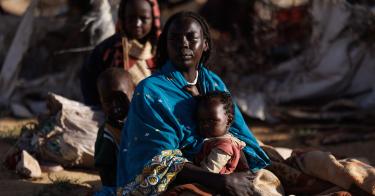
Sudan’s prolonged civil war is a humanitarian disaster that’s left 400,000 people dead and 11 million displaced. The conflict has crippled the country’s economy, leaving some questioning the long-term viability of the state. This has created an economic opening for others, like China, to leverage.
Beijing recently announced that it will eliminate tariffs on goods from 53 African countries beginning in May 2026. While visiting Port Sudan in March, Xu Jian, China’s acting chargé d’affaires in Sudan, announced that China is ready to help with reconstruction. Taken together, these developments signal broader Chinese efforts to build on previous investments across Africa, particularly in the energy and infrastructure sectors.
Since fighting resumed in April 2023, economic production has atrophied. Vital infrastructure has been destroyed, and millions have fled into neighboring Chad, Egypt, and South Sudan. That devastation left the country desperate not only for peace but also for capital and skilled labor.
>>> The Diego Garcia Red Line: Why the Trump Administration Is Sinking the Chagos Islands Deal
In early February, the U.S. State Department hosted a fundraiser focused on the Sudan Humanitarian Fund, pushing for a ceasefire in the war-torn country. The event raised $1.5 billion in humanitarian assistance for the populace.
But humanitarian assistance only goes so far. Port Sudan’s geostrategic position makes it a critical potential node in China’s Belt and Road Initiative (BRI), placing China as a financier of choice for economic development. Although China has taken a neutral position in the civil war, Chinese weapons have ended up in the hands of the Rapid Support Forces (RSF), including sophisticated surface-to-air missile systems, according to The Washington Post.
The concern for policymakers is that Sudan sits along one of the world’s most vital shipping lanes. Roughly 12 percent of global trade passes through the Red Sea off the coast of Sudan, including roughly 30 percent of global container traffic that navigates the Suez Canal. In this context, Chinese-backed infrastructure and logistics projects are not merely commercial ventures. They have the potential to become instruments of long-term strategic influence.
In 2023 alone, the African Development Bank reports that Sudan’s GDP contracted by 37.5 percent, with continued shrinkage forecast as the civil war continues. The World Bank has subsequently warned that the conflict has become a deepening economic and social crisis, as most industrial capacity has been destroyed, severely curtailing basic civil services.
The agricultural sector, once responsible for 35 percent of GDP and employed 40 percent of the workforce, has contracted by 8.8 percent according to the International Food Policy Research Institute. Subsequently, famine has become the norm, with cereal production in 2023 estimated to be 40 percent below the average of the previous five years.
The Merowe Dam, a roughly $2 billion project completed in 2009, was intended to provide water for Northern Sudan, expand electricity availability, and improve the standard of living for the Sudanese population. Although this joint Sudan-Arab-Chinese project predated the BRI’s launch in 2013, it is an early example of Chinese-backed infrastructure cooperation.
>>> Will Darwin Port Remain Under Chinese Control?
If Sudan eventually restructured its debts with China, given its ongoing conflict, Beijing may take a short-term financial loss but gain long-term political influence and control over infrastructure. Today’s financial distress can become tomorrow’s commercial leverage. Critics of the Chinese “debt-trap diplomacy” often cite the Sri Lankan port that China took control of in 2017 on a long-term lease after Sri Lanka was unable to repay its loans.
While signs initially suggested the Sudanese Civil War might end in March 2024, negotiations quickly broke down. Today, the Sudanese Armed Forces (SAF) control most of the country’s territory, while the Rapid Support Forces have entrenched themselves in western Darfur.
If stabilization is in Sudan’s future, the country’s roads, electricity systems, and logistics networks must be reconstructed. Beijing understands that in fragile states, reconstruction finance can buy more than goodwill. It can buy commercial access, political leverage, and long-term influence. Sudan’s economic malaise offers the precise conditions that China has leveraged elsewhere.
American policymakers should be conscious of these developments. Sudan is becoming a case study of how conflict and desperate economic conditions are leveraged to promote greater dependence on Chinese capital and infrastructure in such a strategic location. Prudent or not, the United States offers humanitarian funding while China offers concrete contracts.
This piece originally appeared in The National Interest



