

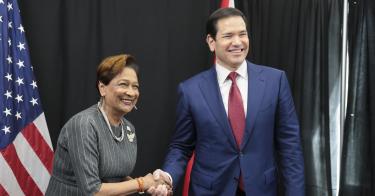
In the wake of Operation Absolute Resolve, one Caribbean leader has stood out in her support of President Donald Trump. Trinidad and Tobago’s prime minister, Kamla Persad-Bissessar, declared that “I made no apology for standing side by side with…the leader of the free world in this hemisphere.”
That stance reflects the law-and-order policy she has pursued since taking office. Her alignment with President Trump’s campaign against narco-terrorism and narco-states positions Trinidad and Tobago as a model for the Caribbean in confronting insecurity in the Americas through partnership with the United States.
Since the late 2010s, violent crime has increased across much of Latin America and the Caribbean. Skyrocketing cocaine production in the Andes has strengthened drug traffickers, enabling them to expand their operations and intensifying competition between gangs for the control of distribution routes. The result has been the destabilization of the region and rising crime rates even in once relatively safe countries like Ecuador, Costa Rica, and Peru.'
Trinidad and Tobago has not been spared. In 2024, it experienced its deadliest year on record, with a homicide rate of 45.7 per 100,000 residents. Like elsewhere, much of this violence stems from gang rivalries, often linked to drug trafficking and fueled by the flow of illegal firearms.
>>> American Samoa Is America’s Strategic Hub in the South Pacific
Much of the responsibility lies with the Venezuelan government. Trinidad and Tobago sits barely 7 miles from Venezuela, and its porous maritime borders have made it an attractive transit point for cocaine, heroin, and other narcotics bound for North America, as well as for illegal gold smuggled out of Venezuela. In addition, the Chavista regime has long provided resources and autonomy to various drug trafficking networks, helping fuel the broader surge in cocaine production and trafficking across the region, with direct spillover effects on Trinidad and Tobago.
The situation is further aggravated by a steady influx of illegal firearms from Venezuela and by the presence of Venezuelan criminal groups such as Tren de Aragua, which collaborate with local gangs and deepen the violence.
Prime Minister Persad-Bissessar understands these dynamics, which is why she has stood with President Trump’s agenda against narco-terrorists and narco-states.
In September, she met with Secretary Marco Rubio to coordinate on counternarcotics efforts and regional stability. Two months later, she permitted the deployment of the U.S. Marine Corps’ G/ATOR long-range sensor at ANR Robinson International Airport, providing the United States with an exceptional vantage point to monitor the Venezuelan coastline. In December, she permitted U.S. military aircraft and personnel to transit through the country. Although Trinidad and Tobago did not directly participate in Operation Absolute Resolve, its cooperation provided the United States with critical surveillance capabilities.
Now, with Venezuela’s Nicolas Maduro under arrest and President Delcy Rodriguez under pressure to cooperate with the United States, there is real reason to hope that Trinidad and Tobago will benefit. In the short term, the new government in Caracas will be pressed by the Trump administration to confront transnational criminal networks. In the long term, if Secretary Rubio’s plan succeeds and Venezuela is democratized, it would open the door to deeper collaboration against crime.
It would also create new economic opportunities. Reduced violence would strengthen Trinidad and Tobago’s tourism sector, while a more cooperative Venezuelan government could finally advance long-stalled energy projects. For years, Port of Spain and Caracas discussed developing the Dragon Gas Field and other deposits along their shared maritime border, with little progress.
>>> Cuba Is the Snakehead of Problems in the Western Hemisphere
Today, with U.S. authorization, Shell and T&T are moving forward on the Dragon Gas Field, and there is growing optimism regarding the development of other deposits by T&T and other Western companies. As Trinidad and Tobago’s energy minister noted, this provides the nation with an opportunity to position itself as an industry leader in the Caribbean.
Others in the Caribbean have taken a skeptical approach toward President Trump’s policy. For instance, during the 80th UN General Assembly, several CARICOM leaders criticized the U.S. military build-up, calling for the Caribbean to be respected as a “zone of peace.” However, as Prime Minister Persad-Bissessar pointed out, there is no peace in the Caribbean because the cartels have been wreaking havoc in complicity with the Chavista regime.
Persad-Bissessar’s stance against transnational crime and the Chavista narco-regime, and her willingness to work closely with the United States, offer a blueprint for how Caribbean nations can pursue security and prosperity. By deepening cooperation with Washington to counter transnational crime, confront malign actors, and pursue mutually beneficial economic cooperation, Caribbean states can chart a more stable and prosperous future for the region.
This piece originally appeared in The National Interest



