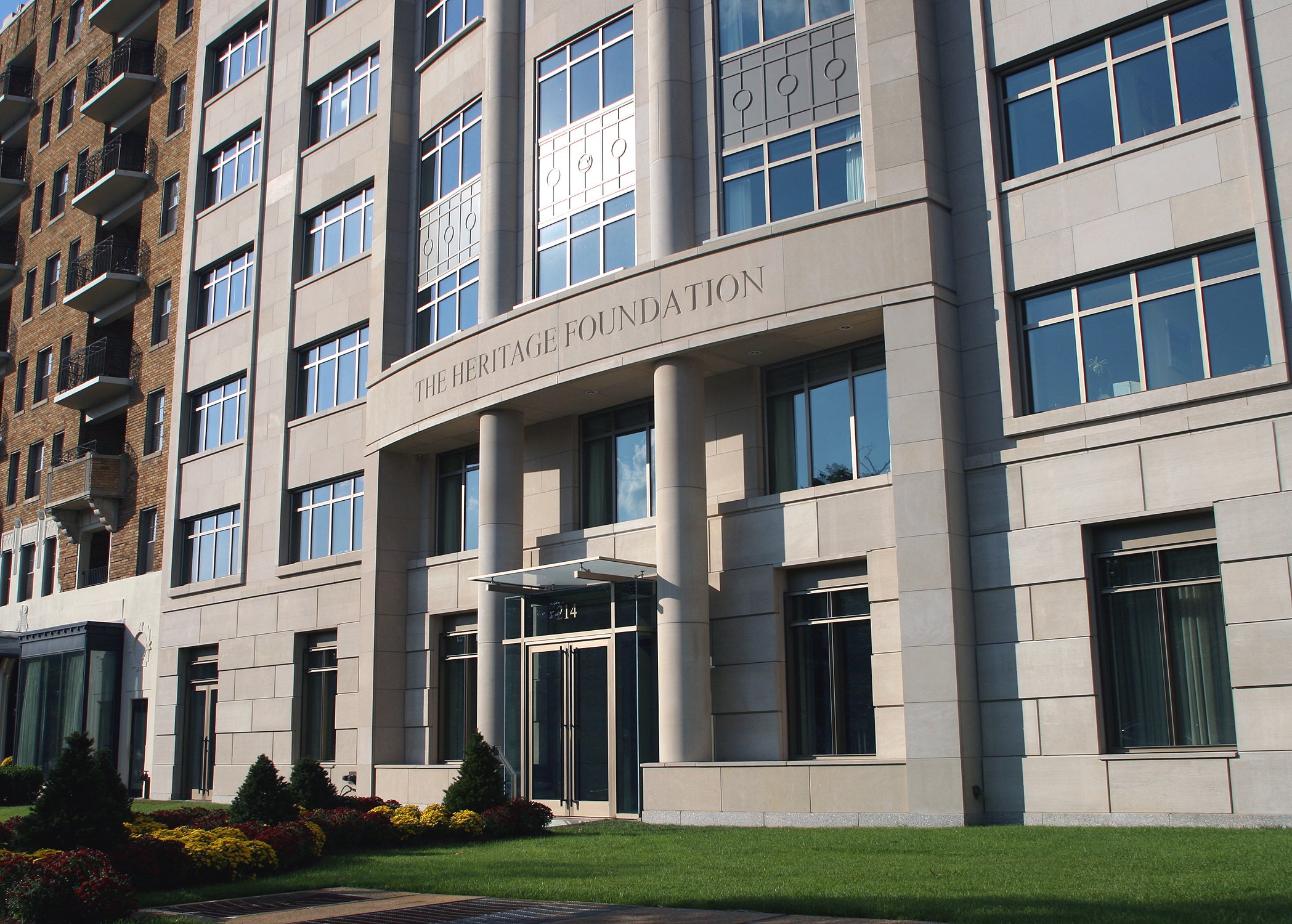
The Heritage Foundation is the nation’s most broadly supported public policy research institute, with more than 600,000 individual, foundation and corporate donors. Heritage, founded in February 1973, has a staff of 244 and an expense budget of $61 million.
Media Information Line Phone: 202-675-1761 Fax: 202-544-6919
Get the details for our policy experts, including full biographies, a list of past publications, and high-resolution photos.
We watch the news as closely as you do, and each day we provide the press with a list of Heritage experts who know the subject matter cold. To get the latest updates as every morning, subscribe to the hot sheet via email.
David John is one of five experts who "exert more influence" on the Social Security debate than anyone else in Washington – and he is The Heritage Foundation's lead analyst on issues relating to pensions, financial markets and institutions, banking regulation, asset building, and Social Security reform. In 2006, John lived up to this title, given to him by Congressional Quarterly, by working with Brookings Institution scholar J. Mark Iwry to come up with a "third way" to promote retirement self-reliance: the Automatic IRA. Their approach would encourage most workers not covered by an employer-sponsored retirement plan to build their own low-cost, diversified individual retirement accounts. It would work much like a direct paycheck deposit to a bank account – a feature now common in the American workplace. Unless workers choose to opt out, they would be automatically enrolled in the generic savings program, with a pre-set contribution rate and diversified investment portfolio. The contribution amount and portfolio selection could be adjusted by workers to meet their individual needs. This approach would let workers accumulate pre-tax retirement savings in every job they hold, even when their employers offer no such benefit of their own. This is just one of John's many professional achievements. Since coming to Heritage in 1998, he has written and lectured extensively on the importance of reforming the nation's retirement system. During this time, he has testified before a number of House and Senate committees on subjects ranging from Social Security and pension reform to improving the nation's flood insurance program. In 2001, he testified before President George W. Bush's Commission to Strengthen Social Security, providing detailed analysis of how personal retirement accounts could be structured and regulated. John also testified before the House Budget Committee's Task Force on Social Security, explaining what the costs of transitioning to a system of Social Security personal retirement accounts might be as compared to the cost of running the current program. In addition, John has testified before the House Ways and Means Committee on issues such as steps that should be taken to improve Social Security for women and minorities, how to increase the information that the public can receive about Social Security programs, and how the United Kingdom's pension system operates. He also testified before both the Senate Special Committee on Aging and the House Education and the Workforce Committee on proposals to strengthen the funding of defined benefit pension plans. John has been published and quoted extensively in many major publications, including The Wall Street Journal, Financial Times, Washington Post, New York Times, Chicago Tribune, Los Angeles Times, Philadelphia Inquirer, Washington Times, Forbes, Business Week, and USA Today. He has also appeared on CBS News, NBC News, CNN, MSNBC, the Fox News Channel, BBC radio, and many other national and syndicated radio and television shows. John came to Heritage from the office of Rep. Mark Sanford (R-SC). He was the lead author of Sanford's plan to reform Social Security by setting up a system of personal retirement accounts. His Capitol Hill service also includes stints in the offices of Reps. Matt Rinaldo (R-NJ), and Rep. Doug Barnard Jr. (D-GA). While working for Barnard, John helped write one of the first bills that would have eliminated restrictions on banks to sell securities and insurance. He also authored a bill in 1981 that restarted the national commemorative coin program. In the private sector, John was a Vice President at the Chase Manhattan Bank in New York, specializing in public policy development. In addition, he worked for three years as Director of Legislative Affairs at the National Association of Federal Credit Unions, and worked as a Senior Legislative Consultant for the Washington law firm of Manatt, Phelps & Phillips. John earned a bachelor's degree in journalism, an MBA in finance, and a master's degree in economics from the University of Georgia in Athens....
James Gattuso handles regulatory and telecommunications issues for The Heritage Foundation as a Senior Research Fellow in its Roe Institute for Economic Policy Studies. Prior to joining Heritage in 2002, he was Vice President for Policy at the Competitive Enterprise Institute. In that position, he oversaw the institute's policy work, and supervised the overall management of the organization. Before that, Gattuso served as Vice President for Policy Development with Citizens for a Sound Economy from 1993 to 1997, where he directed the research activities for that organization. Gattuso also has served in the federal government. From 1990 to 1993, he was the Deputy Chief at the Federal Communications Commission's Office of Plans and Policy. From May 1991 to June 1992, the FCC detailed him to the office Vice President Dan Quayle, where Gattuso served as Associate Director of the President's Council on Competitiveness. Gattuso is currently serving his second tour of duty at Heritage. From 1985 to 1990, he was a Heritage policy analyst with a responsibility for a broad range of issues, including telecommunications, transportation and antitrust policy. Before coming to Heritage the first time, he was an associate with the Washington law office of Squire, Sanders and Dempsey, where he handled matters before a number of regulatory agencies. In 2002, Gattuso's work on government bailouts and free markets earned him the prestigious Drs. W. Glenn and Rita Ricardo Campbell Award. It is given to the Heritage employee who has delivered “an outstanding contribution to the analysis and promotion of a Free Society." Gattuso graduated magna cum laude from the University of Southern California in 1979. He received his law degree from the University of California at Los Angeles in 1983, where he was a member of the UCLA Law Review. He is a member of the California and District of Columbia bars and is the author of a number of articles written for newspapers, magazines and journals. His commentaries have appeared in FOXNews.com, The Hill, The Los Angeles Times, USA Today and The Washington Times . ...
As Director of the Roe Institute for Economic Policy Studies, Alison Acosta Fraser oversees Heritage Foundation research on a wide range of domestic economic issues including federal spending, taxes, energy and environment, retirement savings and regulation. One of the Roe Institute's priorities is reform of the federal retirement programs – Medicaid, Medicare and Social Security. Under Fraser's leadership, Heritage research has helped define and communicate the long-term fiscal threats from spending and taxes and identify solutions and proposals for reforms. Fraser is a member of the Fiscal Wake-Up Tour, designed to educate Americans about the nation's true long-term financial condition and large and growing fiscal imbalance and to encourage Americans to demand action. The tour conducts of town hall forums, business roundtables and editorial board briefings across the country. By uniting with analysts from across the political spectrum on the Fiscal Wake-Up Tour, Heritage hopes to encourage the spirit of bipartisan honesty and discussion that will be necessary to preserve the strength of the American economy for posterity. Unless Congress fundamentally recasts Medicaid, Medicare and Social Security, Americans within two generations will be saddled with European levels of taxation and economic stagnation. Sponsored by the Concord Coalition, the tour features experts from Heritage, the Brookings Institution and U.S. Comptroller General David Walker. The tour of budget and fiscal experts has visited nearly two dozen cities in since its inception in the fall of 2005. Fraser is one of those touring fiscal experts and she carried that same message direct to journalists in 2006, highlighting two National Press Foundation budget seminars for West Coast reporters. Following Hurricane Katrina, she took the lead in preparing Heritage's comprehensive special reports on disaster recovery. These reports were the first and only such policy works published in the weeks following the disaster, making Heritage a leader in solutions on Capitol Hill in the media.Fraser has appeared on all CNBC, CNN, FOX and MSNBC news channels, Bloomberg, PBS and the BBC. Her commentaries on fiscal issues have appeared in the Atlanta Journal-Constitution, the Philadelphia Enquirer, National Review Online, Washington Times and USA Today. Before joining Heritage in 2003, Fraser was Deputy Director of the Oklahoma Office of State Finance where she directed economic research and developed tax and fiscal policy recommendations for then-Gov. Frank Keating. Prior to that, she was a budget manager for Orange County, Calif., where she developed recommendations for bankruptcy recovery....
Baker Spring is the F.M. Kirby Research Fellow in National Security Policy at The Heritage Foundation. Spring specializes in examining the threat of ballistic missiles from Third World countries and U.S. national security issues. In 2005, he developed “Nuclear Games, ” a table-top exercise to show diplomats from Australia, China, India, Japan, Russia and South Korea the realities in a world where many nations, including rogue states such as North Korea, have nuclear weapons. Spring demonstrated how missile defense systems can strengthen stability and promote peace in such a world. Based on its success, Heritage hosted the first war-gaming exercise on energy security in December 2006. Spring also was instrumental in defeating the Anti-Ballistic Missile (ABM) Treaty earlier in the decade. Spring argued that the 1972 pact was worthless because the treaty’s other signing party, the Soviet Union, no longer existed – which meant that the United States could go all out and create a missile defense system. “The ABM Treaty simply didn’t reflect today’s geopolitical realities,” Spring said in a 2002 interview. “When we signed it, Leonid Brezhnev was running the Kremlin, the Cold War was at its height, and U.S-Soviet missile were pointed at each other.” In 2003, Spring received the prestigious Dr. W. Glenn and Rita Ricardo Campbell Award for his work. The award is given annually to the Heritage employee who delivered “an outstanding contribution to the analysis and promotion of a Free Society.” Spring began studying missile defense issues while researching the SALT II Treaty as a Republican National Committee intern in the 1970s. He later served as a defense and foreign policy expert for Sens. Paula Hawkins (R-FL) and David Karnes (R-NE). He joined Heritage in 1989. A graduate of Washington and Lee University, Spring received his master’s degree in national security studies from Georgetown University....
Ariel Cohen brings firsthand knowledge of the former Soviet Union and the Middle East through a wide range of studies, covering issues such as economic development and political reform in the former Soviet republics, U.S. energy security, the global War on Terrorism and the continuing conflict in the Middle East. His analyses are often incisive. For example, he warned repeatedly that multi-billion dollar financial aid to the corrupt Russian government would end up in the wrong pockets – which indeed happened after the 1998 Russian financial crisis. Cohen also predicted the Russian financial collapse in a Heritage Foundation analysis published nine months before the event actually took place. And he warned about Iranian nuclear and missile ambitions and called for restrictions on Russian nuclear and missile technology transfer to Iran as early in 1997. U.S. concerns over the sale or other transfer of such technology, Cohen said, “should be raised repeatedly at the highest levels of the Russian government.”His work on Middle East issues is also just as incisive. In July 2001, just two months before Osama bin Laden’s terror network struck the United States, Cohen testified before Congress, encouraging the U.S. government to “…counter the efforts of radical Islamic groups in Central Asia, including the Taliban and the Osama bin Laden organization.” He also published pioneering work on the “War of Ideas” (strategic information operations) as a key battlefield in the global War on Terrorism against radical Islam, and on counter-insurgency strategy. His expertise in is in demand by the Army and other branches of the federal government.Cohen joined Heritage in 1992 and is now a Senior Research Fellow. He earned his doctorate at the Fletcher School of Law and Diplomacy at Tufts University in Massachusetts. He has served as a consultant to both the executive branch and the private sector on policy toward Russia, Eastern and Central Europe, the Caucasus, and Central Asia. He participated in a long-term study known as Russia 2025 conducted by the World Economic Forum and in Multilateral Deterrence Study for Office of Secretary of Defense and in other projects. He is often called upon to testify on Russian and Eurasian politics, economics, and law before the U.S. Congress, and regularly provides commentary on Russian, Eurasian, and Middle Eastern affairs for ABC, BBC, CNN, FOX, and all three national TV channels in Russia. He was a weekly contributor to the Voice of America radio and TV programs for eight years.A former member of the Board of Directors of the California-Russia Trade Association, from 1985-1992 Cohen has managed media research projects for Radio Liberty's then-Soviet audience. His book, Russian Imperialism: Development and Crisis, was published in 1996 and in 1998 by Greenwood/Praeger. He also co-authored and edited Eurasia in Balance (Ashgate Publishing, 2005), which focuses on the power shift in the region after the Sept. 11 attacks. In addition, he has written nearly 500 articles and 25 book chapters. Cohen is a member of the Council of Foreign Relations, International Institute of Strategic Studies in London, and Association for the Study of Nationalities....
James Phillips is the Senior Research Fellow for Middle Eastern Affairs at the Douglas and Sarah Allison Center for Foreign Policy Studies at The Heritage Foundation. He has written extensively on Middle Eastern issues and international terrorism since 1978. Although his prime research interests are Iran, Iraq, Afghanistan, Persian Gulf security issues, and Middle Eastern terrorism, Phillips also has written numerous articles on the Arab-Israeli conflict, Islamic radicalism, Algeria, Egypt, Israel, Jordan, Kuwait, Lebanon, Libya, Morocco, Pakistan, Saudi Arabia, Somalia, Syria, Sudan, and Turkey. He has testified numerous times before congressional committees on these issues. Phillips wrote papers that predicted the Soviet intervention in Afghanistan, the Soviet defeat there, and the dangers arising from U.S. withdrawal from engagement in that country, which contributed to the rise of the Taliban and the export of terrorism and Islamic radicalism. In 2000, he called for a comprehensive U.S. policy to support the Afghan opposition and overthrow the ultra-radical Taliban regime, rather than narrowly focusing on Osama bin Laden, who was then based in Afghanistan . Since the Sept. 11 attacks, he has written extensively on the global war against terrorism and its implications for U.S. policy in the Middle East . Phillips has frequently been interviewed on a broad range of subjects by U.S. and foreign media, including ABC News, CBS News, NBC News, FOX News, CNN, C-SPAN, MSNBC, Sky News, Al Arabiya, Al Hurra, BBC Television, BBC World Service Radio, National Public Radio, and the Voice of America. He also has published numerous articles in American newspapers, including The New York Times, Washington Times, Newsday , New York Post, Atlanta Journal-Constitution, Baltimore Sun, Chicago Tribune, and USA Today . Phillips is a member of the Committee on the Present Danger, a prestigious bipartisan group dedicated to winning the war on terrorism. He also is a member of the Board of Editors of Middle East Quarterly , the leading conservative journal of Middle Eastern policy studies. Before joining Heritage in 1979, Phillips was a Research Fellow at the Congressional Research Service of the Library of Congress and a former Joint Doctoral Research Fellow at the East-West Center . He received a Bachelor's Degree in International Relations from Brown University as well as a Master's Degree and a M.A.L.D. in International Security Studies from the Fletcher School of Law and Diplomacy at Tufts University . ...
Broadcast live from Capitol Hill? To reserve a fully-equipped Heritage studio, call the Media Information Line at (202) 675-1761 or submit a request here.
Read our latest News Releases.
Better than standing around the water cooler! Get the latest commentary and opinions from our experts and analysts.
The latest strategy to pass Obamacare involves pushing the same discredited provisions through new procedural means. Read more
Iran is considered the world's foremost state sponsor of terrorism, and has a long history of providing arms, training, and financial support to terrorist groups. In recent years, Iran has been building its enriched uranium inventory, and conducting ballistic missile tests. Read more
With Iran's consistent support for terrorism and recent nuclear experiments and ballistic missile tests, a new strategy is needed to bring liberty to the people of Iran. Read more
The pending health care legislation would cover the uninsured mainly by dumping most of them into the federal/state...
Throughout the debate over liberals’ health care proposals, it has become clear that while Americans want health care...
Spring has sprung in Washington, DC, and while many buses line the streets packed with students touring the National...
Please complete the following form to request an interview with a Heritage Expert. Please note that required fields are indicated by bold text and an asterisk (*).