


Established in 2005 to “reduce dependence on foreign sources of petroleum, increase domestic sources of energy, and help us make progress in moving beyond a petroleum-based economy,” the Renewable Fuel Standard has failed to deliver on each of these promises. As a result, the RFS remains one of the nation’s most expensive and misguided energy policies.
Dependence on foreign energy sources
While the program has displaced some gallons of gasoline and diesel with biofuels, it has simultaneously created a new form of import dependence. EPA’s Set 2 rule was finalized in March 2026, requiring 26.81 billion RINs, the compliance credits assigned to each gallon of renewable fuel, in 2026 and 27.02 billion in 2027, after the 70% reallocation of prior small-refinery exemptions. To meet these aggressive renewable fuel volume requirements, the U.S. will have to rely heavily on imported feedstocks and fuels, such as vegetable oils and animal fats.
Updated S&P Global analysis prepared for the American Fuel & Petrochemical Manufacturers confirmed that domestic (and even broader North American) origin feedstocks cannot meet the new targets without sustained imports. The EPA has imposed a policy that trades one form of foreign dependence for another while imposing compliance costs that some estimates place as high as 37 cents per gallon for obligated gasoline and diesel. This equates to a total market value of more than $60 billion.
Homegrown technologies like fracking provide a far more effective means of achieving energy independence goals. Fracking has caused an “eight-fold increase in [domestic] extraction productivity for natural gas and a nineteen-fold increase for oil,” allowing the U.S. to lead the world in oil and gas production.
>>> The Red-Blue Energy Divide: How Overregulation Inflates Prices
Increase domestic energy sources
Corn ethanol production is largely domestic, but the RFS’s design keeps any advantage from scaling cleanly. EPA actions this year expanded the implied conventional renewable fuel mandate to near 15 billion gallons even though the market cannot absorb that volume given the ethanol blend wall and recently declining gasoline demand.
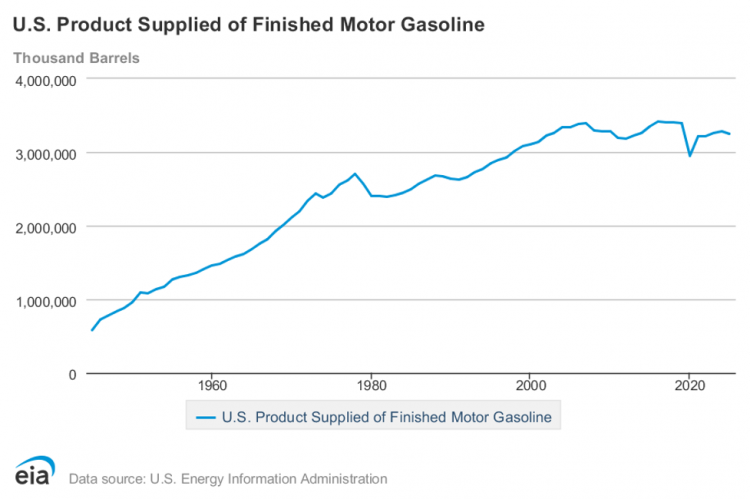
When the market is unable to absorb the mandated levels of ethanol, the shortfall must be covered by more expensive advanced biofuels, like biodiesel, which end up setting the marginal RIN price for the entire conventional category. Meanwhile, the high compliance burden and chronic uncertainty around small-refinery exemptions discourage investment in domestic refining capacity—the infrastructure that supplies the bulk of the nation’s transportation fuel.
The most recent version of section 12501 of the Agricultural Act of 2026 is intended to address the challenges that small refineries face by discarding the extreme company-focused changes to the definitions of what makes a “small refinery” found in the House bill. Despite that attempted correction, the bill would still compound problems for small refiners.
The Senate version of the bill, as released by Sen. John Boozman (R-AR.) on July 31, would end traditional small-refinery exemption petitions after 2027 and replace them with a permanent compliance level based on a refinery’s peak production during 2023–2025. Any small refinery that grows beyond the 75,000-barrel-per-day threshold permanently loses that exemption.
This provision penalizes ambitious refiners—the ones that invest, hire, and expand—while redistributing the exempted volumes (minus a 500-million-gallon buffer) onto every other refiner (or “obligated party”). As the American Energy Association and others have noted, this creates structurally favored and disadvantaged refiners rather than a competitive energy sector.
Policies that discourage domestic refining investment undermine one of the principal ways the U.S. converts domestic energy resources into usable transportation fuels.
Move beyond a petroleum-based economy
Higher ethanol blends such as E15 remain gasoline. They operate within the same petroleum infrastructure, vehicle fleet, and liquid-fuel distribution system, but mandates forcing them into the mix make that system less efficient. Permanent year-round E15 authority—the other half of Section 12501—does not represent a transition beyond petroleum; it is simply a higher percentage of an inefficient fuel that is being forced into the mix by bad policy decisions.
>>> Why Congress Needs to Act Now on Permitting Reform
After 20 years of mandates, subsidies, seasonal waivers, and RIN credit schemes, the proposed changes to the RFS demonstrate how the renewable fuels industry still struggles to compete without federal support. The push to legislate year-round E15 locks the industry’s dependency into statute and prevents markets and consumers from deciding which fuels they prefer.
Section 12501 is only the latest example of the political bargain that keeps the RFS alive: agricultural interests seeking guaranteed demand allied with a very narrow set of small refiners seeking permanent insulation from compliance costs. American drivers, along with refiners without political cover, and any small refinery that wants to grow, will pay the price for this policy.
Large refiners and industry trade associations have also supported requiring year-round E15, while small independent refiners warn that the intended changes could speed up closures and further consolidate the sector. Neither outcome would strengthen energy security.
Agencies and legislators should deal with small-refinery exemptions quickly and base renewable fuels mandates on realistic expectations for ethanol consumption and available North American feedstocks, not unrealistic predictions of import-dependent growth.
Section 12501 should be removed from the Agricultural Act of 2026, as the Renewable Fuel Standard has not delivered on the promises made by its advocates 20 years ago. Access to E15 should be driven by demand, not federal meddling in energy markets. Doubling down in the proposed Farm Bill will not change that record.
This piece originally appeared in RealClear Energy



