

Unlike many other policy institutions, The Heritage Foundation covers a wide range of public policy topics while also maintaining a “one voice” policy. Through internal research and debate, we develop single, unified positions on issues as diverse as tax policy, the definition of marriage, export controls, missile defense, the federal budget, and state election laws. This breadth and unity are possible not only because we deliberate internally, but because we seek to develop policies that are consistent with shared first principles.
What are these principles? Our formal mission statement names five policy areas. Heritage exists to formulate and promote conservative public policies based on the principles of (1) free enterprise, (2) limited government, (3) individual freedom, (4) traditional American values, and (5) a strong national defense.[REF] These are suggestive but clearly rest on more general principles because they leave key questions unanswered. For instance, why should government be limited? What are traditional American values? What do we mean by freedom?
In 2025, as part of “Heritage 2.0,” we began to organize our work around Four Cornerstones: (1) The American Family, (2) The Dignity of Work & The Future of Free Enterprise, (3) National Security, and (4) American Heritage & Citizenship.[REF] These are more than policy priorities. The cornerstones frame all of our work. They are “practical commitments to restore what makes this nation strong.”[REF] While their formulations are new, the cornerstones reflect Heritage’s historic views.
Yet once again, the four cornerstones, like the five policy areas, rest on deeper premises. Many of these we have defended for decades. For instance, Heritage has always worked to apply America’s founding principles—ordered liberty, inalienable rights, and self-government—to the challenges of the modern world.[REF]
We have other principles, however, that serve as prerequisites for everything else but are often tacit in our publications. Like a barely visible hand, they subtly shape our work in countless ways. Yet no single document or report spells all of them out or explains their priority and their relationships to each other.
That is the purpose of this essay. In what follows, I briefly explain the fundamental principles, both implicit and explicit, that shape Heritage research and public advocacy. When circumstances have changed, we have prudently adapted how we apply and articulate these principles—but the underlying principles have not changed.
This summary analysis draws on Backgrounders, Special Reports, First Principles essays, Issue Briefs, the First Principles on Human Rights series, mission statements, model legislation, representative books, and thousands of commentaries by Heritage leaders and scholars. This essay is intended to be descriptive rather than prescriptive, empirical rather than speculative—that is, to describe what our principles are rather than presenting them in idealized form.[REF]
The first principles are arranged logically rather than by policy priority or importance. In what follows, we start with the broad premises and presuppositions and then move to their implications and applications. By making the first principles of The Heritage Foundation explicit, we hope to provide a broad, deep, and durable foundation for the conservative defense of our Republic.
Metaphysical and Moral Foundations
1. The Natural Law Is Real, Knowable, and Binding.
Moral realism and the natural law are our bedrock. For half a century, Heritage scholars have assumed and argued that objective, knowable moral truths exist and that they should bind the actions of individuals and governments alike. The American Founders called these moral truths known by reason “the natural law.” We see this in the appeal to the “Laws of Nature and of Nature’s God” in the Declaration of Independence. These refer to truths, such as the basic contours of human nature and morality that everyone knows or ought to know. They are natural because they are built into the structure of things and fit our created nature.[REF]
Without the natural law, “rights” are mere conventions, and “limited government” is a mere preference rather than a demand of justice.
In the order of being, theism precedes moral realism and the natural law (see below). But in the order of public knowledge and rhetoric, moral realism and the natural law may come first. Even those who deny that God exists have some knowledge of the natural law and so are, in principle, capable of fulfilling the duties of American citizenship even if they cannot affirm its ultimate foundation.
2. God Is the Source of Our Moral Order.
In our publications, Heritage does not assert a natural moral law as a brute fact. We treat it as an aspect or implication of God’s existence, even if this is often tacit rather than explicit. Nor do we treat the existence of God as a merely private belief with no proper public effects. Rather, we follow the Founders, who held that God’s existence and the natural law are public truths that man can know by reason.
As a result, government need not and should not stay neutral on the question of God. This conviction runs through the American Founding itself, even among the least religious Founders. “We hold these truths to be self-evident,” professed the signers of the Declaration of Independence, “that all men are created equal, that they are endowed by their Creator with certain unalienable Rights.”[REF]
Theism precedes a policy such as “religious liberty.” Contrary to popular impression, religious liberty is not and cannot be securely grounded in relativism. The Founders held that rights come from God, not from the state, and that we best fulfill our duty to love God in freedom rather than under coercion.[REF] A just and limited state accommodates natural rights (and their corresponding duties) rather than inventing, redefining, or ignoring them. A state that claims to establish natural rights can also revoke them.
3. All Human Beings Are Created Equal in Dignity.
Every human being, from the moment of fertilization, possesses intrinsic, inalienable worth—not because of utility, social status, or state conferral, but by nature. Although human beings differ from each other in countless ways, all of us are equal in dignity and ought to be treated equally under the law. The conviction that all men are created equal and are endowed by God with inherent, pre-political rights was present at the very birth of our nation.[REF] Those rights draw in turn on roots that reach deep into Western culture and history.
“Human life cannot be measured,” said the late Pennsylvania Governor Robert Casey. “It is the measure itself. The value of everything else is weighed against it.”[REF] This principle bears not just on “social” issues such as abortion, but on economic issues as well. As one Heritage scholar puts it: “The moral case for economic freedom is invariably rooted in the idea that every human being, whatever his or her race, age, or social status, has inherent dignity.”[REF]
Political–Anthropological Principles
4. All Human Beings Possess Inalienable Natural Rights.
Government does not grant natural rights; they inhere in human nature. The positive law should not create rights but should respect the rights we already have. “[T]he rights essential to happiness… are not annexed to us by parchments and seals,” said John Dickinson of the Pennsylvania colony in 1766. “They are created in us by the decrees of Providence, which establish the laws of our nature.”[REF]
Natural rights—such as the rights to life, liberty, property, and the pursuit of happiness—have a clear limiting principle. For the most part, a genuine natural right is universal, is equally shared, and entails a corresponding natural duty. One person’s right to life, for instance, means that others have a duty not to murder that person, and the reverse holds as well.
This view of rights stands against the progressivist tendency to multiply manufactured “rights.” Such efforts to expand rights threaten to undermine the great and noble project of human rights, which are now almost universally invoked but inconsistently protected.[REF]
5. Just Government Requires the Consent of the Governed.
Government draws its just powers from the consent of the governed—not from the divine right of kings, mob rule, or bureaucratic expertise. For decades, Heritage has worked to apply America’s founding principles, such as ordered liberty, inalienable rights, and self-government, to the challenges of the modern world.[REF]
Self-government, properly conceived, has two inseparable meanings. In the political sense, a free people governs itself through its elected representatives rather than submitting to distant powers, unelected administrators, or judicial fiat. In the personal sense, citizens govern themselves—their appetites, their commitments, and their conduct—well enough that political self-rule remains possible. The two rise and fall together. People who cannot govern themselves in private will not long govern themselves in public, and a regime that denies its citizens the responsibility of political self-rule will erode their capacity for personal self-rule as well.
Consent, likewise, is more than a one-time act at the ballot box. It is an ongoing covenant in which government treats citizens as reasoning agents, not as subjects to be managed. Government by consent therefore requires transparency, accountability, and a legislative process in which the people’s representatives—not an opaque administrative state—make the laws under which the people live.
6. Man Is Fallen and So Needs Both Government and Its Limitation.
The Founders’ constitutional design rests on a realistic anthropology. They recognized, as Aleksandr Solzhenitsyn put it, that “the line separating good and evil passes right through every human heart—and through all human hearts.”[REF]
This truth has profound political consequences. James Madison was right:
If men were angels, no government would be necessary. If angels were to govern men, neither external nor internal controls on government would be necessary. In framing a government which is to be administered by men over men, the great difficulty lies in this: You must first enable the government to control the governed; and in the next place oblige it to control itself.[REF]
The dual insight that sin is both why we need government and why we must limit it is the hinge between the natural law and our constitutional structure.
Constitutional and Structural Principles
7. True Liberty Is Ordered, Not License.
Liberty is not license. It requires moral self-governance by virtuous citizens. This is what the American Founders thought of as ordered liberty as opposed to a libertinism in which everybody does what he wants. Only when law and self-restraint order a society can it preserve liberty.
George Washington, for instance, insisted that we distinguish “the spirit of liberty from that of licentiousness, cherishing the first, avoiding the last.”[REF] Ordered liberty is freedom for something, not merely freedom from something. The absence of constraint is not, by itself, a good. A person freed from every external restraint but enslaved to his own passions is not truly free. Genuine liberty is the capacity to pursue the good, true, and beautiful—to build a family, practice a craft, worship in truth, and take up the duties of citizenship—without unjust interference.
This is why we cannot extract ordered liberty from the moral order that precedes it. A society that treats every desire as a right and every restraint as an oppressor does not preserve freedom; it dissolves the foundations for freedom itself. Over time, the loss of inner order invites the imposition of outer order. People that will not govern their appetites will eventually be governed by those who promise to manage the consequences.
8. Just Government Requires the Rule of Law, Not of Men.
Law, rather than the whim of rulers, is the source of just government. The American Experiment stood out at its inception because the Founders appealed to a transcendent source—to “the laws of nature” and “nature’s God”—rather than to a person or group. The Constitution that followed presupposed this truth. To this day, all U.S. government officials and military personnel, as well as new citizens, pledge an oath not to a king or to a tribe, but to the Constitution. As Thomas Paine wrote in Common Sense, “in America, THE LAW IS KING.”[REF]
The Founders did not invent this conviction from nothing. They inherited and refined a long Anglo-American tradition—reaching back through Blackstone, the common law, the English Bill of Rights, and the Magna Carta—in which even kings stood under the law. The American Founding is best understood not as a rupture with that tradition but as its fullest political expression.
The rule of law is not merely the rule of any “law.” Just laws ultimately reflect the natural law, that is, the objective moral order that reason can know and that binds rulers and ruled alike. A statute that contradicts the natural law may carry the form of law, but it lacks its full authority. This is why the Founders anchored the American order in “the Laws of Nature and of Nature’s God” rather than in mere positive enactments. Positive law is legitimate only to the degree that it conforms to a higher, transcendent standard and binds both the rulers and the ruled.
Just as the rule of law demands that statutes and the Constitution bind rulers and ruled alike, it requires that their meaning not be subject to the shifting will of interpreters. In our constitutional order, this means that courts must seek the public meaning the language carried at the time of enactment or ratification, thereby preserving the document’s fixed character and the duty of jurists to respect rather than reinvent it.
Positive law not only reflects morality, but also teaches it. The laws a nation enacts shape the moral imagination of its citizens. Laws signal what a community honors, tolerates, or condemns. Over time, law can also form habits, and habits form character. A nation whose statutes reflect the natural law can help to cultivate citizens capable of ordered liberty. A regime whose statutes defy the natural law gradually deforms the consciences of those it governs. For this reason, lawmakers bear the duty of both teacher and legislator. Within their proper jurisdiction, they are not merely managing behavior but helping to form a people.[REF]
9. Just Government Is Limited in Scope and Divided in Power.
The Founders sought to establish a government limited not only in power, but also in the scope of its authority. Control over whole domains of human life—the conscience, the family, the church, honest labor and exchange, and voluntary association—lies beyond the state’s rightful jurisdiction. A government that respects these limits is ordered to its proper ends and restrained from usurping the ends of others.
Specifically, the Founders sought to avoid the tyranny of both the one and the many. In the Constitution, they therefore set up a “mixed regime”—that is, a republic that seeks to avoid the bad, extreme forms of government from absolute monarchy on one end to mob rule on the other. In our constitutional order, the executive, judicial, and legislative branches balance one another. The federal legislature has two chambers with different rules and procedures. Power is further balanced between the states and the federal government, among the states themselves, and by a heavily armed citizenry.[REF]
10. Religious Liberty Is a Natural Right, Not a State Entitlement.
Religious liberty, including free exercise, does not follow from religious skepticism or an abstract appeal to tolerance or relativism. It follows from our prior principles. If God is the source of our rights, if government is limited, and if we best realize our love of the Creator in freedom rather than under coercion, then citizens should enjoy broad freedom to exercise their religious duties.
As George Mason wrote in the Virginia Declaration of Rights, a predecessor of our own Bill of Rights:
That religion, or the duty which we owe to our Creator, and the manner of discharging it, can be directed only by reason and conviction, not by force or violence; and therefore all men are equally entitled to the free exercise of religion, according to the dictates of conscience; and that it is the mutual duty of all to practise Christian forbearance, love, and charity toward each other.[REF]
It is right, then, that the distant federal government should neither establish a single religion nor prohibit its free exercise. The Church has a proper autonomy that the state must respect. Every American citizen should enjoy religious liberty to the degree that he or she does not violate the natural moral law or the natural rights of others.[REF]
Social and Economic Applications
11. The Family Is a Pre-Political Reality.
The family is the foundation of civilization itself. As such, the family, headed by a married mother and father, is not a creation of the state but a natural institution prior to politics.
The individual is one pre-political reality; the family is another. A just and limited government does not try to redefine such realities. It recognizes and protects the institutions that are outside of its jurisdiction and on which it depends. Therefore, a just and limited state must acknowledge and protect the rights and duties that already exist, including those of fathers, mothers, and their children.
The family is also the first of many “mediating” institutions—including churches, synagogues, schools, neighborhoods, and voluntary associations—that stand between the individual and the state. A just political order respects the principle of subsidiarity. That is, it allows social needs to be met at the level closest to the person, with broader jurisdictions—including local, state, and federal governments—acting only when lower levels genuinely cannot. When the state absorbs the proper work of these mediating institutions, it hollows them out.
We work to restore the natural family—virtuous, faithful, growing, and free—because strong families build strong communities and a flourishing nation.[REF]
12. Our Republic Requires Both Public and Private Virtue.
The Founders agreed that a free republic requires a virtuous people. The Constitution alone cannot sustain freedom. “Neither the wisest constitution nor the wisest laws,” Samuel Adams said, “will secure the liberty and happiness of a people whose manners are universally corrupt.”[REF]
John Adams agreed. “[W]e have no government armed with power capable of contending with human passions unbridled by morality and religion,” he warned. “Our constitution was made only for a moral and religious people. It is wholly inadequate to the government of any other.”[REF]
Self-government in the political sense depends on self-government in the personal sense: citizens who can rule their own passions, honor their commitments, raise their children, and tell the truth about their country’s history, its glories and its failures alike. The state alone cannot produce these habits. They form in families, churches, schools, and local associations.
13. Free Enterprise Is Best at Protecting and Harnessing the Dignity of Work.
Free enterprise is not just about prosperity. Human dignity and the rule of law, prudentially applied, require it. It includes a robust right to private property and a free economy. But more than this, free enterprise is the system in which human beings can best exercise their freedom to take risks, invent new technologies, and deliver a good or service better than before. It is the social space in which we can best exercise the dignity of work, which requires the creation of value.
Work is, moreover, one of the primary ways we pursue happiness. Work is more than a means of survival; it is a source of purpose and prosperity. Through our labor, we exercise our God-given faculties, develop our character, support our families, and contribute something of value to our neighbors. The pursuit of happiness that the Founders enshrined in the Declaration is not the pursuit of idle pleasure but the cultivation of a meaningful life. For most people, most of the time, that pursuit runs through their work in and outside the home.
Applying philosophical first principles in the economic realm requires prudential judgment, because we discover many of the truths of economics through history, testing, and experience.[REF] One truth that applies in the realm of political economy is that trade-offs among genuine goods are ubiquitous.
Another such truth is that genuinely free market exchange is not a zero-sum game. In such an exchange, the consumer receives something he values more than the price he pays; the producer receives just compensation by wisely exercising his labor and talents; and society gains from the innovation, cooperation, and habits of trust and peaceful exchange that commerce can cultivate even among strangers. Free enterprise, rightly ordered, does not merely generate wealth. It knits people together by giving each person a stake in serving others well.[REF]
14. Strong National Defense Is a Prerequisite of Sovereignty.
The primary duty of any government is to defend and protect its citizens from external aggressors.
Defense is downstream from sovereignty, and sovereignty is downstream from the natural law. The people of a nation cannot govern themselves if they cannot secure their own borders, deter their enemies, or decide who enters their territory and on what terms. The Founders understood this. They built a constitutional order designed to “provide for the common defence” precisely because the goods promised in the Preamble to the Constitution—justice, domestic tranquility, the blessings of liberty—presuppose a nation that can defend them.
A weak or confused defense posture does not foster peace. It invites aggression by hostile powers and erodes the conditions under which free citizens can live, work, and worship. “To be prepared for war,” George Washington observed in his first annual address to Congress, “is one of the most effectual means of preserving peace.”[REF]
We seek to ensure that America remains a sovereign nation of strong families, secure from threats at home and abroad. For this reason, we pursue policies that restore military strength, protect our homeland and its borders, and secure our just national interests in a dangerous world.[REF]
15. Our Republic Requires Patriotic Citizenship.
A free republic requires patriotic citizens. To be an American citizen is to take up a specific inheritance—a constitutional order, a founding, a history, and a set of civic duties—as one’s own.
Citizenship is a sacred inheritance rooted in love of country and American culture, civic virtue, faith in God, and a commitment to American principles. These should be preconditions for anyone who wishes to become an American. Such citizenship is a privilege that comes with duties, and those duties require virtues. We seek to cultivate these virtues so that liberty and self-government endure for generations to come.[REF]
Through education, in particular, a free people either transmits its inheritance or loses it. Parents, not the state or society at large, bear the primary duty of forming their children. A just political order protects parents’ freedom to direct that education in truth, virtue, love of country, and love of God—or at least in deference to this foundation of our culture. A civic education worthy of the name teaches the young to understand the American Founding, to honor what is good in our tradition, and to take up the duties of self-government as their own.
Education should pass down a shared story. When we forget or dismantle our shared story, citizenship decays into mere residency, and rights detach from the duties that sustain them.
How the First Principles Relate to Each Other
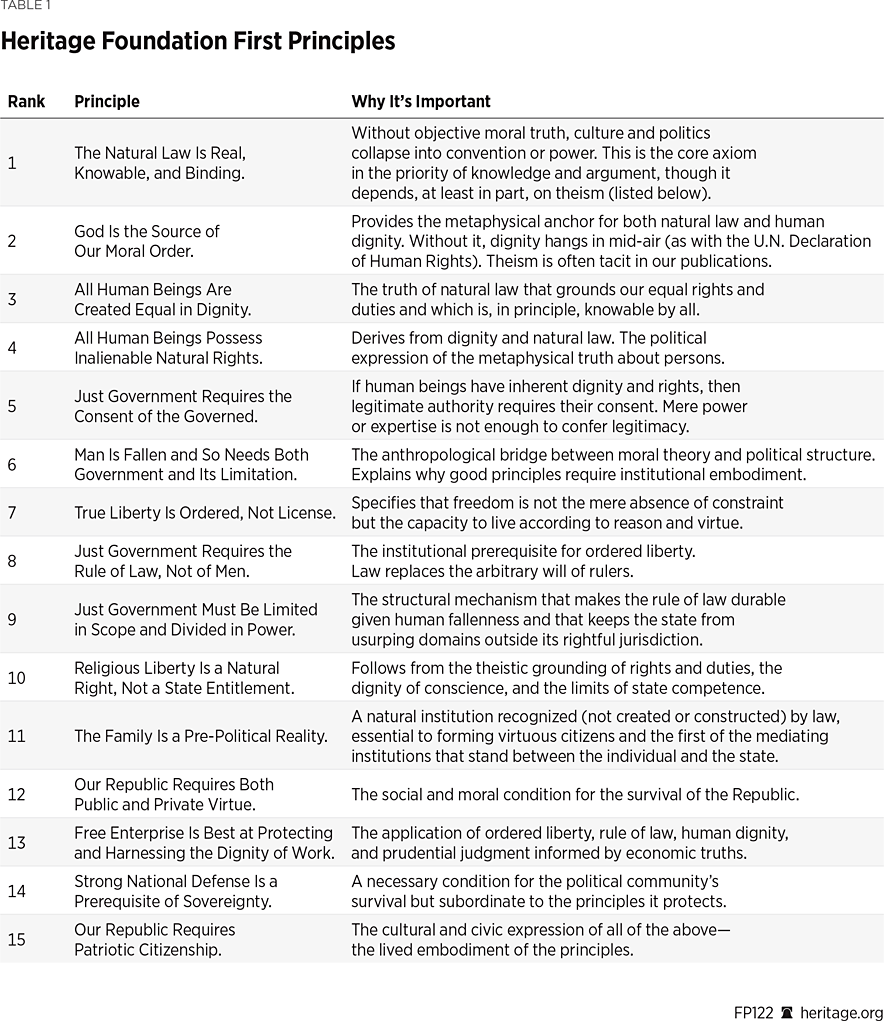
The First Principles reinforce each other and so are not easily ranked in importance. Table 1 does not attempt such a ranking. Insofar as some principles logically presuppose and ground the others, however, their order is roughly as shown.
Jay W. Richards, PhD, is Vice President of Social and Domestic Policy and William E. Simon Senior Research Fellow in American Principles and Public Policy at The Heritage Foundation.


