

Since January 2025, the Trump Administration’s America First approach to border and hemispheric security has secured the southern border and put drug cartels on notice. As policymakers rightly devote more resources and attention to the region, it is pivotal that they incorporate the Eastern Caribbean into their strategic calculus, not least because the cartels are likely to shift to new smuggling routes as U.S. law enforcement and military make their traditional routes more difficult to use.
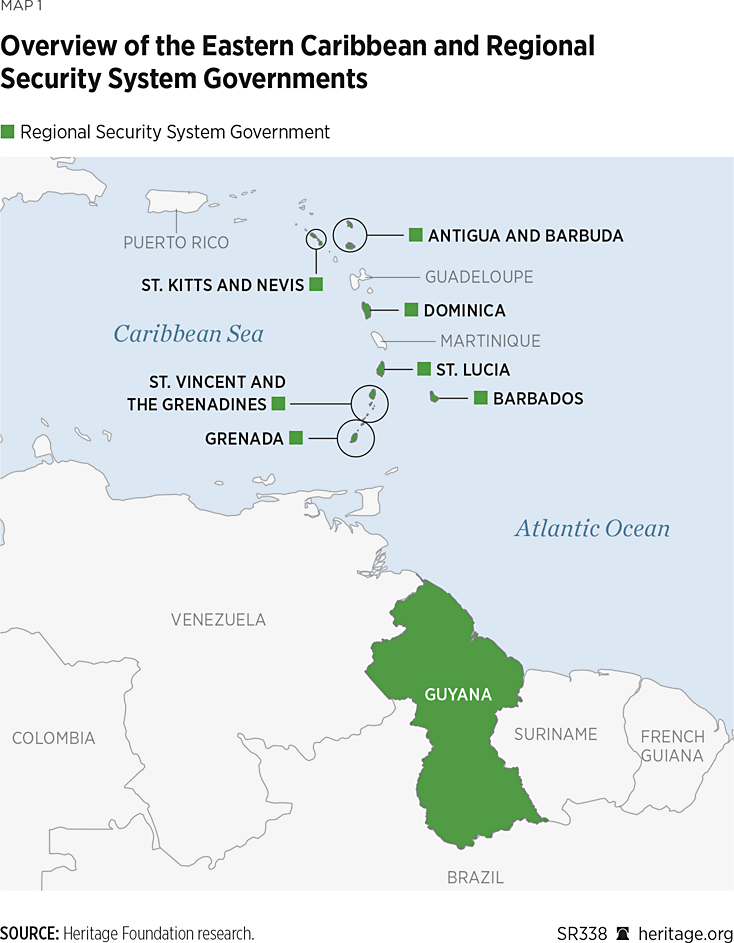
The Eastern Caribbean states sit astride the Lesser Antilles island chain, separating the Caribbean Sea from the Atlantic. Stretching from Antigua and Barbuda in the north to Barbados and Grenada in the south, these island nations and European territories play a critical role in any broader effort to interdict Caribbean narcotics trafficking, countering rising adversarial, primarily Chinese, influence and maintaining regional stability. The recently intensified U.S. targeting of Mexican cartels, as well as the longer-running trends of cocaine overproduction in Latin America and heightened European demand, have reasserted the importance of the Eastern Caribbean in narco-trafficking routes. This has already been observed elsewhere in the Caribbean. The Dominican Republic, whose commercial ports make it an attractive transshipment point for narco-traffickers, has seen a fivefold increase in seized cocaine over the past five years.[REF]
Another concern is the undue interest that Beijing has taken in the region, with a rapidly growing presence. Antigua and Barbuda, for example, recently inaugurated a massive Chinese embassy suspected of doubling as a regional intelligence center.[REF] The scope and scale of Chinese regional involvement risks making certain parts of the Eastern Caribbean China’s second hub of regional influence after Cuba.
Finally, the Eastern Caribbean plays a critical role in maintaining stability in America’s backyard. Gang violence stemming from narcotrafficking and the constant potential for massive economic loss from hurricanes pose problems for governments across the Antilles. One need only compare the Dominican Republic with Haiti to make the point that stable governments with sustained economic growth make for good neighbors while destabilized and impoverished states create problems (especially the illegal flow of drugs and migrants) for everyone in the region, including the United States. The Caribbean is the third border of the United States, and as such there is an obvious and sustained U.S. interest in the region’s security and prosperity.[REF] Few of the security problems facing regional governments can be addressed in isolation, as the region is highly integrated and the islands have much in common in terms of economic and security interests. The most prominent security organization facilitating collective responses to the region’s challenges is the Regional Security System, which comprises most—but not all—Eastern Caribbean governments.
The Regional Security System (RSS)
The Regional Security System (RSS) is a regional collective security organization and agreement among the governments of Barbados, Antigua and Barbuda, Dominica, Saint Lucia, Saint Vincent and the Grenadines, Saint Kitts and Nevis, Grenada, and Guyana—with Guyana having joined most recently in 2022. The RSS was created in 1982 out of a need for a collective response to security threats, especially the adversarial influence and instability that threatened the newly independent Caribbean region in the 1970s and 1980s.[REF] The RSS’s founding members were particularly concerned about Cuba, as well as the growth of Soviet-backed Grenada’s military capacity in the runup to Operation Urgent Fury in October 1983.[REF] The invasion of Grenada to support the legitimate government and protect U.S. citizens in Operation Urgent Fury by U.S. troops in 1983 is one of the most prominent examples of the U.S. employing hard power in pursuit of its interests in the Caribbean, and the RSS was instrumental in coordinating the participation of Caribbean nations in the successful operation. The militaries of Barbados and Antigua and Barbuda contributed troops to the operation (as did Jamaica from outside the RSS), and Saint Lucia, Saint Vincent and the Grenadines, Dominica, and Saint Kitts and Nevis contributed police and paramilitary forces.[REF] U.S. partners in these countries had then, as now, an interest in preventing Russia and Cuba from expanding their influence in the region.
Other notable RSS contributions to preserving regional stability since 1983 include subduing a 1994 prison riot and public disorder in Saint Kitts and Nevis, aiding the Grenadian recovery from Hurricane Ivan in 2004, and assisting with the stabilization of Haiti in the aftermath of the 2010 earthquake.[REF] Member states of the RSS contribute forces on a voluntary basis from their individual militaries or police forces to officially sanctioned RSS initiatives and generally deploy to support peacekeeping or law enforcement missions in the region.
The RSS has strengthened border security and maritime surveillance mechanisms to counter the illegal trafficking of drugs, including through the establishment of an air wing to support counter-drug operations at sea.[REF] Similar tasks include interdicting firearms smuggling, fisheries protection, immigration control, counterterrorism operations, and protecting the extensive exclusive economic zones (EEZs) of RSS member states.[REF] The organization’s stated 2026 priorities include combating firearm smuggling and narcotrafficking, member-state capacity building, and contingency planning amidst heightened regional geopolitical tensions.[REF]
The RSS’s successes have led to its institutionalization as the leading security organization in the Eastern Caribbean. The Caribbean RSS members that do not maintain militaries, namely Dominica, Grenada, Saint Lucia, and Saint Vincent and the Grenadines, rely on the RSS for their defense. These countries do maintain police forces for internal security, some of which have expanded roles in security operations to compensate for the lack of a military.
As detailed in a 2022 Center for Naval Analyses (CNA) study, the RSS facilitates member-state maritime coordination, as well as providing key aerial capabilities lacked by most member militaries.[REF] The RSS Maritime Operations Center in Barbados coordinates member-state maritime assets, the most substantive of which are Barbadian and Vincentian Offshore Patrol Vessels (OPVs) with the capacity for patrols of up to two weeks.[REF] While the RSS itself only possesses minimal maritime assets, it can draw from up to 54 vessels from member states, although most remain limited in range and capabilities.[REF]
The RSS Air Wing Operations Center, also located in Barbados, is the heart of the RSS’s response system. Equipped with communications and information-integration networks, the center coordinates maritime-domain intelligence and manages the operations of the RSS’s two C-26A “Metroliner” aircraft.[REF] These aircraft play a crucial role in providing intelligence, surveillance, and reconnaissance (ISR) capacity for the RSS and its members. Collaborating closely with naval assets as well as a ground radar–based “Intercoastal Surveillance System,” the RSS Air Wing typically contributes to 20 to 25 counter-narcotics interceptions per month.[REF] RSS capacity building and investigational functions also form a substantial portion of the organization’s remit. The RSS Training Institute in Barbados is a regional hub for law enforcement training, and RSS digital and forensics crime laboratories and financial crime units play pivotal roles in training personnel and furthering investigational efficacy.[REF]
Nonetheless, as described in the CNA study, the RSS faces pervasive hurdles. These include funding shortages, inadequate equipment, and endemic corruption among member governments. Barbados provides just under half of RSS funding, with the other members providing about 10 percent each.[REF] The limited fiscal capacity of RSS members means that the organization’s financial baseline remains limited and reliant on external donations. The RSS Air Wing is overstretched. Both C-26As have been in operation with the RSS since 1999 and have seen a consistent decrease in their operational readiness.[REF] Even at maximum availability, the geographic dimensions of the Eastern Caribbean require more aerial coverage than two aircraft can realistically provide. At sea, communications shortfalls, particularly in long-range radios and transmitters, hinder the ability to coordinate interceptions.
On land, RSS staff continue to face threats to their personal safety, reflecting pervasive corruption among member governments. These shortcomings have become more apparent considering the increasing criminal activity across the region. Speaking at a forum in Barbados in May 2026, RSS director Rear Admiral Errington Shurland noted that amidst a precipitous rise in crime across the Caribbean, “our established systems are seriously lagging behind.”[REF]
The U.S. supports the constituent militaries of the RSS, and the organization itself, through training opportunities, financial support, and equipment donations. U.S. support for the RSS dates to the aftermath of the invasion of Grenada in 1983. In the aftermath of Operation Urgent Fury, U.S. troops trained the 80-member Special Service Units (SSUs) of each RSS member, and the U.S. facilitated the equipping of RSS coast guards. The RSS’s two C-26A “Metroliner” aircraft, which contribute to the above missions, similarly originated with a U.S. donation in 1999.[REF] Support for the RSS was institutionalized with the creation of the State Department’s Caribbean Basin Security Initiative (CBSI) in 2010, which provided $942 million to the Caribbean region between 2010 and 2024, and remains operational today.[REF] More recent U.S. donations include the 2021 provisioning of a C-26A maritime patrol aircraft spare engine to the RSS Air Wing (along with other aviation equipment) through the CBSI, with the stated intent of supporting the RSS Air Wing’s operations in “counter-narcotics, disaster relief, search and rescue, fisheries and maritime pollution protection, and command and control.”[REF] The U.S. embassy in Barbados provided $2.6 million in support in 2024, and in 2025, U.S. Southern Command funded a new RSS Logistics Hub and Maritime Centre of Excellence in Barbados for training in engine maintenance, logistics, and diving, as well as maintenance and upkeep of vessels.[REF]
The United States has also provided specialized non-military assistance under the auspices of the RSS, helping to develop the RSS Digital Forensics Lab in Barbados into the “region’s premier hub for court-admissible digital evidence.”[REF] Additionally, the United States has assisted in the development of Saint Lucia’s forensics laboratory into a regional leader for narcotics analysis.[REF]
The United States cooperates closely with the RSS in an interagency context. Two U.S. Drug Enforcement Administration (DEA) agents are seconded to the RSS Regional Fusion Center, which disseminates information to and from member states and RSS assets.[REF] The RSS also cooperates closely with the U.S. Coast Guard, which has jurisdictional authority to make maritime arrests that the RSS lacks. This means that the RSS frequently depends on the presence of Coast Guard tactical law enforcement teams for interdictions.[REF]
Antigua and Barbuda
Antigua and Barbuda occupies a strategically relevant location in the Eastern Caribbean, located close to sea lanes important for U.S. commercial and naval transit.[REF] Antigua and Barbuda’s proximity to the U.S. Virgin Islands and Puerto Rico also makes it an enticing locale for narcotraffickers. As such, Antigua and Barbuda has suffered acutely from the regional resurgence of gang crime and narcotrafficking, prompting new anti-crime legislation, as well as attempts to mediate gang rivalries.[REF]
The Antigua and Barbuda Defence Force is one of the few professional militaries of the Caribbean. The force comprises infantry, maritime, and air components with approximately 300 personnel.[REF] The force, particularly the Coast Guard, lacks sufficient equipment for its mission, although the air wing recently acquired two new aircraft.[REF]
Historically, the U.S. and Antigua and Barbuda have had close and friendly ties. Antigua and Barbuda was one of only three Caribbean nations to provide soldiers to serve alongside U.S. military personnel in Operation Urgent Fury, along with Jamaica and Barbados.[REF] Antigua and Barbuda has engaged in bilateral security cooperation with the U.S. through the CBSI, and U.S. support for Antiguan security has included the 2015 donation of maritime patrol craft and ballistic forensics technology in May of 2026.[REF] The Florida National Guard has also trained with the Antigua and Barbuda Defence Force, and in 2026 Antigua and Barbuda will host Exercise Tradewinds 2026, the major regional security drills led by the U.S. Southern Command (SOUTHCOM).[REF]
In recent years, however, Antigua and Barbuda has presented several security concerns from the perspective of the United States. These primarily relate to its close political ties with China and heavy Chinese investment in critical infrastructure. Under the leadership of Prime Minister Gaston Browne of the Labour Party, Antigua and Barbuda has joined the Belt and Road Initiative (BRI), and Prime Minister Browne has emphatically supported deepening Sino-Antiguan ties. Browne has praised Xi Jinping as someone with “a global view in terms of a common humanity,” and he and his cabinet have undertaken numerous high-level visits and meetings with Chinese officials.[REF] China has also provided limited security assistance to Antigua and Barbuda, donating electronic equipment to the Antiguan police force in 2025.[REF] However, it is China’s investments in Antiguan critical infrastructure that pose the greatest concern to U.S. interests. China has established a substantial economic presence in Antigua and Barbuda, investing more than $1 billion over the past decades and becoming the country’s largest lender. This influx of Chinese investment has become most apparent in the ongoing construction of a special economic zone that will possess its own customs formalities, a shipping port, a dedicated airline, and even the ability to issue passports.[REF] China’s massive newly constructed embassy in St. John’s is also suspected of being a regional intelligence center.[REF] In response to a Newsweek investigation of the substantial Chinese investment and buildup, a spokesman for SOUTHCOM stated:
We are aware that China may use its commercial and diplomatic presence for military purposes. In Asia, Africa and the Middle East, China has already abused commercial agreements at host-country ports for military aims; our concern is they [sic] may do the same in this region.[REF]
Many Antiguans understand the risks involved in the deepening relationship with China, as evidenced by a statement by Gisele Isaac, chairwoman of the opposition United Progressive Party, who said that “Antigua has traded its sovereignty, I think most of us believe, to China.… I think China wants a foothold in more strategic places, as a superpower.”[REF]
These developments have not raised as many alarms in Washington as they should have, since China follows a strategy of slowly building up its relations and infrastructure in the Caribbean, so as to not raise alarms in the United States. In 2025, the Trump Administration announced limitations on visas for citizens of Antigua and Barbuda, citing Antigua’s Citizenship by Investment (CBI) program, which has no residency requirement, concerned that the program may enable citizens of countries adversarial to the United States to obtain Antiguan passports and gain access to the United States.[REF]
More concerted measures will be required to adequately address Chinese entrenchment in Antigua and Barbuda, lest a leading U.S. adversary retain a major foothold only 200 miles from the U.S. Virgin Islands. The United States understands that its partners in the Caribbean seek investment and does not oppose them doing so, but it is deeply concerned about the potential for dual-use facilities that have a potential security or political aspect and are clearly not being developed by China for purely economic reasons.
Barbados
In addition to being an active member of the RSS, Barbados hosts the headquarters of the RSS and maintains its own active-duty military, the Barbados Defence Force (BDF). Barbados also hosts the U.S. embassy that serves much of the Eastern Caribbean, including Antigua and Barbuda, Dominica, Saint Kitts and Nevis, and Saint Vincent and the Grenadines. Barbados engages in bilateral military cooperation with the United States through the CBSI.[REF] Soldiers of the BDF made up the second-largest contingent of soldiers serving alongside the United States in Operation Urgent Fury in 1983, after Jamaica, and also provided logistical and basing support to the operation.[REF]
The BDF consists of approximately 600 personnel, divided among a headquarters echelon, land forces component, and Coast Guard section. The Barbados Coast Guard is among the most advanced in the Caribbean, consisting of more than 10 vessels with a mix of OPVs and smaller interceptors.[REF] Barbados plays a leading role in (and hosts the facilities of) the RSS. The United States often operates with the Barbadian Coast Guard’s vetted Maritime Special Operations Unit.[REF] Close ties are reflected in frequent U.S. equipment donations to the Coast Guard, including four rescue vessels and three secure communications packages in August 2022 and the December 2025 provisioning of a $750,000 35-foot patrol vessel, the first in a series of three planned vessel donations.[REF] The government of Barbados has also demonstrated an interest in enhancing the capabilities of the BDF, investing in unmanned aerial vehicles for the newly established drone unit to assist in maritime intelligence gathering.[REF] Barbadian personnel routinely partake in U.S. training courses and Professional Military Education (PME).[REF]
Alarmingly, however, China has seemingly taken action to increase its influence in Barbados. For instance, on December 23, 2016, the People’s Liberation Army and the BDF signed an agreement through which China donated $3 million in military equipment to Barbados, specifically to the country’s Coast Guard.[REF] China’s 2016 contribution to the Coast Guard was complemented in 2018 by another Chinese gift, the patrol vessel HMBS Pelican.[REF] That same year, China also donated $6 million in the form of heavy vehicular equipment for Barbados’s land component.[REF] Barbadian officers also routinely participate in Chinese PME programs.[REF]
The United States, through taking a more active interest in the region and using existing mechanisms, such as the Excess Defense Article (EDA) program, should seek to be the primary supplier of this sort of equipment for Caribbean nations so that they do not feel the need to turn to China. Facilitating the onboarding of the new drone unit through training and equipment could help Barbados considerably to expand the capabilities of the RSS. Similarly, expanding U.S. training and course offerings for Barbadian personnel could obviate the perceived Barbadian need for Chinese PME. Barbados is the linchpin of regional stability in the Eastern Caribbean, and it is important that its security apparatus remains oriented toward the United States.
The U.S. State Department’s Overseas Security Advisory Council (OSAC) bases its crime ratings for the rest of the Eastern Caribbean on the crime rating for Bridgetown, Barbados, which as of 2025 was assessed as a high-threat location for crime, despite Barbados’s longtime reputation as a relatively safe and prosperous Caribbean nation with a thriving tourism industry.[REF] Nonetheless, Barbados has relatively little international organized crime, since it is not a part of any significant international drug-trafficking route. Most of the island nation’s crimes are related to gang violence.[REF] In January 2026, Barbadian Prime Minister Mia Mottley announced a domestic terrorism bill in response to a mass shooting, saying that crime and violence intended to cause panic should fall into a different category than standard murder charges.[REF] Prime Minister Mottley deserves praise for her efforts, and her leadership in combating crime and trafficking in Barbados can have an outsized impact on regional security given Barbados’s historic leadership role in the Eastern Caribbean.
Dominica
Dominica is one of several countries in the Eastern Caribbean that does not have a defense force, since it was abolished in 1981 following an attempted coup. The nation’s security is the responsibility of the Commonwealth of Dominica Police Force. Totaling 444 officers, it includes a Special Service Unit and maritime component, both oriented toward addressing narcotrafficking.[REF] The United States donated two SAFE patrol craft to Dominica under the auspices of the CBSI in 2012 and upgraded them in February 2021.[REF] Dominica also partners with French security forces, given the proximity of Martinique and Guadeloupe. Dominica’s location between the two French territories makes it an attractive location for smugglers and human traffickers. Dominica is one of the poorer Caribbean nations, and its security capabilities are hampered by a lack of personnel and equipment, as well as prevalent corruption.[REF]
China has been accumulating influence in Dominica in recent years. Dominica is a part of the BRI, and China has been a major partner in the country’s development. This partnership ranges from agricultural collaboration to the construction of the Dominica China Friendship Hospital.[REF] High-level meetings have also become more frequent—Prime Minister Roosevelt Skerrit has praised the BRI and was hosted by President Xi in Beijing in March 2024.[REF]
Like much of the Eastern Caribbean, violence fueled by drug smuggling is among the biggest security challenges that Dominica faces. In 2025, the Commonwealth of Dominica Police Force announced that it had made the biggest drug bust in the nation’s history with the seizure of 1,700 kilograms of cocaine.[REF] Dominica Minister for National Security Rayburn Blackmoore has taken a prominent public stance against the gangs and emphasized the importance of public cooperation with police forces in fighting drug-fueled gang violence, saying, “There is a role for everyone to play in ensuring that we collectively fight against crime and violence in Dominica.”[REF]
In 2025, the Trump Administration announced limitations on visas for citizens of Dominica, citing its CBI-without-residency program, concerned that the program may enable citizens of countries adversarial to the United States to obtain Dominican passports and gain access to the United States.[REF] The United States should take further steps—including using positive economic levers—to ensure that Dominica does not become dependent on China.
Saint Kitts and Nevis
The Federation of Saint Kitts and Nevis Ministry of National Security is tasked with ensuring public safety and protecting the sovereignty of the country, and Saint Kitts and Nevis is among the Caribbean countries that maintain a military, the Saint Kitts and Nevis Defense Force (SKNDF). The force comprises several hundred personnel, with a small maritime branch.[REF] The SKNDF has routine collaboration with the Virgin Islands National Guard through the State Partnership Program, and in 2025 the two forces conducted a Subject Matter Expert Exchange on Humanitarian Assistance/Disaster Relief Logistics and Sustainment—addressing a very real security concern for a country that has seen its annual gross domestic product drop as a result of the destruction caused by hurricanes.[REF] Saint Kitts and Nevis similarly collaborates closely with the United States in counter-narcotics operations and intelligence sharing.[REF] Saint Kitts and Nevis has also benefited from periodic logistical and maintenance support for their maritime branch.[REF] In January 2026, Saint Kitts and Nevis signed a memorandum of understanding with the United States, by which the country may receive a limited number of non-U.S. refugees and deportees from the United States.[REF]
Saint Kitts and Nevis is especially notable in the region as the host of the region’s multinational stock exchange, the Eastern Caribbean Securities Exchange (ECSE), a regional stock exchange established by the Eastern Caribbean Central Bank and serving eight members.[REF] Saint Kitts and Nevis hosts an important array of institutions that combat threat financing, including the Financial Services Regulatory Commission (FSRC) and the Financial Intelligence Unit (FIU).[REF]
The Kittitian government has shown intent to combat international terrorism financing over the years, first with a counterterrorism law passed in 2002 in the wake of 9/11, and more recently with the passage of the Anti-Money Laundering (National Committee) Act in 2019 and the Anti-Proliferation (Financing of Weapons of Mass Destruction) Act in 2024.[REF] The Anti-Money Laundering Bill was passed to align Saint Kitts and Nevis with international money-laundering standards.[REF] Such measures to prevent terrorist financing are especially important for Saint Kitts and Nevis, given both its substantial finance sector and CBI program.[REF]
Saint Kitts and Nevis struggles with significant gang-related violence. Although the data can be somewhat misleading given its small population, it suffers from one of the highest homicide rates in the Americas, mostly gang-related.
Saint Kitts and Nevis maintains formal diplomatic relations with Taiwan, one of several Caribbean nations that continue to do so despite intense Chinese pressure to switch recognition. The government of Saint Kitts and Nevis supports Taiwan’s participation in international organizations, such as the World Health Organization.[REF] Given Saint Kitts and Nevis’s laudable support for Taiwan, its history of partnership with the United States, and its importance for the Caribbean’s financial security, the United States should prioritize supporting Saint Kitts and Nevis in tackling gang violence, especially through donations of excess police and military equipment.
Saint Lucia
As one of the most successful tourist economies of the Eastern Caribbean, Saint Lucia has an interest in reducing the homicide rate and crime more generally. Saint Lucia is vulnerable to trafficking-linked crime, since it is located along the Caribbean drug-trafficking route, through which cocaine and other narcotics are trafficked from South America to North America and Europe. Local gangs receive and protect drug shipments, and fight to control drug routes, leading to violence. Much of the violence is carried out with illegally trafficked firearms from the United States.[REF]
Faced with rising violence, the government of Saint Lucia has responded admirably, with enhanced support for the Royal Saint Lucia Police Force (RSLPF) in its efforts to combat gang violence and drug trafficking. In 2025, the RSLPF reorganized its Drug Squad as the Gang, Narcotics, and Firearms Unit, with expanded investigation authority and efforts to tackle the problems downstream from drug trafficking, including gang violence and the trafficking of illegal firearms.[REF] The police force includes a maritime unit with approximately 50 personnel, operating American-donated vessels.[REF] Beyond assisting Saint Lucia’s judicial and corrections systems, the U.S. government has also cooperated with the government of Saint Lucia to turn the Saint Lucia Forensic Science Laboratory into one of the region’s leading centers for forensics analysis.[REF] Saint Lucia maintains formal diplomatic relations with Taiwan, one of several Caribbean nations that continue to do so despite intense Chinese pressure to switch recognition.[REF] China has been courting the government of Saint Lucia, likely in an attempt to switch official recognition away from Taiwan. Saint Lucia is considered one of the more vulnerable countries to shift recognition, given that the Saint Lucia Labour Party has historically been friendlier to China. In fact, in a recent forum with China and the Community of Latin American and Caribbean States (CELAC), a Saint Lucian official was present, whose comments raised speculation among some international observers that the country was softening its approach toward China. The government of Saint Lucia has said that this official attended the forum as a member of the Labour Party, not as an official government representative.[REF]
Nonetheless, Saint Lucia remains one of only 12 countries worldwide that officially recognize Taiwan, and Taiwanese investment in Saint Lucia is substantial, with Taiwan regularly making investments in Saint Lucia’s infrastructure and economic development.[REF]
Saint Vincent and the Grenadines
Saint Vincent and the Grenadines, a country friendly to the United States run by a government with a clear commitment to improving national and regional security, nonetheless suffers from the negative effects of drug trafficking emanating from Venezuela just as its neighbors do. Venezuelan criminal organizations use the many islands of the Grenadines as a hub for drug smuggling, and the Vincentian government has limited resources with which to combat the smuggling. As Chief Petty Officer Gordon Charles of the Saint Vincent Coast Guard explained in 2023, “Our vessels may be unable to enter certain areas because [of the] reef volume and the waters are sometimes shallow, and it is easier for drug smugglers to actually go ashore in shallow water and stash away the drugs and so on. That is one of the difficulties we face.”[REF] Vincentians have an opportunity with a new government elected in late 2025 to address criminality and reduce homicide rates through increased measures by law enforcement. The new prime minister, Godwin Friday, has pledged to: “Make our country safe again,” living without the fear of “crime and violence that now plague our society.”[REF]
Saint Vincent and the Grenadines lacks a military, relying on the Royal Saint Vincent and the Grenadines Police Force and 100-strong Coast Guard for protection.[REF] Nonetheless, the Coast Guard is capable, comprising eight vessels, including one longer-range Damen OPV.[REF] A major restructuring of the Vincentian police force was announced in May 2026, with a focus on modernization and rebuilding the Vincentian Special Service Unit.[REF] U.S. cooperation includes training and logistical support for Saint Vincent and the Grenadines’ maritime personnel, as well as extending U.S. professional development courses to Vincentian personnel.[REF]
Saint Vincent and the Grenadines maintains formal diplomatic relations with Taiwan, opening an official embassy in Taipei in 2019.[REF] Saint Vincent’s maintenance of relations with Taiwan is laudable, and the United States should ensure that the growth of Chinese influence does not threaten one of Taiwan’s few remaining diplomatic partners.
Grenada
The government of Grenada has had friendly and close ties with the United States since Operation Urgent Fury, in which the Cuban-backed Revolutionary Military Council was toppled following an intervention by U.S., Jamaican, and RSS militaries with the support of the Grenadian opposition. After the intervention, general elections were held, and Grenada has been a successful and functioning democracy ever since. Nonetheless, Grenada’s geographic position at the southern end of the Caribbean exposes it to enduring security challenges. Narcotics destined for European markets that originate in Venezuela and Colombia are frequently routed through Grenada, posing a serious threat to domestic stability and stretching Grenada’s limited security capabilities.
Grenada does not possess a military. Security is provided by the Royal Grenada Police Force, which includes an approximately 50-strong Coast Guard component.[REF] Since 1983, the United States has cooperated with Grenada on a variety of shared security concerns. The Grenadian Coast Guard has received two U.S. Coast Guard SAFE boats (in 2012) as well as periodic logistical and financial support from the CBSI and SOUTHCOM. Most recently, in December 2025, a U.S. team conducted a technical assistance visit to repair the Grenadian Coast Guard’s U.S.-origin vessels.[REF] The U.S. frequently collaborates on counter-narcotics training with Grenadian security forces, and Grenada participates in the annual Tradewinds exercises.[REF]
The Grenadian security establishment faces certain key challenges, most notably a shortage of maritime assets for safeguarding Grenadian waters, as well as shoddy communications.[REF]
In 2025, the United States requested that Grenada allow the installation of radar equipment at Maurice Bishop Airport, and the Grenadian Ministries of National Security, Legal Affairs, and Foreign Affairs are currently assessing the request.[REF] The installation of these systems would be beneficial to the Grenadian and U.S. governments alike, as the United States moves to increase its security and law enforcement operations in the region.
Like most of the Caribbean, Grenada has suffered from gang violence relating to the trafficking of drugs, and enhanced U.S. support for regional security operations would be beneficial for Grenadian and American citizens alike. It would allow both U.S. and Grenadian authorities to better detect and respond to drug trafficking.
However, China is also making a concerted effort to elevate its political and economic influence in Grenada. Grenada is a member of the BRI, and Grenadian Prime Minister Dickon Mitchell met Xi Jinping in January 2025, on a trip that saw Grenada and the People’s Republic of China sign 13 agreements ranging from infrastructure development to agriculture.[REF] Despite Grenada’s minuscule trade with China, China has granted and loaned a cumulative $450 million to Grenada since 2005.[REF] China’s involvement in the island should be cause for concern, as it does not stem from any tangible economic benefit for China and has already extended to critical infrastructure, such as Maurice Bishop International Airport.[REF]
Guyana
Guyana, previously one of the poorest countries in Latin America, has enjoyed tremendous economic growth in recent years, becoming one of the fastest-growing economies in the world. This rapid economic growth is primarily driven by Guyana’s expanding energy sector, whose petroleum production has grown rapidly, expanding from 15,000 barrels per day in December 2019 to 630,000 barrels per day in January 2024. ExxonMobil is leading a consortium that has discovered more than 30 reserves of oil since 2015.[REF]
The primary security threat to Guyana has been the repeated threats against its territorial integrity by Venezuela, driven in part by the Chavista regime coveting the oil wealth of Guyana.[REF] The United States has taken steps to prevent Venezuela from threatening Guyana. Speaking in Guyana’s capital city of Georgetown in 2025, Secretary of State Marco Rubio warned that any military action by Nicolás Maduro’s regime against Guyana would result in a “very bad day” for Venezuela.[REF] Additionally, Secretary Rubio signed a memorandum of understanding with Guyana for increased military collaboration.[REF] This memorandum was later expounded in a statement of intent for increased military collaboration signed some months later.[REF] Secretary Rubio’s visit came amid rising tensions, marked by the incursion of a Venezuelan naval vessel into Guyanese territorial waters. This act of intimidation came as part of a more extensive campaign by Venezuela to assert dominance over its smaller neighbor and lay claim to Guyana’s offshore oil resources.[REF] The Essequibo region, which makes up about two-thirds of Guyana’s territory, has long been the target of Venezuela’s irredentist ambitions, although the recent oil discoveries gave the issue more urgency for Maduro. Venezuela’s territorial claims are both politically motivated and legally unfounded, as the 1899 Arbitral Award, which settled the boundary in Guyana’s favor, remains internationally recognized.[REF]
(In 2024, Venezuela moved troops to the border following a referendum called by Maduro asking Venezuelans whether they wanted to establish Venezuelan sovereignty over Essequibo. A sustained propaganda campaign by Caracas preceded the vote and even included a state-sponsored music festival called “Essequibo Fest,” and a song produced by the Ministry of Ecosocialism called “Essequibo Is Ours.”[REF] In contrast, Guyana has followed a diplomatic path and is currently pursuing a resolution of the dispute through the International Court of Justice, even while ramping up its defense spending.[REF])
With Maduro’s January 2026 capture by the United States in Operation Absolute Resolve, the future of Guyana–Venezuela relations is unclear. After Maduro’s capture, President Irfaan Ali stated that Guyana “welcomes the leadership of the President of the United States in reaffirming shared commitments to freedom, democracy, and regional security.”[REF]
The Guyana Defence Force is underequipped, but the current government in Georgetown is already moving to increase its capacity to defend Guyana’s borders, with a defense budget in 2024 that marked an 85 percent increase over the previous year.[REF] The Guyana Defence Force numbers approximately 3,400 personnel, and includes sizable air and maritime components.[REF] Recent Guyanese acquisitions from the United States include the 2023 purchase of a 115-foot Defiant OPV, as well as two helicopters, a Bell 407 and Bell 429.[REF] Where possible and practical, the United States should look for ways to help the Guyana Defence Force to better equip itself for self-defense through foreign military sales or financing. Besides military sales, the Florida National Guard conducts joint training with the Guyana Defence Force through the U.S. National Guard’s State Partnership Program.[REF]
British, Dutch, and French Territories in the Caribbean
The United Kingdom, the Netherlands, and France all have territories in the Eastern Caribbean with varying degrees of self-government and allocate limited military resources to the Caribbean to combat drug trafficking.[REF] Until very recently, the militaries of all three European allies operated jointly with the United States in the region, sharing intelligence with the Joint Interagency Task Force South (JIATF-South) to coordinate measures. In 2025, the British and Dutch governments both limited intelligence cooperation with the United States in response to U.S. strikes on narco-terrorists who were trafficking drugs in the region, claiming that the strikes violated international law.
Of the three European militaries, the Netherlands has contributed the most to counter-drug actions in the Caribbean alongside the United States and routinely deploys Royal Netherlands Navy ships to the Caribbean to take part in counter-drug operations. The United States also has an agreement with Curaçao and Aruba, both part of the Netherlands, allowing for Cooperative Security Locations, where U.S. aircraft can use existing airfields in actions against drug trafficking.[REF]
Drug trafficking to Europe is a major problem in the British, French, and Dutch Caribbean islands. Just as traffickers use Puerto Rico and the U.S. Virgin Islands to traffic drugs to the American mainland, they also use European territories in the Caribbean to traffic drugs to Europe. Combating drug traffickers in the Caribbean is a shared U.S. and European security interest and European militaries should re-engage with the United States on jointly combating drug trafficking and the cartels.101
Policy Recommendations for the U.S. and Caribbean Governments
In order to combat international narcotraffickers and malign extra-hemispheric influence in the Eastern Caribbean, the United States should:
- Increase funding for the Caribbean Basin Security Initiative and focus new funding on tangible, hard-power security measures, allotting tens of millions of dollars in new spending for militaries and police forces equipment purchases and training. Relatively small amounts of funding go a long way in the Caribbean, and investments of tens of millions of dollars achieve similar effects to billions spent in other regions. Increased funding for the CBSI, especially in partner capacity building, will go a long way toward building more capable and secure Eastern Caribbean governments and edging out Chinese influence.
- Make Caribbean governments a priority within the Excess Defense Articles (EDA) program. Smaller watercraft useful for drug interdictions, as well as armored vehicles, small arms, and body armor, should be given to Eastern Caribbean governments to improve their counter-trafficking and internal security operations and so that they do not become reliant on Chinese equipment donations. Donations of this relatively inexpensive equipment would serve U.S. interests far better in the Caribbean than in the Middle East or Southeastern Europe, where much of it is currently sent.[REF]
- Expand state partnership exercises and exchanges between the Virgin Islands National Guard and Eastern Caribbean militaries and increase resources for the Virgin Islands National Guard to do so. The U.S. Virgin Islands have much in common with the Eastern Caribbean in terms of security interests, and increased funding for it through the National Guard’s State Partnership Program would contribute greatly to U.S. regional engagement.
- Increase foreign military financing for Caribbean and Latin American partners. Foreign military financing in Europe and the Middle East should be reduced, both because U.S. allies and partners in these regions are generally wealthy and capable of purchasing U.S. equipment without financing assistance, and because America’s European and Middle Eastern allies and partners will be taking on more and more responsibility for their own defense. Foreign military financing is more appropriate for Caribbean and Latin American partners, who have a harder time affording military equipment.
Caribbean governments and the United States should:
- Expand intelligence sharing with each other and with friendly governments. Maritime domain awareness is a critical and relatively cost-effective way the United States can support the counter-trafficking measures of Eastern Caribbean governments.
Caribbean governments should:
- Increase funding for their militaries and police forces in response to rising violent crime rates and the push by gangs and cartels into the Caribbean. To protect their own citizens, Caribbean governments need to invest more in their militaries, coast guards, and police forces to combat rising violent crime and drug trafficking and the gangs and cartels responsible. They should also support the enhanced U.S. role and presence in the Caribbean.
Conclusion
The United States is a Caribbean nation, with Florida, Puerto Rico, and the U.S. Virgin Islands all firmly and permanently anchoring the U.S. presence and interest. The United States has neglected Caribbean security for decades, which has allowed the rise in trafficking and violent crime. Now, the United States is taking a renewed interest in the region, and far more resources will be available to counter cartels, gangs, and extra-hemispheric malign adversarial influence. This is good news for America’s Caribbean partners and will result in a safer and more prosperous Caribbean in the years ahead.
Wilson Beaver is Senior Policy Advisor for Defense Budgeting and NATO Policy in the Douglas and Sarah Allison Center for National Security at The Heritage Foundation.



