
The U.S. Department of Education issued final rules for short-term Pell grants on May 19, 2026.[REF] These grants give federal taxpayer funds to students for college programs that last eight weeks to 15 weeks and teach job skills. To qualify, a program must teach skills that workers can use at more than one firm. It also must count toward larger credentials and pass quality checks. Only programs with strong completion and job-placement rates qualify. This program, often called Workforce Pell, has great promise if data inform it and markets guide it.
For many workers, gaining more responsibility and pay requires more training but not another full degree. Workforce Pell encourages colleges to work with businesses to create short-term programs that quickly teach workers new skills.[REF]
As of June 2026, the United States had nearly 7.4 million job openings.[REF] At the same time, more than 4 million students were enrolled in noncredit programs at community colleges.[REF] These programs can adjust quickly as industry needs change. They can also give current and future workers inexpensive credentials that are useful across these workers’ whole industries.
Not all industries are the same—some programs are worth much more than others.[REF] When a program gains Workforce Pell eligibility, it shows students that it is worthwhile.[REF]
On the supply side, more industries will stack groups of valuable skills together as the market for short-term credentials grows. The same student or worker can receive more than one Workforce Pell grant along the way. Over time, many more people may take a sequence of courses as their full college education, obtaining an industry-recognized certificate instead of a full degree.
Principles for the Success of Workforce Pell Grants
To ensure that Workforce Pell grants succeed, the following principles are essential.
Integration of Education and Workforce Policies. In each state, the governor must consult with a state workforce board to decide which college programs should qualify. An eligible program must prepare students for high-skill, high-wage, or in-demand jobs.[REF] It also must lead to an industry-recognized credential and have been in place for at least one year. It must graduate at least 70 percent of students, place at least 70 percent in jobs, and produce earnings equal to 150 percent of the poverty line plus the program’s tuition.[REF] Finally, the skills must be useful at more than one firm. Otherwise, Workforce Pell would subsidize a credential that mainly helps one company. State officials should make sure that programs are collecting this input and output information so that they can qualify under Workforce Pell regulations.
Listening to Industry. Colleges should not simply offer content that professors want to teach. Workforce Pell programs should teach what students need to learn. This approach can match worker demand with college supply. Firms also have strong incentives to keep training useful and relevant.
Resisting Standardization. Government officials are often tempted to make one-size-fits-all rules. Instead, federal officials should keep seeking feedback from industry. They should ask whether good programs are being made worse just to fit the federal rules.
For example, many current programs fall far below the Workforce Pell minimum of 150 instructional hours during the program. Colleges will feel pressure to lengthen programs or bundle several courses merely to qualify.[REF] Instead, federal officials should make the rules more flexible. Similarly, should a program with only 50 percent job placement get a waiver in a weak economy if completion and student satisfaction are still high? What about a hard program with many dropouts but a large payoff for those who finish? These cases deserve review.
Allowing Spontaneous Order to Emerge. Firms may want to partner with colleges in many ways. Some may give advice. Others may provide materials, learning space, or teachers who will become instructors of record at the college. Other firms may help to create online courses or even full learning platforms. Under the Department of Education’s “bundled services” policy,[REF] firms can group marketing and recruiting with education services to support a college program. Such services should be expected and encouraged when firms send their own workers into training. As long as the college keeps final responsibility for the program, it can contract out many such details.
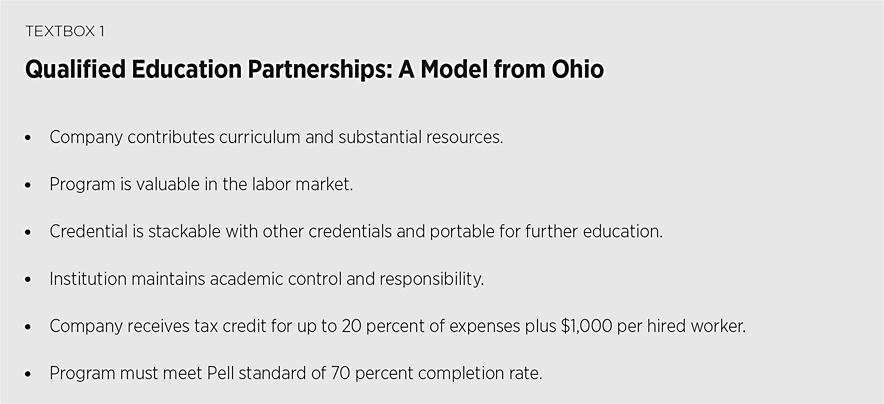
Considering Ohio’s S.B. 462. Ohio State Senator Jane Timken (R) has proposed a state tax credit for public-private partnerships. Under the plan, a firm helps a college to design a high-quality degree or certificate program. The college keeps academic control. The marketing must be clear and direct. The program also must meet Workforce Pell quality standards. The firm receives a tax credit for 20 percent of expenses plus $1,000 for each successful graduate who returns to the industry, even if the graduate works for a rival firm.[REF]
Because many colleges and state systems lack the technical skill, staff, or money to build and maintain online programs on their own, many already use online program management partners (OPMs).[REF] OPMs are third-party organizations or companies that help colleges and universities to develop, manage, and market academic offerings. Online platforms must change as technology changes, while college bureaucracies often move too slowly, adapt less quickly, and face pushback from professors. These partnerships have worked well because teachers can focus on education while outside experts handle OPM and other technologies.[REF] Online programs can scale up or down quickly as student demand changes.
No Central Planning. Governors and workforce boards should strongly resist the urge to plan a state’s economy. Data from industry and government can help to define high-skill or in-demand jobs. But decision-making should let a wide variety of employers and workers use the program how they think best. Established industries and chambers of commerce should share the conversation with new firms. State officials also should not push industry in one direction. Markets handle those choices better. Indeed, all programs that meet the basic criteria should be approved.
Resisting Tuition Inflation. Government subsidies make education programs easier to afford, but they can also cause harm. A strong program that already succeeds without Workforce Pell will become easier to enter with the subsidy. The risk is that a college will simply raise tuition because students can now pay more. A good test for an existing program is whether Pell access raises enrollment. If not, why subsidize what was already happening?
Measuring Success. A new program like Workforce Pell offers a great research opportunity. Too often, research on results comes too late. Researchers then must track down students and fill data gaps after the fact. Data on short-term and noncredit programs remain limited.[REF] Governors and workforce boards should partner with academic researchers now to learn what works.
These questions can be useful to researchers:
- Are more people in the state getting better-paid jobs?
- Are four-year graduation rates in a state rising because students leave poor fits and choose better skill-based programs instead?
- What is the relative return on investment when comparing four-year, two-year, and short-term Pell programs in the state? Return should measure value created, not taxes paid.
- Market evidence: How many employers are sending how many workers into Workforce Pell programs, including qualified education partnerships? How many students take part with or without employer guidance? Are the programs growing merely because of subsidies? Or are they growing because all parties gain real benefits?
Letting Failing Programs Adapt or Close. Programs that are not succeeding should be allowed to continue—without federal dollars. They can reform and regain eligibility if they become worthwhile. If industry needs or wants such programs to keep going anyway, firms can pay the tuition. If no firms and no students see enough value in a program to invest in it, the program will naturally end.
Policy Recommendations for the States and Federal Agencies
Subsidies distort prices and other key market signals. But higher education is already heavily subsidized and distorted by government policy. Workforce Pell can help to restore balance. It can draw students away from four-year and two-year programs that are a poor fit for them, and into short-term, job-ready programs that fit them better.
State leaders should:
- Link education and workforce policy. Governors and state workforce boards should remove job barriers, listen to industry, use data cautiously, and encourage colleges and industries to innovate and partner. They should make sure that programs are collecting the data needed to qualify for Workforce Pell. But state leaders should strongly resist the urge to centrally plan the workforce. They also should not pick winners and losers among industries. Leaders also can compare notes through the National Governors Association and State Higher Education Executive Officers Association’s Workforce Pell project, called the Workforce Pell Readiness Academy.[REF]
State workforce boards and colleges should:
- Resist tuition inflation and standardization. Adding a subsidy to an already subsidized education market gives colleges a reason to raise tuition even more. State boards should track enrollment closely. They need to know whether Workforce Pell programs are serving more people or just raising prices while still excluding the same people because of cost. At the same time, state boards should remember that industry is creative and fast-moving. Regulators should avoid the urge to simplify but instead should expand flexibility.
State workforce boards should:
- Report outcomes clearly. State workforce boards should publish completion rates, placement rates, median earnings, and employee and employer participation numbers by program with as little delay as possible. This information should help all parties to adjust to market changes.
Federal agencies should:
- Keep lines open for industry feedback as Workforce Pell grows nationwide. If states should not centrally plan their economies, federal agencies should be even more cautious. Counting each degree, certificate, or program at each college as a separate credential, Credential Engine reports nearly 2 million credentials.[REF] Federal agencies should not even try to guide this extremely diverse market. They should let it work. When agencies and legislators learn that federal rules are needlessly limiting workforce education programs, they should revise the rules.
Federal and state agencies should:
- Work early with researchers to test Workforce Pell. Waiting too long to design studies will create data gaps and uneven data. That will make the research less useful to policymakers.
The U.S. Department of Education and the U.S. Department of Labor should:
- Encourage public-private education and labor partnerships—and work with Congress to codify the Education Department’s “bundled services” policy. Clear rules would help colleges and firms that partner with colleges to serve students better. Workforce Pell is a strong area for such partnerships. Firms and colleges can work together across many parts of the student experience, and they need clear rules.[REF]
Congress should:
- Cut spending to offset Pell costs. Some advocates simply want Pell spending to rise, but America’s federal education budget must become more responsible. Workforce Pell is expected to cost up to $6 billion over the next decade. The full Pell program may face a $100 billion 10-year “shortfall.”[REF] A narrow offset could follow the recent congressional proposals to require students to take 30 credit hours per year for maximum Pell eligibility or to require at least half-time enrollment.[REF] Such reforms would also make Pell students more likely to graduate.[REF] Ending Public Service Loan Forgiveness for new borrowers could save $30 billion over 10 years.[REF]
Most public and private colleges should:
- Adapt more to workforce demand. Most students enter college with future work in mind. Career colleges, above all, should partner with local and state industry to create useful, stackable, portable mini-credentials. Four-year colleges should also consider short-term programs where they fit. For colleges seeking industry partners, Ohio’s plan for qualified education partnerships is an excellent model. (See Textbox 1.)
Conclusion
A college education is about much more than job training. At its best, it helps people to grow in mind, character, social life, and faith. It can help them to become better individuals, citizens, parents, and members of their communities. (Unlike career colleges, liberal arts and religious colleges with distinct missions should not feel pressured to create narrow job tracks.) Many students still choose a college credential because highly skilled work can give them meaning and income. For those students, Workforce Pell grants can be an excellent support.
Adam Kissel is a Visiting Fellow for Higher Education Reform in the Center for Education Policy at The Heritage Foundation.


