
If the open-borders activists running Joe Biden’s immigration policy while he was U.S. president had simply admitted they wanted to let in every foreigner who arrived at the American border, they might have faced blowback earlier. So they hid what they were doing in an envelope of inscrutable euphemisms and diversions.
The mass release of migrants arriving at the border became a “lawful pathway.” Biden’s state department shoveled millions into creating 13 “Safe Mobility Offices” in Latin America to channel illegal migrants to the U.S.
The United Nations uses the same weasel wording on a global scale. The 2026 Global Appeal of the UN High Commission for Refugees (UNHCR) is 156 pages that prints out in a tiny font that should be known as Times New Glasses. It is riddled with NGO-speak that obscures what appears to be their mass migration agenda.
Here’s an example: they advocate “route-based approaches to mixed movements of refugees and migrants [that] will focus on protection-sensitive entry and admission.” Huh? What that really seems to mean is that they want countries to accept all migrants, not just qualified refugees but also those merely looking for better jobs and improved lives.
>>> Europe’s Migration “Crackdown” Still Pulls Its Punches
UNHCR was founded in 1950 to coordinate the response to emergencies causing mass exodus. The precedents were Jews fleeing Nazi extermination and dissidents fleeing Communist persecution.
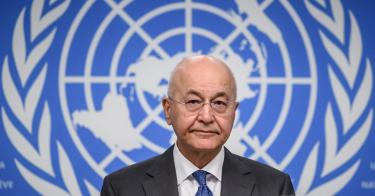
Barham Salih was named High Commissioner in 2026. According to a speech he gave to donor countries in February, the three “pillars of UNHCR’s mandate” are “protection, life-saving assistance, and advancing durable solutions.” All three goals sound worthy but are opaque.
“Life-saving assistance” is the clearest. It suggests providing shelter, food, medicine, and clothing for displaced people. Few voters in donor countries would take issue with this. But it does not address the duration of the assistance, which in some cases has gone on for decades.
“Protection” seems to mean physical safety for people fleeing for their lives. But for Salih, protection means “not only advocacy,” but “ensuring access to territory, legal status… documentation.” The Global Appeal speaks of “inclusion” and “pathways out of displacement.” In plain English: this seems to mean either immediate host countries such as Egypt, Kenya, or Turkey must permanently absorb refugees (which pro-migration campaigners now refer to as “person[s] with refugee experience”) or third countries must take them.
“Access to territory” appears to mean that the UNHCR wants countries like Spain and the United States to allow in anyone who physically reaches their borders. Yes, they would then have to apply for “protection” through asylum. But everyone knows that few of those denied—because they don’t qualify—will ever be removed. The European Union countries grant asylum around half the time but expel nowhere near all of those ruled ineligible. That means a foreigner with a bogus asylum claim has a significant chance of remaining in the EU once they get in—odds well worth the risk.
In the U.S., rates vary by year but historically only around 15 per cent of asylum applications end in approval. But like in Europe, few of those refused asylum are ever removed. That makes “access to territory” a Trojan horse for permanent settlement.
Salih’s big strategic goal for UNHCR is to reduce the number of refugees living in “protracted displacement” by half by 2035, through “durable solutions.”
The most obvious “durable solution” is for refugees to go home. Salih says he supports this, but that return must be “voluntary, safe, and sustainable.” But even if places such as Ghana and India are “safe,” they are still poor. Requiring their nationals to volunteer to return, once ensconced in a richer country with benefits, would surely result in very few going home even when denied asylum.
“Durable solutions” must therefore be a euphemism for facilitating mass migration. Echoing Biden, Salih has spoken of “pathways to rights, inclusion, and solutions” for refugees or asylum claimants once they are in safer countries.
If it doesn’t mean return, then “durable solutions” appears to mean, in Salih’s words, “freedom of movement and the right to work,” and “expanded access to resettlement.” He also advocates for “complementary pathways”—which sounds like a euphemism for ways to get around visa caps or numerical limits voted in by host populations.
Through its staff in American-funded Safe Mobility Offices, UNHCR spent $67.1m of U.S. taxpayer money in 2023-24 to advise aliens on such “complementary pathways” to enter the U.S. according to a congressional report. Biden is accused of using immigration parole as one such “pathway” to bring in over 1.5 million inadmissible migrants.
>>> Swiss Miss Out on Chance To Save Their Nation From Immigrant Invasion
Salih speaks of “responsibility sharing,” echoing the European Union’s recent Pact on Migration and Asylum. The EU deal, in effect, implies endless mass migration due to high asylum approval rates and low deportation rates. It requires that each EU member state take an assigned share of total annual illegal arrivals into the bloc, regardless of the wishes of their own populations.
To encourage “responsibility sharing,” UNHCR uses donor money to advocate “opening more resettlement places.” What they seem to mean by this is moving refugees from frontline states such as Kenya or Turkey to Europe, the U.S. and other developed countries with more generous welfare benefits.
So, in a donor-funded double whammy, UNHCR lobbies for “inclusive national laws, policies and systems” in desirable receiving countries, and pays for legal assistance to help migrants access them.
The goals of UNHCR should be to: (1) protect refugees as close to home geographically and culturally as possible; (2) provide emergency assistance; and (3) return refugees home as soon as the crisis causing exodus is over. They should do so while mindful of donor-country interests, too, leaving each to set its own limits and policies on “pathways” to third-country settlement. The UN should not be in the business of facilitating mass economic migration from poor and dysfunctional countries to more prosperous ones while laundering it as refugee protection.
Charity is given freely, not compelled. Every country gets to decide which foreign populations to admit or support, and to what extent. Ceding that sovereignty to unelected, unaccountable international bureaucrats should be anathema to the United States and all self-respecting nations.
This piece originally appeared in The Telegraph


