

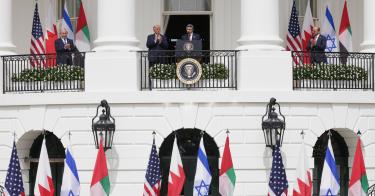
When President Donald Trump recently challenged America’s Arab allies to join the Abraham Accords as a bloc, he declared that such a move would make the Middle East “united, powerful, and economically strong, like perhaps no other area in the world.”
This was more than a diplomatic appeal. It signaled the evolution of the president’s signature Abraham Accords strategy: from advancing bilateral pacts, as he did in his first term, to building a new U.S.-aligned regional architecture linking the United States, Israel, Arab partners, and other key allies, fueled by mutual interests in security and prosperity.
The past two and a half years have demonstrated both the resilience and the strategic potential of the Abraham Accords, which will mark their sixth anniversary this September. Now, President Trump wants to take them to the next level to fundamentally reshape the Middle East in the wake of the Iran War.
The robustness of the Abraham Accords ties is evidenced by the fact that, despite the multi-front regional war that followed Hamas’ October 7, 2023, attacks, diplomatic ties between Israel and accords member nations remained firmly in place. Trade between Israel and its Arab partners, including the UAE, Bahrain, and Morocco, as well as Jordan and Egypt, was higher in 2025 than in 2024, which was itself a record-breaking year. In fact, trade between Israel and its Arab neighbors has grown every year since the Abraham Accords were signed in 2020.
>>> To Achieve Lasting Middle East Peace, We Must Expand the Abraham Accords
The UAE was the third-most popular destination for Israeli travelers in 2025. Flights between Israel and the UAE were among the few that continued nearly uninterrupted throughout the post-October 7 war.
These growing ties took place despite the damage to public opinion caused by the war. Indeed, undermining public support for Arab-Israeli peace was likely one of Iran‘s and Hamas’s central goals in launching the October 7 attacks.
As President Trump understands, the answer is not to retreat in the face of this hostility, but to advance a comprehensive strategy for a more secure, stable, and prosperous region. Several important steps have already been taken, and more should follow.
In January, U.S. Central Command announced the establishment of a new Middle Eastern Air Defense—Combined Defense Operations Cell, designed to enhance coordination among regional partners. This builds on the first Trump administration’s farsighted decision to move Israel from EUCOM’s to CENTCOM’s area of responsibility.
Such cooperation is not limited to the Persian Gulf. In January, Morocco and Israel, at a meeting marking five years since the reestablishment of relations under the Abraham Accords, signed a joint military work plan for 2026. This groundbreaking security cooperation follows Moroccan purchases of Israeli air and missile defense systems and satellites to enhance homeland security, as well as Israeli participation in the U.S.-led African Lion exercises in Morocco.
Houthi and Iranian disruptions to global shipping also demonstrated the urgency of advancing the India—Middle East—Europe Economic Corridor (IMEC), which was envisioned in the first Trump term. The corridor would link India and the Gulf States to Europe via Israel in a physical manifestation of the regional cooperation President Trump envisions.
>>> Saudi’s Petroline Undercuts Iran’s Energy Blackmail and Offers a Lesson for America
Yet IMEC should not be viewed only through the lens of trade. Saudi Arabia’s East-West oil pipeline connecting its refineries to the Red Sea has demonstrated the strategic value of energy infrastructure capable of bypassing the Strait of Hormuz. The energy component of IMEC should shift from its originally envisioned focus on green energy to the more immediate priority of natural gas, including pipelines from the Persian Gulf to Israel’s Mediterranean ports, which could then transit through the eastern Mediterranean pipeline to Europe.
After almost six years of success under the Abraham Accords, the benefits of partnership with Israel and the United States are beyond question. Now is the time for America’s Arab and Muslim partners to take the historic and courageous step of joining the accords and helping build this new regional architecture.
Such an alliance would certainly strengthen the campaign against the radical Iranian regime, but the accords’ expansion should not be tied to any particular Iran deal. It should be rooted in the sovereign priorities of every country. The United States should therefore develop detailed, country-specific plans for each potential member of the accords to help ensure that all those joining the circle of peace receive concrete benefits aligned with their national goals.
By doing so, President Trump can transform the region and counter the Iranian threat, while advancing America’s critical economic, technological, security, and diplomatic interests in the Middle East and far beyond.
This piece originally appeared in The National Interest.


