
Delano Squires
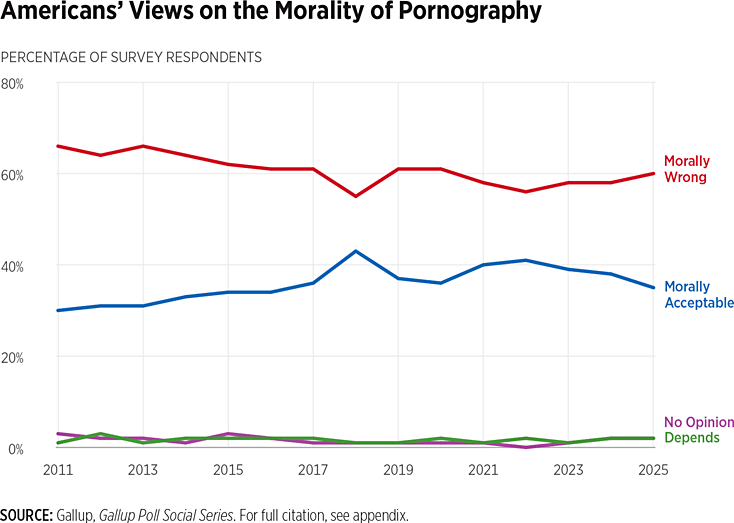
Attitudes about sex and sexuality have changed significantly in the past half-century. This includes how Americans view the legality—and morality—of pornography. In 1980, 40 percent of Americans believed pornography should be illegal for people of any age; by 2021, support for complete prohibition had dropped by more than 15 percentage points.[REF] It is worth noting, however, that close to 65 percent of Americans support banning pornography for children under 18—an increase of more than 15 percentage points since 1980. The general acceptance of adults consuming sexually explicit material is reflected in the chart above, which shows that slightly less than 60 percent of Americans believe pornography is morally wrong and that close to 40 percent say it is morally acceptable.
These trends reflect the reality of living in a digitally connected world. In decades past, accessing sexually explicit material required intentional effort. Today, pornography is easy to access online, including on social media sites that allow access by minors. It is no surprise that adults, including parents, support restricting access to pornography for anyone under 18 when one considers that 95 percent of U.S. teens have access to a smartphone, 90 percent have access to a desktop or laptop, and 80 percent have access to a gaming console.[REF]
Nor are concerns about the effects of pornography restricted to children and teens. According to analysis from the Institute for Family Studies, men who frequently consume pornography report the highest rates of loneliness: Sixty percent of men who watched pornography in the preceding 24 hours said they felt lonely or isolated during the preceding week.[REF] By contrast, 38 percent of men who never watched pornography reported feeling lonely within the previous week.[REF] Moreover, loneliness is not the only issue associated with pornography consumption. Research also suggests that it rewires the brain and can lead to addiction, dependence, relationship issues, and unhealthy sexual behaviors.[REF]
The explosion of the “vice economy” makes these trends particularly troubling. For example, content creators on OnlyFans keep 80 percent of the revenue they generate from paid subscribers with the rest going to the platform. This model is financially attractive to creators, including young women who post adult content. It is also profitable for the company. In 2023, OnlyFans generated more revenue per employee than tech giants Apple, Google, and Microsoft generated.[REF]
But profitability does not change the fact that pornography makes a commodity of the human body. Ubiquitous access, social acceptance, and mental health effects all contribute to the increasing prevalence of pornography, which is why anyone concerned about the protection of children and the future of family formation must confront the consequences of its effects on America’s social life.
Endnotes
- NORC at the University of Chicago, “Feelings About Pornography Laws (PORNLAW),” GSS Data Explorer, https://gssdataexplorer.norc.org/variables/640/vshow (accessed May 21, 2026). ↩
- Emily A. Vogels, Risa Gelles-Watnick, and Navid Massarat, “Teens, Social Media and Technology 2022,” Pew Research Center, August 2022, p. 5, https://www.pewresearch.org/internet/2022/08/10/teens-social-media-and-technology-2022/#smartphones-desktop-and-laptop-computers-and-gaming-consoles-remain-widely-accessible-to-teens (accessed April 6, 2026). ↩
- Daniel A. Cox, Beatrice Lee, and Dana Popky, “How Prevalent Is Pornography?” Institute for Family Studies Blog, May 3, 2022, https://ifstudies.org/blog/how-prevalent-is-pornography#:~:text=In%20the%20internet%20era%2C%20online,point%20during%20the%20past%20month (accessed April 6, 2026). ↩
- Ibid. ↩
- Natalie Buchwald, “The Hidden Cost of Pornography: How It Shapes Your Brain and Behavior,” Manhattan Mental Health Counseling, March 11, 2025, https://manhattanmentalhealthcounseling.com/the-hidden-cost-of-pornography-how-it-shapes-your-brain-and-behavior/#:~:text=Beyond%20its%20addictive%20potential%2C%20pornography,and%20sustaining%20it%20for%20hours (accessed April 6, 2026). ↩
- Rounak Jain, “OnlyFans Beats Apple, Google, Netflix, and Other Big Tech Companies in Revenue Per Employee: Here’s the Down Low,” Yahoo Finance, September 14, 2024, https://finance.yahoo.com/news/onlyfans-beats-apple-google-netflix-213116182.html (accessed April 6, 2026). ↩
Sources
- Gallup, Gallup Poll Social Series, “Moral Issues,” https://news.gallup.com/poll/1681/moral-issues.aspx (accessed May 10, 2026).