Madison Marino Doan
Today, 42.7 million Americans owe approximately $1.7 trillion in student loan debt. How did we get here?
Rising college costs, fueled in large part by overly generous federal lending policies, have encouraged more students to take on unsustainable levels of student loan debt. There was a time when a part-time job and modest savings could cover the cost of a college degree; by the early 2000s, the cost of attendance, including tuition, fees, room, and board, already outpaced the annual earnings of full-time minimum-wage workers.[REF]
With costs soaring, students increasingly are turning to loans to finance their college education. The federal government now originates about 90 percent of all student loans and has effectively crowded out private lenders. In the 2018–2019 academic year alone, federal subsidies for higher education totaled $150 billion.[REF] Federal spending on student loans has increased dramatically by 328 percent over the past three decades.[REF]
According to the “Bennett Hypothesis,” first proposed by former U.S. Secretary of Education William Bennett, increased federal aid enables colleges to raise tuition. A Federal Reserve Bank of New York study confirmed this effect, finding that each additional dollar in subsidized federal loans results in a 60-cent increase in tuition.[REF] Colleges have little incentive to rein in costs when students and families can borrow heavily from the government to foot the bill.
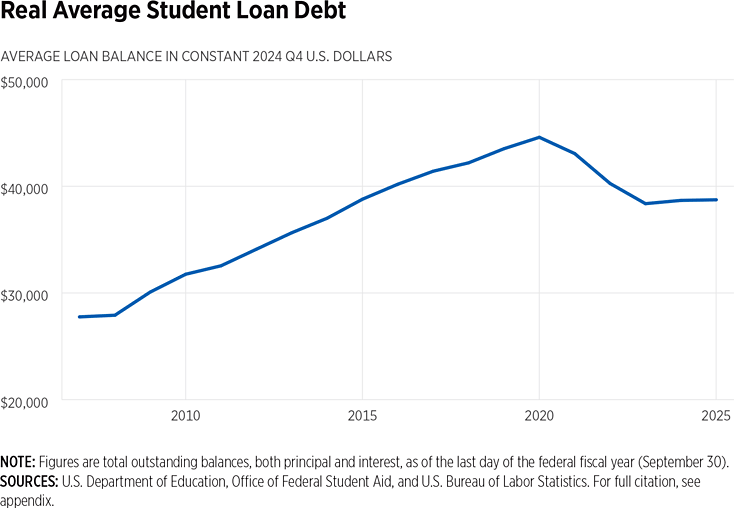
Recent research reinforces this view. Heritage Foundation research, for example, has found that tuition and fees for in-state students at four-year universities have nearly tripled in real terms since 1990, and inflation-adjusted tuition at both public and private institutions has increased fivefold since 1970.[REF] Some argue that net price—what students pay after aid—is a more accurate measure, but former Foundation for Research on Equal Opportunity scholar Preston Cooper has found that even net prices have risen by thousands of dollars in real terms.[REF] Despite massive taxpayer subsidies, students are paying more than ever to attend college.[REF] This trend is depicted in the chart above, which shows that over the past decade, the average student loan debt per borrower has increased by nearly $15,000.
Recent reforms in the so-called One Big Beautiful Bill Act have attempted to rein in these excesses. This bill imposes new caps on graduate borrowing under the Direct Loan program, ends the inflationary Graduate PLUS loan program, and limits Parent PLUS borrowing.[REF] These changes, along with a new earnings test for institutional eligibility, may help to curb tuition inflation and create space for more private lending, but still more needs to be done to reduce overreliance on federal financing.
Other trends are compounding the problem. Degree inflation, commonly known as over-credentialism, means that more graduates are taking jobs that don’t require a college degree. For example, just 9 percent of executive assistants held a bachelor’s degree in 1990; in 2023, that figure had jumped to 33 percent.[REF] At the same time, many students fail to graduate on time. Federal data show that just 49.1 percent of those who entered college in 2017 graduated within four years, and only 64.6 percent of those who entered in 2016 graduated within six years.[REF] The longer students remain in school, the more debt they are likely to accrue.
Meanwhile, the Biden Administration pursued a series of unlawful student loan cancellation efforts, one of which was ultimately blocked by the Supreme Court of the United States.[REF] These sweeping forgiveness proposals not only shifted more than $138 billion in student debt onto taxpayers,[REF] two-thirds of whom either did not attend college or already had paid off their loans, but also encouraged the misguided belief that debt would simply vanish. That message may well have compounded the crisis by further incentivizing excessive borrowing.
Alongside its loan cancellation proposals, the Biden Administration extended the pandemic-era pause on student loan payments six times until October 2023 when Congress forced the Administration to restart loan payments.[REF] Additionally, the Administration announced in June 2023 that the Department of Education was “instituting a 12-month ‘on-ramp’ to repayment, running from October 1, 2023 to September 30, 2024, so that financially vulnerable borrowers who miss monthly payments during this period are not considered delinquent, reported to credit bureaus, placed in default, or referred to debt collection agencies.”[REF] The Biden Administration’s efforts to extend the student loan payment pause cost taxpayers approximately $258 billion.[REF]
Debts never truly go away; they simply get transferred. As long as federal policy continues to subsidize skyrocketing costs without increased accountability, American taxpayers will be responsible for paying those debts.
Endnotes
- Based on the author’s calculations. The minimum wage was $5.15 an hour in 2000; multiplied by 40 hours a week and 52 weeks a year, this equates to a full-time salary of $10,712. “Prices and Wages by Decade: 2000-2009,” University of Missouri, https://libraryguides.missouri.edu/pricesandwages/2000-2009 (accessed April 7, 2026). See also Table 330.10, “Average Undergraduate Tuition, Fees, Room, and Board Rates Charged for Full-Time Students in Degree-Granting Postsecondary Institutions, by Level and Control of Institution: Selected Academic Years, 1963–64 through 2022–23,” U.S. Department of Education, Institute of Education Sciences, National Center for Education Statistics, Digest of Education Statistics, https://nces.ed.gov/programs/digest/d23/tables/dt23_330.10.asp (accessed April 7, 2026). ↩
- Preston Cooper, “Why College Is Too Expensive—And How Competition Can Fix It,” Foundation for Research on Equal Opportunity White Paper, March 5, 2021, https://freopp.org/whitepapers/why-college-is-too-expensive-and-how-competition-can-fix-it/ (accessed April 7, 2026). ↩
- Jay P. Greene and Lindsey M. Burke, “Education Policy Reforms Are Key Strategies for Increasing the Married Birth Rate,” Heritage Foundation Backgrounder No. 3872, November 15, 2024, https://www.heritage.org/sites/default/files/2024-11/BG3872.pdf. ↩
- David O. Lucca, Taylor Nadauld, and Karen Shen, “Credit Supply and the Rise in College Tuition: Evidence from the Expansion in Federal Student Aid Programs,” Federal Reserve Bank of New York Staff Report No. 733, July 2015, revised February 2017, https://www.newyorkfed.org/medialibrary/media/research/staff_reports/sr733.pdf?la=en (accessed April 7, 2026). ↩
- Greene and Burke, “Education Policy Reforms Are Key Strategies for Increasing the Married Birth Rate.” ↩
- Cooper, “Why College Is Too Expensive—And How Competition Can Fix It.” ↩
- Ibid. ↩
- Preston Cooper, “An Analysis of the One Big Beautiful Bill Act’s Effect on Student Loans,” American Enterprise Institute, July 2025, https://www.aei.org/wp-content/uploads/2025/07/Cooper_An-Analysis-of-the-One-Big-Beautiful-Bill-Acts-Effects-on-Student-Loans_July-2025.pdf (accessed April 7, 2026). See also H.R. 1, An Act to Provide for Reconciliation Pursuant to Title II of H. Con. Res. 4, Public Law 119-21, 119th Congress, July 4, 2025, Sections 81001 and 82003, https://www.congress.gov/119/plaws/publ21/PLAW-119publ21.pdf (accessed April 7, 2026). ↩
- Preston Cooper, “You Don’t Need a College Degree for Every Job. Employers Are Wising Up,” Fox News, July 3, 2023, https://www.foxnews.com/opinion/dont-need-college-degree-every-job-employers-wising (accessed April 7, 2026). ↩
- Table 326.10, “Graduation Rate from First Institution Attended for First-Time, Full-Time Bachelor’s Degree-Seeking Students at 4-Year Postsecondary Institutions, by Race/Ethnicity, Time to Completion, Sex, Control of Institution, and Percentage of Applications Accepted: Selected Cohort Entry Years, 1996 Through 2017,” U.S. Department of Education, Institute of Education Sciences, National Center for Education Statistics, Digest of Education Statistics, https://nces.ed.gov/programs/digest/d24/tables/dt24_326.10.asp (accessed April 7, 2026). ↩
- Adam Kissel and Madison Marino Doan, “Biden’s ‘Plan C’ Scheme for Canceling Student Loan Debt Also Gets an ‘F,’” The Daily Signal, April 16, 2024, https://www.dailysignal.com/2024/04/16/bidens-plan-c-scheme-canceling-student-loan-gets-f/. See also Biden v. Nebraska, 600 U.S. 477 (2023), https://www.supremecourt.gov/opinions/22pdf/600us1r56_1o13.pdf (accessed April 7, 2026). ↩
- Preston Cooper, “The Student Debt Cancellation Cheat Sheet,” Foundation for Research on Equal Opportunity OPP Blog, April 2, 2024, https://freopp.org/oppblog/the-student-debt-cancellation-cheat-sheet/ (accessed April 7, 2026). ↩
- Ibid. ↩
- “Fact Sheet: President Biden Announces New Actions to Provide Debt Relief and Support for Student Loan Borrowers,” The White House, June 30, 2023, https://bidenwhitehouse.archives.gov/briefing-room/statements-releases/2023/06/30/fact-sheet-president-biden-announces-new-actions-to-provide-debt-relief-and-support-for-student-loan-borrowers/ (accessed April 7, 2026). ↩
- Cooper, “The Student Debt Cancellation Cheat Sheet.” ↩
Sources
- U.S. Department of Education, Office of Federal Student Aid, “Federal Student Aid Portfolio Summary,” https://view.officeapps.live.com/op/view.aspx?src=https%3A%2F%2Fstudentaid.gov%2Fsites%2Fdefault%2Ffiles%2Ffsawg%2Fdatacenter%2Flibrary%2FPortfolioSummary.xls&wdOrigin=BROWSELINK (accessed May 10, 2026).
- U.S. Department of Labor, Bureau of Labor Statistics, “Databases, Tables & Calculators by Subject: Consumer Price Index for All Urban Consumers (CPIU), U.S. City Average, Seasonally Adjusted,” Series ID CUSR0000SA0, https://data.bls.gov/timeseries/CUSR0000SA0 (accessed May 10, 2026).