Madison Marino Doan
The National Assessment of Educational Progress (NAEP), popularly known as the Nation’s Report Card, was introduced in 1969 and provides critical data on student performance in mathematics and reading across the United States. Administered every two years to 4th-grade, 8th-grade, and 12th-grade students, NAEP serves as a benchmark for academic proficiency.
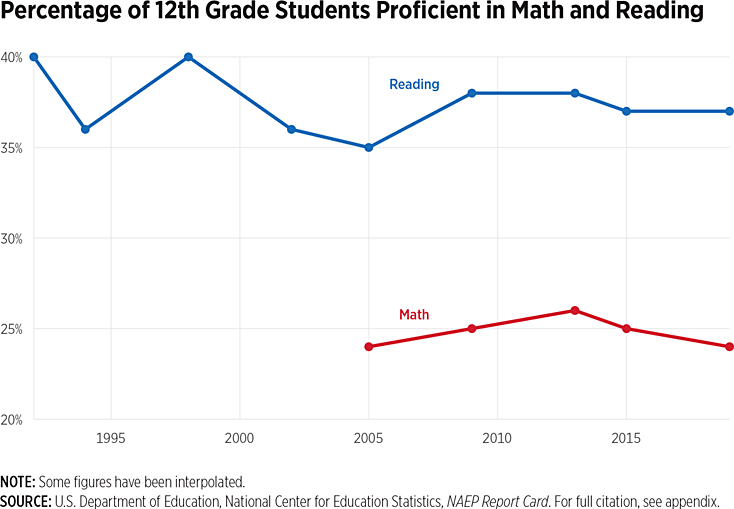
The most recent 2019 assessment for 12th graders revealed troubling results: Only 24 percent were proficient in math—a figure virtually unchanged from 2005 when proficiency stood at 23 percent. (Data on reading are available for the years from 1992 to the present, but because of significant changes in assessment content and administration, comparable pre-2005 data on math results are not available.) Reading proficiency has also declined. In 1992, 40 percent of 12th graders were proficient in reading; by 2019, that number had dropped to 37 percent, marking a statistically significant decline. These stagnant or worsening outcomes raise serious concerns about the effectiveness of America’s current education system.
Some argue that insufficient spending is the reason for low proficiency levels, but the data tell a different story. Federal spending per pupil, even after adjusting for inflation, has more than doubled since 1979 when the Department of Education was established.[REF] Despite this increase, NAEP scores have remained stagnant; in some cases, such as reading, they have even declined. A major factor in this disconnect is how education funds are allocated. Instead of being used for classroom instruction, much of the increased spending has been used for administrative expansion. “Since the 1950s,” as Heritage Foundation education expert Lindsey Burke has noted, “the number of school personnel per student has skyrocketed by a staggering 381[%], and the number of non-teaching staff has increased by a staggering 709%.”[REF] Additionally, in 2010, teachers made up “only 50% of total school staff, down from 70.2% in 1950.”[REF]
One way to improve resource allocation is to give parents access to their child’s share of education funds, thereby allowing them to choose the best educational environment for that child. Fostering an environment of educational choice yields numerous benefits, including enhanced academic achievement and attainment among students, increased competitive pressure on schools, and improved overall quality of local schools.[REF] School choice also makes schools more accountable, as parents can vote with their feet and leave a school district with their education dollars if the district is not meeting their needs.[REF]
Overall, the nation’s alarmingly low 12th-grade proficiency levels reflect a significant need for improvement in both reading and math. These students are on the verge of adulthood, preparing to enter the workforce or higher education. If they lack fundamental skills in math and reading, we are failing them—and our society. It is time to give families the power to choose the educational setting that best meets their child’s needs. This will not just benefit today’s students; it will create pathways for upward mobility for generations of students yet to come.
Endnotes
- Lindsey M. Burke, “No, We Don’t Need the Department of Education After All,” Heritage Foundation Commentary, March 20, 2025, https://www.heritage.org/education/commentary/no-we-dont-need-the-department-education-after-all. ↩
- Ibid. ↩
- Ibid. ↩
- Jude Schwalbach and James Selvey, “Here Are 10 Reasons School Choice Is Winning,” Heritage Foundation Commentary, January 24, 2019, https://www.heritage.org/education/commentary/here-are-10-reasons-school-choice-winning. ↩
- Ibid. ↩
Sources
- U.S. Department of Education, National Center for Education Statistics, “The Nation’s Report Card: Mathematics: National Achievement-Level Results: Grade 12 as of 2019,” https://www.nationsreportcard.gov/mathematics/nation/achievement/?grade=12 (accessed May 10, 2026).
- U.S. Department of Education, National Center for Education Statistics, “The Nation’s Report Card: Reading: National Achievement-Level Results: Grade 12 as of 2019,” https://www.nationsreportcard.gov/reading/nation/achievement/?grade=12 (accessed May 10, 2026).