
Christos A. Makridis, PhD
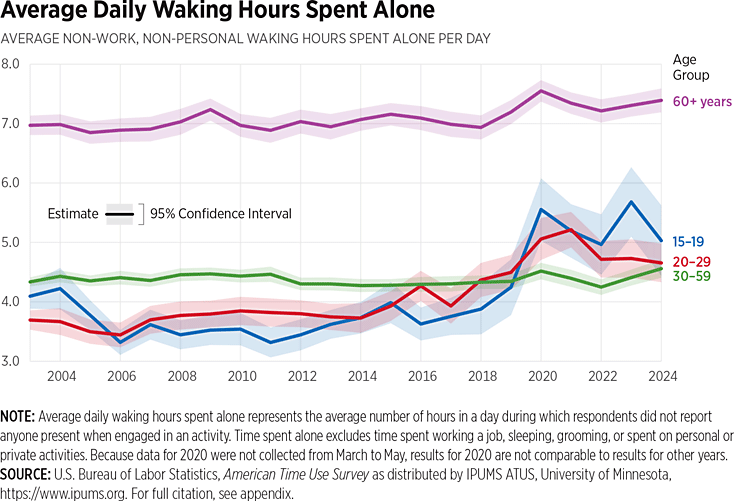
Trends in time spent alone vary markedly by age. Older Americans (age 60 and above) consistently spend the most time alone—around seven hours per day on average, reflecting such factors as retirement, empty-nest living, or widowhood. Younger cohorts historically have spent far less time alone. Teens (ages 15–19) and adults in their 20s averaged only about 3.5–4.5 hours alone per day in the early 2000s as school, work, and active social lives kept them more frequently in others’ company.
However, these age gaps have narrowed over time. Even before 2020, the charts show a gradual rise in solitude among young people. By the late 2010s, adults who were 20–29 years old were spending about four to 4.5 hours alone—an increase that may reflect changing social habits (for example, more time on smartphones or online interaction, replacing some in-person activities).[REF]
The divergence sharpened after 2020. During the COVID-19 pandemic, time alone surged across all ages, but proportional increases among younger groups were especially large. Remote schooling, curtailed social events, and delayed milestones (for example, entering the workforce or forming new households) left adolescents and young adults unusually isolated. In 2020, teens and adults in their 20s spent roughly five or more hours alone per day on average—a level approaching that of older adults. Although solitude for youth receded somewhat as schools and universities reopened, it has not reverted to earlier baselines. By 2022, a typical individual aged 15 to 29 still spent roughly 30–60 minutes more alone per day than his or her counterpart did in the preceding decade. Older adults saw less change: Their alone time rose in 2020 but remained near the 6.5- to 7-hour range in 2022, which was similar to pre-pandemic levels.
A major structural driver of increased alone time is the rise of remote work. The share of employees working from home skyrocketed from under 5 percent to over 60 percent during the initial onset of COVID-19 in early 2020 before settling to around 28 percent of work days at home by 2023. This large-scale shift in work arrangements has reduced daily in-person interactions. Hours once spent commuting or working alongside colleagues are now often spent physically alone. By 2022, controlling for demographics, workers in remote-capable jobs were spending an average of 50 fewer minutes per day working (compared to 2019) and about 37 more minutes per day on leisure—a trend that continued even after the lockdowns ended.[REF] Much of this newfound leisure likely occurs at home, potentially in isolation.
Crucially, the reduction in work time was not merely due to less commuting: It reflected actual declines in hours worked. These changes were most pronounced among certain demographics—notably single, older men. Single males over 45 who worked remotely cut their work hours by an average of two hours per day in 2022 versus 2019—far more than other groups.
For individuals who live alone or lack family at home, remote work can mean that both work and non-work hours are spent without face-to-face contact. Other national surveys confirm a link between remote arrangements and heightened loneliness: Fully remote employees report frequently feeling “lonely” at substantially higher rates (25 percent) than those who are working exclusively on-site (16 percent).[REF] In short, while telework offers flexibility and saved commute time, fully remote arrangements may also amplify physical isolation, whereas hybrid arrangements may offer the best of both worlds.[REF]
The rise in time spent alone, although not on its own a driving explanation behind loneliness, nonetheless raises flags because human well-being is deeply intertwined with social connection and collaboration. Loneliness is not a transient emotion; chronic social isolation has been linked to worse health outcomes and reduced life expectancy on par with or even exceeding other risk factors.[REF] By contrast, strong relationships are associated with better mental health, happiness, and economic and educational success.
The Global Flourishing Study—a new 22-country longitudinal study of individual flourishing—highlights social relationships as one of the pillars of “flourishing.” Close social connections are nearly universal in their importance: Studies across more than 100 countries show that having supportive relationships is among the strongest correlates of life satisfaction, in some analyses equivalent to the effect of a fivefold increase in income.[REF] Yet about one in five people worldwide report having few or no close social supports. In the Global Flourishing Study’s first wave, for example, 17 percent of young adults said they did not have anyone in their lives to whom they felt very close—a stark indicator of social isolation.
Economic, technological, and cultural shifts have altered how people form and maintain relationships. For instance, the decline of in-person community activities, the rise of social media, and labor market changes (like remote work or gig jobs) all shape the structural context of socializing. Structural factors, especially financial precarity and economic anxiety, can facilitate or impede social connection, which in turn affects health and happiness.[REF] In this sense, trends toward greater time alone may reflect not just individual preferences, but also systemic changes in how we live and work.
Endnotes
- Jean M. Twenge, Gabrielle N. Martin, and Brian H. Spitzberg, “Trends in U.S. Adolescents’ Media Use, 1976–2016: The Rise of Digital Media, the Decline of TV, and the (Near) Demise of Print,” Psychology of Popular Media Culture, Vol. 8, No. 4 (2019), pp. 329–345, https://www.apa.org/pubs/journals/releases/ppm-ppm0000203.pdf (accessed April 8, 2026); Amy Orben and Andrew K. Przybylski, “The Association Between Adolescent Well-Being and Digital Technology Use,” Nature Human Behaviour, Vol. 3, Issue 2 (2019), pp. 173–182. ↩
- Christos Makridis, “The Allocation of Time and Remote Work,” CESifo Working Paper, December 2025, https://www.ifo.de/DocDL/cesifo1_wp12363.pdf (accessed April 8, 2026). ↩
- Ryan Pendell, “1 in 5 Employees Worldwide Feel Lonely,” Gallup Workplace, June 12, 2024, https://www.gallup.com/workplace/645566/employees-worldwide-feel-lonely.aspx (accessed April 8, 2026). ↩
- Prithwiraj (Raj) Choudhury et al., “Is Hybrid Work the Best of Both Worlds? Evidence from a Field Experiment,” Review of Economics and Statistics, forthcoming; Nicholas Bloom, Ruobing Han, and James Liang, “Hybrid Working from Home Improves Retention Without Damaging Performance,” Nature, Vol. 630 (2024), pp. 920–925, https://www.nature.com/articles/s41586-024-07500-2 (accessed April 9, 2026). ↩
- Julianne Holt-Lunstad et al., “Loneliness and Social Isolation as Risk Factors for Mortality: A Meta-Analytic Review,” Perspectives on Psychological Science, Vol. 10, No. 2 (2015), pp. 227–237, https://www.researchgate.net/publication/273910450_Loneliness_and_Social_Isolation_as_Risk_Factors_for_Mortality_A_Meta-Analytic_Review (accessed April 9, 2026). ↩
- Tyler J. VanderWeele et al., “The Global Flourishing Study: Study Profile and Initial Results on Flourishing,” Nature Mental Health, Vol. 3 (2025), pp. 636–653, https://www.nature.com/articles/s44220-025-00423-5 (accessed April 9, 2026); James L. Ritchie-Dunham et al., “Childhood Predictors of Social Support and Intimate Friends in a Cross-National Analysis of the Global Flourishing Study,” Scientific Reports, Vol. 15 (2025), article no. 25068, https://www.nature.com/articles/s41598-025-09953-5 (accessed April 9, 2026). ↩
- Piotr Bialowolski et al., “Analysis of Demographic Variation and Childhood Correlates of Financial Well-Being Across 22 Countries,” Nature Human Behaviour, Vol. 9 (2025), pp. 917–932, https://www.nature.com/articles/s41562-025-02207-4 (accessed April 9, 2026). ↩
Sources
- U.S. Department of Labor, Bureau of Labor Statistics, American Time Use Survey, as distributed by Sarah M. Flood, Liana C. Sayer, and Daniel Backman, American Time Use Survey Data Extract Builder: Version 3.3 [dataset], College Park, MD: University of Maryland, and Minneapolis, MN: IPUMS ATUS, 2025, https://doi.org/10.18128/D060.V3.3 (accessed May 11, 2026).