Jennifer Galardi
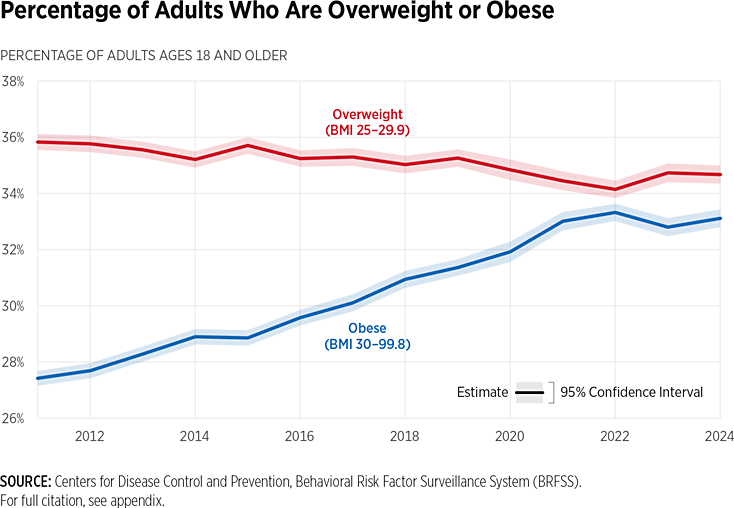
Obesity has accelerated at an alarming pace in the United States since 2011, even as the rate of those who are overweight has remained relatively steady and, in some years, has declined. What has been labeled an epidemic takes a toll not only on Americans’ health, but also on their wallets: The Centers for Disease Control and Prevention (CDC) estimates that obesity costs the U.S. health care system almost $173 billion a year.[REF]
From 2019 to 2022, while the number of adults (over 18 years of age) who were overweight decreased, that number is almost inversely proportional to the number of those who are obese. This signals a disturbing trend: More and more Americans are not just a few pounds overweight; they are grossly and dangerously overweight.
This trend began to change in 2021 when the number of obese people declined and the number of overweight people increased. This small shift could be a result of the off-label use of GLP-1 inhibitors, known by the brand names Ozempic, Mounjaro, and Wegovy. Initially a medication to control blood sugar for diabetics, they began to be used to reduce appetite and, for some, to quiet what is known as “food noise.”[REF] However, the FDA currently lists concerns about the use of unapproved GLP-1 drugs for weight loss,[REF] and many experts have expressed apprehension over long-term safety.
Obesity is categorized as a chronic disease. According to the CDC, “[c]hronic diseases are defined broadly as conditions that last 1 year or more and require ongoing medical attention or limit activities of daily living or both.”[REF] Overweight is defined as having a body mass index, or BMI, of 25–29.9; a BMI of 30 or higher signals obesity.[REF] BMI has been a standard used by health practitioners for decades to determine obesity. It is calculated by dividing weight in kilograms by height in meters squared.
Some have questioned whether BMI is the most accurate representation of a person’s health. Because muscle is denser and more compact than fat, it takes up less room than fat and could lead to false conclusions about obesity. Someone could weigh much more than an obese person and still be slimmer and have better metabolic health because of increased muscle mass. This is the origin of the saying “muscle weighs more than fat,” which is not empirically true; a pound of muscle weighs the same as a pound of fat, but the consequences for health are radically different. A person with good muscle mass will likely measure better in all other health outcomes than someone who may have a lower BMI but much more body fat.
This is an important fact to consider when determining how much of the country is actually obese and overweight. Nevertheless, the percentages still alarm many in the health policy community, and the solutions are complex. Reversing this threat to America’s public health will require a multi-pronged approach that includes shifts in food and nutrition, agricultural, and pharmaceutical policies. It will also require that Americans take responsibility for altering diet and exercise habits in ways that lead to better health outcomes.
Endnotes
- U.S. Department of Health and Human Services, Centers for Disease Control and Prevention, “About Obesity,” January 23, 2024, https://www.cdc.gov/obesity/php/about/index.html (accessed April 8, 2026). ↩
- Daisuke Hayashi et al., “What Is Food Noise? A Conceptual Model of Food Cue Reactivity,” Nutrients, Vol. 15, No. 22 (2023), https://doi.org/10.3390/nu15224809 (accessed April 8, 2026). ↩
- U.S. Food and Drug Administration, “FDA’s Concerns with Unapproved GLP-1 Drugs Used for Weight Loss,” content current as of February 4, 2026, https://www.fda.gov/drugs/postmarket-drug-safety-information-patients-and-providers/fdas-concerns-unapproved-glp-1-drugs-used-weight-loss (accessed April 8, 2026). ↩
- U.S. Department of Health and Human Services, Centers for Disease Control and Prevention, “Chronic Disease: About Chronic Diseases,” March 4, 2025, https://www.cdc.gov/chronic-disease/about/index.html (accessed April 8, 2026). See also American Medical Association, “Chronic Diseases,” https://www.ama-assn.org/topics/chronic-diseases (accessed April 8, 2026). ↩
- U.S. Department of Health and Human Services, Centers for Disease Control and Prevention, National Center for Health Statistics, NCHS Data Query System, “Overweight and Obesity,” June 25, 2025, https://www.cdc.gov/nchs/dqs/topics/overweight-obesity.html (accessed April 8, 2026). ↩
Sources
- U.S. Department of Health and Human Services, Centers for Disease Control and Prevention, Behavioral Risk Factor Surveillance System, “Annual Survey Data,” 2011–2024, https://www.cdc.gov/brfss/annual_data/annual_data.htm (accessed May 10, 2026).