For 75 years, NATO has relied on American conventional power to defend Europe. That era is ending.[REF] As the United States increasingly prioritizes deterrence in the Indo-Pacific, European allies will need to assume primary responsibility for defending the continent. Yet America’s contribution to European deterrence remains both indispensable and unique. NATO’s security has always rested not only on conventional strength, but also on the credibility of its nuclear deterrent—and that responsibility will continue to fall primarily on the United States.
By the middle of the Cold War, NATO deterrence strategy was known as Flexible Response: an integrated escalation architecture that combined conventional forces, theater nuclear weapons, and strategic nuclear deterrent capabilities.[REF] While NATO still has Flexible Response as one of its deterrent options, that architecture’s capability has eroded.
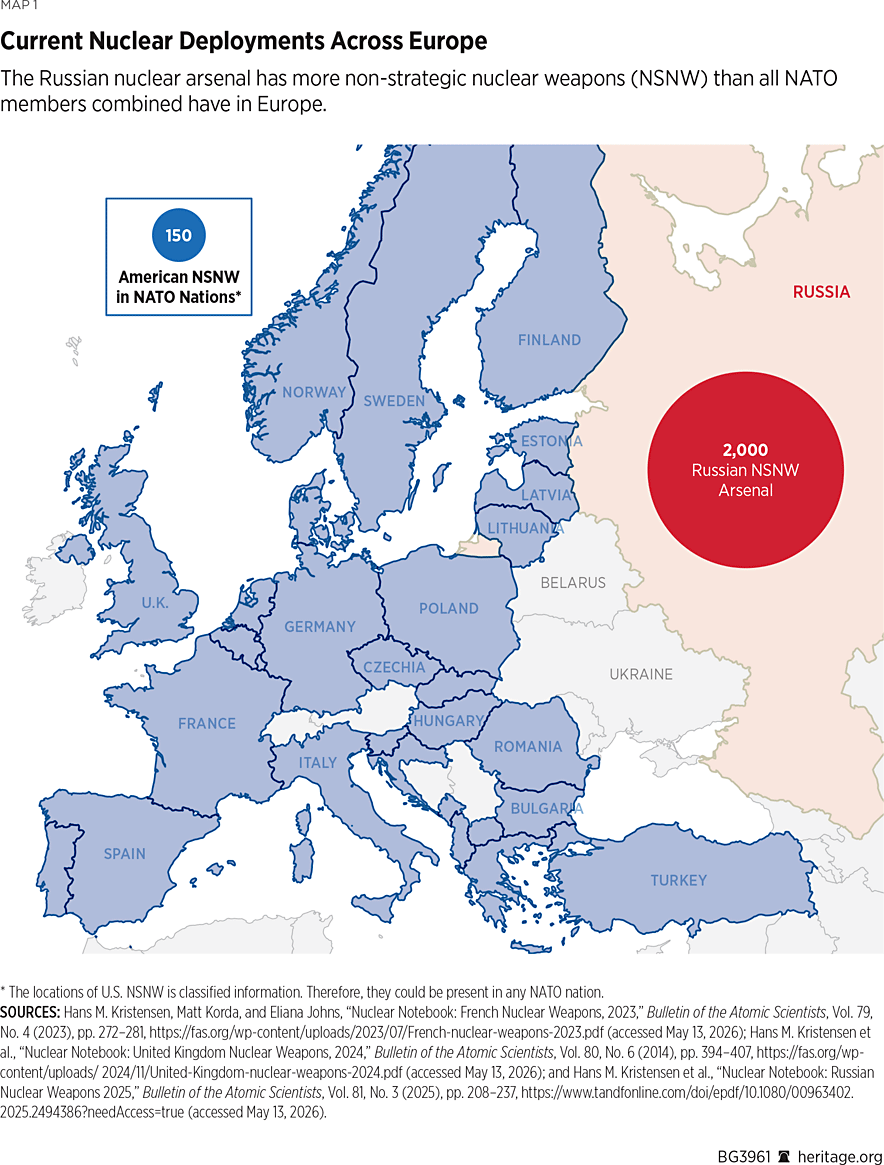
Russia possesses the world’s largest arsenal of non-strategic nuclear weapons (most of which are in its Western Military District, which abuts NATO states) and openly integrates nuclear escalation into its regional war planning. Moreover, Moscow has nearly completed the modernization of its strategic arsenal and, with the collapse of arms control constraints, faces few if any limits on its nuclear posture.[REF] By contrast, NATO retains a minimalist theater nuclear posture developed in the 1990s and centered on a small number of Cold War–era gravity bombs delivered by dual-capable fighter-bombers.[REF] At the same time, the United States today must deter two nuclear peers simultaneously, stretching a nuclear force structure originally designed for a single adversary.[REF]
A new division of deterrence labor is therefore required. European allies should assume primary responsibility for deterring high-intensity conventional conflict while the United States ensures that the Alliance maintains a credible and flexible theater nuclear deterrent that is capable of managing escalation if deterrence fails. At the top of the escalation ladder sits the Alliance’s ultimate guarantee: the strategic nuclear forces of the United States, the United Kingdom, and France. NATO 3.0 therefore requires a modernized doctrine of Flexible Response 2.0.
The Conventional Gap of the Late 2020s
The most immediate danger facing NATO is a conventional offensive in a narrow window before the Alliance’s rearmament—begun following Russia’s invasion in 2022—is complete. Russia’s battlefield losses in Ukraine have significantly degraded its conventional forces, but the Kremlin has already accelerated wartime mobilization of its defense industrial base and has begun to rebuild key combat formations, especially its ground and missile forces of particular utility for an invasion of one of its NATO neighbors.[REF] Western intelligence assessments increasingly suggest that Russian force reconstitution could occur within three to seven years.[REF]
The expansion of NATO’s conventional capability will take much longer to mature. Many European armies must reconstitute brigade-level and division-level formations after decades of downsizing.[REF] Defense industrial capacities—particularly for munitions, armor, and air defense interceptors—must expand radically so that European nations can provide the ships, planes, munitions, and platforms that are needed to arm modern militaries.[REF] Even where funding has increased, it will take the better part of a decade for European states to translate resources into deployable combat power.
These efforts are necessary and will take time. Even moving with purpose, European states are unlikely to make meaningful progress on these issues before the end of the 2020s. Until they do so, there will be a potential deterrence gap in the late 2020s during which Russia will regain offensive capability before NATO’s conventional buildup is complete.[REF]
In this context, Moscow would not need to achieve conventional superiority over all NATO forces deployed across Europe to succeed. It would need only to achieve localized conventional superiority within a narrow area to convince NATO that further resistance risks uncontrolled escalation—thereby shifting the burden of decision from the conventional battlefield to the nuclear domain.[REF]
Russia’s Theater Nuclear Advantage
Russia’s theater nuclear posture is designed precisely to enable this form of coercion. Moscow’s advantage is not simply numerical: It is structural. The Kremlin fields roughly 2,000 non-strategic nuclear weapons across a wide range of delivery systems, including cruise missiles, short-range ballistic missiles, naval platforms, and dual-capable aircraft.[REF] These capabilities are integrated into operational planning, giving Russian leaders multiple options to calibrate escalation at the regional level.
This creates a form of escalation density that gives Russian leaders optionality while creating targeting and escalation dilemmas for NATO leaders. Russia is therefore able to escalate at a time and intensity of its choosing.[REF] NATO, on the other hand, has far fewer credible nuclear options at the theater level. The result is an asymmetry in both capabilities and doctrine that leaves NATO exceptionally vulnerable to Russian nuclear coercion at the theater level.
NATO’s Missing Rungs
NATO does not simply lack nuclear weapons; it lacks usable options. The Alliance’s theater nuclear posture remains centered on gravity bombs that are delivered by dual-capable aircraft from a limited number of forward bases.[REF] This structure presents three key weaknesses.
- The bases that host these systems are vulnerable to preemption. Known airbases can be targeted by conventional missile strikes, cyber disruption, or sabotage in the early stages of a conflict.
- NATO’s existing nuclear posture offers limited escalation flexibility. With few intermediate options, NATO faces a stark transition between conventional operations and mutually destructive strategic nuclear exchanges because of its paucity of low-yield non-strategic options and therefore reliance on high-yield strategic nuclear capabilities.
- The Alliance is increasingly challenged by modern air defense systems that complicate the penetration missions required for gravity bomb delivery, particularly given the need for aerial refueling of nuclear-capable fighter-bombers.
The result is a short and fragile escalation ladder—one that risks leaving NATO without credible responses at the very point that escalation becomes most dangerous.[REF]
Flexible Response 2.0
If NATO is to deny Russia the ability to coerce through limited nuclear escalation, it must rebuild the escalation architecture it has allowed to atrophy. This requires a modernized doctrine of Flexible Response—Flexible Response 2.0—structured around three pillars: European conventional deterrence, U.S. control of theater nuclear escalation, and strategic deterrence provided by the United States, the United Kingdom, and France.
Pillar I: European Conventional Deterrence. Europe must assume primary responsibility for forward conventional defense, particularly along NATO’s northeastern flank. A credible conventional posture requires not only increased spending, but also the generation of deployable, integrated forces that are capable of denying a rapid Russian breakthrough.[REF]
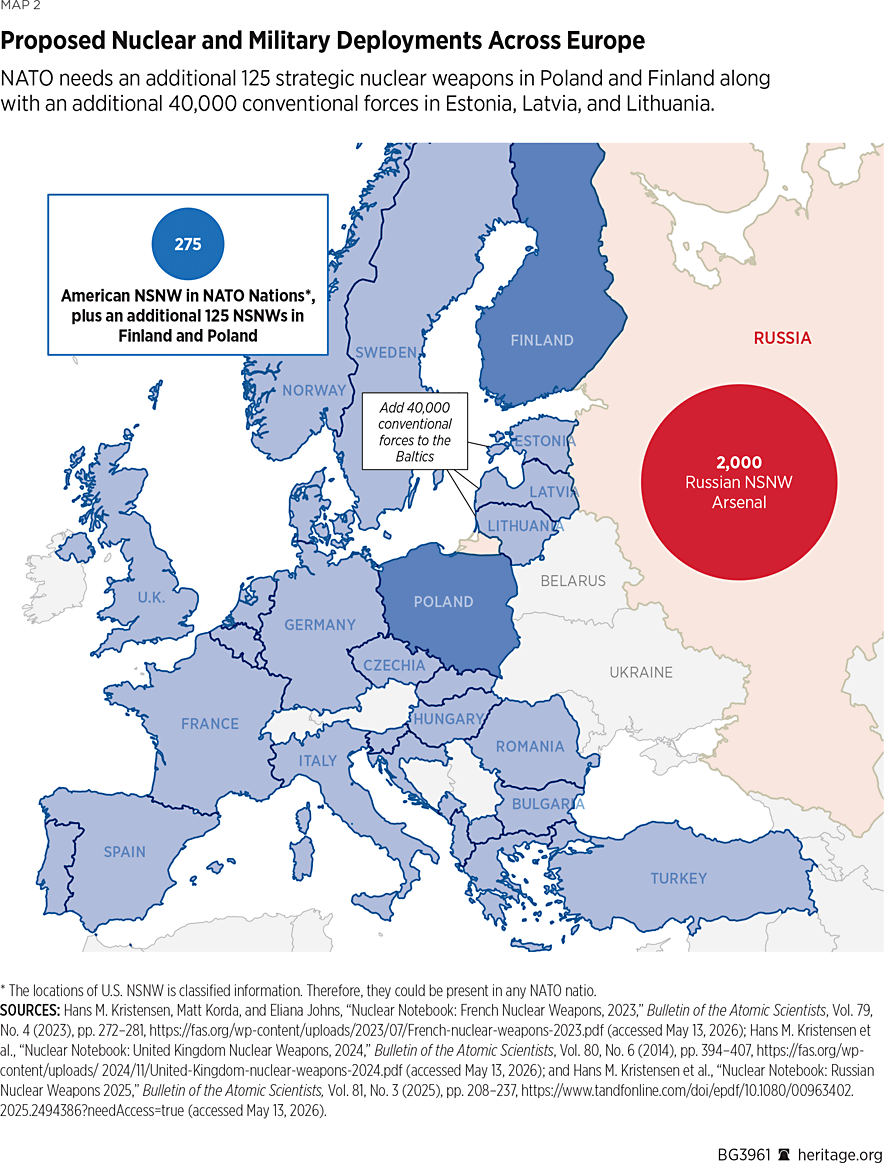
One practical step would be the establishment of a multinational corps of approximately 40,000 conventional troops deployed in the Baltic region. This force should be structured as a credible warfighting formation—not merely as a tripwire—that is capable of denying a rapid Russian breakthrough and imposing immediate operational costs. Such a deployment is politically and militarily feasible: Recent “coalition of the willing” proposals envisioned a comparable European force for Ukraine, demonstrating that both the scale and the willingness that are required already exist within the Alliance.
However, Europe’s conventional buildup must avoid the trap of preparing to fight the last war. The conflict in Ukraine has often devolved into attritional positional warfare, but this reflects the specific conditions of that battlefield. A future NATO–Russia conflict is more likely to involve large-scale maneuver under persistent long-range precision strike.
European force development must therefore combine mass with mobility. Armored formations must be capable of rapid maneuver, supported by deep fires, air defense, and resilient logistics. Europe must become not only the Alliance’s conventional shield, but also a shield that is capable of operating in a dynamic, high-intensity battlefield environment.[REF]
Pillar II: U.S. Theater Nuclear Deterrence. If Europe provides conventional denial, the United States must ensure credible control of escalation. The objective is less to fight a nuclear war than it is to deny Russia any advantage from limited nuclear use. This will require the expansion and diversification of NATO’s theater nuclear capabilities.
The United States should therefore consider deploying an additional 100–150 non-strategic nuclear weapons in the European theater, forward deployed to bases potentially in Poland and Finland to ensure a credible deterrence posture and operational relevance.[REF] Such deployments would help to restore escalation ladder density and reinforce deterrence credibility across both theaters.
In the near term, the United States should prioritize adapting existing delivery systems to provide credible theater nuclear options. This would include the integration of nuclear warheads—such as W80 variants—onto platforms like the Joint Air-to Surface Standoff Missile (JASSM), Tomahawk (TLAM), and emerging systems such as Dark Eagle. Such adaptations would provide rapid, flexible strike options without requiring entirely new force structures, restoring escalation ladder density on timelines relevant to the late-2020s deterrence gap.[REF]
At the same time, NATO should modernize its delivery systems. The transition to the Lockheed Martin F-35 Lightning II offers an opportunity to move beyond gravity bombs toward nuclear standoff weapons.[REF] A miniaturized nuclear-capable cruise missile designed to fit within the F-35’s internal weapons bay would significantly improve both survivability and flexibility.
Sea-based systems also play a critical role. A sea-launched nuclear cruise missile (SLCM-N) deployed on Virginia-class submarine platforms would provide a survivable, flexible option that is capable of threatening key targets such as the Kola Peninsula and elements of Russia’s Northern Fleet infrastructure.[REF] Other basing modes would offer more limited reach against these critical assets.
Finally, NATO should reconsider ground-launched intermediate-range systems analogous to the Pershing II and BGM-109G Gryphon deployed during the Cold War.[REF] Such systems would enhance signaling, reduce response times, and reintroduce bargaining leverage into arms control dynamics.
Pillar III: Strategic Deterrence (U.S.–U.K.–France). At the top of the escalation ladder sits the Alliance’s ultimate guarantee: the strategic nuclear forces of the United States, the United Kingdom, and France. These forces ensure that no adversary can escalate to the strategic level without facing unacceptable consequences.
Maintaining this strategic guarantee requires sustained modernization of the U.S. nuclear triad and its supporting command, control, and missile defense architecture.[REF] The United States is recapitalizing all three legs of its deterrent, but these programs must be delivered quickly and at scale to ensure credible deterrence against two nuclear peers. Russia, by contrast, has nearly completed the modernization of its strategic forces and continues to develop novel systems such as the nuclear-powered Burevestnik cruise missile.[REF] In this context, emerging missile defense initiatives—often framed as a “Golden Dome”—should be understood not as a quest for invulnerability, but as a form of damage limitation that strengthens deterrence by complicating adversary attack planning and reinforcing the survivability of the U.S. and allied deterrent.[REF]
France’s renewed interest in “dissuasion avancée” (forward deterrence) should be welcomed as a political signal of European commitment.[REF] However, the French deterrent remains strategic in both doctrine and capability, France’s relatively limited arsenal constrains both its ability to provide extended deterrence at the theater level and its ability to generate forward-deployed options without eroding the survivability required for a credible second strike.
The United Kingdom’s contribution to NATO’s strategic deterrent also warrants careful attention. Britain’s continuous at-sea deterrent currently relies on a single ballistic missile submarine on patrol at any given time, placing significant weight on a limited force structure. As the U.K. transitions to the Dreadnought-class SSBNs and modestly expands its warhead ceiling, maintaining credibility will require greater operational resilience—including consideration of a second boat at sea to enhance second strike survivability.[REF]
French and British forces therefore strengthen NATO’s strategic deterrent at the highest level of escalation, but they cannot substitute for the flexible, theater-level nuclear capabilities that only the United States currently provides.
Conclusion: NATO 3.0 Requires Flexible Response 2.0
The NATO 3.0 debate rightly emphasizes European responsibility for conventional defense, but conventional burden-sharing alone will not stabilize deterrence in Europe. The Alliance must also rebuild its escalation architecture at the nuclear level. This will require a new division of labor by which Europe provides the conventional shield; the United States provides theater nuclear escalation control; and the United States, the United Kingdom, and France together provide the Alliance’s ultimate strategic guarantee.
In addition to stabilizing deterrence against Russia, a stronger U.S. theater nuclear posture in Europe would reduce the risk of Chinese aggression in the Indo-Pacific. Reducing the need for large-scale U.S. conventional deployments to counter a nuclear-backed offensive in Europe would free American forces to concentrate on the Indo-Pacific. Moreover, it would demonstrate both the capability and the willingness to respond to limited nuclear use at the theater level. China would continue to expand its own theater nuclear arsenal, but it would be less likely to conclude that it could replicate a Russian-style strategy of nuclear coercion to achieve a rapid fait accompli.
Flexible Response 2.0 is not about increasing reliance on nuclear weapons. It is about ensuring that nuclear coercion fails as a strategy. In a world of multiple nuclear powers, deterrence cannot be managed one region at a time. Rebuilding NATO’s escalation ladder is therefore not only a European requirement: It is a global requirement.
Robert Peters is Senior Research Fellow in and Assistant Director of the Douglas and Sarah Allison Center for National Security at The Heritage Foundation. Leo A. Keay is a PhD candidate in the Department of Defence Studies at King’s College London.