
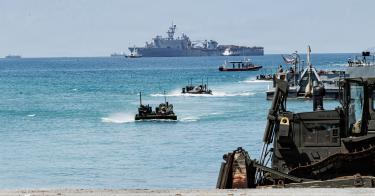
Most Americans seldom hear the term “amphibious operations” outside of an entertainment context: John Wayne as Sgt. John Stryker in The Sands of Iwo Jima or Tom Hanks as Capt. John Miller in the opening scenes of Saving Private Ryan. For service members, though, it’s a different story.
Historically, the ability to project power onto a hostile shore is a critical element of national security and a mainstay of a maritime nation. Military strategist B. H. Liddell Hart explains that “Amphibious flexibility is the greatest strategic asset that a sea power possesses.”
Yet, despite its strategic necessity, America’s amphibious readiness faces critical funding and organizational challenges that demand immediate action from Congress and the Department of the Navy.
>>> Theater Missile Defense Inventory: Inadequate for a U.S.–China Conflict
One must understand the sheer complexity of amphibious operations. These are not simply steaming a ship near a beach and kicking a few Marines out; they require highly detailed planning to integrate time-sensitive air, land, and sea assets. U.S. warships play a critical role as they are mobile sovereign U.S. territory and force can be projected from them without needing permission to use host-nation airfields or ports.
Joint doctrine divides amphibious operations into five types:
- Amphibious Assault: The primary and most difficult form, involving the establishment of a landing force on a hostile or potentially hostile shore (e.g., the battle of Iwo Jima)
- Amphibious Raid: A swift incursion into, or temporary occupation of, an objective followed by a planned withdrawal (e.g., Task Force 58’s seizing of Kandahar International Airport in the opening days of the war in Afghanistan)
- Amphibious Demonstration: A show of force conducted to deceive the enemy with the expectation of a landing, intended to draw adversary forces away from the true main effort (e.g., the 5th Marine Expeditionary Brigade used as part of a deception plan to keep multiple Iraqi divisions out of 1990’s Gulf War)
- Amphibious Withdrawal: The extraction of forces by sea in ships or craft from a hostile or potentially hostile shore (e.g., the evacuation of Dunkirk in 1940)
- Amphibious Support to Other Operations: Utilizing the unique capabilities of the amphibious force to support broader missions, such as disaster relief, noncombatant evacuation operations (NEO), or foreign humanitarian assistance (e.g., the USS Boxer and the 15th Marine Expeditionary Unit supporting disaster recovery efforts in the Philippines after 2024’s Typhoon Julian)
Regardless of the type, executing these missions requires specialized equipment, significant training, extensive inter-service coordination, and a robust fleet of amphibious warships. The Heritage Foundation’s Index of U.S. Military Strength explains: “Amphibious warfare ships are the cornerstone of maritime crisis response, deterring adversaries, and building partnerships.”
Unfortunately, this fleet is currently under significant strain. The statutory requirement to maintain a fleet of at least 31 amphibious warfare ships is frequently treated as a suggestion rather than a law.
>>> Four Defense Export Reforms for the United States
To ensure the Navy and Marine Corps can execute any of the five amphibious operation types and remain the nation's premier crisis response force, Congress and the Department of the Navy (DoN) must implement the following recommendations:
- Fund and Ensure the 31-Ship Statutory Floor. Congress must hold itself and the DoN accountable to the legally mandated 31-ship amphibious fleet. Multi-year procurement funding for Landing Platform Dock (LPD) and Landing Helicopter Assault (LHA)-class ships is a necessity. The Navy cannot effectively support amphibious operations and Marine Corps priorities if it doesn’t have enough ships.
- Accelerate the Landing Ship Medium (LSM) Program. The DoN must rapidly field the Landing Ship Medium. The LSM is essential for distributed maritime operations and the stand-in capability required of the Marine Corps. Congress must ensure the Navy fully funds the research, development, and procurement of this class of ships to enable tactical mobility within island chains.
- Modernize Contested Logistics. The DoN must prioritize investments in contested logistics. Getting ashore is only the commute to work; sustaining distributed forces in a contested environment on hostile shores requires unmanned surface vessels, more heavy-lift aircraft, and autonomous underwater resupply capabilities. Congress should mandate and fund research and development into emergent technologies specifically focused to identify and correct gaps in logistical sustainability in the Pacific.
The United States is a maritime power, and much of our deterrence stems from the ability to conduct amphibious assaults, raids, demonstrations, withdrawals, and support to other operations. When adversaries know that Marines can appear anywhere, anytime, and destroy or seize something of great value to them, they tend to respect the United States’ strategic posture.
The 1962 film The Longest Day captured the massive scale of the Normandy invasion. “The longest day” may also be appropriate for Marines left waiting for budgets and procurements to provide the necessary transportation for today's amphibious operations.
This piece originally appeared in RealClear Defense



