Achieving an American maritime revival not only requires building more ships, but training more dedicated Merchant Mariners—the men and women who crew American civilian ships and support military operations. Currently, five government agencies rely on America’s Merchant Marine (and more would benefit from having Merchant Mariners on their staffs, such as the Defense Logistics Agency): the U.S. Navy’s Military Sealift Command (MSC), the Maritime Administration (MARAD), the National Oceanic and Atmospheric Administration, the U.S. Committee on the Maritime Transportation System, and, indirectly, the Federal Maritime Commission. Combined, these five agencies number 2,460 civilian employees on shore, and yet America’s mariners are still too few.[REF]
Despite past efforts, a manpower and sealift crisis persist; the MSC had to sideline ships for want of crews. A new approach using proven methods to revive the nation’s maritime industry is needed—a viable career path at sea supporting national interests, with American Merchant Mariners at the helm. This new approach will require action by Congress, the Maritime Administration, and the Department of War to implement a new hybrid commercial–military business model that rethinks military sealift support and prepositioning of needed operational energy needs at sea with maritime business practices. In short, it is a commonsense, sustainable, and militarily effective approach.
Background
Without a strong headquarters attuned to the realities on America’s commercial ships, it is hard to imagine effective maritime decisions being made by government agencies. A 2024 Government Accountability Office report found MARAD—which is responsible for the development and promotion of the American maritime industry—to have a 13 percent vacancy rate, with 31 percent of employees above retirement age, projected to rise to 40 percent by 2028. Within MARAD’s Strategic Sealift Office, vacancies were even higher, at 21 percent.[REF] MARAD has not been able to find and train the employees it needs; in one case, an important marine finance position in the Office of Shipyards and Marine Engineering went unfilled for three years. The situation at the MSC is similarly dire and has resulted in the sidelining of 17 ships vital to sustaining military operations due to manpower shortages.[REF] Given that the Merchant Marine provides the U.S. military with the logistical support to defend the nation around the globe, the current situation is untenable and unacceptable. A solution to the problem is already on the books; it just needs to be put into action.
In 1936, the U.S. government established the U.S. Maritime Service (USMS) “for the training of citizens of the United States to serve on merchant vessels of the United States and to perform functions to assist the United States merchant marine” amidst labor issues and growing national security concerns.[REF] Almost a century later, the country faces similar challenges, with a 15 percent shortfall in the number of mariners needed for emergency sealift.[REF] To address these issues, MARAD should revive the USMS.
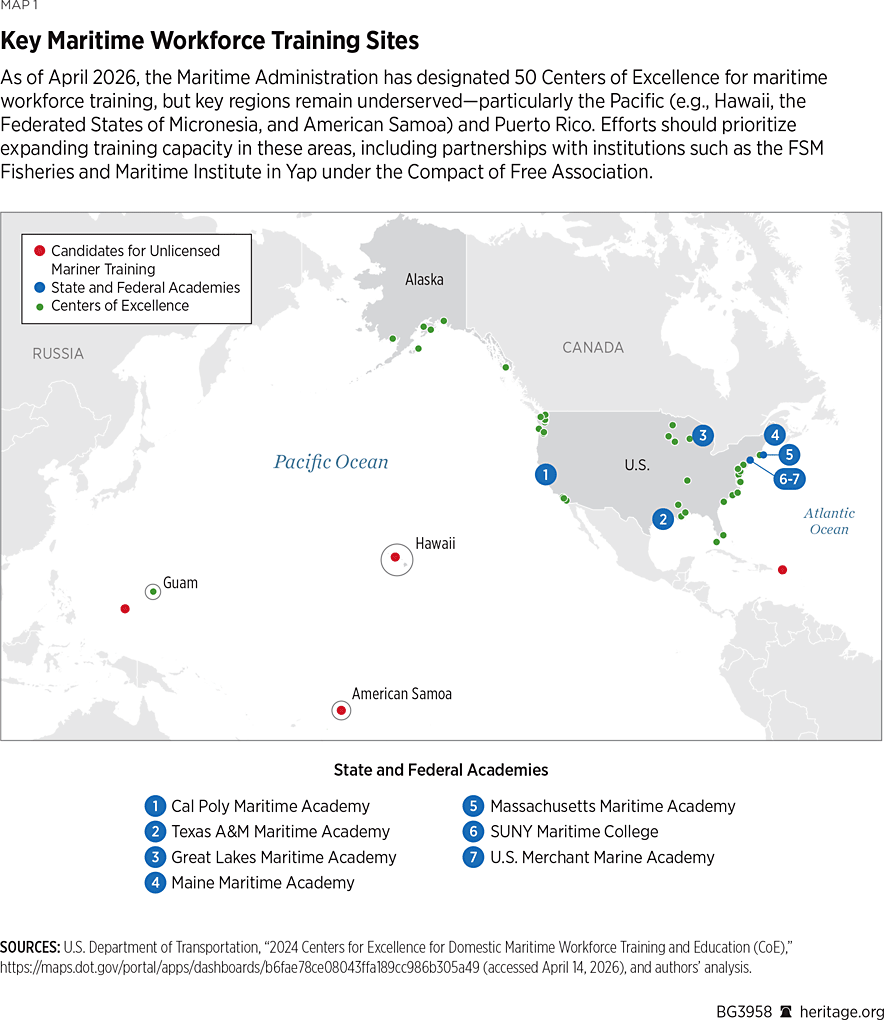
At-sea and classroom experience prepare maritime academy graduates for an active role today in reviving the nation’s maritime industry. For example, four years at the U.S. Merchant Marine Academy entails classes, hands-on training, simulator courses, and a year spent at sea working on the business of shipping. Once licensed and graduated, Kings Pointers (U.S. Merchant Marine Academy (USMMA) graduates) enter the industry as credentialed mariners on commercial vessels, or in the government fleet, and at ports and shipyards. Their service obligation is for five years in the maritime industry upon graduation, and, simultaneously, eight years in the Navy Reserve.
After eight years of academic and practical maritime experience, including years working in different positions aboard ship, and extensive training, academy graduates are qualified to assume positions of responsibility. At the MSC, Surface Warfare Officers of the U.S. Navy comprise most of the leadership, with only two Merchant Mariners on a staff of 15 as of March 17, 2026.[REF] This situation weakens the MSC’s ability to attract and ably manage a fleet of ships crewed by licensed and unlicensed (think officers and enlisted) Merchant Mariners. This lack of affinity for and experience at sea on commercial vessels by the MSC staff contributes to an inability to attract enough mariners, as shown by well-documented grievances by mariners against the MSC.[REF]
Currently, the graduates of the USMMA, the nation’s foremost source of maritime officers, can choose to serve on active duty in the military or to work as civilian maritime officers while in the Navy Reserve. Graduates of the State Maritime Academies who receive scholarships can likewise opt for either path to fulfill their service obligation.[REF] Active-duty service by maritime academy graduates made up 40 percent of the class of 2025 at USMMA.[REF] Though admirable, this is not in the best interest of the United States at a time when personnel shortages exist in the maritime sector and the President has directed a revival of the maritime industry.[REF]
One early remedy is to direct all graduates and recipients of Merchant Mariner education stipends to commercial ships and relevant staff and operational headquarters. Currently, too many USMMA graduates, and an unknown number of stipend recipients, do not enter the Merchant Marine. The most recent class of 2025 comprehensively graduated 262 students with service obligations: 197 USMMA graduates and 65 Strategic Sealift Incentive Program recipients who are Reserve Strategic Sealift Officers. These graduates should be activated as officers in a reconstituted USMS for the duration of their five-year service obligation.
As such, Merchant Marine officers would be free to work on the vessel of their choice for the first four years of their obligation, with the fifth year spent in an area of critical need within the maritime industry, be it at MARAD, MSC headquarters, or aboard an MSC ship.[REF] In an industry with high wages, starting salaries for a Merchant Mariner range from $78,481 to $82,539 for unlicensed crew, and averaging $156,502 for licensed crew, while the salary of an equivalent Ensign (O-1) in the Navy is a mere $49,802.40.[REF] As such, activating as active-duty USMS officers, USMMA graduates would begin to address staffing issues at MARAD and the MSC.
At present, the MSC struggles to keep pace with private-sector salaries and vacation times; relying on a re-activated USMS officer corps would ensure that MSC ships can always be fully crewed without starving the private sector of mariners. Just as important, it would provide the MSC and MARAD with headquarters personnel who have years of hands-on experience in the industry. Allowance should also be made for those who wish to remain in the commercial industry as USMS officers. This should not preclude these USMS sailors and officers from future opportunities at the MSC or MARAD headquarters. A re-activated USMS provides a career path that rewards at-sea and commercial industry experience, which should see graduates eventually taking on leadership roles at the MSC and at MARAD. Such an approach sets up a viable USMS career path that integrates commercial industry activity with government service.
In the same way that the Navy has shore tours, MARAD and the MSC should offer USMS mariners the opportunity to rotate into key posts at sea and respective headquarters. A similar idea was implemented by Rear Admiral Philip Sobeck, MSC commander from 2023 to 2025, and should be expanded to include not just MSC mariners but others from across the U.S. civilian fleet.[REF] Doing so would increase interoperability and effectiveness during times of contested logistics—such as that in 2026 of Iran’s threats to shipping in the Strait of Hormuz. Moreover, a professional USMS corps mitigates the reliance on foreign sailors and civilian mariners who rightfully can refuse to sail in combat zones to support naval operations. Numerous cases since the Vietnam War until today have merited this concern, most notably during the 1991 Gulf War when the Japanese crew of freighter Sea Venus carrying military equipment refused to dock in Saudi Arabia.[REF] Offering Merchant Mariners leadership positions at the MSC and formally re-activating the USMS creates a professional career path to senior positions that gets mariners with firsthand knowledge of America’s civilian fleet actively involved in the nation’s maritime revival and national security.
For the U.S. maritime sector to flourish, experienced mariners must increasingly join the ranks of decision-makers throughout maritime-focused components of the government.
A Revived U.S. Maritime Service
The Merchant Marine, like the military, is divided into two groups: unlicensed (that is, enlisted) and licensed (that is, officers).[REF] A revived USMS is also necessary to lay the groundwork for the efficient training of large numbers of unlicensed mariners in the event of a full-scale war necessitating sealift to sustain a wartime economy. This was the primary reason for creating the USMS in 1936 and is no less relevant today. Given an industry ratio of 54 percent unlicensed to 46 percent licensed mariners, at least 700 additional unlicensed mariners would be needed to man the Ready Reserve Fleet—a fleet managed by MARAD to rapidly support national crises.[REF] Furthermore, while previous forecasts of workforce gaps in a sealift scenario assume that all sealift-qualified mariners will show up voluntarily and be physically ready, only 60 percent chose wartime maritime service in World War II.[REF]The number of mariners required on commercially owned and MSC-contracted vessels is larger at an estimated 2,522 unlicensed mariners needed to fill the gaps.[REF] Conservatively, it is likely the nation will require more than 3,000 additional unlicensed mariners on day one of a major conflict to meet the nation’s wartime emergency sealift needs.
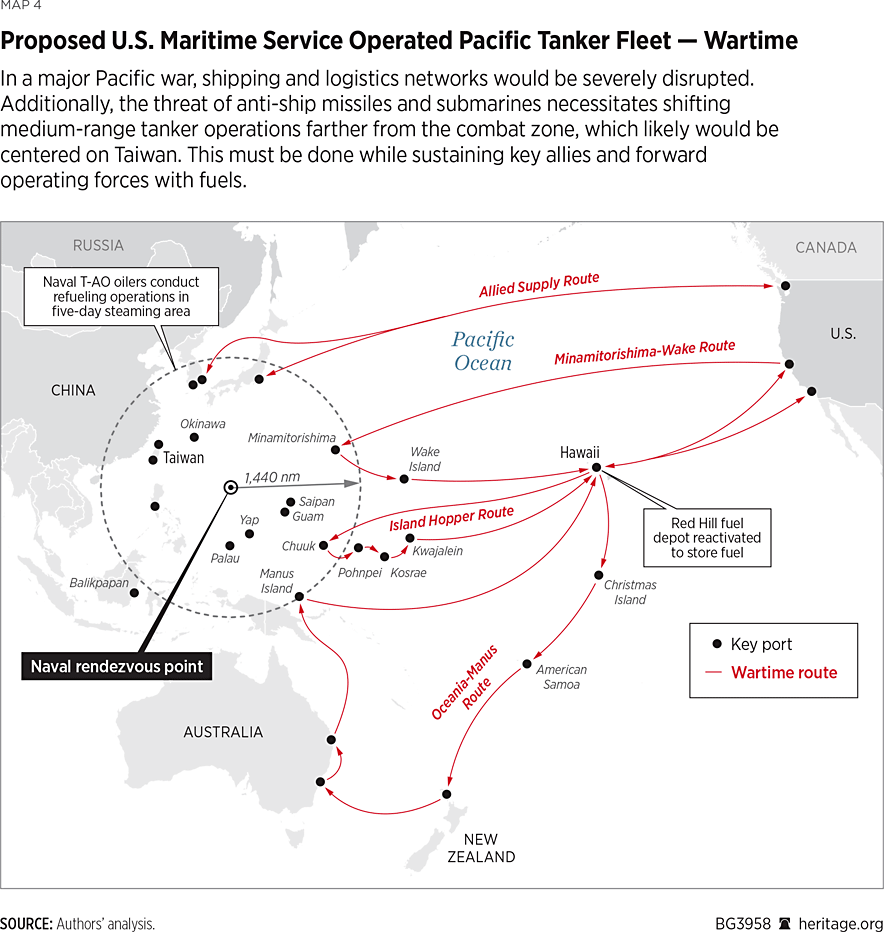
To prepare for this likely scenario, a revived USMS should include units ready to set up maritime training institutions, whether at Coast Guard or Navy installations. These units would be the educational equivalent of the MSC’s Expeditionary Port Units (EPUs). EPUs are small Navy Reserve units that assist with cargo operations and ensure the Navy’s ability to move large quantities of cargo through various ports during times of conflict.[REF] Drawing on the knowledge and skills of retired mariners, USMS Educational Units would ensure that manpower and training needs can be fully met during an extended conflict. In World War II, young men seeking to join the Navy and Coast Guard were often redirected to the Merchant Marine. This redirection was needed to fill losses and meet a rapidly expanding logistical demand to sustain operations first in North Africa, then in Europe, for the D-Day invasion, increasing up to the Japanese surrender.[REF] In a modern Indo–Pacific war, one should expect a similar progression as analyzed by The Heritage Foundation’s TIDALWAVE project and witnessed today from the effects of Iran’s ongoing strikes on tankers in the Persian Gulf.[REF] The TIDALWAVE analysis has identified a need for an additional 20 naval oilers (T-AOs) as well as 15 additional dry stores ships (T-AKEs) to sustain Pacific theater combat operations—and an additional 20 oilers to meet global requirements. In turn, those ships would be supported by a nominally U.S. commercially active tanker fleet, which would be repurposed in war to ensure that rear-area fuel depots across the Pacific remain full for military use. This is especially important given the shuttering of the massive Red Hill Bulk Fuel Storage Facility in Hawaii due to cracks in its tanks that contaminated local aquifers.[REF]
Little-Known Unlicensed Crew and Credentialing: An Achilles Heel
Critical to getting merchant ships to sea are the unlicensed mariners vital to operating, repairing, and sustaining ship and crew. The nation needs MARAD and the U.S. Coast Guard to take direct steps to increase the number of at-sea sealift-qualified unlicensed mariners now. In 2020, MARAD had proposed creating an enlisted component of the Navy Reserve’s Strategic Sealift Officer Program.[REF] In 2024, Commander Joseph Schwartzstein and Lieutenant John Kinlein, two Navy Reserve Strategic Sealift Officers, suggested filling empty billets with current Navy Reserve sailors.[REF] Both would be more costly and complicated than creating a roster (updated yearly) of sealift-qualified mariners who are willing to participate in emergency sealift operations[REF]—and, critically, periodically calling them to duty to ensure readiness.
The MSC and MARAD have attempted fixes but the division of responsibility across the Departments of War and Transportation has made an effective solution elusive. Moreover, the Coast Guard’s obsolete credentialing and records maintenance system by which mariners are licensed and tracked has stymied solutions.[REF] The Coast Guard’s credentialing system, developed in the 1990s, was intended to keep track of individual credentials of mariners, but has proven impractical as an effective recall system for active and inactive sealift-qualified mariners. The USMS would bridge the gap among these three agencies (the Navy, the Coast Guard, and MARAD) by managing the credentialing and maintaining records of all American sealift-qualified mariners. A critical first step to address the nation’s mariner needs is a modern and effective credentialing records program.
A revived USMS will also play an integral role in unlicensed training. Building new ships for American commercial and strategic interests must be accompanied by increasing the unlicensed mariner workforce. Moreover, the Trump Administration has proposed a historic shipbuilding and procurement budget that includes over 40 new orders in fiscal year (FY) 2027, which represents a demand for more mariners.[REF] In 2017, MARAD reported a shortage of 1,839 mariners, with the majority being unlicensed roles.[REF] For MSC vessels, the unlicensed component is higher than for commercial fleets, comprising approximately 70 percent of the crew. Currently, the pipeline for officers entering the workforce with a Third Mate or Third Assistant Engineer license through the U.S. Merchant Marine Academy or one of the six state academies is streamlined and supported by federal and state funding. However, for mariners seeking to upgrade from Ordinary Seaman (OS), Able Seaman (AB), or Qualified Member of the Engine Department (QMED), very few options exist for doing so. Of more than 200 U.S. Coast Guard–approved course providers for unlicensed mariners, only two offer unlicensed apprenticeships. These apprenticeships upgrade entry-level mariners to AB or QMED in one year. This timeline is far shorter than the alternative route, which requires at-sea experience at the temporarily reduced requirement of 540 days, while taking standalone upgrade courses during vacation time.[REF] Investing in unlicensed apprenticeship programs with a ready pipeline to licensing academies is a promising way to recruit new mariners. The ability to gain a head start in the industry with one year of training gives Americans considering enlisting in the military or attending vocational schools the opportunity to serve their country and earn above-average income while meeting a national need for mariners.
In addition to future training needs, incentivizing mariners to become and remain sealift-qualified is crucial. At present, there are no incentives for mariners to remain or become sealift-qualified unless actively working on a large ocean-going vessel. A revived USMS would provide career stability with additional training to unlicensed mariners at no cost in exchange for a commitment to participate in sealift operations, a recommendation first made in a 2017 MARAD report.[REF]
Operationalizing a Strategic Commercial Fleet
The Shipbuilding and Harbor Infrastructure for Prosperity and Security (SHIPS) for America Act has proposed a 250-ship Strategic Commercial Fleet (SCF), to be composed of militarily useful civilian ships.[REF] Like the Maritime Security Program and Tanker Security Program (TSP), the SCF would support naval operations in a time of war. Significantly, though, it would incentivize the domestic construction of a large number of new commercial ships. The SCF is envisioned as a backstop to fragile and inadequate MSC capacities, while at the same time participating in commercial shipping without jeopardizing meeting military requirements for sealift.
As of April 2026, the MSC numbers 125 vessels of various classes, including fleet oilers to fleet ocean tugs crewed by Merchant Mariners. Augmenting the MSC are a potential pool of 172 commercial U.S.-flagged ships suitable for military use, though the majority of these vessels are inadequate for international trade.[REF] For a sense of scale, analysis conducted by The Heritage Foundation indicates a required fleet of no fewer than 1,315 commercial ships in various classes to sustain a U.S. wartime economy.[REF] On some vessels, U.S. Navy personnel are present to handle military functions—such as communications during at-sea exercises and underway fuel replenishment. That said, given the persistent dangers to American shipping in conflict zones like the Red Sea and Persian Gulf, military forces deployed onboard these vessels are increasingly needed to protect against attack from small boats, drones, and cyber attacks.[REF] All told, the MSC struggles to meet the day-to-day needs of the military, and recent unexpected events have further exposed its inadequacy. The most recent example came in September 2024 when the Big Horn, a fleet replenishment oiler, ran aground off the coast of Oman. In the wake of its grounding, the aircraft carrier Abraham Lincoln was left without a reliable fuel supply during combat operations in the Red Sea. The Navy had to scramble to find a commercial tanker capable of supplying its air wing and escort ships with fuel.[REF] In the wake of this event, the need for a Strategic Commercial Fleet is more apparent.
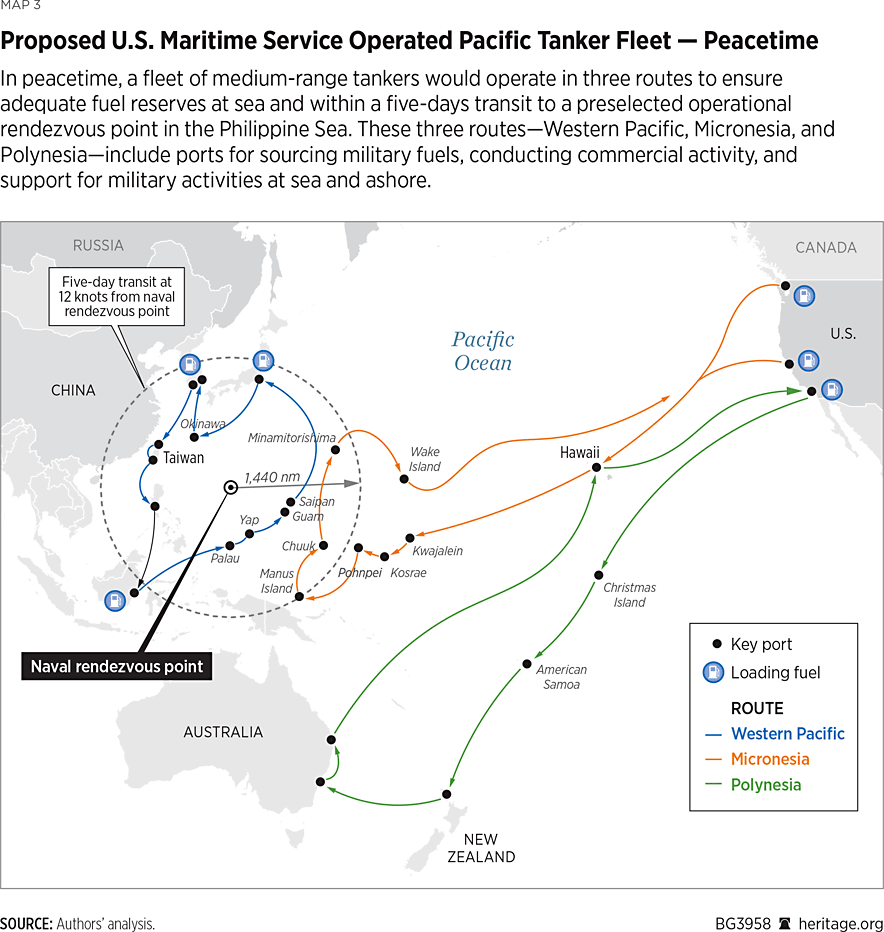
The USMS has a major role to play in operationalizing the Strategic Commercial Fleet and demonstrating its viability. This role starts with operating tanker fleets able to trade on the international market while ready to support Department of War needs. Doing so would require a fleet of USMS-crewed MSC-operated tankers within ready transit distance to designated potential military flashpoints. This fleet, while conducting commerce, would mandate minimums of refined petroleum in its ships’ holds to meet urgent military needs. Such an approach builds and improves on the current TSP, which can only be called up in a sealift emergency. This new hybrid commercial–military tanker fleet differs from the TSP in that it is always operating nearby, whereas TSP tankers can be activated many days away and without adequate cargo, adding more time and challenges to get fuels to the Navy fleet in a timely fashion. As such, the TSP approach potentially involves extensive downtime to load needed fuel and to transit to a naval rendezvous point—which also imposes additional economic opportunity costs to rapidly access needed refined fuels.
Securing logistics in contested environments requires a deeper pool of reserve vessels and assets closer to flashpoints of conflict. A war in the Indo–Pacific would require around 100 tankers.[REF] Currently, the United States only has 55 that are militarily useful.[REF] This situation, although challenging, presents an opportunity for closer cooperation with allies and partners in the form of energy diplomacy. In April 2026, with a permanent ceasefire with Iran elusive, a reimagined USMS operating a small tanker fleet in the Indian Ocean makes sense. It is an area of significant civilian and U.S. military demand for energy and security.
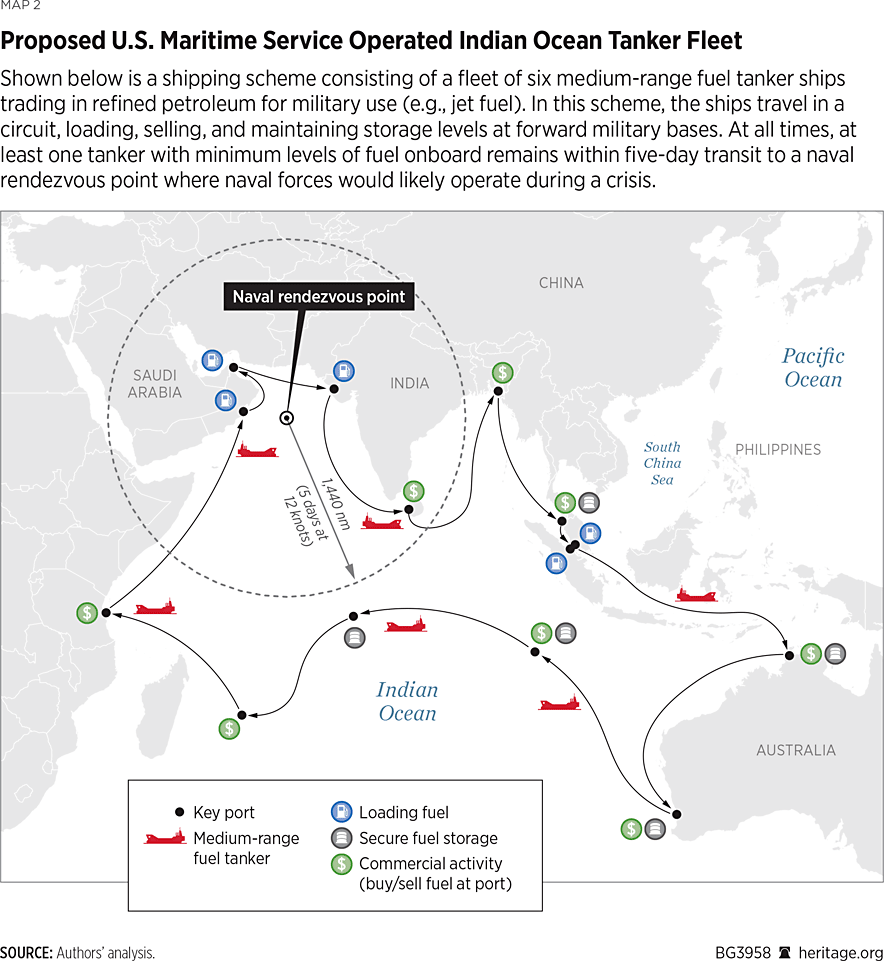
Focusing on support for combat operations against Iran, warships in the Arabian Sea would be supported by a small fleet of commercial tankers operated by the MSC and crewed by the USMS. Absent a region-wide war, these tankers would onload refined petroleum from ports in Oman and the United Arab Emirates and sell this fuel on the open market to India and other countries on the Bay of Bengal. They would then refuel in Malaysia, again selling refined petroleum in Australia and East Africa, returning to the Arabian Sea to repeat the cycle. All the while, these tankers would be required to maintain a minimum amount of select-grade refined fuel in their holds (such as jet fuel, marine diesel, or JP-5) as stipulated by the Navy. A preliminary envisioned Indian Ocean tanker fleet would include six medium range (MR) tankers able to access most of the world’s ports, with a 300,000-barrel capacity—166 percent larger than the Navy’s largest oiler class, the Henry J. Kaiser. MR tankers typically have several internal tanks, which would be filled with a variety of militarily useful fuel—for example, a minimum of 40,000 barrels of F-76 used for gas turbine engines and 60,000 barrels of JP-5/JP-8 for aircraft. At this capacity with these fuels, a commercial tanker adapted for naval operations—consolidated cargo replenishment at sea (CONSOL)—could sustain naval operations for many days.
A carrier strike group typically comprises three Arleigh Burke-class destroyers (each with approximately 10,700 barrels capacity)[REF] and one Ticonderoga-class cruiser (with about 16,500 barrels capacity).[REF] Assuming a total tank capacity of 48,600 barrels of F-76, 40,000 barrels would be enough to refill all vessels from 20 percent to 100 percent tank capacity. Nimitz-class carriers carry about 71,000 barrels of jet fuel,[REF] so 60,000 barrels would be enough to refill the carrier from 20 percent to 100 percent tank capacity, as well. The MR tankers would also carry small amounts of lubricants and other refined products as needed.
Additionally, MR tankers with a 300,000-barrel capacity afford space for commercial activity to sustain operations and, significantly, to maintain familiarity with and access to regional fuel markets in a crisis. Engaging this fleet in commercial activity is also important to cycle through fuels that degrade over time.[REF]
When required, all six vessels could be called upon to deliver fuel to a carrier strike group on a rotating basis. To ensure timely replenishment of a carrier strike group engaged in combat operations, MSC staff would manage the fleet’s operations to ensure availability of a tanker with fuel within five days of steaming at 12 knots speed. Notably, these ships would be crewed by active USMS members, mitigating concerns about sending otherwise contracted sailors into a combat zone. In effect, this MR tanker fleet would augment the fleet oilers that accompany all carrier strike groups. With installed CONSOL systems, these commercial MR tankers would be able to refuel the Navy’s oilers (and potentially warships) at sea.[REF] Given recent operational experiences in the Red Sea and conflict with Iran, modifications to the current CONSOL system are needed, including doubling of pump capacity per refueling station to shorten refueling time and possible installation of kingposts to enable refueling of smaller naval warships and Coast Guard cutters. Under this system, the Navy’s fleet oilers would no longer need to return to port to refuel, thus enabling the carrier strike group to operate at a dramatically increased operational tempo for a longer time.
Following is a description of the Scheme of Indian Ocean Hybrid Tanker Fleet Operations:
The Gulf of Oman. Ports in the Gulf of Oman, such as Duqm, Salalah, and Fujairah, will play a critical role in an MR tanker shipping routine. With Naval assets in the vicinity, MR tankers participating in this trade begin a transit circuit by loading fuel here, for which the Defense Logistics Agency has already established Defense Fuel Support Points at Fujairah and Salalah. If the port of Duqm is added to this list, its output of 130,000 barrels per day (bpd) of marine diesel and 22,000 bpd of jet fuel adds options and resilience to the MR tanker route.
India. Jamnagar on the West Coast is currently home to the world’s largest refinery operated by the Indian conglomerate Reliance Industries Limited. Located in the North Arabian Sea, and in close proximity to historic carrier strike group operations, it offers an ideal port for sourcing naval fuel. Reliance operates the Jamnagar SEZ and Jamnagar DTA refineries, which have a total refining capacity of 1.24 million bpd.[REF] India also offers several ports where refined petroleum products could be sold as well.
Malaysia and Singapore. While not a major supplier of refined products like Oman, adding a load port in the vicinity of the Straits of Malacca is beneficial for servicing western and northern Australian ports. Singapore generates roughly $56 billion annually in refined petroleum exports and has a total refining capacity of 1.5 million bpd.[REF] Ports in Peninsular Malaysia are major suppliers of refined petroleum, including the ports of Johor, Dickson, and Klang. Johor is home to the Pengerang Integrated Petroleum Complex, capable of refining 300,000 bpd.[REF]
Australia. Even as a net exporter of energy, Australia relies heavily on imported refined products; 79 percent of refined petroleum consumption in Australia was imported between 2023 and 2024.[REF] South Korea and Singapore are the two largest suppliers of refined products to northern Australia and western Australia, with India and Malaysia also active in this $30 billion market.[REF] A Strategic Commercial Fleet tanker trading between Singapore and northern Australia, supplying Darwin and the diesel-reliant mining port of Dampier, would be critical in keeping the oil flowing to a crucial ally, which could be cut off in the event of a major conflict.
East Africa. The countries of East Africa form a strong market for refined product imports, with an estimated annual growth rate of 3.31 percent over the next five years.[REF] A sizable and reliable American presence in the East African energy market would be a powerful tool for advancing energy diplomacy and U.S. interests in the region.
The employment of USMS-crewed MR tankers in a new Strategic Commercial Fleet, making regular rounds in the Indian Ocean, reduces the current U.S. military’s reliance on foreign-flagged vessels for the resupply of Defense Fuel Support Points (DFSPs).[REF] While U.S.-flagged tankers will deliver fuel from the DFSP to the strike group, much of the DFSP’s fuel could be reliant on foreign-flagged vessels if U.S. tankers are not available.[REF] Moreover, this SCF would service remote bases (such as the joint U.S.–U.K. Diego Garcia in the Indian Ocean) and smaller partner nation markets (such as Maldives and Australia’s Cocos Island).
The SCF tankers are not merely an extension of the existing Defense Logistics Agency supply chain, but when cheaper foreign-flagged vessels are not an option in a conflict, U.S.-flagged and -crewed ships will be vital.
Recommendations for Congress, the President, and MARAD
For a revived USMS to be effective, it must be stood up deliberately and incrementally. As such, Congress should:
Fund and direct the MARAD administrator to activate the USMS in the next Maritime Administration budget. This initial budget should fund the activation of all current Merchant Mariners at USMS at MSC headquarters and on MSC ships. Salaries should be commensurate with appropriate military pay scales, with bonuses considered. In time, USMS sailors would be activated to crew MSC-contracted vessels. Furthermore, the U.S. Committee on the Marine Transportation System, an interagency group tasked with coordinating maritime initiatives, should be staffed by USMS members.
Direct MARAD to begin publishing annual reports on unlicensed mariners to identify where gaps exist and how they can be filled. These reports should include the use of USMS Educational Units to meet manpower needs during wartime. The initial report should be issued prior to the next Department of Transportation budget submission in FY 2028.
Fund the purchase by MARAD on the open market or new construction of six MR tankers, all equipped with CONSOL underway-replenishment equipment to fuel the Navy’s fleet. These ships should be crewed by USMS mariners. The initial cost for these orders would total $273 million for tankers built in treaty ally shipyards (such as in Japan and South Korea) or $1.35 billion if U.S.-built, with associated first-year operating and crew expenses estimated at $70 million.[REF] This order complements the validated need for additional naval oilers (T-AO) and additional dry stores (T-AKE) and shortens the reload time for these naval combat logistics forces (T-AO, T-AKE) as recommended by the authors of TIDALWAVE.[REF] The total cost for an initial MR tanker fleet operated by an activated USMS crew would be $1.693 billion for first-year operating and total procurement costs.
Pursue wartime logistics capacity purchases. Based on the analysis conducted by the TIDALWAVE authors, procurement of needed 15 new T-AKE dry stores ships and 40 additional T-AO oilers would cost approximately $44.5 billion.[REF] Without options for at-sea refueling, assured port access, and expanded forward stockpiles, the requirement rises further to around 55 to 60 total oilers just in the Pacific theater. The total cost for procurement of an expanded naval combat logistics fleet would be $44.5 billion (15 T-AKEs and 40 T-AOs).
The President should:
Name, and Congress should confirm, a Commander of USMS as an active-duty flag officer at the rank of Vice Admiral. This rank is commensurate with the authorities and responsibilities of an equivalent Navy numbered-fleet Commander (such as the Seventh Fleet).
MARAD should:
Direct a newly appointed Commander of USMS to propose several new regionally dispersed high-quality schools for unlicensed mariners. This should include the expansion of existing unlicensed apprentice programs and the creation of new ones. There are currently only two schools in the U.S. that offer such apprenticeships, of more than 200 Coast Guard–approved unlicensed course providers. Incentives should be given to streamline the training of unlicensed mariners.
The Secretaries of War and Transportation should:
Present to Congress an operational plan for an activated USMS-crewed MSC-operated MR tanker fleet in the Indian and Pacific Oceans. These fleets would be engaged in commercial energy trades, while remaining within ready steaming time to supply fuel of various qualities and quantities as directed by the Secretary of War. This plan should include provisions for modified CONSOL systems to increase refueling rates and flexibility to service a wider set of Navy and Coast Guard vessels. Finally, as the recent experiences of American Merchant Mariners in the Red Sea and Persian Gulf make clear, this plan must include measures for onboard force protection and secure communications.
Conclusion
While Congress considers legislation to restore America’s Merchant Marine, the Maritime Administration can act within its authority to revive the USMS.[REF] Doing so would provide a low-cost structure to address some of America’s most pressing maritime challenges and would begin rebuilding the personnel component of the U.S. Merchant Marine, while the construction of new tankers would address the greatest weakness in physical capacity. Taken together, these steps are the best foundation for a systems approach to maritime power and energy diplomacy. As MARAD Administrator Stephen Carmel recently stated: “Assets fail; systems endure.”[REF]
While this proposed system requires new assets, it is not the tankers that will add value to the fleet, but the ability to sustainably extend military logistics by reorienting commercial trade in critical energy markets where the Navy is expected to operate.
Inaction would mean exposing the nation to great risk in a possible war with China. In that scenario, U.S. inability to overcome the status quo of having too few mariners and no way to rapidly train more would mean that U.S. warfighters and the nation would have severely reduced access to necessary energy supplies. The existing fleet of MSC vessels and aging U.S.-flagged commercial fleet are inadequate and needs to be modernized and expanded quickly. A smart, sustainable approach is to employ the USMS in support of the military through the MSC on American ships engaged in commerce close to where the Navy operates.
Hollins Randolph and Peter Lynch are members of the Young Leaders Program at The Heritage Foundation and both have at-sea experience as merchant mariners. Brent D. Sadler is Senior Research Fellow for Naval Warfare and Advanced Technology in the Douglas and Sarah Allison Center for National Security at The Heritage Foundation.