

China took an extraordinary diplomatic step last February by unveiling a comprehensive strategic agreement with the Cook Islands. Avarua’s decision was surprising in itself, but more striking was the scale of the deal. It was the most expansive agreement Beijing has ever concluded with a South Pacific nation. The partnership pledged cooperation across economic and infrastructure development, seabed mining, and maritime resilience.
Almost a year later, key questions remain unanswered. While the terms of the agreement are public, they offer few concrete policy commitments. Given that the deal is intended to structure bilateral relations for the next decade, and may shape regional dynamics more broadly, it remains essential to assess how it may take shape.
In the absence of policy announcements, China’s activities, alongside corresponding political developments, offer the best indicators for what the partnership may portend. By most measures, signs clearly point to deepening military and political ties.
The Cook Islands has grown noticeably closer to Beijing, reflected in a new willingness to honor Beijing’s wishes at regional fora. China, for its part, has sustained a presence in the Pacific nation, deploying research vessels ostensibly for maritime exploration. Together, these developments point to a rapidly expanding Chinese footprint, increasingly advanced through the close bilateral relationship.
>>> Countering China at Sea: Inside America’s Cook Islands Play
For a partnership purportedly centered on economic cooperation, the deal oddly places political alignment at the fore. In the Action Plan, which serves as the overarching framework for the deal, adherence to the One China policy is explicitly mentioned as “a cornerstone of the bilateral relationship.” This follows China’s broader campaign to win over diplomatic recognition from all Pacific Island nations. In the past few years, three nations in the region – the Solomon Islands, Nauru, and Kiribati – have switched to recognize Beijing after a generous increase in foreign aid.
Since normalizing ties nearly three decades ago, the Cook Islands has supported China’s political positions – but in a restrained manner. Its foreign affairs are managed by neighboring New Zealand through a free-association arrangement, which often reflects Wellington’s attitude toward Beijing.
With those relations straining, Avarua had adopted a less visible, and more passive, form of endorsement for China. That’s why this partnership, in the words of New Zealand officials, “blindsided” Wellington. Not only was New Zealand not consulted, which was a constitutional requirement, but Avarua’s favorable stance toward China has, since the deal’s signing, become more pronounced, reflecting a drift from the traditional Western orbit.
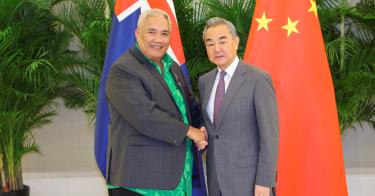
This new assertiveness became visible in July, when Cook Islands Foreign Minister Tingika Elikana attended the Third China-Pacific Islands Foreign Ministers Meeting, a China-led forum intended to “reaffirm mutual understandings and support,” particularly on the One China policy. The Cook Islands had abstained from the first two meetings in 2022 and 2021, perhaps to preserve diplomatic balance. This time, Elikana appeared publicly alongside Chinese Foreign Minister Wang Yi, symbolizing a new chapter for regional relations.
Not long after, the Cook Islands sent another bold diplomatic message by publicly endorsing Beijing’s wish to bar all dialogue members from the Pacific Island Forum Leaders Meeting. External partners have traditionally attended the forum, using meetings on the sidelines to sustain regional engagement. The exclusion this year eliminated an important channel for partners, especially Taiwan, to maintain a diplomatic presence at the summit.
The partnership also included a Memorandum of Understanding (MOU) on deep-sea minerals, committing both nations to explore commercial mining ventures. Joint studies to “survey seabed mineral areas” were slated to follow, an effort that many are worried carries military undertones. In November 2025, the Chinese research vessel Da Yang Hao reached the Cook Islands to begin a three-day exploration of an area around Rarotonga, a visit personally welcomed by Prime Minister Mark Brown.
The Da Yang Hao is no stranger to controversy. In 2021, it was identified illegally surveying Palau’s exclusive economic zone, prompting Palau officials to request support from the U.S. Coast Guard. When a U.S. aircraft located the vessel, it was moving at an unusually slow pace, behavior consistent with bathymetry data collection, important information that can aid in submarine deployment.
More recently, the Da Yang Hao was involved in a separate incident off Taiwan’s east coast, waters considered strategic by the Chinese navy. Again, its abnormal grid-like movement strongly suggested engagement in a systematic data-collection effort.
Concerns that the partnership may facilitate military activity are not merely speculative. China’s 15th Five Year Plan (2026-2030) reaffirmed its commitment to military-civil fusion, explicitly linking technological development and scientific research to defense modernization. Indeed, the maritime research body named in the Action Plan for maritime cooperation, the Second Institute of Oceanography, has formal cooperation agreements with the People’s Liberation Army (PLA).
Viewed in this context, data and information collected in bilateral research efforts can reasonably be expected to carry military utility. The fact that the China-Cook Islands partnership’s first major deployment involved a vessel with a documented history of military activity is quite telling.
A final development likely to shape the trajectory of the partnership is China’s growing interest in establishing dual-use infrastructure at strategically sensitive locations. Beijing recognizes the importance of the Second Island Chain, which cuts through Palau and the Marshall Islands, for sustaining U.S. combat operations amid a contingency in the Taiwan Strait, the South China Sea, or the Korean Peninsula. Restricting access along this corridor, even incrementally, could disrupt operational coordination, logistical resupply, and maintenance efforts.
>>> How Weak Flag Oversight Is Undermining the Legitimacy of Pacific Island States
Accordingly, China’s state-run enterprises have poured hefty investments into renovating airstrips, wharves, ports, and telecommunications towers. Although framed as efforts to “promote economic interests,” many facilities have been designed or modified with latent military capabilities. In Vanuatu, for instance, the Luganville Wharf was expanded to accommodate warships, despite receiving few visits at the time from large commercial vessels.
The Cook Islands may now be confronting a similar playbook. Another MOU included in the deal identifies ports and wharves as areas for investment cooperation. While no official projects have been formally announced, Chinese companies have already begun bidding on infrastructure contracts. This remains one of the most consequential areas to track as regional tensions continue to mount. Within days of the partnership announcement, PLA forces conducted live-fire drills close to Australia and New Zealand, a stark reminder of Chinese military adventurism.
While much remains uncertain, developments over the past year offer a clearer sense of what lies ahead. The China-Cook Islands partnership is a real-time demonstration of Beijing’s expanding regional footprint, and the balance of power in the Pacific is beginning to shift. Western nations must recognize that without commensurate engagement with Pacific states, they risk ceding long-term strategic influence to China.
This piece originally appeared in The Diplomat


