


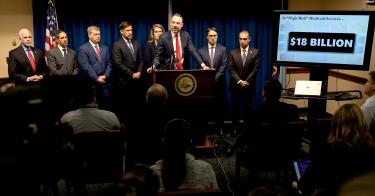
The welfare fraud in Minnesota seems to be a never-ending story. We’re learning that scammers bilked multiple programs intended to help low-income families, including Medicaid, food aid, housing assistance and childcare programs. Based on what’s been uncovered so far, the people who perpetrated those schemes may have stolen upwards of $9 billion.
Yet, while Minnesota’s welfare fraud is particularly brazen and systemic, it is not unique to that state. That is because the basic design of most U.S. welfare programs makes them highly susceptible to fraud.
For example, for years, Medicaid has been on the U.S. Government Accountability Office (GAO) list of federal programs at “high-risk” for fraud, waste and abuse. GAO finds the program has insufficient federal oversight. In 2024, it estimates, there were more than $31 billion in erroneous Medicaid payments.
That is particularly concerning because Medicaid is the largest means-tested government welfare program, costing federal and state taxpayers around $900 billion annually. Unsurprisingly, Medicaid was also the source of most of the money stolen in Minnesota.
In short, the Minnesota scandals are the bitter fruit of deeply rooted problems in a system badly in need of reform.
>>> Taxpayer Cash, Zero Accountability: Minnesota Fraud Proves Welfare Is Broken
The biggest design flaw is that most of the funding for welfare programs come from the federal coffers, but the federal government has largely delegated to states responsibility for administering and policing those programs. Yet, federal oversight of fraud prevention in welfare programs is often lacking, and because states are spending mostly federal dollars, they lack strong incentives to ensure funds are spent properly.
Case in point: the federal Child Care and Development Fund—which financed Minnesota’s now-infamous “Quality Learing Center”—has also received scrutiny for poor federal oversight. A 2016 U.S. Department of Health and Human Services Inspector General’s report on that program explained that states are required to submit fraud protection plans to HHS.
Those plans include things like reviewing attendance records at childcare centers, conducting staff reviews and performing on-site visits. But the report noted that HHS had not established a process to ensure that states carry out their fraud protection plans. Obviously, a plan that isn’t implemented is useless.
Another major problem is that funding for most welfare programs is calculated and allocated not according to performance measures, but on the number of people served. That gives service providers an incentive to “pad the rolls,” and it also disincentivizes state government officials from monitoring those providers too closely, since tighter controls could reduce the flow of federal funds to the state.
>>> How Trump’s “Big, Beautiful Bill” Ends Decades of Temporary Tax Policy Games in Washington
That leads to yet another, related flaw in the current system. Many welfare programs provide grant funding to third parties to deliver services. The intended beneficiaries of those services have no say in how the funds are spent. That makes those programs vulnerable to large-scale abuse, like occurred in Minnesota.
A third-party service provider—either for-profit or nonprofit—can pull in a lot of government dollars by artificially inflating participant rolls or by claiming to provide services they haven’t truly provided.
In contrast, programs that deal directly with the intended recipients and give them a say in how funds are spent—such as through account- or voucher-type mechanisms—are less prone to massive fraud schemes. For instance, a family given a voucher or account to pay for childcare has a natural incentive to get value for the money.
The silver lining of the recent crisis is that it has brought attention to fraud in the welfare system. Now is an opportunity to tackle this problem. Agencies should increase federal oversight of states to ensure that fraud prevention occurs. Congress should also reform welfare programs so that states are required to provide a greater portion of welfare funding, giving states more incentive to see programs are protected against abuse.
Policymakers and the public are outraged by what happened in Minnesota. Unfortunately, we’re likely to see more of it unless policymakers address the deeper flaws of the welfare system.
This piece originally appeared in Fox News



