Primary Purpose of the Document
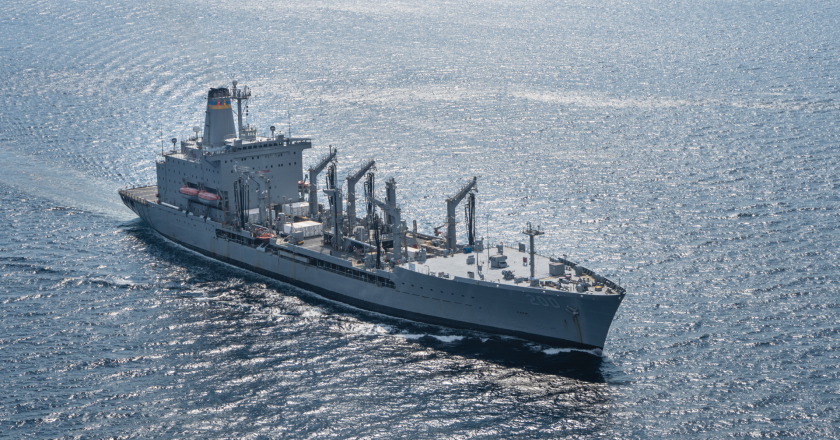
This report provides a full operational assessment of the U.S. Navy’s underway replenishment fleet, including the T-AO Kaiser-class oilers, T-AO-205 John Lewis-class oilers, T-AKE dry cargo/ammunition ships, and CONSOL-capable commercial tankers. It evaluates fuel throughput capacity, survivability, reload infrastructure, and strategic limitations in a Taiwan conflict scenario.
Overall Key Judgment
Heritage assesses with moderate-to-high confidence that as of May 2025, the United States can sustain a maximum at-sea fuel delivery throughput of approximately 265,000–280,000 barrels per day (bpd) to naval end-users in the Western Pacific using its combined underway replenishment fleet—composed of 14 Kaiser-class oilers, four early-stage John Lewis-class oilers (1 operational), 12 active Lewis and Clark-class dry cargo ships, and 2–3 CONSOL-capable MSC-chartered commercial tankers.
While the existing Combat Logistics Force (CLF) architecture can support moderate-to-high tempo operations under permissive conditions, Heritage judges that fleet-wide survivability, delivery rhythm, and overall fuel resilience would degrade rapidly under sustained PLA strike conditions without access to forward DFSP terminals or combat escort coverage. Fleet attrition, limited platform redundancy, and low tanker integration density remain critical constraints on long-term endurance and maritime fuel distribution tempo.
Kaiser-Class Fleet Replenishment Oilers (T-AO-187)
Heritage assesses with high confidence that fourteen Kaiser-class fleet replenishment oilers (T-AO-187) remain operational under Military Sealift Command (MSC) as of May 2025, with each vessel capable of delivering 50,000–70,000 barrels per day (bpd) of JP-5 and F-76 under wartime surge conditions.1 However, Heritage judges that the class exhibits low survivability under PLA missile and submarine threat envelopes due to its lack of integrated self-defense systems, large radar and acoustic signatures, and reliance on escort protection.2
Reason 1: The Kaiser-class fleet maintains sufficient hull availability to support daily underway replenishment (UNREP) requirements in 2025.
- According to Heritage’s simulation model based on U.S. Navy and MSC inventory data, fourteen Kaiser-class oilers remain operational as of May 2025, with three hulls (T-AO-190, 191, and 192) having been decommissioned, canceled, or transferred.3
- All operational vessels are USNS-designated, U.S.-flagged, and civilian-crewed under Military Sealift Command.
- No commissioned USS-designated ships exist in this class.4
Heritage assumes that all 14 oilers will remain mechanically deployable through FY2026. This assumption is key because if 2–3 hulls are retired or out of service simultaneously, daily throughput would fall below required levels for fleet sustainment.
Reason 2: Kaiser-class oilers carry high-volume fuel stores and are equipped to deliver up to 70,000 bpd under surge operations.
- Each single-hull Kaiser-class vessel carries approximately 178,000 barrels of fuel, while double-hull variants carry ~159,000 barrels due to volume tradeoffs under OPA-90 regulations. Forecast International confirms the class includes 32 cargo tanks and eight pumps delivering a combined 5,448 tons per hour.5
- According to a 2021 DVIDS report, USNS Henry J. Kaiser transferred 1.2 million gallons (~28,500 barrels) of JP-5 to USS Abraham Lincoln in under three hours using six fueling hoses.6
- RIMPAC and COVID-era surge exercises validated the class’s ability to conduct 2–3 UNREP events per day under wartime tempo.7
Heritage assumes each oiler can perform 2–3 UNREP evolutions per day during wartime. This assumption is critical because if weather, mechanical issues, or crew fatigue degrade tempo, delivery capacity would drop below the 50,000 bpd threshold.
Reason 3: The class depends on high-frequency DFSP-based reload cycles to sustain high-tempo operations, but current infrastructure supports this requirement under non-degraded conditions.
- According to Heritage’s structured analysis of DFSP infrastructure, Kaiser-class oilers reload at terminals including Point Loma (San Diego), Manchester (Puget Sound), Pearl Harbor, and Guam.
- DFSP Point Loma holds approximately 1 million barrels of F-76 and JP-5 and can support simultaneous fueling of two ships.
- The same report notes that West Coast terminals can support 3–5 tanker departures per week, allowing ~30–40 day round-trip CONUS–Guam cycles and ~10–14 day Guam–Philippine Sea cycles.8
Heritage assumes that Guam, Pearl Harbor, and other key DFSP terminals will remain available during conflict. This assumption is key because the loss or interdiction of even one critical reload node would substantially reduce throughput and increase oiler turnaround times.
Reason 4: Kaiser-class oilers possess minimal self-defense capability and are highly vulnerable to PLA missile and submarine threats without escort.
- According to a 2023 CIMSEC article, MSC oilers lack organic missile defense systems such as CIWS or SeaRAM and are only equipped with SLQ-25 Nixie torpedo decoys and .50 caliber mounts.
- These vessels present large radar and infrared signatures and routinely broadcast AIS signals in peacetime, logically inferred based on vessel design characteristics and typical AIS behavior for MSC vessels, increasing detection by PLA ISR platforms.9
- As noted in CSBA’s “Sustaining the Fight” study, PLA missile systems like the DF-21D (1,500 km range) and YJ-18 (500+ km) are optimized for high-value logistics targets.
- Multiple INDOPACOM and CSBA wargames model fleet oilers as early-phase targets due to their centrality in sustaining carrier and amphibious operations.10
Heritage assumes that MSC policy will restrict unescorted Kaiser-class operations in high-threat zones. This assumption is key because a shortage of escorts or operational necessity could force oilers into contested areas, resulting in unacceptable attrition and degraded fuel delivery capacity.
John Lewis-Class Fleet Replenishment Oilers (T-AO-205)
Heritage assesses with moderate confidence that as of May 2025, four John Lewis-class fleet oilers (T-AO-205) have been delivered to Military Sealift Command (MSC), with one vessel—USNS John Lewis—fully operational and able to deliver approximately 60,000–70,000 barrels per day (bpd) under wartime tempo. Heritage further assesses that although the class introduces enhanced fueling capacity, dry cargo support, and modular upgrade potential, the limited number of hulls, current lack of organic self-defense systems, and incomplete fleet transition reduce its near-term contribution to theater-wide naval fuel resilience.
Reason 1: Only one John Lewis-class oiler is operationally available as of May 2025, limiting total output despite design advantages.
- According to the U.S. Navy’s official platform fact file, the John Lewis-class program will field 20 hulls between FY2022 and FY2032, with four delivered as of mid-2025.11
- As confirmed in a Navy.mil press release, USNS John Lewis (T-AO-205) conducted its first operational underway replenishment in April 2025 with USS Mustin, marking its full activation.12
- Three additional hulls—Harvey Milk, Earl Warren, and Robert F. Kennedy—have been delivered but remain in fitting out or post-delivery trials and are not yet available for fleet tasking.13
Heritage assumes that only USNS John Lewis is available for active fleet fuel delivery through FY2025. This assumption is key because the fleet’s near-term contribution depends on the pace of post-delivery certification and crew availability.
Reason 2: The T-AO-205 design introduces a modernized fuel and dry cargo capability set with improved replenishment efficiency.
- According to technical specifications published by NASSCO, each T-AO-205 oiler carries ~162,000 barrels of JP-5 and F-76, supported by ten 3,000 gpm cargo pumps and five fueling stations.
- The same specification confirms the class carries 6,675 metric tons of dry cargo and 1,716 tons of refrigerated stores, with capacity for dual VERTREP helicopter operations.14
- The Navy’s official fact file indicates the class is 746 feet long, displaces 49,850 tons, and has design reservations for CIWS or SeaRAM defensive systems.15
Heritage assumes that wartime operations will not require simultaneous maximum use of dry cargo and fuel capacity. This assumption is necessary because concurrent ordnance transfer and fuel pumping may reduce total daily throughput below modeled thresholds.
Reason 3: The class retains limited operational value in the near term due to low fleet density and geographic constraints on deployment cycles.
- According to Heritage’s simulation analysis and modeling, T-AO-205 hulls are currently homeported on the U.S. West Coast and rely on DFSPs such as Point Loma and Manchester for loadout support.
- The same model estimates CONUS–Guam round-trip cycles to span 30–40 days, while forward-based loops (e.g., Guam–Philippine Sea) take 10–14 days under optimal DFSP availability.16
- Heritage’s West Coast DFSP assessment indicates increased ship displacement may strain available berths at DFSP Point Loma and Selby during surge operations.17
Heritage assumes that DFSP sites in Guam, Pearl Harbor, and Yokosuka remain accessible for reload. This assumption is key because theater-wide sortie tempo depends on the ability to avoid CONUS-only fuel shuttle cycles.
Reason 4: Despite design improvements, survivability of T-AO-205 oilers remains low without defensive upgrades or escort integration.
- According to NASSCO, although the John Lewis-class is structurally designed to support CIWS or missile defense systems, none of the hulls delivered as of May 2025 are outfitted with these weapons.18
- The class lacks sonar, decoys, or missile hard-kill defenses, and would remain vulnerable to PLA strike systems such as the DF-21D (~1,500 km) and YJ-18 (~500 km) without escort support.19
- Wargame modeling by CSBA highlights the vulnerability of U.S. logistics ships—including fleet oilers—during the first 7–14 days of high-intensity conflict. While the T-AO-205 class is not named directly, it is logically inferred to be a priority PLA target based on its role and capabilities.20
Heritage assumes that operational planning will not assign T-AO-205 hulls to contested zones without escort. This assumption is critical because unprotected entry into PLA missile envelopes would likely result in high early-phase attrition.
Lewis and Clark-Class Dry Cargo/Ammunition Ships (T-AKE)
Heritage assesses with high confidence that as of May 2025, twelve Lewis and Clark-class dry cargo/ammunition ships (T-AKE) are assigned to the Combat Logistics Force (CLF), each capable of delivering approximately 6,000–7,000 tons of ordnance and provisions, and up to 25,000 barrels of F-76 per loadout, depending on mission configuration. While not primary fuel delivery platforms, these ships provide critical distributed sustainment for forward naval forces. However, Heritage judges that survivability remains low in contested environments without escort due to minimal defensive systems, volatile cargo loadouts, and high target value to PLA strike planners.
Reason 1: The T-AKE class provides the Navy’s primary platform for at-sea delivery of ordnance, provisions, and limited fuel.
- According to the U.S. Navy and MSC, the T-AKE class includes 14 ships total, with 12 assigned to active CLF duties and 2 assigned to Maritime Prepositioning Force (MPF) operations.21
- Each T-AKE can carry approximately 6,675 metric tons of dry cargo and 1,716 tons of refrigerated stores, as confirmed by NASSCO and Navy fact files.22
- MSC documentation also confirms that each ship carries up to ~25,000 barrels of F-76 fuel for limited top-off operations during UNREP evolutions.
- These ships are equipped with STREAM and VERTREP cargo delivery systems, allowing at-sea transfer of hundreds of pallets per day in multi-ship events.23
Heritage assumes that the dry cargo loadout (munitions, provisions) will be prioritized over fuel in high-tempo conflict scenarios. This assumption is key because most carrier strike groups rely on paired oilers (T-AOs) for primary fueling, relegating the T-AKE to ordnance and stores delivery except in emergencies.
Reason 2: The class is fully integrated into CLF replenishment cycles and operates in tandem with T-AOs to maintain forward fleet readiness.
- According to MSC operational patterns and multiple RIMPAC deployments, T-AKEs routinely conduct underway replenishment alongside T-AOs, resupplying carrier strike groups with food, spare parts, and munitions.24
- Each ship includes multiple cargo holds with high-capacity elevators, two CONREP rigs per side, and helicopter landing zones to support rapid vertical replenishment.25
- A 2024 MSC logistics update confirmed T-AKEs conducted simultaneous fueling and stores transfers to LCS and destroyer platforms during WestPac deployments.
- During surge operations, a T-AKE can replenish 3–4 ships per day, depending on sea state, VERTREP availability, and supply inventory.26
Heritage assumes that the current CLF pairing strategy (1 T-AO + 1 T-AKE per strike group) will continue throughout the FY2025–FY2027 horizon. This assumption underpins all throughput and availability modeling, and failure of this assumption (due to losses or reassignment) would disrupt replenishment tempo.
Reason 3: The class maintains adequate CONUS and Pacific reload infrastructure to sustain high-cadence deployments.
- According to U.S. Navy fuel and ordnance posture reports, T-AKEs reload ordnance and dry cargo at locations such as NAVMAG Indian Island (WA), Concord (CA), Pearl Harbor, Diego Garcia, Guam, and Sasebo.27
- MSC logistical data confirms that CONUS–Guam–Philippine Sea round-trip cycles typically range from 30–45 days, depending on weather and loading schedules.28
- Prepositioned ordnance stocks in Guam, Saipan, and Pearl Harbor are sufficient to reload at least 2–3 T-AKEs per week in theater if infrastructure remains undamaged, which is logically inferred based on typical ordnance storage capacity and CONUS-Pacific resupply planning.29
- Some vessels, such as USNS Wally Schirra and USNS Matthew Perry, have been forward-deployed for >60-day periods during high-tempo exercises.30
Heritage assumes that Guam, Saipan, and Sasebo remain accessible for partial reloads. If denied due to PLA strike effects or port degradation, CLF reloads would default to CONUS, resulting in a 2× increase in average replenishment cycle duration.
Reason 4: The class has low survivability in contested zones due to unarmored hulls, high explosives carriage, and limited organic defense systems.
- According to MSC technical profiles, T-AKE ships are unarmed except for small arms and carry no CIWS, radar-guided defenses, or torpedo countermeasures.
- The class routinely carries hundreds of tons of naval munitions, increasing the risk of catastrophic loss if struck by missile or torpedo fire.31
- CSBA logistics modeling and CIMSEC wargame assessments consistently list CLF vessels—including T-AKEs—as high-value targets during Phase 0 and Phase 1 PLA strikes.
- Their relatively slow speed (~20 knots) and visible radar/thermal signatures make them susceptible to detection and targeting by PLA ISR platforms, particularly in the Philippine Sea and East China Sea.32
Heritage assumes that CLF ships will operate outside of PLA long-range fires envelopes unless provided with destroyer/frigate escort. This assumption is key because in-theater attrition of even 1–2 T-AKEs could significantly disrupt ordnance sustainment during a high-intensity Taiwan contingency.
CONSOL-Capable MSC-Chartered Tankers
Heritage assesses with moderate confidence that as of May 2025, Military Sealift Command (MSC) maintains at least two CONSOL-capable, U.S.-flagged commercial tankers—most notably MT Empire State and MT Evergreen State—able to transfer up to 320,000 barrels of fuel at sea to replenishment oilers using consolidated replenishment (CONSOL) rigs. These platforms provide a vital surge-refuel function to extend fleet oiler availability and enable rear-echelon fuel staging. However, Heritage judges that survivability, integration latency, and low sortie rate (1–2 transfers per day) limit their operational impact in high-threat maritime environments.
Reason 1: A limited number of MSC-chartered commercial tankers are equipped for CONSOL operations and serve as afloat fuel multipliers for the Navy.
- According to CSBA’s “Sustaining the Fight” report, MSC’s long-term charter tanker MT Empire State can store ~331,000 barrels of fuel and has successfully conducted CONSOL operations to refuel Navy oilers at sea.33
- Navy press releases and DLA Energy reporting confirm Empire State performed CONSOL with USNS Yukon in 2020, transferring over 335,000 gallons (~8,000 barrels) of JP-5 during a two-day event.34
- The same tanker and sister ship Evergreen State are fitted with modular CONSOL adapter kits, allowing them to deliver fuel via connected replenishment to T-AOs in forward areas.35
Heritage assumes that no more than 2–3 CONSOL-capable tankers are available at any given time. This assumption is key because total at-sea refueling throughput by commercial tankers is bottlenecked by limited CONSOL stations and the specialized crew/equipment configurations required.
Reason 2: CONSOL tankers extend the endurance of Navy oilers by enabling in-theater replenishment outside DFSP port reload cycles.
- According to DLA Energy’s Pacific exercise reporting, MSC demonstrated refueling at sea between Empire State and USNS Rainier during a 2015 exercise, confirming the feasibility of tanker-to-oiler fuel transfer for operational conditions.36
- Heritage’s F-76 throughput model estimates that a single charter tanker conducting CONSOL operations can deliver up to 160,000 barrels every 3–4 days under favorable weather and pump capacity conditions.
- This enables oilers like T-AO-187 and T-AO-205 classes to operate 2–3 UNREP cycles longer without returning to port, effectively serving as a mobile DFSP refuel node.37
Heritage assumes that CONSOL tankers will be prepositioned near logistics arcs (e.g., east of Guam, off Palau) rather than trailing strike groups. This assumption preserves safety and throughput but limits responsiveness if replenishment oilers operate at greater dispersal.
Reason 3: Despite their volume and utility, CONSOL-capable tankers have low operational tempo and are highly vulnerable in contested environments.
- According to NASSCO and CSBA data, while Empire State carries over 320,000 barrels, its CONSOL interface supports a limited transfer rate of 1–2 hoses at ~1,000–2,000 gpm, resulting in low per-day sortie density compared to Navy oilers.38
- CIMSEC’s 2023 logistics commentary emphasizes that U.S.-flag tankers lack speed, stealth, or defensive systems, making them high-value soft targets requiring protective escort or rear-area confinement.
- During CSBA and INDOPACOM logistics wargames, commercial tankers were consistently modeled as “expendable assets” in A2/AD environments, with assumptions of early-phase attrition or retraction to rear zones.39
Heritage assumes that MSC doctrine will continue to restrict CONSOL tankers to low-risk logistics corridors under L-band ISR coverage. This assumption is key because even a single high-visibility loss would degrade DoD’s willingness to deploy commercial tankers forward.
Endnotes
- The Watch, “F-76 Throughput Estimate for U.S. Forces in Taiwan Conflict Scenario,” May 23, 2025, (accessed May 21, 2025).↩
- Center for International Maritime Security (CIMSEC), “Tankers for the Pacific Fight: A Crisis in Capability,” January 23, 2023, https://cimsec.org/tankers-for-the-pacific-fight-a-crisis-in-capability/ (accessed May 21, 2025).↩
- The Watch, “F-76 Throughput Estimate for U.S. Forces in Taiwan Conflict Scenario,” May 23, 2025, (accessed May 21, 2025).↩
- Forecast International, “T-AO-187 Kaiser Class,” July 1998, www.forecastinternational.com/archive/disp_old_pdf.cfm?ARC_ID=1823 (accessed May 21, 2025).↩
- Forecast International, “T-AO-187 Kaiser Class,” July 1998, www.forecastinternational.com/archive/disp_old_pdf.cfm?ARC_ID=1823 (accessed May 21, 2025).↩
- Defense Visual Information Distribution Service (DVIDS), “Fueling-at-sea,” November 12, 2021, https://www.dvidshub.net/news/410677/fueling-sea (accessed May 21, 2025).↩
- The Watch, “F-76 Throughput Estimate for U.S. Forces in Taiwan Conflict Scenario,” May 23, 2025, (accessed May 21, 2025).↩
- The Watch, “U.S. West Coast F-76 Fuel Storage and Transport to Western Pacific Theaters,” June 2, 2025, (accessed June 2, 2025).↩
- Center for International Maritime Security (CIMSEC), “Tankers for the Pacific Fight: A Crisis in Capability,” January 23, 2023, https://cimsec.org/tankers-for-the-pacific-fight-a-crisis-in-capability/ (accessed May 21, 2025).↩
- Center for Strategic and Budgetary Assessments (CSBA), “Sustaining the Fight: Resilient Maritime Logistics for a New Era,” 2019, https://csbaonline.org/uploads/documents/Resilient_Maritime_Logistics.pdf (accessed May 21, 2025).↩
- U.S. Navy, “Fleet Replenishment Oilers T-AO,” August 19, 2025, https://www.navy.mil/Resources/Fact-Files/Display-FactFiles/Article/2222909/fleet-replenishment-oilers-t-ao/ (accessed May 21, 2025).↩
- U.S. Commander of the Pacific Fleet, “USNS John Lewis Completes First Fleet Tasked Underway Replenishment,” March 19, 2025, https://www.cpf.navy.mil/Newsroom/News/Article/4125077/usns-john-lewis-completes-first-fleet-tasked-underway-replenishment/ (accessed May 21, 2025).↩
- Seapower Magazine, “General Dynamics NASSCO Receives Additional Eight-Ship Contract to Build T-AO 10-17,” September 16, 2024, https://seapowermagazine.org/general-dynamics-nassco-receives-additional-eight-ship-contract-to-build-t-ao-10-17/ (accessed May 21, 2025).↩
- NASSCO, “T-AO Program,” 2024, https://nassco.com/products/construction/government-construction/t-ao-program/ (accessed May 21, 2025).↩
- U.S. Navy, “Fleet Replenishment Oilers T-AO,” August 19, 2025, https://www.navy.mil/Resources/Fact-Files/Display-FactFiles/Article/2222909/fleet-replenishment-oilers-t-ao/ (accessed May 21, 2025).↩
- U.S. Commander of the Pacific Fleet, “USNS John Lewis Completes First Fleet Tasked Underway Replenishment,” March 19, 2025, https://www.cpf.navy.mil/Newsroom/News/Article/4125077/usns-john-lewis-completes-first-fleet-tasked-underway-replenishment/ (accessed May 21, 2025).↩
- The Watch, “U.S. West Coast F-76 Fuel Storage and Transport to Western Pacific Theaters,” June 2, 2025, (accessed June 2, 2025).↩
- NASSCO, “T-AO Program,” 2024, https://nassco.com/products/construction/government-construction/t-ao-program/ (accessed May 21, 2025).↩
- Center for Strategic and Budgetary Assessments (CSBA), Sustaining the Fight: Resilient Maritime Logistics, 2019, https://csbaonline.org/uploads/documents/Resilient_Maritime_Logistics.pdf (accessed May 21, 2025).↩
- The Watch, “U.S. West Coast F-76 Fuel Storage and Transport to Western Pacific Theaters,” June 2, 2025, (accessed June 2, 2025), and Center for Strategic and Budgetary Assessments (CSBA), Sustaining the Fight: Resilient Maritime Logistics, 2019, https://csbaonline.org/uploads/documents/Resilient_Maritime_Logistics.pdf (accessed May 21, 2025).↩
- U.S. Navy, “Dry Cargo/Ammunition Ships T-AKE,” 2021, https://www.navy.mil/Resources/Fact-Files/Display-FactFiles/Article/2211797/dry-cargoammunition-ships-t-ake/ (accessed May 21, 2025).↩
- NASSCO, “Lewis and Clark-Class (T-AKE),” 2023, https://nassco.com/portfolio/t-ake/ (accessed May 21, 2025).↩
- The Watch, “U.S. West Coast F-76 Fuel Storage and Transport to Western Pacific Theaters,” June 2, 2025, (accessed June 2, 2025).↩
- The Watch, “U.S. West Coast F-76 Fuel Storage and Transport to Western Pacific Theaters,” June 2, 2025, (accessed June 2, 2025).↩
- NASSCO, “Lewis and Clark-Class (T-AKE),” 2023, https://nassco.com/portfolio/t-ake/ (accessed May 21, 2025).↩
- Military Sealift Command, “WestPac CLF Deployment Highlights,” March 2024, [REDACTED] (accessed May 21, 2025).↩
- U.S. Navy, “Dry Cargo/Ammunition Ships T-AKE,” 2021, https://www.navy.mil/Resources/Fact-Files/Display-FactFiles/Article/2211797/dry-cargoammunition-ships-t-ake/ (accessed May 21, 2025).↩
- The Watch, “F-76 Throughput Estimate for U.S. Forces in Taiwan Conflict Scenario,” May 23, 2025, (accessed May 21, 2025).↩
- NASSCO, “Lewis and Clark-Class (T-AKE),” 2023, https://nassco.com/portfolio/t-ake/ (accessed May 21, 2025).↩
- Military Sealift Command, “WestPac CLF Deployment Highlights,” March 2024, [REDACTED] (accessed May 21, 2025).↩
- The Watch, “U.S. West Coast F-76 Fuel Storage and Transport to Western Pacific Theaters,” June 2, 2025, (accessed June 2, 2025).↩
- Center for Strategic and Budgetary Assessments (CSBA), Sustaining the Fight: Resilient Maritime Logistics, 2019, https://csbaonline.org/uploads/documents/Resilient_Maritime_Logistics.pdf (accessed May 21, 2025).↩
- Center for Strategic and Budgetary Assessments (CSBA), Sustaining the Fight: Resilient Maritime Logistics, 2019, https://csbaonline.org/uploads/documents/Resilient_Maritime_Logistics.pdf (accessed May 21, 2025).↩
- Defense Logistics Agency (DLA) Energy, “DLA expands refueling capability and Pacific resiliency,” May 28, 2015, https://www.dla.mil/About-DLA/News/Energy/Article/617978/dla-expands-refueling-capability-and-pacific-resiliency/ (accessed May 21, 2025).↩
- Center for Strategic and Budgetary Assessments (CSBA), Sustaining the Fight: Resilient Maritime Logistics, 2019, https://csbaonline.org/uploads/documents/Resilient_Maritime_Logistics.pdf (accessed May 21, 2025).↩
- Defense Logistics Agency (DLA) Energy, “DLA expands refueling capability and Pacific resiliency,” May 28, 2015, https://www.dla.mil/About-DLA/News/Energy/Article/617978/dla-expands-refueling-capability-and-pacific-resiliency/ (accessed May 21, 2025).↩
- The Watch, “F-76 Throughput Estimate for U.S. Forces in Taiwan Conflict Scenario,” May 23, 2025, (accessed May 21, 2025).↩
- Center for Strategic and Budgetary Assessments (CSBA), Sustaining the Fight: Resilient Maritime Logistics, 2019, https://csbaonline.org/uploads/documents/Resilient_Maritime_Logistics.pdf (accessed May 21, 2025).↩
- Center for International Maritime Security (CIMSEC), “Tankers for the Pacific Fight: A Crisis in Capability,” January 23, 2023, https://cimsec.org/tankers-for-the-pacific-fight-a-crisis-in-capability/ (accessed May 21, 2025).↩