Key Judgment
Heritage assesses that the PLA’s combined strategic and operational fuel reserves are likely sufficient to sustain major combat operations in a Taiwan conflict for multiple months, with moderate confidence.
Key Assumption: Heritage assumes that China’s national strategic petroleum reserve contains sufficient refined fuels—or can refine stored crude fast enough—to be mobilized for military use during wartime.
Reason 1: China maintains deep strategic petroleum reserves ashore that can be diverted to military use, including sufficient volumes of aviation (RP-3/JP-8) and naval diesel (F-76-equivalent) fuels.
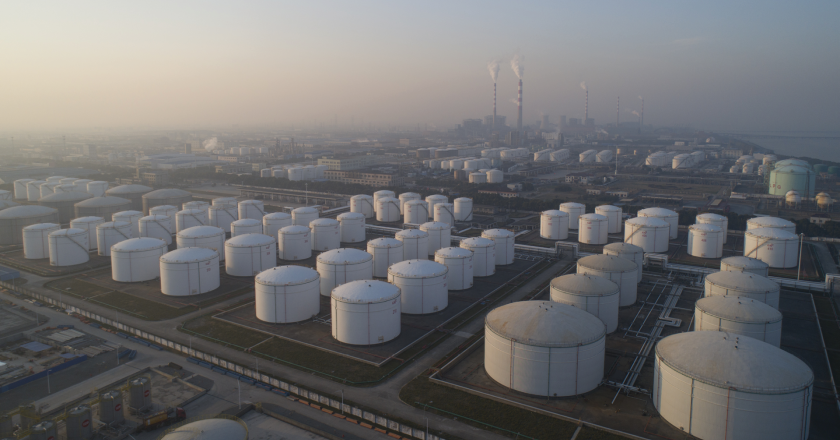
China’s national oil stockpiling program includes tens of millions of barrels of refined and unrefined petroleum across underground caverns, coastal tank farms, and dual-use depots in Northern, Eastern, and Southern Theater Commands. According to Reuters and satellite-based assessments, China had constructed at least five underground strategic fuel reserve sites by 2020, including at Huangdao, Jinzhou, Zhanjiang, and Huizhou, with underground capacity approaching 130 million barrels, much of which can support wartime needs through rapid refining and distribution.1
Heritage assesses that a meaningful portion of this crude oil and diesel inventory could be made available for military operations under national mobilization authority. This reserve system is centrally administered and held in strategic rear areas, including inland depots controlled by the Wuhan Joint Logistics Support Base, which is explicitly tasked with wartime fuel support to the theaters.2
Key Assumption: Heritage assumes that PLA logistics units have sufficient control over pipeline and rail access to redirect oil flows from strategic reserves into the operational pipeline within days—not weeks—of a major conflict onset.
- According to Chinese state media and academic studies of the PLA logistics system, the Joint Logistic Support Force (JLSF) is responsible for managing these strategic stocks and activating their use when front-line supplies falter.3
- These reserves are separate from the civilian economy and fall under state and party control during wartime mobilization, allowing the Central Military Commission (CMC) to direct fuel flows toward military use regardless of commercial pricing or civilian needs.4
- Heritage assumes that a portion of China’s large commercial SPR capacity is either composed of refined fuels or could be rapidly processed into JP-8/F-76 equivalents at refineries such as Zhenhai, Maoming, and Dalian, which are plausibly integrated with state-controlled distribution networks, although no explicit source was identified.5
The geographic spread of these reserves covers multiple theaters, with hardened or concealed depots situated inland and coastal ones either buried or protected. This strategic dispersion increases survivability under attack and enables selective activation in different theaters depending on operational need. Some of these depots are linked via national oil pipeline systems and could be directed toward specific military users if primary supply chains are degraded.6
Reason 2: The PLA maintains sizable operational-level fuel reserves near front-line bases that provide short-term sustainment for early wartime operations.
Heritage assesses that PLA operational reserves—including aviation and naval fuel—distributed across regional depots, air bases, and naval stations in the Eastern and Southern Theater Commands are likely sufficient to sustain one to two weeks of high-tempo combat operations without immediate reliance on national strategic reserves, with moderate confidence.
Key Assumption: Heritage assumes that these theater-level reserves are pre-filled to maximum capacity before conflict initiation, as part of PLA strategic preparation doctrine (战备加注), and that PLA logistics commands have routine authority to begin drawdown on D-0 without requiring CMC approval.
Chinese doctrinal writings and PLA logistics reform documents refer to these as “war readiness oil” (战备油料), which are stored at joint logistics support nodes or directly at operational units for immediate use.7
These depots include hardened underground or bermed above-ground storage tanks, typically located near major naval facilities like Zhoushan, Yulin (Sanya), and Zhanjiang, and airbases in Fujian, Zhejiang, and Guangdong. Satellite imagery and regional energy infrastructure assessments show visible POL tank clusters within or adjacent to many PLA airfields and ports, indicating substantial local reserves. Heritage assesses that these facilities collectively hold between five and 10 million barrels of JP-8/RP-3 and naval diesel fuel in dispersed tankage.
- According to CSIS’s AMTI satellite analysis and port infrastructure reports, major Chinese naval hubs—including Sanya/Yulin and Zhanjiang—host petroleum infrastructure designed for high-volume fuel handling, likely capable of supporting sustained naval operations for weeks.8
- Military analysts, including testimony before the U.S.–China Economic and Security Review Commission, have assessed PLA logistics doctrine as prioritizing forward-positioned “war readiness oil” to reduce early wartime dependence on long-range distribution.9
- Heritage assumes that each theater maintains a minimum of one to two weeks of surge-level fuel consumption in on-hand operational reserves, sufficient to sustain air sorties and naval deployments during the first phase of a Taiwan conflict.
These forward reserves are tactically essential for the PLA to rapidly generate combat power before strategic distribution lines are fully activated or if adversary interdiction delays national supply. However, they are inherently finite and geographically constrained. While they provide strong resilience for initial high-tempo operations, they cannot by themselves sustain prolonged combat beyond 30–60 days unless resupplied from deeper strategic stocks or national refineries.
Reason 3: The PLA Navy maintains afloat fuel reserves aboard dedicated replenishment ships and commercial tankers, enabling limited at-sea endurance and theater-level surge response.
Heritage assesses that PLA replenishment tankers and auxiliary oilers afloat are likely able to provide approximately 1 million barrels of JP-8/RP-3 and F-76-equivalent fuels as distributed, mobile reserve capacity at the outset of a Taiwan conflict, with moderate confidence.
Key Assumption: Heritage assumes that PLAN replenishment ships are pre-loaded to maximum practical fuel capacity at or near D-0, and that at least two-thirds of the fleet is operationally available for deployment to the Eastern and Southern Theater Commands.
As of mid-2025, the PLA Navy operates at least nine Type 903/903A Fuchi-class replenishment ships and two to three Type 901 Fuyu-class fast combat support ships. The Type 903 series typically displaces 23,000–25,000 tons and carries approximately 10,000 tons of fuel (≈75,000–80,000 barrels), while the larger Type 901 displaces ~45,000 tons and is assessed to carry up to 20,000 tons of liquid fuel (≈150,000+ barrels) in segregated tanks for JP-8 and naval diesel.⁶ These ships are purpose-built for underway replenishment, supporting carrier strike groups and major surface formations in contested waters.10
- According to Business Insider and defense analysis platforms, the Type 903/903A ships form the PLAN’s replenishment backbone, while the newer Type 901 provides faster, higher-volume resupply capability for carrier-led groups.11
- The PLAN reportedly commissioned a third Type 901 by early 2024, with the Hulunhu and Chaganhu already in service.12
- Heritage assumes each of the nine Type 903s and three Type 901s is capable of transporting its maximum fuel load on D-0 and that roughly two-thirds (≈8 ships) are mission-ready and fuel-loaded during initial wartime posture.
In aggregate, the PLA’s at-sea fuel carrying capacity likely exceeds 1 million barrels, with approximately 700,000–800,000 barrels in the Type 903 fleet and 450,000–500,000 barrels in the Type 901 class. These tankers may serve multiple roles:
- Stationed near the coastline (e.g., Sanya, Zhanjiang, Zhoushan) as floating depots, capable of offloading fuel to shore bases or amphibious assault formations;
- Escorting major surface task forces and providing fuel while underway during extended naval operations;
- Serving as mobile prepositioned reserves to quickly replace theater losses or surge consumption in a forward-operating zone.
In addition, Heritage assesses with moderate confidence that select commercial tankers under COSCO or Sinopec’s wartime mobilization authority may be pre-designated to carry reserve fuel loads or assist in distributing oil from shore to combat zones. This expands afloat capacity, though with higher vulnerability and less refueling flexibility.
Heritage assumes that PLAN doctrine includes preloading select civilian tankers in peacetime to create reserve capacity near the Southern and Eastern TCs, which may be anchored or loitering at key ports (e.g., Sanya, Zhanjiang, Ningbo) under escort or camouflage. However, no public source confirms this explicitly.
While afloat reserves enhance flexibility and reduce reliance on static infrastructure, they are operationally finite and logistically constrained. A single carrier strike group could consume over 30,000–40,000 barrels/day during high-intensity operations, meaning the entire replenishment fleet could be drained in less than one month without resupply from mainland ports. Their survivability, port access, and ability to execute underway refueling in contested waters directly affect usable throughput.
Reason 4: PLA reserve drawdown capacity is likely sufficient to sustain military operations for several months under moderate fuel delivery degradation but becomes critically constrained under severe throughput shortfalls.
Heritage assesses that PLA fuel reserves are likely sufficient to sustain combat operations for at least two to three months under a 30 percent daily delivery shortfall and up to six to 12 months under a 20 percent shortfall but are unlikely to prevent operational degradation beyond three months if throughput is cut by 50 percent or more, with moderate confidence.
Key Assumption: Heritage assumes a baseline PLA fuel demand of approximately 225,000 barrels per day during a Taiwan conflict and that daily shortfall values (20 percent–50 percent) reflect interdiction effects on both internal transport and port-based delivery, not total national production.
Under wartime conditions, the PLA may be unable to deliver its full daily requirement of petroleum—modeled at ~225,000 barrels per day—to operational end-users due to kinetic attacks, port interdictions, infrastructure bottlenecks, or logistics delays. The PLA’s ability to compensate for this shortfall depends on both total reserve volume and distribution access. To assess drawdown resilience, Heritage modeled three degradation scenarios (20 percent, 30 percent, and 50 percent) and calculated reserve endurance based on estimated strategic and operational reserve volumes.
- A 20 percent shortfall (~45,000 bpd deficit) could plausibly be absorbed using forward operational reserves for the first few weeks, followed by phased release of strategic ashore reserves. Assuming ~50 million barrels of usable strategic fuel stock, this drawdown rate yields a theoretical endurance of ~1,100 days, though bottlenecks and combat prioritization likely constrain this to ~6–12 months of sustained high-intensity operations.13
- A 30 percent shortfall (~67,500 bpd deficit) would require earlier and more frequent draws from strategic reserves. Using the same volume baseline, endurance would decline to ~740 days on paper but is more realistically modeled at 2–4 months before cumulative distribution friction, combat losses, or target prioritization reduce effective delivery.14
- A 50 percent shortfall (~112,500 bpd deficit) is unlikely to be sustainable for more than 2–3 months under sustained fighting. Even if reserve volumes suffice mathematically, Heritage assesses that delivery degradation, fuel site attrition, and transport loss would sharply reduce practical availability and force rationing across theaters.
Heritage assumes that PLA reserve activation follows a tiered logic:
- Operational reserves at base and theater level;
- Regional strategic depots released by the Joint Logistics Support Force; and
- National strategic petroleum reserves or civilian inventories diverted via State Council mobilization orders.
No open-source doctrine explicitly confirms this sequencing, but multiple sources describe the Joint Logistics Support Base network as the mid-point between local stocks and national emergency fuel access.
To illustrate the dynamic constraint, consider that even under a 50,000-bpd shortfall (≈22 percent degradation), a 25-million-barrel reserve would last 500 days—but only if full distribution capacity remains intact. If rail or pipeline segments are struck, or if port offload is delayed, delivery—not inventory—becomes the limiting factor. The PLA’s known effort to develop pipeline troops and cross-theater fuel routing options underscores their recognition of this constraint.⁸
Heritage therefore assesses that reserve volume alone does not define endurance; usable throughput capacity under fire will determine how long the PLA can maintain full operational tempo. Beyond 2–3 months of 50 percent degradation, campaign scale-backs, sortie rationing, and regional prioritization are likely required.
Endnotes
- Reuters, “China goes underground to expand its strategic oil reserves,” News Report (January 6, 2016), https://www.reuters.com/article/china-oil-storage-idUSKBN0UK2NT (accessed June 9, 2025); Gabriel Collins, “Energy Stockpiling as a China Strategic Warning Indicator” (testimony before the U.S.-China Economic and Security Review Commission, June 13, 2024), 12. https://www.uscc.gov/sites/default/files/2024-06/Gabriel_Collins_Testimony.pdf (accessed June 9, 2025); “Underground Oil Storage: China Risk Series,” Ursa Space Systems, August 23, 2024. https://ursaspace.com/blog/underground-oil-storage-china-risk-series/ (accessed June 9, 2025); and W. Chen et al., “Selecting China’s strategic petroleum reserve sites by multi-objective programming model,” Petroleum Science 14 (2017): 622–635. https://link.springer.com/article/10.1007/s12182-017-0175-0 (accessed June 9, 2025).↩
- U.S.–China Economic and Security Review Commission (USCC), “Energy Stockpiling as a China Strategic Warning Indicator,” Congressional Testimony (June 13, 2024), https://www.uscc.gov/sites/default/files/2024-06/June_13_2024_Hearing_Transcript.pdf (accessed June 9, 2025).↩
- U.S.–China Economic and Security Review Commission (USCC), “Energy Stockpiling as a China Strategic Warning Indicator,” Congressional Testimony (June 13, 2024), https://www.uscc.gov/sites/default/files/2024-06/June_13_2024_Hearing_Transcript.pdf (accessed June 9, 2025); Kevin McCauley, “Modernization of PLA Logistics: Joint Logistic Support Force” (testimony before the U.S.-China Economic and Security Review Commission, Washington, DC, February 15, 2018), 5-7, https://www.uscc.gov/sites/default/files/McCauley_Written%20Testimony.pdf (accessed June 9, 2025); and Joel Wuthnow, “Joint Logistics Support to PLA Theater Operations” (paper prepared for the Army War College PLA Conference, March 31–April 1, 2022). https://usawc-ssi-media.s3.us-east-1.amazonaws.com/pla-conf/Joint_Log_Support_PLA_Ops_Wuthnow.pdf (accessed June 9, 2025).↩
- Erin Richter and Ben Rosen, “China’s National Defense Mobilization System: Foundation for Military Logistics” (conference paper, U.S. Army War College Strategic Studies Institute, 2022), 13-14, https://usawc-ssi-media.s3.us-east-1.amazonaws.com/pla-conf/China_National_Defense_Mobilzation_System_Richter_Rosen.pdf (accessed June 9, 2025).↩
- “Sinopec - Zhenhai Oil Refinery,” IndustryAbout, https://www.industryabout.com/country-territories-3/61-china/oil-refining/149-sinopec-zhenhai-oil-refinery (accessed June 9, 2025); “China Oil & Gas Downstream Market,” Mordor Intelligence, April 2025, https://www.mordorintelligence.com/industry-reports/china-oil-and-gas-downstream-market (accessed June 9, 2025); “Zhenhai Refinery Exports First Diesel, Jet Fuel to Europe,” MRC Hub, February 2019, https://www.mrchub.com/news/349130-zhenhai-refinery-exports-first-diesel-jet-fuel-to-europe (accessed June 9, 2025); and SINOPEC Zhenhai Refining & Chemical Company, “Company Profile,” http://www.sinopec.com/listco/en/about_sinopec/subsidiaries/refinery_petrochemical/20161109/news_20161109_371005707581.shtml (accessed June 9, 2025).↩
- China Daily, “Pipeline soldiers: The ‘steel veins’ fueling PLA readiness,” News Article (August 13, 2019), https://www.chinadaily.com.cn/global/2019-08/13/content_37501285.htm (accessed June 9, 2025), and National Defense University Press, “Handling Logistics in a Reformed PLA: The Long March Toward Joint Logistics,” Academic Chapter (2019), https://ndupress.ndu.edu/Publications/Books/Chairman-Xi-Remakes-the-PLA/Article/2066523/chapter-7-handling-logistics-in-a-reformed-pla-the-long-march-toward-joint-logis/ (accessed June 9, 2025).↩
- U.S.–China Economic and Security Review Commission (USCC), “Energy Stockpiling as a China Strategic Warning Indicator,” Expert Testimony (June 13, 2024), https://www.uscc.gov/sites/default/files/2024-06/June_13_2024_Hearing_Transcript.pdf (accessed June 9, 2025).↩
- CSIS Asia Maritime Transparency Initiative (AMTI), “Infrastructure and Intentions: China’s Maritime Logistics Network,” Satellite Analysis (February 14, 2023), https://amti.csis.org/infrastructure-and-intentions-chinas-maritime-logistics-network/ (accessed June 9, 2025).↩
- U.S.–China Economic and Security Review Commission (USCC), “Energy Stockpiling as a China Strategic Warning Indicator,” Expert Testimony (June 13, 2024), https://www.uscc.gov/sites/default/files/2024-06/June_13_2024_Hearing_Transcript.pdf (accessed June 9, 2025).↩
- “China Increases Type 903A Replenishment Oiler Fleet to Extend Naval Reach Across the Pacific,” Army Recognition, November 13, 2025. https://www.armyrecognition.com/news/navy-news/2025/china-increases-type-903a-replenishment-oiler-fleet-to-extend-naval-reach-across-the-pacific (accessed June 9, 2025); “Type 901 Class Fleet Replenishment Ship,” Naval Technology, January 21, 2022. https://www.naval-technology.com/projects/type-901-class-fleet-replenishment-ship/ (accessed June 9, 2025); and “Type 901,” GlobalSecurity.org, https://www.globalsecurity.org/military/world/china/type-901.htm (accessed June 9, 2025).↩
- Business Insider, “The US Navy is working to close the gap with China’s growing fleet of support ships,” Defense News Article (November 2, 2024), https://www.businessinsider.com/us-navy-working-to-close-gap-with-chinas-support-ship-fleet-2024-11 (accessed June 9, 2025).↩
- Business Insider, “The US Navy is working to close the gap with China’s growing fleet of support ships,” Defense News Article (November 2, 2024), https://www.businessinsider.com/us-navy-working-to-close-gap-with-chinas-support-ship-fleet-2024-11 (accessed June 9, 2025).↩
- U.S.–China Economic and Security Review Commission (USCC), “Energy Stockpiling as a China Strategic Warning Indicator,” Expert Testimony (June 13, 2024), https://www.uscc.gov/sites/default/files/2024-06/June_13_2024_Hearing_Transcript.pdf (accessed June 9, 2025).↩
- U.S.–China Economic and Security Review Commission (USCC), “Energy Stockpiling as a China Strategic Warning Indicator,” Expert Testimony (June 13, 2024), https://www.uscc.gov/sites/default/files/2024-06/June_13_2024_Hearing_Transcript.pdf (accessed June 9, 2025).↩