The Douglas and Sarah Allison Center for National Security
Key Judgments
Heritage judges that China’s military fuel system has a highly centralized logistical architecture whose foundational dependencies on maritime importation and coastal refinery production create multiple, decisive vulnerabilities in a conflict. The systematic targeting of specific, well-defined hubs within this system would likely trigger a cascading failure, severely degrading the ability of the People’s Liberation Army (PLA) to sustain high-intensity joint operations in the Western Pacific.
This judgment is made with high confidence, based on our models of fuel consumption, multi-variable sensitivity analysis to identify the most impactful levers, and target system analysis to pinpoint critical vulnerabilities.
This analysis assumes that China’s military fuel system lacks a deep, covert, and resilient network of hardened underground pipelines and storage depots. If this assumption is false, the strategic impact of targeting the known coastal nodes would be substantially reduced, as the PLA could bypass them and rely on a more survivable, clandestine infrastructure. This assumption, however, is supported by the lack of significant open-source or intelligence reporting on the existence of such a large-scale strategic network, and the high probability that a construction effort of this magnitude would be detected by modern surveillance assets. However, the absence of such a network cannot be definitively confirmed.
The system’s vulnerabilities can be grouped into two primary categories:
- Strategic Chokepoints are the well-understood, macro-level risks to the system. A military blockade of the Strait of Malacca, for instance, would sever the primary artery for crude oil imports, while kinetic attacks on concentrated coastal refineries would destroy production capacity. These actions would require significant military force and carry high escalation risks.
- Technological Dependencies are less visible but equally critical vulnerabilities within the system’s brittle backbone. ████████████████████████████████████████████████████████████████████████████████████████████████████████████████████████████████████████████████████████████████████████████████████████████████████████████████████████████████████████████████████████████████████████████████████████████████████████████████████████████████████████████████████████████████████████████████████████████████████████████████████████████████████████████████████████████████████
Our analysis identifies the system’s primary vulnerabilities:
- Deep-Water Ports and Terminal Infrastructure
- Reliance on the Strait of Malacca
- Complex Refinery Process Units
- Refinery and Pier Infrastructure
- ███████████████████████████████████████
Exploiting these weaknesses through a layered, multi-domain campaign would almost certainly cripple China’s ability to sustain joint military operations, thereby enhancing the U.S. operational advantage.
System Structure: Linking Capabilities and Requirements
Overview and Assumptions
The core purpose of the People’s Republic of China’s (PRC’s) military fuel system is almost certainly to enable and sustain the PLA’s joint combat operations and mitigate the PRC’s long-acknowledged strategic vulnerability to energy coercion.
China imports approximately 70 percent of its oil, the majority of which must transit maritime chokepoints.1 While this geographic vulnerability is well understood, it is compounded by a less visible but equally critical dependency: a foundational reliance on foreign-sourced components and intellectual property that underpins its domestic refining capability.
- According to an assessment from the U.S. Department of War, a key function of the system is fueling the naval and air assets that project power at increasingly long ranges from the Chinese mainland.2 This function is executed through a national strategy of Military–Civil Fusion, which deeply integrates the PLA’s logistics with the country’s vast state-owned civilian energy infrastructure.3 This fusion almost certainly entails leveraging commercial refineries, ports, and storage depots to serve military requirements during a conflict.
- The overall architecture is best understood as a multi-echeloned “system of systems” that connects national reserves to tactical end users. This architecture’s strategic echelon is centered on the Strategic Petroleum Reserve (SPR), which provides a national buffer against a sustained blockade.4
- The system’s tactical echelon depends on an expanding fleet of underway replenishment ships, which are critical for sustaining naval operations far from shore.
Key Assumption 1: Military–Civil Fusion Efficacy. This analysis assumes China’s Military–Civil Fusion strategy will function as intended during a conflict, making its vast civilian energy infrastructure reliably available for military use. If this assumption is false—due to technical incompatibility or the reluctance of civilian crews to operate in a high-threat environment—the PLA’s entire fuel distribution model would be severely degraded, as its organic military logistics assets are insufficient to meet wartime demands. However, indicators that this assumption holds true include the legal authorities granted under China’s National Defense Mobilization Law and PLA exercises that consistently integrate civilian assets.
Key Assumption 2: Persistent Technological Dependency. This analysis assumes that China’s continued procurement of foreign technology for its most advanced refineries reflects a genuine and persistent performance gap, and that it cannot rapidly reverse-engineer or mass-produce high-quality domestic substitutes █████████████████████████████████████████████████████████████. If this proves false, and China possesses a latent or “shadow” domestic capability, the impact of the recommended non-kinetic supply chain interdiction would be significantly diminished, shifting the vulnerability from a long-term technological chokepoint to a more conventional physical supply issue. Indicators that this assumption holds true include the consistent pattern of Chinese state-owned oil companies licensing foreign process technologies for their flagship projects and the documented use of foreign subcomponents by China’s own domestic industrial champions.
Key Assumption 3: Absence of a Covert, Resilient Network. This analysis assumes that China has not constructed a vast, covert network of hardened and deeply buried underground fuel pipelines and storage depots that would provide a resilient alternative to its visible coastal infrastructure. If this assumption is false, the strategic impact of kinetically targeting the known coastal nodes of the fuel system would be substantially reduced, requiring a more prolonged and widespread interdiction campaign to achieve a decisive effect. This assumption is supported by the high probability that a construction effort of such a strategic scale would be detected by modern intelligence, surveillance, and reconnaissance assets, and the lack of significant open-source evidence to support its existence.
Critical Capabilities Analysis
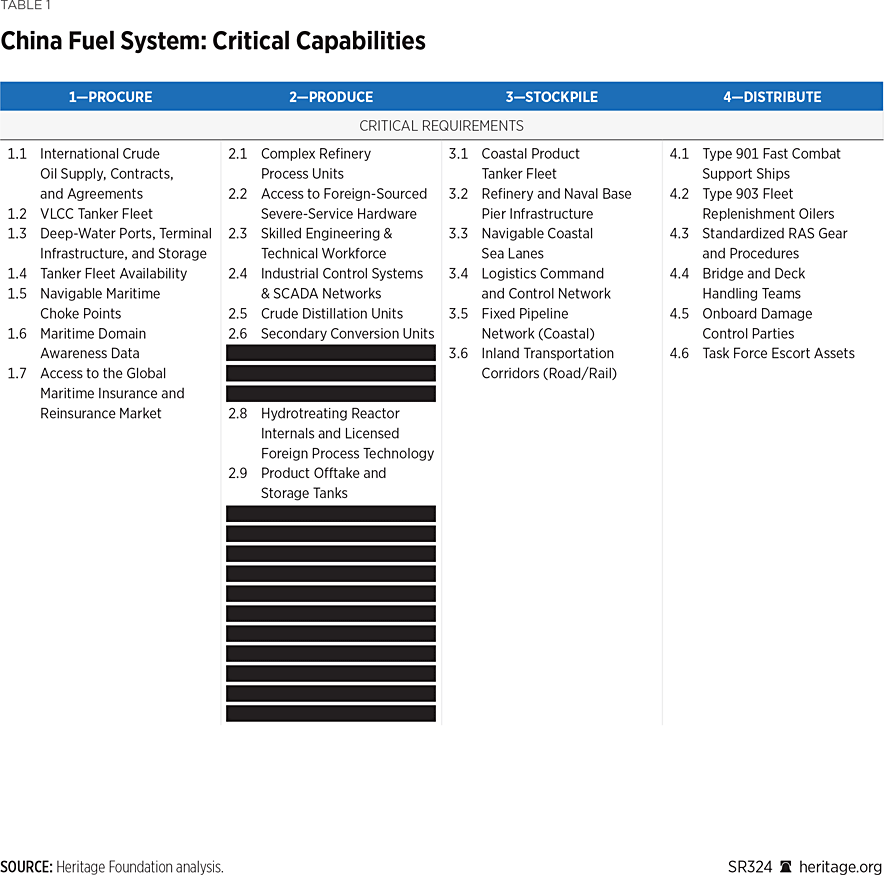
The following represents the top-scoring critical capabilities based on our CARVER framework assessment of China’s military fuel system:
The four critical capabilities of the PLA’s fuel system are not independent functions but are linked in a fragile, sequential chain. The entire system is predicated on the success of the first capability, (1) Import, which provides raw feedstock. A failure to import crude oil would immediately starve (2) Refine, making the nation’s significant refining capacity useless. Without refined products, (3) Distribute becomes an empty capability, as the coastal tanker fleet would have no military-grade fuel to move. Ultimately, this means the (4) Replenish fleet, the critical enabler of blue-water naval power, would be unable to access fuel, confining the PLA Navy to its immediate coast. This sequential dependency means a failure at the beginning of the chain almost certainly triggers a total, cascading collapse of the entire system.
Critical Capability 1: Import (High-Volume Maritime)
The PLA’s ability to sustain high-tempo operations is existentially dependent on the continuous, large-scale importation of crude oil, a flow that is geographically constrained and relies on a fragile global maritime ecosystem. China’s import dependency represented 70.9 percent of its total oil consumption in 2023. The system must process about 11.3 million barrels per day, the vast majority of which arrives via sea.5
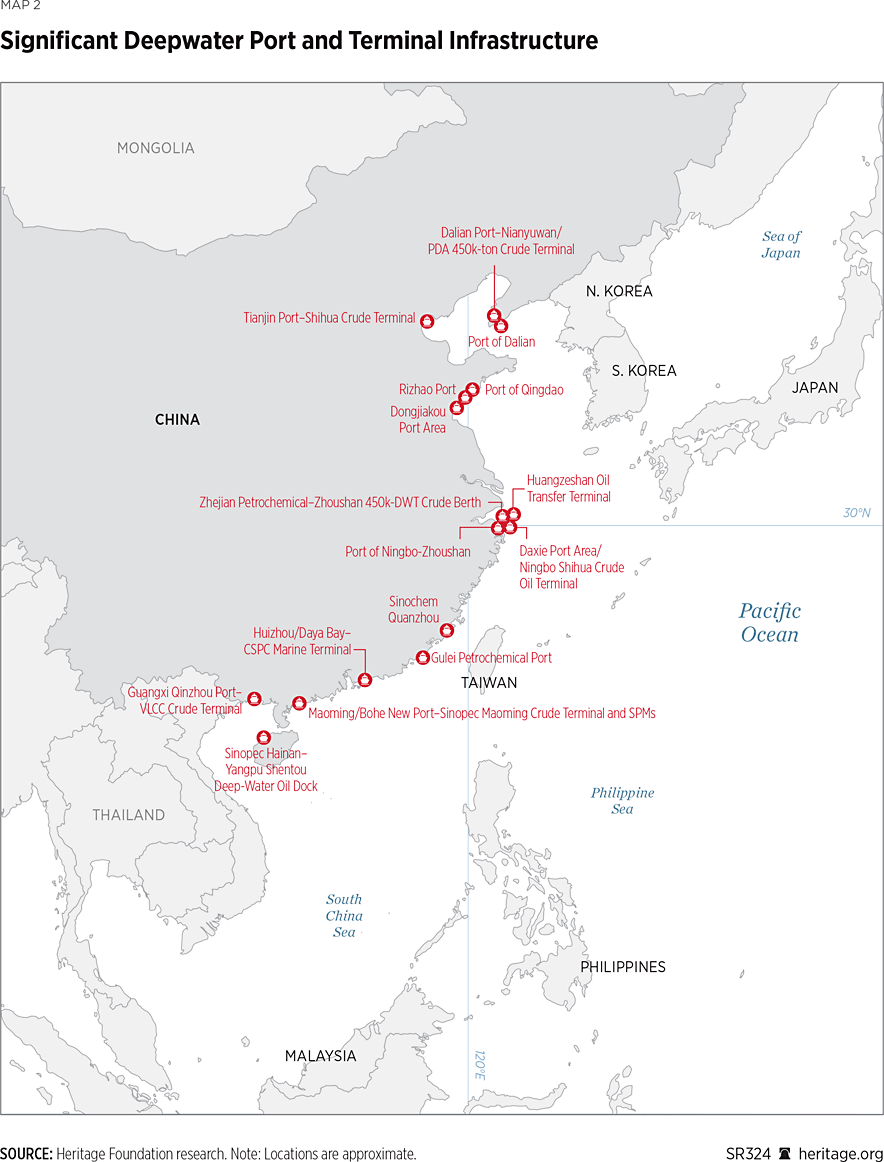
An estimated 80 percent of these imports must transit the Strait of Malacca, a single geographic chokepoint with no viable alternative at scale. This massive flow is funneled into a few deep-water ports, like the Port of Ningbo-Zhoushan, equipped to handle the Very Large Crude Carriers (VLCCs) that form the backbone of this maritime supply line.6
This intricate system functions as a continuous, high-volume conveyor belt connecting global oil producers to China’s coastal refineries. The process begins with the execution of supply contracts and diplomatic agreements that secure the raw material from producer nations. To physically move the crude, China must charter VLCCs from the international market, as its state-owned fleet is insufficient to meet demand. Before a voyage can commence, each tanker and its multi-million-dollar cargo must be underwritten by specialized maritime insurance, a nonnegotiable prerequisite for non-gray-fleet commercial voyages.
Guided by satellite navigation data and operated by international crews, these tankers then traverse secure sea lines of communication, with the majority funneled through the indispensable Strait of Malacca chokepoint. Upon arrival, the system’s final step relies on the specialized infrastructure of a few deep-water ports, where the crude is offloaded into vast coastal tank farms, completing the journey from the wellhead to the doorstep of China’s refining industry.
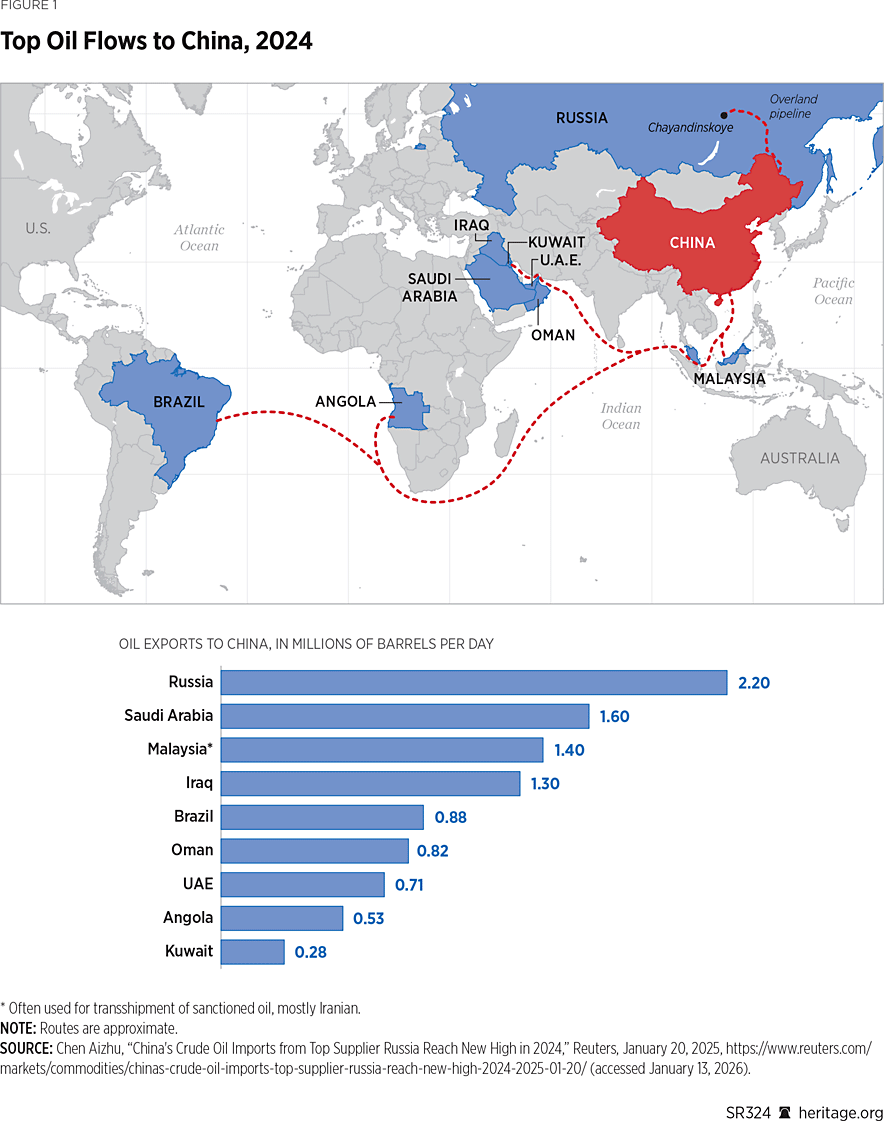
- Critical Requirement 1.1: International Crude Oil Supply, Contracts, and Agreements. This requirement consists of the established contract, legal, and diplomatic arrangements that guarantee access to producer nations, a critical factor given that Russia was China’s top supplier in 2023, providing 2.1 million barrels per day, according to Reuters.7
- Critical Requirement 1.2: VLCC Tanker Fleet. This requirement is the physical conveyance system, comprised of state-owned and internationally chartered VLCCs that can each transport approximately two million barrels of oil, which is essential for moving crude at the required scale.8
- Critical Requirement 1.3: Deep-Water Ports, Terminal Infrastructure, and Storage. This requirement encompasses the small number of fixed coastal facilities that possess the requisite deep-water anchorages and specialized offloading equipment to handle the VLCCs, such as the Port of Ningbo-Zhoushan, which is the world’s busiest by cargo tonnage and is equipped to handle massive volumes of crude oil, according to global shipping analysis.9
- Critical Requirement 1.4: Tanker Fleet Availability. This requirement is the combined physical availability of sufficient VLCC hulls (Critical Requirement 1.2)—evidenced by COSCO Shipping Energy’s fleet of approximately 43 VLCCs (with industry data suggesting as many as 83 across COSCO Shipping Energy Transportation and affiliated operators)—and the trained, willing maritime crews needed to operate them on hazardous routes, as detailed in maritime industry publications.10 This also depends on the willingness of international shipowners to service Chinese ports. China’s state-owned tanker fleet can carry less than 10 percent of its crude oil imports, making it critically dependent on the global charter market to meet its needs.11
- Critical Requirement 1.5: Navigable Maritime Chokepoints. This requirement is the continuous, unimpeded access to geographically constrained transit routes and sea lines of communication, particularly the Strait of Malacca, which an estimated 80 percent of China’s crude oil imports must pass through, according to a U.S. government assessment of global energy chokepoints.12
- Critical Requirement 1.6: Maritime Domain Awareness Data. This requirement is the real-time positional and navigation information needed for safe maritime operations. China’s BeiDou satellite system is increasingly contributing to this domain: It has been certified by the International Maritime Organization for maritime distress and safety communications via the Global Maritime Distress and Safety System, and Chinese state media, along with industry analysis, indicate growing adoption of BeiDou across Chinese shipping lines and export-linked infrastructure, according to an English-language web portal of the Chinese government, which often syndicates content from the state press agency, Xinhua.13
- Critical Requirement 1.7: Access to the Global Maritime Insurance and Reinsurance Market. This requirement includes the essential financial architecture, including specialized war-risk insurance needed to cover high-value assets like VLCCs and the nonnegotiable prerequisite for any tanker to operate legally and commercially. Global maritime trade operates on a “No Insurance, No Sail” doctrine. Without valid, internationally recognized insurance, a tanker is a commercial pariah, unable to enter most major ports, secure financing for its voyage, or legally transport its cargo, according to academic legal analysis.14
Critical Capability 1: Linked Vulnerabilities
These vulnerabilities are deeply interconnected, creating a cascade of potential failures where a single trigger event could activate multiple chokepoints simultaneously. The physical risk of a military blockade at a maritime chokepoint or a standoff attack on port infrastructure would almost certainly trigger the non-kinetic vulnerabilities within the commercial maritime ecosystem. █████████████████████████████████████████████████████████████████████████████████████████████████████████████████████████████████████████████████████████████████████████████████████████████████████████████████████████████████████████████████████████████████████████████████████████████████████████████████████████████████████████████████████████████████████████████████████████████████████████████████████████████████████████████████████████████████████████████████████████████████████████████████████████████████████
- International Tanker Charter Market
Availability. This dependency creates a vulnerability to a “private blockade” effect. ██████████████████████████████████████████████████████████████████████████████████████████████████████████████████████████████████████████████████████████████████████████████████████████████████████████████████████████████████████████████████████████████████████████████████████████████████████████████████████████████████████████████████████████████████████████████████████████████████████████████████████████████████████████████████████████████████████████████████████████████████████████████████████████████████████████████████████████████████████████████████████████████████████████████████████████████████████████████████████████████████████████████████████████████████████████████████████████████████████████████████████████████████████15
- Long-Term Supply Contracts
Geopolitical Instability in Supplier Nations. This dependency creates a vulnerability to sudden political shocks within a supplier state, which can halt exports regardless of contractual obligations, as demonstrated when Libyan oil production fell by over 75 percent following the outbreak of its civil war, according to a U.S. Congressional Research Service report.
- Maritime Insurance and Financial Networks
████████████████████████████████████████████████████████████████████████████████████████████████████████████████████████████████████████████████████████████████████████████████████████████████████████████████████████████████████████████████████████████████████████████████████████████████████████████████████████████████████████████████████████████████16
- VLCC Hulls and Cargo Capacity
Charter Market Refusal. The system’s reliance on the global charter market creates a vulnerability wherein shipowners can refuse to lease vessels for high-risk voyages, a right often codified in standard “war-risk” clauses within charter agreements, as outlined by international maritime law firms.17
- Trained Maritime Crews
Crew Refusal. This operational constraint makes the system vulnerable to a large-scale refusal by seafarers to enter a conflict zone, a right supported by maritime labor organizations like the International Transport Workers’ Federation, which can designate “warlike operations areas” where crews are entitled to refuse sailing and be repatriated.18
- Port Offloading Infrastructure
Specialized Equipment Failure with Long Lead Times. Highly specialized marine loading arms required to offload VLCCs almost certainly represent a vulnerability due to a lack of redundancy and long replacement lead times, a common feature of large, bespoke industrial systems, according to industrial engineering safety analysis.19
- Coastal Storage Tank Farms
Susceptibility to Standoff Attack. The concentration of large, unhardened tanks at coastal depots exposes them to precision standoff attacks capable of causing cascading fires. This vulnerability was demonstrated when Ukrainian drones struck an oil depot in Oryol, igniting storage tanks and triggering secondary fires—a strategic impact on fuel logistics in the Russia–Ukraine conflict.
- Maritime Domain Awareness and Navigational Data
Denial or Spoofing of Positioning, Navigation, and Timing Data. The dependency on satellite navigation creates a vulnerability to electronic warfare, as multiple instances of significant GPS interference and spoofing impacting commercial shipping have been officially reported in strategic waterways like the Eastern Mediterranean and the Black Sea.20
- Navigable Maritime Chokepoints
Military Blockade or Closure. This geographic single point of failure is the system’s most acute vulnerability, as a closure of the Strait of Malacca would force tankers onto longer and less secure alternative routes, such as the Lombok Strait, adding approximately 4,600 nautical miles to a voyage from the Persian Gulf, according to U.S. government energy analysis.21
- Indian Ocean Sea Lanes
Far Blockade via India Partnership. Beyond chokepoints like Malacca, China’s reliance on Indian Ocean sea lanes creates an additional external vulnerability exploitable through coalition interdiction. Dozens of VLCCs per day transit the Indian Ocean toward China, representing roughly half of its oil supply. The Indian Navy, with its geographic advantage at the Andaman and Nicobar Islands and a fleet of approximately 130 combatants, submarines, and P-8I aircraft, is operationally capable of sustaining interdiction patrols across these approaches. A U.S.–India partnership would very likely enable a “far blockade” outside China’s A2/AD envelope, cutting imports at source while reducing U.S. force diversion from the Taiwan theater. This lever could sever China’s alternative supply routes and shorten the timeline on PLA fuel endurance.22
- Financial/Insurance Sanctions
Import Vulnerabilities. Beyond physical interdiction of sea lanes, China’s crude import system is critically exposed to non-kinetic disruption through the global maritime insurance regime. ███████████████████████████████████████████████████████████████████████████████████████████████████████████████████████████████████████████████████████████████████████████████████████████████████████████████████████████████████████████████████████████████████████████████████████████████████████████████████████████████████████████████████████████████████████████
Critical Capability 2: Refine (Mass-Scale Coastal Production)
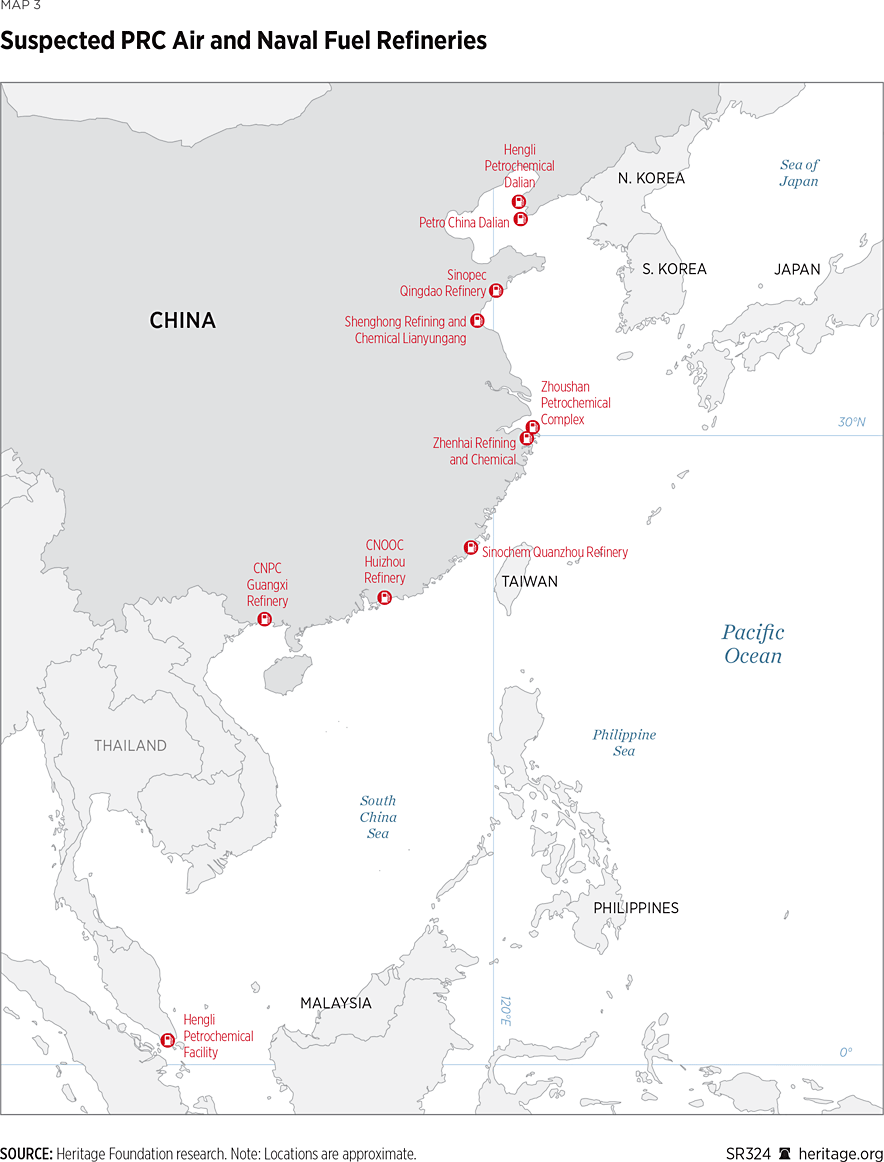
China’s mass-scale coastal refining capability is the industrial core of its military fuel system, converting imported crude into the specialized fuels required for modern warfare. This capability is defined by its world-leading scale, its geographic concentration in vulnerable coastal zones, and its deep integration with the civilian sector under the national strategy of Military–Civil Fusion. China possesses the world’s largest refining network with a capacity of 19.1 million barrels per day, concentrated in coastal areas, according to a comprehensive worldwide refining survey in the Oil & Gas Journal, a globally respected trade publication known for its detailed industry data.23 This physical infrastructure is leveraged for military purposes through the state’s Military–Civil Fusion strategy.
This production system functions by processing crude oil through a sequence of technologically complex, interconnected process units. The operation begins with Crude Distillation Units that perform the initial separation, which is then fed into Secondary Conversion Units, such as hydrocrackers, that upgrade the raw fractions into on-specification military fuels.
The system’s operation depends on multiple critical dependencies functioning in concert. The high-performance hardware at the heart of the most critical units very likely relies on foreign-sourced severe-service components and licensed process technologies. This physical infrastructure is operated via a sophisticated digital architecture of industrial control systems, while the chemical conversion processes are fed by a continuous stream of specialized catalysts and consumables. The facility is powered by a massive and uninterrupted supply of electricity from the external power grid and managed by a cadre of skilled engineers, without whom the system cannot safely or efficiently produce the finished fuels that are moved to offtake storage.24
- Critical Requirement 2.1: Complex Refinery Process Units. This requirement consists of the essential industrial hardware, such as fluid catalytic cracking units that convert heavy oils into more valuable lighter products, which are fundamental to producing military-grade fuels, according to U.S. government energy analysis.25
- Critical Requirement 2.2: Access to Foreign-Sourced Severe-Service Hardware. This requirement is the set of specialized, high-performance components engineered to withstand the extreme temperatures and pressures of advanced refining processes needed to produce military-grade fuels. Key components include severe-service valves, high-pressure compressors, and American Petroleum Institute (API)-certified pumps.26
- Critical Requirement 2.3: Skilled Engineering and Technical Workforce. This requirement represents a cadre of specialized engineers and technicians needed to operate the refinery.27
- Critical Requirement 2.4: Industrial Control Systems and Supervisory Control and Data Acquisition (SCADA) Networks. This requirement is the digital architecture used to operate the refinery, which is a known target for malicious cyber actors who seek to disrupt or damage critical infrastructure.28
- Critical Requirement 2.5: Crude Distillation Units. This requirement is the foundational process unit that performs the initial separation of crude oil into hydrocarbon fractions; its processing capacity directly defines the overall capacity of the entire refinery, according to U.S. government energy analysis.29
- Critical Requirement 2.6: Secondary Conversion Units. This requirement consists of high-complexity hardware, such as hydrocrackers, that are essential for upgrading heavier oils into high-value, military-specification products like jet fuel, as described by industrial chemical engineering resources.30
- Critical Requirement 2.7: Continuous Supply of Imported Chemical Consumables. This requirement is the stream of high-performance catalysts and specialty chemicals that are consumed during the refining process and are essential for producing on-specification military fuels. █████████████████████████████████████████████████████████████████████████████████████████████████████████████████████████████████████████████████████████████████████████████████████████████████████████████████████████████████31
- Critical Requirement 2.8: Hydrotreating Reactor Internals and Licensed Foreign Process Technology. These are the complex, custom-engineered components inside the reactor vessels that are essential for managing the flow of liquids and gases through the catalyst beds.32 Their design is foreign-licensed, proprietary, non-interchangeable, and critical to running the most efficient, high-yield refining processes.33
- Critical Requirement 2.9: Product Offtake and Storage Tanks. This requirement encompasses the dedicated storage tanks and pipeline infrastructure needed to move finished products out of the refinery, without which the facility would be forced to reduce or halt production due to internal bottlenecks, a fundamental principle of refinery logistics.34
- Critical Requirement 2.10: ████████████████████████████████████████████████████████████████████████████████████████████████████████████████████████████████████████████████████████████████████████████████████████████████████████████████████████████████████████████████████████████████████████████████████████████████████████████████████████████████████████████████████████████████████████████████████████████████████████████████████████████████████████████████████████████████████████████████████████████████████████████████████████████████████████████████████████████████████████████████████████████████████████████████████████████████████████████████████████████████████████████████████████████████████████████████████████████████████████████████████████████████████████████████████████████████████████████████████████████████████████████████████████████████████████████████████████████35
- Critical Requirement 2.11: ████████████████████████████████████████████████████████████████████████████████████████████████████████████████████████████████████████████████████████████████████████████████████████████████████████████████████████████████████████████████████████████████████████████████████████████████████████████████████████████████████████
- Critical Requirement 2.12: █████████████████████████████████████████████████████████████████████████████████████████████████████████████████████████████████████████████████████████████████████████████████████████████████████████████████████████████████████████████████████████████████████████████████████████████████████████████████████████████████████████████████████████████████████████36
- Critical Requirement 2.13: █████████████████████████████████████████████████████████████████████████████████████████████████████████████████████████████████████████████████████████████████████████████████████████████████████████████████████████37
- Critical Requirement 2.14: ███████████████████████████████████████████████████████████████████████████████████████████████████████████████████████████████████████████████████████████████████████████████████████38
- Critical Requirement 2.15: ███████████████████████████████████████████████████████████████████████████████████████████████████████████████████████████████████████████████████████████████████████████████████████████████████████████████████████████████████████████████████████████████████████████████████████████████████████████████████████████████████████████████████████39 ███████████████████████████████████████████████████████████████████████████████████████████████████████████████████████████████████████████████████████████████████████████████████████████████████████████████████████████████████████████████████████████
Critical Capability 2: Linked Vulnerabilities
The vulnerabilities within China’s coastal refining capability are critically interlinked, creating a cascade where a physical event can be catastrophically amplified by non-kinetic actions. For instance, a kinetic strike targeting a key secondary conversion unit or its essential power substation is the initial shock. However, the true vulnerability emerges in the recovery phase.
The ability to repair this damage is almost certainly crippled by the refinery’s deep-seated reliance on foreign technology. ███████████████████████████████████████████████████████████████████████████████████████████████████████████████████████████████████████████████████████████████████████████████████████████████████████████████████████████████████████████████████████████████████████████████████████████████████████████████████████████████████████████████████████████████████████████████████████████████████████████████████████████████████████████████████████████████████████████████████████████████████████████████████████████████████████████████████████████████████████████████████████████████████████████████████████████████████████████████████████████████████████████
███████████████████████████████████████████████████████████████████████████████████████████████████████████████████████████████████████████████████████████████████████████████████████████████████████████████████████████████████████████████████████████████████████████████████████████████████████████████████████████████████████████████████████████████████████████████████████████████████
- █████████████████████████████████████████████████
██████████████████████████████████████████████████████████████████████████████████████████████████████████████████████████████████████████████████████████████████████████████████████████████████████████████████████████████████████████████████████████████████████████████████████████████████████████████████████████████████████████████████████████████████████████████████████████████████████████████████████████████████████████████████████████████████████████████████████████████████████████████████████████████████████████████████████████████████████████████████████████████████████████████████████████████████████████████████████████████████████████████████████████████████████████████████████████████████████████████████████████████████████████████████████████████████████████████████████40
- ████████████████████████████████
██████████████████████████████████████████████████████████████████████████████████████████████████████████████████████████████████████████████████████████████████████████████████████████████████████████████████████████████████████████████████████████████████████████████████████████████████████████████████████████████████████████████████████████████████████████████████████████████████████████████████████████████████████████████████████████████████████████████████████████████████████████████████████████████████████████████████████████████████████████████████████████████████████████████████████
- ██████████████████████████████████████████████████
████████████████████████████████████████████████████████████████████████████████████████████████████████████████████████████████████████████████████████████████████████████████████████████████████████████████████████████████████████████████████████████████████████████████████████████████████████████████████████████████████████████████████████████████████████████████████████████████████████████████████████████████████████████████████████████████████████████████████████████████████████████████████████████████████████████████████████████████████████████████████████████████████████████████████████████████████████████████████████████████████████████████████████████████████████████████████████████████████████████████████████████████████████████████████████████████████████████41
- Crude Distillation and Secondary Conversion Units
Kinetic Attack on Process Units: These units are single points of failure whose destruction would be catastrophic, as the failure of a single distillation unit can cause explosions with a blast radius of over half a mile, according to official U.S. government investigations of refinery accidents.42
- Skilled Engineering and Technical Workforce
Personnel Unavailability: The dependency on a specialized workforce likely creates a vulnerability where a national crisis could prevent essential staff from reaching the plant, a challenge that required extensive mitigation strategies by energy companies during the COVID-19 pandemic, according to analysis by a major global professional services firm.43
- External Grid Electrical Power
Grid and Substation Vulnerability: The refinery’s total dependence on external power makes its local substation a single point of failure, and physical attacks on such electrical infrastructure have increased dramatically, becoming a significant threat to grid stability, according to major news organization reporting.44
- Chemical Catalysts and Consumables
Specialized Supply Chain Interdiction: The dependency on a global supply chain for catalysts, which are essential for producing high-quality fuels, creates a vulnerability to disruption, as the market is concentrated among a few international suppliers.45
- ██████████████████████████████████
████████████████████████████████████████████████████████████████████████████████████████████████████████████████████
- ████████████████████████████████
███████████████████████████████████████████████████████████████████████████████████████████████████████████████████████████████████████
- ████████████████████████████████████████████████
██████████████████████████████████████████████████████████████████████████████████████████████████████████████████████████████████████████████
- █████████████████████████████████████████████████
█████████████████████████████████████████████████████████████████████████████████████████████████████████████████████████████████████████████████████████████████████████████████████████████████████████████████████████████████████████████████████████████████████████████████████████████████████████████████████████████████████████████████████████████████████████████████46
- █████████████████████████████████████████████████████████████
██████████████████████████████████████████████████████████████████████████████████████████████████████████████████████████████████████████████████████████████████████████████████████████████████████████████████████████████████████████████████████████████████████████████████████████████████████████████████████████████████████████████████████████████████████████████████████████████████████████████████████████████████████████████████████████████████████████████████████████████████████████████████████████████████████████████████████████████████████████████████████████████████████████████████████████████████████████████████████████████████████████████████████47
- ███████████████████████████████████
████████████████████████████████████████████████████████████████████████████████████████████████████████████████████████████████████████████████████████████████████████████████████████████████████████████████████████████████████████████████████████████████████████████████48
- Product Offtake and Storage Tanks
Downstream Distribution Bottlenecks: This systemic dependency means that a failure in the distribution network for finished fuels would create a bottleneck, filling storage tanks and forcing the refinery to cut production or shut down entirely, as reported by RBN Energy Daily.49
- Operation of Foreign-Supplied ICS
████████████████████████████████████████████████████████████████████████████████████████████████████████████████████████████████████████████████████████████████████████████████████████████████████████████████████████████████████████████████████████████████████████████████████████████████████████████████████████████████████████████████████████████████████████████████████████████████████████████████████████████████████████████████████████████████████████████████████████████████████████████████████████████████████████████████████████████████████████████████████████████████████████████████████████████████████████50
Critical Capability 3: Distribute (Vulnerable Coastal Network)
The PLA’s coastal distribution network is very likely the critical logistical artery that connects fuel production to frontline naval and air forces. This capability is almost certainly dependent on a large fleet of civilian and military coastal product tankers, managed by the PLA’s Joint Logistics Support Force (JLSF), to move refined fuels from refineries to key military installations along China’s heavily trafficked coast.
This distribution system operates as a coastal relay system, with the JLSF moving the refined products from production to consumption points. The JLSF is empowered by China’s National Defense Mobilization Law, which grants the state the authority to requisition its civilian merchant marine to support military logistics. These civilian and military coastal product tankers are directed to specific refinery out-loading piers. Once loaded, these tankers then transit the congested but predictable coastal sea lanes. The final, critical step is the offloading of fuel at the dedicated pier infrastructure of fixed naval and air bases, such as Yulin Naval Base, transferring the fuel into the PLA’s forward-positioned storage depots. This entire operation very likely depends on the continuous, unimpeded functioning of these three core elements: the tanker fleet, the coastal transit routes, and the fixed port infrastructure at both ends of the logistical chain.
- Critical Requirement 3.1: Coastal Product Tanker Fleet. This requirement is the large fleet of civilian and military tankers that transport refined fuels. These tankers service critical, fixed-location naval bases. Under Chinese law, the state has the authority to requisition its civilian merchant marine to support military logistics, according to analysis from the U.S. Naval War College.51
- Critical Requirement 3.2: Refinery and Naval Base Pier Infrastructure. This requirement consists of the fixed out-loading and in-loading facilities, such as the extensive underground fuel depots and dedicated piers observed at the PLA Navy’s Yulin Naval Base, which are necessary to transfer fuel to and from coastal tankers.52
- Critical Requirement 3.3: Navigable Coastal Sea Lanes. This requirement is the network of established and heavily trafficked maritime routes along China’s coast that tankers must transit, which are among the most congested waterways in the world, according to academic studies on maritime traffic data.53
- Critical Requirement 3.4: Logistics Command and Control Network. This requirement is the formal organization responsible for managing the distribution of fuel and other supplies, a role performed by the PLA’s JLSF.54
- Critical Requirement 3.5: Fixed Pipeline Network (Coastal). This requirement consists of the fixed pipelines connecting ports, depots, and bases. These pipelines are often non-redundant, meaning a single break or valve failure can halt fuel flow without an immediate rerouting option, creating a significant vulnerability.
- Critical Requirement 3.6: Inland Transport Corridors (Road/Rail). This requirement is the limited number of road and rail routes that pass through geographic chokepoints like mountain passes and bridges. To move fuel from inland sources to coastal forces, the PLA must use these routes. These corridors concentrate fuel transport, making them vulnerable to interdiction.
Critical Capability 3: Linked Vulnerabilities
The vulnerabilities within the coastal distribution network are mutually reinforcing, creating a system where a single point of failure can trigger a network-wide collapse. A kinetic attack targeting the fixed pier infrastructure at either a refinery or a key naval base would do more than just destroy a single node; it would very likely create an immediate and catastrophic bottleneck. This would make the tanker fleet itself a more lucrative and vulnerable target for interdiction as vessels cluster at remaining ports.
Simultaneously, a cyber or electronic warfare attack on the JLSF’s logistics command and control network could paralyze the entire system without physical damage, as the efficient routing of the tanker fleet would almost certainly be disrupted. These vulnerabilities are therefore linked in a way that allows for combined disruption: a kinetic strike on a pier, amplified by a cyberattack on the C2 network, could lead to a rapid and total breakdown of the PLA’s coastal fuel distribution.
- Coastal Product Tanker Fleet
Interdiction in Littoral Waters: The reliance on a tanker fleet operating in confined coastal sea lanes makes it highly vulnerable to interdiction by submarines, naval mines, and anti-ship missiles, which could quickly sever the logistical arteries between refineries and key naval bases.
- Refinery and Naval Base Pier Infrastructure
Precision Strikes on Fixed Nodes: The piers and loading facilities required to transfer fuel are fixed, unhardened, and easily identifiable targets. Their destruction via precision strike would create immediate bottlenecks, preventing both the loading and offloading of fuel, effectively isolating key military installations from the national supply.
- Navigable Coastal Sea Lanes
Blockade of Key Chokepoints: The distribution network depends on predictable, high-traffic sea lanes that act as geographic chokepoints. These routes are vulnerable to being closed by a naval blockade or mining, which could curtail maritime movement of military fuel.
- Logistics Command and Control Network
Cyber and Electronic Warfare: The JLSF’s C2 network used to coordinate the tanker fleet is vulnerable to disruption through cyberattack or electronic warfare, which could paralyze the efficient distribution of fuel to frontline forces during a conflict, according to think tank analysis.55
Critical Capability 4: Replenish-at-Sea Sustainment
The PLA Navy’s (PLAN’s) at-sea replenishment capability very likely serves as the tactical enabler for sustained blue-water power projection, yet the fleet’s small size represents a decisive operational constraint. The system’s effectiveness is defined by a numerically insufficient force of specialized logistics ships, whose scarcity directly limits the range, endurance, and operational tempo of the PLAN’s large and modern surface combatant fleet based on an analysis of the PLAN’s order of battle.
This capability functions as a precisely choreographed tactical operation at sea, essential for extending the endurance of the PLAN’s surface fleet. The process almost certainly begins with the dispatch of a low-density, high-demand replenishment ship—either a Type 901 for a carrier group or a Type 903 for a surface action group—protected by a screen of task force escort assets. To transfer fuel, the replenishment ship and the receiving combatant must steam in close formation at the same speed, a dangerous evolution managed by highly proficient bridge and deck handling teams. Using standardized replenishment at sea (RAS) gear, these crews send heavy rigs and fuel hoses between the ships. Given the significant risk of fire and collision during this multi-hour process, onboard damage control parties maintain heightened readiness. The entire system’s success hinges on the perfect execution of these standardized procedures by skilled personnel, as a single error can lead to mission failure.
The U.S. Department of War’s annual report to Congress explicitly identifies the “limited number of underway replenishment ships” as a key constraint on the PLAN’s ability to sustain operations at a distance. This small fleet, consisting of two Type 901 fast combat support ships and nine Type 903A replenishment oilers, must support the at-sea replenishment needs of the entire PLAN.56 This significant discrepancy between logistics enablers and combat assets makes the replenishment fleet a low-density, high-demand critical vulnerability.57
- Critical Requirement 4.1: Type 901 Fast Combat Support Ships. This requirement is the premier logistics asset for blue-water power projection, consisting of two large, high-speed vessels specifically designed to sustain an aircraft carrier strike group during high-tempo operations, according to a U.S. Department of War report.58
- Critical Requirement 4.2: Type 903 Fleet Replenishment Oilers. This requirement comprises the nine vessels that form the backbone of the PLAN’s logistics fleet, responsible for sustaining destroyer and frigate task forces on long-duration deployments.59
- Critical Requirement 4.3: Standardized RAS Gear and Procedures. This requirement consists of the specialized transfer equipment and the well-practiced, common procedures necessary for safe and efficient operations, which are likely essential given that underway replenishment is a complex and dangerous evolution requiring a high degree of standardization.60
- Critical Requirement 4.4: Bridge and Deck Handling Teams. This requirement is the highly proficient crews on both the delivering and receiving ships who perform the difficult seamanship and rigging work, a critical human factor, as even small errors in ship handling can lead to collision and mission failure.61
- Critical Requirement 4.5: Onboard Damage Control Parties. This requirement for trained damage control teams is likely most critical in a heightened state of readiness during replenishment, as the risk of fuel spills and catastrophic fires is significant.62
- Critical Requirement 4.6: Task Force Escort Assets. This requirement is the screen of destroyers, frigates, or aircraft assigned to protect the replenishment group, a tactical necessity as ships conducting replenishment are constrained in their ability to maneuver for several hours and are considered high-value targets by adversaries, according to naval strategic analysis.63
Critical Capability 4: Linked Vulnerabilities
The vulnerabilities within the PLAN’s at-sea replenishment capability are deeply intertwined, creating a high-risk operational dilemma that an adversary can exploit. The foundational weakness is the numerical insufficiency of the replenishment fleet, which makes each oiler a low-density, high-demand, and therefore strategically valuable asset. This high value almost certainly necessitates the diversion of potent task force escort assets from other combat missions to protect them, creating an operational trade-off.
This entire group becomes most vulnerable during the replenishment evolution itself, a multi-hour period where ships are constrained in their ability to maneuver. During this time, the exposed RAS gear is susceptible to mission-killing damage, the performance of skilled crews is degraded by combat fatigue, and the ship’s limited damage control parties are most likely to be overwhelmed, making the permanent loss of the high-value oiler—and the failure of the combat task force it supports—a distinct possibility.
- Type 901 Fast Combat Support Ships
Low-Density, High-Demand Asset: The lack of redundancy in this class creates a critical vulnerability, as the PLAN has only two of these ships to support its aircraft carrier groups, meaning the loss of one would halve its long-range carrier sustainment capacity, according to a U.S. Department of War report.64
- Type 903 Fleet Replenishment Oilers
Numerical Insufficiency: The fleet likely lacks sufficient assets for a peer conflict, as the PLAN’s total of 11 modern replenishment ships is very unlikely to sustain its entire modern surface fleet during a high-tempo, geographically dispersed conflict.65
- RAS Masts, Rigs, and Hoses
Exposure to Damage: The exposed, topside nature of the heavy transfer equipment is likely a vulnerability, as any damage could disable the ship’s primary mission, a risk amplified by the inherently dangerous nature of the evolution.
- Bridge and Deck Handling Teams
Skill Degradation from Combat Fatigue: This dependency on human proficiency is vulnerable to the operational stress of combat, as sustained high-threat environments are known to cause fatigue that degrades cognitive performance and the execution of complex motor tasks.66
- Onboard Damage Control Parties
Resource Depletion: This operational constraint becomes a vulnerability in sustained combat, as damage control teams can be exhausted and their finite supply of materials depleted while fighting multiple fires or responding to other casualties.
- Task Force Escort Assets
Diversion of Combat Power: The need to protect the vulnerable replenishment group creates an operational vulnerability by diverting escort ships from other primary combat missions, a necessary trade-off as logistics ships are considered high-priority targets by adversaries, according to a RAND Corporation report.67
Critical Vulnerability Analysis
The following represent the top-scoring critical vulnerabilities, based on our CARVER framework assessment.
Critical Vulnerability 1: Deep-Water Port and Terminal Infrastructure
Score 28/30
Description: This node represents the small number of specialized, fixed coastal facilities equipped to handle the massive VLCCs that form the backbone of China’s maritime oil supply line. These ports are the chokepoints through which the vast majority of imported crude oil must pass before entering the refining system.
Opportunity Analysis
Heritage judges that the geographic concentration and low redundancy of China’s deep-water port infrastructure almost certainly creates a critical, single point of failure for its entire crude oil import capability. Therefore, the kinetic destruction or disruption of these fixed nodes would very likely sever the link between maritime supply and coastal refining, leading to a rapid and catastrophic depletion of feedstock for military fuel production.
This judgment is made with high confidence, based on geospatial analysis of port infrastructure and established data on VLCC shipping requirements.
Key Nodes
- ███████████████████████████████████████████████████████████████████████████████████████████████████████████████████████████████████████████████████████████████████████████████████████████████████
- ███████████████████████████████████████████████████████████████████████████████████████████████████████████████████████████████████████████████████████████████████████████████████████████████████████████████████████████████████████████████████████
Target Elements
- ██████████████████████████████████████████████████████████████████████████████████
- ██████████████████████████████████████████████████
- ███████████████████████████████████████████████████████████████████████████████████████
- ████████████████████████████████████████████████████████████████████████████████████████████
CARVER Score Justifications
██████████████████████████████████████████████████████████████████████████████████████████████████████████████████████████████████████████████████████████████████████████████████████████████████████████████████████████████████████████
████████████████████████████████████████████████████████████████████████████████████████████████████████████████████████████████████████████████████████████████████████████████████████████████████████████████
███████████████████████████████████████████████████████████████████████████████████████████████████████████████████████████████████████████████████████████████████████████████████████████████████████████████████████████████████████████████████████████████████
████████████████████████████████████████████████████████████████████████████████████████████████████████████████████████████████████████████████████████████████████████████████████████████████████████████████████████████████████████████████████████████████████████████████████████████████
██████████████████████████████████████████████████████████████████████████████████████████████████████████████████████████████████████████████████████████████████████████████████████████████████████████████████████████████████████████████████
███████████████████████████████████████████████████████████████████████████████████████████████████████████████████████████████████████████████████████
Critical Vulnerability 2: Secure Maritime Transit Routes (Strait of Malacca)
Score 27/30
Description: This node represents the geographic chokepoint of the Strait of Malacca, a narrow sea lane that is the primary and most efficient maritime route connecting the Indian Ocean to the Pacific. An estimated 80 percent of China’s crude oil imports must traverse this single, constrained waterway, making it the most critical artery in its entire energy supply chain.
Opportunity Analysis
Heritage judges that the PLA’s extreme geographic dependency on the Strait of Malacca is almost certainly the most significant strategic vulnerability in its entire fuel system. A military blockade or closure of this chokepoint would very likely cut off China’s crude oil supply line at its source, forcing China to rapidly draw down its strategic reserves and crippling its ability to sustain a prolonged, high-intensity conflict.
This judgment is made with high confidence, based on extensive, corroborated data on China’s import volumes and the lack of any viable, scalable alternative sea routes.
Target Elements
- ███████████████████████████████████████████████████
- ███████████████████████████████████████████████████████████████████████
- █████████████████████████████████████████████████████████████████████████████████
- ██████████████████████████████████████████████████████████████████████████████████████████████
CARVER Score Justifications
██████████████████████████████████████████████████████████████████████████████████████████████████████████████████████████████████████████████████████████████████████████████████████████████████████████████████████
████████████████████████████████████████████████████████████████████████████████████████████████████████████████████████████████████████████████████████████████████████████████████████████████████
██████████████████████████████████████████████████████████████████████████████████████████████████████████████████████████████████████████████████████████████████████████████████████████████████████
█████████████████████████████████████████████████████████████████████████████████████████████████████████████████████████████████████████████████████████████████████████████████████████████████████████████████████████████████
███████████████████████████████████████████████████████████████████████████████████████████████████████████████████████████████████████████████████████████████████████████████████████████████████████████████████████████████████████████████████
███████████████████████████████████████████████████████████████████████████████████████████████████████████████████████████████████████████████████████████████
Critical Vulnerability 3: Complex Refinery Process Units
Score 27/30
Description: This node represents the core industrial hardware of a refinery, specifically the crude distillation units (CDUs) and secondary conversion units like hydrocrackers that are essential for producing military-grade fuels. These large, fixed process units are the physical heart of the refining capability, where raw crude is transformed into finished products like jet fuel and naval distillate.
Opportunity Analysis
Heritage judges that the concentration of China’s fuel production capacity into these few, technologically complex process units almost certainly creates a decisive single point of failure within the refining system. The kinetic destruction of these core units at key coastal refineries would very likely inflict irrecoverable, long-term damage on China’s ability to produce military-specification fuels.
This judgment is made with high confidence, based on the known vulnerability of these massive industrial sites and the multi-year timelines required for their reconstruction.
Key Nodes
- ██████████████████████████████████████████████████████████████████████████████████████████████████████████████████████████████████████████████████████████████████████████████████████████████████████████████████████████████████████████████████████████████████████████████████████████████████████████████████████████████████████████████████████████████████████████████████████████████████
- ████████████████████████████████████████████
- ██████████████████████████████████████████
Target Elements
- ██████████████████████████████████
- ████████████████████████████████████████████████████████████
- ████████████████████████████████████████████████████████████████████████████████
- ██████████████████████████████████████████████████████████████████████
CARVER Score Justifications
███████████████████████████████████████████████████████████████████████████████████████████████████████████████████████████████████████████████████████████████████████████████████████████████████████████████████████████
█████████████████████████████████████████████████████████████████████████████████████████████████████████████████████████████████████████████████████████████████████████████████████
███████████████████████████████████████████████████████████████████████████████████████████████████████████████████████████████████████████████████████████████████████████████████████████████████████████████████████
███████████████████████████████████████████████████████████████████████████████████████████████████████████████████████████████████████████████████████████████████████████████████████████████████████████████████████████
█████████████████████████████████████████████████████████████████████
███████████████████████████████████████████████████████████████████████████████████████████████████████████████████████████████████████████████████████████████████████████████████████████████████████████████████████████████████████████████████████████████████████████████
Critical Vulnerability 4: Refinery and Naval Base Pier Infrastructure
Score 27/30
Description: This node consists of the fixed, specialized pier infrastructure, including loading arms and pipelines, required to transfer refined fuels from coastal product tankers to military installations like naval bases. These facilities are the physical bridge connecting the coastal distribution fleet to the PLA’s forward-deployed fuel depots.
Opportunity Analysis
Heritage judges that the fixed, unhardened, and easily identifiable nature of refinery and naval base pier infrastructure almost certainly creates a critical bottleneck in the coastal distribution network. Precision strikes against these nodes would very likely sever the physical connection between the tanker fleet and forward-deployed fuel depots, effectively isolating key naval and air assets from their supply.
This judgment is made with high confidence, based on satellite imagery analysis and the fundamental principles of bulk liquid logistics.
Key Nodes
██████████████████████████████████████████████████████████████████████████████████████████████████████████████████████████████████████████████████████████████████████████████████████████████████████████████████████████████████████████████████████████████████████████████████████████████████████████████████████████████████████████████████████████████████████████████████████████████████████████████
Target Elements
- ██████████████████████████████████████████████████
- ████████████████████████████████████████████████████████████████
- ██████████████████████████████████████████████████████
- ███████████████████████████████████████████████████████
CARVER Score Justifications
████████████████████████████████████████████████████████████████████████████████████████████████████████████████████████████████████████████████████████████████████████████████████████████████████████████
███████████████████████████████████████████████████████████████████████████████████████████████████████████████████████████████████████████████████████████████████████████████████████████████████
█████████████████████████████████████████████████████████████████████████████████████████████████████████████████████████████████████████████████████████████████████████████████████████████████████████
████████████████████████████████████████████████████████████████████████████████████████████████████████████████████████████████████████████████████████████
███████████████████████████████████████████████████████████████████████████████████████████████████████████████████████████████████████████████████████████████████████████████████████
████████████████████████████████████████████████████████████████████████████████████████████████████████████████████████████████████████████████████████████
Critical Vulnerability 5: ████████████████████████████████
███████████
████████████████████████████████████████████████████████████████████████████████████████████████████████████████████████████████████████████████████████████████████████████████████████████████████████████████████████████████████████████████████████████████████████████████████████████████████████████████████████████████████████████████████████████████████████████████████████████████████████████████████
████████████████████
███████████████████████████████████████████████████████████████████████████████████████████████████████████████████████████████████████████████████████████████████████████████████████████████████████████████████████████████████████████████████████████████████████████████████████████████████████████████████████████████████████████████████████████████████████████████████████████████████████████████████████████████████████████████████████████████████████████████████████████████
███████████████████████████████████████████████████████████████████████████████████████████████████████████████████████████████████████████████
█████████
████████████████████████████████████████████████████████████████████████████████████████████████████████████████████████████████████████████████████████████████████████████████████████████████████████████████████████████████████████████████████████████████████████████████████████████████████████████████████████████████████████████████████████████████████████████████████████
███████████████
- ███████████████████████████████████████████████████████
- ███████████████████████████████████████████████████████████
- ███████████████████████████████████████████████████
███████████████████████████
████████████████████████████████████████████████████████████████████████████████████████████████████████████████████████████████████████████████████████████████████████████████████████████████████████████████████████
████████████████████████████████████████████████████████████████████████████████████████████████████████████████████████████████████████████████████████████████████████████████
████████████████████████████████████████████████████████████████████████████████████████████████████████████████████████████████████████████████████████████████████████████████████████████████████████████████████████████████████
████████████████████████████████████████████████████████████████████████████████████████████████████████████████████████████████████████████████████████████████████████
████████████████████████████████████████████████████████████████████████████████
███████████████████████████████████████████████████████████████████████████████████████████████████████████████████████████████████████████████████████████████████████████████████████
Foreign-Sourced Chokepoints
Foundational Dependency on Imported Crude Oil
China very likely remains dependent on foreign sources for over 70 percent of its crude oil, the foundational feedstock for all military fuels, while simultaneously streamlining import controls.
China’s status as a net oil importer since 1993 is a foundational element of its energy posture. This reliance has grown, with official state media reporting that China’s crude oil imports reached a record high in 2023 due to increasing energy demands and strategic stockpiling.68 This dependency exposes weaknesses in its energy supply chains that could affect military fuel production and distribution, according to analysis from the Center for Strategic and International Studies and the U.S. Energy Information Administration (EIA).69
The PRC sources this crude from dozens of countries, with the U.S. EIA, an authoritative and independent federal agency, identifying Russia, Saudi Arabia, Iraq, Oman, and Malaysia as the largest suppliers.70 According to expert analysis from Columbia University’s Center on Global Energy Policy, over one-fifth of these imports originate from countries under Western sanctions, such as Iran and Venezuela, creating both economic and geopolitical dependencies.71
According to a U.S. Naval War College report, which reflects U.S. military analysis of PLA logistics, China relies on foreign sources for nearly two-thirds of its oil, much of which passes through the Strait of Malacca chokepoint.72 The same report, which focuses on cross-strait invasion logistics, concludes that an enemy blockade would cause a national oil shortage and “seriously affect military fuel supplies,” noting that China’s stockpiles of approximately 100 days are a finite buffer.
To manage these volumes, China governs imports through state trading rules, as shown in its Ministry of Commerce’s republication of its primary legal framework.73 China also defines non-state quotas annually; for 2025, state media reports, which directly cite government notices, place the non-state crude allowable volume at 257 million tons, while official MOFCOM announcements set the non-state fuel oil allowable volume at 20 million tons.74 Concurrently, the General Administration of Customs accelerated import clearance by moving to a “release-then-inspect” model in 2020 and further shifted to trust-based acceptance for imported crude inspections effective January 1, 2024, as stated in authoritative primary texts and provincial government interpretations.75
Critical Reliance on Foreign Refining Catalysts and Technology
China’s domestic refineries almost certainly face critical dependencies on imported materials, foreign technology, and precursor metals for specialized refining stages.
The production of military-grade jet fuel relies heavily on FCC units, which analysis from the Atlantic Council, a nonpartisan think tank with expertise in geopolitical and energy security, describes as the “workhorse of a refinery.”76 These units require catalysts stabilized by the rare earth element lanthanum. While China dominates global lanthanum production, this creates a mutual vulnerability, as the catalyst manufacturing technology or other precursor chemicals may be sourced externally.
Key refining processes like kerosene hydrotreating and dewaxing, essential for fuel quality, often require catalysts containing platinum group metals (PGMs).77 Corroborating this dependency, a research brief from Stanford University, which assesses U.S.-China mineral competition based on strategic analysis, identifies that both nations are “highly import-reliant” on PGMs like platinum and palladium, which are primarily sourced from South Africa and Russia.78 According to a 2025 market report from Johnson Matthey, a widely cited market reference, the platinum market is projected to remain in a deficit, implying tighter global supply and price volatility that could impact catalyst availability.79
Industry analysis from Ken Research, a firm specializing in market outlooks, indicates that a “lack of skilled workforce” in China “increases reliance on imported catalysts” for its refining sector.80 █████████████████████████████████████████████████████████████████████████████████████████████████████████████████████████████████████████████████████████████████████████████████████████████████████████████████████████████████████████████████████████████████████████████████████████████████████████████████████████████████████████████████81
██████████████████████████████████████████████████████████████████████
████████████████████████████████████████████████████████████████████████████████████████████████████████████████████████████████████████████████████████████████████████████████████████████████████████████████████████████████████████████████████████
████████████████████████████████████████████████████████████████████████████████████████████████████████████████████████████████████████████████████████████████████████████████████████82████████████████████████████████████████████████████████████████████████████████████████████████████████████████████████████████████████████████████████████████████████████████████████████████████████████████████████████████████████83████████████████████████████████████████████████████████████████████████████████████████████████████████████████████████████████████████████████████████████████████████████████████████████████████████84
██████████████████████████████████████████████████████████████████████████████████████████████████85█████████████████████████████████████████████████████████████████████████████████████████████████████████████████████████████████████████████████████████████████████████████████████████████████86████████████████████████████████████████████████████████████████████████████████████████████████████████████████████████████████████████████████████████████████████████████████████████████████████████████████████████████████████████████87
███████████████████████████████████████████████████████████████████████████████████████████████████████████████88███████████████████████████████████████████████████████████████████████████████████████████████████████████████████████████████████████████████████████████████████████████████████████████████████████████████████████████████████████████████████████████████████████████████████89████████████████████████████████████████████████████████████████████████████████████████████████████████████████████████████████████████████████████████████████████████████████████████████████████████████████████████████████████████████████████████████████████████████████████████████████████████████████████████████████████████90
██████████████████████████████████████████████████
█████████████████████████████████████████████████████████████████████████████████████████████████████████████████████████████████████████████████████████████████████████████████████████
█████████████████████████████████████████████████████████████████████████████████████████████████████████████████████████████████████████████████████████████████████████████████████████████████████████████████████████████████████████████████████████████████████████████████████████████████████████████████████████████████████████████████████████████████████████████████████████████████████████████████████████████████████████████91
███████████████████████████████████████████████████████████████████████████████████████████████████████████████████████████████████████████████████████████████████████████████████████████████████████████████████████████████████████████████████████████████████████████████████████████████████████████████████████████92
██████████████████████████████████████████████████████████████████████████████████████████████████████████████████████████████████████████████████████████████████████████████████████████████████████████████████████████████████████████████████████████████████████████████████████████████████████████████████████████████████████████████████████████████████████████████████████████████████████93
Optimal Targeting Sequence
Based on our CARVER assessment of vulnerabilities in the PRC’s military fuel system, we determined the optimal sequence of actions to maximize degradation of China’s sustainment capacity.
████████████████████████████████████████████████████████████████████████████████████████████████████████████████████████████████████████████████████████████████████████████████████████████████████████████████████████████████████████████████████████████████████████████████████████████████████████████████████████████████████████████████████████████████████████████████████████████████████████████████████████████████████████████████████████████████████████████████████████████████████████████████████████████████████████████████████████████████████████████████████████████████████████████████████████████████████████████████████████████████████████████████████████████████████████████████████████
███████████████████████████████████████████████████████████████████████████████████████████████████████████████████████████████████████████████████████████████████████████████████████████████████████████████████████████████████████████████████████████████████████████████████████████████████████████████████████████████████████████████████████████████████████████████████████████████████████████████████████████████████████████████
███████
████████████████████████████████████████████████████████████████████████████████████████████████████████████████████████████████████████████████████████████████████████████████████████████████████████████████████████████████████████████████████████████████████████████████████████████████████████████████████████████████████████
██████████████████████████████████████████████████████
- ███████████████████████████████████████████████████████████████████████████████████████████████████████████████████████████████████████████████████████████████████████████████████████████████
- █████████████████████████████████████████████████████████████████████████████████████████████████████████████████████████████████████████████████████████████████████████████████████████████████████████████████████████████████████████████████████████████████████████████████████████████████████████████████████████████████████████████████
- █████████████████████████████████████████████████████████████████████████████████████████████████████████████████████████████████████████████████████████████████████████████████████████████████████████████████████████████████████████████████████████████████████████████████████████████████94
███████
████████████████████████████████████████████████████████████████████████████████████████████████████████████████████████████████████████████████████████████████████████████████████████████████████████████████████████████████████████████████████████████████████████████████████████████████████████████95
- █████████████████████████████████████████████████████████████████████████████████████████████████████████████████████████████████████████████████████████████████████████████████████████████████████████████████████████████████████████████████
- ███████████████████████████████████████████████████████████████████████████████████████████████████████████████████████████████████████████████████████████████████████████████████████████████████████████
- ███████████████████████████████████████████████████████████████████████████████████████████████████████████████████████████████████████████████████████████████████████████████████████████████████████████████████████████████████████████████96
███████
███████████████████████████████████████████████████████████████████████████████████████████████████████████████████████████████████████████████████████████████████████████████████████████████████████████████████████████████████████████████████████████████████████████████████████████████████████████████████████████████████████████
- ██████████████████████████████████████████████████████████████████████████████████████████████████████████████████████████████████████████████████████
- ███████████████████████████████████████████████████████████████████████████████████████████████████████████████████████████████████████████████████████████████████████████████████████████████████████████████████████████████████████████████████████████████████████
- ███████████████████████████████████████████████████████████████████████████████████████████████████████████████████████████████████████████████████████████████████████████████████████████████████████████████████████████97
██████████████████████
████████████████████████████████████████████████████████████████████████████████████████████████████████████████████████████████████████████████████████████████████████████████████████████████████████████████████████████████████████████████████████████████████████████████████████████████████████████████████████████████████████98███████████████████████████████████████████████████████████████████████████████████████████████████████████████████████████████████████████████████████████████████████████████████████████████████████████████████████████████████████████████████████████████████████████████████████████████████████████████████████████████████████████████████████████████████████████████████████████████████████████████████████████████████████████████████████████████████████████████████████████████████████████████████
███████████████
████████████████████████████████████████████████████████████████████
- ███████████████████████████████████████████████████████████████████████████████████████████████████████████████████████████████████████████████████████████████████████████████████████████████████████████████████████████████████████████████████████████████████████████████████████████████████████████████████████████████████████████████████████████████████████████████████████████████
- ███████████████████████████████████████████████████████████████████████████████████████████████████████████████████████████████████████████████████████████████████████████████████████████████████████████████████████████████████████████████████████████████████████████████████████████████████████████████████████████████████████████████████████████████████████████████████
- ██████████████████████████████████████████████████████████████████████████████████████████████████████████████████████████████████████████████████████████████████████████████████████████████████████████████████████████████████████████████████████████████████████████████████████████████████████████████████████████████████████████████████████████████████████████████████████████████99
Analytic Tradecraft Summary
Key Intelligence Questions and Strategic Alignment
This analysis addressed three key intelligence questions:
- What are the key system components and functions of China’s fuel network operating in the Western Pacific?
- How would those components perform under sustained moderate-to-high-intensity naval conflict, including kinetic engagements, missile strikes, and U.S. or allied interdiction of fuel logistics and maritime supply routes?
- What are the critical vulnerabilities within this system that could disable or destroy its fuel refining and replenishment capabilities?
This analysis directly supports U.S. strategic objectives to maintain a free and open Indo-Pacific by identifying key leverage points against a potential adversary, aligning with the National Security Strategy’s focus on the PRC as the nation’s pacing challenge. The assessment addresses departmental priorities concerning contested logistics and aligns with congressional mandates in the National Defense Authorization Act that require the armed forces to assess and prepare for peer competition. The findings are designed to meet the Combatant Commander’s requirements for actionable intelligence to support operational planning and are consistent with the principles of the Joint Warfighting Concept, which emphasizes the need to dis-integrate an adversary’s systems to achieve strategic advantage.
Confidence Level and Source Summary
The key judgments in this assessment are made overall with high confidence. This confidence is based on a strong convergence of information from a wide range of reliable and independent source types, including official U.S. government reporting, quantitative data from international energy and maritime authorities, detailed analysis from reputable think tanks, and corroborating information from specialized industry publications.
The confidence in these judgments was further reinforced by a sensitivity analysis using TIDALWAVE’s model, which confirmed the decisive impact of vulnerabilities related to maritime importation and refinery production.
The U.S. Department of War’s annual report to Congress on China’s military provided authoritative data on the size and composition of the PLA Navy’s replenishment fleet. Data from the U.S. EIA were critical in establishing the baseline for China’s extreme dependency on maritime oil imports and the significance of key geographic chokepoints. Analysis from non-governmental organizations and commercial satellite imagery provided specific, verifiable details on the location and nature of key infrastructure nodes like naval base fuel depots.
The primary limitation of the source base is its reliance on unclassified, open-source information, which precludes insight into classified PLA operational plans, stockpile levels, or its damage repair capabilities. There is a potential for bias in Chinese state-affiliated media, though this source was used sparingly and only to understand official perspectives.
Key Assumptions
The key assumption is that China’s Military–Civil Fusion strategy will function as intended during a conflict, making the vast civilian energy infrastructure, particularly its commercial tanker fleet and port facilities, reliably available for military use. If this proves false—due to the reluctance of civilian crews, technical incompatibility, or inefficient bureaucracy—the PLA’s entire fuel distribution model would be severely degraded, as its organic military logistics assets are insufficient to meet wartime demands.
A secondary assumption is that the PLA will generally adhere to its established and observable doctrine for logistics, making its operations generally predictable. Another assumption is that open-source data on the location of major infrastructure and the numbers of key assets like ships are reasonably accurate and not subject to a large-scale, systematic deception campaign. The analysis also assumes that the model, based on the best available data, accurately reflects the complex, real-world dynamics of a systemic logistical failure. If these assumptions are incorrect, the PLA’s logistical operations could be less predictable, and the system could possess a higher degree of resilience or redundancy than is apparent in open sources.
Alternative Judgment
An alternative judgment is that China’s military fuel system is significantly more resilient, redundant, and hardened than this analysis assesses and could sustain high-intensity operations for a much longer period despite interdiction efforts. This could prove valid if China has successfully constructed a vast, covert network of hardened and deeply buried underground fuel pipelines and storage depots that are not detectable by current open-source intelligence methods.
Indicators that would support this alternative judgment include the discovery of widespread, unexplained tunneling activity near key military and industrial zones; PLA exercises that demonstrate unexpectedly rapid and effective damage repair and reconstitution capabilities for port facilities and pipelines; or classified intelligence revealing a far larger and more dispersed strategic reserve than is publicly known. If this alternative judgment were true, the strategic impact of targeting the known coastal nodes of the fuel system would be substantially reduced, and a successful strategy to cripple China’s fuel supply would require a much more prolonged and widespread interdiction campaign.
Information Gaps
A significant information gap is the precise quantity, location, and operational status of China’s SPR and, more critically, its dedicated military-only fuel depots. Another key gap is the actual level of readiness, training, and integration of mobilized civilian assets under the Military–Civil Fusion doctrine; the legal authority for their use exists, but their practical effectiveness in a high-threat environment is unknown. Finally, there is a gap concerning the PLA’s classified doctrine for logistics prioritization, damage control, and infrastructure repair during a conflict, making it difficult to predict how it would adapt to targeted attacks on its fuel system.
Future Research
Future research should prioritize the analysis of all-source intelligence to identify and characterize potential underground or hardened fuel storage and transportation infrastructure, particularly in key coastal regions. Further research should also focus on analyzing PLA exercises for patterns of civil-military logistics integration to better understand the practical application of their mobilization laws.
Targeted collection and analysis of the capabilities of the PLA’s engineering and damage control units would directly address the information gap regarding China’s ability to reconstitute its fuel infrastructure after an attack, a key uncertainty underlying this assessment’s judgments on system recuperability.
An examination of alternative disruption methods short of blockade for the Straits of Malacca and petrochemical points of origin would also provide a broader array of options with less demand for intelligence, surveillance, and reconnaissance platforms and maritime interdiction assets required elsewhere.
Endnotes
- U.S. Energy Information Administration, “China,” last updated May 19, 2025,
https://www.eia.gov/international/analysis/country/CHN (accessed August 20, 2025).↩ - U.S. Department of War, Annual Report to Congress: Military and Security Developments Involving the People’s Republic of China 2023,
https://media.defense.gov/2023/Oct/19/2003323409/-1/-1/1/2023-MILITARY-AND-SECURITY-DEVELOPMENTS-INVOLVING-THE-PEOPLES-REPUBLIC-OF-CHINA.PDF (accessed August 20, 2025).↩ - Miranda Priebe, Laurinda L. Rohn, Alyssa Demus, et al., Promoting Joint Warfighting Proficiency, RAND Corporation, August 16, 2018,
https://www.rand.org/pubs/research_reports/RR2472.html (accessed August 20, 2025).↩ - U.S. Energy Information Administration, “China.”↩
- U.S. Energy Information Administration, “China’s Crude Oil Imports Decreased from a Record as Refinery Activity Slowed,” February 11, 2025,
https://www.eia.gov/todayinenergy/detail.php?id=64544 (accessed August 20, 2025).↩ - Chen Aizhu and Florence Tan, “Exclusive: China’s CNOOC Stockpiles Russian Oil at New Reserve Base,” Reuters, April 15, 2024,
https://www.reuters.com/business/energy/chinas-cnooc-stockpiles-russian-oil-new-reserve-base-traders-tanker-trackers-say-2024-04-15/ (accessed August 20, 2025), and “MISC and Consortium Partners Secure Five More Newbuilding LNG Carriers with QatarEnergy,” VesselFinder, November 3, 2022,https://www.vesselfinder.com/news/24838-MISC-and-Consortium-Partners-Secure-Five-More-Newbuilding-LNG-Carriers-With-QatarEnergy (accessed August 21, 2025).↩ - Jeslyn Lerh and Trixie Sher Li Yap, “Middle East Conflict Slows Tanker Bookings, Lifts Rates,” Reuters, June 16, 2025,
https://www.reuters.com/business/energy/middle-east-conflict-slows-tanker-bookings-lifts-rates-2025-06-16/ (accessed August 22, 2025).↩ - U.S. Energy Information Administration, “World Oil Transit Chokepoints,” June 25, 2024,
https://www.eia.gov/international/analysis/special-topics/World_Oil_Transit_Chokepoints (accessed August 20, 2025).↩ - Andrew Hayley, “China’s Imports of Russian Oil Near Record High in March,” Reuters, April 23, 2024,
https://www.reuters.com/business/energy/chinas-imports-russian-oil-near-record-high-march-2024-04-20/ (accessed August 22, 2025), and Katherine Si, “Ningbo Zhoushan Port Throughput Exceeds 1.2bn Tons in 2021,” Seatrade Maritime News, January 21, 2022,https://www.seatrade-maritime.com/ports-logistics/ningbo-zhoushan-port-throughput-exceeds-12bn-tons-2021 (accessed August 22, 2025)..↩ - “TankerOperator’s Top 30 Owners and Operators,” TankerOperator, 2018,
https://www.sea-connect.com/assets/img/uploads/pdf/f1e2680d9cf34f844bd9318f494d3fbd.pdf (accessed August 22, 2025).↩ - Andrew S. Erickson and Gabe Collins, “Beijing’s Energy Security Strategy: The Significance of a Chinese State-Owned Tanker Fleet,” Orbis, Vol. 51, No. 4 (Fall 2007),
https://www.andrewerickson.com/wp-content/uploads/2010/11/Chinas-New-Tanker-Fleet_Orbis_Fall-2007.pdf (accessed August 28, 2025).↩ - U.S. Energy Information Administration, “World Oil Transit Chokepoints.”↩
- The State Council of the People’s Republic of China, “China’s BeiDou System Empowers Global Shipping with New Applications,” May 27, 2024,
http://english.www.gov.cn/news/202405/27/content_08b43876e9694e86b3e8e1957bf855e9.htm (accessed August 22, 2025).↩ - Craig Jallal, “VLCC Newbuilding Re-Specified to LNG Power,” Riviera Maritime Media, January 2, 2020,
https://www.rivieramm.com/news-content-hub/news-content-hub/vlcc-newbuilding-re-specified-to-lng-power-57316 (accessed August 22, 2025), and Ehsan Jahanian, “Impact of Marine Insurers on Maritime Safety Laws and Rescue Operations at Sea,” International Journal of Law, Vol. 8, No. 5 (September 2022),https://www.lawjournals.org/assets/archives/2022/vol8issue5/8-5-19-280.pdf (accessed August 27, 2025)↩ - ███████████████████████████████████████████████████████████████████████████████████████████████████████████████████████████████████████████████████████████████████████████████████↩
- ████████████████████████████████████████████████████████████████████████████████████████↩
- “EU Sanctions Hit Iran Crude, No Reprieve for Tanker Insurance,” Middle East Economic Survey (MEES), June 29, 2012,
https://www.zawya.com/en/business/eu-sanctions-hit-iran-crude-no-reprieve-for-tanker-insurance-m9bk7hby (accessed August 22, 2025), and UK Defence Club, “Contractual Implications FAQs,”https://www.ukdefence.com/fileadmin/uploads/uk-defence/Documents/Ukraine/Ukraine_FAQs_V5.pdf (accessed August 22, 2025).↩ - Skuld, “Houthi Attacks on Red Sea Shipping: Charterparty Implications,” February 6, 2024,
https://www.skuld.com/topics/legal/pi-and-defence/houthi-attacks-on-red-sea-shipping-charterparty-implications (accessed August 22, 2025).↩ - “2023 Worldwide Refining Survey,” Oil and Gas Journal, 2023,
https://ogjresearch.com/products/2023-worldwide-refinery-survey.html (accessed August 22, 2025).↩ - Health and Safety Executive, “Catastrophic Failure of Marine Loading Arm,” Safety Bulletin, 2021,
https://www.hse.gov.uk/safetybulletins/marine-loading-arm-failure.htm (accessed August 22, 2025).↩ - John T. Hanley Jr., “Changing DoD’s Analysis Paradigm,” Naval War College Review, Vol. 70, No. 1 (Winter 2017),
https://digital-commons.usnwc.edu/cgi/viewcontent.cgi?article=1033&context=nwc-review (accessed August 25, 2025).↩ - Andrew Latham, “The U.S.–India Relationship Is Built on Interests, Not Illusions,” RealClear Defense, May 9, 2025,
https://www.realcleardefense.com/articles/2025/05/09/the_us-india_relationship_is_built_on_interests_not_illusions_1109196.html (accessed August 25, 2025), and Hanley, “Changing DoD’s Analysis Paradigm.”↩ - Bridget Diakun, “War Zone GPS Jamming Sees More Ships Show Up at Airports,” Lloyd’s List, April 5, 2024,
https://www.lloydslist.com/LL1148748/War-zone-GPS-jamming-sees-more-ships-show-up-at-airports (accessed August 24, 2025).↩ - U.S. Energy Information Administration, “North America’s LNG Export Capacity Is on Track to More Than Double by 2028,” September 3, 2024,
https://www.eia.gov/todayinenergy/detail.php?id=62984 (accessed August 20, 2025); Hua Zhou, Jianxiang Lu, Zhikai Cao, et al., “Modeling and Optimization of an Industrial Hydrocracking Unit to Improve the Yield of Diesel or Kerosene,” Fuel, Vol. 90, No. 12 (December 2011),https://www.sciencedirect.com/science/article/abs/pii/S0016236111001864 (accessed August 24, 2025); and Future Market Insights Inc., “Refinery Catalyst Market Growth—Trends & Forecast 2025 to 2035,” May 30, 2025,https://www.futuremarketinsights.com/reports/refinery-catalyst-market (accessed August 29, 2025).↩ - U.S. Energy Information Administration, “Hydrocracking Is an Important Source of Diesel and Jet Fuel,” January 18, 2013,
https://www.eia.gov/todayinenergy/detail.php?id=9650 (accessed August 24, 2025).↩ - News release, “MOGAS Receives Multimillion-Dollar Order from Hengli Group,” MOGAS Industries, August 22, 2017,
https://www.mogas.com/news/mogas-receives-multimillion-dollar-order-from-hengli-group/ (accessed August 29, 2025), and Tom Mostyn, “Sulzer Provides 12 Pumps for Chinese Refinery,” Hydrocarbon Engineering, July 9, 2020,https://www.hydrocarbonengineering.com/refining/09072020/sulzer-provides-12-pumps-for-chinese-refinery/ (accessed August 29, 2025).↩ - Associated Press, “Feds: Lack of Safeguards Led to Superior Refinery Explosion,” AP News, January 4, 2023,
https://apnews.com/article/business-explosions-wisconsin-0f92cc508c597edf8b4607253a4cd09b (accessed August 24, 2025).↩ - Cybersecurity and Infrastructure Security Agency, “Unsophisticated Cyber Actor(s) Targeting Operational Technology,” Alert, May 6, 2025,
https://www.cisa.gov/news-events/alerts/2025/05/06/unsophisticated-cyber-actors-targeting-operational-technology (accessed August 24, 2025).↩ - U.S. Energy Information Administration, “Crude Oil Distillation and the Definition of Refinery Capacity,” July 5, 2012,
https://www.eia.gov/todayinenergy/detail.php?id=6970 (accessed August 24, 2025).↩ - Zhou et al., “Modeling and Optimization of an Industrial Hydrocracking Unit.”↩
- █████████████████████████████████████████████████████████████████████████████████████████████████████████████████████████████████████████████████████████████████████████████████████████████████████████████████████████████████████████↩
- Cybersecurity and Infrastructure Security Agency, “Unsophisticated Cyber Actor(s) Targeting Operational Technology.”↩
- Clyde Russell, “Asia’s Refined Fuel Imports Drop, but Margins Still Hold,” Reuters, May 15, 2025,
https://www.reuters.com/business/energy/asias-refined-fuel-imports-drop-margins-still-hold-russell-2025-05-15/ (accessed August 24, 2025), and “Chevron Lummus Bags Contract for Hydrocracking Unit in China,” Fuels & Lubes Asia, January 4, 2023,https://www.fuelsandlubes.com/flo-article/chevron-lummus-bags-contract-for-hydrocracking-unit-in-china/ (accessed August 30, 2025).↩ - U.S. Energy Information Administration, “U.S. Battery Storage Capacity Will Increase Significantly by 2025,” December 8, 2022,
https://www.eia.gov/todayinenergy/detail.php?id=54939 (accessed August 20, 2025).↩ - █████████████████████████████████████████████████████████████████████████████████████████████████████████████████████████████████████████████████████████████████████████████████████████████████████████████████████████████████████████████████████████████████████████████████████████████████████████████████████████████████████████████████████████████████████████████████████████████████████████████████████████████████████████████████████████████████████████████████████████████████████████████████████████████████████████████████████████████████████████████████↩
- ████████████████████████████████████████████████████████████████████████████████████████████↩
- ███████████████████████████████████████████████████████████████████████████████████████████████████████████████████████████████████████↩
- ██████████████████████████████████████████████↩
- █████████████████████████████████████████████████████████████████████████████████████████████████████████████████████████████████↩
- █████████████████████████████████████████████████████████████████████████████████████████████████████████████████████████████████████████████████████████████████████████████████████████████████████████████████████████████████████████████████████████████████████████████████████████████████████████████████████████████████████████████████████████████████████████████████████████████████████████████████████████████████████████████████████████████████↩
- ████████████████████████████████████████████████████████████████████████████████████████████████████████████████████████████████████████████████████████████████████████████████████████████████████████████████████████████████████████████████████████████████████████████████████████████████████████████████████████████████████████████████████████████████↩
- U.S. Chemical Safety and Hazard Investigation Board (CSB), “BP America (Texas City) Refinery Explosion,” March 20, 2007,
https://www.csb.gov/bp-america-texas-city-refinery-explosion/ (accessed August 20, 2025).↩ - Deloitte, “COVID-19: Practical Workforce Strategies That Put Your People First,” March 10, 2020,
https://www.deloitte.com/global/en/issues/resilience/practical-workforce-strategies-that-put-your-people-first.html (accessed August 24, 2025).↩ - Nicole Sganga, “Physical Attacks on Power Grid Rose by 71% Last Year, Compared to 2021,” CBS News, February 22, 2023,
https://www.cbsnews.com/news/physical-attacks-on-power-grid-rose-by-71-last-year-compared-to-2021/ (accessed August 24, 2025).↩ - Transparency Market Research, “FCC Catalyst Market,”
https://www.transparencymarketresearch.com/fcc-catalyst-market.html (accessed August 24, 2025).↩ - ███████████████████████████████████████████████████████████████████████████████████████████████████████████████████████████████████████████████↩
- ██████████████████████████████████████████████████████████████████████████████████████████████████████████████████████████████████████████████████████████████████████████████████████████████████████████████████████████████████████████████████████████████████████████████████████████████████████████████████████████████████████████████↩
- ████████████████████████████████████████████████████████████████████████████████████████████████████████████████████████████████████████████████████████████████████████████████████████████████████████████████████████████████████████████████████████████████↩
- Housley Carr, “Baby Break It Down—How Much Can Refineries Slow Their Operations .0Without Going Offline?” RBN Energy, April 22, 2020,
https://rbnenergy.com/daily-posts/blog/how-much-can-refineries-slow-their-operations-without-going-offline (accessed August 24, 2025).↩ - ████████████████████████████████████████████████████████████████████████████████████████████████████████████████████████████████████████████████████████████████████████████████████████████████████████████████████████████████████████████████████████████████████████████████████████████████████████████████████████████████████████████████████████████████████████████████████████↩
- Michael N. Schmitt, “The Law of Cyber Targeting,” Naval War College Review, Vol. 68, No. 2 (Spring 2015),
https://digital-commons.usnwc.edu/cgi/viewcontent.cgi?article=1199&context=nwc-review (accessed August 20, 2025).↩ - Mike Yeo, “Satellite Images Reveal Chinese Expansion of Submarine Base,” Defense News, September 21, 2022,
https://www.defensenews.com/naval/2022/09/21/satellite-images-reveal-chinese-expansion-of-submarine-base/ (accessed August 25, 2025).↩ - Maritime Education, “Strategic Shipping Routes Through the East and South China Seas,”
https://maritimeducation.com/strategic-shipping-routes-through-the-east-and-south-china-seas/ (accessed August 24, 2025).↩ - U.S. Department of War, Military and Security Developments Involving the People’s Republic of China 2023.↩
- Jason Wolff, “The Department of Defense’s Digital Logistics Are Under Attack,” Brookings Institution, July 2023,
https://www.brookings.edu/articles/the-department-of-defenses-digital-logistics-are-under-attack/ (accessed August 31, 2025).↩ - Chad Peltier, “China’s Logistics Capabilities for Expeditionary Operations,” Janes, April 2020,
https://www.uscc.gov/sites/default/files/2020-04/China%20Expeditionary%20Logistics%20Capabilities%20Report.pdf (accessed August 31, 2025).↩ - U.S. Department of War, Annual Report to Congress: Military and Security Developments Involving the People’s Republic of China 2024,
https://media.defense.gov/2024/Nov/02/2003350552/-1/-1/1/2024_DOES_CHINA_MILITARY_POWER_REPORT.pdf (accessed August 31, 2025), and International Institute for Strategic Studies, The Military Balance 2025 (London: Routledge, February 2025),https://www.iiss.org/publications/the-military-balance/the-military-balance-2025 (accessed August 31, 2025).↩ - U.S. Department of War, Military and Security Developments Involving the People’s Republic of China 2023.↩
- Ibid.↩
- U.S. Department of the Navy, Underway Replenishment, Naval Warfare Publication, November 18, 2018.↩
- Naval Safety Command, “Safety Awareness Dispatch: Underway Replenishment Mishaps,”
https://navalsafetycommand.navy.mil/Portals/100/Documents/SA%2024-33%20Underway%20Replenishment%20Mishaps.pdf (accessed August 27, 2025).↩ - Ibid.↩
- Joslyn Fleming, Bradley Martin, Fabian Villalobos, et al., Naval Logistics in Contested Environments, RAND Corporation, March 6, 2024,
https://www.rand.org/pubs/research_reports/RRA1921-1.html (accessed August 27, 2025).↩ - U.S. Department of War, Military and Security Developments Involving the People’s Republic of China 2023.↩
- Ibid.↩
- Naval Safety Command, “Safety Awareness Dispatch: Fatigue,”
https://navalsafetycommand.navy.mil/Portals/100/Documents/SA%2023-24%20Fatigue.pdf (accessed August 27, 2025).↩ - RAND Corporation, The U.S. Navy’s Undersea Warfighting Tipping Point, 2023,
https://www.rand.org/pubs/research_reports/RRA1053-1.html (accessed August 27, 2025).↩ - “China’s Crude Oil Imports Hit Record High in 2023,” China Daily, January 15, 2024,
https://www.chinadaily.com.cn/a/202401/15/WS65a4d0a9a3105f21a507c9f0.html (accessed November 10, 2025).↩ - Center for Strategic and International Studies, “China’s Energy Security and Its Grand Strategy,”
https://www.csis.org/analysis/chinas-energy-security-and-its-grand-strategy (accessed November 10, 2025), and U.S. Energy Information Administration, “China.”↩ - U.S. Energy Information Administration, “China’s Crude Oil Imports Decreased from a Record as Refinery Activity Slowed.”↩
- Erica Downs, “China’s Oil Demand, Imports, and Supply Security,” Center on Global Energy Policy, Columbia University, April 30, 2025,
https://www.energypolicy.columbia.edu/publications/chinas-oil-demand-imports-and-supply-security/ (accessed November 10, 2025).↩ - Kevin McCauley, “Logistics Support for a Cross-Strait Invasion: The View from Beijing,” China Maritime Report No. 22, U.S. Naval War College, China Maritime Studies Institute, July 15, 2022,
https://digital-commons.usnwc.edu/cmsi-maritime-reports/22/ (accessed November 10, 2025).↩ - Ministry of Commerce of the People’s Republic of China, “原油、成品油、化肥国营贸易进口经营管理试行办法” [Interim Measures for State Trading Management of Crude Oil, Refined Oil, and Fertilizer Imports], July 18, 2002,
https://www.mofcom.gov.cn/zfxxgk/zc/gz/art/2021/art_87a991467e68497f9be42b5a3212916e.html (accessed November 10, 2025).↩ - China News Service, “商务部:2025年原油非国营贸易进口允许量为25700万吨,” October 22, 2024,
https://www.chinanews.com.cn/cj/2024/10-22/10305816.shtml (accessed November 10, 2025), and Ministry of Commerce of the People’s Republic of China, “中华人民共和国商务部公告2024年第61号,” February 11, 2025,https://www.mofcom.gov.cn/zcfb/zgdwjjmywg/art/2025/art_6e8866e7e6b54142a4e0e43d9528553c.html (accessed November 10, 2025).↩ - General Administration of Customs of the People’s Republic of China, “中华人民共和国海关总署公告2020年第110号,” October 30, 2020,
https://www.mofcom.gov.cn/zcfb/zgdwjjmywg/art/2020/art_935244a838644b849b3537b0a7781055.html (accessed November 10, 2025), and Fujian Provincial Department of Commerce, “解读 | 关于进口原油采信要求的公告,” December 31, 2023,https://swt.fujian.gov.cn/jdhy/qtzcwjjd/202312/t20231231_6370087.htm (accessed November 10, 2025).↩ - Macdonald Amoah, Morgan Bazilian, and Jahara Matisek, “Jet Fuel, China, and Lanthanum: A Hidden Risk to U.S. Military Power Projection,” Atlantic Council, September 15, 2025,
https://www.atlanticcouncil.org/blogs/energysource/jet-fuel-china-and-lanthanum-a-hidden-risk-to-us-military-power-projection/ (accessed November 10, 2025).↩ - Press release, “Johnson Matthey Publishes 2025 PGM Market Report,” Johnson Matthey, May 15, 2025,
https://matthey.com/media/2025/johnson-matthey-publishes-2025-pgm-market-report (accessed November 10, 2025).↩ - Stanford Center on China’s Economy and Institutions, “Assessing the U.S.–China Competition for Minerals Crucial to Emerging Technologies,” Stanford University, October 1, 2023,
https://sccei.fsi.stanford.edu/china-briefs/assessing-us-china-competition-minerals-crucial-development-emerging-technologies (accessed November 10, 2025).↩ - Johnson Matthey, “Johnson Matthey Publishes 2025 PGM Market Report.”↩
- Yogita Sahu, “China High Performance Catalyst Market Outlook to 2030,” Ken Research, December 2024,
https://www.kenresearch.com/industry-reports/china-high-performance-catalyst-market (accessed November 10, 2025).↩ - ████████████████████████████████████████████████████████████████████████████████████████████████████████████████████████████████████████████████████↩
- ██████████████████████████████████████████████████████████████████████████████████████████████████████████████████████████████████████████████████████████████████████████████████████████████████████████████████████████████↩
- ███████████████████████████████████████████████████████████████████████████↩
- ██████████████████████████████████████████████████████████████████████████████████████████████████████████████↩
- ███████████████████████████████████████████████████████████████████████████████████████████████████████████████████████████████████████████████████████↩
- ███████████████████████████████████████████████████████████████████████████████████████↩
- ███████████████████████████████████████████████████████████████████████████████████████████████████████████████████████████████↩
- ████████████████████████████████████████↩
- █████████████████████████████████████████████████████████████████████████████↩
- ██████████████████████████████████████████████████████████████████████████████████████████████████████████████████████████████████████████████████████████████████████████████████████████████████████↩
- ██████████████████████████████████████████████████████████████████████████████████████████████████████████████████████████████████████████████████████████████████████████████████████████████████████████████████████████████████████████████████████████████████████████████████████████████████████████████████████████████████↩
- ██████████████████████████████████████████████████████████████████████████████████████████████████████████████████████████████████████████████████↩
- ████████████████████████████████████████████████████████████████████████████████████████████████████████████████████████████████████████↩
- ██████████████████████████████████████████████████████████████████████████████████████████████████████↩
- ████████████████████████████████████████████████████████████████████████████████████████████████████████████████████████████████████████████████████████████████████████████████████████████████████████████████████████████████████████████████████████████████████████████↩
- ██████↩
- █████████████████████████████████████████████████████████████████████████████████████↩
- ███████████████████████████████████████████████████████████████████████████████████████████████████████████████████████████████████████████████████████████████████████████████████↩
- ████████████████████████████████████████████████████████████████████████████████████████████████████████████████████████████████████████████████████████████████████↩